The Streetlight Effect and Cold Fusion

By David J French

Sometimes an iconic article is written that makes a change in how our society views important issues. One possibly iconic article is that published in Discover Magazine in July – August, 2010 by a contributing journalist, David H Freedman. Freedman coined the expression “The Streetlight Effect”. The idea is old but the name is rich with meaning; this concept now has a Wikipedia page.

The article explored how scientists everywhere when they undertake research often start with a focus which is driven by their own comfort and convenience. They acknowledge that there’s a puzzle to be solved and they aspire to make a contribution. They have specialized equipment available in their labs and graduate students who are trained in a specific field. Possibly, they may also have access to funding which is slanted towards a certain type of research. So it’s natural that they make a proposal to use their existing resources to address the specific scientific problem. Can this be wrong?

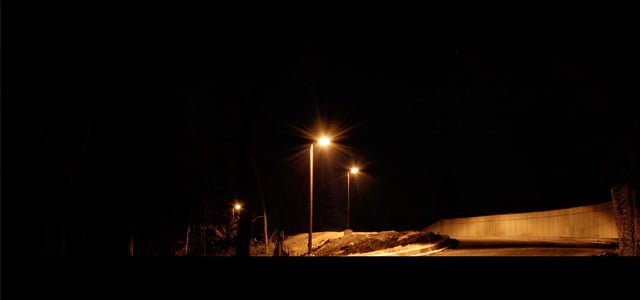
This is the essence of the “Streetlight Effect”: researchers tend to do the kind of research that’s easy, convenient and accessible. They have an aversion to going where no researcher has gone before if it means going where they must acquire new resources and/or undertake a major learning exercise to equip themselves appropriately. Instead, they pursue the easy path.

How does this relate to the scientific mystery colloquially called “Cold Fusion”? This July will see the 18th annual meeting of Cold Fusion researchers from around the world in Columbia, Missouri, attending ICCF-18. Sponsored by the University of Missouri, ICCF-18 will allow dozens of Cold Fusion researchers over a period of five days to present their findings in this field. The field of Cold Fusion is remarkable for the reality that while the miracle of unexplained excess energy has been demonstrated over and over again, more than 1000 times since 1989, the source of this energy is still not accounted for. Nobody understands clearly what is happening.

Since Fleischmann & Pons made their first ill-fated announcements in March, 1989 at the University of Utah, the field of Cold Fusion, also now called Low Energy Nuclear Reactions – LENR, has been in general disrepute in the broader scientific community. The failure by many major institutions in 1989 – 1990 to replicate the Fleischmann & Pons effect and produce meaningful amounts of unexplained excess heat at significant temperature levels has caused an unfortunate prejudice to persist in the scientific community.

This prejudice was entrenched by the publication of several highly critical books such as “Bad Science: The Short Life and Weird Times of Cold Fusion” by Gary Taubes, and “Cold Fusion: The Scientific Fiasco of the Century“ by John R Huizenga. Even though subsequent developments have negated most of the criticisms leveled by critics at the Fleischmann & Pons effect, there is still a general belief in many physics departments, and indeed in government agencies, that Cold Fusion simply is not real.

Well something about it is real. There’s no question that moderate amounts of heat have been generated from sources that cannot be chemical and cannot be attributed to experimental artifacts; heat has persisted long enough that the effect cannot be ignored. But no theory has been presented so far that can conclusively explain the source of this energy.

Now enter the “Streetlight Effect”. What are we going to expect of the experimenters who make presentations at ICCF-18?

Most of them will be reporting on the experimental results that they have achieved. A large number of these results have been will have been carried out in electrolytic cells, in the liquid phase. This is true even though there have been definite demonstrations of the LENR effect in the gas phase, both in the case of Palladium saturated with deuterium as well as nickel saturated with hydrogen. Indeed, even other hydride-forming metals have been shown to demonstrate the unexplained release of excess heat.

Experiments are still being done in the liquid phase even though the gas phase has much greater commercial potential simply because of many of the experimenters have laboratories that are well equipped for electrolysis and the researchers themselves have spent years immersed in this field. But now even the gas phase is finally being explored more extensively. This may open up new opportunities.

These experiments have all been invaluable in order to assemble data on what gives rise to the LENR effect. But the amount of data that has been generated, while almost overwhelming, has not yet lifted the veil on what is actually happening. We have to give credit for all this work that has been done, and indeed it is invaluable in providing a foundation for further thought and analysis. But something more is needed.

Where are the “killer” experiments that will lift the veil and finally provide understanding for what is really going on? Will there be a Milliken attending to describe the measurement of electric charge on oil drops? Or a Rutherford who provides results on alpha particle scattering? Examples of such key experiments in the history of science could be extended indefinitely. But will such a corresponding experiment be proposed at ICCF-18, an experiment that will solve the LENR Mystery? Possibly, but not probably.

We can expect to hear at the conference from researchers who have assiduously been collecting data using the apparatus that they have on hand, attended by their previously recruited graduate students who are focused on their supervisor’s field of expertise and funded by sources who are able to comprehend the proposed research for which they are providing money. Is this the best way to crack the nut that will explain this potentially revolutionary phenomenon?

This work has all made its contribution and more along such lines will still have to be done. It may be that the “Streetlight Effect” is unavoidable. But is it too much to hope that someone, or the consensus of this assembled wisdom, will be able propose an experiment, or series of experiments, which will be so telling that finally a basis will exist to shine light on a robust theory that will explain what is really happening?

ICCF-18 will be a gathering of people knowledgeable in the field. There will be plenty of exchanges of information and insight. Perhaps the “killer” experiment has already been done and may finally see the light of day. But if not, rather than continuing to pursue pet theories, a tremendous opportunity is available for those who know how to do experiments to discuss the key types of tests that should be done. This may, however, require them to depart further away from their streetlights and explore possibilities that will finally bring truth from the darkness. Let us hope this will happen.
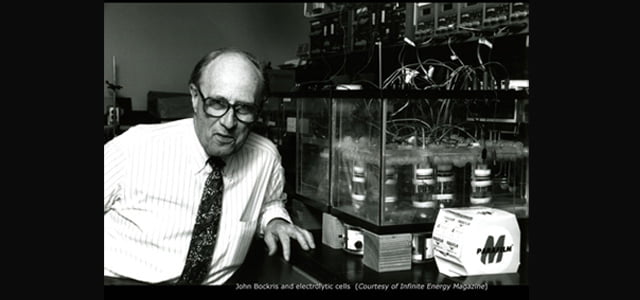
John O’ Mara Bockris: 1923-2013

Photo: John O’M. Bockris from the 2013 History of Cold Fusion Calendar month of April courtesy Infinite Energy.

Infinite Energy Magazine reports that John O’M. Bockris has crossed over on July 7. Words of remembrance are gathered in IE’s Bockris Memorial. [.pdf]

IE32He was one of the first few scientists to detect tritium from cold fusion electrolytic cells while reproducing the Fleischmann-Pons Effect (FPE) of excess heat, and he paid a price for it. Accused of fraud, and then “misconduct”, Texas A&M University’s Committee of Inquiry eventually cleared of all charges after a third and final investigation turned up no wrongdoing.

Still, an early workshop on transmutations, documented in The History of the Discovery of Transmutation at Texas A&M University [.pdf] written by Bockris, was organized in an atmosphere so hostile, the second workshop was held off-campus at a Holiday Inn, with off-duty police hired for security.

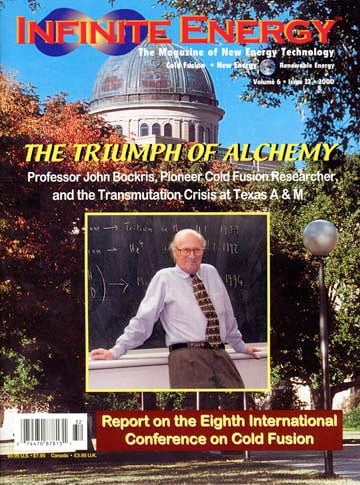
Eugene Mallove wrote a full report in Infinite Energy issue #32The Triumph of Alchemy: Professor John Bockris and the Transmutation Crisis at Texas A&M“. [.pdf]

However, Bockris told his own story in the documentary film Cold Fusion: Fire from Water written by Eugene Mallove and Jed Rothwell and directed by Chris Toussaint.

Released in 1999, Bockris speaks nonchalantly as a man at-ease who was nonplussed at the events.

“I think the main part was that, I had done work which was against the paradigm, and that’s what they were really upset about,” said Bockris.

“You know people said they’d been to our university, and some people had laughed at it, saying ‘What the heck are you doing trying to disprove the laws of nuclear physics?‘, and of course, that’s exactly what we were doing,” he laughs, ” – and succeeding.”

Watch the clip of John Bockris here. (The still image is that of George H. Miley, but Bockris begins the piece.)

One of the world’s top electrochemists, Bockris was first to use the phrase “Hydrogen Economy” in the year 1970. A prolific writer, he authored more than twenty books on electrochemistry, energy resources, and the topology of cultural paradigms. Aware of Peak Oil and the work of Richard Heinberg, he was realistic in his analyses of renewable energies, though still clear on the need for alternatives to carbon-emitting fuels. Read his Global Warming [.pdf] for a comprehensive outline of the problem.

First and foremost, Bockris was a teacher. After the passing of Martin Fleischmann, and the journal Nature‘s horrendous obituary, Bockris was one of many who wrote to protest the “gross distortion” of statements made by author Philip Ball. Bockris had supervised part of Martin Fleischmann‘s PhD thesis, calling him “a brilliant scientist”.

As a generation of new-energy researchers leaves our world behind for bigger, better beyonds, their teaching remains alive, with us here today, through the legacy of their work. You can honor the contributions of these scientists by buying their books, and giving them to schools, science clubs, and your local library.

Peace, and

Cold Fusion Now!

International experts on low-energy nuclear reactions meet at Mizzou

Original article by Nancy Moen on Mizzou News here.

A cool scientific mystery is drawing researchers worldwide to Mizzou for a week in July to investigate recent developments in understanding how nuclear fusion could occur at or near room temperature.

Scientists representing the U.S. and 18 countries internationally will gather July 21–27 at the International Conference on Condensed Nuclear Matter Science to share information on low-energy nuclear reactions (LENR) that could someday provide a new energy source.

The idea of usable low-energy nuclear reactions is compelling to countries worldwide. Participants of the ICCF-18 conference include distinguished nuclear physicists and related research specialists from countries such as Italy, China, Japan, India, Russia, South Korea and the United Arab Emirates.

The researchers are looking for the capability to eventually produce high-performance, inexpensive, clean energy with few or no emissions. Such a sustainable energy source could eliminate the problems of greenhouse gases and heavy air pollution.

For years, scientists have either experienced or read reports of unexplained substantial levels of excess heat thought to be caused by nuclear phenomena that deviate from what is expected.

The regularity of these anomalous heat occurrences — reported by scientific observation worldwide — continues to pique interest, and logical conclusions seem to indicate the existence of an entirely new nuclear reaction that could become a source of energy.

Global interest

hoto of Vice-Chancellor of Research Robert Duncan by Shane Epping
While in graduate school at the University of California, Santa Barbara, working toward a PhD in low-temperature physics, Robert Duncan designed liquid helium cells. The glass sphere is a sample of helium gas, which is how gasses were stored and transported long ago. Photo by Shane Epping
Leading the conference is MU Vice Chancellor for Research Rob Duncan, who oversees MU’s research and facilities. Duncan says it has taken years for mainstream scientific communities to realize this science is valid and real.

“It has been undervalued and treated as a ‘pariah science’ in the past, but now the world is beginning to realize how important it is,” he says.

An expert in measuring energy, Duncan has published extensively in low-temperature physics. Among his $8 million of funded projects, Duncan developed ultra-sensitive measuring equipment — specifically the best thermometer made in its temperature range — for a proposed NASA experiment in space aboard the 2005 International Space Station.

At the request of CBS television’s 60-Minutes in 2009, Duncan served as an independent scientist to test the validity of research in low-energy nuclear reactions by examining the objective scientific methods used in the experiments.

How LENR works

The ingredients involved in a low-energy nuclear reaction can be quite simple: deuterium, which is a type of heavy hydrogen (found in ocean water), a palladium wire and an electric current.

Researchers become very excited when far more energy comes out of the apparatus than was put in. That’s anomalous heat. These levels of anomalous heat are often more than a thousand times greater than what could be produced by a chemical process.

In recent work, researchers have made advancements in understanding the physics and in developing small units capable of initiating low-energy reactions, but the mechanisms of the phenomena still pose many questions. Improved research methodology may be the key that unlocks the mysteries of a potentially limitless supply of energy for global use.

The challenge is to determine the physical mechanisms causing excess thermal energy, the “whys” and “hows,” if you will. It’s not easy because measuring the input power is tricky, and the heat isn’t necessarily produced on demand. It can take days or even weeks for the heat to appear.

“We don’t fundamentally understand the process yet. In the past, only one in 10 or so attempts actually produced excess heat,” Duncan says. Excess heat is a comparison of the amount of heat produced to the amount of energy put in.

Experiments then and now

The first report of a possible low-energy nuclear reaction occurred in a 1926 test conducted in Germany by Austrian-born scientists Friedrich Paneth and Kurt Peters of the Berlin University Institute of Chemistry. The researchers were experimenting with palladium loaded with hydrogen. They reported that the process produced helium but later retracted their findings.

In 1989, electrochemists Martin Fleischmann and Stanley Pons at the University of Utah reported excess heat in their “cold fusion” experiments, but their work was later discredited when other researchers were unable to reproduce the results. “We understand now why these results were not immediately reproducible,” Duncan says.

Although the early experiments were difficult to replicate, other researchers through the years have observed similar anomalous heat effects in low-temperature nuclear research at several laboratories, including the Naval Research Laboratory, Los Alamos National Laboratory, ENEA (the national energy lab of Italy) and Bhabha Atomic Research Centre in Bombay, India.

In 2009, when Duncan accompanied the 60 Minutes news team on an investigation of claims of LENR at Energetics Technologies in Israel, he was a good choice because he counted himself among the skeptics.

For two days on site, Duncan asked questions, measured, checked numbers and looked for errors and other explanations. What he found was repeatable results, leading him to conclude that “excess heat is quite real.” 60 Minutes broadcast his reports on a segment airing that year.

“In Israel, I found how important the research was. I think it surprised a lot of people when a main-street physicist found the research credible. Since then, there have been exciting new developments,” Duncan says.

Researchers working independently in 20 different laboratories have repeated the results, finding excess heat in low-temperature nuclear experiments, Duncan says. Some of those have been confirmed scientifically, making the study of LENR a new and real science.
Fascinating potential

Conference attendees will go into extreme depth of this phenomenon, which is just beginning to be understood. One of the major questions being considered is whether researchers can produce excess heat on demand.

In addition to serious scientific debate, there will be discussion of opportunities in research, engineering and the development of technology.

The many participants have a lot to share. Among them, Vittorio Violante, representing ENEA, the Italian Agency for Energy and Economic Development, will lead a panel on some of the best recent work in condensed matter nuclear science.

Electrochemist Michael McKubre, director of SRI International in California, will discuss a new technique he developed to perform a range of critically important experiments. McKubre is recognized internationally for his work in examining potential new energy sources and has been at the top of his field for the past 24 years. He also was featured in the 60 Minutes report on cold fusion.

Speakers include David Kidwell of the U.S. Naval Research Laboratory; Professor Emeritus Jirohta Kasagi of Tohoku University in Japan; and Thomas Passell of TOP Consulting, a retired project manager for Electric Power Research Institute. Attendees are from top laboratories and research institutions such as the Hoover Institute, MIT and the Aerospace Corporations.

Visit the conference website for a list of conference attendees and the topics of their presentations. Members of the press are invited to register to attend.

MU’s nuclear research facilities

For the first time in 20 years, the ICCF conference is being held on a major research university campus, an achievement for MU and one that brings new opportunities, Duncan says.

Mizzou’s facilities offer a rich combination of ongoing research, and the university recently acquired a new, prestigious $3 million grant from the National Science Foundation specifically to investigate and apply neutron scattering, which has already begun.

Conference attendees will tour MU’s nuclear research facilities:

The MU Research Reactor is the nation’s largest university-operated research reactor, making possible advances in basic and applied sciences across multiple disciplines.

With seven collaborative scientific groups, the Sidney Kimmel Institute for Nuclear Renaissance is dedicated to finding the origin of anomalous heat effects using a sound materials-science approach.

The Nuclear Science and Engineering Institute is becoming a global leader in nuclear– engineering education and research with a mission to offer degrees in nuclear engineering.

The International Center for Nano/Micro Systems and Nanotechnology provides equipment supporting research in micro/nano-fabrication and nanotechnology.

The International Institute of Nano and Molecular Medicine is dedicated to the discovery and application of fundamental and translational medical science based on previously unexplored chemistry combined with nanotechnology and the biosciences.

Visit conference registration page here.

Original article by Nancy Moen on Mizzou News here.

Sergio Focardi in Remembrance

Video by Ecat.com Sergio Focardi: This is an energy revolution

Sergio Focardi from Ecat.com's video This is an energy revolution
Sergio Focardi from Ecat.com’s video This is an energy revolution
Physicist Sergio Focardi of University of Bologna has crossed over.

He was part of an early group that included Fracesco Piantelli and Roberto Habel who pioneered the generation of excess heat from Flesichmann-Pons cells using light-water and the metal nickel.

He inspired and worked closely with Andrea Rossi on the design of the Energy Catalyzer, or E-Cat, a thermal generator that operates from nickel powders and light-hydrogen gas.

Today on the Journal of Nuclear Physics website, Rossi wrote of Focardi’s passing:

Andrea Rossi
June 22nd, 2013 at 2:46 AM

SERGIO FOCARDI, PROF. EMERITUS OF THE UNIVERSITY OF BOLOGNA, IS DEAD. I RECEIVED THE NEW FROM ITALY TODAY AT 3 A.M., USA EASTERN TIME, FEW MINUTES AGO.

We all have lost one of the greatest scientists in the field of the LENR.

For me he has been a tremendous ally, he helped our work enormously and the safety certifications that we are obtaining are the fruit of his consulting during the last 7 years. For me he has been also a teacher for Physics and Mathematics, anytime I needed his help in these matters to better understand the theory behind the effect of the E-Cat.

He has always worked with us with total, absolute and disinterested attitude, thinking only the the interest of the Science behind the LENR.

All the newspapers of the scientific world will say what he has been in the Scientific and University world and his enormous legacy: he has been Professor of Physics, Mathematic, he has been the Dean of the Scientific Faculties of the Alma Mater University of Bologna and the founder of the Cesena branch of the University of Bologna. His pubilcations in the fields of Mathematics and Physics are monumental.

Now, after a long period of illness, that obviously all his friends have taken secret to respect his privacy, he ceased to suffer and starts a new duty for God under anothe form of life. I am sure he will continue to look after my work from where he is now.

See you soon, my great Friend and Master Sergio! I will never forget our work together and that day in the Brasimone Nuclear facility.

Yours Andrea Rossi

Sergio Focardi at TEDxBologna: E-cat e la fusione nucleare fredda con il Nichel e l’Idrogeno

Related

Anomalous Heat Production in Ni-H Systems 1994 [.pdf]
Sergio Focardi, Francesco Piantelli, and Roberto Habel

Overview of Ni-H systems: old experiments and new set-up [.pdf] by E. Campari, S. Focardi, V Gabbani, V. Montalbano, F. Piantelli, and S. Veronesi

Cold Fusion: The History of Research in Italy 2009 [.pdf]

James Truchard of National Instruments to share Keynote Address at ICCF-18

The presence of National Instruments in the LENR field has brought attention and gravitas to the historically marginalized science. Despite the lack of a theory to describe it, engineers are creating a new technology and company president and CEO James Truchard continues to pull the field of condensed matter nuclear science (CMNS) into the mainstream that neglected it for so long.

Dr. Truchard will speak at this year’s International Conference of Cold Fusion (ICCF-18), sharing the keynote address with Dr. David Kidwell, a Naval Research Lab scientist who will present Low Energy Nuclear Reaction Research at the Naval Research Laboratory [.pdf abstract].

Truchard has supported cold fusion research for years, offering LabView software free to all researchers in the field. Last year, LENR featured prominently at NIWeek 2012, the National Instruments showcase of their new products and solutions for scientific research. Dr. Francesco Celani of the Italian Institute of Nuclear Physics (INFN) also demonstrated a live cell on the floor of the show, giving participants a close-up view of the tiny technology that holds big promise for clean energy in our future.

This year, NIWeek 2013 will include a live demo by Defkalion Green Technologies, a company developing a commercial product based on nickel-hydrogen exothermic reactions called the Hyperion.

A multi-faceted individual who enjoys photography and is author of a book on gardening, the Leonardo-like Truchard will talk on The Role of National Instruments in the Global Environment on the opening day.

The multi-billion dollar company could play a big role indeed.

Related

University of Missouri hosts top scientists for ICCF-18

James Truchard opening NIWeek 2012: Free LabView to cold fusion scientists since 1989

Letter to Nature on Martin Fleischmann released

On August 3, 2012 Dr. Martin Fleischmann, co-discoverer of cold fusion, passed away in his home after a long illness.

Obituaries produced by mainstream news outlets were nothing more than gross distortions of career that exemplified intellectual honesty and integrity. The science journal Nature was but one publication that mischaracterized Fleischmann’s work where author Philip Ball wrote of cold fusion as a “pathological science”, and the “blot” it left on Fleischmann’s career.

Fortunately, Dr. Brian Josephson, a Cambridge University professor and Nobel laureate, responded to Nature’s portrayal with a letter published in Nature Correspondence. Because of licensing arrangements, the text has only recently become available to non-subscribers, and is reproduced here.

Here is Brian Josephson’s letter to Nature magazine:

Cold fusion: Fleischmann denied due credit
Brian D. Josephson

From Nature 490, 37 (04 October 2012)
doi:10.1038/490037c
Original online publication at nature.com, 03 October 2012
Philip Ball’s obituary of Martin Fleischmann (Nature 489, 34; 2012), like many others, ignores the experimental evidence contradicting the view that cold fusion is ‘pathological science’ (see www.lenr.org). I gave an alternative perspective in my obituary of Fleischmann in The Guardian (see go.nature.com/rzukfz), describing what I believe to be the true nature of what Ball calls a “Shakespearean tragedy”.

The situation at the time of the announcement of cold fusion was confused because of errors in the nuclear measurements (neither Fleischmann nor his co-worker Stanley Pons had expertise in this area) and because of the difficulty researchers had with replication. Such problems are not unusual in materials science. Some were able, I contend, to get the experiment to work (for example, M. C. H. McKubre et al. J. Electroanal. Chem. 368, 55–56; 1994; E. Storms and C. L. Talcott Fusion Technol. 17, 680; 1990) and, in my view, to confirm both excess heat and nuclear products.

Skepticism also arose because the amount of nuclear radiation observed was very low compared with that expected from the claimed levels of excess heat. But it could be argued that the experiments never excluded the possibility that the liberated energy might be taken up directly by the metal lattice within which the hydrogen molecules were absorbed.

In my opinion, none of this would have mattered had journal editors not responded to this skepticism, or to emotive condemnation of the experimenters, by setting an unusually high bar for publication of papers on cold fusion. This meant that most scientists were denied a view of the accumulating positive evidence.

The result? Fleischmann was effectively denied the credit due to him, and doomed to become the tragic figure in Ball’s account.

For more, see Brian Josephson’s Link of the Day archive.

Related Links

New energy solution from Nobel laureate ignored at NY Times April 7, 2013

Brian Josephson safeguards historic contribution of Martin Fleischmann October 6, 2012

Martin Fleischmann leaves brilliant legacy of courage in pursuit of truth August 4, 2012

Top