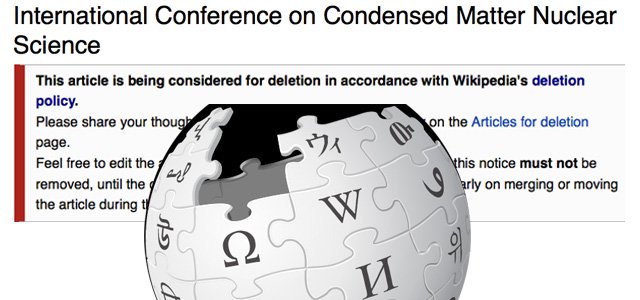
The Wikipedia page for the International Conference of Condensed Matter Nuclear Science (CMNS) is being considered for deletion “in accordance with Wikipedia’s deletion policy.”
Generally called the International Conference on Cold Fusion (ICCF), the apparent violation includes designation as a “Fringe topic with insufficient coverage in mainstream sources to establish notability“.
In Wikispeak, the article fails the “General notability guideline“, i.e.:
If a topic has received significant coverage in reliable sources that are independent of the subject, it is presumed to satisfy the inclusion criteria for a stand-alone article or stand-alone list.
According to Wikipedia, the article also fails for “Primary, secondary and tertiary sources“:
Wikipedia articles should be based on reliable, published secondary sources and, to a lesser extent, on tertiary sources. Secondary or tertiary sources are needed to establish the topic’s notability and to avoid novel interpretations of primary sources, though primary sources are permitted if used carefully. All interpretive claims, analyses, or synthetic claims about primary sources must be referenced to a secondary source, rather than to an original analysis of the primary-source material by Wikipedia editors.
While we find the article poorly written (focusing on the word “crackpot” one too many times), the article does not meet the deletion criteria above.
High level research more than notable
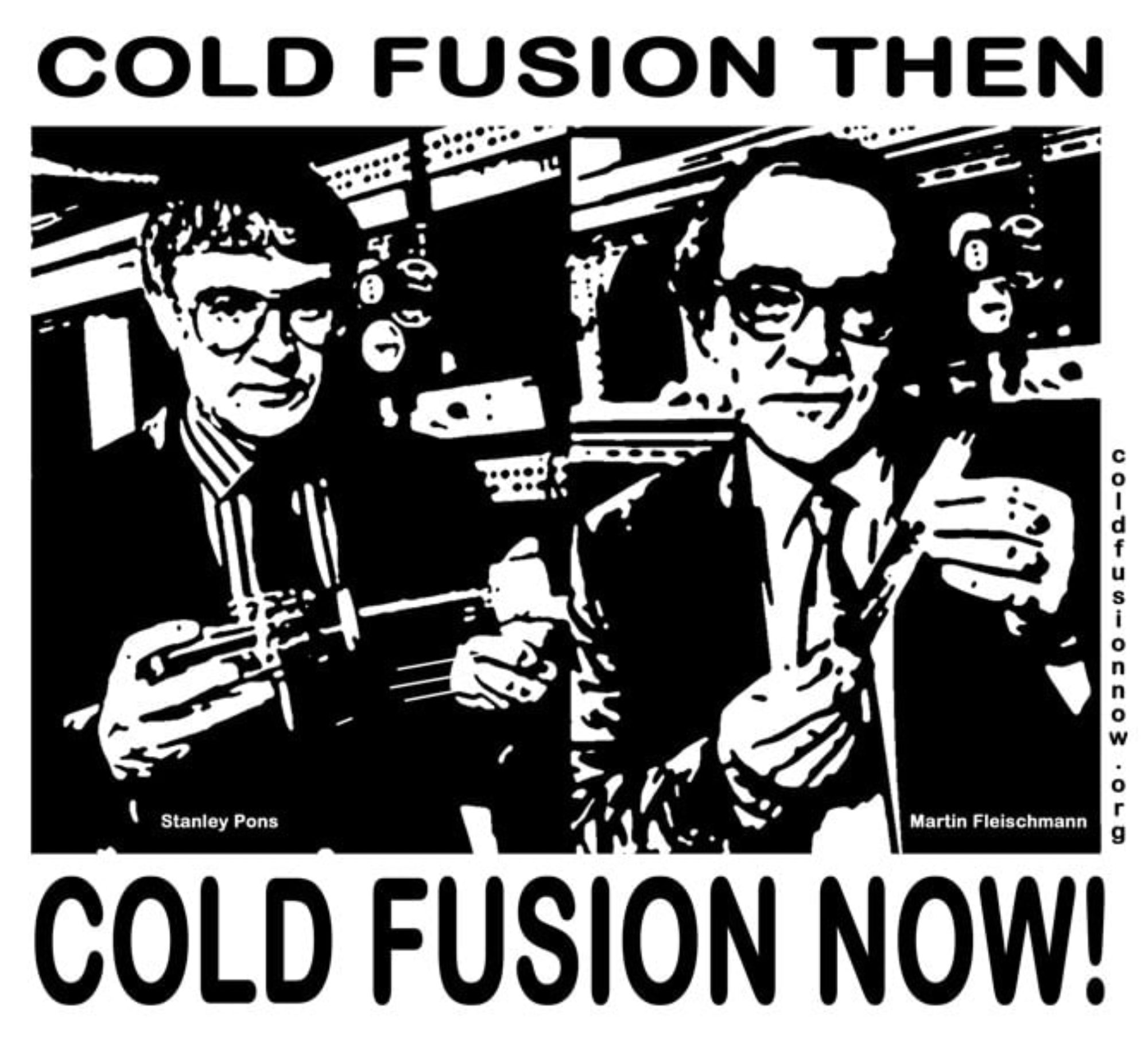
Cold fusion is an umbrella term utilized to denote the science surrounding the Fleischmann-Pons Effect (FPE) of excess heat generated from metal-hydrides, as well as the multitude of transmutation effects.

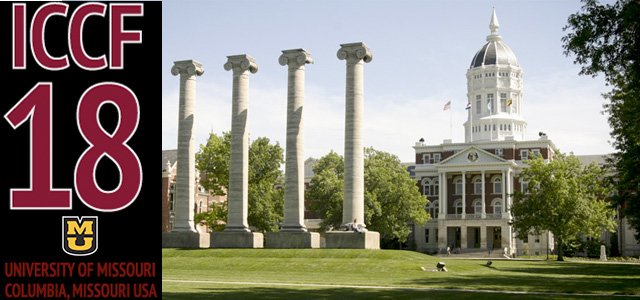
To find an answer, workshops have been conducted by every branch of the U.S. military, with the Naval Research Lab (NRL) scheduled to present results of their decades-long program at the next ICCF-18 meeting to be held at the University of Missouri, Columbia, Missouri. The NRL’s David Kidwell will deliver a keynote speech on the opening day.
Sharing that opening address will be the CEO of a multi-billion dollar scientific equipment and software company, National Instruments. James Truchard will speak on the role his firm will play in developing both the science and technology.
The Defense Threat Reduction Agency (DTRA), the Defense Advanced Research Projects Agency (DARPA) and the Electric Power Research Institute (EPRI) have seen fit to fund SRI International’s science program, among other programs. EPRI sponsored the proceedings of ICCF-4.
Low-energy nuclear reaction (LENR) research has been taken seriously by NASA, who have been the most vocal of U.S. agencies in advocating for increased attention and funding, given the huge ramifications for space exploration and society as a whole.
Open-source projects like the Martin Fleischmann Memorial Project have produced a coalition of citizen scientists and nuclear physicists across borders through international cooperation.
The American Nuclear Society and American Chemistry Society are but a few of the entities around the world working to provide answers in condensed matter nuclear science.
The service environment for a new economy is building around small independent start-ups seeking to produce a commercial product.
Is not this list not notable?
Secondary sources provided by federal government’s collection
For years, Wikipedia has unreasonably targeted cold fusion, low-energy nuclear reaction (LENR), lattice-assisted nuclear reaction (LANR), chemically-assisted nuclear reaction (CANR), Fleischmann-Pons Effect (FPE), the anomalous heat effect (AHE), quantum fusion, low-energy nuclear transmutation (LENT), and Hydrogen energy nuclei interactions (HENI).
Abd ul-Rahman Lomax knows a bit about that, as he was one Wikipedian editor who advocated to keep the topic justly-treated, and was banned for his efforts. Now he seeks to develop a ‘cold fusion kit’ that would be available for the public to reproduce the experiment. Lomax provided the experimental set-up used by high-school student Eric Golab in The Believers movie.
For over two-decades, CMNS papers appeared only on community websites, such as the International Society of Condensed Matter Nuclear Science library or author Jed Rothwell‘s lenr-canr.org.
Now, these papers find themselves in the federal stores at science.gov (search LENR). From the website:
Science.gov is an interagency initiative of 17 U.S. government science organizations within 13 Federal Agencies. These agencies form the voluntary Science.gov Alliance which governs Science.gov. – About
Even the U.S. Department of Energy (DoE), who does not yet officially acknowledge the existence of the anomalous phenomenon, has a database of papers at scienceaccelerator.gov (search LENR) whose list of citations includes many papers from ICCF proceedings themselves:
Science Accelerator is a gateway to science, including R&D results, project descriptions, accomplishments, and more, via resources from the Office of Scientific and Technical Information (OSTI), U.S. Department of Energy. – About
Thanks and credit go to Paul Maher for keeping tabs on the federal information banks, and watching the evolution of their fare. They show secondary sources on a science that is decidedly not fringe.
We suggest screen shots of Wikipedia’s page. There will come a day when the Wikipedia article on Wikipedia will need a good dose of historical fact.
Related
ICCF Wikipedia article up for deletion Lenr-forum
LENR Conference Proceedings New Energy Times