Cold Fusion Now’s Jeremy Rys of AlienScientist.com is attending and filming the lectures for a second year in a row. Jeremy will be uploading video on the Cold Fusion Now Youtube channel for your pleasure throughout the week.
“The Fusion battery was the object of many science fiction novels and movies; the most recent one being “Star Trek,” but now it is poised to come to life. These batteries rely on a process that converts the fusion energy into electricity. They are more compact and state-of-the-art and resemble an aluminum air battery, but up to about 10 million times more powerful.
In my developments I have learned that is possible that in a specific particle arrangement, sometimes met by nano-structures, with a specific excitation creating what now is considered exceptional conditions it is possible to generate nuclear reactions, like transmutation, fusion or fission.”
This LENR patent Is related to his work, I expect it to be granted soon.
“A method and device to generate electric energy on demand by fusion or transmutation nuclear reactions produced inside a super-capacitor that uses inter-atomic field’s particularities obtained inside nano-structures, by using temperature, density and electric fields in order to modify nuclear entanglement and quantum non-localities particularities in order to control nuclear reaction rate of an inserted material, called nuclear fuel, facilitated by the nano-structure nuclear composition, called burner, that controls the non-local nuclear reaction.
Fusion or transmutation generated nuclear particles’ energy is converted using a super-capacitor made of a micro-nano-hetero structure meta-material that loads from the nuclear energy and discharges by electric current.
The device contains the nuclear burner module that produces the nuclear particles surrounded by the direct nuclear energy conversion into electricity super-capacitor modules comprising several functional sub-modules, and the utilities that provide the nuclear fuel and byproducts management and process control systems.”
I am just beginning to appreciate the true depth of Liviu Popa Simil, I checked out his books at the library and am on the fourth of five. When finished, I will enthusiastically contact him to say, “Keep up the good work… and always remember… we love you!”.
My prevailing thought, while reading his books was:
“This gentleman will enjoy working together with us on Open Source LENR projects.”
Read his books, and if you concur, then go ahead and reach out to him.
“The Fusion Battery, A Novel Type of Nuclear Battery and Potential Outcomes and Applications”, (Nuclear Power – Fusion… by Liviu Popa-Simil (Jun 28, 2012)
“Applied Nano-technologies Improves Nuclear Power Safety and Performances”, (Nano-technologies in Nuclear Power) by Liviu Popa-Simil (Feb 21, 2012)
“The Challenges of the Future Individual Transportation”, by Liviu Popa Simil (Feb 27, 2011)
“The Challenges of the Future – How the Climate Change Might Affect US!”, by Liviu Popa Simil (Mar 8, 2011)
“Who Doomed US? We the People! New IP Initiative Might Save US!”, by Liviu Popa-Simil (Jan 19, 2012)
And as an addendum there is also…
This is a story I wrote a few months ago.
You might enjoy the re-telling of it.
If so, please do tell as often as you like.
Insight into the workings of cold fusion LENR science and engineering…
LENR science, is best served to, as a multi-disciplinary art.
A visit to California took Sterling Allan of PESN to the labs of SRI International and Brillouin Energy to tour the facilities and get the latest on their research on low-energy nuclear reaction (LENR) energy cells in development for commercial use.
An interview with SRI International’s Dr. Michael McKubre was previously posted. Now, video interviews have been posted of SRI International’s Dr. Francis Tanzella and Brillouin Energy’s Chief Technical Office Robert Godes as well as Brillouin CFO David Firshein and CEO Bob George.
Ecliptic plane calendar for LANR/CF ColloquiumThe 2014 CF/LANR Colloquium will be held Friday, Saturday, and Sunday March 21-23, 2014 at the Massachusetts Institute of Technology (MIT) in Cambridge, MA USA.
Nearby Hotels and Lodging for CF/LANR Colloquium at MIT [.pdf]
This event will mark the 25th anniversary of the announcement of the discovery of cold fusion by Drs. Martin Fleischmann and Stanley Pons on March 23, 1989.
While mainstream science institutions have refused to acknowledge the field, the breakthrough energy science has developed in part through the International Conference on Cold Fusion (ICCF) which has held eighteen events that bring scientists together from around the world to discuss their findings. The next ICCF-19 is scheduled for March 2015, which makes the 2014 LANR/CF Colloquium one of the year’s top cold fusion meetings.
Sponsored by JET Energy, Inc. and Nanortech, companies headed by Dr. Mitchell Swartz, the CF/LANR Colloquium is the sixth such event held since 2005 that discusses both the scientific and engineering aspects of cold fusion, also called lattice-assisted nuclear reactions (LANR), including theory, physics, electrochemistry, material science, metallurgy, physics, and electrical-engineering.
Energy density comparison chartJET Energy and Nanortech produced the NANOR-device demonstrated at MIT during the 2012 Cold Fusion 101 course, which ran continuously for five months and was open-to-the-public. The NANOR is a tiny, dry, pre-loaded with hydrogen fuel, nano-material, two-terminal component that generate excess energy gain. Massachusetts State Senator Bruce Tarr witnessed the event, and is now a supporter of the pioneer technology.
2014 Colloquium speakers include Peter Hagelstein, Mitchell Swartz, Larry Forsley, Frank Gordon, Pamela Mosier-Boss, George Miley, Tom Claytor, Mel Miles, John Dash, Yiannis Hadjichristos, Yeong Kim, Brian Ahern, Robert Smith, John Fisher, Vladimir Vysotskii, Yasuhiro Iwamura, and Charles Beaudette.
Developing topics include:
Engineering and Material Science – Lattices, Loading, Vacancies, Pd, Ni, ZrO2-PdNi, Ti,
and Hydrogenated/Deuterated Alloys, Aqueous Systems, High Impedance Systems,
Cooperative Role of the Solid State Lattice, and Nanostructured Materials
Engineering Non-equilibrium Electrochemistry – Fluxes, Types of Codeposition
Excess Heat Production – Calorimetry, Modes of Excess Heat, HAD
Reproducibility and Control – Optimal Operating Point (OOP) Manifolds, Loading Equations
Products in CF/LANR – Fusion and other Effective CF/LANR/CMNS Processes
Emissions – Neutron and other Emissions, Near IR Studies, Nuclear Tracks and Imaging in CR-39 Detectors
Metamaterials – Spillover Systems, Improved Deep Flux Distribution
Dielectric Science – Electrophysics and Charge Transfer, Roles of Applied E- and H-Fields, Avalanche Behavior, Transconduction, Advanced Magnetic materials
Quenching – Gripping Impact on Energy Gain, Roles of Catalysis, Breakdown and LANR Effects
Successful Mathematical CF/LANR Theories – Modeling Reactions and Excess Heat in the Fleischmann-Pons Experiment, Analysis of More Effective CF Systems and in CF Nanomaterials
Applications – Survey of Preloaded Systems, Embedded Systems, Motor Systems, Power Systems, CF/LANR Energy Conversion and Production
Business Issues – Intransigence at the US PTO, Impacts of Heavywatergate, Censorship and Minimal Funding
This Colloquium will follow a planned 2014 IAP Cold Fusion 1.01 course scheduled for the end of January during the week of 1/27-1/31 at 10:30AM-1:30PM.
From Open Power Association Report OO6 by Ugo Abundo and Luciano Saporito, these excerpts are google translated from the original Italian:
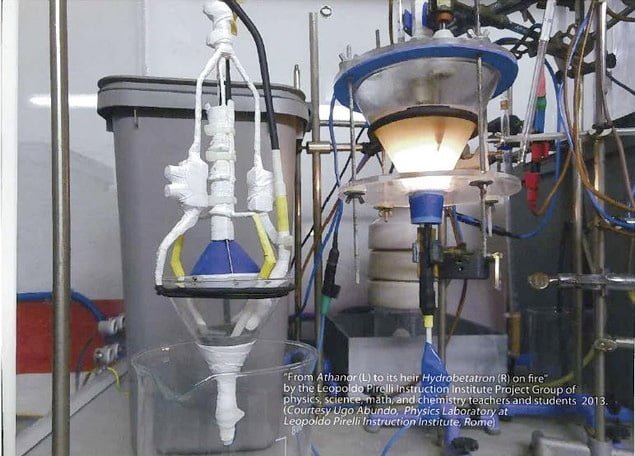
Best wishes for the new year 2014 from the staff of hydrobetatron.org/Open Power!
May you be peaceful and happy, and make the most of your projects in the spirit of “open” and sharing, possibilente …
Dear friends,
In this latest report, compiled by Ugo Abundo, is communicated in an articulated manner the state of the art of the important work of our team.
In particular, it is shown that, as far as we are concerned, our attention is paid to all those theories, working hypotheses, and experimental ideas, even different, that through a clever synthesis can contribute to achieve the results that we hope for, namely: the discovery of a new energy, economic, inexhaustible and clean, for the welfare of ‘humanity and the survival of Planet Earth!
In particular, our research is oriented to the extraction and production of electricity (electric power) directly from LENR (from Plasma, the Zero Point Energy, etc.), with Overunity.
I do not hide the enormous difficulties faced by our work carried out only on voluntary basis, and in almost no financial aid from the institutions, and so on. While the waste of public money, and the depredations of all kinds, especially in our country, they are all on the agenda.
Recall that the logo refers to the meritorious and innovative activity and REVOLUTIONARY scientific methodology that is known as the “Live Open Science”, introduced in October 2012 by a group of researchers of the International Martin Fleischmann Memorial Project (MFMP) .
Their website, exclusively for the exchange of scientific information, has so far been visited by more than a million Internet users.
The metolologia of Live Open Science was also recently nominated for the Nobel Peace Prize in 2014! More information is HERE.
Our Logo!
Maybe some good soul wants to nominate even modest We Rircercatori of hydrobetatron.org Open Power for the Nobel Prize for Peace? Certainly this would help a lot also working on our new energy!
Francesco Celani has published “Improved understanding of self-sustained, sub-micrometric multicomposition surface Constantan wires interacting with H2 at high temperatures: experimental evidence of Anomalous Heat Effects”. For .pdf, click HERE
See our collection of articles, including “HOW MUCH ET INERTIA” by Stephen QUATTRINI and “Quantum Space Theory” (QST) and “THE ATTEMPT TO FLY HIGH NO MORE long overdue” by Ugo ABUNDO and Francis SANTANDREA, by clicking the “WALL” to address: http://www.hydrobetatron.org/articoli.html
“We are humble, but we develop our talents, without false modesty, always remembering that: to understand a poem must be Poets”
—Luciano Saporito Open Power Association
Google translated: The long period of silence after our meeting of Coherence 2013 Conference on 15 October has seen us working on three major parallel fronts:
the experimental set of cathodes that now allow “direct” energy balances in the reactor to be measured, the Calorimetric response times compatible with the demand for scientific precision, and the development of a special protocol of optimal loading of the cathodes, in tune with the functional constraints introduced by operations with the apparatus (pilot program).
a powerful work coordinating the responsibilities that belong to the Association: to outline a route to a leap in quality of energy yields theorized about, and the study of solutions for the direct extraction of electrical energy from LENR any apparatus, to which the experimenters demonstrate performance in Overunity, if adaptable to the conceptual core set forth below (theoretical program).
a separate design of experiments for new generation reactors that aim to build on theoretical indications and to come to integrate with the phenomenon of which must be an expression (pilot program).
The title deliberately recalls a paradigm exposed long ago to duet with Francis Santandrea on 22Passi, according to which the very different interpretations of this experimental research area can traced back to a common central core whose identification and investigation not only promise to improve the understanding of said specific interpretations, but give rise to a design “synergistic” that is enriched with all aspects and should especially avoid the risk of phenomena antagonists.
In this ambitious goal are collaborating, directly or with their previous work, Francesco Celani, Antonella De Ninny, Fabio Cardone, Santandrea by Francesco Domenico Cirillo, Luciano Saporito, Paola Pieravanti, Michele Di Lecce with Alessandro Burgognoni, in Ugo Abundo and many other precious companions on this journey.
For the first point, it refers to a subsequent communication, to be issued at the completion of the experimental campaign in progress.
As for the second and third front, we have the pleasure to present the following preview for readers!
Conceptual core
We recall the same name as in the previous post we http://22passi.blogspot.it/2012/09/il-ponte-della-conoscenza-post-di-ugo.html [translate]including different types of experiments integrating mainly in the context of a metal matrix condensed capable of accepting hydrogen in the presence of a driving force for loading (pressure, voltage , etc.) and subjected to stresses (plasma, laser, ultrasound , etc. .), also using additives that catalyze one or more steps of the reactions.
He spoke to outline the equipment as triodes generalized (if any third electrode for adjustment) proposing to introduce, if they are not already ‘ constructively present, a cathode (metal matrix), an anode, an interelectrode voltage, a voltage intracatodica, half conductor (electrolyte or ionized gas, eg. hydrogen).
To give a concrete example of adaptation to the paradigm suggested, in a nanostructured (or cathode monolithic, metal layers, powder or composite) reactor cathode wire, it is possible to introduce an anode facing from which starts a voltage relative to the cathode while fed to its heads under less tension, the loading is no longer created by the gas pressure but by the inter-electrode voltage across the void of ionized hydrogen (or the voltage of the electrolytic cell), an RC circuit would extract electrical energy, by means of the download autopulsante in scheme resistance negative (see below), from the source of excess claimed abnormal, be it of Zero Point or LENR (even, possibly, as reported in some papers, from the thermal energy content of the external environment).
Theories
In the literature, a very diverse aspects and implications of the different approaches have been addressed, both in experimental and theoretical.
At the moment, our commitment is not intended to discriminate the validity of competing theories. On the contrary, we consider all the interesting working hypotheses that are internally consistent, to help in the search of the interrelationships between parameters governing the phenomena.
Solicitations
The strain appears to be more effective as a preventive measure, the electric force that directly participates in the charged particles (protons or electrons) within the appropriate paths by making them “buy” the necessary energy and local concentrations under the action of the electric field.
It is, as repeatedly stressed during our presentations, to act both on the field of loading (or deloading, more promising because it does not directly limited by processes in the effect of saturation) and on the migration of the charges through the latex.
The stress then is the administration of periodic pulses of high peak, extremely steep, and very high load-bearing, powers for durations so low as to cause only small energy input to the system.
The techniques implemented using the latest state of the art equipment in the field of production and impulse control, and of K. Shoulders EV (Strong electron), show bundles consisting of an incredibly high number of energetic electrons.
Structures
The adoption of nanostructures is presented as a must for the emergence of behaviors that have been predicted theoretically by several authors (B. Ahern, etc.) relating to far-from-equilibrium conditions and the consequent possibility of localization of energy above threshold levels for the activation of nuclear reactions.
It must not necessarily consist of nano powders, but preferably micro-structure surface nano-powders, in combination with ceramic powders to avoid sintering.
Of fundamental importance is also the presence of alkali or alkaline-earth elements as electron donors.
Systems with two/three active components may raise the synergistic effect. For example, combining metals with significant difference between the Fermi levels, or using piezoelectric or pyro powders, which enhance the effects of the localizations of temperature or of electrical impulses.
Important as well is the experimentation on the stresses in metal colloids. We therefore realized electrodes of metalloceramici to nanoscale structure, and a more easily handled powder.
Reactors
Were designed (and is currently under construction), three different reactors, based on cathodes in electrolytic mixture of powders:
a radial configuration, serial and serial Shoulders;
two pulse – integrated reactors (which perform both the function of on-site production of the discharge, that the use of ) high voltage, one electrolyte, the other for operation in vacuum;
a vacuum tube for replication and enhancement of the experiments of P. Correa, using nano-structured cathodes also metalloceramici.
Extraction of electricity
And ‘ all clear how simple heat production (medium or high temperature) is in itself already a high goal, if achieved by processes that do not require non-renewable fuel, do not produce CO2, do not pollute, and the next step, the transformation of thermal energy into electricity, in addition to requiring high temperatures and a cycle of transformation with machines in motion, always presents low yields.
Thus the need for a direct production of electric energy from processes with unclaimed Overunity is much felt by justify a significant research effort.
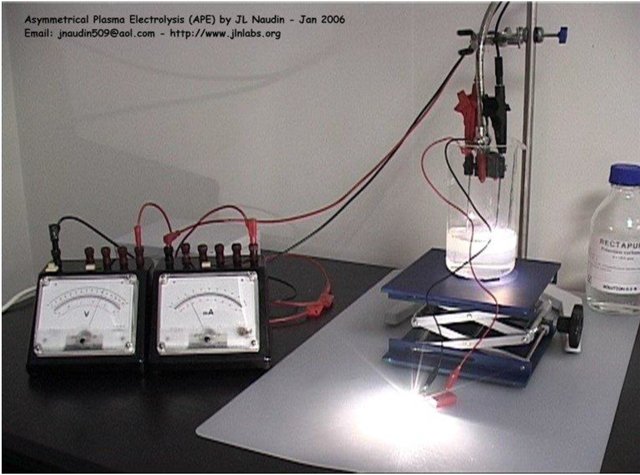
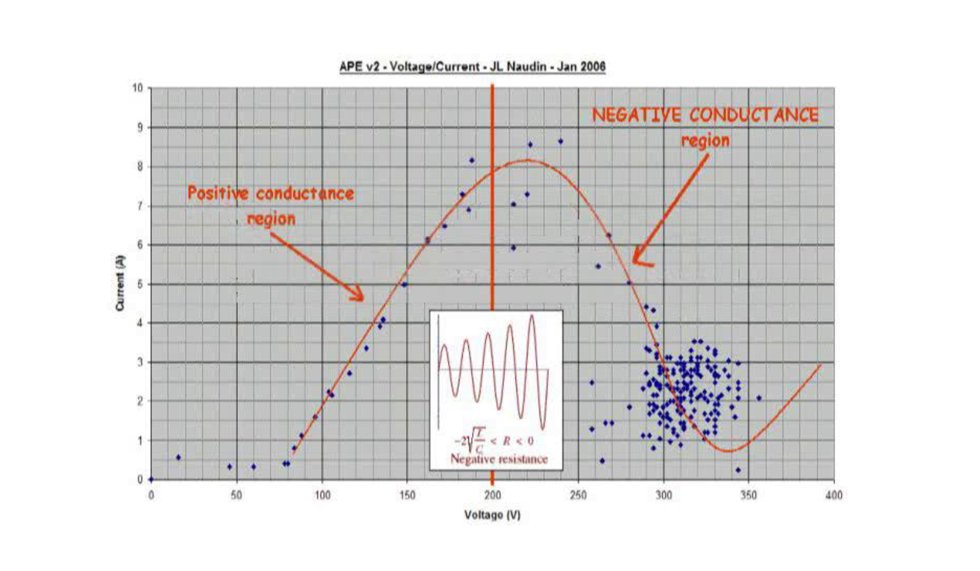
The experiments for the extraction of current of P. Correa with Glow Discharges in vacuum tubes, those of A. Chernetsky with Spark Gaps of J.L. Naudin and our plasma electrolytic, have in common at least a fundamental point: the existence of a part of the diagram IV with negative slope, the so-called negative resistance zone, in which a voltage increase corresponds to a decrease of current.
According to the theories, processes are assumed periodic spontaneous reorganization of the plasma, negative entropy, the so-called negentropy.
From the sustained spontaneous oscillations that arise exerting the plasma in these conditions, it is possible to extract energy directly as electricity through an RC circuit consistently sized to agree with the frequencies of pulsation of the plasma.
In accordance with what is stated, we are determining the values of the optimum parameters for our configurations and for the corresponding operating ranges.
Conclusions
Whether it’s energy or Zero Point of anomalous excess energy, the complex plasma – circuit can extract the energy available and ennobles the form electricity.
It remains to be seen whether, and how much, electricity has pulled from Overunity, but it is certainly a crucial first step towards the efficient production of electricity, a method which deserves to be given an adequate trial.
In addition, the direct provision of electricity brings us closer to the day when we will have self-reliance of equipment, allowing machines to generate enough power to power themselves. —Ugo Abundo Open Power Association
Help support our research and experimentation on LENR
We remind you that you can join the Association “Open Power” by connecting with us at hydrobetatron.org HERE