A letter to local legislators

I wrote this to the mayor of Seattle, the nearest large city. I will also send a suitably-modified version to the mayor of Bellevue. Perhaps I will do more, such as attend a Bellevue city council meeting and try to work out a way to stimulate local political discussion, or at least awareness, of the matter. —George Henry

Mayor McGinn,

Seattle has taken the lead in divesting from fossil fuels, which is aligned with our need as a nation to replace our dependence on dirty energy with the cultivation of clean energy alternatives. I think Seattle’s initiative is very laudable and thank you again for being a visionary leader in this area.

Within the past week, articles have appeared in Forbes magazine and elsewhere affirming that Italian inventor Andrea Rossi‘s E-Cat “cold fusion” power generator actually works substantially as claimed, producing “anomalous” amounts of heat / power that cannot be explained via conventional chemical reactions. The importance of this corroboration can hardly be overestimated. One knowledgeable commentator dubs this method of generating energy “the most important invention since fire” and states that because of it the world economic playing field has been radically reconfigured and that positive change will rapidly accelerate, now that the viability of Rossi’s invention has been soundly confirmed via independent study.

It’s worthy of note that Rossi is only perhaps the most advanced of many inventors and scientists working with this technology. Although national governments continue to invest wastefully in technologies that don’t work and may never work, and/or are more expensive and ultimately less practical, research in low-energy and chemically-assisted nuclear reactions (LENR/CANR) continues due to the passionate interest of scientists and their supporters, individuals and small groups, who are determined to find a clean, dependable and cheap way to fulfill humanity’s energy needs. Over the past 20+ years, hundreds if not thousands of experiments have conclusively proven that the technology works. This energy revolution therefore will definitely happen; the only question is when, and the validation of Rossi’s work seems to indicate that it will happen sooner than many may have imagined – indeed it is already happening.

Although it will require a significant investment of your personal time, I strongly recommend that you listen to the audio at http://11radio.com/wp-content/uploads/CFnowDotOrg-5-22-2013.mp3 and read the free ebook available at http://lenr-canr.org/acrobat/RothwellJcoldfusiona.pdf (or at least the chapters of the latter that you deem most relevant), as well as do any further research on this topic that you feel inclined to indulge in. The information is interesting in an abstract sense, but more importantly it will help you and anyone else who accesses and understands it to be “ahead of the curve” in education and, as a result, ready to participate most beneficially in the energy revolution that is now upon us.

Please consider the economic benefits that our community as a whole will reap from early and enthusiastic adoption of this technology. Ultimately, the fossil fuel industry will have to reinvent itself and get on the bandwagon by investing in and supporting this technology, or that industry will simply fade away. Suppressing the technology via anything short of a worldwide Fascist dictatorship will not succeed. It seems a fair assessment that all industries, as well as private persons, who are primarily consumers rather than producers of energy will benefit immeasurably. Of even greater ad global importance, this technology fulfills the promise of abundant, clean and inexpensive energy – something that our civilization desperately needs if we are to survive and thrive on a planet that can continue indefinitely to support us.

Thank you for considering my rather lengthy missive.

Warm regards,
George Henry
Bellevue, WA

Pre-loaded hydrogen fuel an engineering answer for efficiency, ease and safety

Multiple independent labs are racing to produce a commercial product based on the Fleischmann-Pons Heat Effect (FPHE), most working quietly in their labs. But since the public demonstration of Andrea Rossi‘s E-Cat in January 2011, we’ve witnessed on the global theater the grueling process of actualizing a revolutionary technology.

Early prototype E-Cat had external hydrogen tank for fuel.
It has been amazing to watch. A thermal generator based on nickel-hydrogen exothermic reactions, E-Cat design changes have been guided by efforts to make an efficient, easy-to-use, and safe commercial product.

The earliest prototypes were fueled by hydrogen gas from a canister connected to the unit. For obvious reasons, the danger of hydrogen tanks in a domestic environment present a problem, and having the fuel pre-loaded inside the new E-Cat HT removes a huge liability.

But a pre-loaded fuel cartridge also makes a compact device easy to use.

Previous announcements have set the life for a single charge at six months, after which time the contents can be recycled and a new one installed. As this first generation of new-energy technology filters out to the public, we can expect much longer life-cycles in the future.

How is this fuel pre-loaded into the less-than-a-gram nickel-powder mixture? The answer is proprietary at the moment. But what is possible?

Perhaps a material that absorbs hydrogen and then releases it slowly is used. Metallic-hydrides can do exactly that. Could there be amongst the nickel-powder another transition metal that serves this function?

While we wait to see what’s next for the E-Cat, there are others in the field that have discovered the pre-loaded reactor benefits, each having different designs.

Pre-loaded solid wire works to make heat

Scanning Electron Microscope image of treated Celani wire by MFMP.
SEM image of treated Celani wire by MFMP.
Francesco Celani used a pre-loaded wire for his live demonstrations last year at ICCF-17 and NIWeek 2012. A very different design than Rossi’s, this solid-cathode type cell is being reproduced by the Martin Fleischmann Memorial Project as an open-source enterprise with step-by-step activity documented and available online.

The group showed the results of loading hydrogen in their wire and how it affected resistivity and temperature. Stunning scanning electron microscope (SEM) images reveal close-up views of the metal and its bumpy surface.

Separating loading from activation for Pd-D systems solved by pre-loading

Pre-loading of hydrogen has also benefited palladium-deuterium (Pd-D) systems, helping to hasten initiation of the reaction, which can sometimes take weeks or even months to begin. Waiting so long for a reaction to occur makes data acquisition burdensome, and discoveries difficult.

Ideally, multiple cells would run at the same time, allowing several variables to be monitored and determined simultaneously. At one point, Drs. Fleischmann and Pons were running up to 32 cells, an expensive and still time-dependent undertaking.

SRI International experimented with pre-loading of hydrogen in fine wires as described in Calorimetric Studies of the Destructive Stimulation of Palladium and Nickel Fine Wires [.pdf]. From the paper, a description of how they did it:

SRI electrolytic cell with pre-loaded cathode.
1. Loading. When Pd wires were used as a substrate or as test objects these were pre-loaded electrolytically with either H or D in low molarity SrSO4 electrolytes (50μM) using procedures developed previously at SRI [8] and elsewhere [9].

2. Sealing. The atomic loading of H or D can be sealed inside the Pd lattice for extended periods (several hours or days) with the addition of very small concentrations of Hg2SO4 to the SrSO4 electrolyte and continued cathodic electrolysis [8,9]. The deposited Hg at monolayer coverage is a highly effective poison for hydrogen atom recombination, effectively preventing= desorption by inhibiting molecule formation.

The outcome?

The results show clearly that excess energy is generated both from Pd and Ni wires loaded either with deuterium or natural hydrogen5. However, data from Pd/D codeposited onto highly loaded Pd wires (solid triangles) sit on top of the plot, indicating that this category of wires generates the most excess heat. Interestingly, the Ni codeposited system also yields significant amounts of excess heat.

Pre-loaded NANOR devices can be electrically driven

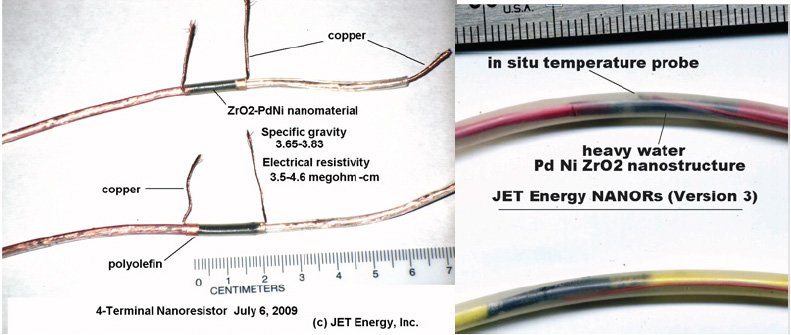
Separating the long loading times from the activation of the reaction was achieved by Dr. Mitchell Swartz of JET Energy, Inc. with his nano-composite ZrO2-PdNi-D cell that is pre-loaded with hydrogen fuel creating a “reproducible active nanostructured cold fusion/lattice-assisted nuclear reaction (CF/LANR) quantum electronic device.”

In the paper Energy Gain From Preloaded ZrO2-PdNi-D Nanostructured CF/LANR Quantum Electronic Components [.pdf] by Mitchell Swartz, Gayle Verner, and Jeffrey Tolleson, the authors write:

The importance is they enable LANR devices and their integrated systems to now be fabricated, transported, and then activated. They are the future of clean, efficient energy production.

A sixth-generation NANOR was publicly demonstrated in the office of Dr. Peter Hagelstein on the campus of Massachusetts Institute of Technology (MIT) during the 2012 IAP Cold Fusion 101 course, operating from January 30 to mid-May. Swartz also described the technology in the 2013 IAP short course captured on video by Jeremy Rys.

Designed to run at low-power due to safety considerations for a multi-month demonstration on a public campus, “over several weeks, the CF/LANR quantum device demonstrated more reproducible, controllable, energy gain which ranged generally from 5 to 16 [14.1 while the course was ongoing].”

With the core smaller than 2 centimeters containing less than a gram of active material, this device produced LANR excess power density “more than 19,500 watts/kilogram of nanostructured material.”

From the paper, Swartz describes the “proprietary self-contained CF/LANR quantum electronic component, called a two terminal NANOR™-type of LANR device”:

The NANOR represents the pre-loaded core of the reactor.
At LANR’s nanostructured material “core” is an isotope of hydrogen, usually deuterons, which are tightly packed (“highly loaded”) into the binary metals, alloys, or in this case, nanostructured compounds, containing palladium or nickel, loaded by an applied electric field or elevated gas pressure which supply deuterons from heavy water or gaseous deuterium.

Loaded are isotopes of hydrogen -protons, protium, deuterons, deuterium, and hydrogenated organic compounds, deuterated organic compounds, D2, H2, deuterides and hydrides. Precisely for these NANOR-type LANR devices, the fuel for the nanostructured material in the core, is deuterium.

The preloaded nanostructured material is placed into the hermetically sealed enclosure which is specially designed to withstand pressure, minimize contamination, enable lock on of wires connecting to it. The enclosure is tightly fit with the electrodes.

Described in the paper, the production of the preloaded core material involves “preparation, production, proprietary pretreatment, loading, post-loading treatment, activation, and then adding the final structural elements, including holder and electrodes.”

Fig. 2 – Series II and III two terminal NANOR™-type devices containing active ZrO2-PdNiD nanostructured material at their core.

Very pure materials are also required. “Contamination remains a major problem, with excess heat potentially devastatingly quenched,” the paper states.

The ratios of the NANOR’s composite elements are “in the range of Zr (~60-70%), Ni (0-30%), and Pd (0-30%) by weight, with the weights being before the oxidation step, and several later additional preparation steps. The additional D2 and H2 yield loadings (ratio to Pd) of up to more than 130% D/Pd.”

After several bakes, eventually an oxidized zirconia “surrounds, encapsulates, and separates the NiPd alloy into 7-10 nm sized ferromagnetic nanostructured islands located and dispersed within the electrically insulating zirconia dielectric.”

Each nanostructured island acts as a short circuit element during electrical discharge. These allow deuterons to form a hyperdense state in each island, where the deuterons are able to be sufficiently close together.”

The latest Series VI NANORs have had energy gains beyond 30.

More than basic science, it’s an engineering development

Pre-loaded core reactors have “a decreased size, decreased response time, improved and dual diagnostics, and increased total output energy density.”

They are compact, portable and durable. Suitable for small power needs, they can respond on-demand with scalable power.

It’s a ragged course to a next-generation clean energy technology. Even as the science is still uncertain, the new pre-loaded hydrogen reactors are an engineering development that brings us closer to that goal.

Discovery News misinforms on cold fusion again

The recent article 5 Reasons Cold Fusion is Bunk published on Discovery.com News continues the misinformation and serious inaccuracies that make clear mainstream media’s ignorance of a new discovery that offers a solution to our energy problems.

The article does not clearly discern the five distinct reasons that cold fusion cannot occur, but objections appear to be the same criticisms heard for two-and-a-half decades: cold fusion does not fit the conventional nuclear theory of hot fusion developed one hundred years ago, and therefore it cannot occur.

Sources for the article are astrophysisist Ethan Siegel, who does not accept the two-and-a-half-decades research documenting anomalous effects from deuterated systems, and known Rossi-detractor Steven Krivit, Editor of New Energy Times, who actively campaigns against E-Cat HT technology.

Taken one at a time, the “reasons” given that cold fusion cannot occur are:

Inaccuracy 1 Fusion of two elements requires high-temperatures and pressure, like the conditions inside the Sun, to overcome the Coulomb barrier, the force that keeps like-charged nucleons apart.

This statement is true for hot fusion, which has spent untold billions on attempting to re-create the conditions of the Sun here on Earth, without successfully generating any usable power.

The statement is not true of cold fusion.

“The circumstances of cold fusion are not the circumstances of hot fusion”, said Nobel laureate Julian Schwinger.

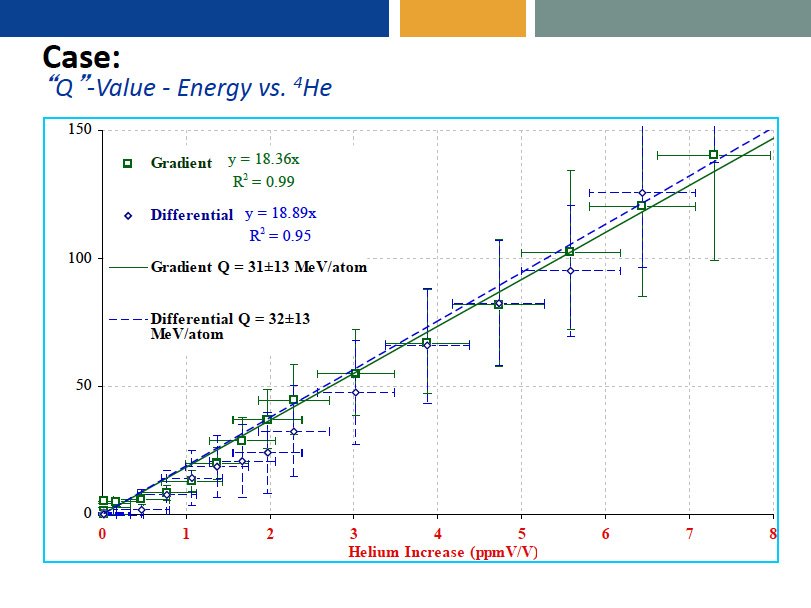
Heat is correlated with Helium in this slide from Michael McKubre
Cold fusion has no definitive theory – as yet, but the experimental evidence is overwhelming: anomalous heat and transmutations can occur within metallic-hydrides systems contained in small cells that sit on a table-top.

In experiments were palladium is infused with deuterium (Pd-D), the resulting reaction produces heat and helium. This has been documented by scientists from California Polytechnic Institute, the Navy’s China Lake research lab, and SRI International in Menlo Park, California.

This is not a likely reaction pathway that occurs in hot fusion, and yet, it occurs almost exclusively in Pd-D. Whether your vocabulary is low-energy nuclear reactions (LENR), lattice-assisted nuclear reactions (LANR), quantum fusion, or the Anomalous Heat Effect (AHE), the result does not change; put in deuterium and you can generate helium.

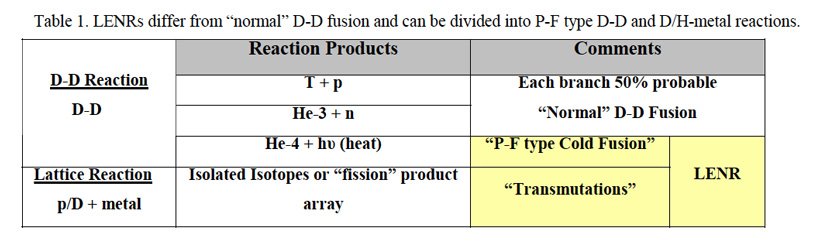
Table-1 from Review of Transmutation Reactions in Solids by G. H. Miley and J. Shrestha
While the nuclear mechanism is still unknown, resonance appears to be a key component of initiating the reaction. Irving Dardik‘s Superwaves describe the fractal electromagnetic pulses that brought Energetics Technologies energy output to 25x energy input. Robert GodesQ-waves give Brillouin Energy control over its Hot Tube reaction.

Increasing the temperature, as in Andrea Rossi‘s E-Cat HT and Defkalion’s Hyperion, also create movement in the system.

There are many discoveries and hypotheses today that are absurd on the face of it, yet people accept them without second thought. The idea that two particles can join together in a solid material through resonance by a nuclear mechanism we have yet to understand should not be a difficult concept, that is unless you have a vested interest in not seeing this technology come to light.

Inaccuracy 2 Fusion is always accompanied by dangerous radiation.

This statement is true of hot fusion as modeled by the Standard Model of nuclear reactions from one-hundred years ago.

It is not true of cold fusion.

Cold fusion cells sometimes emit radiation, depending on the type of design.

Radiation from cold fusion cells is 11 million times less than hot fusion. Some systems emit no radiation at all.

The Pd-D systems cited above emit only helium. In all cases, the radiation is so little, scientists must work hard to even detect it.

Indeed, the lack of radiation is what makes cold fusion the ultra-clean energy-dense solution for a green technological future on Earth.

The sources for this article compare cold fusion with the theory of hot fusion, a mistake the conventionally-minded make when they do not review the literature and refuse to accept the experimental data. It is a perplexing scientific question, and needs the full community to solve it.

Inaccuracy 3 Transmutation of nickel to copper cannot occur at room-temperature, in condensed matter.

Researchers at the University of Chicago Urbana-Champagne, University of LaVerne, at Mitsubishi in Japan, at labs in France, among others around the world, have all have detected a host of elements generated by their LENR cells.

In the Ukraine, Vladimir Vysotskii has reported biological transmutations, whereby a bacteria absorbs radioactive cesium and transmutes it into other benign materials, research which may lead to a process that can rid the planet of the thousands of tons of radioactive waste.

Reports of copper in both Pd-D and Nickel-Hydrogen Ni-H systems, as well as other elements not present before the experiment, have been reported by numerous scientists in the field causing some to use a new name for this particular research avenue: low-energy nuclear transmutations (LENT).

Inaccuracy 4 The intimation that there was a secret, hidden power source during the E-Cat testing of which the scientists were unaware, or if aware, in collusion with each other, to create the observed power output.

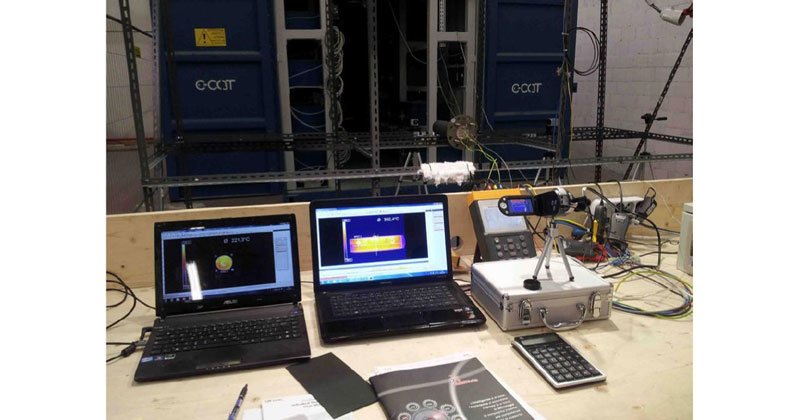
Testing of Andrea Rossi's E-Cat HT was conducted by independent scientists.
Testing of Andrea Rossi’s E-Cat HT was conducted by independent scientists.
It stretches the boundaries of logic to suggest that the half-a-dozen scientists who conducted the third-party E-Cat test are so incompetent as to miss a secret power source, or, that they were colluding with Rossi for some global fraud.

Such accusations should address what these scientists would have to gain from this association, in either case.

The scientists who tested the unit were:

Giuseppe Levi, Bologna University, Bologna, Italy
Evelyn Foschi, Bologna, Italy
Torbjorn Hartman, Uppsala University, Uppsala, Sweden
Bo Hoistad, Uppsala University, Uppsala, Sweden
Roland Pettersson, Uppsala University, Uppsala, Sweden
Lars Tegner, Uppsala University, Uppsala, Sweden
Hanno Essen, Royal Institute of Technology, Stockholm, Sweden

Continuing to attack the capability or veracity of this group is reprehensible.

Inaccuracy 5 Rossi has not divulged his secret catalyst that makes the E-Cat produce such big heat because he is hiding a fraudulent claim.

It is true that the scientists who conducted the tests were unable to inspect the proprietary fuel mixture inside the inner-cartridge.

However, as a black box, where all other inputs and outputs were known and measured, it was clear to the authors of the test report that the reactor made a lot of excess heat.

Whatever the 0.3 grams nickel-powder mixture inside, the E-Cat HT energy density was off-the-chart.

Rossi’s proprietary mixture of fuel is his secret alone, which he will likely have to share for a U.S. patent. If he chooses to produce marketable devices without a patent, then he will be attempting to stay ahead of the competition by driving innovation and price.

Nevertheless, the fact that there is secrecy involved in a revolutionary new energy technology is not surprising. Each of the independent labs and small companies working on a commercial device have their own proprietary element, though none have yet achieved (as far as we know) the kind of big heat, and/or or the stability and control demanded for a usable product.

What you can do

Discovery.com is part of Discovery Communications which appears to operate websites for the Discovery Channel, the Science Channel, Discovery Magazine, and surprisingly, the Oprah Winfrey Network!

Their magazine has published material on the Widom-Larsen Theory of cold fusion, which has not been confirmed (no definitive theory of cold fusion exists yet). Their source continues to be only those who have negative views of the field, and I haven’t seen any positive LENR pieces on the Science channel. (Let me know if you do!) The battle with misinformation will continue until a commercial product is available for purchase, or, a theory of cold fusion is confirmed.

Until then, let’s ask Oprah to turn her empire towards a green energy solution.

Post your request on Do You Have an Idea for Lisa Ling?

Our family is in trouble, and we could use some help.

Cold Fusion Now!

Jeremy Rys says “Go to space or go extinct…it’s your choice humanity!”

Jeremy Rys is a physicist, filmmaker, and advocate of new energy science.

He put together our Cold Fusion Now Youtube channel with his video The Answer to All Our Energy Problems, and was the inspiration for me to start making movies.

Most recently, Jeremy attended the 2013 MIT IAP Cold Fusion 101 course and captured lectures of Drs. Peter Hagelstein and Mitchell Swartz.

His new release titled Go to Space or Go Extinct … It’s Your Choice Humanity! again features the new energy solution, and it’s narrated in Jeremy’s rocking New Englander-voice that will inspire even the most apathetic to action!

Related Links

Youth keeping new energy movement alive with constant creations of non-conventional science October 29, 2010

Nobel laureate Brian Josephson affirms reality of E-Cat HT


university-of-cambridgeDr. Brian Josephson discusses Andrea Rossi‘s E-Cat technology with Dr. Judith Driscoll in a video released in 2011. Published on the University of Cambridge website for Video and Audio Collections, the page is now amended to include the latest confirmation of heat-producing capability by the E-Cat HT.

“It is a very favorable report”, said Dr. Josephson.

The recently released third-party report by scientists conducting an independent test of three different E-Cat HT devices wrote that even in the most conservative estimates, the heat-producing capacity is “at least one order of magnitude greater than chemical energy sources”.

Josephson received the Nobel Prize for his work predicting the quantum tunneling of electrons in Cooper pairs which has had multiple applications in digital electronics. Driscoll is a Cambridge Professor of Materials Science also associated with Los Alamos National Lab in the U.S.

The video is available in several downloadable formats. A transcript is included and we reproduce that here:

PREAMBLE

The deafening silence of the scientific and other media, in regard to what may well be the most important technological advance of the century, was the main stimulus for the creation of this video.

Whereas the ITER thermonuclear project may lead to practical power generation some decades hence, generators based on the Rossi reactor, first demonstrated in January 2011, are already under construction.

In the following, we discuss a number of aspects of this controversial device.

——–

[Picture of Rossi and Levi with the reactor]

Dennis M. Bushnell, NASA Chief Scientist, Langley Research Center: “… this is capable of, by itself, completely changing geo-economics, geo-politics, and solving climate and energy”.*

Judith Driscoll: What’s this Rossi reactor then? Why do you consider it so important?

Brian Josephson: This picture shows Rossi with his device [being shown to Sven Kullander, chairman of the Royal Swedish Academy of Sciences’ Energy Committee, and Hanno Essén, associate professor of theoretical physics and member of the board of the Swedish Skeptics Society, who carried out one of the investigations], which he calls the ‘Energy Catalyzer’, or E-cast for short. He says what’s happening is that there’s a nuclear reaction involving nickel and hydrogen. And since nuclear reactions produce so much more energy than ordinary chemical reactions, this means you can get a vast amount of energy with very little consumption of fuel. Furthermore, you won’t get any greenhouse gases produced.

JD: What’s the evidence that a nuclear process is involved?

BJ: Well, there’s some suggestion that copper is produced, that nickel has been transmuted into copper. But clear evidence is in regard to the amount of energy it produces. There’s a maximum amount of energy you can produce in a chemical reaction, so if the device produces vastly more energy than that, there must be something else going on, either a nuclear reaction or some unknown process. It’s been investigated a number of times, teams have come in to investigate it. For example, in February this year a test was carried out that ran for 18 hours. The amount of heat produced during that time was measured at 270 kWh. And that is the amount of energy you’d get from 25 kg of petrol. And since the size of the reaction chamber is only 50 ml, this rather rules out the idea of energy being generated by any conventional source. This appears to be pretty good evidence [various sources are mentioned at this point, repeated in subtitles. The Wikipedia article on the reactor is currently good, but is subject to the whims and prejudices of editors].

However, there are some problems with the idea that it is a nuclear reaction, because first of all conventional theory says that you need extremely high temperatures to get the reaction to go at a measurable rate, so people are sceptical on those grounds. On the other hand, there may be something wrong with the theory, because here we’ve got something happening in a solid; it’s not in a gas with isolated protons going round. It’s in a solid, so maybe many protons can cooperate and intensify the effect. So I think that’s not such strong grounds for rejecting it.

Another argument people have against this is to say not many gamma rays are produced — an extremely small amount of gamma rays [relative to what would be expected], and these fusion processes normally generate gamma rays. But then again we’ve got a very different kind of situation to what happens in thermonuclear processes. You can see what might happen in this slide. Imagine two different situations. One is a rock that is falling in air; it falls with a crash on some surface. The other situation is where it’s falling through water, and when it’s falling through water the energy is just gradually getting transferred to the water, there’s no big crash. That’s just an explanation [in general terms] of why you mightn’t get gamma rays. There’s really very little in the way of theory — actually lots of attempts have been made to explain it [cold fusion] but there isn’t enough evidence to show which is right. I think it’s not impossible that an explanation will be found.

JD: How is the amount of heat measured?

BJ: Well, this is really just school physics. You’re putting cold water in and you’re getting hot water or steam coming out, and if you know how much water’s going through you know how much heat is being produced, that’s all there is to it really[1].

—–
[1] In principle, but in practice one has to look carefully intoTo embed this video in a web page, use this code: what additional sources of heat there may be. Also, when steam is generated there are complications. The various investigations have attempted to address these issues.
—–

Also, there’s quite a big difference in temperature, in some experiments there’s [at least] a five degrees temperature rise; in other cases the water actually boiled. So you can’t say that errors in measuring the temperature are responsible for it.

JD: Why does energy need to be fed into the reactor to keep it going? Can’t the energy it generates be fed back into the reactor, so it can keep going with no energy input?

BJ: According to Rossi you can do that — he says it can be run in a mode where you aren’t feeding energy in, but you it’s then difficult to stabilise it; … in practical applications you want a reactor that can easily be stabilised. So the devices he’s building have energy being fed in, and you control it by altering how much current is being fed into the device.

JD: You say no greenhouse gases are involved, but what about radioactivity?

BJ: Well, Rossi says there are no radioactive residues. It’s not like ordinary reactors where you have radioactive residues that go on emitting radiation and heat as well for a very long time. And also he says should there be something like, say, and earthquake, then the hydrogen would escape and the reaction would stop. So he claims, at any rate, that it’s all very safe.

JD: Is it possible that Rossi’s just fooling people, he’s made it seem as if the reactor is heating up water, but he’s just trying to persuade people to invest in it, or to buy it, but it actually doesn’t really work.

BJ: Various people think that this is all a scam, but it’s not that plausible an idea because he allows people to investigate it; they can decide what to measure, how to measure it, they can also look inside, peer inside; the only thing they can’t look at is the reactor that contains his secret catalyst. But it doesn’t matter if you can’t look inside as what you’re trying to do is to see if it can produce this vast amount of heat which has been measured, and no matter what ordinary process it is you can’t produce more than a certain amount of energy in that amount of volume. So it doesn’t really matter if you can’t look inside. The reason he doesn’t want people to look inside is that they might discover how he does it and obviously, since it’s a commercial enterprise he doesn’t want other people to be able to make it so that he would lose what he gets back by selling the devices.

JD: Can’t he protect the invention by patenting the ideas?

BJ: Well, the trouble is, patenting is a rather tricky process if you really want to protect [your invention]. He has got some patents but it’s not fully protected.

JD: If this is as important as you believe it is, how is it we haven’t heard about it?

BJ: Well, that’s a very interesting question. One wonders about this. What isn’t Nature [Journal], say, writing this up, I mean, [this information] is available, but Nature doesn’t seem to be interested. However, if you were in Sweden you would know about it because there’s a Swedish technology journal called Ny Teknik, and someone there called Mats Lewan has been following it — somebody told him about it — and he at any rate was interested, he’s been following it and in fact he was responsible for [arranging] some of the setups. He’s written a great number of articles over that time.

It’s funny that people aren’t interested, but it has its historical precedents. One thing that was pretty similar was when the Wright brothers — they got their first flying machine and people had seen it, and you’d have thought this would be of tremendous interest, but very little was published. The publisher of the local journal [the Dayton Daily News] said, when he was asked about it later, “Frankly, we didn’t believe it.” And then there’s a typical account with scepticism was a newspaper which said “The Wrights have flown or they have not flown. They possess a machine or they do not possess one. They are in fact either fliers or liars. It is difficult to fly. It’s easy to say, ‘We have flown'”. So this shows … the sceptical mind at work, dismissing something in that way. So, in the case of the Rossi reactor, people are saying “it is easy to overlook something”. But the question is, what has been overlooked. It is such a simple measurement that it is not clear what could have been overlooked [by people who have looked carefully at the device.

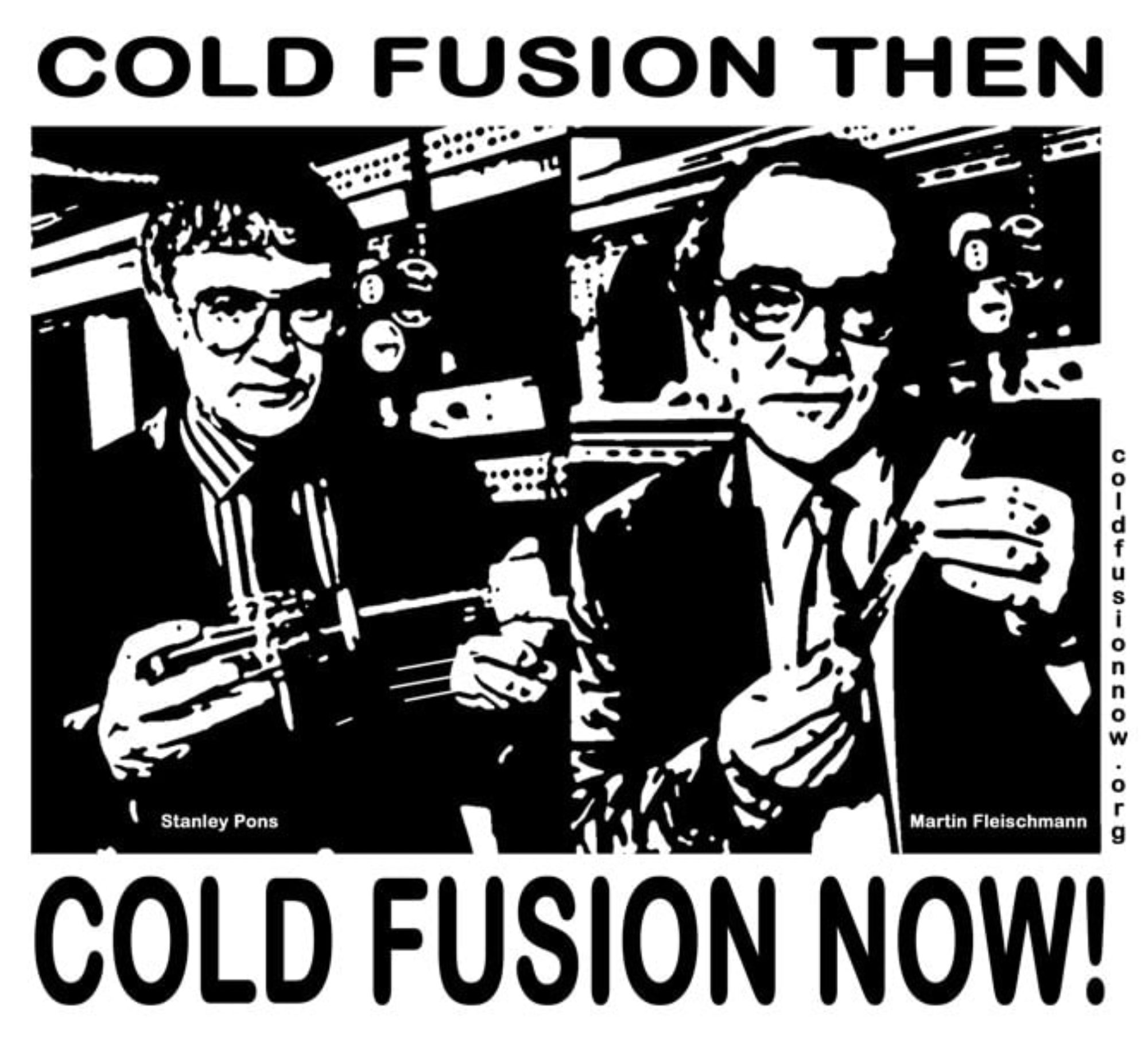
But of course, part of the problem is the history of cold fusion. Pons and Fleischmann brought out their original spectacular claims in a press conference they were rather pushed into and there was a lot of scepticism, they were attacked. … People tried to reproduce the experiment … they thought it was a very easy experiment — you just [feed in] an electric current and lo and behold the reaction would go, but it wasn’t actually that simple. So the result was, a lot of people failed to get anything out and they denounced Pons and Fleischmann, and said ‘this is all incompetence’, and somehow their voice was heard more loudly than the other people, who were successful. The sceptics got in first. And so, the scepticism bandwaggon rolled, and somebody invented the phrease ‘fiasco of the century’ to describe it, and it had become the ‘well-estabTo embed this video in a web page, use this code:lished fact’ that cold fusion was a delusion. So Rossi had to fight against that general viewpoint.

But he’s really not so bothered about what the scientists think. In fact he wasn’t that keen on having scientists investigate it. His original plan had been simply to make a big reactor, producing so much power that people couldn’t say ‘nothing’s happening’. So that’s how it went.

JD: Is the reactor claim really so unbelievable?

BJ: Well, it looks unbelievable at first sight, but always in physics there are things you haven’t thought about, and I think here one possibility is that you’re getting energy concentrated into a point, as I said before. A familiar example of getting energy into a point is just hammering in a nail. The energy you have wouldn’t be able to get you into wood or whatever, but because it all gets concentrated into a point that forces its way in [SLIDE]. And so something like this may be happening, you may be pushing the hydrogen into nickel and there’s some obstruction or bottleneck, the [enhanced] flow of energy is produced at that point.

That’s one possibility. Another thing which is really quite similar, which people haven’t thought of in this context: someone called Seth Putterman — he and his colleagues got a device to work which actually produced nuclear reactions in a table-top experiment, and the way he did this was something called pyroelecticity. You heat up a substance and an electric field is produced. And that electric field he focussed on to a point, and there was a very strong electric field at that point. He had his crystal in deuterium gas, and that ionised the deuterium, and the electric field imparted so much energy to it that there were nuclear reactions and neutrons were produced. So … it shouldn’t really be thought so impossible. Fleischmann’s original idea was having a material where hydrogen was pushed in with high density with an electric current to see if anything happened, and lo and behold it did happen.

So, it’s been a gradual development. Rossi’s advance would appear to be to discover his secret catalyst, which makes the reaction go much faster, and make it a practical source of energy.

JD: So what do you think is going to happen?

BJ: Well, as I see it, there are two different worlds, there’s the world of the academic, and the world of the practical person. The academic is mired in theory, and wanting absolute proof, and says ‘this is nonsense’ — at least that’s the general view. Meanwhile Rossi is going ahead in the practical sphere, … he’s building these reactors and people will — one hopes — see that they’re producing lots of energy. His first reactor is due to be produced in October, and he has a buyer for it. People, by the way, don’t have to pay until they’re convinced it is working, which is not what fraudsters do. So I think gradually it will take off.

The unfortunate thing is there’s been a delay; there will be a delay in it getting going because the journals, and the media who follow the scientists, are refusing to publish anything. That delay will have consequences. It really does matter, from that point of view, that the scientists and the media are looking away.

* In the broadcast, this statement was preceded by the following: “I think this will go forward fairly rapidly now, and if it does …”.

END Transcript

Related Links

New energy solution from Nobel laureate ignored by New York Times

Brian Josephson safeguards historic contribution by Martin Fleischmann

A Nobel laureate speaks out on the Energy Catalyzer

E-Cat enters the Wiki
Mystery or Knot Science “Cold Fusion” – LENR

DownloadedFile-3Mystery or Knot Science


Mystery is a Knot…  Intertwining

Science is an Art…  Unraveling


Love is a World – Operation

Love is a Lattice – Vibration

Love is a Source – Energizing

Love is a Life – Learning


Love is the Earth – We Birth

Love is the Water – We Drink

Love is the Fire – We Live

Love is the Air – We Breathe


An Art of the   Love of Science

The Rites of    Well Being


For All Life


Essence of Spirit

Heart of Matter


The End

The Beginning


Love Is


The Cold Fusion Quantum

Energy – Knot       Now


Unravelled


gbgoble2013


Ravel (the phase before unravelment)


Ravel


Verb

raveled, raveling, also  ravels


Verb Transitive

1. To separate the fibers or threads of (cloth, for example); unravel.


2. To clarify by separating the aspects of.


3. To tangle or complicate.


Verb Intransitive

1. To become separated into its component threads; unravel or fray.


2. To become tangled or confused.


Noun  – A Raveling

1. A broken or discarded thread.


2. A tangle.


Ravelen – Obsolete Dutch


Ravel – [ˈrævəl]

raveller n. – ravelly adj – ravel vbs, also -els, -elling, -elled / in U.S. -els -eling, -eled


1. to tangle (threads, fibres, etc.) or (of threads, fibres, etc.) to become entangled


2. (often foll by out) to tease or draw out (the fibres of a fabric or garment) or (of a garment or fabric) to fray out in loose ends; unravel


3. (tr; usually foll by out) to disentangle or resolve to ravel out a complicated story


4. to break up (a road surface) in patches or (of a road surface) to begin to break up; fret; scab


5. Archaic to make or become confused or complicated


Ravelen –  A Middle Dutch Noun


A tangle or complication.

(quantum energy is presently attaining unravelment)


Cold Fusion Now!


Explore The Low Energy Nuclear Reaction Unravelled


Images from

“Ancient Celtic Knots Inspire Scientific Breakthrough”

Minute knots and chains have industrial and medical uses.

The Irish Times Science article 

Top