Letter to Nature on Martin Fleischmann released

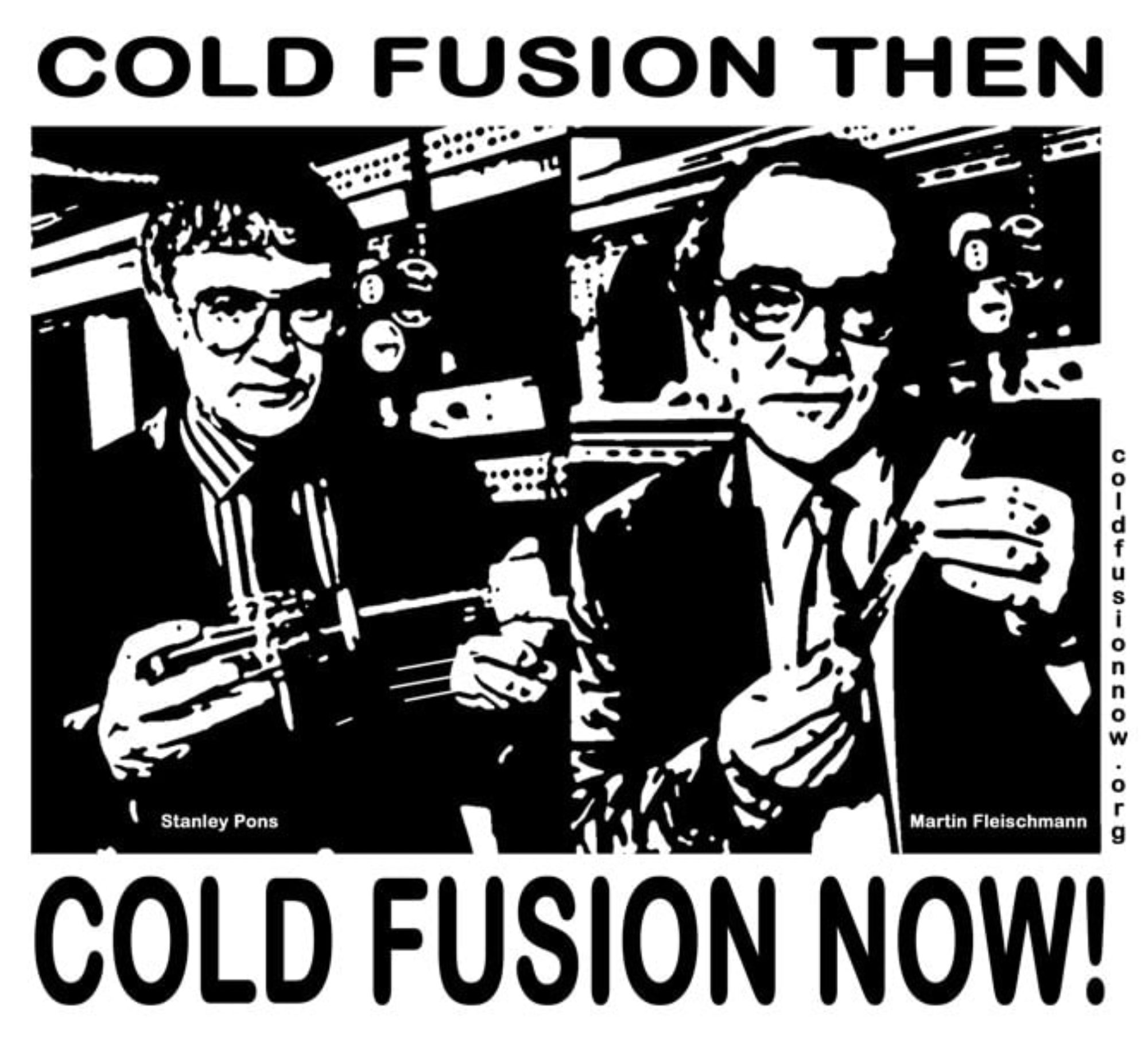
On August 3, 2012 Dr. Martin Fleischmann, co-discoverer of cold fusion, passed away in his home after a long illness.

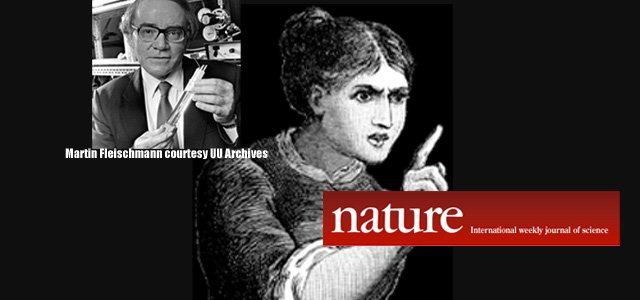
Obituaries produced by mainstream news outlets were nothing more than gross distortions of career that exemplified intellectual honesty and integrity. The science journal Nature was but one publication that mischaracterized Fleischmann’s work where author Philip Ball wrote of cold fusion as a “pathological science”, and the “blot” it left on Fleischmann’s career.

Fortunately, Dr. Brian Josephson, a Cambridge University professor and Nobel laureate, responded to Nature’s portrayal with a letter published in Nature Correspondence. Because of licensing arrangements, the text has only recently become available to non-subscribers, and is reproduced here.

Here is Brian Josephson’s letter to Nature magazine:

Cold fusion: Fleischmann denied due credit
Brian D. Josephson

From Nature 490, 37 (04 October 2012)
doi:10.1038/490037c
Original online publication at nature.com, 03 October 2012
Philip Ball’s obituary of Martin Fleischmann (Nature 489, 34; 2012), like many others, ignores the experimental evidence contradicting the view that cold fusion is ‘pathological science’ (see www.lenr.org). I gave an alternative perspective in my obituary of Fleischmann in The Guardian (see go.nature.com/rzukfz), describing what I believe to be the true nature of what Ball calls a “Shakespearean tragedy”.

The situation at the time of the announcement of cold fusion was confused because of errors in the nuclear measurements (neither Fleischmann nor his co-worker Stanley Pons had expertise in this area) and because of the difficulty researchers had with replication. Such problems are not unusual in materials science. Some were able, I contend, to get the experiment to work (for example, M. C. H. McKubre et al. J. Electroanal. Chem. 368, 55–56; 1994; E. Storms and C. L. Talcott Fusion Technol. 17, 680; 1990) and, in my view, to confirm both excess heat and nuclear products.

Skepticism also arose because the amount of nuclear radiation observed was very low compared with that expected from the claimed levels of excess heat. But it could be argued that the experiments never excluded the possibility that the liberated energy might be taken up directly by the metal lattice within which the hydrogen molecules were absorbed.

In my opinion, none of this would have mattered had journal editors not responded to this skepticism, or to emotive condemnation of the experimenters, by setting an unusually high bar for publication of papers on cold fusion. This meant that most scientists were denied a view of the accumulating positive evidence.

The result? Fleischmann was effectively denied the credit due to him, and doomed to become the tragic figure in Ball’s account.

For more, see Brian Josephson’s Link of the Day archive.

Related Links

New energy solution from Nobel laureate ignored at NY Times April 7, 2013

Brian Josephson safeguards historic contribution of Martin Fleischmann October 6, 2012

Martin Fleischmann leaves brilliant legacy of courage in pursuit of truth August 4, 2012

Wikipedia Beyond Cold Fusion – part two Subatomic Particles


DownloadedFile

Of Particular Interest to Cold Fusioneers are the Quasiparticles

Once again we take a journey beyond the surface of the Wikipedia Cold Fusion article into the depths of Wiki Science. This journey takes us into the world of subatomic particles. The following article is gleaned from excellent Wiki articles on cutting edge subatomic research.

The inner workings of the atom involve many different exciting particles and interactions. Studying this information helps one to begin to understand the science behind the popularly known cold fusion -LENR -low energy nuclear reactive environment. Quite a few of the Quasiparticles are mentioned in cold fusion patents and papers and are of particular interest to cold fusioneers.

Much of the subatomic research presented challenges one theoretical model or another, yet none of their Wiki articles are a battleground of contention as is the Wiki article, Cold Fusion… even now.

Elementary Particles ——— 25

Composite Particles ———– 68

Quasiparticles ——————-  20

Subatomic Particles Total  –   113

More Particles Predicted – 23

Subatomic particles are the particles smaller than an atom. There are two types of subatomic particles: elementary particles, which are not made of other particles, and composite particles.

Then there are the quasiparticles.

“Not-quite-so Elementary, My Dear Electron” link

Fundamental particle ‘splits’ into quasiparticles, including the new ‘orbiton’

by Zeeya Merali 18 April 2012, Nature: International weekly journal of science

Elementary Particles  /25

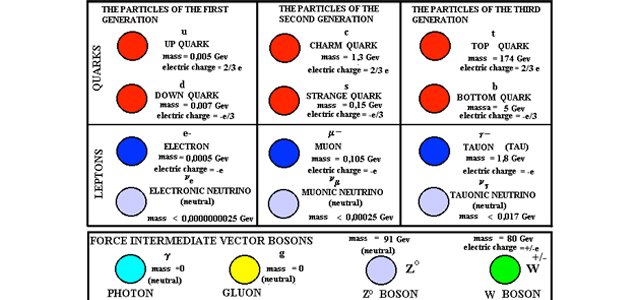
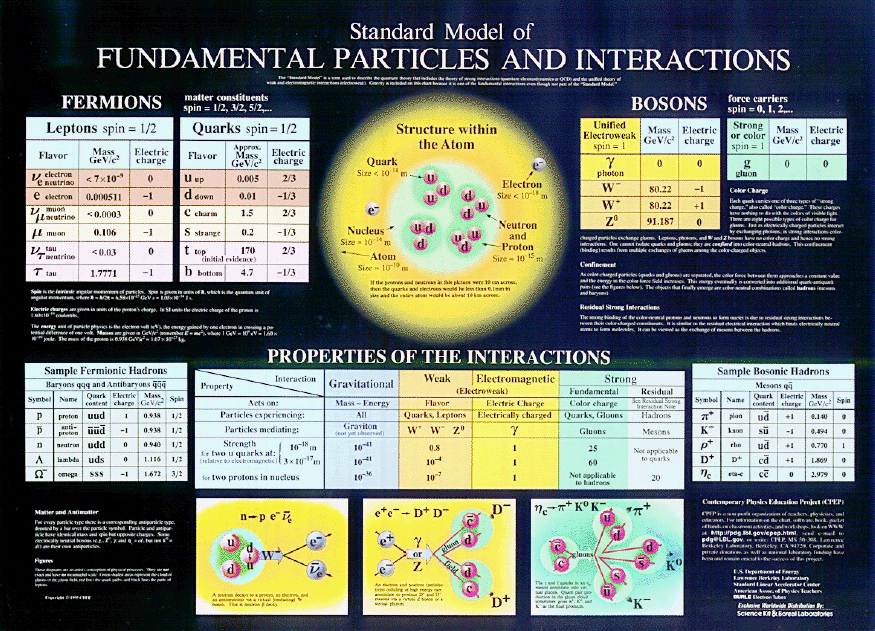
The elementary particles of the Standard Model include:

A) Six “flavors” of quarks: up, down, bottom, top, strange, and charm. @6 Particle

B) Six types of leptons: electron, electron neutrino, muon, muon neutrino, tau, tau neutrino. @6 Particles

C) Twelve gauge bosons (force carriers): the photon of electromagnetism, the three W and Z bosons of the weak force, and the eight gluons of the strong force. @12 Particles

D) The Higgs boson. @1 Particle

stdchrt


Twenty five Elementary Particles

Note:  Various extensions of the Standard Model predict
the existence of an elementary graviton particle
and many other elementary particles.


Composite Particles /68

Composite subatomic particles (such as protons or atomic nuclei) are bound states of two or more elementary particles. For example, a proton is made of two up quarks and one down quark, while the atomic nucleus of helium-4 is composed of two protons and two neutrons. Composite particles include all hadrons, a group composed of baryons (e.g., protons and neutrons) and mesons (e.g., pions and kaons).

Elementary particles are particles with no measurable internal structure; that is, they are not composed of other particles. They are the fundamental objects of quantum field theory. Many families and sub-families of elementary particles exist. Elementary particles are classified according to their spin. Fermions have half-integer spin while bosons have integer spin. All the particles of the Standard Model have been experimentally observed, recently including the Higgs boson.

Fermions (quarks and leptons) @22

Fermions are one of the two fundamental classes of particles, the other being bosons. Fermion particles are described by Fermi–Dirac statistics and have quantum numbers described by the Pauli exclusion principle. They include the quarks and leptons, as well as any composite particles consisting of an odd number of these, such as all baryons and many atoms and nuclei.

Fermions have half-integer spin; for all known elementary fermions this is 1⁄2. All known fermions are also Dirac fermions; that is, each known fermion has its own distinct antiparticle. It is not known whether the neutrino is a Dirac fermion or a Majorana fermion. Fermions are the basic building blocks of all matter. They are classified according to whether they interact via the color force or not. In the Standard Model, there are 12 types of elementary fermions: six quarks and six leptons.

Quarks – Quarks are the fundamental constituents of hadrons and interact via the strong interaction. Quarks are the only known carriers of fractional charge, but because they combine in groups of three (baryons) or in groups of two with antiquarks (mesons), only integer charge is observed in nature. Their respective antiparticles are the antiquarks which are identical except for the fact that they carry the opposite electric charge (for example the up quark carries charge +2⁄3, while the up antiquark carries charge −2⁄3), color charge, and baryon number. There are six flavors of quarks; the three positively charged quarks are called up-type quarks and the three negatively charged quarks are called down-type quarks.

Six Quarks and their antiparticles the Six Antiquarks @12 Particles

1) Up Quark

2) Down Quark

3) Charm Quark

4) Strange Quark

5) Top Quark

6) Bottom Quark

Leptons – Leptons do not interact via the strong interaction. Their respective antiparticles are the antileptons which are identical except for the fact that they carry the opposite electric charge and lepton number. The antiparticle of the electron is the antielectron, which is nearly always called positron for historical reasons. There are six leptons in total; the three charged leptons are called electron-like leptons, while the neutral leptons are called neutrinos. Neutrinos are known to oscillate, so that neutrinos of definite flavour do not have definite mass, rather they exist in a superposition of mass eigenstates wiki. The hypothetical heavy right-handed neutrino, called a sterile neutrino, has been left off the list.

The Five Leptons and their antiparticles the Five Antileptons @10 Particles

1) Electron

2) Electron nutrino

3) Muon

4) Tau

5) Tau nutrino

Bosons (elementary bosons)

Bosons are one of the two fundamental classes of particles, the other being fermions. Bosons are characterized by Bose–Einstein statistics and all have integer spins. Bosons may be either elementary, like photons and gluons, or composite, like mesons. The graviton is added to the list although it is not predicted by the Standard Model, but by other theories in the framework of quantum field theory.

An important characteristic of bosons is that there is no limit to the number that can occupy the same quantum state. This property is evidenced, among other areas, in helium-4 when it is cooled to become a superfluid. In contrast, two fermions cannot occupy the same quantum space. Whereas fermions make up matter, bosons, which are “force carriers” function as the ‘glue’ that holds matter together. There is a deep relationship between this property and integer spin (s = 0, 1, 2 etc.).

The Higgs boson is postulated by electroweak theory primarily to explain the origin of particle masses. In a process known as the Higgs mechanism, the Higgs boson and the other gauge bosons in the Standard Model acquire mass via spontaneous symmetry breaking of the SU(2) gauge symmetry. The Minimal Supersymmetric Standard Model (MSSM) predicts several Higgs bosons. The graviton is not a Standard Model particle. Furthermore, gravity is non-renormalizable.The Higgs boson has been observed at the CERN/LHC dated 14th March in 2013 around the level of energy 126,5GeV and at the accuracy of five-sigma (>99,4% which accepted as definitive)

The fundamental forces of nature are mediated by gauge bosons, and mass is believed to be created by the Higgs Field. According to the Standard Model (and to both linearized general relativity and string theory, in the case of the graviton). While most bosons are composite particles, in the Standard Model, there are five bosons which are elementary:

A) The four gauge bosons (γ · g · Z · W±)

B) The Higgs boson (H0)

Five Elementary Bosons / these 5 Particles are already tallied

The following Composite bosons are important in superfluidity and other applications of Bose–Einstein condensates.

Hadrons (baryons and mesons) @46

Hadrons are defined as strongly interacting composite particles. Hadrons are either: Composite fermions, in which case they are called baryons. or Composite bosons, in which case they are called mesons.

Quark models, first proposed in 1964 independently by Murray Gell-Mann and George Zweig (who called quarks “aces”), describe the known hadrons as composed of valence quarks and/or antiquarks, tightly bound by the color force, which is mediated by gluons. A “sea” of virtual quark-antiquark pairs is also present in each hadron.

Baryons – Baryons are the family of composite particle made of three quarks, as opposed to the mesons which are the family of composite particles made of one quark and one antiquark. Both baryons and mesons are part of the larger particle family comprising all particles made of quarks – the hadron. The term baryon is derived from the Greek “βαρύς” (barys), meaning “heavy”, because at the time of their naming it was believed that baryons were characterized by having greater masses than other particles that were classed as matter.

Since baryons are composed of quarks, they participate in the strong interaction. Leptons on the other hand, are not composed of quarks and as such do not participate in the strong interaction. The most famous baryons are the protons and neutrons which make up most of the mass of the visible matter in the universe, whereas electrons (the other major component of atoms) are leptons. Each baryon has a corresponding antiparticle (antibaryon) where quarks are replaced by their corresponding antiquarks. For example, a proton is made of two up quarks and one down quark; and its corresponding antiparticle, the antiproton, is made of two up antiquarks and one down antiquark.

A combination of three u, d or s-quarks with a total spin of 3⁄2 form the so-called baryon decuplet. Proton quark structure: 2 up quarks and 1 down quark.

This list is of all known and predicted baryons: 1)nucleon/proton 2) nucleon/neutron 3) Lamda 4) charmed Lamda 5) bottom Lamda 6) Sigma 7) charmed Sigma 8) bottom Sigma 9) Xi 10) charmed Xi 11) charmed Xi prime 12) double charged Xi prime 13) bottom Xi 14) bottom Xi prime 15) charmed bottom Xi 16) charmed bottom Xi prime 17) charmed Omega 18) bottom Omega 19) double charmed Omega, 20) charmed bottom Omega 21) charmed bottom Omega prime, 22) double bottom Omega, 23) double charmed bottom Omega, 24) charmed double bottom Omega @24 Particles

Mesons – Ordinary mesons are made up of a valence quark and a valence antiquark. Because mesons have spin of 0 or 1 and are not themselves elementary particles, they are composite bosons. Examples of mesons include the pion, kaon, the J/ψ. In quantum hydrodynamic models, mesons mediate the residual strong force between nucleons.

At one time or another, positive signatures have been reported for all of the following exotic mesons but their existence has yet to be confirmed.

A tetraquark consists of two valence quarks and two valence antiquarks;

A glueball is a bound state of gluons with no valence quarks;

Hybrid mesons consist of one or more valence quark-antiquark pairs and one or more real gluons.

This list is of all known and predicted scalar,  pseudoscalar and vector mesons:

1) Pion 2) Antipion 3) Eta meson 4) Eta prime meson 5) charmed eta meson 6) Bottom eta meson 7) Kaon 8) K- Short 9) K- Long 10) D meson 11) Anti D meson 12) Strange D meson 13) B meson 14) Anti B meson 15) Strange B meson 16) Charmed B meson 17) Charged rho meson 18) Neutral rho meson 19) Omega meson 20) Phi meson 21) J/Psi 22) Upsilon meson @22 Particles

There are two complications with neutral kaons: Due to neutral kaon mixing, the K0
S and K0
L are not eigenstates of strangeness. However, they are eigenstates of the weak force, which determines how they decay, so these are the particles with definite lifetime.

Note that these issues also exist in principle for other neutral flavored mesons; however, the weak eigenstates are considered separate particles only for kaons because of their dramatically different lifetimes.
1.10471

Quasiparticles /20

In physics, quasiparticles and collective excitations (which are closely related) are emergent phenomena wiki that occur when a microscopically complicated system such as a solid behaves as if it contained different (fictitious) weakly interacting particles in free space. For example, as an electron travels through a semiconductor, its motion is disturbed in a complex way by its interactions with all of the other electrons and nuclei; however it approximately behaves like an electron with a different mass traveling unperturbed through free space. This “electron” with a different mass is called an “electron quasiparticle”. In an even more surprising example, the aggregate motion of electrons in the valence band of a semiconductor is the same as if the semiconductor contained instead positively charged quasiparticles called holes. Other quasiparticles or collective excitations include phonons (particles derived from the vibrations of atoms in a solid), plasmons (particles derived from plasma oscillations), and many others.

These fictitious particles are typically called “quasiparticles” if they are fermions (like electrons and holes), and called “collective excitations” if they are bosons (like phonons and plasmons), although the precise distinction is not universally agreed.

Quasiparticles are most important in condensed matter physics, as it is one of the few known ways of simplifying the quantum mechanical many-body problem (and as such, it is applicable to any number of other many-body systems).

This is a list of quasiparticles (study them at the following Wikipedia links)

1)  Bipolaron – A bound pair of two polarons

2)  Chargon – A quasiparticle produced as a result of electron spin-charge separation

3)  Configuron  – An elementary configurational excitation in an amorphous material which involves breaking of a chemical bond

4)  Electron quasiparticle – An electron as affected by the other forces and interactions in the solid

5)  Electron hole  – A lack of electron in a valence band

6)  Exciton – A bound state of an electron and a hole

7)  Fracton – A collective quantized vibration on a substrate with a fractal structure.

8)  Holon – A quasi-particle resulting from electron spin-charge separation

9)  Magnon – A coherent excitation of electron spins in a material

10) Orbiton  – A quasiparticle resulting from electron spin-orbital separation

11) Phason – Vibrational modes in a quasicrystal associated with atomic rearrangements

12) Phonon – Vibrational modes in a crystal lattice associated with atomic shifts

13) Plasmaron – A quasiparticle emerging from the coupling between a plasmon and a hole

14) Plasmon  – A coherent excitation of a plasma

15) Polaron – A moving charged quasiparticle that is surrounded by ions in a material

16) Polariton – A mixture of photon with other quasiparticles

17) Roton – Elementary excitation in superfluid Helium-4

18) Soliton  – A self-reinforcing solitary excitation wave

19) Spinon  – A quasiparticle produced as a result of electron spin-charge separation

20) Trion – A coherent excitation of three quasiparticles (two holes and one electron or two electrons and one hole) Quasiparticles @20 particles

References quasiparticles ^ Angell, C.A.; Rao, K.J. Configurational excitations in condensed matter, and “bond lattice” model for the liquid-glass transition. J. Chem. Phys. 1972, 57, 470-481 ^ J. Schlappa, K. Wohlfeld, K. J. Zhou, M. Mourigal, M. W. Haverkort, V. N. Strocov, L. Hozoi, C. Monney, S. Nishimoto, S. Singh, A. Revcolevschi, J.-S. Caux, L. Patthey, H. M. Rønnow, J. van den Brink, and T. Schmitt; (18.04.2012). “Spin–orbital separation in the quasi-one-dimensional Mott insulator Sr2CuO3”. Nature, Advance Online Publication. arXiv:1205.1954. Bibcode:2012Natur.485…82S. doi:10.1038/nature10974.

Supersymmetric theories predict the existence of more particles, none of which have been confirmed experimentally as of 2011:

1) neutralino 2) chargino 3) photino 4) wino/zino 5) Higgsino 6) gluino

7) gravitino 8) sleptons 9) sneutrino 10) squarks @10 Particles

No matter if you use the original gauginos or this superpositions as a basis, the only predicted physical particles are neutralinos and charginos as a superposition of them together with the Higgsinos.

Other theories predict the existence of additional bosons and fermions.

List of Other hypothetical bosons and fermions:

1) graviton 2) graviscalar 3) graviphoton 4) axion 5) saxion 6) branon 7) dilaton 8) X & Y bosons

9) W & Z bosons 10) magnetic photon 11) majoron 12) majorana fermion 13) Chameleon  @13 Particles

Mirror particles are predicted by theories that restore parity symmetry.

Magnetic monopole is a generic name for particles with non-zero magnetic charge. They are predicted by some GUTs.

Tachyon is a generic name for hypothetical particles that travel faster than the speed of light and have an imaginary rest mass.

Kaluza-Klein towers of particles are predicted by some models of extra dimensions. The extra-dimensional momentum is manifested as extra mass in four-dimensional space-time.

Timeline of Subatomic Particle Discoveries

Including all particles thus far discovered which appear to be elementary (that is, indivisible) given the best available evidence. It also includes the discovery of composite particles and antiparticles that were of particular historical importance.

More specifically, the inclusion criteria are:

Elementary particles from the Standard Model of particle physics that have so far been observed. The Standard Model is the most comprehensive existing model of particle behavior. All Standard Model particles including the Higgs boson have been verified, and all other observed particles are combinations of two or more Standard Model particles.

Antiparticles which were historically important to the development of particle physics, specifically the positron and antiproton. The discovery of these particles required very different experimental methods from that of their ordinary matter counterparts, and provided evidence that all particles had antiparticles—an idea that is fundamental to quantum field theory, the modern mathematical framework for particle physics. In the case of most subsequent particle discoveries, the particle and its anti-particle were discovered essentially simultaneously.

Composite particles which were the first particle discovered containing a particular elementary constituent, or whose discovery was critical to the understanding of particle physics.

Note that there have been many other composite particles discovered; see list of mesons wiki and list of baryons wiki. See list of particles wiki for a more general list of particles, including hypothetical particles.

  • 1800: William Herschel discovers “heat rays”
  • 1801: Johann Wilhelm Ritter made the hallmark observation that invisible rays just beyond the violet end of the visible spectrum were especially effective at lightening silver chloride-soaked paper. He called them “oxidizing rays” to emphasize chemical reactivity and to distinguish them from “heat rays” at the other end of the invisible spectrum (both of which were later determined to be photons). The more general term “chemical rays” was adopted shortly thereafter to describe the oxidizing rays, and it remained popular throughout the 19th century. The terms chemical and heat rays were eventually dropped in favor of ultraviolet and infrared radiation, respectively.

Albert Einstein Born in Ulm, Germany, in 1879.

  • 1895: Discovery of the ultraviolet radiation below 200 nm, named vacuum ultraviolet (later identified as photons) because it is strongly absorbed by air, by the German physicist Victor Schumann.
  • 1895: X-ray produced by Wilhelm Röntgen (later identified as photons).
  • 1897: Electron discovered by J.J. Thomson.
  • 1899: Alpha particle discovered by Ernest Rutherford in uranium radiation.

Albert Einstein received his fist teaching diploma from Zurich Polytechnic in 1900.

  • 1900: Gamma ray (a high-energy photon) discovered by Paul Villard in uranium decay.
  • 1911: Atomic nucleus identified by Ernest Rutherford, based on scattering observed by Hans Geiger and Ernest Marsden.
  • 1919: Proton discovered by Ernest Rutherford.

Martin Fleischmann Born in Karlovy Vary, Czechoslovakia, in 1927.

  • 1932: Neutron discovered by James Chadwick (predicted by Rutherford in 1920).
  • 1932: Antielectron (or positron) the first antiparticle, discovered by Carl D. Anderson (proposed by Paul Dirac in 1927 and by Ettore Majorana in 1928).
  • 1937: Muon (or mu lepton) discovered by Seth Neddermeyer, Carl D. Anderson, J.C. Street, and E.C. Stevenson, using cloud chamber measurements of cosmic rays. (It was mistaken for the pion until 1947).
  • 1947: Pion (or pi meson) discovered by C. F. Powell’s group (predicted by Hideki Yukawa in 1935).
  • 1947: Kaon (or K meson), the first strange particle, discovered by George Dixon Rochester and Clifford Charles Butler.
  • 1947: Λ0 discovered during a study of cosmic ray interactions.

Martin Fleischmann received his PhD from Imperial College London in 1950.

  • 1955: Antiproton discovered by Owen Chamberlain, Emilio Segrè, Clyde Wiegand, and Thomas Ypsilantis.
  • 1956: Electron neutrino detected by Frederick Reines and Clyde Cowan (proposed by Wolfgang Pauli in 1931 to explain the apparent violation of energy conservation in beta decay). At the time it was simply referred to as neutrino since there was only one known neutrino.
  • 1962: Muon neutrino (or mu neutrino) shown to be distinct from the electron neutrino by a group headed by Leon Lederman.
  • 1964: Xi baryon discovery at Brookhaven National Laboratory.
  • 1969: Partons (internal constituents of hadrons) observed in deep inelastic scattering experiments between protons and electrons at SLAC; this was eventually associated with the quark model (predicted by Murray Gell-Mann and George Zweig in 1964) and thus constitutes the discovery of the up quark, down quark, and strange quark.
  • 1974: J/ψ meson discovered by groups headed by Burton Richter and Samuel Ting, demonstrating the existence of the charm quark  (proposed by James Bjorken and Sheldon Lee Glashow in 1964).
  • 1975: Tau discovered by a group headed by Martin Perl.
  • 1977: Upsilon meson discovered at Fermilab, demonstrating the existence of the bottom quark  (proposed by Kobayashi and Maskawa in 1973).
  • 1979: Gluon observed indirectly in three jet events at DESY.
  • 1983: W and Z bosons discovered by Carlo Rubbia, Simon van der Meer, and the CERN UA1 collaboration (predicted in detail by Sheldon Glashow, Abdus Salam, and Steven Weinberg).

The “Cold Fusion” announcement of 1989.

  • 1995: Top quark discovered at Fermilab.
  • 1995: Antihydrogen produced and measured by the LEAR experiment at CERN.
  • 2000: Tau neutrino first observed directly at Fermilab.
  • 2011: Antihelium-4 produced and measured by the STAR detector; the first particle to be discovered by the experiment.
  • 2011: χb(3P) discovered by researchers conducting the ATLAS experiment at CERN’s Large Hadron Collider; the first particle to be discovered by this experiment.
  • 2011: An excited neutral Xi-b baryon Ξ∗0
b discovered by researchers conducting the Compact Muon Solenoid experiment at CERN’s Large Hadron Collider, in concert with researchers at the University of Zurich; it is the first particle discovered by the CMS.
  • 2012: A particle exhibiting most of the predicted characteristics of the Higgs boson discovered by researchers conducting the Compact Muon Solenoid and ATLAS experiments at CERN’s Large Hadron Collider.
European Parliament ITRE committee meets over Fleischmann-Pons Effect

Euro-Parl-logoThe European Parliament’s Industry, Research and Energy (ITRE) committee chaired by Amalia Sartori met yesterday in Brussels with scientists and business leaders from the new energy community to discuss the status of the Fleischmann-Pons Effect (FPE), the generation of anomalous excess heat from a reaction between hydrogen and various transition metals.

Titled “New advancements on the Fleischmann-Pons Effect: paving the way for a potential new clean renewable energy source?“, the meeting was co-organized by the Italian National Agency for New Technologies, Energy and Sustainable Economic Development (ENEA). An announcement on their website read:

3 June 2013, Brussels. New advancements on the Fleischmann-Pons Effect: paving the way for a potential new clean renewable energy source? Event co-organized by ENEA at the European Parliament. Under the patronage of Hon. Amalia Sartori, Chair of the ITRE Committee c / o European Parliament, the event sees participants between the Commissioner ENEA Giovanni Lelli, the Director of the Industrial Technologies Directorate Herbert Von Bose, the Director of the Sidney Kimmel Institute for Nuclear Renaissance (USA) Graham Hubler, and the Vice-Chancellor for Research, University of Missouri (USA) Robert Duncan.

Daniele Passerini at 22Passi first reported the participants listed as:

Robert Duncan , Vice-Chancellor for Research University of Missouri (USA)
Michael McKubre , SRI – Stanford Research International (USA)
Graham Hubler , Director Sidney Kimmel Institute for Nuclear Renaissance (USA)
Stefano Concezzi , Vice President of National Instruments (USA)
PJ King , CEO ReResearch (Ireland))
Konrad Czerski , University of Szczecin (Poland), Technische Universität Berlin (Germany)
Vittorio Violante , Roma2 Tor Vergata University , Research Centre ENEA Frascati
Andrea Aparo , Roma1 Sapienza University , Politecnico di Milano , Ansaldo Energia
Enrico Paganini , ENEL Green Power
Antonio La Gatta , President TSEM Engineering and Electronics
Giovanni Lelli , Commissioner ENEA
Aldo Pizzuto , Head of Technical Unit Merger ENEA
Maximum Busuoli , Head of EU ENEA – Liaison Office
Herbert von Bose , Director of Industrial Technologies Sub-Commission of the European Parliament
Amalia Sartori , President comission ITRE Committee of the European Parliament

Passerini has posted a report of the meeting which includes photos of slides of several presentations.

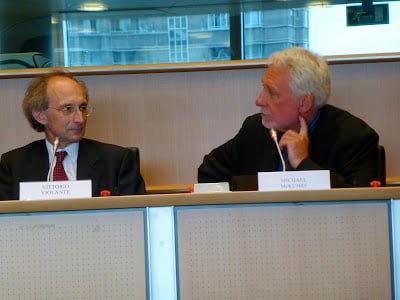
Dr. Vittorio Violante and Dr. Michael McKubre at European Parliament ITRE meeting.
Dr. Michael McKubre presented on New Nuclear Effects in Deuterium-Palladium Electrolysis and Gas Systems under near ambient conditions [visit]

Dr. Vittorio Violante, of whom McKubre said “was once the only man in the world who could make palladium that worked”, presented Material Science for Understanding the Fleischmann and Pons Effect. [visit]

Konrad Czerski New Evidence of the Cold Nuclear Fusion – Accelerator Experiments at Very Low Energies. [visit]

.

Dr. Graham Hubler is Director of Sidney Kimmel Institute for Nuclear Renaissance
Dr. Graham Hubler is Director of Sidney Kimmel Institute for Nuclear Renaissance at University of Missouri.
Dr. Graham Hubler presented Anomalous Heat Results from the Naval Research Lab and the University of Missouri. [visit]

Dr. Robert Duncan presented Discovery of New Nuclear Phenomena in Condensed Matter the State. [visit]

Both Hubler and Duncan will be hosting the 18th International Conference on Cold Fusion ICCF-18 this July from their campus at University of Missouri.

According to Passerini, the meeting in Brussels was held “to convince decision makers of the importance of funding research.”

From their website, the ITRE Committee “will deal with legislative proposals on Research; the EU policy on research is due to be redefined for the years to come and to cope with new challenges.”

Ironically, Passerini cites American research as an impetus for the European community, implying targeted support for new energy in the U.S. – were it only true. He also mentions Italy’s official position on cold fusion, which mirror’s the U.S. federal stance: cold fusion is impossible, so let’s ignore it.

Still, Italy has been the heart of new energy research in Europe beginning with Vittorio Violante‘s lab at ENEA focusing on palladium-deuterium cells, and Francesco Piantelli and Sergio Focardi‘s early work on nickel-hydrogen reactions.

Andrea Rossi presented his first public demonstration of the E-Cat steam generator at the University of Bologna in January 2011 which brought the world’s attention to new energy and galvanized a whole community of supporters. Today, an open source project links citizen scientists around the world with longtime researcher Francesco Celani of the Italian Institute for Nuclear Physics (INFN).

ENEA published a report in 2008 on the History of Cold Fusion in Italy [ .pdf] to commemorate the 20th Anniversary of Drs. Martin Fleischmann and Stanley Pons’ announcement of cold fusion which coincided with the 15th International Conference on Cold Fusion held in Rome in 2009.

No doubt there were discussions of the recent report on Rossi’s progress and redesign of the E-Cat HT. The caliber of research presented by both scientists and entrepreneurs could only have impressed the ITRE committee. Positive recommendations to the full Parliament could produce a funding stream for a coordinated research program to hasten the quickening pace of development.

Decontamination of radioactive ashes by nano silver

This is the 3rd report about the decontamination by nano silver which may be LENR transmutation.

In Japan, city garbage is gathered by trucks and taken to the incinerator plant everyday. In the plant, the garbage is burned and the ashes are buried into landfills. That was before March 11, 2011, the disaster of Fukushima Daiichi Nuclear Plant.

The 2nd incinerator plant of Kashiwa city in Japan.

After the disaster, at some incinerator plants, the radioactivity of the ashes is very high and exceeds the limit for land reclamation. As the volume of the ashes is about 1-10% of the original garbage, the radioactive materials are concentrated. The highly-radioactive ashes are packed into containers and moved to a temporary warehouse.  

For example, in the second incinerator plant of Kashiwa city in Japan, 57.60 tons of radioactive ashes were moved to a temporary warehouse in April of 2013, as below (this data is published at here ).

date

quantity of
ashes (ton)

number of
containers

density of radioactive materials (Bq/Kg)

April 8

7.20

12

38,100

April 10

7.20

12

49,900

April 12

7.20

12

49,900

April 15

7.20

12

47,800

April 17

7.20

12

51,200

April 19

7.20

12

51,200

April 24

7.20

12

49,400

April 26

7.20

12

49,400

sum

57.60

96

51,200 (Max)

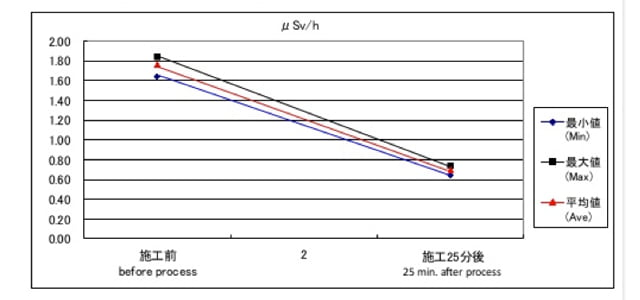
On March 28, 2012 from 9:30 am to 11:45 am, Dr. Norio Abe, Chief of Itabashi Firefly Ecosystem Center, went to the plant and conducted an experiment that would decontaminate the ashes using nano-silver.

A report on the experiment is shown in SlideShare ( here ).  I added English terms beside the Japanese terms. Figures in the report are not as clear in the embedded view of SlideShare, so please download the PDF document from SlideShare if you have trouble reading it.

Abstract of the experiment:

  • 12Kg of the ashes were moved to 3 pails ( Each pail had 12Kg of the ashes) 
  • The team prepared 3 types of materials.  They mixed each material for each pail and measured radioactive level just after mixing and after 30 min ( or 25 min ).
  • The 3 types of materials:
    (A) 3.6 liter of tap water  ( for controlled experiment )
    (B)  3 liter of nano silver embedded collagen (10ppm) and 3 Kg of nano silver embedded boan coal
    (C)  3 liter of nano silver embedded collagen (20ppm) and 3 Kg of nano silver embedded boan coal
    (The difference between B and C is the density of nano silver embedded collagen — 10 ppm vs 20 ppm)
  • As the result, in the cases of B and C, the level of radioactivity of the ashed decreased.  For example, in the case of C, the level was 6.12 μSV before mixing and decreased to 4.00 μSV just after mixing. The level after 30 min was similar to the level just after mixing.

Unfortunately, they had to end the experiment after 30 min of mixing due to time limitations.  I speculate that the level of radioactivity might be decreased further by additional stirring of ashes, because in the experiment (here) reported at the conference of “radiation detectors and their uses”, a decrease after stirring is shown.

Anyway, I think this experiment shows the possibility of transmutation from radioactive material into a non-radioactive one.  I hope other researchers will try and re-produce this experiment.

If you want to contact me, please write a comment or send e-mail to me ( sengaku1046@gmail.com ).

Cold Fusion Now!

Related article:


Jeane Manning on live demo of Defkalion’s Hyperion

Jeane Manning, author of Breakthrough Power, has published an article in Atlantic Rising on her visit to Defkalion Green Technologies new office in Vancouver, Canada where she viewed a live demonstration of their Hyperion thermal generator.

Beyond LENR (aka ‘cold fusion’) to Useful Energy [.pdf] is available for free on Manning’s Changing Power website and describes a generator capable of producing 5 kilowatts of thermal power, with “several times” energy output.

A planned 45 kilowatt generator will be comprised of nine units in parallel. A test generator in Greece is claimed to run continuously for six months producing power at 45 kilowatts. Preferring to call the reaction Heat Energy Nuclei Interactions (HENI), the thermal energy was generated on just 3 grams of nickel powder and 2 liters of hydrogen.

The company moved to Vancouver “after their government failed to help the start-up company.” Canada “offered a stable environment for research-and-development companies, with a support network and fiscal incentives.” Additional labs in Athens, Milan, Italy as well as Brazil will be developing applications with multiple business partners.

Initially a partner with Andrea Rossi, Defkalion and Rossi split after differences arose over contractual issues. Deciding to develop a generator on their own, the company began with the premise that only after achieving stability and control would they scale up to high heat output.

The article quotes Peter Gluck, a chemist and longtime low-energy nuclear reactions (LENR) researcher. “Cold fusion came before its time. It is too complex, too new, too unexpected, too messy, too multifaceted, too dynamic, too non-linear and too weird to be really understood and controlled at the time of its discovery.”

Defkalion’s Chief Technical Officer John Hadjichristos responded “Science is one, and we have to keep it that way if we want to keep on talking with Mother Nature …We cannot see or listen and understand her stories if we stop talking to and hearing each other.”

The divine road ahead

Medieval-manI am a one- trick pony.

OK. A three-trick pony then.

I do not have the scary blades of Wolverine or Thor’s mighty Hammer.

And there is a lot of water between me and Igil Skallagrimson.

I am not even as good a poet. (You guessed that he was an exceptional Poet, right?)

However, I am not without my immodest strengths.

Star Trek alien head. Source: Oil Drum
Mighty throbbing brain of Star Trek alien head. Source: Oil Drum

The Lesser of the three is a Mighty Throbbing Brain. This sort of effect.

If I am to survive I had better put my Superpower to use.

We (A cluster of exceptional survivors and me) need a few favors from the Gods.

The first is a miraculous and bounteous source of portable energy.

If you are not a Deist please insert your fingers in your ears at this point and sing “La La, La La. I can’t hear you”, at the top of your voice .

Apparently Atheism is losing ground as such a source is in the offing. Gail Tverberg and I doubt that it will come in good time to do you any favors. (Evolution is such a ruthless process).

Andrea Rossi’s eCat has been verified by an argument of professors in Sweden and at Cornell University. From the report:

An experimental investigation of possible anomalous heat production in a special type of reactor tube named E-Cat HT is carried out. The reactor tube is charged with a small amount of hydrogen loaded nickel powder plus some additives. The reaction is primarily initiated by heat from resistor coils inside the reactor tube. Measurement of the produced heat was performed with high-resolution thermal imaging cameras, recording data every second from the hot reactor tube. The measurements of electrical power input were performed with a large bandwidth three-phase power analyzer. Data were collected in two experimental runs lasting 96 and 116 hours, respectively. An anomalous heat production was indicated in both experiments. The 116-hour experiment also included a calibration of the experimental set-up without the active charge present in the E-Cat HT. In this case, no extra heat was generated beyond the expected heat from the electric input. Computed volumetric and gravimetric energy densities were found to be far above those of any known chemical source. Even by the most conservative assumptions as to the errors in the measurements, the result is still one order of magnitude greater than conventional energy sources.

Well. That will give us some breathing space. (Please do not be tempted to include yourselves in the pronoun “Us”).

The next issue to be addressed is the need for artificial intelligence and robotics. I see that we are making steady progress. You might like to observe Big Dog. Primitive, but it has possibilities.

The next thing that you we will need is a really smart way of building huge structures. And here another apple falls into our laps in the form of 3d printing.
And God just keeps giving.

What we also need is a lot of living space while we wrestle this urge to breed and it’s commensurate exponential function, to the ground.

“Space is Big. Really, really big. If you thought it was a long way to the pharmacy that is peanuts compared to space.” (Apologies to Douglass Adams)

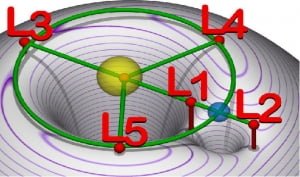
At L4 alone there is enough room for several orders of magnitude  more people than on the cramped two dimensional surface of this orb. Here is a graphic of what a Lagrange point looks like.

Lagrange Point Source: Wiki

(You see that hole in the middle. That is the Gravity Well. You live at the bottom of it, poor thing.)

But how do we get there? We all “know” that it takes $$thousands of dollars to get even one pound out of the well, don’t we?

And just what will we find when we get there? The vacuum of space is no place for a trowel and mortar. But please- one issue at a time!!

Space elevator. Source: Wiki

How are we going to loft the remnants of humanity off the planet? Well there are several options available to us. Colossal Carbon Nano-tubes offer us a splendid means of taking the Elevator.

Or if a week of sitting around in a lift is just too boring, please consider orbital airships. At a cost of $1 per ton per vertical mile that might be within your our budget. (Wiki does fret about re-entry problems. There will be no re-entry. Unless you are a masochist of cause.)

But ponder this problem. Where are we going to get the materials? A hint: It will not be from the bottom of some gravity well. Gravity wells suck.

The God that gives, keeps giving.

The purpose of the Moon is not to help seduce maidens.

The purpose of the moon is to offer us the resources we need at just the right distance to encourage us into The Void.

“But,” we used to declare confidently “It has no water.”

When will we learn to keep our mouths shut? So now we have water at the poles. Someone else declared that the water at the poles was the greatest discovery of all time. He was right, because we now have run out of excuses.

What’s that I hear you think? We don’t have strong enough materials. See my point above about keeping our mouths shut. Only open them to give thanks.

Graphene, a layer of triple bonded atoms just one atom thick is capable of supporting an elephant. To get it to rip the elephant would need to stand on a pencil.

OK so now we have the Energy. Check.

We have the means to get into space in huge numbers. Checkᶩ (Did I mention the fact that the Orbital Airships are made of graphene? No? I did not think it necessary. Everything will be made of graphene.)

We are developing the robots to do the hard work on the moon and construct the habitat at the Lagrange points. Check

What are we still missing? Ah Yes. The Motivation. And here it is.

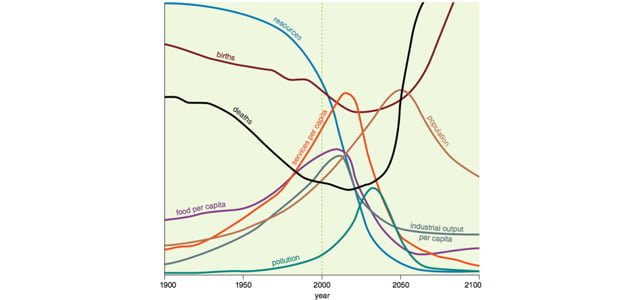
Standard run model from The Limits to Growth report.

Do you see that Black line? That is Deaths.

Do you see that little wobbly bit a few years into the 20th century? That was the combined effect of 1st and 2nd World Wars, the Spanish flu, Stalin’s pogroms and the famine in China and India.

Now look a little further along the line. Do you see a subtle change?

If you don’t see anything odd, do not be alarmed. It does not concern you.

The Limits to Growth report. [.pdf] Standard run. (Also known as the Business-As-Usual run)

To tell the truth I am getting bored spoon-feeding you. Talk about pulling teeth!

What I will do instead is to give you your  homework. Here is a fictional story that I wrote for your amusement and pleasure. It is all about human relationships and sex, so there is something in it for the girls and the boys. (Sorry. No car chase.)

My story is called “The Breeding.” And if you are very good and read to the end there is a special treat.

Unconvinced? May I suggest you stare for a good half hour into your crystal ball.

Somebody please tell the Atheists they can take their fingers out their ears now.

Top