
Wikipedia Beyond Cold Fusion – part two Subatomic Particles


DownloadedFile

Of Particular Interest to Cold Fusioneers are the Quasiparticles

Once again we take a journey beyond the surface of the Wikipedia Cold Fusion article into the depths of Wiki Science. This journey takes us into the world of subatomic particles. The following article is gleaned from excellent Wiki articles on cutting edge subatomic research.

The inner workings of the atom involve many different exciting particles and interactions. Studying this information helps one to begin to understand the science behind the popularly known cold fusion -LENR -low energy nuclear reactive environment. Quite a few of the Quasiparticles are mentioned in cold fusion patents and papers and are of particular interest to cold fusioneers.

Much of the subatomic research presented challenges one theoretical model or another, yet none of their Wiki articles are a battleground of contention as is the Wiki article, Cold Fusion… even now.

Elementary Particles ——— 25

Composite Particles ———– 68

Quasiparticles ——————-  20

Subatomic Particles Total  –   113

More Particles Predicted – 23

Subatomic particles are the particles smaller than an atom. There are two types of subatomic particles: elementary particles, which are not made of other particles, and composite particles.

Then there are the quasiparticles.

“Not-quite-so Elementary, My Dear Electron” link

Fundamental particle ‘splits’ into quasiparticles, including the new ‘orbiton’

by Zeeya Merali 18 April 2012, Nature: International weekly journal of science

Elementary Particles  /25

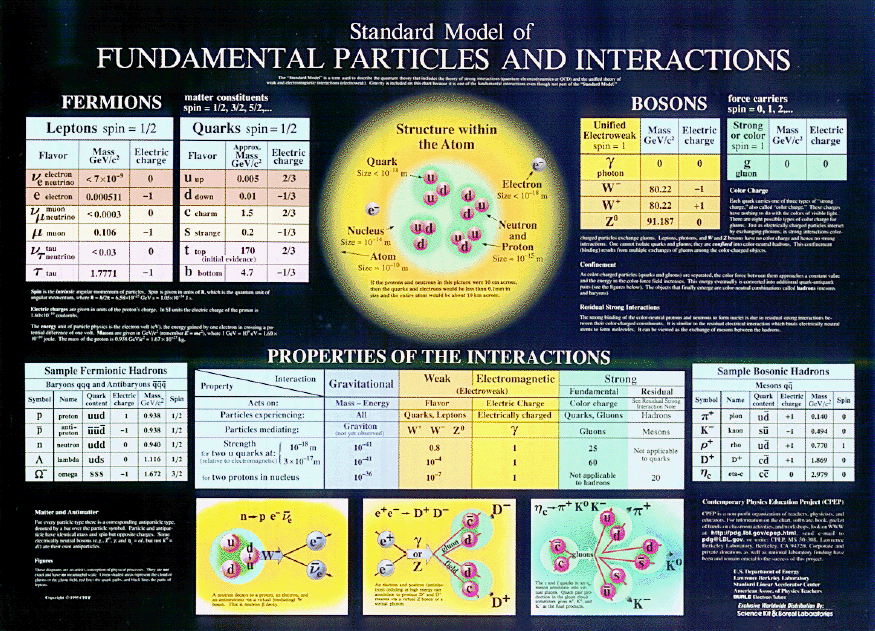
The elementary particles of the Standard Model include:

A) Six “flavors” of quarks: up, down, bottom, top, strange, and charm. @6 Particle

B) Six types of leptons: electron, electron neutrino, muon, muon neutrino, tau, tau neutrino. @6 Particles

C) Twelve gauge bosons (force carriers): the photon of electromagnetism, the three W and Z bosons of the weak force, and the eight gluons of the strong force. @12 Particles

D) The Higgs boson. @1 Particle
stdchrt


Twenty five Elementary Particles

Note:  Various extensions of the Standard Model predict
the existence of an elementary graviton particle
and many other elementary particles.


Composite Particles /68

Composite subatomic particles (such as protons or atomic nuclei) are bound states of two or more elementary particles. For example, a proton is made of two up quarks and one down quark, while the atomic nucleus of helium-4 is composed of two protons and two neutrons. Composite particles include all hadrons, a group composed of baryons (e.g., protons and neutrons) and mesons (e.g., pions and kaons).

Elementary particles are particles with no measurable internal structure; that is, they are not composed of other particles. They are the fundamental objects of quantum field theory. Many families and sub-families of elementary particles exist. Elementary particles are classified according to their spin. Fermions have half-integer spin while bosons have integer spin. All the particles of the Standard Model have been experimentally observed, recently including the Higgs boson.

Fermions (quarks and leptons) @22

Fermions are one of the two fundamental classes of particles, the other being bosons. Fermion particles are described by Fermi–Dirac statistics and have quantum numbers described by the Pauli exclusion principle. They include the quarks and leptons, as well as any composite particles consisting of an odd number of these, such as all baryons and many atoms and nuclei.

Fermions have half-integer spin; for all known elementary fermions this is 1⁄2. All known fermions are also Dirac fermions; that is, each known fermion has its own distinct antiparticle. It is not known whether the neutrino is a Dirac fermion or a Majorana fermion. Fermions are the basic building blocks of all matter. They are classified according to whether they interact via the color force or not. In the Standard Model, there are 12 types of elementary fermions: six quarks and six leptons.

Quarks – Quarks are the fundamental constituents of hadrons and interact via the strong interaction. Quarks are the only known carriers of fractional charge, but because they combine in groups of three (baryons) or in groups of two with antiquarks (mesons), only integer charge is observed in nature. Their respective antiparticles are the antiquarks which are identical except for the fact that they carry the opposite electric charge (for example the up quark carries charge +2⁄3, while the up antiquark carries charge −2⁄3), color charge, and baryon number. There are six flavors of quarks; the three positively charged quarks are called up-type quarks and the three negatively charged quarks are called down-type quarks.

Six Quarks and their antiparticles the Six Antiquarks @12 Particles

1) Up Quark

2) Down Quark

3) Charm Quark

4) Strange Quark

5) Top Quark

6) Bottom Quark

Leptons – Leptons do not interact via the strong interaction. Their respective antiparticles are the antileptons which are identical except for the fact that they carry the opposite electric charge and lepton number. The antiparticle of the electron is the antielectron, which is nearly always called positron for historical reasons. There are six leptons in total; the three charged leptons are called electron-like leptons, while the neutral leptons are called neutrinos. Neutrinos are known to oscillate, so that neutrinos of definite flavour do not have definite mass, rather they exist in a superposition of mass eigenstates wiki. The hypothetical heavy right-handed neutrino, called a sterile neutrino, has been left off the list.

The Five Leptons and their antiparticles the Five Antileptons @10 Particles

1) Electron

2) Electron nutrino

3) Muon

4) Tau

5) Tau nutrino

Bosons (elementary bosons)

Bosons are one of the two fundamental classes of particles, the other being fermions. Bosons are characterized by Bose–Einstein statistics and all have integer spins. Bosons may be either elementary, like photons and gluons, or composite, like mesons. The graviton is added to the list although it is not predicted by the Standard Model, but by other theories in the framework of quantum field theory.

An important characteristic of bosons is that there is no limit to the number that can occupy the same quantum state. This property is evidenced, among other areas, in helium-4 when it is cooled to become a superfluid. In contrast, two fermions cannot occupy the same quantum space. Whereas fermions make up matter, bosons, which are “force carriers” function as the ‘glue’ that holds matter together. There is a deep relationship between this property and integer spin (s = 0, 1, 2 etc.).

The Higgs boson is postulated by electroweak theory primarily to explain the origin of particle masses. In a process known as the Higgs mechanism, the Higgs boson and the other gauge bosons in the Standard Model acquire mass via spontaneous symmetry breaking of the SU(2) gauge symmetry. The Minimal Supersymmetric Standard Model (MSSM) predicts several Higgs bosons. The graviton is not a Standard Model particle. Furthermore, gravity is non-renormalizable.The Higgs boson has been observed at the CERN/LHC dated 14th March in 2013 around the level of energy 126,5GeV and at the accuracy of five-sigma (>99,4% which accepted as definitive)

The fundamental forces of nature are mediated by gauge bosons, and mass is believed to be created by the Higgs Field. According to the Standard Model (and to both linearized general relativity and string theory, in the case of the graviton). While most bosons are composite particles, in the Standard Model, there are five bosons which are elementary:

A) The four gauge bosons (γ · g · Z · W±)

B) The Higgs boson (H0)

Five Elementary Bosons / these 5 Particles are already tallied

The following Composite bosons are important in superfluidity and other applications of Bose–Einstein condensates.

Hadrons (baryons and mesons) @46

Hadrons are defined as strongly interacting composite particles. Hadrons are either: Composite fermions, in which case they are called baryons. or Composite bosons, in which case they are called mesons.

Quark models, first proposed in 1964 independently by Murray Gell-Mann and George Zweig (who called quarks “aces”), describe the known hadrons as composed of valence quarks and/or antiquarks, tightly bound by the color force, which is mediated by gluons. A “sea” of virtual quark-antiquark pairs is also present in each hadron.

Baryons – Baryons are the family of composite particle made of three quarks, as opposed to the mesons which are the family of composite particles made of one quark and one antiquark. Both baryons and mesons are part of the larger particle family comprising all particles made of quarks – the hadron. The term baryon is derived from the Greek “βαρύς” (barys), meaning “heavy”, because at the time of their naming it was believed that baryons were characterized by having greater masses than other particles that were classed as matter.

Since baryons are composed of quarks, they participate in the strong interaction. Leptons on the other hand, are not composed of quarks and as such do not participate in the strong interaction. The most famous baryons are the protons and neutrons which make up most of the mass of the visible matter in the universe, whereas electrons (the other major component of atoms) are leptons. Each baryon has a corresponding antiparticle (antibaryon) where quarks are replaced by their corresponding antiquarks. For example, a proton is made of two up quarks and one down quark; and its corresponding antiparticle, the antiproton, is made of two up antiquarks and one down antiquark.

A combination of three u, d or s-quarks with a total spin of 3⁄2 form the so-called baryon decuplet. Proton quark structure: 2 up quarks and 1 down quark.

This list is of all known and predicted baryons: 1)nucleon/proton 2) nucleon/neutron 3) Lamda 4) charmed Lamda 5) bottom Lamda 6) Sigma 7) charmed Sigma 8) bottom Sigma 9) Xi 10) charmed Xi 11) charmed Xi prime 12) double charged Xi prime 13) bottom Xi 14) bottom Xi prime 15) charmed bottom Xi 16) charmed bottom Xi prime 17) charmed Omega 18) bottom Omega 19) double charmed Omega, 20) charmed bottom Omega 21) charmed bottom Omega prime, 22) double bottom Omega, 23) double charmed bottom Omega, 24) charmed double bottom Omega @24 Particles

Mesons – Ordinary mesons are made up of a valence quark and a valence antiquark. Because mesons have spin of 0 or 1 and are not themselves elementary particles, they are composite bosons. Examples of mesons include the pion, kaon, the J/ψ. In quantum hydrodynamic models, mesons mediate the residual strong force between nucleons.

At one time or another, positive signatures have been reported for all of the following exotic mesons but their existence has yet to be confirmed.

A tetraquark consists of two valence quarks and two valence antiquarks;

A glueball is a bound state of gluons with no valence quarks;

Hybrid mesons consist of one or more valence quark-antiquark pairs and one or more real gluons.

This list is of all known and predicted scalar,  pseudoscalar and vector mesons:

1) Pion 2) Antipion 3) Eta meson 4) Eta prime meson 5) charmed eta meson 6) Bottom eta meson 7) Kaon 8) K- Short 9) K- Long 10) D meson 11) Anti D meson 12) Strange D meson 13) B meson 14) Anti B meson 15) Strange B meson 16) Charmed B meson 17) Charged rho meson 18) Neutral rho meson 19) Omega meson 20) Phi meson 21) J/Psi 22) Upsilon meson @22 Particles

There are two complications with neutral kaons: Due to neutral kaon mixing, the K0
S and K0
L are not eigenstates of strangeness. However, they are eigenstates of the weak force, which determines how they decay, so these are the particles with definite lifetime.

Note that these issues also exist in principle for other neutral flavored mesons; however, the weak eigenstates are considered separate particles only for kaons because of their dramatically different lifetimes.
1.10471

Quasiparticles /20

In physics, quasiparticles and collective excitations (which are closely related) are emergent phenomena wiki that occur when a microscopically complicated system such as a solid behaves as if it contained different (fictitious) weakly interacting particles in free space. For example, as an electron travels through a semiconductor, its motion is disturbed in a complex way by its interactions with all of the other electrons and nuclei; however it approximately behaves like an electron with a different mass traveling unperturbed through free space. This “electron” with a different mass is called an “electron quasiparticle”. In an even more surprising example, the aggregate motion of electrons in the valence band of a semiconductor is the same as if the semiconductor contained instead positively charged quasiparticles called holes. Other quasiparticles or collective excitations include phonons (particles derived from the vibrations of atoms in a solid), plasmons (particles derived from plasma oscillations), and many others.

These fictitious particles are typically called “quasiparticles” if they are fermions (like electrons and holes), and called “collective excitations” if they are bosons (like phonons and plasmons), although the precise distinction is not universally agreed.

Quasiparticles are most important in condensed matter physics, as it is one of the few known ways of simplifying the quantum mechanical many-body problem (and as such, it is applicable to any number of other many-body systems).

This is a list of quasiparticles (study them at the following Wikipedia links)

1)  Bipolaron – A bound pair of two polarons

2)  Chargon – A quasiparticle produced as a result of electron spin-charge separation

3)  Configuron  – An elementary configurational excitation in an amorphous material which involves breaking of a chemical bond

4)  Electron quasiparticle – An electron as affected by the other forces and interactions in the solid

5)  Electron hole  – A lack of electron in a valence band

6)  Exciton – A bound state of an electron and a hole

7)  Fracton – A collective quantized vibration on a substrate with a fractal structure.

8)  Holon – A quasi-particle resulting from electron spin-charge separation

9)  Magnon – A coherent excitation of electron spins in a material

10) Orbiton  – A quasiparticle resulting from electron spin-orbital separation

11) Phason – Vibrational modes in a quasicrystal associated with atomic rearrangements

12) Phonon – Vibrational modes in a crystal lattice associated with atomic shifts

13) Plasmaron – A quasiparticle emerging from the coupling between a plasmon and a hole

14) Plasmon  – A coherent excitation of a plasma

15) Polaron – A moving charged quasiparticle that is surrounded by ions in a material

16) Polariton – A mixture of photon with other quasiparticles

17) Roton – Elementary excitation in superfluid Helium-4

18) Soliton  – A self-reinforcing solitary excitation wave

19) Spinon  – A quasiparticle produced as a result of electron spin-charge separation

20) Trion – A coherent excitation of three quasiparticles (two holes and one electron or two electrons and one hole) Quasiparticles @20 particles

References quasiparticles ^ Angell, C.A.; Rao, K.J. Configurational excitations in condensed matter, and “bond lattice” model for the liquid-glass transition. J. Chem. Phys. 1972, 57, 470-481 ^ J. Schlappa, K. Wohlfeld, K. J. Zhou, M. Mourigal, M. W. Haverkort, V. N. Strocov, L. Hozoi, C. Monney, S. Nishimoto, S. Singh, A. Revcolevschi, J.-S. Caux, L. Patthey, H. M. Rønnow, J. van den Brink, and T. Schmitt; (18.04.2012). “Spin–orbital separation in the quasi-one-dimensional Mott insulator Sr2CuO3”. Nature, Advance Online Publication. arXiv:1205.1954. Bibcode:2012Natur.485…82S. doi:10.1038/nature10974.

Supersymmetric theories predict the existence of more particles, none of which have been confirmed experimentally as of 2011:

1) neutralino 2) chargino 3) photino 4) wino/zino 5) Higgsino 6) gluino

7) gravitino 8) sleptons 9) sneutrino 10) squarks @10 Particles

No matter if you use the original gauginos or this superpositions as a basis, the only predicted physical particles are neutralinos and charginos as a superposition of them together with the Higgsinos.

Other theories predict the existence of additional bosons and fermions.

List of Other hypothetical bosons and fermions:

1) graviton 2) graviscalar 3) graviphoton 4) axion 5) saxion 6) branon 7) dilaton 8) X & Y bosons

9) W & Z bosons 10) magnetic photon 11) majoron 12) majorana fermion 13) Chameleon  @13 Particles

Mirror particles are predicted by theories that restore parity symmetry.

Magnetic monopole is a generic name for particles with non-zero magnetic charge. They are predicted by some GUTs.

Tachyon is a generic name for hypothetical particles that travel faster than the speed of light and have an imaginary rest mass.

Kaluza-Klein towers of particles are predicted by some models of extra dimensions. The extra-dimensional momentum is manifested as extra mass in four-dimensional space-time.

Timeline of Subatomic Particle Discoveries

Including all particles thus far discovered which appear to be elementary (that is, indivisible) given the best available evidence. It also includes the discovery of composite particles and antiparticles that were of particular historical importance.

More specifically, the inclusion criteria are:

Elementary particles from the Standard Model of particle physics that have so far been observed. The Standard Model is the most comprehensive existing model of particle behavior. All Standard Model particles including the Higgs boson have been verified, and all other observed particles are combinations of two or more Standard Model particles.

Antiparticles which were historically important to the development of particle physics, specifically the positron and antiproton. The discovery of these particles required very different experimental methods from that of their ordinary matter counterparts, and provided evidence that all particles had antiparticles—an idea that is fundamental to quantum field theory, the modern mathematical framework for particle physics. In the case of most subsequent particle discoveries, the particle and its anti-particle were discovered essentially simultaneously.

Composite particles which were the first particle discovered containing a particular elementary constituent, or whose discovery was critical to the understanding of particle physics.

Note that there have been many other composite particles discovered; see list of mesons wiki and list of baryons wiki. See list of particles wiki for a more general list of particles, including hypothetical particles.

  • 1800: William Herschel discovers “heat rays”
  • 1801: Johann Wilhelm Ritter made the hallmark observation that invisible rays just beyond the violet end of the visible spectrum were especially effective at lightening silver chloride-soaked paper. He called them “oxidizing rays” to emphasize chemical reactivity and to distinguish them from “heat rays” at the other end of the invisible spectrum (both of which were later determined to be photons). The more general term “chemical rays” was adopted shortly thereafter to describe the oxidizing rays, and it remained popular throughout the 19th century. The terms chemical and heat rays were eventually dropped in favor of ultraviolet and infrared radiation, respectively.

Albert Einstein Born in Ulm, Germany, in 1879.

  • 1895: Discovery of the ultraviolet radiation below 200 nm, named vacuum ultraviolet (later identified as photons) because it is strongly absorbed by air, by the German physicist Victor Schumann.
  • 1895: X-ray produced by Wilhelm Röntgen (later identified as photons).
  • 1897: Electron discovered by J.J. Thomson.
  • 1899: Alpha particle discovered by Ernest Rutherford in uranium radiation.

Albert Einstein received his fist teaching diploma from Zurich Polytechnic in 1900.

  • 1900: Gamma ray (a high-energy photon) discovered by Paul Villard in uranium decay.
  • 1911: Atomic nucleus identified by Ernest Rutherford, based on scattering observed by Hans Geiger and Ernest Marsden.
  • 1919: Proton discovered by Ernest Rutherford.

Martin Fleischmann Born in Karlovy Vary, Czechoslovakia, in 1927.

  • 1932: Neutron discovered by James Chadwick (predicted by Rutherford in 1920).
  • 1932: Antielectron (or positron) the first antiparticle, discovered by Carl D. Anderson (proposed by Paul Dirac in 1927 and by Ettore Majorana in 1928).
  • 1937: Muon (or mu lepton) discovered by Seth Neddermeyer, Carl D. Anderson, J.C. Street, and E.C. Stevenson, using cloud chamber measurements of cosmic rays. (It was mistaken for the pion until 1947).
  • 1947: Pion (or pi meson) discovered by C. F. Powell’s group (predicted by Hideki Yukawa in 1935).
  • 1947: Kaon (or K meson), the first strange particle, discovered by George Dixon Rochester and Clifford Charles Butler.
  • 1947: Λ0 discovered during a study of cosmic ray interactions.

Martin Fleischmann received his PhD from Imperial College London in 1950.

  • 1955: Antiproton discovered by Owen Chamberlain, Emilio Segrè, Clyde Wiegand, and Thomas Ypsilantis.
  • 1956: Electron neutrino detected by Frederick Reines and Clyde Cowan (proposed by Wolfgang Pauli in 1931 to explain the apparent violation of energy conservation in beta decay). At the time it was simply referred to as neutrino since there was only one known neutrino.
  • 1962: Muon neutrino (or mu neutrino) shown to be distinct from the electron neutrino by a group headed by Leon Lederman.
  • 1964: Xi baryon discovery at Brookhaven National Laboratory.
  • 1969: Partons (internal constituents of hadrons) observed in deep inelastic scattering experiments between protons and electrons at SLAC; this was eventually associated with the quark model (predicted by Murray Gell-Mann and George Zweig in 1964) and thus constitutes the discovery of the up quark, down quark, and strange quark.
  • 1974: J/ψ meson discovered by groups headed by Burton Richter and Samuel Ting, demonstrating the existence of the charm quark  (proposed by James Bjorken and Sheldon Lee Glashow in 1964).
  • 1975: Tau discovered by a group headed by Martin Perl.
  • 1977: Upsilon meson discovered at Fermilab, demonstrating the existence of the bottom quark  (proposed by Kobayashi and Maskawa in 1973).
  • 1979: Gluon observed indirectly in three jet events at DESY.
  • 1983: W and Z bosons discovered by Carlo Rubbia, Simon van der Meer, and the CERN UA1 collaboration (predicted in detail by Sheldon Glashow, Abdus Salam, and Steven Weinberg).

The “Cold Fusion” announcement of 1989.

  • 1995: Top quark discovered at Fermilab.
  • 1995: Antihydrogen produced and measured by the LEAR experiment at CERN.
  • 2000: Tau neutrino first observed directly at Fermilab.
  • 2011: Antihelium-4 produced and measured by the STAR detector; the first particle to be discovered by the experiment.
  • 2011: χb(3P) discovered by researchers conducting the ATLAS experiment at CERN’s Large Hadron Collider; the first particle to be discovered by this experiment.
  • 2011: An excited neutral Xi-b baryon Ξ∗0
b discovered by researchers conducting the Compact Muon Solenoid experiment at CERN’s Large Hadron Collider, in concert with researchers at the University of Zurich; it is the first particle discovered by the CMS.
  • 2012: A particle exhibiting most of the predicted characteristics of the Higgs boson discovered by researchers conducting the Compact Muon Solenoid and ATLAS experiments at CERN’s Large Hadron Collider.

Decontamination of radioactive ashes by nano silver

This is the 3rd report about the decontamination by nano silver which may be LENR transmutation.

In Japan, city garbage is gathered by trucks and taken to the incinerator plant everyday. In the plant, the garbage is burned and the ashes are buried into landfills. That was before March 11, 2011, the disaster of Fukushima Daiichi Nuclear Plant.

The 2nd incinerator plant of Kashiwa city in Japan.

After the disaster, at some incinerator plants, the radioactivity of the ashes is very high and exceeds the limit for land reclamation. As the volume of the ashes is about 1-10% of the original garbage, the radioactive materials are concentrated. The highly-radioactive ashes are packed into containers and moved to a temporary warehouse.  

For example, in the second incinerator plant of Kashiwa city in Japan, 57.60 tons of radioactive ashes were moved to a temporary warehouse in April of 2013, as below (this data is published at here ).

date

quantity of
ashes (ton)

number of
containers

density of radioactive materials (Bq/Kg)

April 8

7.20

12

38,100

April 10

7.20

12

49,900

April 12

7.20

12

49,900

April 15

7.20

12

47,800

April 17

7.20

12

51,200

April 19

7.20

12

51,200

April 24

7.20

12

49,400

April 26

7.20

12

49,400

sum

57.60

96

51,200 (Max)

On March 28, 2012 from 9:30 am to 11:45 am, Dr. Norio Abe, Chief of Itabashi Firefly Ecosystem Center, went to the plant and conducted an experiment that would decontaminate the ashes using nano-silver.

A report on the experiment is shown in SlideShare ( here ).  I added English terms beside the Japanese terms. Figures in the report are not as clear in the embedded view of SlideShare, so please download the PDF document from SlideShare if you have trouble reading it.

Abstract of the experiment:

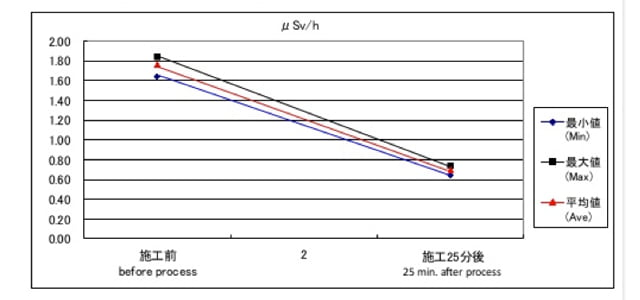
  • 12Kg of the ashes were moved to 3 pails ( Each pail had 12Kg of the ashes) 
  • The team prepared 3 types of materials.  They mixed each material for each pail and measured radioactive level just after mixing and after 30 min ( or 25 min ).
  • The 3 types of materials:
    (A) 3.6 liter of tap water  ( for controlled experiment )
    (B)  3 liter of nano silver embedded collagen (10ppm) and 3 Kg of nano silver embedded boan coal
    (C)  3 liter of nano silver embedded collagen (20ppm) and 3 Kg of nano silver embedded boan coal
    (The difference between B and C is the density of nano silver embedded collagen — 10 ppm vs 20 ppm)
  • As the result, in the cases of B and C, the level of radioactivity of the ashed decreased.  For example, in the case of C, the level was 6.12 μSV before mixing and decreased to 4.00 μSV just after mixing. The level after 30 min was similar to the level just after mixing.

Unfortunately, they had to end the experiment after 30 min of mixing due to time limitations.  I speculate that the level of radioactivity might be decreased further by additional stirring of ashes, because in the experiment (here) reported at the conference of “radiation detectors and their uses”, a decrease after stirring is shown.

Anyway, I think this experiment shows the possibility of transmutation from radioactive material into a non-radioactive one.  I hope other researchers will try and re-produce this experiment.

If you want to contact me, please write a comment or send e-mail to me ( sengaku1046@gmail.com ).

Cold Fusion Now!

Related article:


Pre-loaded hydrogen fuel an engineering answer for efficiency, ease and safety

Multiple independent labs are racing to produce a commercial product based on the Fleischmann-Pons Heat Effect (FPHE), most working quietly in their labs. But since the public demonstration of Andrea Rossi‘s E-Cat in January 2011, we’ve witnessed on the global theater the grueling process of actualizing a revolutionary technology.

Early prototype E-Cat had external hydrogen tank for fuel.
It has been amazing to watch. A thermal generator based on nickel-hydrogen exothermic reactions, E-Cat design changes have been guided by efforts to make an efficient, easy-to-use, and safe commercial product.

The earliest prototypes were fueled by hydrogen gas from a canister connected to the unit. For obvious reasons, the danger of hydrogen tanks in a domestic environment present a problem, and having the fuel pre-loaded inside the new E-Cat HT removes a huge liability.

But a pre-loaded fuel cartridge also makes a compact device easy to use.

Previous announcements have set the life for a single charge at six months, after which time the contents can be recycled and a new one installed. As this first generation of new-energy technology filters out to the public, we can expect much longer life-cycles in the future.

How is this fuel pre-loaded into the less-than-a-gram nickel-powder mixture? The answer is proprietary at the moment. But what is possible?

Perhaps a material that absorbs hydrogen and then releases it slowly is used. Metallic-hydrides can do exactly that. Could there be amongst the nickel-powder another transition metal that serves this function?

While we wait to see what’s next for the E-Cat, there are others in the field that have discovered the pre-loaded reactor benefits, each having different designs.

Pre-loaded solid wire works to make heat

Scanning Electron Microscope image of treated Celani wire by MFMP.
SEM image of treated Celani wire by MFMP.
Francesco Celani used a pre-loaded wire for his live demonstrations last year at ICCF-17 and NIWeek 2012. A very different design than Rossi’s, this solid-cathode type cell is being reproduced by the Martin Fleischmann Memorial Project as an open-source enterprise with step-by-step activity documented and available online.

The group showed the results of loading hydrogen in their wire and how it affected resistivity and temperature. Stunning scanning electron microscope (SEM) images reveal close-up views of the metal and its bumpy surface.

Separating loading from activation for Pd-D systems solved by pre-loading

Pre-loading of hydrogen has also benefited palladium-deuterium (Pd-D) systems, helping to hasten initiation of the reaction, which can sometimes take weeks or even months to begin. Waiting so long for a reaction to occur makes data acquisition burdensome, and discoveries difficult.

Ideally, multiple cells would run at the same time, allowing several variables to be monitored and determined simultaneously. At one point, Drs. Fleischmann and Pons were running up to 32 cells, an expensive and still time-dependent undertaking.

SRI International experimented with pre-loading of hydrogen in fine wires as described in Calorimetric Studies of the Destructive Stimulation of Palladium and Nickel Fine Wires [.pdf]. From the paper, a description of how they did it:

SRI electrolytic cell with pre-loaded cathode.
1. Loading. When Pd wires were used as a substrate or as test objects these were pre-loaded electrolytically with either H or D in low molarity SrSO4 electrolytes (50μM) using procedures developed previously at SRI [8] and elsewhere [9].

2. Sealing. The atomic loading of H or D can be sealed inside the Pd lattice for extended periods (several hours or days) with the addition of very small concentrations of Hg2SO4 to the SrSO4 electrolyte and continued cathodic electrolysis [8,9]. The deposited Hg at monolayer coverage is a highly effective poison for hydrogen atom recombination, effectively preventing= desorption by inhibiting molecule formation.

The outcome?

The results show clearly that excess energy is generated both from Pd and Ni wires loaded either with deuterium or natural hydrogen5. However, data from Pd/D codeposited onto highly loaded Pd wires (solid triangles) sit on top of the plot, indicating that this category of wires generates the most excess heat. Interestingly, the Ni codeposited system also yields significant amounts of excess heat.

Pre-loaded NANOR devices can be electrically driven

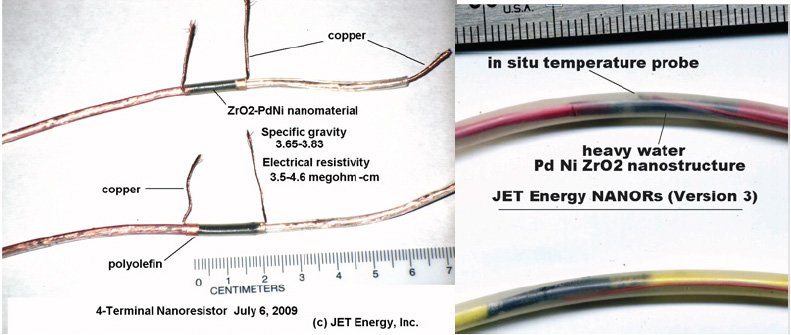
Separating the long loading times from the activation of the reaction was achieved by Dr. Mitchell Swartz of JET Energy, Inc. with his nano-composite ZrO2-PdNi-D cell that is pre-loaded with hydrogen fuel creating a “reproducible active nanostructured cold fusion/lattice-assisted nuclear reaction (CF/LANR) quantum electronic device.”

In the paper Energy Gain From Preloaded ZrO2-PdNi-D Nanostructured CF/LANR Quantum Electronic Components [.pdf] by Mitchell Swartz, Gayle Verner, and Jeffrey Tolleson, the authors write:

The importance is they enable LANR devices and their integrated systems to now be fabricated, transported, and then activated. They are the future of clean, efficient energy production.

A sixth-generation NANOR was publicly demonstrated in the office of Dr. Peter Hagelstein on the campus of Massachusetts Institute of Technology (MIT) during the 2012 IAP Cold Fusion 101 course, operating from January 30 to mid-May. Swartz also described the technology in the 2013 IAP short course captured on video by Jeremy Rys.

Designed to run at low-power due to safety considerations for a multi-month demonstration on a public campus, “over several weeks, the CF/LANR quantum device demonstrated more reproducible, controllable, energy gain which ranged generally from 5 to 16 [14.1 while the course was ongoing].”

With the core smaller than 2 centimeters containing less than a gram of active material, this device produced LANR excess power density “more than 19,500 watts/kilogram of nanostructured material.”

From the paper, Swartz describes the “proprietary self-contained CF/LANR quantum electronic component, called a two terminal NANOR™-type of LANR device”:

The NANOR represents the pre-loaded core of the reactor.
At LANR’s nanostructured material “core” is an isotope of hydrogen, usually deuterons, which are tightly packed (“highly loaded”) into the binary metals, alloys, or in this case, nanostructured compounds, containing palladium or nickel, loaded by an applied electric field or elevated gas pressure which supply deuterons from heavy water or gaseous deuterium.

Loaded are isotopes of hydrogen -protons, protium, deuterons, deuterium, and hydrogenated organic compounds, deuterated organic compounds, D2, H2, deuterides and hydrides. Precisely for these NANOR-type LANR devices, the fuel for the nanostructured material in the core, is deuterium.

The preloaded nanostructured material is placed into the hermetically sealed enclosure which is specially designed to withstand pressure, minimize contamination, enable lock on of wires connecting to it. The enclosure is tightly fit with the electrodes.

Described in the paper, the production of the preloaded core material involves “preparation, production, proprietary pretreatment, loading, post-loading treatment, activation, and then adding the final structural elements, including holder and electrodes.”

Fig. 2 – Series II and III two terminal NANOR™-type devices containing active ZrO2-PdNiD nanostructured material at their core.

Very pure materials are also required. “Contamination remains a major problem, with excess heat potentially devastatingly quenched,” the paper states.

The ratios of the NANOR’s composite elements are “in the range of Zr (~60-70%), Ni (0-30%), and Pd (0-30%) by weight, with the weights being before the oxidation step, and several later additional preparation steps. The additional D2 and H2 yield loadings (ratio to Pd) of up to more than 130% D/Pd.”

After several bakes, eventually an oxidized zirconia “surrounds, encapsulates, and separates the NiPd alloy into 7-10 nm sized ferromagnetic nanostructured islands located and dispersed within the electrically insulating zirconia dielectric.”

Each nanostructured island acts as a short circuit element during electrical discharge. These allow deuterons to form a hyperdense state in each island, where the deuterons are able to be sufficiently close together.”

The latest Series VI NANORs have had energy gains beyond 30.

More than basic science, it’s an engineering development

Pre-loaded core reactors have “a decreased size, decreased response time, improved and dual diagnostics, and increased total output energy density.”

They are compact, portable and durable. Suitable for small power needs, they can respond on-demand with scalable power.

It’s a ragged course to a next-generation clean energy technology. Even as the science is still uncertain, the new pre-loaded hydrogen reactors are an engineering development that brings us closer to that goal.

Nobel laureate Brian Josephson affirms reality of E-Cat HT


university-of-cambridgeDr. Brian Josephson discusses Andrea Rossi‘s E-Cat technology with Dr. Judith Driscoll in a video released in 2011. Published on the University of Cambridge website for Video and Audio Collections, the page is now amended to include the latest confirmation of heat-producing capability by the E-Cat HT.

“It is a very favorable report”, said Dr. Josephson.

The recently released third-party report by scientists conducting an independent test of three different E-Cat HT devices wrote that even in the most conservative estimates, the heat-producing capacity is “at least one order of magnitude greater than chemical energy sources”.

Josephson received the Nobel Prize for his work predicting the quantum tunneling of electrons in Cooper pairs which has had multiple applications in digital electronics. Driscoll is a Cambridge Professor of Materials Science also associated with Los Alamos National Lab in the U.S.

The video is available in several downloadable formats. A transcript is included and we reproduce that here:

PREAMBLE

The deafening silence of the scientific and other media, in regard to what may well be the most important technological advance of the century, was the main stimulus for the creation of this video.

Whereas the ITER thermonuclear project may lead to practical power generation some decades hence, generators based on the Rossi reactor, first demonstrated in January 2011, are already under construction.

In the following, we discuss a number of aspects of this controversial device.

——–

[Picture of Rossi and Levi with the reactor]

Dennis M. Bushnell, NASA Chief Scientist, Langley Research Center: “… this is capable of, by itself, completely changing geo-economics, geo-politics, and solving climate and energy”.*

Judith Driscoll: What’s this Rossi reactor then? Why do you consider it so important?

Brian Josephson: This picture shows Rossi with his device [being shown to Sven Kullander, chairman of the Royal Swedish Academy of Sciences’ Energy Committee, and Hanno Essén, associate professor of theoretical physics and member of the board of the Swedish Skeptics Society, who carried out one of the investigations], which he calls the ‘Energy Catalyzer’, or E-cast for short. He says what’s happening is that there’s a nuclear reaction involving nickel and hydrogen. And since nuclear reactions produce so much more energy than ordinary chemical reactions, this means you can get a vast amount of energy with very little consumption of fuel. Furthermore, you won’t get any greenhouse gases produced.

JD: What’s the evidence that a nuclear process is involved?

BJ: Well, there’s some suggestion that copper is produced, that nickel has been transmuted into copper. But clear evidence is in regard to the amount of energy it produces. There’s a maximum amount of energy you can produce in a chemical reaction, so if the device produces vastly more energy than that, there must be something else going on, either a nuclear reaction or some unknown process. It’s been investigated a number of times, teams have come in to investigate it. For example, in February this year a test was carried out that ran for 18 hours. The amount of heat produced during that time was measured at 270 kWh. And that is the amount of energy you’d get from 25 kg of petrol. And since the size of the reaction chamber is only 50 ml, this rather rules out the idea of energy being generated by any conventional source. This appears to be pretty good evidence [various sources are mentioned at this point, repeated in subtitles. The Wikipedia article on the reactor is currently good, but is subject to the whims and prejudices of editors].

However, there are some problems with the idea that it is a nuclear reaction, because first of all conventional theory says that you need extremely high temperatures to get the reaction to go at a measurable rate, so people are sceptical on those grounds. On the other hand, there may be something wrong with the theory, because here we’ve got something happening in a solid; it’s not in a gas with isolated protons going round. It’s in a solid, so maybe many protons can cooperate and intensify the effect. So I think that’s not such strong grounds for rejecting it.

Another argument people have against this is to say not many gamma rays are produced — an extremely small amount of gamma rays [relative to what would be expected], and these fusion processes normally generate gamma rays. But then again we’ve got a very different kind of situation to what happens in thermonuclear processes. You can see what might happen in this slide. Imagine two different situations. One is a rock that is falling in air; it falls with a crash on some surface. The other situation is where it’s falling through water, and when it’s falling through water the energy is just gradually getting transferred to the water, there’s no big crash. That’s just an explanation [in general terms] of why you mightn’t get gamma rays. There’s really very little in the way of theory — actually lots of attempts have been made to explain it [cold fusion] but there isn’t enough evidence to show which is right. I think it’s not impossible that an explanation will be found.

JD: How is the amount of heat measured?

BJ: Well, this is really just school physics. You’re putting cold water in and you’re getting hot water or steam coming out, and if you know how much water’s going through you know how much heat is being produced, that’s all there is to it really[1].

—–
[1] In principle, but in practice one has to look carefully intoTo embed this video in a web page, use this code: what additional sources of heat there may be. Also, when steam is generated there are complications. The various investigations have attempted to address these issues.
—–

Also, there’s quite a big difference in temperature, in some experiments there’s [at least] a five degrees temperature rise; in other cases the water actually boiled. So you can’t say that errors in measuring the temperature are responsible for it.

JD: Why does energy need to be fed into the reactor to keep it going? Can’t the energy it generates be fed back into the reactor, so it can keep going with no energy input?

BJ: According to Rossi you can do that — he says it can be run in a mode where you aren’t feeding energy in, but you it’s then difficult to stabilise it; … in practical applications you want a reactor that can easily be stabilised. So the devices he’s building have energy being fed in, and you control it by altering how much current is being fed into the device.

JD: You say no greenhouse gases are involved, but what about radioactivity?

BJ: Well, Rossi says there are no radioactive residues. It’s not like ordinary reactors where you have radioactive residues that go on emitting radiation and heat as well for a very long time. And also he says should there be something like, say, and earthquake, then the hydrogen would escape and the reaction would stop. So he claims, at any rate, that it’s all very safe.

JD: Is it possible that Rossi’s just fooling people, he’s made it seem as if the reactor is heating up water, but he’s just trying to persuade people to invest in it, or to buy it, but it actually doesn’t really work.

BJ: Various people think that this is all a scam, but it’s not that plausible an idea because he allows people to investigate it; they can decide what to measure, how to measure it, they can also look inside, peer inside; the only thing they can’t look at is the reactor that contains his secret catalyst. But it doesn’t matter if you can’t look inside as what you’re trying to do is to see if it can produce this vast amount of heat which has been measured, and no matter what ordinary process it is you can’t produce more than a certain amount of energy in that amount of volume. So it doesn’t really matter if you can’t look inside. The reason he doesn’t want people to look inside is that they might discover how he does it and obviously, since it’s a commercial enterprise he doesn’t want other people to be able to make it so that he would lose what he gets back by selling the devices.

JD: Can’t he protect the invention by patenting the ideas?

BJ: Well, the trouble is, patenting is a rather tricky process if you really want to protect [your invention]. He has got some patents but it’s not fully protected.

JD: If this is as important as you believe it is, how is it we haven’t heard about it?

BJ: Well, that’s a very interesting question. One wonders about this. What isn’t Nature [Journal], say, writing this up, I mean, [this information] is available, but Nature doesn’t seem to be interested. However, if you were in Sweden you would know about it because there’s a Swedish technology journal called Ny Teknik, and someone there called Mats Lewan has been following it — somebody told him about it — and he at any rate was interested, he’s been following it and in fact he was responsible for [arranging] some of the setups. He’s written a great number of articles over that time.

It’s funny that people aren’t interested, but it has its historical precedents. One thing that was pretty similar was when the Wright brothers — they got their first flying machine and people had seen it, and you’d have thought this would be of tremendous interest, but very little was published. The publisher of the local journal [the Dayton Daily News] said, when he was asked about it later, “Frankly, we didn’t believe it.” And then there’s a typical account with scepticism was a newspaper which said “The Wrights have flown or they have not flown. They possess a machine or they do not possess one. They are in fact either fliers or liars. It is difficult to fly. It’s easy to say, ‘We have flown'”. So this shows … the sceptical mind at work, dismissing something in that way. So, in the case of the Rossi reactor, people are saying “it is easy to overlook something”. But the question is, what has been overlooked. It is such a simple measurement that it is not clear what could have been overlooked [by people who have looked carefully at the device.

But of course, part of the problem is the history of cold fusion. Pons and Fleischmann brought out their original spectacular claims in a press conference they were rather pushed into and there was a lot of scepticism, they were attacked. … People tried to reproduce the experiment … they thought it was a very easy experiment — you just [feed in] an electric current and lo and behold the reaction would go, but it wasn’t actually that simple. So the result was, a lot of people failed to get anything out and they denounced Pons and Fleischmann, and said ‘this is all incompetence’, and somehow their voice was heard more loudly than the other people, who were successful. The sceptics got in first. And so, the scepticism bandwaggon rolled, and somebody invented the phrease ‘fiasco of the century’ to describe it, and it had become the ‘well-estabTo embed this video in a web page, use this code:lished fact’ that cold fusion was a delusion. So Rossi had to fight against that general viewpoint.

But he’s really not so bothered about what the scientists think. In fact he wasn’t that keen on having scientists investigate it. His original plan had been simply to make a big reactor, producing so much power that people couldn’t say ‘nothing’s happening’. So that’s how it went.

JD: Is the reactor claim really so unbelievable?

BJ: Well, it looks unbelievable at first sight, but always in physics there are things you haven’t thought about, and I think here one possibility is that you’re getting energy concentrated into a point, as I said before. A familiar example of getting energy into a point is just hammering in a nail. The energy you have wouldn’t be able to get you into wood or whatever, but because it all gets concentrated into a point that forces its way in [SLIDE]. And so something like this may be happening, you may be pushing the hydrogen into nickel and there’s some obstruction or bottleneck, the [enhanced] flow of energy is produced at that point.

That’s one possibility. Another thing which is really quite similar, which people haven’t thought of in this context: someone called Seth Putterman — he and his colleagues got a device to work which actually produced nuclear reactions in a table-top experiment, and the way he did this was something called pyroelecticity. You heat up a substance and an electric field is produced. And that electric field he focussed on to a point, and there was a very strong electric field at that point. He had his crystal in deuterium gas, and that ionised the deuterium, and the electric field imparted so much energy to it that there were nuclear reactions and neutrons were produced. So … it shouldn’t really be thought so impossible. Fleischmann’s original idea was having a material where hydrogen was pushed in with high density with an electric current to see if anything happened, and lo and behold it did happen.

So, it’s been a gradual development. Rossi’s advance would appear to be to discover his secret catalyst, which makes the reaction go much faster, and make it a practical source of energy.

JD: So what do you think is going to happen?

BJ: Well, as I see it, there are two different worlds, there’s the world of the academic, and the world of the practical person. The academic is mired in theory, and wanting absolute proof, and says ‘this is nonsense’ — at least that’s the general view. Meanwhile Rossi is going ahead in the practical sphere, … he’s building these reactors and people will — one hopes — see that they’re producing lots of energy. His first reactor is due to be produced in October, and he has a buyer for it. People, by the way, don’t have to pay until they’re convinced it is working, which is not what fraudsters do. So I think gradually it will take off.

The unfortunate thing is there’s been a delay; there will be a delay in it getting going because the journals, and the media who follow the scientists, are refusing to publish anything. That delay will have consequences. It really does matter, from that point of view, that the scientists and the media are looking away.

* In the broadcast, this statement was preceded by the following: “I think this will go forward fairly rapidly now, and if it does …”.

END Transcript

Related Links

New energy solution from Nobel laureate ignored by New York Times

Brian Josephson safeguards historic contribution by Martin Fleischmann

A Nobel laureate speaks out on the Energy Catalyzer

E-Cat enters the Wiki

The Experimental Investigation of the E-Cat HT, and Heuristics

Heuristic: relating to the general strategies or methods for solving problems

Recently an experimental investigation of possible anomalous heat production in a special type of reactor tube named E-Cat HT was carried out and published (“Indication of anomalous heat production in a reactor device containing hydrogen loaded nickel powder,” http://arxiv.org/abs/1305.3913 ).

Data was collected in two experimental runs lasting 96 and 116 hours respectively, and anomalous heat production was indicated in both experiments. Computed volumetric and gravimetric energy densities were found to be far above those of known any chemical source. Even by the most conservative assumptions as to the errors in the measurements, the result is still one order of magnitude greater than conventional energy sources.

Pretty strong words, this “sanity test” seems to have pretty conclusively proven that the E-Cat HT is everything Rossi has claimed. On the other hand, looking at the comments on various web articles on the subject, it hasn’t seemed to convince the “skeptics.” Why?

Apparently, the strongest criticism is that the tests were not independent, that the reactor was built by, controlled, and was ran in Rossi’s lab. Furthermore, since Rossi has told lies in the past, according to some critics, he can’t be trusted now. Finally, big claims need overwhelming evidence, which this investigation didn’t provide.

Hot Cat reactor coreIn the first of the two runs, a energy density of around 5 orders of magnitude was calculated, as well as a COP of nearly 6, which would make this tested device revolutionary. Many well respected scientists participated in this investigation. The methodology was straightforward, and even the second run demonstrated results far above those of any chemical reaction. Again, why aren’t the “skeptics” convinced?

A heuristic is a mental shortcut that allows people to solve problems and make judgments quickly and efficiently. These rule-of-thumb strategies shorten decision-making time and allow people to function without constantly stopping to think about the next course of action. While heuristics are helpful in many situations, they can also lead to biases.

Examples of faulty heuristics are “mental filter” (focusing on the negative detail and ignoring the big picture), “confirmation bias” (accepting only information that agrees with our conclusion), “emotional reasoning” (believing something because it feels true, ignoring contradictory evidence),“disqualifying the positive” (looking at only the negative information we have), “over-generalization” (drawing huge conclusions that don’t fit the evidence), “all-or-nothing” (seeing only the extremes in a situation), and “tunnel vision” (failing to see any positives in a situation).

Distorted thinking is recognized by its characteristics: narrow, resistant to change, biased toward negativity, and often irrational.

It is my premise that those “skeptics” that continue to believe that Rossi is a fraud, and discount the above investigative report, suffer from distorted thinking caused by faulty heuristics. I referred earlier to the investigative report as a “sanity test.” What I mean is that the experimental investigation was aimed at only confirming or denying if anomalous heat was produced by the E-Cat HT.

When “skeptics” claim that the tests weren’t independent, I believe they were using the mental filter faulty heuristic by focusing on the negative detail, and ignoring the big picture. No doubt the experimental investigation could have been more independent, but short of outright blatant fraud, the results prove that anomalous heat could not be explained by simply a chemical exothermic reaction.

Furthermore, if the “skeptics” are claiming outright fraud, especially given the credibility of the scientists participating in the experimental investigation, then I believe they are using the confirmation bias, and emotional reasoning faulty heuristics of accepting only information that agrees with their conclusion, and believing something is false because it feels false and ignoring the contradictory evidence.

When some “skeptics” say that Rossi has told lies in the past and therefore can’t be trusted now, so we ought not trust the experimental investigation, I believe they are using the disqualifying the positive, and over generalization faulty heuristics of looking only at the negative information that we have, and drawing huge conclusions that aren’t justified by the evidence.

Finally, when some “skeptics” say that big claims need overwhelming evidence which this investigation didn’t provide, I believe that they are using the all-or-nothing, and tunnel vision faulty heuristics of seeing only the extremes, and failing to see any positives in the situation.

In other words, I see those “skeptics” as having distorted thinking. In other words, their demonstrated skepticism is irrational. That is not to say that skepticism in general is irrational, quite the contrary. Skepticism is healthy, but is often cited to justify undue skepticism, which is distorted, narrow, and biased toward negativity.

To summarize, the recent experimental investigation of the E-Cat HT pretty conclusively proved that anomalous heat was produced that can’t be explained by any conventional energy source. Furthermore, this report didn’t satisfy the “skeptics.” My belief is that the reason those “skeptics” were swayed is that they are using faulty heuristics resulting in bias against the clearly logical conclusion that the E-Cat HT is everything that Rossi said it was. It is certainly true that those “skeptics” will view my paper as indulging in name calling, and my criticism of their heuristics as faulty. We’ll just have to agree to disagree. As Rossi has said, the time for talk is over, and the market will be the final arbitrator.

That is why this experimental investigation is so significant: it wasn’t conducted on some experimental device, it was validating a product that Leonardo Corporation will be selling in the very near future.

Rossi E-Cat HT energy density “off-the-chart”

A third-party report on tests performed by European scientists has confirmed anomalous excess heat from Andrea Rossi‘s E-Cat HT, a thermal energy generator based on nickel-hydrogen exothermic reactions developed by Leonardo Technologies.

The Energy Catalyzer first came to public attention in January 2011 when the unit was demonstrated at the University of Bologna in Italy. Since then, in a drive for control, stability and certification, the E-Cat has gone through multiple design changes with the latest version, the E-Cat HT operating at high-temperature.

The tests were performed by scientists from Italy and Sweden who had access to the unit and conducted their investigation independently. The team included:

Giuseppe Levi, Bologna University, Bologna, Italy
Evelyn Foschi, Bologna, Italy
Torbjorn Hartman, Uppsala University, Uppsala, Sweden
Bo Hoistad, Uppsala University, Uppsala, Sweden
Roland Pettersson, Uppsala University, Uppsala, Sweden
Lars Tegner, Uppsala University, Uppsala, Sweden
Hanno Essen, Royal Institute of Technology, Stockholm, Sweden

Data was gathered over two four-day tests, one in December 2012 and another in March of this year. For each test, the E-Cat HTs performed continuously while measurements were taken.

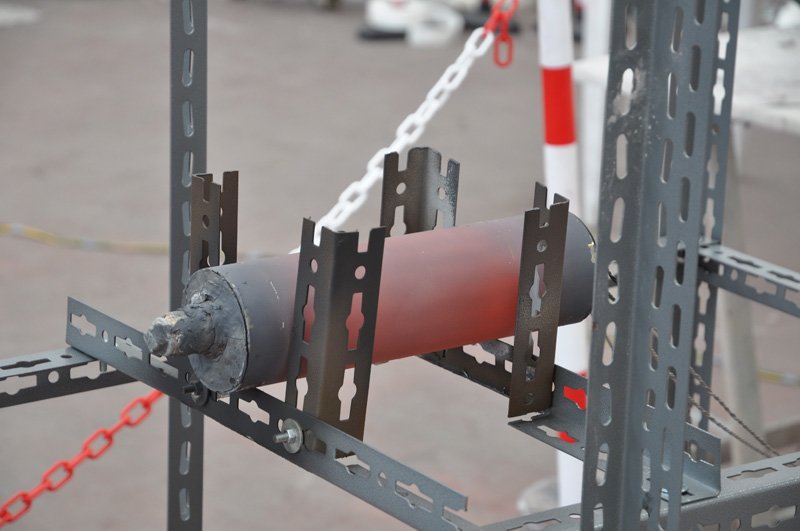
The E-Cat HT operates from an “as yet unknown reaction” in a chamber of hydrogen-infused nickel powder containing some additional catalyst. The nickel powder is enclosed by a hermetically-sealed steel cylinder 3 centimeters in diameter and 33 centimeters long. Surrounding this inner cylinder are resistor coils that heat up the core, initiating the reaction.

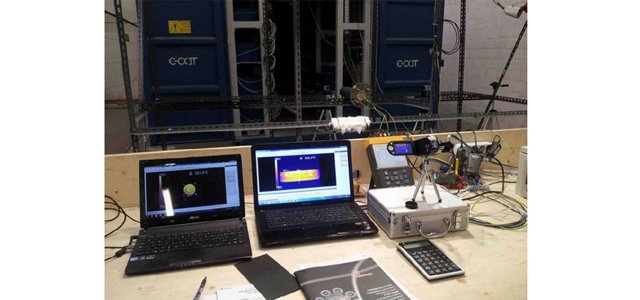
nov-test-tempAll of this is housed in an outer cylinder made of steel and ceramic that varies depending on the experiment. A thermal camera imaged the surface of the reactor over time, determining the temperature of the outer steel casing.

A first test occurred in November 2012, but that unit overheated, melting the stainless-steel inner chamber. While the data was incomplete, it was clear the reactor made significant heat beyond any chemical reaction. After re-designing the experiments for the second and third tests, computations of Coefficient of Performance (COP) and thermal energy density were strong and impressive.

“The procedures followed in order to obtain these results were extremely conservative, in all phases…. it is therefore reasonable to assume that the thermal power released by the device during the trial was higher than the values given by our calculations”, the report states.

December test gives COP of ~5.6

For the December test, the E-Cat HT ran for 96 hours.

Input power to the heating coils was modulated “with an industrial trade secret waveform”, with the average hourly power consumption used by the heating coils at 360 Watts.

The average thermal Output Power of ~ 2034 +/- 203 Watts assumed a 10% error.

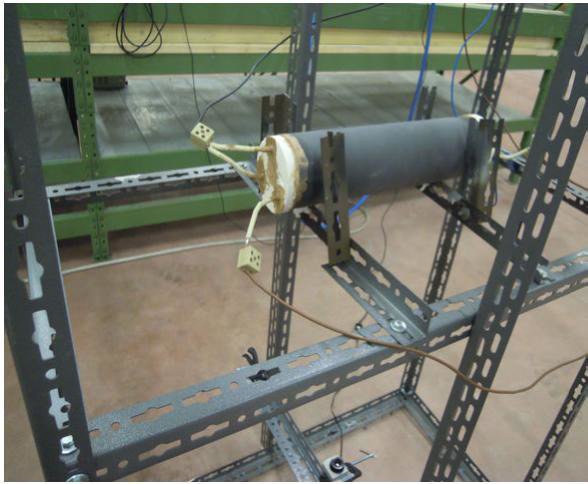
E-Cat HT on support frame from December test
E-Cat HT on support frame from December
A simple ratio of thermal output power/ input power gives a COP of

COP
= 2034 Watts / 360 Watts
~ 5.6 +/- 0.8.

Power density, defined as watts per kilogram of fuel, is the ratio of thermal excess power generated in watts to the mass of nickel powder fuel in kilograms.

Excess power is the thermal output power minus the input power. The amount of fuel used for the calculation was 0.236 kilograms, an overweight value that included the mass of the caps of the inner chamber. This over-value for fuel gives a lower limit for power density, so we can assume that the power produced by the E-Cat HT was even greater than that computed in the report.

Thermal Power Density
= (2034 – 360) / 0.236
= 7093 +/- 709 Watts/kilogram, again assuming a 10% error.

Thus, power density is about 7 kilowatts per kilogram of nickel powder fuel.

To get the thermal energy density, the power density is multiplied by the total number of hours the E-Cat HT ran, giving:

Thermal Energy Density
=7093 * 96
~ 681,000 Watt-hours/kilogram
= 681 kilowatt-hours/kilogram

After 96 hours, this unit was shut down to end the experiment.

E-Cat HT2 is self-sustaining

A new generator was employed in the March test, one with a slightly different design called the E-Cat HT2.

The inner reactor core was the same size as the previous one, but an added control system for the E-Cat HT2 allowed this experiment to run in self-sustained mode, whereby the input power is turned off, while the reaction continues to provide output power.

This unusual feature commences with an ON/OFF phase, as described in the report “where the resistor coils were powered up and powered down by the control system at regular intervals of about two minutes for the ON state and four minutes for the OFF state.”

Most of the four-day March test was conducted in this mode where it was shown that the reactor continued to increase heat output “for a limited amount of time” when switched OFF.

Input power to the resistor coils was increased steadily over the first two hours of the test until the ON/OFF mode was reached. After that, input power to the coils then averaged within a range of 910-930 Watts when ON. Subsequent data analysis showed that the resistor coils were on approximately 35% of the time, and off 65% of time over the duration of the test.

Since the control box was estimated to consume 110 Watts, the Instantaneous Power Consumption, the power input when ON, was computed as

Instantaneous Power Consumption
= 920 Watts – 110 Watts
= 810 Watts

But since the input power to the coils was only on 35% of the time, an Effective Power Consumption is computed by

Effective Power Consumption
= 0.35 * 810
= 283.5 Watts

where the authors again assume a 10% error, to take into consideration any unknown uncertainties.

For this experiment, the average thermal output power was approximately 816 +/- 16 Watts, using a computed 2% error.

Thus, total energy produced over the 116-hours March test is then

Produced Energy
= (816 -283.5) * 116
~ 62,000 Watt-hours
= 62 kilowatt-hours

Energy density is off-the-chart

In this experiment the amount of nickel powder fuel mixture was determined by first weighing the inner reactor core cylinder loaded with fuel. Then, the proprietary nickel mixture was extracted from the inner reactor core “by the manufacturer”, and the empty cylinder returned and weighed. From the difference, the fuel amount was computed as 0.3 grams. To compensate for any uncertainties, the authors of the report used a value of 1 gram to compute the power and energy density.

Fig. 15 Ragone Plot showing energy densities for various sources; E-Cat HT2 is off-the-scale here.
Ragone Plot of energy densities for various sources; E-Cat HT2 is off-the-scale here.
Thermal Power Density
= (816 -283.5) Watts / 0.001 kilograms
= 532,500 W/kg
~ 532 kilowatts/kilogram

Over the full 116-hours March test, the thermal energy density is then computed as

Thermal Energy Density
= (532,500 W/kg)(116 hrs.)
= 61,770,000 Watt-hours/kg
~ 62,000 kilowatt-hours/kg

The energy density of the E-Cat HT2 places it
“about three orders of magnitude beyond any other conventional chemical energy source.”

This thermal energy density for the HT2 is larger than that computed for the December HT test by a factor of three. According to the authors, this this is due to the overestimation of the amount of fuel in the December test, where the steel cylinder caps were included. Still, both E-Cats performed off-the-chart.

For this experiment, the COP is computed as

COP
= 816 Watts / 283 Watts
= 2.9 +/- 0.3 again assuming a generous 10% error

This COP is noticeably different from the COP of the E-Cat HT in the December test of 5.6. This difference is attributed to the fact that the COP tends to increase as the temperature increases.

The average temperature of the E-Cat HT was 438 C while the average temperature of the E-Cat HT2 was 302 C, leading the HT to have a higher COP.

But the authors note that as they did not inspect the nickel powder fuel in either case, so perhaps the disparity in COP may be the result of differences in the two samples.

After 116 hours, the March HT2 test was shut-down and the experiment ended. It is made clear in the report that the fuel was not exhausted, and the tests could have gone on longer, increasing the value of thermal energy production and density.

To quote the report, “… energy densities were found to be far above those of any known chemical source. Even by the most conservative assumptions as to the errors in the measurements, the result is still one order of magnitude greater than conventional energy sources.

In addition, both tests were monitored for radiation by David Bianchini, and no dangerous emissions were found. Again, from the report:

The measurements performed did not detect any significant differences in exposure and CPM (Counts per Minute), with respect to instrument and ambient background, which may be imputed to the operation of the E-Cat prototypes”.

This summer, a new test will be conducted for a six-month period. Together with this report, a data set is emerging that proves without a doubt the E-Cat is leading the race for ultra-clean energy-dense power for the people. When global energy policy will catch up with the reality of new energy, no one knows. Congratulations to Mr. Rossi for bringing us one step closer to that free, green, technological future we imagine.

Top