2014 Cold Fusion/LANR Colloquium at MIT

Make plans now to attend the 2014 Cold Fusion/LANR Colloquium Friday, March 21 – Sunday March 23, 2014 at the Massachusetts Institute of Technology in Cambridge, Massachusetts, US.

To register, go here.

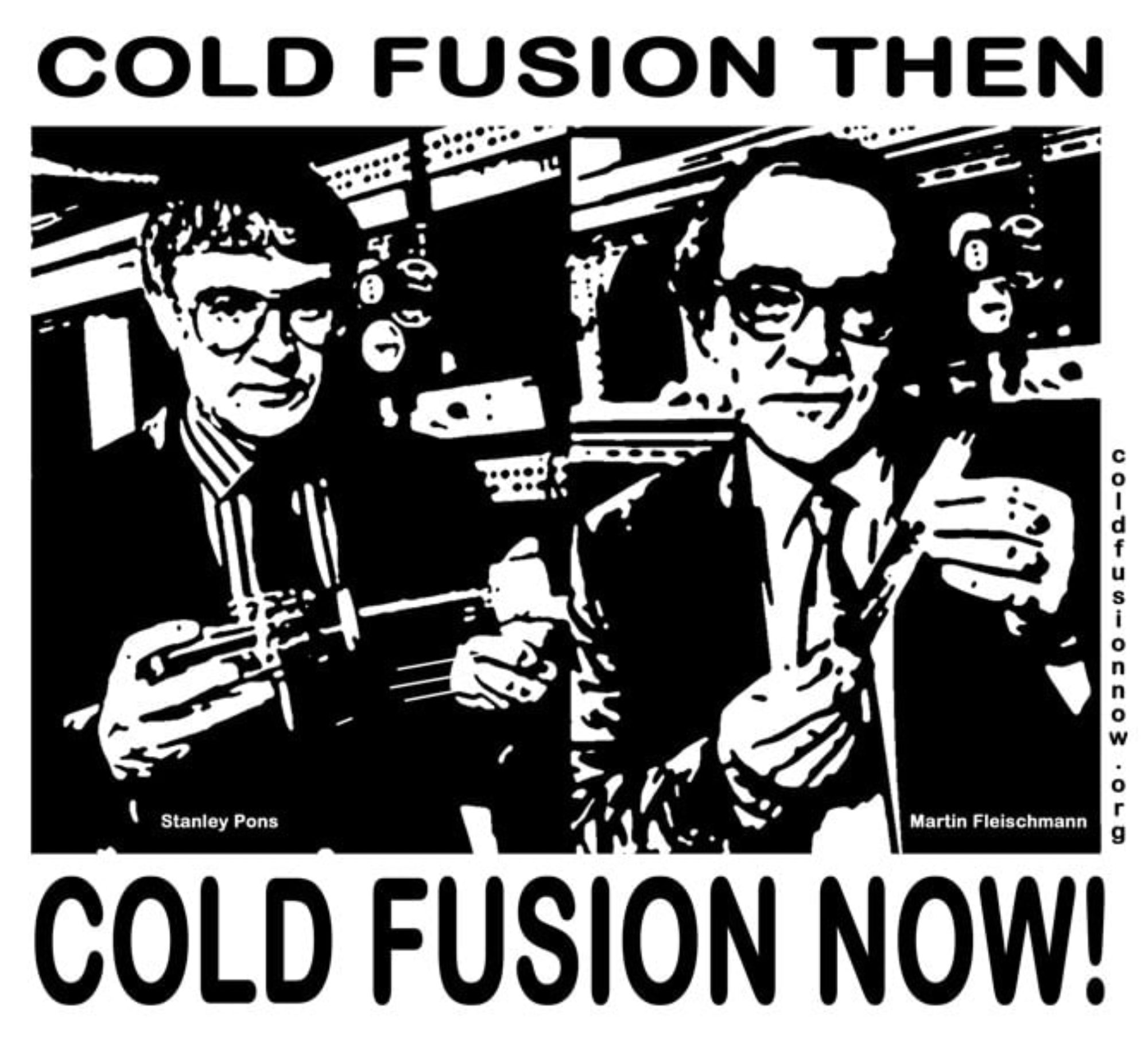
The Colloquium occurs one month from now on the 25th anniversary of the announcement of the discovery of cold fusion by scientists Drs. Martin Fleischmann and Stanley Pons. Banished from mainstream science institutions and academic journals, research in what is now called condensed matter nuclear science continues to accelerate towards breakthrough energy technology as scientists gather to discuss the latest results in formulating a theory for the elusive reaction, more professors are bringing research into academic labs, and a growing number of companies race to develop proto-type technologies that promise a revolution in power generation.

This is the sixth such Colloquium sponsored by Dr. Mitchell Swartz of JET Energy, Inc. and Nanortech in collaboration with Dr. Peter Hagelstein of MIT. 2014 Colloquium scheduled speakers include:

Peter Hagelstein Model for Fractionation and Inverse Fractionation
Peter Hagelstein Landscape in Cold Fusion Research
Peter Hagelstein Anomalies associated with Fracture Experiments
Mitchell Swartz Excess Power Gain on both sides of an Avalanche Through a PdNi Nanostructured Cold Fusion Component
Tom Claytor Recent tritium production from electrically pulsed wires and foils
Yasuhiro Iwamura Deuterium Permeation Induced Transmutation Experiments using Nano-Structured Pd/CaO/Pd Multilayer Thin Film
George Miley Ultra-dense clusters in Nanoparticles and thin films for both hot and cold fusion
Larry Forsley Enhanced Tc Superconductivity and Anomalous Nuclear Emissions in YBCO and Palladium
Larry Forsley Neutron and Charged Particle Spectroscopy
Frank Gordon Observations of a variety of Codeposition protocols use to prepare Cold Fusion Cathodes
Pamela Mosier-Boss CR-39 Detecting Emission during Pd/D Codeposition Cold Fusion
John Dash SEM and Energy Dispersive Spectrometer Studies of Metal Surfaces Interacting with Hydrogen Isotopes
John Fisher Polyneutron theory and its application to Excess Power Generation in three types of Devices
Brian Ahern Nanomagnetism for Energy Production
Robert Smith Assuring Sufficient Number Of Deuterons Reside in the Excited Band State For Successful Cold Fusion Reactor Design
Charles Beaudette Post Missouri Priorities for Cold Fusion
David Nagel Scientific and Practical Questions about Cold Fusion
Arik El-Boher Progress Toward Understanding Anomalous Heat
Olga Dmitriyeva Using numerical simulations to better understand the Cold Fusion Environment
Vladimir Vysotskii Application of coherent correlated states of interacting particle for Cold Fusion Optimization
Vladimir Vysotskii Observations of Biophysical Effects from Cold Fusion
Yiannis Hadjichristos Heat Energy from Hydrogen-Metal Interactions and the need for new Scientific Alliances
Nikita Alexandrov Advanced analytic and highly parallel Cold Fusion Experimentation
Tadahiko Mizuno Replicable Model for Controlled Nuclear Reaction using Metal Nanoparticles.
John Wallace Relativistic Quantum Mechanics and Cold Fusion
Dimitris Papanastasiou Design Characteristics of a Novel Mass Spectrometry Platform for High Pressure Plasma Sampling
Nathan Cohen The Tortuous Path of Innovation and Implications for Cold Fusion in the next Decade
David French The Role of the Patent Attorney in patenting Cold Fusion inventions.
Thomas Grimshaw Cold Fusion Public Policy: Rational – and Urgent– Need for Change
Carl Dietrich Flying Cars

Panels include:

Panel on Censorship and USPTO Obstruction
Panel on Education and Public Policy

Developing topics:

Engineering and Material Science – Lattices, Loading, Vacancies, Pd, Ni, ZrO2-PdNi, Ti,
and Hydrogenated/Deuterated Alloys, Aqueous Systems, High Impedance Systems,
Cooperative Role of the Solid State Lattice, and Nanostructured Materials

Nuclear Solid-State – Optical phonons, Nuclear excited states, Lossy Spin Boson Coupling, Phusons

Engineering Non-equilibrium Electrochemistry – Fluxes, Types of Codeposition

Excess Heat Production – Calorimetry, Modes of Excess Heat, HAD

Reproducibility and Control – Optimal Operating Point (OOP) Manifolds, Loading Equations

Products in CF/LANR – Fusion and other Effective CF/LANR/CMNS Processes

Emissions – Neutron and other Emissions, Near IR Studies, Nuclear Tracks and Imaging in CR-39 Detectors

Metamaterials – Spillover Systems, Improved Deep Flux Distribution
Dielectric Science – Electrophysics and Charge Transfer, Roles of Applied E- and H-Fields, Avalanche Behavior, Transconduction, Advanced Magnetic materials

Activation – Anharmonic motion, Crystal Size, Applied Magnetic Fields, Optical Irradiation

Quenching – Gripping Impact on Energy Gain, Roles of Catalysis, Breakdown and LANR Effects

Successful Mathematical CF/LANR Theories – Modeling Reactions and Excess Heat in the Fleischmann-Pons Experiment, Analysis of More Effective CF Systems and in CF Nanomaterials

Applications – Survey of Preloaded Systems, Embedded Systems, Motor Systems, Power Systems, CF/LANR Energy Conversion and Production

Business Issues – Intransigence at the US PTO, Impacts of Heavywatergate, Censorship and Minimal Funding

Future Directions

For further information, visit the 2014 CF/LANR Colloquium at MIT website
http://world.std.com/~mica/2014colloq.html

To register for the Colloquium, go here.

The CF/LANR Colloquium at MIT has special rates for attendees with hotel Hyatt Regency Cambridge through https://resweb.passkey.com/go/12a4238d.

Hyatt Regency Cambridge
575 Memorial Drive
Cambridge, MA 02139

Other nearby hotels are listed here: [.pdf]

Related Links

2014 LANR/CF Colloquium marks 25th Anniversary of New Energy Breakthrough

Past Colloquium
2011: Part 1 – http://www.infinite-energy.com/images/pdfs/LANR2011Colloq.pdf
Part 2 – http://www.infinite-energy.com/images/pdfs/SwartzColloqPart2.pdf
2010: http://www.infinite-energy.com/images/pdfs/Colloquium2010.pdf
2009: http://world.std.com/~mica/colloq09.html
2007: http://www.infinite-energy.com/iemagazine/issue75/colloquium.html
2005: http://world.std.com/~mica/colloq.html
“The Cold Fusion Revolution is Here – Time to Change the World”

The MIT IAP Cold Fusion 101 course taught by Dr. Peter Hagelstein and Dr. Mitchell Swartz was attended by Cold Fusion Now’s Jeremy Rys of Alien Scientist and all five days of science lectures are posted on the Cold Fusion Now Youtube channel.

Now, Jeremy has put together a video summarizing the state of the field with a historical background for the non-scientist to enjoy.

Watch: “The Cold Fusion Revolution is Here at MIT 2014 – Time To Change the Worldhere!

2014 Cold Fusion 101 video lectures

Cold Fusion 101: Introduction to Excess Power in Fleischmann-Pons Experiments began Monday, January 27, 2014 for a week of classes led by Dr. Peter Hagelstein of Massachusetts Institute of Technology (MIT) and Dr. Mitchell Swartz of JET Energy.

Cold Fusion Now’s Jeremy Rys of AlienScientist.com is attending and filming the lectures for a second year in a row. Jeremy will be uploading video on the Cold Fusion Now Youtube channel for your pleasure throughout the week.

Here is the video link for Monday, January 27, 2014 Day 1 lectures for Cold Fusion 101 featuring Dr. Peter Hagelstein and Dr. Mitchell Swartz.

Tuesday, January 28 Day 2 FULL lectures

Wednesday, January 29 Day 3 FULL lecture

Thursday, January 30 Day 4 FULL lecture

Friday, January 31 Day 5 FULL lecture


Brillouin Energy Lab Tour

Video: Brillouin Energy Lab Tour conducted by Sterling Allan of PESN.

A visit to California took Sterling Allan of PESN to the labs of SRI International and Brillouin Energy to tour the facilities and get the latest on their research on low-energy nuclear reaction (LENR) energy cells in development for commercial use.

An interview with SRI International’s Dr. Michael McKubre was previously posted. Now, video interviews have been posted of SRI International’s Dr. Francis Tanzella and Brillouin Energy’s Chief Technical Office Robert Godes as well as Brillouin CFO David Firshein and CEO Bob George.

Original article on PESN here.

Video: Francis L Tanzella tour of Brillouin’s SRI International set up

Video: Brillouin’s Finance Opportunities: Car Ride with David N. Firshein, CFO

Video: Brillouin Roundtable Discussion at SRI

Peter Hagelstein on the Fleischmann-Pons Experiment


SeriousScience.org has posted a video of Dr. Peter Hagelstein of the Massachusetts Institute of Technology discussing the Pons & Fleischmann Experiment and its implications for nuclear physics.

Hagelstein will be conducting an IAP course Cold Fusion 101 on the MIT campus beginning January 27-31 with collaborator Dr. Mitchell Swartz of JET Energy, developer of the NANOR technology. More information here.

From the original article (transcript):

What was the main problem of nuclear physics for the last 25 years? How did the scientific community split into two broad camps? Associate Professor of Electrical Engineering at Massachusetts Institute of Technology Peter Hagelstein explains his view on the cold fusion experiments.

“Cold fusion started in March of 1989 with the announcement of the observational facts by Fleischmann and Pons. The claim was stunning. Energy of nuclear origin, a lot of it, in a test tube, palladium electrode, heavy water: simple current, and there you have it. If true — it’s a big deal. It’s unlocking source of clean nuclear energy. All you have to do is doing some electrochemistry, and you can get clean nuclear energy. That’s magic at that time I was interested surely in. What happened next was not much fun. People tried to replicate it, and more than a hundred laboratories reported negative results. People scratched their head and they thought about how the science could work. And came to the conclusion that based on a lots of physics, and nuclear physics there was no basis for the existence of such an effect.”

“I was interested in why it’s impossible, and the role of experiment in terms of trying to sort out what’s real and what’s not real. The basic issue is that in nuclear physics people have studied nuclear reactions for many years. If you make energy in a nuclear reaction, the energy is made and the energy is carried away. That’s a consequence of fundamental laws of conservation of energy in momentum on a microscopic scale. In Fleischmann and Pons experiment the thing that was amazing is energy was being produced was nuclear, but there was no energetic nuclear emission coming off. That’s hard to understand.”

“Now we have experiments confirming the basic effect, we have experiments showing that energy is produced, that the energetic reaction products aren’t there, and the question is what to do about it. Actually, we should be very interested in these experiments. We should be interested, because we have experimental results which by now have been confirmed a great number of times. We learned about nature from doing experiments. So, here are experimental results. Can we, should we pay attention to them? Follow them up, see, where they lead? Today, sadly, the experiments in the cold fusion business are nor considered to be part of science. And that’s the resolution that we have come to as the scientific community. From my perspective, having been in labs, having seen the results, having talked to experimentalists, having looked at the data, having spent great time on it, it looks like pretty much these experiments are real. They need to be taken seriously.”

Watch the 13-minute video on Youtube here.

2014 LANR/CF Colloquium marks 25th Anniversary of New Energy Breakthrough

Ecliptic plane calendar for LANR/CF Colloquium
The 2014 CF/LANR Colloquium will be held Friday, Saturday, and Sunday March 21-23, 2014 at the Massachusetts Institute of Technology (MIT) in Cambridge, MA USA.

Nearby Hotels and Lodging for CF/LANR Colloquium at MIT [.pdf]

This event will mark the 25th anniversary of the announcement of the discovery of cold fusion by Drs. Martin Fleischmann and Stanley Pons on March 23, 1989.

While mainstream science institutions have refused to acknowledge the field, the breakthrough energy science has developed in part through the International Conference on Cold Fusion (ICCF) which has held eighteen events that bring scientists together from around the world to discuss their findings. The next ICCF-19 is scheduled for March 2015, which makes the 2014 LANR/CF Colloquium one of the year’s top cold fusion meetings.

Sponsored by JET Energy, Inc. and Nanortech, companies headed by Dr. Mitchell Swartz, the CF/LANR Colloquium is the sixth such event held since 2005 that discusses both the scientific and engineering aspects of cold fusion, also called lattice-assisted nuclear reactions (LANR), including theory, physics, electrochemistry, material science, metallurgy, physics, and electrical-engineering.

Energy density comparison chart
JET Energy and Nanortech produced the NANOR-device demonstrated at MIT during the 2012 Cold Fusion 101 course, which ran continuously for five months and was open-to-the-public. The NANOR is a tiny, dry, pre-loaded with hydrogen fuel, nano-material, two-terminal component that generate excess energy gain. Massachusetts State Senator Bruce Tarr witnessed the event, and is now a supporter of the pioneer technology.

2014 Colloquium speakers include Peter Hagelstein, Mitchell Swartz, Larry Forsley, Frank Gordon, Pamela Mosier-Boss, George Miley, Tom Claytor, Mel Miles, John Dash, Yiannis Hadjichristos, Yeong Kim, Brian Ahern, Robert Smith, John Fisher, Vladimir Vysotskii, Yasuhiro Iwamura, and Charles Beaudette.

Developing topics include:

Engineering and Material Science – Lattices, Loading, Vacancies, Pd, Ni, ZrO2-PdNi, Ti,
and Hydrogenated/Deuterated Alloys, Aqueous Systems, High Impedance Systems,
Cooperative Role of the Solid State Lattice, and Nanostructured Materials

Nuclear Solid-State – Optical phonons, Nuclear excited states, Lossy Spin Boson Coupling, Phusons

Engineering Non-equilibrium Electrochemistry – Fluxes, Types of Codeposition

Excess Heat Production – Calorimetry, Modes of Excess Heat, HAD

Reproducibility and Control – Optimal Operating Point (OOP) Manifolds, Loading Equations

Products in CF/LANR – Fusion and other Effective CF/LANR/CMNS Processes

Emissions – Neutron and other Emissions, Near IR Studies, Nuclear Tracks and Imaging in CR-39 Detectors

Metamaterials – Spillover Systems, Improved Deep Flux Distribution
Dielectric Science – Electrophysics and Charge Transfer, Roles of Applied E- and H-Fields, Avalanche Behavior, Transconduction, Advanced Magnetic materials

Activation – Anharmonic motion, Crystal Size, Applied Magnetic Fields, Optical Irradiation

Quenching – Gripping Impact on Energy Gain, Roles of Catalysis, Breakdown and LANR Effects

Successful Mathematical CF/LANR Theories – Modeling Reactions and Excess Heat in the Fleischmann-Pons Experiment, Analysis of More Effective CF Systems and in CF Nanomaterials

Applications – Survey of Preloaded Systems, Embedded Systems, Motor Systems, Power Systems, CF/LANR Energy Conversion and Production

Business Issues – Intransigence at the US PTO, Impacts of Heavywatergate, Censorship and Minimal Funding

Future Directions

Past CF/LANR events are documented here:

2011: Part 1 – http://www.infinite-energy.com/images/pdfs/LANR2011Colloq.pdf
Part 2 – http://www.infinite-energy.com/images/pdfs/SwartzColloqPart2.pdf
2010: http://www.infinite-energy.com/images/pdfs/Colloquium2010.pdf
2009: http://world.std.com/~mica/colloq09.html
2007: http://www.infinite-energy.com/iemagazine/issue75/colloquium.html
2005: http://world.std.com/~mica/colloq.html

A four-minute video of the 2007 CF/LANR Colloquium at MIT is here courtesy of Alan Weinberg:

Make plans to attend the Colloquium now, as area hotels may fill quickly during MIT’s spring break week, beginning that weekend.

For more information on the 2014 LANR/CF Colloquium, go here.

This Colloquium will follow a planned 2014 IAP Cold Fusion 1.01 course scheduled for the end of January during the week of 1/27-1/31 at 10:30AM-1:30PM.

Related Links

Cold Fusion Times

Mitchel Swartz at ICCF-18: “Amplification and Restoration of Energy Gain Using Fractionated Magnetic Fields on ZrO2-PdD Nanostructured CF/LANR Quantum Electronic Component

Pre-loaded hydrogen fuel an engineering answer for efficiency, ease, and safety

Conclusively Demonstrating the “New Energy Effect” of Cold Fusion

JET Energy NANOR device at continuing to operate months later

Massachusetts State Senator visits still-operating JET Energy NANOR demo

Cold Fusion 101 2nd Week Summary with Dr. Mitchell Swartz

Top