
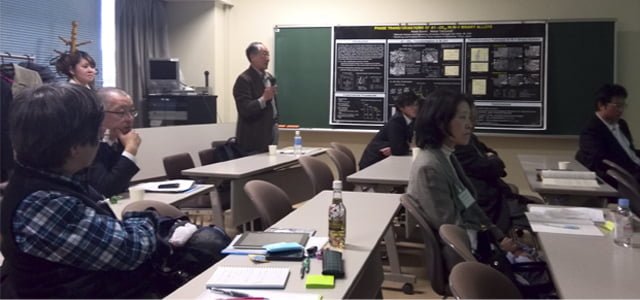
Industry and academic partnerships report from JCF-14 meeting

The Japanese Cold Fusion Research Society (JCF) held their fourteenth meeting on December 7-8, 2013 at the Tokyo Institute of Technology in Tokyo, Japan where teams from academia and industry reported on their research.

Japanese business was an early supporter of cold fusion, also called Condensed-matter Fusion (CF), with giants like Toyota Corporation funding research that supported Drs. Martin Fleischmann and Stanley Pons in their French laboratory.

Over the twenty-five years since, official support waned for the notoriously difficult-to-reproduce reaction. The Japanese Cold Fusion Society (JCF) was formed in 1999 to bring scientists still working in the field together to share data. Since then, annual meetings have hosted live demonstrations of energy-producing cells, along with reports on multiple reproductions of key experiments.

Today, momentum is stronger than ever as industry involvement grows rapidly with corporations like Technova, Toyota, and Mitsubishi engaging in partnership with independent scientists and academics to pursue a commercial product.

Clean Planet is a new capital firm now working to advance the field with funding and resources. Founder and Chair Hideki Yoshino attended the recent meeting in Tokyo and described what triggered his involvement.

“On March 11, 2011, Japan was struck by a tsunami which devastated and created havoc throughout this island nation,” writes Yoshino. “The Fukushima meltdown triggered by the tsunami highlighted our vulnerability, even when we have the best back up systems in place. The failure of backup systems has left this country and parts of the world dealing with the threats of radioactive fallout. It became apparent that nuclear fission simply isn’t a safe and clean form of energy. This event was the catalyst for Clean Planet.”

“Clean Planet was created out of the need to better understand how we as a society can grow and prosper while protecting and providing peace and security for our future generations because we believe that a clean, safe and abundant source of energy is the key for the future of our global community.”

Yoshino and his team at Clean Planet have extensive experience in education, business, and law, and they’ve launched strong into CF. Two of the first recipients of support are Dr. Tadahiko Mizuno‘s group at Hydrogen Engineering Application & Development Company (HEAD) and Dr. Yoshiaki Arata‘s team at Arata Research Lab.

“Our direct and transparent approach allows us to 1, fund, and 2, bring human resources to the table which in turn allows us to optimize these resources to their full potential,” says Yoshino.

“Also, by bringing the community of researches and scientist together we are able to share in each others experiences which brings efficiencies both financially and academically to this exciting field of research.”

To what purpose? Yoshino is clear.

“We will initiate, create and distribute clean energy technologies that will enhance the well-being of all mankind to the global community.”

Clean Planet and HEAD will host JCF-15 scheduled for next year in Hokkaido, Japan.

Until then, Dr. X.F. Wang of the Hydrogen Eng. A&D Co. (HEAD) and the Arata R&D Center has filed this report on JCF-14.
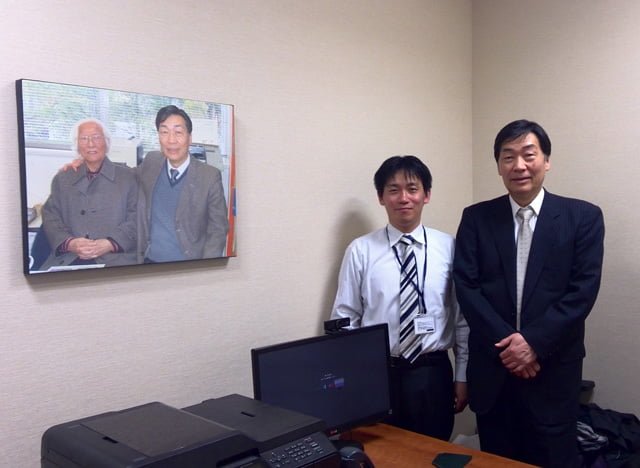
JCF-14-Heavyweights

14th Japanese Cold Fusion Research Society Meeting Report by Dr. X.F. Wang

The program: http://jcfrs.org/JCF14/jcf14-program.pdf

The abstracts: http://jcfrs.org/JCF14/jcf14-abstracts.pdf

Paper presentation: Oral presentation 20 min.
(Review: 25min) + Discussion 5 min.
Oral report language: Japanese

Please see the following abstract of JCF14 about the brief content of theoretical analysis, which is not involved in this report. (The abstracts: http://jcfrs.org/JCF14/jcf14-abstracts.pdf)

It is summarized by the speech sequence.

Day 1 Saturday, December 7, 2013

13:00-13:10 Opening Address H. Numata (Tokyo Institute of Tech.)

Experiment-1 Chairman; T. Mizuno (Hydrogen Eng. A&D Co.)
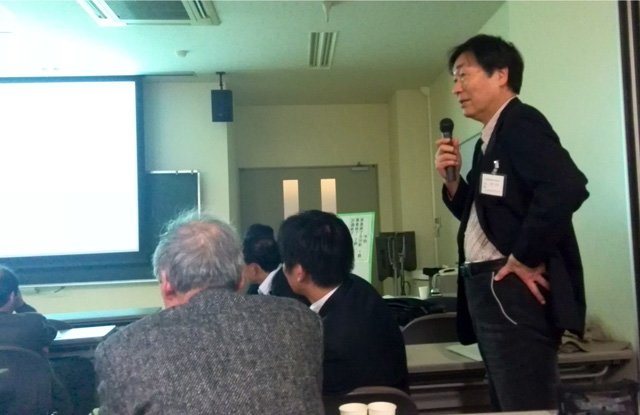
JCF-14-1

13:10-13:35 JCF14-1 A. Kitamura (Technova Inc., Kobe U.)
Title: Study on Anomalous Heat Evolution from H-Ni Nanoparticle System at Elevated Temperature with Mass-Flow Calorimetry

① A new scaled-up (ten-times-larger volume: from 50cc to 500cc) absorption system with oil(boiling point: 390 deg-C)-mass-flow calorimetry (Fig.1) is calibrated using a dummy Al2O3 powder:

Conclusions:
a. The coolant oil reached almost 300 deg.C at heater input of 231W.
b. Long-term stability, or fluctuation in terms of standard deviation, is better than 0.5deg.C.
c. Conversion factor, dW/dT=(0.970.08)W/deg with an oil-flow rate of 20 cc/min.
d. Heat recovery efficiency is (0.880.03) with heat removal time constant of (301.2) min.

②The first trial run with a 50g CNS sample (silica-included Cu・Ni nano-compound containing 4g of Ni) mixed with 200g Al2O3:

Conclusions:
a. Both TC2 at the oil outlet and RTD’s inside the reaction chamber show higher temperatures than for the blank sample, which implies a long-lasting excess power of ~20W(i.e., 5W/g-Ni).
b. The assumed excess heat appears to be on the same order as that of the CNZ(Cu・Ni/ZrO2) sample yielding 2 W/g-Ni excess power.
c. Further measurements with more precise comparison are necessary to confirm the excess.

③ The runs with a 294-g CNZ4 sample (ZrO2-supproted Cu・Ni nano-composite containing 61-g of Ni) with an axial heater added:

Conclusions:
a. TC2 at the oil outlet and RTD’s inside the reaction chamber showed higher temperatures than for the blank sample, which implies an excess power and energy of ca. 10W (i.e., 0.2W/g-Ni) and 30 eV/atom-Ni, respectively.
b. The excess power is hardly explained only by atomic/molecular processes, although no hard radiations have been observed.
c. Further investigations with a variety of run parameters is necessary to enhance the excess.

13:35-14:00 JCF14-2 S. Tsuruga (Mitsubishi H. I.)
Title: Recent Advances in Deuterium Permeation Induced Transmutation Experiments using Nano-Structured Pd/CaO/Pd Multilayer Thin Film

Concluding Remarks:
1. Low energy nuclear transmutations from Cs into Pr, Sr into Mo, Ba into Sm and Ca into Ti have been observed in the Pd complexes, which are composed of Pd and CaO thin film and Pd substrate, induced by D2 gas permeation (Fig.4).
2. An electrochemical method was applied to increase the local deuteron density near the surface of the nano-structured Pd multilayer film. Transmutation products were increased up to ~1μg/cm2 by this approach (Fig.5).
3. Statistically significant gamma-rays were detected. These emissions were supposed to be caused by the increase of transmutation products (Fig.6).

14:00-14:25 JCF14-3 T. Takahashi (Iwate U.)
Title: Deuterium permeation experiment using Pd/Ni multi-layered sample
Deuterium permeation experiment using Pd/Pd/Ni/Pd Multi-layered sample was carried out(Fig.7a).

Experiment process:
1. Sample was sealed inside the stage (shown in Fig. 7c), and then vacuumed (10-4Pa) at temperature 120℃, kept for 48~72h.
2. The temperature of sample was set up to 70℃, and then D2 gas was loaded into the chamber (Fig.7b) until 0.2MPa. D2 gas flow rate was measured by the Mass flow meter. This process was kept for 7 days.
3. After the D2 gas loading process , the chamber was exhausted at temperature 120℃ for 48~72 hours.
4. The sample was analyzed by TOF-SIMS (Time-of-Flight Secondary Ion Mass Spectrometry).
Conclusions:
1. Transmutation products from Element 133Cs were not identified (Fig.8).
2. For other transmutation products (Fig.9), it is necessary to proceed carefully assess from the impurity.
3. It is necessary to investigate about increasing the permeate flow rate, and the optimization of conditions for forming the film (Fig.10).
The flow rate is about 0.1~0.3[ccm/cm2] (Fig.10). Higher flow rate applying the sample immediately after preparation is observed. That is to say that the impurities on the surface is related to the flow rate.

Theory-1 Chairman; N. D. Cook (Kansai U.)

14:40-15:05 JCF14-4 T. Sawada (Nihon U.)
Title: Relation between the magnetic monopole and NAE of the nuclear cold fusion

15:05-15:30 JCF14-5 H. Kozima et al. (CF Res. Lab.)
Title: Atomic Nucleus and Neutron Nuclear Physics Revisited with the Viewpoint of the Cold Fusion Phenomenon

15:30-15:55 JCF14-6 H. Kozima (CF Res. Lab.)
Title: Nuclear Transmutation in Actinoid Hydrides and Deuterides

16:00-17:30 JCF Annual Meeting

18:00-20:00 Reception
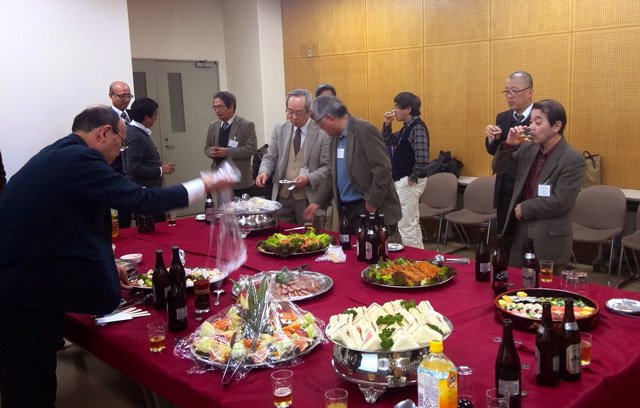
JCF-14-reception

Day 2 Sunday, December 8, 2013

Experiment-2 Chairman; Y. Iwamura (Mitsubishi H. I.)
*This section was chaired by S. Narita (Iwate U.) because Y. Iwamura (Mitsubishi H. I.) called in sick.

10:00-10:25 JCF14-7 X.F. Wang (Arata R&D Center and Hydrogen Eng. A&D Co.)
Title: Synthesis of nano-Pd particles in Y-Zeolite pores by ultrasonic irradiation

0.8nm nano-Pd particles can be synthesized in Y-Zeolite pores by ultrasonic irradiation as shown in Fig.12. Since the synthesis process is not complicated, nano-Pd particles in Y-Zeolite pores can be expected to be applied to Cold Fusion. The Hydrogen/deuterium absorption features of nano-Pd particles in Y-Zeolite pores should be investigated as follows:
1. The effect of species, pores ​​diameter of Y-Zeolite.
2. The effect of average particle size, particle size distribution of Nano Pd particles.
3. The effect of temperature, pressure.
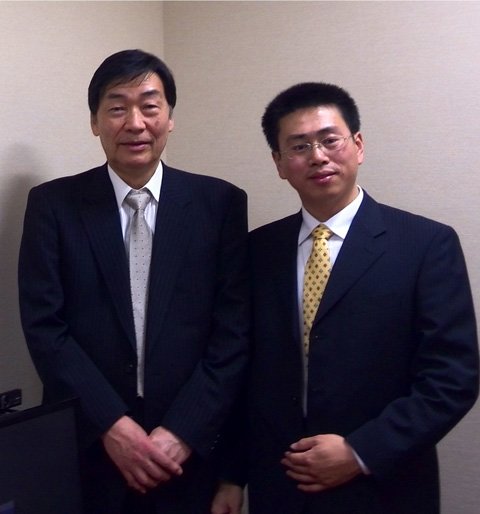
JCF-14-Mizuno-Wang

10:25-10:50 JCF14-8 H. Yamada et al. (Iwate U.)
Title: Impressive Increase in Number of Etch Pit occasionally Produced on CR-39 in Light and Heavy Water Electrolysis Using Ni Film Cathode

Conclusions:
1. The reaction does not always take place in every electrolysis experiment but occasionally does under the same experimental condition.
2. Impressive increase in number of etch pit has been observed in 4 out of 16 for H2O and 1 out of 6 for D2O electrolysis conditions.
3. The common factors to increase number of the etch pit in the CR-39 chip might be
 ①Ni film cathode
②The long electrolysis time
③Li in the electrolyte solution

Theory-2 Chairman; K.Tsuchiya (Tokyo National College of Tech.)

10:50-11:20 JCF14-9 A. Takahashi et al. (Technova Inc.)
Title: D(H)-Cluster Langevin Code and Some Calculated Results

*The source of BASIC EXE applied by Prof. Takahashi can be downloaded from here:
http://hp.vector.co.jp/authors/VA008683/basicw32.htm

11:20-11:45 JCF14-10 H. Miura
Title: Computer Simulation of Hydrogen States near T site in Ni and Pt Metals

11:45-12:10 JCF14-11 H. Numata (Tokyo Institute of Tech.)
Title: Numerical simulation of vortex appeared on electrode surface under long term evolution of deuterium in 0.1M LiOD

Vortex formation locally, triggered by cylindrical pillar current initiation.

12:10-13:30 Lunch

Theory-3 Chairman; E. Yamaguchi (Doshisya U.)

13:30-13:55 JCF14-12 K. Tsuchiya (Tokyo National College of Tech.)
Title: The quantum states of the system including two species of charged bosons in ion traps Ⅲ

13:55-14:25 JCF14-13 E. Igari (Hydrogen Eng. A&D Co.)
Title: Discussion about the quality of the experiments in cold fusion

Conclusions:
When we experiment in cold fusion, we must think about both theoretical and technical issues. The theory of cold fusion continues to evolve. But, the technology of experiment has not caught up with the theory. The Problems remains in the nanostructure and gas control. However, these problems will be solved by technological innovations.
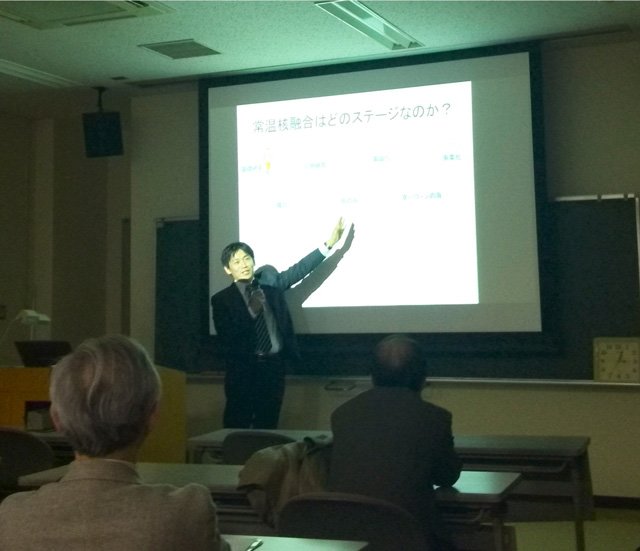
JCF-14-Igari

14:25-14:50 JCF14-14 N. D. Cook (Kansai U.)
Title: Transmutation of Palladium and Nickel Isotopes

14:50-15:15 JCF14-15 H. Kozima (CF Res. Lab.)
Title: Nuclear Transmutations (NTs) in Cold Fusion Phenomenon (CFP) and Nuclear Physics

15:15-15:40 JCF14-16 H. Kozima (CF Res. Lab.)
Title: The Cold Fusion Phenomenon What is It?

**********************************************************************************************

Cold Fusion NOW!

Related Links

Clean Planet [in English]

Japanese Cold Fusion Research Society [in English]

Dr. Yasuhiro Iwamura
at ICCF-18 “Recent Advances in Deuterium Permeation Induced Transmutation Experiments Using Nano-Structured Pd/CaO/Pd Multilayer Thin Film” [slides]

Akira Kitamura at ICCF-18 “A Mass-Flow-Calorimetry System for Scaled-up Experiments on Anomalous Heat Evolution at Elevated Temperatures” [slides]

Akito Takahashi at ICCF-18 “Nuclear Products of Cold Fusion by TSC Theory” [slides]

Decontamination of radioactive ashes by nano-silver by Toshiro Sengaku

No active nuke power in Japan in Toshiro Sengaku

MIT IAP Cold Fusion 101 to run again

The IAP course on cold fusion co-taught by Drs. Peter Hagelstein and Mitchell Swartz is scheduled to run again in 2014 for a third year in a row.

Cold Fusion 101: Introduction to Excess Power in Fleischmann-Pons Experiments will be held on campus at the Massachusetts Institute of Technology (MIT) January 27-January 31 at 10:30AM-1:30PM in Room 4-145. The class is sponsored by the MIT Electrical Engineering and Computer Science Department where Hagelstein is a faculty member.

In 2012, the course was well-attended and featured a JET Energy, Inc demonstration of the NANOR, a nano-material, two-terminal component that generates excess energy gain using a dry, pre-loaded hydrogen fuel. Open to the public for viewing, the NANOR ran for months in Hagelstein’s office. Massachusetts State Senator Bruce Tarr visited the campus to witness the event, and is now a supporter of the pioneer technology.

Cold Fusion Now’s Jeremy Rys attended the course in 2013 and videod the lectures throughout the week. Problems with the audio feed were lessened with a second Enhanced Audio edit by uploadJ. Watch the 2013 background and theory lectures by Peter Hagelstein here, and see the experimental and technology talks by Mitchell Swartz of JET Energy, Inc. here.

The course syllabus includes:

Excess power production in the Fleischmann-Pons experiment;
lack of confirmation in early negative experiments;
theoretical problems and Huizenga’s three miracles;
physical chemistry of PdD;
electrochemistry of PdD;
loading requirements on excess power production;
the nuclear ash problem and He-4 observations;
approaches to theory;
screening in PdD;
PdD as an energetic particle detector;
constraints on the alpha energy from experiment;
overview of theoretical approaches;
coherent energy exchange between mismatched quantum systems;
coherent x-rays in the Karabut experiment and interpretation;
excess power in the NiH system;
Piantelli experiment;
and prospects for a new small scale clean nuclear energy technology.

Independent Activities Program (IAP) is designed for MIT students wishing to learn between semesters, but enrollment is open with permission from the instructor and there is no advance registration required. For more information and to contact the instructor, visit the IAP Cold Fusion 101 course page.

Related Links

Synopsis of Cold Fusion 101 2013 [.pdf] by Gayle Verner Infinite Energy Magazine

Peter Hagelstein Introduction to Excess Power … 2013

Mitchell Swartz Introduction to Excess Power … 2013

Slide Set of NANOR®type output presented at MIT IAP Course [.pdf] 2012

Moray B. King: Breakthrough Energy, EVO Clusters, and Paradigm Shifts

Interview with Engineer and New Energy Pioneer Moray B. King. The first portion of the interview features focused discussion on John Wheeler’s model of the quantum vacuum and how topological vortex structures are permitted to self-organize out of a turbulent, orthogonal electromagnetic flux.

During the middle part of the interview Moray further elucidates how this flux might be coherently abstracted into our dimension to do work. He outlines the discoveries of Yull Brown (Brown’s Gas Torch), Ken Shoulders (Plasmatic Exotic Vacuum Objects) and Mark LeClair (Crystalline Water Cluster Jets), and goes on to explain why their experiments demonstrate substantive evidence for Zero Point Energy (ZPE) extraction.

Toward the tail-end of our dialogue Moray ventures into the arena of LENR-Cold Fusion theory. He visualizes a scenario where cracking in the crystalline lattice creates an environment where micron-scale ball lightning (aka self-organized ZPE plasmoid) is being generated and released. Micron-sized ball lightning has been demonstrated to be highly energetic and capable of transmuting elements during laboratory studies in at least three countries. Also worth considering is that amplified ZPE interactions are known to occur within reflective Nano-domains during Cavity-QED experiments. While the ZPE explanation for LENR still remains undefined and speculative in certain important respects, further investigation of ZPE fluctuations in Nano-cavities may provide us with better understanding of what goes on within the Nuclear Active Environment (NAE) to produce the Pons-Fleischmann Excess Heat Effect.

In closing we spend some time focusing on the philosophical side of the Breakthrough Energy Movement and what will be required for a paradigm shift to occur.

Thank you for taking an interest. A more detailed outline can be found @ my blog if so desired.

“Cold Nuclear Fusion” at RASA

Edward Tsyganov of Cold Fusion Power
Edward Tsyganov of Cold Fusion Power, International and OSNovation Systems, Inc. presents Cold Nuclear Fusion at RASA.
Edward Tsyganov forwards a report Cold Nuclear Fusion on his research presented at the Russian-speaking Academic Science Association (RASA) meeting held 8-10 November 2013, Clearwater Beach, FL.

RASA: Cold Nuclear Fusion presentation .pdf slides [5.5M]

Currently, humanity has reached a stage of development at which the struggle for energy resources is particularly important, because all the known sources of energy in the near future will not be able to provide our needs. Chemical energy, in addition, is limited on account of the so-called greenhouse effect. Nuclear energy is based on the use of fissile materials, and is not a solution, because the stock of these materials is limited. The initial optimistic expectation of the transition to the process of controlled nuclear fusion has not yet materialized. Technical difficulties in obtaining sustainable superhot plasma and the damaging effects of the enormous neutron flux arising as a result of fusion reactions back down the solution to this problem on a more distant and uncertain future.

Recently there was the belief that the problem of controlled nuclear fusion could be solved in a completely different way. It has been shown experimentally that the cross-barrier synthetic processes depend greatly on the physical state of the matter that reactive atoms are placed in. Distance convergence of two deuterium nuclei through the mechanism of the Rydberg crystal cell in metals occurs by an order of magnitude smaller than the size of a free atom of deuterium. Coulomb barrier permeability in this DD fusion process increases greatly (by the 50–60 orders of magnitude) as compared with a permeability barrier to free molecules of deuterium. In this recent work, we discuss the possibility of detecting the “cold” DD fusion process experimentally by detecting low-energy electrons resulting from the fusion reaction of two deuterons in palladium crystals with very small (thermal) excitation energies of the intermediate compound nucleus 4He*. This process is made possible by the exchange of the excited compound nucleus with electrons of the crystal lattice that results from virtual photons.

It happens historically that the process of DD cold fusion was studied in more detail than other, similar processes. In this regard, we have restricted ourselves to this particular process. Presented below is a summary report of the situation that has now developed, in a cold DD fusion.

Accelerator experiments have shown that the value of screening potential for the impurity atoms in metallic crystals reaches up to 300 eV or even more. This means that, during DD reaction occurring in the medium of the metal crystal, impurity atoms are excited, and deuterium has not circular but elliptical electron orbits, which are oriented relative to each other a certain crystallographic manner. In this case, the nuclei of these atoms can approach each other by a distance substantially less than the size of the unexcited atom, yet still without Coulomb repulsion. Such processes are known in the art and are the cause of chemical catalysis. The processes were first quantitatively described by Johannes Rydberg in 1888.

Thus:

1. The existence of the phenomenon of cold fusion is now conclusively proved by experiments, including experiments on low-energy accelerators.

2. The observed absence of nuclear products for cold fusion can be explained by the decay of a compound nucleus 4He* slowing through nuclear channels as its excitation decreases in energy. The release of energy in this connection is mediated by virtual photons.

3. Prejudice of many nuclear experts to the phenomenon of cold fusion is due to the unusual nature of the nuclear process, in which cold fusion forms an intermediate compound nucleus 4He* in a metastable state.

4. The accumulated empirical rules of nuclear physics seem indisputable to the nuclear community, while the range of their application is merely limited.
E.N. Tsyganov

English version of the RASA 2013 report is here:
RASA: Cold Nuclear Fusion

Russian version of the report is here:
http://rasa-usa.org/?q=node/19115

and here:
https://www.dropbox.com/sh/hliboxtbwznmshl/sjst5lSIQ2


Related Links

A Physicist’s Formula

LENT of radioactive materials by super vibration

In Japan, Fukushima Daiichi Nuclear Plant is continuing to generate radioactively contaminated water and leak it out.   On September 10, 2013, the Ministerial Meeting on Contaminated Water and Decommissioning Issues discussed “Policies and Concrete Actions for Addressing the Contaminated Water and Decommissioning Issues”, and concluded that a team to collect expertise from all over the world and to invite proposals of countermeasures would be established.  (The detail is here in English.)

The issued Request for Information (RFI) was closed on October 23.  The overview of result of RFI is here in English.  The number of proposals submitted is 779 and they are published as PDF files in here in Japanese.  (Some proposals from overseas are written in English.)

removing radioactive particles from the earth
A few proposals seem to be based on LENR or LENT (Low Energy Nuclear Transmutation).  For example, Dr. Shin Iwasaki proposed LENT technology by nano silver particles (No.210 and No.211) which I have introduced at here.

Another LENT technology described in No.396 (in Japanese) is very interesting and may attract LENR watchers’ attention.  This is proposed by JAPAN TECHNO CO., LTD.  The company is famous for OHMASA-GAS that is very stable and easy storable oxygen and hydrogen mixed gas.  OHMASA-GAS was featured in NHK WORLD NEWSLINE as here.

OHMASA-GAS is generated by electrolysis while the water is being stirred by “super vibration” wings.  No.396 is related with the super vibration in water but not related with OHMASA-GAS itself.

JAPAN TECHNO claims that the super vibration in water generates many nano bubbles which cause nuclear transmutation.  As the result, radioactive materials, for example radioactive cesium, are transmuted to non-radioactive materials.  While the paper of No.396 does not describe detail, Dr. Ryushin Ohmasa, the president of JAPAN TECHNO, seems to be very confident because he got the result of elementary analysis of contaminated water before and after the super vibration when I talked to him.

In this context, a very interesting patent application was applied on July 27, 2007 in Japan by Dr. Ohmasa.  (The Japanese patent application is published here.)

In the application, Dr. Ohmasa claimed that over 100 Hz vibration to water for over 100 hour caused increase of Mg, Zn, Ca, Al, Cu, Na, K and Se in the water.  The following table shows the result of ICP Mass Spectrometry of pure water before and after the vibration in 200 hours.

(unit: ppb) Mg Al Se Cu Zn Na Ca K
1st experiment
Pure Water
Before Vibration
0.00 0.00 0.00 0.00 0.00 0.11 0.12 0.00
Pure Water
After Vibration
583.47 6.30 0.36 6.74 133.44 3.53 12.17 1.84
2nd experiment
Pure Water
Before Vibration
0.00 0.00 0.00 0.00 0.00 0.14 0.00 0.02
Pure Water
After Vibration
621.29 7.48 0.97 7.33 147.35 4.36 8.85 1.94


This phenomenon is very interesting and one of hopes that can decontaminate huge radioactive water.  I hope the committee will study seriously the phenomenon and technology.

Cold Fusion Now!

Michael McKubre: A Comprehensive Dialogue on LENR

Interview with an LENR pioneer who likely needs little introduction: Dr. Michael McKubre. Dr. McKubre is an accomplished electrochemist who has been working in the field of Cold Fusion for over 20 years. He joined Stanford Research Institute in the late 1970s and has served as their Director of Energy Research up till the present day. He has made countless contributions to the field, including important replications in the mid 1990s that demonstrated an important correlation between excess heat and helium production in a variety of experimental setups. He was one of the driving forces in achieving a DOE review of cold fusion in 2004. In 2009 he was interviewed for and prominently featured on the 60-Minutes segment: Cold Fusion is Hot Again, in which the successes of Cold Fusion over the past 20 years were brought into focus.

Early on Dr. McKubre discusses his transition into the field of Cold Fusion having had experience with palladium/deuterium systems in previous work. He presents a clear overview of his experimental efforts spanning from 1989 until 2000. Much of it devoted to verifying A) whether excess heat was a reality, and B) whether there was a statistically significant correlation between excess heat and helium production (as per Miles).

We discuss the work leading up to the 2004 DOE review of Cold Fusion, and the mixed outcomes that resulted from it. He argues that skeptical arguments against LENR have remained rather stagnant, and have not evolved much at all over the years. He applauds skeptic turned promoter Dr. Rob Duncan for his open mind and efforts in promoting the field since 2009. We also discuss the work of Dr. Irving Dardik of the Energetics Group and their use of complex waveforms to increase loading, flux, and reliability.

In regards to which company’s system goes to market first (Rossi, Defkalion, or Brillouine), Dr. McKubre had this to say: “I don’t think first matters…if anyone gets to the market place there will be a position to setup…there’s room for all three of them to succeed and twenty more people to succeed…all of them competing for a very large market…all could succeed beyond their wildest expectations.”

Toward the end of the interview while speculating a bit on theory, McKubre admits that the reaction mechanism still largely remains a black box of sorts; we still are not sure what is going on and will require further experimental data (input/output conditions) before a valid theory can be decided upon. In discussing Ed Storms’ theory of the NAE, McKubre states: “I acknowledge the existence of a NAE…what is going on is a reconfiguration of the lattice…close to the surface…[Ed’s theory] is an interesting one…if it turns out Ed is right, then my hat is off to him…he’s already done more work than anyone in the field…Ed is already a Cold Fusion hero. If it turns out [the NAE mechanism] is true…he will certainly be a candidate for the Nobel Prize…the field deserves a Nobel Prize…if he is right….I will promote him for it.”

In closing Dr. McKubre explains his shifting focus away from pure experimental research and toward helping to commercialize LENR systems.

Top