Open Power Newsletter 14: “WE WANT A CHANGE OF CONSCIENCE!”

Open Power Association Newsletter #14 has been released. The newsletter is archived in Italian here. The following are a few google-translated and slightly modified excerpts that refer to cold fusion-related activities.
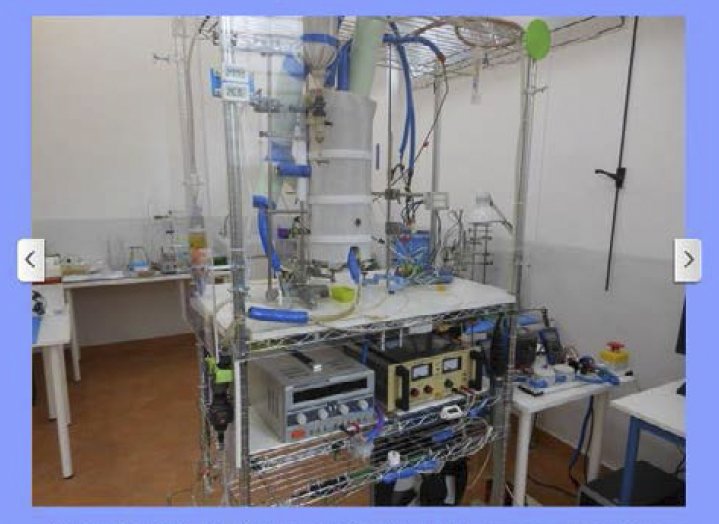
Open Power lab workstation
Hydrobetatron Full Gallery http://www.hydrobetatron.org/

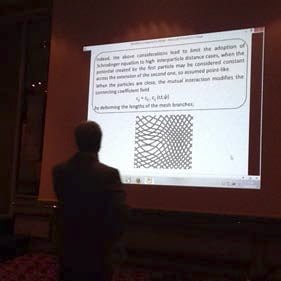
Ugo Abundo speaking in Rhodes
Our Scientific Director: Prof. Ugo Abundo at the International Conference of Rhodes
From 22 to 28 September was held in Rhodes (Greece) International Conference 2014 on Numerical Analysis and Applied Mathematics. Ugo Abundo was invited to participate in the proceedings as a representative of Open Power, to discuss the results of the activities that are part of the Association.

The work has been focused on the re-establishment of new mathematical foundations of physics, able to address the many issues currently unresolved, through change of paradigms in force. The new isomatematica (and evolutions “geno” and “hyper”) Professor Ruggero Maria Santilli presented as the appropriate tools to deal with maps deformed intrinsic irreversibility fields to ipervalori.

By means of these tools, it has been shown by speakers from all over the world, in view of industrial development, advanced applications in the field of energy, and in particular, in regards to the structure of the neutron and the atomic behavior for the purpose of nuclear synthesis. In the previous treatment of such areas, the math, as well as Quantum Mechanics appears inadequate. Hadronic mechanics, specifically developed by Prof. Santilli as an evolution of the above when both distances between particles comparable to the size of the nuclei, is revealed adequate to treat nuclear-type energy situations, where the particles can not be assimilated to material points, as in Quantum Mechanics.

Ugo Abundo presented in two separate reports, the LENR experiments conducted in the Open Power laboratory, and a neural network model generalized setting from the field of Artificial Intelligence, which makes homogeneous Quantum Mechanics and the Hadronic, justifying the applicability conditions of each of them, showing from the mathematical point of view, what happens in terms of internal information to physical systems when the first turns in the second.

Abundo’s report, entitled “An intrinsically Irreversible, Neural-network-like Approach to the Schrödinger Equation and some Results of Application to Drive Nuclear Synthesis Research Work” [.pdf] has been accepted for publication as part of the American Institute of Physics in the Proceedings of the Conference. Hence, the conditions for collaboration with other mathematicians (mainly French, Indian, Greek) to jointly pursue such studies about the applications of AI in the field isomatematica and subsequent transferability to modeling of elementary particles in interaction.

Ugo Abundo presentation slides http://www.hydrobetatron.org/files/ABUNDOpdf.pdf

(L) Prof. Santilli, (R) Prof. Abundo at Rhodes Conference
New web site nuovascienza.org dedicated to the work of Prof. Ruggero Maria Santilli
It is certainly easy to understand and explain briefly the complex thought articulated by Prof. Ruggero Maria Santilli, developed in the ‘arc of 40 years of work, both theoretical and experimental. Remarkable also is the amount of writings, conference papers, and scientific publications, he authored. This website has as main purpose to spread all those materials, video lectures, writings, etc.. In which Santilli describes in clear words and straightforward His theories and their mathematical models; His experimental paths (and industrial), and insights for the future of scientific research and experimentation in the field of new energy …

Here lists the work and thought of Santilli, who (unlike many academics pigtails Italian or not), does not miss at all courage in an attempt to place in certain areas more correct and the same theories of Eintein (Holy Grail?), and even quantum mechanics, from certain points of view. He did not even hesitate to take a picture of the “Science Today”; a photograph very brave, uncomfortable, and merciless; in substance, very critical …

In fact, he argues more explicitly that “the greatest responsibility for the crisis of physics should be seen in the press as a result of the total subservience to the centers of scientific power, while the political responsibility is only indirectly, as the political world uses print as a medium of information and action.”

This website has been designed so as a sort of very concise and articulate “compendium”, the enormous scientific thought and work Santilliano not yet sufficiently known and disclosed, and therefore unappreciated by the general public (at least in Italy, in my opinion), but certainly well-known and much appreciated from a small circle of experts and professionals, even in Italy, for his innovative value; a “compendium” I said for the use of those Italian researchers thirsty and with the critical spirit of true knowledge, but alas mè, with little time available to study the large amount of material and information that the Internet provides us every day.

Prof. Ruggero Maria Santilli Works and Thought http://www.nuovascienza.org/

Third-party report on ‘E-CAT released — Andrea Rossi

Observation of abundant heat production from a reactor device of and isotopic changes in the fuel [.pdf]
Giuseppe Levi
Bologna University, Bologna, Italy
Evelyn Foschi
Bologna, Italy
Bo Höistad, Roland Pettersson and Lars Tegnér
Uppsala University, Uppsala, Sweden
They Essén
Royal Institute of Technology, Stockholm, Sweden

ABSTRACT
New results are presented from an extended experimental investigation of anomalous heat production in a special type of reactor tube operating at high temperatures. The reactor, named E-Cat, is charged with a small amount of hydrogen-loaded nickel powder plus some additives, mainly Lithium. The reaction is primarily initiated by heat from resistor coils around the reactor tube. Measurements of the radiated power from the reactor were performed with high-resolution thermal imaging cameras. The measurements of electrical power input were performed with a large bandwidth three-phase power analyzer. Data were collected during 32 days of running in March 2014. The reactor operating point was set to about 1260 ºC in the first half of the run, and at about 1400 °C in the second half. The measured energy balance between input and output heat yielded a COP factor of about 3.2 and 3.6 for the 1260 ºC and 1400 ºC runs, respectively. The total net energy obtained during the 32 days run was about 1.5 MWh. This amount of energy is far more than can be obtained from any known chemical sources in the small reactor volume.
A sample of the fuel was carefully examined with respect to its isotopic composition before the run and after the run, using several standard methods: XPS, EDS, SIMS, ICP-MS and ICP-AES. The isotope composition in Lithium and Nickel was found to agree with the natural composition before the run, while after the run it was found to have changed substantially. Nuclear reactions are therefore indicated to be present in the run process, which however is hard to reconcile with the fact that no radioactivity was detected outside the reactor during the run.
Read the full report: http://www.hydrobetatron.org/files/ROSSI.pdf
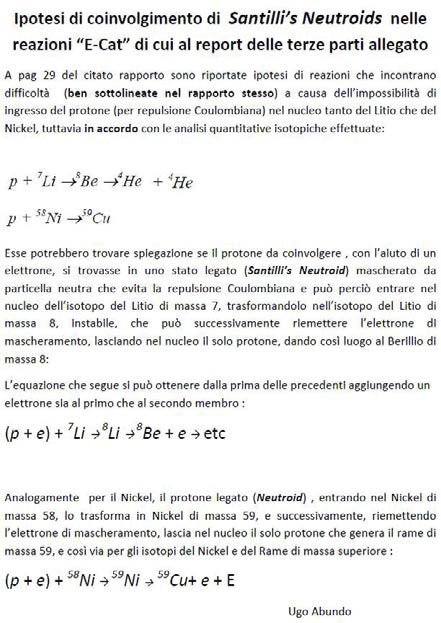
Ugo Abundo on the E-Cat

Newsletter compiled by L.S. and the Open Power Association

Andrea Rossi on 3rd-Party Report, Industrial Heat, & 1MW Plant — New Interview

Intro: You are listening to the Q-Niverse podcast. Let me just say, before we get started, that today’s episode is being brought to you in part by ColdFusionNow.org who helped facilitate the dialogue you are about to listen to. Today I have with me Andrea Rossi. Mr. Rossi is an inventor and entrepreneur who, for many years, has worked to develop the Energy Catalyzer, also known as the E-Cat – a reactor fueled by nickel and hydrogen that allegedly harnesses “cold fusion”, or low-energy nuclear reactions, on an industrial scale. Mr. Rossi has been working on this technology for well over a decade and has recently partnered with a highly-credible commercial investor to take the technology to the “next level”. A recent third-party analysis of the E-Cat, carried out by a coalition of European professors and engineers over the course of the past year, reports that the technology is in fact producing energy well in excess of any known chemical reaction. Andrea Rossi, thank you for being with me today.

Andrea Rossi: Thank you.

John Maguire: Starting off, can you explain your thoughts and feelings over the past year waiting for the new analysis of the E-Cat? Has this been a tense time for you, or have you been too busy refining the reactor to worry much about it?

Rossi: Basically I am focused on my work which is Research and Development, and direction of the manufacturing of the E-Cat and plant. This has been, as always, a period just of work. For what concerns the report – it is for sure an important report. [It] has been made by a third, independent party. The results are interesting, [and] very problematic, and we are studying these results.

JM: Now, were you worried at all that [analysis/report] might come up with negative results? Did you have any indication over the course of the year? Or were you pretty much in the dark like everyone else?

Rossi: This report is in the hands of the professors that made it.

JM: Sure…fair enough. What do you think the ultimate impact of the report will be? Can it possibly persuade the larger scientific community or other major industrial players beside ELFORSK to get interested in LENR generally speaking, in your opinion?

Rossi: This is difficult to say…this is difficult to say. Honestly, I do not know. But our target is not to convince anybody. Our target is to make a plant that works properly. Now we have finished [with all the tests] and we are focusing exclusively on the market and on the production that we have to set up. This report is no doubt very interesting and we are studying it because, as you probably know, there is a surprising result regarding the Nickel-62 in particular, and we are studying it because we are strongly directed, under a theoretical point of view, to understand these kinds of results that was unexpected. But our main focus remains the operation of industrial plant.

JM: Now you mentioned theory there real quick, so maybe we can talk about that really quick. Do you think that the reaction can be explained within the Standard Model or do you think we’re gonna have to go well beyond that to account for what’s going on, because as you noted there were some strange changes in the powder – which we don’t really have time to get into too much – but can you put it in a theoretical context, or do you any ideas theory wise that you’re able to share?

Rossi: No, we are starting on it. It will take time because the reconciliation is not an easy task. And we are studying with specialists.

JM: You’re working with a team to develop the theory, is that the idea?

Rossi: Yes.

JM: Now getting back to the report. In regards to excess heat, the measured coefficient-of-performance, or COP, came out to be around 3.2-3.6 over a very prolonged period of time. Some experts argue the calorimetry was suitable, while others remain unsatisfied for various reasons. So first, what did you make of the review group’s methodology and excess heat measurements?

Rossi: Well the calculations have been made by the professors. I know that some of them are very well [experienced with] that kind of measurement. They have also [made a core] with manufacturer of thermal chambers. I suppose they know what they did. I want not to enter into this question because I just accept the results [I have been given]. I have nothing to comment about that. About the various opinions [out there] we do not consider them real [objections] because what’s of interest to us, again, is that the plant we have in operation works properly. Honestly we have no more time to lose in this discussion. [Concerning] the COP – you have seen in the report the COP has been calculated in a very conservative way. Every number has been calculated [within] the most conservative margin. Actually, I think [the COP] could be maybe increased but again, this is not a theoretical issue, this is a technological issue that can be seen only at a fixed point in an industrial, operational plant — no more theoretical suppositions.

JM: The new version of the E-Cat that was tested this time had an alumina casing on it. Now this as far as my understanding goes acted as an insulator…

Rossi: It has been described in the report. I don’t want to say anything about that. The report has been very well described [elsewhere] – the casing of the reactor.

JM: You brought up the 1MW plant – how is progress going on that? And to be more specific how is the new design superior to the old version, and how long do you think it will take to get to market or, at the very least, be demonstrated publically for people?

Rossi: Well, yes, the new 1MW plant has gotten a strong evolution with [regard] to the older one — mainly under the reliability point of view; under the industrial point of view. The control system is enormously more sophisticated. Basically the plant is governed by a robot. Nevertheless it will take at least one year of operation in the factory of the customer of Industrial Heat, to whom the plant has been supplied…it will take at least one year before they complete the analysis [and] all possible errors have been adjusted. After this year with the permission of the customer, because industry is not a showroom or a theatre, so we cannot just open access to the public and say, “Alright guys, come and see!” It will not be that simple, but selected visits for a person who has title to that will be open – [but] not before we consider the plant absolutely [finished] under an industrial point of view. I suppose it will take about one year…about one year from now I suppose. But when you are in this field you cannot be sure about the scheduling because you can be sure of one thing now today, and tomorrow discover you were wrong and have to change something. This is the first time – and this is important to underline – this is the first time we had the possibility to see in operation 24-hours-a-day continuously the plant because before we could only operate on it for a couple of days or three before [we encountered] a lot of problems. The [past manufacturing facilities that we installed the old 1MW plant were not in full operations]. There was not a load to supply all the energy to. So now in the real industrial operation/situation we can see all the problems that are generated from this real operation.

JM: Now you say you’ve seen it running longer than a few days can you give some idea of how long one has been running, or how long one has been tested for? Are we talking weeks?

Rossi: You know in our factory the one megawatt plant that had been presented in October 2012 — it worked at that time.  Then, we could work with it for some [amount of time], but you cannot put in exercise for long a plant like that if you don’t have a real load and if you do not have a real operation going on.

JM: Can you give us an idea of how many people are working to develop the E-Cat? Obviously you have your hands on it in some capacity, but is this a rather large team or just a small group of engineers?

Rossi: We are working with a complex team where there are specialists for any issue.

JM: Can you give an idea of how many scientists are working on [the project]?

Rossi: I prefer to not answer in detail, but what I can say is that for any single matter, we have a specialist to take care of [that].

JMGetting a bit more personal, I’m sure people are wondering what exactly has driven you all these years, and what do you hope to ultimately achieve by bringing this technology to the world? How do you hope to be remembered?

Rossi: The first stone has been put in the building so, you know, the first industrial plant, not working in an experimental warehouse, but working in the factory of a customer to produce a profit is already in operation. So this process of industrialization has begun already.

JM: What do you hope to accomplish personally?  What drives you to keep pushing this forward?

Rossi:  Well, you know, I just go one step at a time. My biggest aspiration now is to make the 1 MW plant perfect, absolutely and totally reliable, with all the defects corrected.  This is my aspiration now. After this, I do not know.

JM: Briefly, can you speak on your past work with the now-deceased Professor Sergio Focardi of the University of Bologna. I think he might be one of the unsung heroes after the story is told, along with many others of course, but he was one of the pioneers in the nickel-hydrogen work, along with [Francesco] Piantelli and others, most notably Italians. How significant in your opinion were his contributions to the genesis of the E-Cat, your work, and just your general thoughts on him?

Rossi: Focardi has been a strong collaborator with me, mainly in the period between 2007 and 2010. I have been lucky to be helped by him with his strong theoretical preparation.  For sure, he has contributed to the development of this work, and we absolutely have to be grateful forever for his precious contribution and he is always present in our memory.

JM: I know he was in a special situation in one sense because he was retired, and though his career wasn’t behind him, he could come out and support controversial work that he might not have been able to do while he was still a teaching professor, and that’s the kind of pressure many academics face in dealing with these new technologies or this new science.  And so, we need people like Sergio Focardi, we need people like Hano Essen, like Sven Kullander, who are willing to stick their necks out for new science to discover something new. Without pioneers, without people taking these kind of risks, both economic on your end, and sociologically, say in the scientific community, on the professors’ end. So I wish people were more open-minded [and] would follow their example. I think a lot of the barriers to people understanding this new technology, this new science, is again the academic pushback, so I am always encouraged by these men of integrity, whether they are sure or unsure of what’s going on, they say, “let’s look”, “let’s investigate”.  That’s why I’m always in inspired by those kinds of people, and that’s why I brought him up.

Rossi:  Yes, I agree with you.

JM: I know you don’t have a lot of time today. We appreciate all the time you afforded to us. I know there are things you can talk about, and things you cannot talk about. So before we go our separate ways, do you have any parting thoughts? Any words of wisdom or anything you think is appropriate?

Rossi: What I can say is that, at this point, we have to focus on the industrial plant in operation, because at this point in the story we are in a situation similar to the one at the dawn of the computers.  At the very beginning it was important to have the theoretical discussion on microchips, etcetera, but at a certain point, the development, and the importance of the computer, has been determined by the market, not by the scientific community.

JM: Absolutely. Thank you for taking the time out of your very busy schedule to speak to us.

Rossi: Thank you very much.  It has been a pleasure and an honor to be with you today.

Conclusion: That does it for today’s episode. Thanks again to Andrea Rossi, Ruby Carat at Cold Fusion Now.org, and thanks to you for listening. Take care, and stay tuned for more episodes in the near future.

* More of Interviews/Essays on Cold Fusion/LENR & other topics can be found at Q-Niverse.


The Ultimate Hot Tub

2014-report-coverI have never been an optimist or a pessimist. I’m an apocalyptic only. Our only hope is apocalypse. Apocalypse is not gloom. Its salvation.” –Marshall McLuhan

Apocalypse – Old English, via Old French and ecclesiastical Latin from Greek apokalupsis, from apokaluptein ‘uncover, reveal,’ from apo- ‘un-’ + kaluptein ‘to cover.’ –Google

A report released Wednesday on a test of the E-Cat Energy Catalyzer concludes a large amount of heat was generated using a fuel of one gram of nickel powder, with no radiation detected at all.

The authors describe details of the equipment, the experimental set-up, and how heat measurements were taken, along with an analysis of the outer shell material and fuel, in the paper Observation of abundant heat production from a reactor device and of isotopic changes in the fuel [.pdf]


Listen to Andrea Rossi discuss the results with John Maguire here.


The paper was authored by scientists who had performed tests on an earlier version of the E-Cat, releasing the report Indication of anomalous heat energy production in a reactor device containing hydrogen loaded nickel powder [.pdf] last year. During one November, 2012 experiment, the E-Cat generated so much thermal power, it melted the steel inner core body and the ceramic casing. This second test purposefully kept the input power moderate to ensure a longer life for the newly designed E-Cat.

As in the previous test, David Bianchini monitored radiation from the unit “before, during, and after operation”. No radiation was reported from the E-Cat, or from the fuel charge.

Over the last year, E-Cat intellectual property and licensing rights were acquired by private company Industrial Heat, LLC, an affiliate of Cherokee Investment Partners, with investment in the project reported at over $10 million. The group has retained inventor, designer, and Chief Engineer of the E-Cat, Andrea Rossi to lead the development of the energy generator.

Andrea Rossi participated in the experiment by fueling, starting the E-Cat, stopping the E-Cat, and removing the fuel from inner chamber. At these times, members of the evaluation team were present, and observing the activity.

Observation of abundant heat production from a reactor device and of isotopic changes in the fuel [.pdf]

The report was organized into sections with the lead authors writing the Abstract and main body of the report. Five other authors contributed four appendixes describing radiation monitoring and fuel analysis, including scanning electron microscope SEM and x-ray spectroscopy studies.

Giuseppe Levi
Bologna University, Bologna, Italy

Evelyn Foschi
Bologna, Italy

Bo Höistad, Roland Pettersson and Lars Tegnér
Uppsala University, Uppsala, Sweden

Hanno Essén
Royal Institute of Technology, Stockholm, Sweden

Abstract
1. Introduction
2. Reactor characteristics and experimental setup
3. Experimental procedure
4. Data analysis method
5. Analysis of data obtained from the dummy reactor
6. Analysis of data obtained from the E-Cat
7. Rangone Plot
8. Fuel analysis
9. Summary and concluding remarks
Acknowledgements
References

Appendix 1
Radiation measurements during the long-term test of the E-cat prototype.
D. Bianchini
Bologna

Appendix 2
Alumina sample analysis
Ennio Bonetti
Department of Physics and Astronomy
University of Bologna

Appendix 3
Investigation of a fuel and its reaction product using SEM/EDS and ToF-SIMS
Ulf Bexell and Josefin Hall
Materialvetenskap, Hogskolan Dalarna

Appendix 4
Results ECAT ICP-MS and ICP-AES
Jean Pettersson
Inst. of Chemistry-BMC, Analytical Chemistry
Uppsala University

Comparing E-Cats

E-Cat HT on support frame from December test
E-Cat HT on test bed November 2012
The E-Cat has undergone many design changes since 2011 when the public got their first glimpse of the Energy Catalyzer.

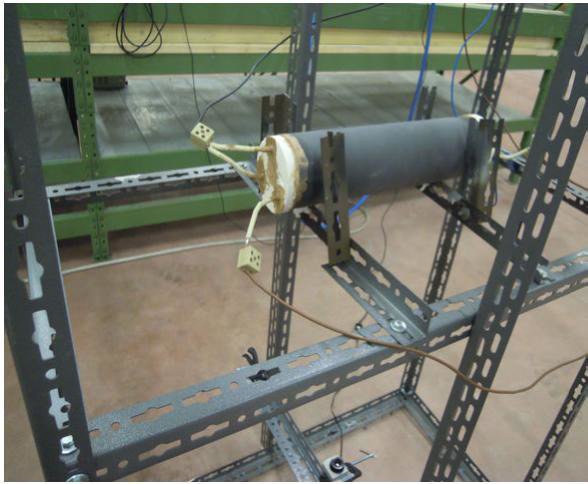
Last year, the E-Cat appeared as a smooth, silicon nitride ceramic shell cylinder 33 cm in length and 10 cm in diameter, painted black. Inside was a second cylinder made of corandom, which contained resistor coils to heat the reactor with an “industrial trade secret waveform”. The innermost cylinder was made of steel, 33 mm long and 3 mm in diameter and contained the fuel charge of treated nickel powder with the secret catalyst.
 

E-Cat on scale, February 2014
E-Cat on scale February 2014
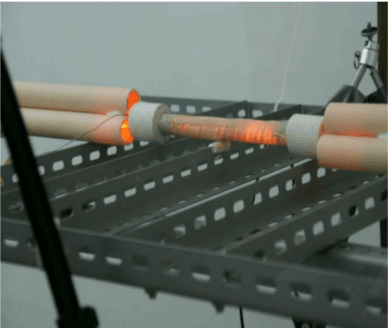
This year, the E-Cat is less than two-thirds the length, appearing as “an alumina cylinder, 2 cm in diameter and 20 cm in length, ending on both sides with two cylindrical alumina blocks (4 cm in diameter, 4 cm in length), non-detachable from the body of the reactor…”

The outer surface of the body of the E-Cat is no longer smooth, but “molded in triangular ridges, 2.3 mm high and 3.2 mm wide at the base, covering the entire surface and designed to improve convective thermal exchange…”

Design changes allowed for improved features, says the report. This year’s 2014 model E-Cat thermal generator can attain higher temperatures, while avoiding internal melting of the powder.

To initiate and control the reaction, resistor coils surrounding the inner fuel cylinder heat up from “specific electromagnetic pulses”. The authors report the reactant is a micron-sized nickel-powder mixture and that once heated, “it is plausible” that a lithium hydride delivers the hydrogen fuel for the reaction.

Last year, the E-Cat had a cyclic input power, which appeared to regulate the heat-producing reaction. On one end of this year’s new bone-shaped generator, a hole that allows for re-charging of the reactant also holds a temperature sensor that sends data to the controller. If the inner chamber gets too hot, the pulse is dialed down.

Measuring E-Cat Heat

Previous model E-Cat HT from 2013 report
As in the previous test, heat was measured by thermal imaging and computing the convection away from the surface of the generator.

Two thermal image cameras mapped the heat data of the generator across its surface as the E-Cat operated. Thermal imaging is a well-developed technology with a strong track record in many applications, but not in the field of cold fusion, which has relied on calorimeters and direct contact thermocouples.

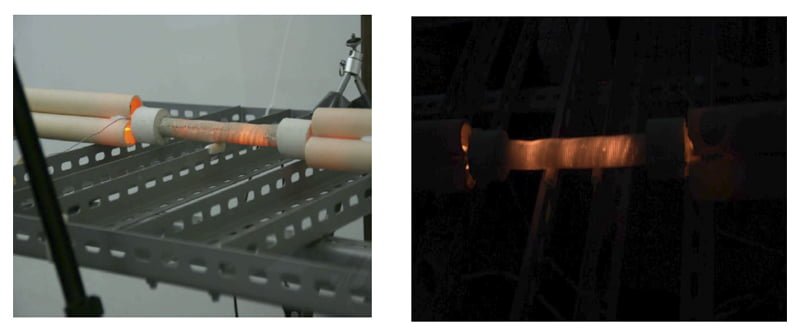
New model 2014 E-Cat in operation.
Optical photo of new model E-Cat in operation.

The authors of the report state that they wanted to use a thermocouple, but that “the ridges made thermal contact with any thermocouple probe placed on the outer surface of the reactor extremely critical, making any direct temperature measurement with the required precision impossible.”

An empty E-Cat played the dummy to check that power in would match power out, as was observed.

The infrared camera’s temperature readings were converted to radiant power in watts by the Stephan-Boltzmann formula, an equation with parameters dependent on the emissivity ε of the material as well as the temperature. The outer shell of 99% alumina was divided into sections, and ε assigned to each area.

The issue of emissivity of alumina is still under discussion in the scientific community. Some believe there may be a larger source of error in the value ε. Aware that the emissivity of Alumina is temperature-dependent, the authors plot the emissivity ε over temperature saying that ε “has been measured at +/- 0.01 for each value of emissivity; this uncertainty has been taken into account when calculating radiant energy.”

E-Cat Power and Energy

Net thermal power produced by E-Cat
Plot 6: Net thermal power produced by E-Cat
Plot 6 shows a graph of the Net Power Out. The horizontal axis marks every two days and the vertical axis showing average Watts produced.

Net Power Out is the power produced by the E-Cat, minus the power inputs, and shows the amount of watts generated solely by the E-Cat.

As described in the report, after the first ten days, the input power was lowered by the controller. The team then decided to increase the input power about 100 Watts, which over six minutes, activated a large jump in temperature, equating to a net thermal power output of about 2.3 kilowatts. At peak usage, a large home may require 1-3 kilowatts electrical power.

The area under the graph over the next twenty-days represents just over 1 Megawatt-hour of energy. According to the report, the total energy produced over the month of testing was a remarkable 1.5 MWh generated from 1 gram of nickel-powder fuel.

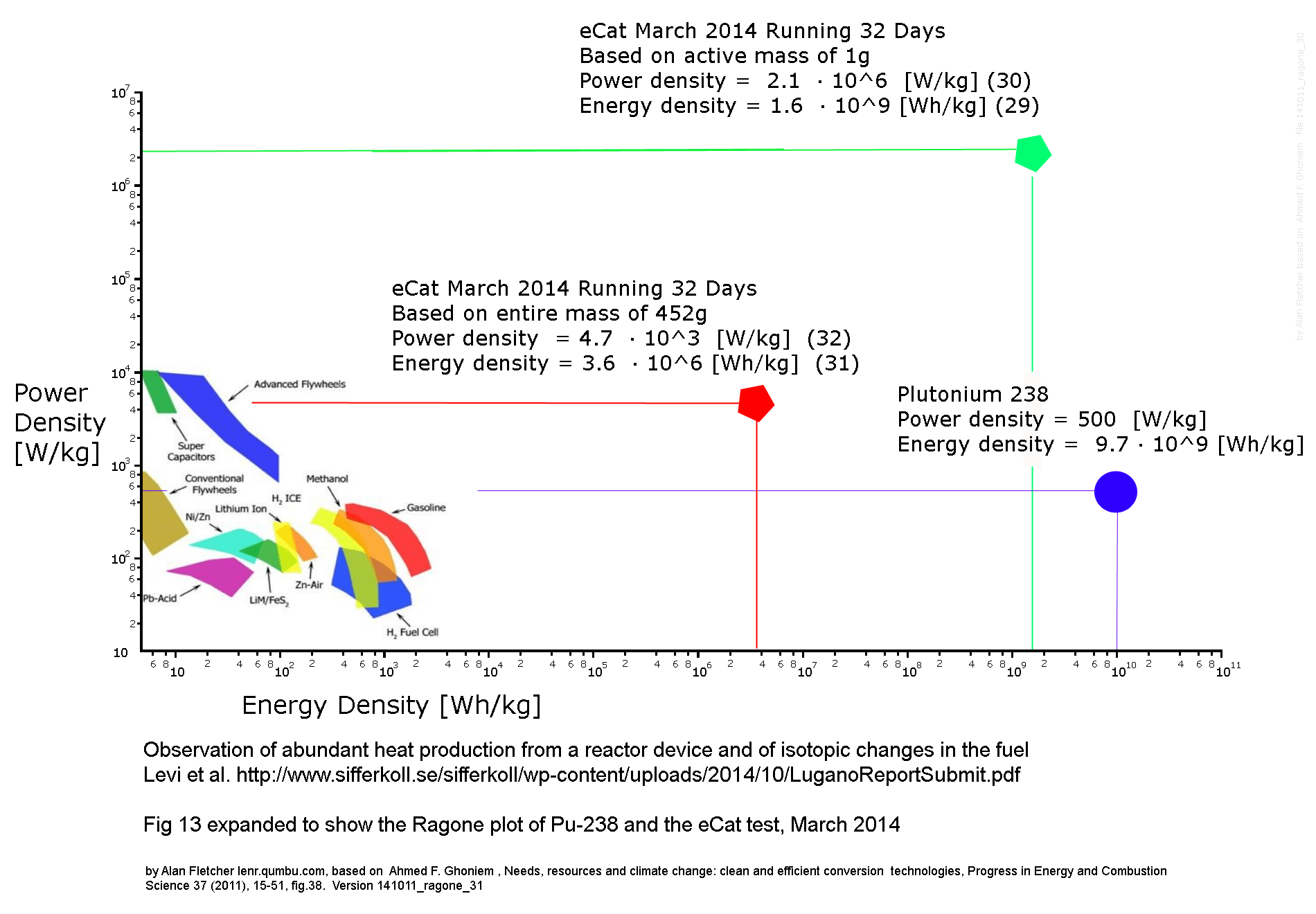
Thus, E-Cat energy density – 1.6 billion +/- 10% Watt hours/kilogram – is much greater than any energy derived from the chemical burning of gasoline, oil, or coal.

Compare energy densities of traditional fuels modified Rangone chart by Alan Fletcher:

141011_ragone_30-ColdFusionNow

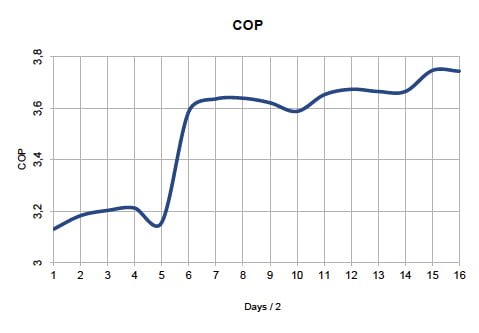
Plot-8-COP-cropLast year, E-Cat test COPs at or below three, with values of 2.9 +/- 0.3.

This year, COP was computed as well over 3, even though the device was said to not have operated at maximum output.

It has been stated many times that a COP > 3 makes a commercially-viable energy technology.

Read David French’s explanation of COP here.

Fuel Analysis

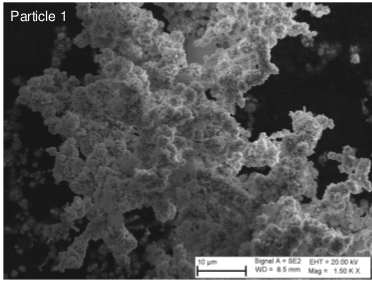
SEM of fuel Particle 1
SEM of fuel “sample granule” Particle 1
Of the 1 gram total in the reactor, a 10 mg sample was removed from the reactor and analyzed for content.

Materials analysis revealed natural nickel grains of a few microns in size as the bulk of the material. Other elements included Lithium, Aluminum, Iron, and Hydrogen. “Large amounts” of Carbon and Oxygen were also found.

But after the reaction, the ash had a “different texture than the powder-like fuel by having grains of different sizes”, and there was an unusual and unexpected shift in isotopic composition for the Nickel and Lithium grains.

Quoting from the report:

The Lithium content in the fuel is found to have the natural composition, i.e. 6Li 7 % and 7Li 93 %. However at the end of the run a depletion of 7Li in the ash was revealed by both the SIMS and the ICP-MS methods. In the SIMS analysis the 7Li content was only 7.9% and in the ICP-MS analysis it was 42.5 %. This result is remarkable since it shows that the burning process in E-Cat indeed changes the fuel at the nuclear level, i.e. nuclear reactions have taken place.

The shift in Nickel is reported as:

Another remarkable change in the ash as compared to the unused fuel is the identified change in the isotope composition of Ni. The unused fuel shows the natural isotope composition from both SIMS and ICP-MS, i.e. 58Ni (68.1%), 60Ni (26.2%), 61Ni (1.1%), 62Ni (3.6%), and 64Ni (0.9%), whereas the ash composition from SIMS is: 58Ni (0.8.%), 60Ni (0.5%), 61Ni (0%), 62Ni (98.7%), 64Ni (0%), and from ICP-MS: 58Ni (0.8%), 60Ni (0.3%), 61Ni (0%), 62Ni (99.3%), 64Ni (0%). We note that the SIMS and ICP-MS give the same values within the estimated 3% error in the given percentages.

Possible reaction pathways to these stunning results are provided in the report, but the authors caution that “reaction speculation above should only be considered as an example of reasoning and not a serious conjecture.” There is as yet no explanation for these findings.

What to think

The E-Cat has attracted financial investment, and inventor Andrea Rossi has given rights to the technology to private company Industrial Heat. They are in to win. Engineering changes are improving control of the reaction and the E-Cat is shrinking in size, now down to a breadstick.

While discussion of procedure and parameters continues, it won’t change the fact that we are within epsilon of a revolution in energy technology. Whether it is the front-running E-Cat, or another start-up that finds the right recipe, the E-Cat test report gives a peek at what is possible to achieve.

On multiple occasions, the E-Cat has publicly demonstrated steam, heat, and energy, once producing one-half megawatt power. Even if the net power out were 50% less, this E-Cat test run would still be making excess heat.

Global research, as presented at these conferences here and here, is focused on understanding the science, and finding a theory to describe this newly discovered phenomenon. Swedish research and development institute Elforsk, a partial sponsor of the test along with the Royal Swedish Academy of Sciences, will begin a ‘research initiative’ as stated by Elforsk CEO Magnus Olofsson.

Companies like Industrial Heat and men like Andrea Rossi are pushing the frontiers of engineering to create a product to re-make the world. Safe, non-polluting, with the energy-density to free a planet from the present destructive paradigm, there is nothing that will change our world more than new energy technology.

Renewing a civilization by empowering local communities, restoring our wildspaces and the wildlife that lives there, powering the hot tub in my backyard (that’s not my backyard in the picture), we are at the break-boundary. Are you ready for Apocalypse???

Cold Fusion Now!

An-impossible-invention-cover-200x279The most important thing that can be learned from the work that we are doing is that we will overcome any critical moment, so in this difficult moment for everybody, if anybody works, believing in what he does, and works with all his efforts, we can build up a new, strong economy.” —Andrea Rossi in interview with James Martinez December 2011

Ask questions of the authors at LENR-forum.

Related Links

Status Report – Rossi Pending US Patent Application David French October 2014

US Examiner Addresses Andrea Rossi US Patent Application David French March 2014

Raleigh investor Darden still bullish on controversial nuclear technology Bizjournal.com October 2014

Mats Lewan Interview E-Cat, Andrea Rossi, & An Impossible Invention John Maguire May 2014

Rossi E-Cat HT energy density off the chart Ruby Carat May 2013

Andrea Rossi in James Martinez interview [.mp3] December, 2011

E-Cat test: One-half Megawatt Self-Sustained Ruby Carat October 2011

Videos: Rossi’s “One Megaatt Plant” + New E-Cat Test (via NYTeknik) Eli Eliott September 2011

E-Cat World Frank Acland

New E-Cat Report Positive, 1400C+ and Isotopic Changes in Ni+Li

New E-Cat Report Download Here

Observation of abundant heat production from a reactor device
and of isotopic changes in the fuel

This test was performed by the same group as the previous test with the following names on the paper:

Giuseppe Levi
Bologna University, Bologna, Italy
Evelyn Foschi
Bologna, Italy
Bo Höistad, Roland Pettersson and Lars Tegnér
Uppsala University, Uppsala, Sweden
Hanno Essén
Royal Institute of Technology, Stockholm, Sweden

This 760 hour test is the longest running example of controllable LENR/Cold Fusion and at an excess of 5825MJ it is also the most powerful.

The Temperature peaked at above 1400C, hot enough to be extremely practical as an energy source.  The measured COP was between 3.2 and 3.6 with the authors hinting they could have pushed the device further but were cautious due to the huge energy gains when they initially turned it up a bit.

The fuel was analyzed before and after the test and showed significant changes in the elemental profile including shifts to Ni62 and depletion of other Ni isotopes as well as a shift in Lithium isotopes.

Listen to Andrea Rossi discuss the results with John Maguire here.


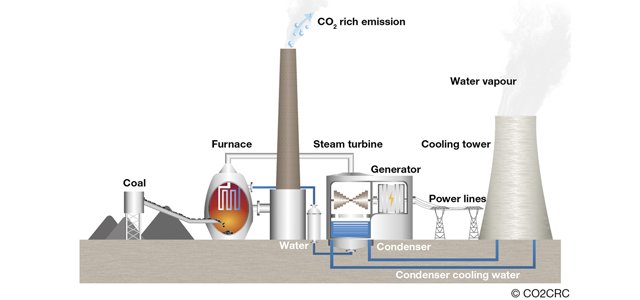
How could cold fusion reactors replace coal-fired steam power plants?

Graphic: copyright CO2CRC

Because the grade of heat generated [and recoverable] from the cold fusion processes [as of now] is modest in relation to furnace temperatures of conventional power plant [ which are in the range of 2500- 3500 deg.F (1400C-1900C)], it is not obvious to me how the existing furnace/ boiler plant can be efficiently utilized for the cold fusion processes.

However, if the CF energy cell is used directly to generate saturated steam at pressures in the range of 500-3000 psig. (pounds per square inch gauge) where boiling temperatures would be in the range of 470-700 deg.F (240C-370C) [respectively for the pressure range] and then, a separate CF energy cell is used to directly superheat that steam to 750 deg.F (400C) for a 500 psig. and to say 1000 deg.F (540C) for the 3000 psig. boiler, then that superheated steam [for what ever steam pressure system is used] could be routed to an existing steam turbine plant [with the return treated and de-aerated condensate returned as feed to the new CF fired boiler.

In summary, the existing fossil-fired boiler plant [including all fuel/ combustion air/ furnace/boiler/ash systems/flue gas systems, are all deactivated and preferably removed, and the new cold fusion powered boiler together with the cold fusion powered superheater would be integrated into the existing steam turbine generating plant [including the steam condensing plant and, of course, a modified control room].

This whole project would certainly drastically reduce emmissions to zero, but would be very costly, I suspect, because of labour costs of dismantling the majority of the power station.

It may be a better option to build new power station using the new CF boiler and superheater plant with a custom designed and compact steam turbine/ generator plant in a small modern compact building.

With the most appropriate and efficient small 25MW cold fusion powered station I would suggest the following :

Boiler outlet conditions : 500 psig. sat. steam [at 470 deg. F (240C)]
Superheater outlet conditions : 470 psig. steam at 750 deg. F (400C)
Steam Turbine outlet conditions [to steam condenser] : 1 psia. @ 10% wetness.

The practical steamrate for generating electrical power with this relatively simple, small and compact station is about 9 lbs/ kwhour so the total steamrate from the small boilers serving a single multi-stage steam turbine/generator system which exhausts to a steam condenser is 225,000 lbs/hour.

Scientists would decide how much steam capacity each boiler/superheater combo would have and that would determine how many units would be required to meet the total steam demand.

Note: The use of steam for electric power generation [via boiler and steam turbine as presently done] is really 20th. century technology and all forms of cold and hot fusion should seek to find DIRECT electrical generation processes that harness ion transfer in conjunction with an external excitation field.

The use of steam at high pressure as an electrolyte, may however make use of an abundant commodity that facilitates extreme process efficiency, and this applies to the pressurized CIHT unit where high pressure steam is extremely efficient as an electrical conductor [the electrolyte] permeating the catalyst fill [consisting of back to back catalyst discs] through micro gaps in the catalyst structure. Further the basis of direct electric power is when a stream of ions or electrons flowing and driven by an existing voltage potential, will interact with an external excitation field thus creating export electric power.

Addendum:

This proposed and detailed [perhaps speculative] bold upgrade to the original BLP – CIHT unit could be a blockbuster in that a compact direct energy CIHT based system, offered in a wide range of sizes and used in multi-module applications for the power generation industry, but more importantly, for the shipping industries [from private and recreational craft to commercial shipping and naval shipping including surface vessels and submarines].

This conceptual unit [or units] could be installed in the ships engine room and bypass the existing electric generating plant with out the costly removal of that plant [or in the case of nuclear powered vessels deactivate and bypass the entire systems of the existing reactor compartment].

See details on The PRESSURIZED CIHT Unit [.pdf]

THE PRESSURIZED CIHT UNIT – after the SunCell


To: Industry and Government

The following letter was sent to Blacklight Power (BLP) in the hope that the original CIHT unit [now apparently redundant because of the promise and enthusiasm for their SF-CIHT project] could be revisited with a prospect of being commercially viable as perhaps, a second alternative to their main project [with the SF-CIHT]. I hope you find the following interesting

John Varney

—————————————————————-
To Dr. Randell Mills
Dated September 3rd. 2014 -[Rev 1 dated Sept. 4th. 2014]

From John Varney

THE PRESSURIZED CIHT UNIT
Using saturated steam at 500 psig as electroyte – Generated in a small adjacent pressurized electric kettle.

The steam passes from the inlet chamber via a porous anode disc and a porous [non conductive] catalyst containment disc, through the stack of catalyst discs, to the other catalyst containment disc and then the cathode disc to the outlet chamber.
This vertical cylindrical unit with the steam inlet chamber at the top and the steam outlet chamber at the bottom will have an effective stack height of say 36 inches and a disc diameter of 12 inches.
The shell, with an internal diameter of 12.06 inches will be made of a non-conductive, non-porous material [perhaps a composite material] of suitable thickness to contain the steam pressure. The design conditions of all pressure parts shall be generous to withstand temperature excursions that may occur during the three phases of operation [ charge phase, discharge phase and idle phase ].
The complete exterior of the pressure vessel will be applied with a 4 inch layer of insulation such that little heat will be lost from the unit during operation in the charge or discharge phases.

A small, compact and simple electric steam generator or kettle [constructed of same material as pressure vessel for the CIHT unit] will provide a low feed rate of saturated steam [at a final pressure of 500 psig and derived from a distilled water feed]that will be maintained throughout all three phases of operation.
In the event of over pressure due to electrolysis in the charge phase or a temperature excursion during the discharge phase, bleeds from the top or bottom chambers will be automatically activated to re-establish the operating pressure and temperature. If some condensation is occuring within the CIHT unit then this will be handled with a steam trap serving the bottom chamber.

With regard to bleeds, [following experimentation, showing magnitude, frequency and causes of pressure/temperature excursions during the charge or discharge phases] it may be practical to initiate, on commencement of charge, a continuous micro-bleed [from the bottom chamber] and to have a slightly larger bleed to automatically cut in when serious over press/temp occurs [that can not be corrected with the micro-bleed]. The accumulative loss of steam with such a system could still be small and acceptable [energy wise] whilst enabling the unit to operate smoothely without ongoing operator interface.

Note: The unit may be mounted in a horizontal position, but care taken to drain minute condensate effectively to steam trap.

CHARGE PHASE
When the steam condition in the CIHT unit has gradually increased and is stabilized at 500 psig, the charging phase may proceed and with a 36 inch total layer of catalyst discs to be penetrated, the voltage required may be substantial [perhaps in the range of several hundred volts]. When the charging energy approaches zero, the electrolysis [charge] phase is ended and the discharge phase can begin.

DISCHARGE PHASE
Only experimentation will indicate the optimum conditions of discharge or the consistency, duration, magnitude of exported energy.
It is probable that temperature or pressure excursions will occur and will require focused attention to remedy.
One would not be surprised if the basic performance signatures of the pressurized CIHT unit were indeed found to be remarkable and encouraging.

John Varney

I trust you find the above of some interest in that it would provide a secondary option to your promising SF-CIHT unit.

Top