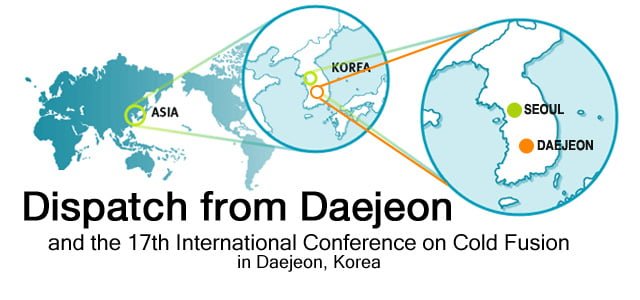
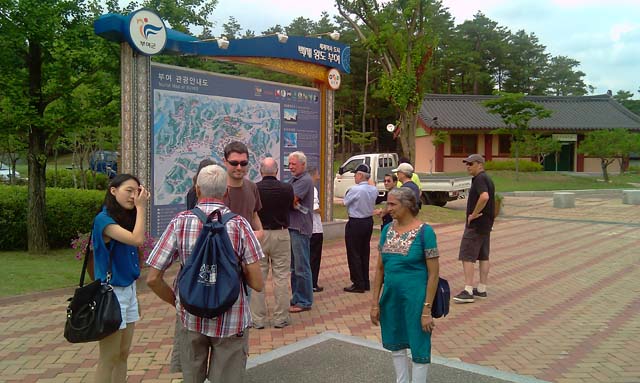
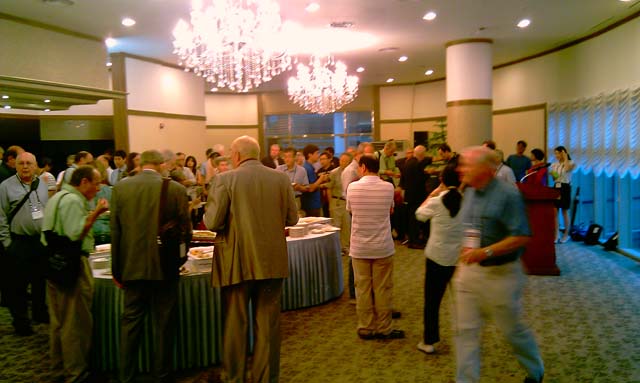
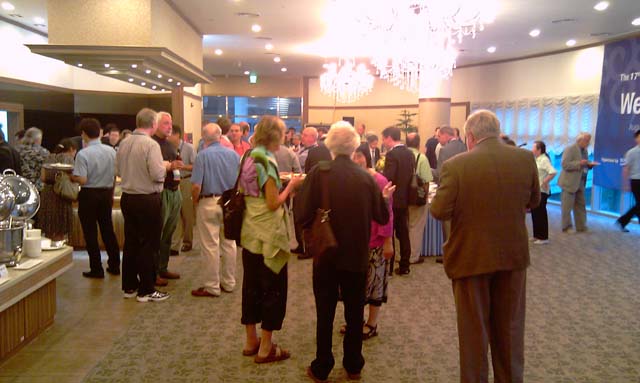
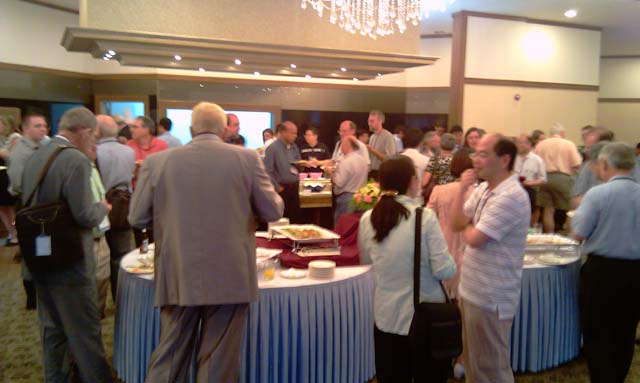
Cold Fusion Now is attending the 17th International Conference on Cold Fusion ICCF-17 in Daejeon, Korea in the form of science fiction author and CFN contributor Arthur Robey traveling from Australia, and patent lawyer and author David French, who trekked in from Canada.
ICCF-17 runs August 12-17, although a Workshop began on the 10th. ICCF has been the primary international conference for cold fusion research since 1990.
David French will be posting his impressions of the conference in a report after returning home from the event – and a short vacation trip around the area!
Arthur Robey is wiring in his thoughts each day. His observations are personal, informal, and provide a fascinating look at major figures in cold fusion research.
Mr. Robey shares them here for your enjoyment!
Following the Austin, Texas NIWeek 2012 event with ICCF-17 in Daejeon, Korea, scientists and technologists will surely be on a real high with the feel that, finally, the dam is breaking in planetary consciousness for the fast-rising meme of clean energy from cold fusion. –Ruby Carat
Daejeon, Korea 10th Aug 2012
OK, so I burned a lot of carbon over the last two days.
“Mian Hamnida”. (That is Korean for “Sorry”, as far as I know).
Listen, I am right out of my comfort zone here. I know two phrases “Thank you” and “I am sorry.”
Hangeul is a very simple alphabet that any normal person can learn in a morning and a fool can learn in a day, according to the blurb. After a month of study I am transported back to my childhood. Did you ever learn to read with Janet and John books? You know the story line that goes something along the lines of “John has a ball. Kick the ball John.” Well, that is where I am at except that I have no idea what the sentences mean. I hope you appreciate the effort.
The lady in the shop where I bought milk and some sort of surprise in a box to go with the coffee taught me to say “Yook Chon” (five thousand). I think we are going to be friends.
Today in the bus from the airport I met Ryan from America. He is from some place near a city called Chicago. I think he said Cincinnati. (Is that near Chicago?) He wants me to tell him about my experience at trying to create Cold Fusion. (“Quantum Energy” might give us more street cred, Lord knows we lack it.) I explain that I am a Groupie, so he sticks to his story line that he has been working with the hydrogen nickel system but has not had any positive results. I have the feeling that cards are going to be played very close to chests.
“A groupie from Australia? Come on, gimme a break. The man is obviously a spy.”
Thank you, dear Mr. Patents Office.
Today I burned carbon.
While waiting for my washing to dry, I bought a beer from the cabinet. (Hint: Don’t buy the stuff that looks like better grade beer in a bottle, it is flavored industrial alcohol. “Have you tried this sir?” asks the receptionist.) I settle down with another beer and a newspaper.
Seoul’s water supply is threatened by an algal bloom due to the heat and lack of rain. That is an entire city’s water supply. Think about that. And then think about the wheat belt of the USA failing due to unseasonable drought. Can you join the dots? Is the trend line up or down? Stop burning carbon must be on our “to do” list.
There is something else on our list, but you dear reader, are not ready for it yet. I shall administer a spoonful of strong medicine at a time. I was going to say that we have to change how we do things on this planet but there is an error in that thought. Can you spot it?
Well, in a couple of hours I shall gird my loins for the beginning of another day. Kamse Hamnida. –Arthur Robey
Komyo i (Friday)
 Professor Sunwon Park has been a credit to Korea. He ran the whole shebang.
We were all guided to our hotels and transport was laid on. This is treatment fit for Royalty. I am humbled.
Have you ever been in the presence of true genius? It is a rare privilege. I was surrounded by them. Yet more humbling.
Ok, so then the spoiling was over, time to get down to work. Ryan and I sat together in the auditorium and the first speaker was Professor David J. Nagel. He should have retired but is having too much fun with these. . .
And here I must confess confusion. The range of phenomena involved defies an over-riding noun. “Cold Fusion” just does not cover the field. Professor Nagel urged young people to get involved. There is so much being discovered now.
Science is all about creating hypotheses and then trying to destroy them. Those that cannot be destroyed are promoted to a “Theory”. Think of children making little boats, launching them on the pond and then all the children throw stones at them. Those that sink are no good. The good theories stay afloat. But the very next stone could sink them.
True Skeptics are the throwers of stones. Pseudo-skeptics are the children on the shore begging others not to throw stones at their pet boat. They are the pathetic mewling kids who are happy to throw stones other people’s boats, but complain when theirs are sunk.
There are many little boats that are just a memory. Phlogiston, the Aether and the latest little boat that has a huge rock lobbed at it, the Big Bang theory. (What? You thought it was sacred? So did I. Watch this space.) The point is “dogma” is a religious term, not a scientific one. This is something that I will be returning to again.
Professor Nagel is an enthusiastic builder of boats and lobber of stones. Peter Pan lives. He urges your involvement. It is huge fun.
Dr. Michael McKubre was in the registration lobby. I am so cool. I did not react like a teenage groupie. I managed to maintain my dignity.
He gave the next lecture. His subject was calorimetry. Dr McKubre has been doing calorimetry for neigh on a quarter of a century. He emphasized the difficulty of doing it well. There are three classes of calorimeter: Isoperibolic, Flow, Seebeck and Phase change. (Spot the error. I am so pleased that I am not going to be graded on this stuff.)
The one that made the most intuitive sense to me was the phase change calorimeter. The principle is easy. You get a block of ice, heat it up and what melts is proportional to the heat pumped in. How cool is that?
OK, so what we get from this is that it is not a walk in the park.
What became obvious to me is that because calorimetry is so difficult, many chemical experimenters ignore it and make assumptions about the exothermic heat balance of their results. Think! How many overlooked CF anomalies are edited out of the results? They are removed on the assumption that the phenomenon cannot happen.
This is a typical Left Brain error. It confuses the map with the terrain. Read the Literature. You don’t want to? There is a lot of that. It is the problem. The book will explain why. Dr. Iain McGilchrist is a Psychiatrist. Insight is his trade.
Next I want to introduce Professor Mahadeva Srinivasan and his much loved and patient wife. He presented information that will stretch your models to breaking point. Tough. Build a bridge and get over it kiddie.
And then we meet a true genius. No-one got the mic who was not. I am sure that Professor Peter Hagelstein has become bored by the adjective. Last week his model predicted an outcome. Now that is the gold standard for any model, can it predict the results of an experiment?
More heavyweights in the field spoke: Professor Jean-Paul Biberian on gas-loading experiments, Professor Yeong E. Kim on theory, and Professor Michael E. Melich and Professor David J. Nagel. But first I am off on a bus trip with my heroes around this beautiful country.
Wish you were here. –Arthur Robey
Toyo il (Saturday)
Listen, I have a confession to make. I am not a Nuclear Physicist.
I have not spent many years of toil at my desk getting on speaking terms with Sir Roger Penrose. Although I did follow him into the thicket as far as the Riemann Hypothesis before I realized he was leading me astray. His explanation is a lot prettier than the link that I have given, the smooth talking bounder. He nearly had his wicked way with me.
Anyway, I do not have years of baggage with me. Speaking of which, I shall begin with a bit of baggage that Professor Mahadeva Srinivasan offered at the end of his lecture.
A basic tenant of science.
- All 92 elements on Earth were produced during nuclear-synthesis in stars which exploded: from their debris planets were formed: since then no elemental transmutations from one to another has taken place, nor can happen.
- (Except for radio-active decay etc. . .)
- But no “simple” physical or chemical process can cause nuclear transmutations!
Wow. That sounds like fun. Can I join in the spirit too?
- The Moon is made of green cheese.
There. That was easy. A new dogma is born.
(Something to do with the “absence of evidence” not being “evidence of absence”?)
The evidence is coming in thick and fast. The good Professor told us that when Martin Fleischmann and Stanley Pons announced their discovery he had a Milton Roy electrolytic cell on his desk.
Here is the important bit: the cell only manipulated the chemistry (ie electron cloud) of electrolyte. (Remember, according to conventional physics, because he was not playing with the nucleus, no nuclear products would be evident.)
Tritium (H3) has a half-life of 12 years, which is not very long at all in geological time, so if you find tritium, it is actively being generated somewhere. So the electrolyte was sent off to be checked out for tritium. Result: 20 000 times more tritium than there should have been in the heavy water.
Now listen up. Fleischmann and Pons reported excess heat. On the other hand, in the order of 100 good scientists in good laboratories between 1989 to 1990 reported nothing. But time moves on and things change.
There is a lot more evidence. With Yasuhiro Iwamura’s setup, he could watch the elements being formed in situ. But I won’t labor the point. (There is one little boat going down, loaded with baggage.)
I am glad that I got that bit about not being a nuclear physicist off my chest because I am going to lean on that excuse heavily when reporting on Professor Peter Hagelstein’s presentation.
Phonons are what separate condensed matter from the other states.
Here is a visual of phonons taken from Wikipedia.
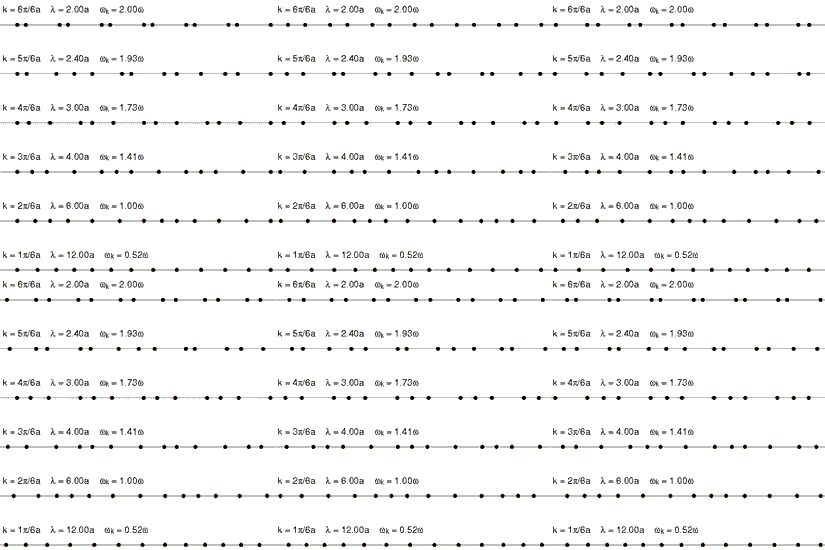
However phonons and quantum tunneling effects were well understood in 1989.
The crux of the argument (of Prof. Hagelstein) turned on the loading of hydrogen or deuterium into the nickel lattice. Fleischmann and Pons insisted that to get the thing to work one had to have high loadings. It was generally understood that the peak loading comes in at 0.84. Michael McKubre showed that the effect initiated at 0.9 and peaked at 0.94, above the maximum predicted by theory. SRI‘s lab was reporting loadings of 0.96. The other scientists said “But we have maximum loading, according to theory.”
OK let’s move this thing along a bit. It is not a trivial problem, so I shall skip important considerations like ‘electron cloud densities in the octahedral sites’, where the hydrogen and deuterium sit. And then there are the Hamiltonian equations to think about, which model the total energy of the system, and the problem of scaling 9 orders of magnitude to enable the coupling of nuclear and phonon energies. (Why does the image of Chihuahuas and St Bernard dogs spring to mind?)
On consideration I cannot précis 30 years of experimental and theoretical work down to a one-liner. But it is enough to say that it is accessible, and there is a lot of it.
However I understand Professor Peter Hagelstein to say he chose Mercury because it had the “closest (lowest) nuclear energy to phonon energy”, i.e. it presents the least worst coupling problem. (The smallest St Bernard dog. Now to find the biggest Chihuahua)
He plugged the numbers into his model and predicted that the surface of the mercury would produce collimated x-rays. And it worked. Put that in your pipe and smoke it.
A quick note on the relationship between x-rays and gamma radiation. They are both photons with the difference that x-rays come from the electron cloud and gamma comes from the nucleus. There is plenty of spectrum overlap.
Michael McKubre says that it is now up to the empiricists to provide more data for the theoreticians to work with.
Seeing that we are enthusiastically bailing out the banks perhaps just a small fraction? A teeny tiny little bit? After all we are talking about the viability of our existence on this planet.
Think about it. –Arthur Robey
Sunday night. 12th Aug 2012
Boy, I am glad that I don’t eat like that every day.
A bus picked us up in front of the hotels. It was full of professors from all over the world. Never have I been in the presence of such a high powered group. I got to talk with nearly everybody. As soon as the official photographs are released I shall get them on the website.
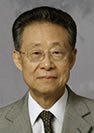 But now we must talk of Professor Yeong E Kim’s contribution last Friday.
Kim, Y.E. Conventional Nuclear Theory of Low-Energy Nuclear Reactions in Metals: Alternative Approach to Clean Fusion Energy Generation in 17th International Conference on Cold Fusion. 2012. Daejeon, Korea. .pdf
John Huizenga had “three miracles” that must be overcome to validate Fleischmann and Pons‘ claim.
1. The Coulomb Barrier suppression.
2. No Nuclear products
3. A momentum violation in 3 Space (plus time)
In answer, from several hundred experiments, we find that the Coulomb Barrier is, somehow, “suppressed” between two deuterium atoms.
And there are nuclear products. Notably, tritium, which I have previously explained does not hang around too long (there’s very little of it around naturally) and therefore, its presence cannot be from an ambient source.
Helium 4 is also produced proportional to the amount of energy produced.
Radiation is detected, but not the 23.8 MeV predicted by hot fusion.
I was talking to Professor Xing-Zhong Li, head of the Fusion Power Program at Tsinghua University in Beijing, China. He pointed out that the sun produces very few neutrons. So why the demand that CF produce a shower of lethal neutrons to be real? Is the sun not real?
But I digress.
Professor Kim then began to address his colleagues in mathematical formulae. The gist of it – that I gathered – is that the Gamow factor in a dense matrix of matter does not apply as it does in (high energy) free space, and, the coulomb barrier is overcome by the stopping power of the deuteron loaded matrix.
I think of it this way. Consider a bullet hitting a feather. The bullet has to hit very fast to smash the feather or the feather just moves out of the way. This is the free (Hot Fusion) situation.
Now think of a bullet hitting a large metal plate. The bullet in this case does not have to be going too fast to impart its energy to the iron plate. (The Solid State situation) Remember the extreme pressure environment due to Nernst’s law. (I seem to recall that the Brownian motion due to thermal agitation is about 1000 km/hr.)
In any event, ‘the circumstances of Cold Fusion are not the circumstances of hot fusion.’
Professor Yeong also invoked the Bose-Einstein Condensate (BEC) idea mathematically, using two routes. Both these routes agreed to within a factor of 2.
Heisenberg’s Uncertainty Principle says that an objects position and momentum may not both be known. The more you know of an object’s position, the less certainty there is to its momentum. Bose Einstein Condensates have been made by restricting an object’s momentum to close to zero by lowering its temperature towards absolute zero, whereby its position grows to macroscopic volumes.
Here is a picture of one being formed. Wiki
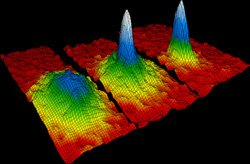
The obverse also applies. If a (deuteron) particle’s position is confined in a trap, then its momentum tends towards infinity, perhaps more than enough to penetrate the Coulomb barrier.
I think that I have done more than enough damage to Professor Kim’s explanation.
If you want a corrected interpretation perhaps you can contact him here. Or you could save up now for ICCF18. Bring your friends.
All the errors are mine. —Arthur Robey
Monday 13th Aug 2012
Last night I went out with the boys for dinner. One of the boys turned out to be Nicholas Chauvin, the owner of LENR Cars. I did not seek him out. We were just having beers at a delightful Korean restaurant and so it emerged. I could write the whole dispatch on him and his project alone, but it is just once such event: these are extra-ordinary times and extra-ordinary people.
I am sure my Korean hosts wonder what on earth I am doing here, so obviously out of my depth. But I answered them that in spite of my difficulties understanding the physics, there is no place on the planet that I would rather be.
And speaking of extra-ordinary people we started the day with a memorial speech for Professor Fleischmann given by his friend Dr. Michael McKubre. I learned that Dr Fleischmann was a delight to be with and that his sentences were carefully crafted to have many levels and maximum effect. What a loss, and what an injustice.
These dispatches are going to earn me a reputation as a name dropper. For that I apologize, but imagine a hall of approximately 200 distinguished professors. I am the fisherman who drops his line into the water and every time catches a huge fish. Yes, that is what it is, a huge school of professors.
Defkalion was there. They laid a lot of their cards on the table. Not all mark you, but I got the feeling that they were engendering a more healthy relationship with the academics and pure researchers.
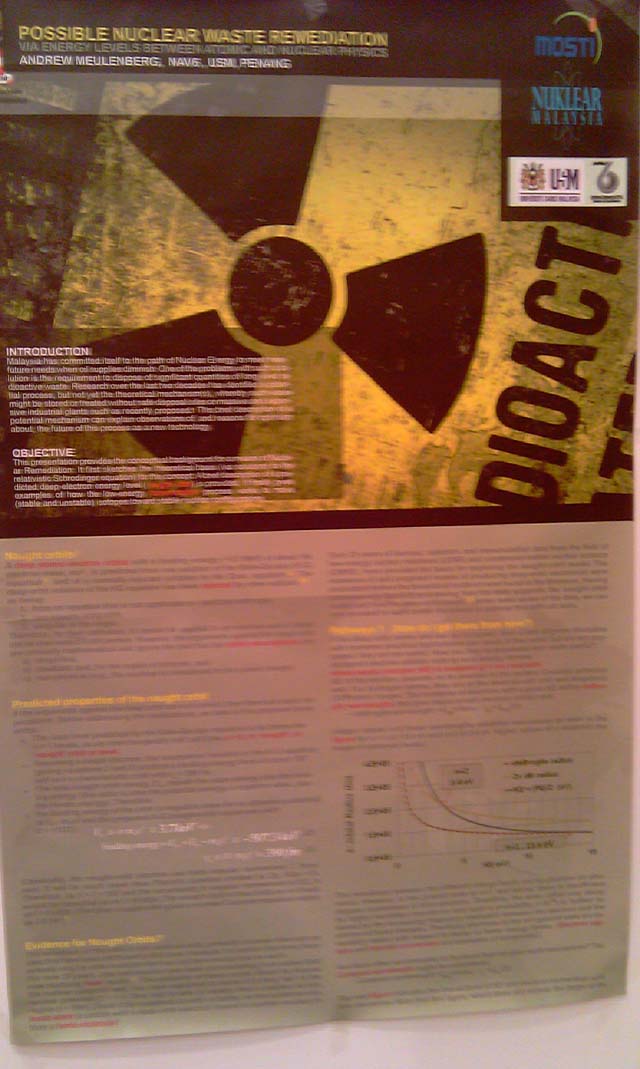
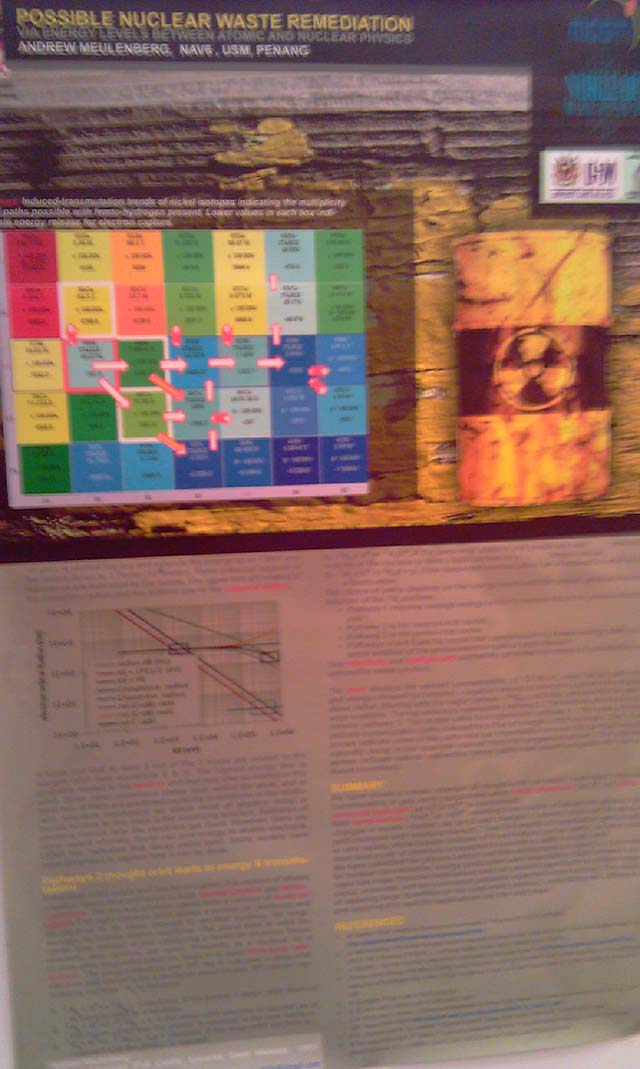
 I asked Professor Meulenberg if he thought that their model of the hydrogen atom was correct and he said that he believed that ‘it was not necessary to invoke a highly oblate orbit in order to get the electron close enough to the proton to cancel out the Coulomb charge.’ He felt that this Condensed Matter Nuclear Physics is going to move Quantum Physics from a very useful tool into one that is both useful and intuitive.
I think that I understand parts of his model and it would be a dereliction of duty for me to not at least try to impart my understanding to you…,well…er…I did try, but find that too many of my sacred cows are being skittled. I had better leave the task to brighter minds than mine.
How many years have we used fire? Yet it is only in the last two hundred that we have understood that it is a chemical process. Complete knowledge is not necessary for a useful application.
What I hope to impart to you is that the importance of this field is going to be far greater than merely saving civilization. It will revolutionize physics. There will be papers published sometime after the closing ceremony and those interested can read them and get a far more accurate picture of what is being considered.
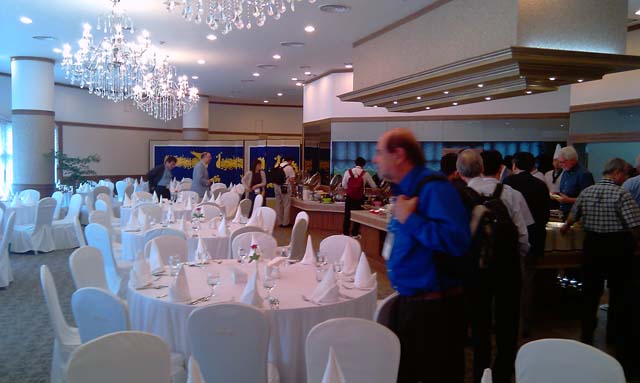
Lunch was a feast for the eye as well as nourishment for the soul. My photos remain locked in my camera. If only either of my sons were here they would find it a trivial task to leach them off into my computer and hence onto the web.
It is in the nature of a conversation with bright minds that the data rate is high, and so it is with these events. What has surprised me is the number of contenders in the race to bring non-theoretical applications to you, the consumer.
In the beer drinking symposium (Symposium means drinking together), it was speculated that in the future, all these miracles will be taken for granted, in much the same way we are taking the internet, flight, and all the other fruits of research for granted now.
By the way girls, there are some incredibly good catches here. The young men are coming into the field. It is a self-selection process. You might want to join in the fun too. –Arthur Robey
Tuesday 14th Aug 2012
One of my peers is a climate skeptic and claims we are going into another ice age. I replied that I was indifferent to the excuses.
Because of my night out I had a sleep-in and had to miss breakfast, but with this missive, I shall repair shortcomings of the last dispatch. There is a lot of ground to cover.
There are two reasons to do experiments on Cold Fusion.
The first is scientific: to verify and understand the anomalous heat effect (AHE).
The other reason is to produce a marketable product, something useful.
And then there are the experiments that have a foot in each camp.
The NANOR is such a device, and Professor Peter Hagelstein chose as his topic to discuss the NANOR. (Now there is an interesting and informative website! Thanks Barry.)
This [the NANOR] is a device about the size of an electronic resistor that produces heat on-demand in a highly reproducible and consistent way.
Actually the reproducibility issue is becoming a bit of a yawn. I have a PDF of the talk by Prof Hagelstein but there are copyright issues so my urge to cut and paste the beautiful curves will have to be suppressed. Enough to say that the energy gain is 16.
Professor Hagelstein was asked why the device was so small, and can we scale it up?
He answered that it is a lot cheaper, and with quicker results, if experiments are done on small scale. (This is in contrast to most hot fusion devices. I give a nod of recognition to Focused Beam Fusion)
Michael McKubre has been vaporizing tiny pieces of ‘saturated and prepared wire’ in liquid nitrogen. By measuring the amount of nitrogen vaporized, this told him how much power he had generated.
David Kidwell challenged Dr McKubre’s method because of the presence of ammonia in the liquid nitrogen from the manufacturing process. Liquid ammonia vaporizes at -50C so it would be a component of the volume measured.
I gather they are going to sort it out behind the bike shed. That is how science is done.
It was pointed out to me by one of the wives that I am not the only Australian in the pack. I tracked down Steve Heaton, and he represents Star Scientific. When I went to the east coast to buy my motorbike, Ruby asked me to interview them. My request was rejected.
Star Scientific is taking the muon catalyzed fusion approach. Understanding that I did not want to embarrass Steve, I quizzed him cautiously and asked him if he felt optimistic. After some reflection he said that he did. You will have to be satisfied with that.
There were many other lectures. Most were unintelligible to me because of the language barrier, my ignorance, and my loss of consciousness. It was a late night. I am sure they were important lectures, but if you pay peanuts you get monkeys. (Me)
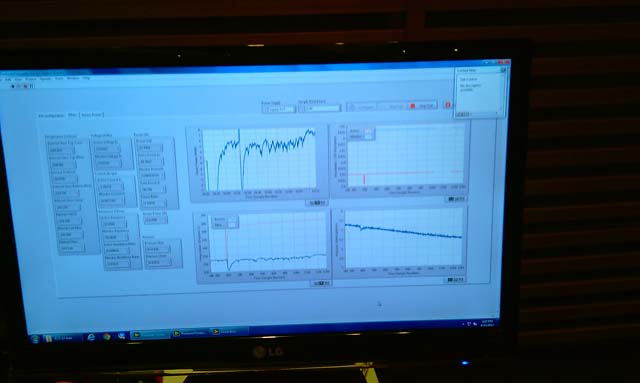
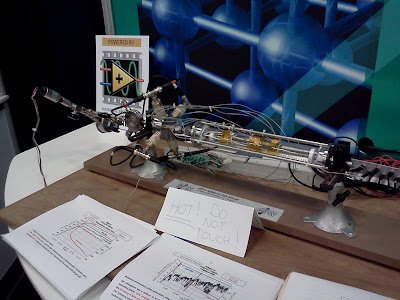
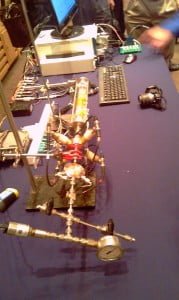
But what I did get from Professor Celani’s presentation is that constantan is even more permeable to hydrogen than Palladium. A working demonstration was set up for us to look at. David A Kidwell from the Naval research center cast his critical eye over the apparatus and I understand that there were some things he would have done differently, (Is there such a thing as a perfect machine?), but it got a nod of approval.
It is gas loaded and runs at >100°C. I believe it was running at about 1.16 efficiency. Celani said that tomorrow it would perform even better. I shall correct that figure in tomorrows dispatch. It is a scientific demonstration that achieves its goal of repeatability.
Naoko Takahashi presented a demonstration on how to prepare the surface of palladium to increase its permeability. She was sponsored by Toyota. I do not know of any other giant manufacturing company supporting this research. She is young and competent. I wish her a successful career.
David Kidwell rushed through a lecture at the end of the day in which he demonstrated a video of a Sterling motor that he had running (assisted ) on anomalous heat generated simply by pressurizing and depressurizing H2 and D2. The best explanation that I have is that I have got the wrong end of the stick. It was a long day.
David French and I met. He is as straight as an arrow; nice bloke. We decided to collaborate, but the day was too full.
I must apologize for not covering the other speakers. –Arthur Robey
Thursday 16th Aug 2012
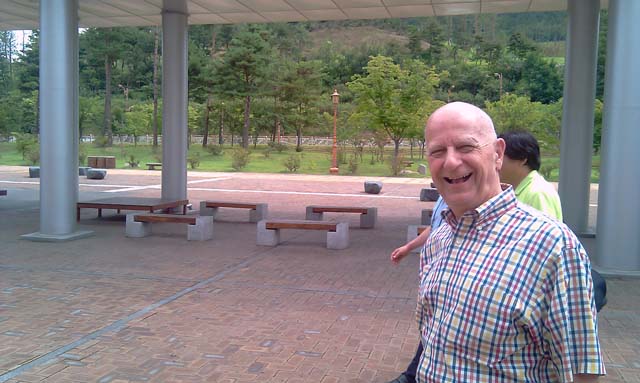
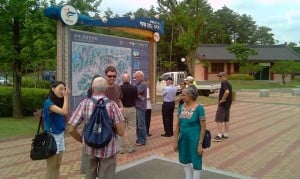
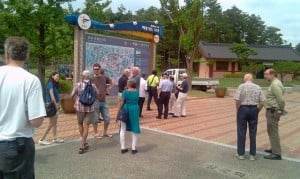
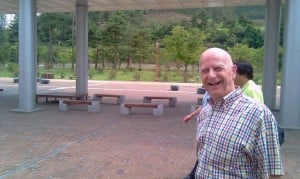
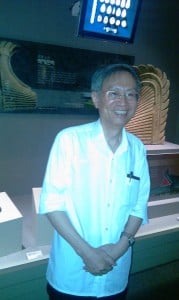
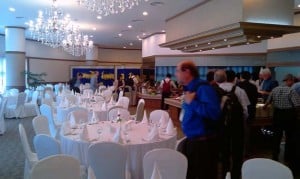
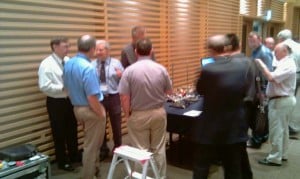
Pictures!
We await Mr. Robey’s descriptors, but I couldn’t resist posting them up bare naked anyway! –Ruby Carat





Thursday continued…
If you ever get lost, do it in Korea.
The taxi dropped me off in front of the K1 building, and it was locked. Now what? Breakfast is always a good thing. I went to the café to re-group. I wondered around the campus in a purposeful manner. (I know what I am doing, right?)
I went to the entrance gate where the guards are. They understood. I am an idiot tourist who hasn’t a clue. I am embarrassed and try to escape. They insisted that I was theirs now. They found a student and we worked out that I was nowhere near my target. They summoned a taxi, explained where I am going and I am saved.
Try to be kind to foreigners and small children.
What I am trying to say is that I missed two of the most important theoretical lectures, one by Professor Hagelstein and another by Professor Meulenberg.
I marched in as Professor Vladimir Vyovskii offered his interpretation of the empiricists’ findings. My jaw dropped when he took a large hammer to Planks constant, ħ. He bent it horribly out of shape. He said that ħ lives on the border between classical physics and Quantum physics and therefore it should be stretched out to cover classical physics. All you classical people now live in a quantum world.
With this assumption, he dived into the mathematics (which I would describe to you – but haven’t the time), got his computer to draw up some theoretical graphs, and overlaid them on the empirical results. Not quite a prediction, more sort of post-diction. His fit impressed me.
I happen to know that while Professors Meulenberg and Vyovskii are hell bent on having a good time at the expense of Quantum theory, while Professor Hagelstein believes that the answer lies somewhere in the existing theories, if only he could find it. (Recall his convincing prediction of collimated x-rays.)
For those who concern themselves in such matters, copies of the papers can be found here. You will find the link under “News” as soon as they release their final drafts.
Dawn D Dominguez of the Naval Surface Warfare Centre, USA told us how she tried to disprove Drs. Fleischmann and Pons, and failed. In other words she lobbed stones at this little boat and it would not go down. That is the nature of the scientific method. Science can only disprove things, it cannot prove things. So the next time someone tells you that it is scientifically proven, tell them that nothing is.
An AK 47 round discharges 2kJ. Run #64 produced a spike of 10kJ, five times that of a 7.62 round. Therefore, the Fleischmann and Pons experiment was not disproved.
Dr. Yasuhiro Iwamura of Mitsubishi Heavy Industries explained how they have been layering palladium with compounds, for instance calcium oxide, and diffusing deuterium through the diaphragm to transmute elements successfully. He sees the potential to make scarce elements on demand. They have been doing this research for the past 13 years.
I guess now we can’t squabble over mineral deposits. We will have to find some other rationalization for our insanities. It is going to be hard.
Dr. Jean-Paul Biberian turned off one of his experiments and went home for the weekend. When he got in on Monday morning, it had exploded. Critics supposed it was a hydrogen/oxygen explosion so, just like in the Mythbusters, he tried to explode his apparatus by filling a copy up with hydrogen and oxygen and firing it off with a platinum wire. It went “pop” in a dispirited sort of way. Nothing, nada. Myth Busted. The explosion was not chemical.
Don’t try this at home kids.
There is so much more to tell and the good news is that my contretemps with the photos is resolved. When I get home, I shall compile them into a digestible essay for your gratification.
I see that Ruby is already onto the case. Thank you Ruby. –Arthur Robey
LAST WORD from Daejeon
Tomorrow I am taking the bullet train to Seoul to begin my journey.
I have had a ball.
Good night. –Arthur Robey
Thank you Arthur!!! –Ruby
MORE
Skype: sunwonpark
To participants of ICCF-17: Greetings from the Groundlings by zed short
Brillouin Energy presentation ICCF17_Tanzella_Brillouin
Celani, F., et al., Cu-Ni-Mn alloy wires, with improved sub-micrometric surfaces, used as LENR device by new transparent, dissipation-type, calorimeter ICCF-17 Presentation .pdf
Celani, F., et al. Cu-Ni-Mn alloy wires, with improved submicrometric surfaces, used as LENR device by new transparent, dissipation-type, calorimeter in 17th International Conference on Cold Fusion. 2012. Daejeon, Korea. .pdf