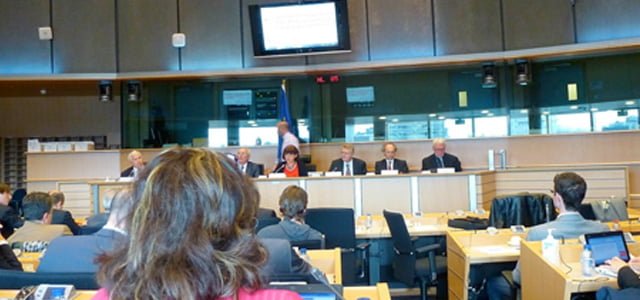
The European Parliament’s Industry, Research and Energy (ITRE) committee chaired by Amalia Sartori met yesterday in Brussels with scientists and business leaders from the new energy community to discuss the status of the Fleischmann-Pons Effect (FPE), the generation of anomalous excess heat from a reaction between hydrogen and various transition metals.
Titled “New advancements on the Fleischmann-Pons Effect: paving the way for a potential new clean renewable energy source?“, the meeting was co-organized by the Italian National Agency for New Technologies, Energy and Sustainable Economic Development (ENEA). An announcement on their website read:
3 June 2013, Brussels. New advancements on the Fleischmann-Pons Effect: paving the way for a potential new clean renewable energy source? Event co-organized by ENEA at the European Parliament. Under the patronage of Hon. Amalia Sartori, Chair of the ITRE Committee c / o European Parliament, the event sees participants between the Commissioner ENEA Giovanni Lelli, the Director of the Industrial Technologies Directorate Herbert Von Bose, the Director of the Sidney Kimmel Institute for Nuclear Renaissance (USA) Graham Hubler, and the Vice-Chancellor for Research, University of Missouri (USA) Robert Duncan.
Robert Duncan , Vice-Chancellor for Research University of Missouri (USA) Michael McKubre , SRI – Stanford Research International (USA) Graham Hubler , Director Sidney Kimmel Institute for Nuclear Renaissance (USA) Stefano Concezzi , Vice President of National Instruments (USA) PJ King , CEO ReResearch (Ireland)) Konrad Czerski , University of Szczecin (Poland), Technische Universität Berlin (Germany) Vittorio Violante , Roma2 Tor Vergata University , Research Centre ENEA Frascati Andrea Aparo , Roma1 Sapienza University , Politecnico di Milano , Ansaldo Energia Enrico Paganini , ENEL Green Power Antonio La Gatta , President TSEM Engineering and Electronics Giovanni Lelli , Commissioner ENEA Aldo Pizzuto , Head of Technical Unit Merger ENEA Maximum Busuoli , Head of EU ENEA – Liaison Office Herbert von Bose , Director of Industrial Technologies Sub-Commission of the European Parliament Amalia Sartori , President comission ITRE Committee of the European Parliament
Passerini has posted a report of the meeting which includes photos of slides of several presentations.
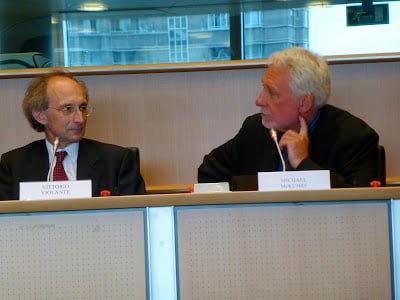
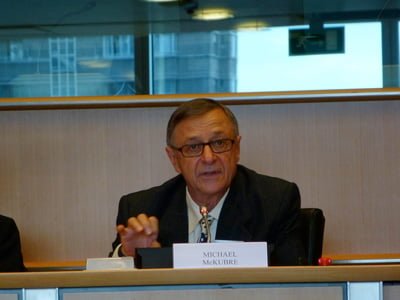
Dr. Vittorio Violante and Dr. Michael McKubre at European Parliament ITRE meeting.Dr. Michael McKubre presented on New Nuclear Effects in Deuterium-Palladium Electrolysis and Gas Systems under near ambient conditions [visit]
Dr. Vittorio Violante, of whom McKubre said “was once the only man in the world who could make palladium that worked”, presented Material Science for Understanding the Fleischmann and Pons Effect. [visit]
Konrad CzerskiNew Evidence of the Cold Nuclear Fusion – Accelerator Experiments at Very Low Energies. [visit]
.
Dr. Graham Hubler is Director of Sidney Kimmel Institute for Nuclear Renaissance at University of Missouri.Dr. Graham Hubler presented Anomalous Heat Results from the Naval Research Lab and the University of Missouri. [visit]
Dr. Robert Duncan presented Discovery of New Nuclear Phenomena in Condensed Matter the State. [visit]
According to Passerini, the meeting in Brussels was held “to convince decision makers of the importance of funding research.”
From their website, the ITRE Committee “will deal with legislative proposals on Research; the EU policy on research is due to be redefined for the years to come and to cope with new challenges.”
Ironically, Passerini cites American research as an impetus for the European community, implying targeted support for new energy in the U.S. – were it only true. He also mentions Italy’s official position on cold fusion, which mirror’s the U.S. federal stance: cold fusion is impossible, so let’s ignore it.
Still, Italy has been the heart of new energy research in Europe beginning with Vittorio Violante‘s lab at ENEA focusing on palladium-deuterium cells, and Francesco Piantelli and Sergio Focardi‘s early work on nickel-hydrogen reactions.
Andrea Rossi presented his first public demonstration of the E-Cat steam generator at the University of Bologna in January 2011 which brought the world’s attention to new energy and galvanized a whole community of supporters. Today, an open source project links citizen scientists around the world with longtime researcher Francesco Celani of the Italian Institute for Nuclear Physics (INFN).
ENEA published a report in 2008 on the History of Cold Fusion in Italy [ .pdf] to commemorate the 20th Anniversary of Drs. Martin Fleischmann and Stanley Pons’ announcement of cold fusion which coincided with the 15th International Conference on Cold Fusion held in Rome in 2009.
No doubt there were discussions of the recent report on Rossi’s progress and redesign of the E-Cat HT. The caliber of research presented by both scientists and entrepreneurs could only have impressed the ITRE committee. Positive recommendations to the full Parliament could produce a funding stream for a coordinated research program to hasten the quickening pace of development.
Chapters play a crucial role in fulfilling the Society’s mission. Led by dedicated volunteers, SER Chapters focus on local issues and give our members the opportunity to mobilize and engage in regions around the world. We are proud to partner with our chapters in Australasia, Asia, Europe and North America to advance our common goals.
AsiaSER Nepal Chapter: Established in 2011 and serving members in Nepal
AustralasiaSER Australasia Chapter: Established in 1999 and serving members in 17 countries throughout Australasia
EuropeSER Europe Chapter: Established in 2001 and serving members in Europe and the British Isles
SER Great Basin Chapter: Established in 2011 to serve members in Utah, Nevada, southern Idaho, southeastern Oregon and eastern California
SER Mid-Atlantic Chapter: Established in 2004 and serving members in Maryland, New Jersey, New York, Pennsylvania, Delaware, Virginia, West Virginia and the District of Columbia
SER Midwest-Great Lakes Chapter: Established in 2008 and serving members in Indiana, Illinois, Ohio, Michigan, Minnesota and Wisconsin
SER New England Chapter: Established in 2005 and serving members in Maine, New Hampshire, Vermont, Massachusetts, Rhode Island and Connecticut
SER Northwest Chapter: Established in 1992 and serving members in the Cascadia Bioregion, including Alaska, Idaho, Northern California, Montana, Oregon and Washington
SER Ontario Chapter: Established in 1994 and serving members in Ontario, Canada
SER Southeast Chapter: Established in 1995 and serving members in Alabama, Florida, Georgia, Kentucky, Louisiana, Mississippi, North Carolina, South Carolina and Tennessee
SER Southwest Chapter: Established in 2011 and serving members in Arizona, New Mexico, Utah, southern Nevada and southern California
As cold fusion LENR technology matures with market applications, I can not help but reach out to those who I hope most to succeed. Environmental Remediation (removal of toxins or radio-actives) and Environmental Restoration (ecology revival) are fairly new industries with an impressive growth rate.
The science of LENT – low energy nuclear transmutations, for the first time, allows us to advance beyond the contain or bury “solution” for nuclear waste; supplying a method to transmute these from harmful to benign elements.
Almost as a side benefit, (considering the boon of the aforementioned LENT technology) LENR energy will benefit the peoples of the Society for Ecological Restoration, as it will all of us, with reduced energy expenses. (restoration/remediation projects have high energy costs)
Ecological restoration and environmental remediation will be empowered and enabled by the recent validation of marketable LENR energy and emerging LENT (transmutation science). These folks deserve it, their hearts are in the right place as well as their brains.
Become a member, attend their 25th anniversary celebration, and watch this fast growing industry.
As the oil, coal, and U238 energy industry and infrastructure collapses there will be lots of more clean-up projects going on. Cold fusioneers seeking employment should attend. Exciting opportunities can be found. We will be creating them. Cold Fusion Now.
“Reflections on the Past, Directions for the Future”
Thanks be – gbgoble – 2013
The SER2013 World Conference on Ecological Restoration and 25th Anniversary
Reflections on the Past…
Directions for the Future
The SER2013 World Conference on Ecological Restoration: Reflections on the Past, Directions for the Future will bring together more than 1,200 delegates from around the world interested in the science and practice of ecological restoration as it relates to natural resource management, climate change responses, biodiversity conservation, local and indigenous communities, environmental policy and sustainable livelihoods.
It is no secret that today’s world is struggling with the challenges of climate change, biodiversity loss, sustainable resource extraction and human poverty. Here at SER, we stand firm in our belief that ecological restoration plays a crucial role in mitigating and adapting to these challenges. We envision a future where ecological restoration is widely and effectively implemented to re-establish and enhance biodiversity, ecosystem services, and human well-being. Since our incorporation in 1988, we have made it our mission to advance the field of ecological restoration.
Global Network
SER has grown into one of the world’s leading global networks dedicated solely to the science and practice of ecological restoration.
-Established chapters to advance our mission in fourteen regions around the world
-Expanded our network to include members in over 70 countries around the world, solidifying a global voice behind ecological restoration
-Hosted world conferences in Spain, Australia, Mexico, Canada, England and the United States to allowed academics, practitioners, and students come together to exchange ideas, showcase their work, forge new alliances and participate in workshops, field trips and other educational activities
Policy and International Collaboration
SER participates in international fora that engage the public, private and NGO sectors at global, regional, national and local levels, to advocate for the use of appropriate, participatory, and knowledge-based restoration activities. Click here for detailed information on all of SER’s global partnerships.
– Entered agreement with the Ramsar Convention on Wetlands and participated with the preparation of proposals for updating and expanding existing Ramsar guidance on the restoration and rehabilitation of lost or degraded wetlands
– Contributed to various IUCN ‘Internional Union for the Conservation of Nature’ commissions and initiatives over the past decade
– Launched initiative with the Wildlands Network to bridge the gap between the science and practice of ecological restoration and the practice of conservation biology and landscape ecology within the context of connecting regionally significant fragmented wildlands in North America.
Publications and Resources
SER distributes a variety of publications and resources aimed at education, practical application and awareness.
-Launched the Global Restoration Network, an online database that links research, projects, and practitioners around the world
-Established book series on ecological restoration in collaboration with Island Press to create a forum devoted to advancing restoration science and practice through an interdisciplinary approach
-Produced Restoration Ecology, a peer-reviewed journal that highlights the results of restoration projects worldwide as well as scientific advances, practical implications, lessons learned and new perspectives
-Developed the SER Primer on Ecological Restoration (pdf), a concise statement of restoration principles and includes a clear definition of what restoration is, how it is planned, conducted, and evaluated, and how it coordinates with related disciplines
-Released Investing in our Ecological Infrastructure (pdf), a timely and relevant brochure, to highlight the economic benefits inherent in ecological restoration projects
Introduced conversation on the role of ecological restoration in mitigating climate change and ongoing biodiversity loss through Opportunities and Challenges for Ecological Restoration within REDD+ (pdf)
Cold Fusion Now Acivist Letter Sent
To The Society for Ecological Restoration
Dr. Dhanajay Regmi, Professor Kingsley Dixon, Vern Newton, Norbert Hölzel, Tamara Bonnemaison, Wendy Horan, Professor Eric Higgs, Professor Mark Paschke, Nancy Shaw, Michael Leff, Nancy Sherman, Bruce Pluta, Dennis Burton, Professor Roger Anderson, Professor Young D. Choi, Mickey Marcus, Denise Burchsted MD, Jules Opton-Himmel, Allison Warner, Dr. W. Barry Southerland, Rolf Gersonde, Ray Entz, Sal Spitale, Professor Stephen Murphy, Jennifer Franklin, Charlotte Reemts, Kelly Lyons, Marissa Sipo
Respectfully to each of you…
and your colleagues,
I would like to discuss Cold Fusion / LENR Energy and LENT Science.
My hope is that you will make this a highlight at your upcoming international conference (SER 2013).
These three articles will show you the importance of this emerging clean energy technology.
Please call and discuss the possibilities.
Nearly Free and Unlimited – Totally Nonpolluting
Benign Transmutation of Radioactive Elements
Energy and Science to Empower and Enable Ecological Restoration and Environmental Remediation
On a Scale Never Seen Before
This century will be known as…
The Century of Ecological Restoration and Environmental Remediation
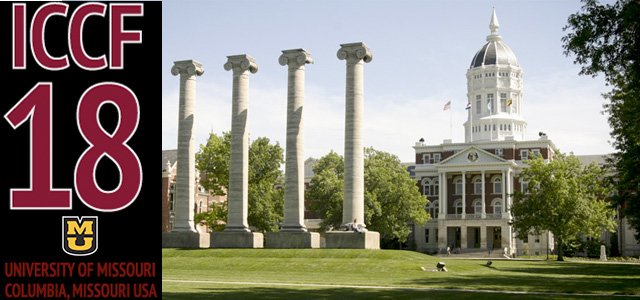
The 18th International Conference on Cold Fusion (ICCF-18) will be held at the University of Missouri in Columbia, Missouri, U.S. July 21-27 where Vice Chancellor of Research Dr. Robert Duncan has led the creation of a world-class research program based on low-energy nuclear reactions (LENR).
Since his appearance on the CBS network’s 60 minutes program in 2009, Duncan has brought international researchers to the university’s business incubator park and helped to establish a new facility specifically devoted to the science.
The Sidney Kimmel Institute for Nuclear Renaissance (SKNIR) is named after philanthropist Sidney Kimmel who funded the project. An overview of the facility will be presented by Director of the Institute and Former Navy Research Lab (NRL) nuclear physicist Dr. Graham Hubler on the first day of the week-long conference. Fellow NRL scientist Dr. David Kidwell will give the Keynote speech.
ICCF-18 brings together some of the top scientists in the world to report on their research. This year’s program “Applying the Scientific Method to Understanding Anomalous Heat Effects: Opportunities and Challenges” has been published and is accessible here.
Researchers will speak on multiple types of systems, both palladium-deuterium Pd-D and nickel-hydrogen Ni-H. Most talks will focus on experimental results regarding excess heat and transmutations, but theorists will present several models of the reaction as well.
Included are panel discussions on diverse topics of Tritium, and Emerging Career Opportunities.
A panel on Entrepreneurship and Innovation chaired by Mr. Matt Trevithick features former-Navy SEAL and new-energy entrepreneur Douglas Moorhead along with materials scientist and ARPA-E GRIDS program director Mark Johnson.
Dr. Mahadeva Srinivasan, head of the Organizing Committee for ICCF-16, will chair Condensed Matter Nuclear Science – The Way Forward Panel that includes researchers from multiple countries.
A workshop held by Italian National Agency for New Technologies, Energy and Sustainable Economic Development (ENEA) will be led by Dr. Vittorio Violante, and include Dr. Michael McKubre of SRI International, Dr. Robert Duncan of University of Missouri, Dr. Graham Hubler of SKINR, and Dr. Emanuele Castagna of ENEA.
A Transmutations in Biological and Chemical Systems Panel chaired by Dr. Jean-Paul Biberian will include Dr. Mahadeva Srinivasan and Dr. Vladimir Vysotskii, whose research has reportedly revealed transmutations by biological systems that have turned radioactive isotopes into benign material, a process which may lead to the ability to rid the planet of radioactive waste.
Cold Fusion Now author and patent expert David J. French will also present time TBD. Ruby Carat will attend to conduct video interviews and provide news updates throughout the week.
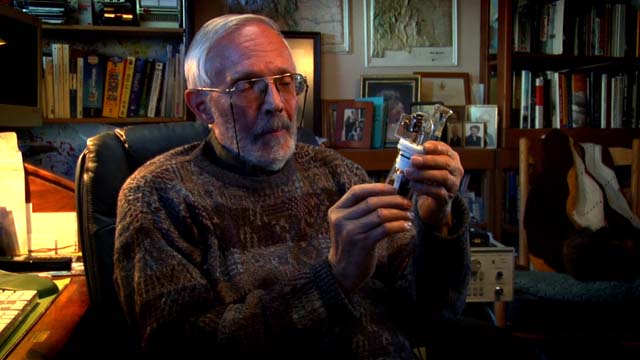
137 Films’ The Believers played a packed house at the Cinequest International Film Festival last Friday night in San Jose, California. It was Cold Fusion Now’s third viewing.
Eli Elliott attended the film’s premier in the Chicago Film Festival and his video review is here. I caught screenings at the Studio City Film Festival in Los Angeles and the Cinequest Film Festival in San Jose, California.
The film attempts to “show the way science is done in America”, using one of the most pathological sagas in science history. Directors Monica Long-Ross and Clayton Brown had a tough task using as example the content of cold fusion, also called low-energy nuclear reactions (LENR), lattice-assisted nuclear reactions (LANR), and quantum fusion.
The movie portrays the consequences of Drs. Martin Fleischmann and Stanley Pons‘ announcement of their discovery of fusion-sized energy from a table-top electrolytic cell. Initial excitement lasted a matter of weeks. When elite American scientists failed to reproduce the effect, accusations of delusion, and even fraud, circulated widely.
The new, clean energy claim that defied conventional theory dropped into the TV/satellite environment, bypassing the mainstream print hierarchy, and the warring domains retrieved Greek tragedy, which the filmmakers realize with a sad, pessimistic tone throughout the movie.
21rst century sacrifice
In the ancient Mediterranean, tragedy brought the villages together through the social ritual of theater. The tragedy of cold fusion was set in the global theater just as digital technology brought the world together with fax machines and 24-7 instant news coverage.
Greek tragedies were traditionally performed in late-March and early-April, with the original ancient spectacles only lasting three days, while the tragedy of cold fusion continues nearly a quarter-of-a-century later.
Origins of Greek tragedy are uncertain. However the word τραγῳδία meant “song for the sacrificed goat”.
In the case of cold fusion, two men who dared challenge the scientific doctrine of their time were sacrificed for the status quo of political and financial favor.
Death threats were made, children taunted, and normally decent scientists threw tantrums, acting like bullies. Careers were destroyed. Anyone able to reproduce the experiments was shunned from mainstream science. Stanley Pons opted out of the field long ago, giving up his citizenship to the U.S. when he left the country, and Martin Fleischmann, who continued to pursue research throughout the rest of his career, has now crossed-over. (Read the Infinite Energy obituary here.)
The movie tells the story of this sacrifice through the recollections of those that lived it, from both sides of the amphitheater.
Characters in a Marathon battle
Edmund Storms provides an articulate Chorus. A former Los Alamos National Lab nuclear chemist who measured tritium from his early Fleischmann-Pons experiments, proving a nuclear origin of the reaction, Storms describes a chronology of events with a reasoned, matter-of-factness.
He has seen the reaction take place time and time again since 1989, and put experimental skills to documenting the anomalous effects. Now with a new description of the nuclear active environment (NAE), Storms focuses on science, not drama.
The narrative is grounded with his chronicle.
But Robert Park, the former Director of Public Information for the American Physical Society (APS), draws himself as the villain.
At the APS meeting on May 1, 1989, a program was choreographed by physicists with competing interests, as noted in the film by science historian Thomas Gieryn. That session ended in an absurd vote on whether or not cold fusion was dead – by show of hands. The vote was led by Steven Jones then of Brigham Young University, who was working on another form of unusual muon catalyzed fusion already dubbed ‘cold fusion’. That meeting defined the status of research for the next 24 years: untouchable.
In the film, Robert Park refers to scientists who pursue this research as “a cult of believers”, from which the movie’s title derives. But Park really speaks about himself.
He believes that nuclear reactions only happen in high-energy plasmas, like the Sun. Park points to the lack of radiation and neutrons from cold fusion experiments (which normally occur in hot fusion reactions) revealing his allegiance to the standard model of nuclear reaction created a century ago.
Robert Park refuses to look at any contrary research data because of his belief.
Empirical facts show otherwise.
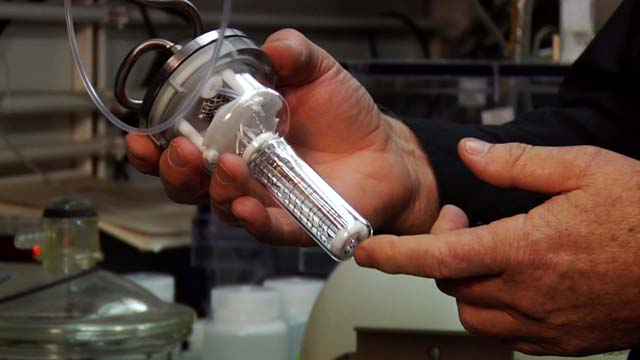
A cold fusion energy cell is small, using as fuel the hydrogen from water.
Excess heat experiments have been confirmed again and again by first-class labs around the world, and anomalous effects now include low-energy nuclear transmutations (LENT).
Even as researchers try to form a theory to model this elusive reaction, there are an increasing number of commercially-minded participants entering the field.
But The Believers does not portray this success. The documentary is tightly focused on the back-and-forth battle between the reality of empirical data and the dogma of conventional theory.
When Robert Park criticizes Fleischmann and Pons saying “this was not their field”, and claims that Martin Fleischmann‘s career was based “on one experiment and not much else”, Michael McKubre rightly describes Fleischmann’s unique skills and achievements that put him at the top of his field in the world.
But not every punch was countered.
Irving Dardik, portrayed madly amidst piles of paper and books, has his Superwave concept in “quotations” during lower-third text, making it appear speculative, without mentioning it was Dardik’s “Superwaves” that brought Energetics Technologies cells to 25x excess energy return, attracting the interest of Michael McKubre and the lab at SRI International.
While making a disclaimer referencing Dardik’s earlier medical practice legal problems, the film fails to make clear that he successfully helped Fleischmann regain his health to the point where he was able to travel to Rome and accept the Minoru Toyoda Gold Medal Award from the International Society of Condensed Matter Nuclear Science (ISCMNS)for his achievements.
In the film, one of the strongest validations of Fleischmann and Pons’ accomplishment comes from Marvin Hawkins, the then-graduate student who ran the lab of Stanley Pons at the University of Utah during all the hoopla. His determined endorsement for the scientists he worked with, intellectually and emotionally, was rational, and powerful.
“What we did was correct…” he states.
“I will defend them at every turn.”
James Martinez of Cold Fusion Radio is perhaps the most enthusiastic voice in the movie. He opens the first scenes (and the trailer) conveying an urgency for change: “Cold fusion is the key to liberating the human race.” Filmed while speaking with Edmund Storms live on the radio, you can download that interview here.
High-school student Eric Golab provides the only real hope for the future, as an honest inquiry from youth furnishes what’s sorely missing from mainstream science.
Between two worlds
The filmmakers repeatedly make the point they aren’t “trying to show whether cold fusion is real or not”. The content of the film is not the science of cold fusion. A viewer who knows nothing of cold fusion before viewing the film, will most likely know little about cold fusion afterwards, save there was a lot of ruckus.
Through archival film and the words of original participants going at it cabeza-y-cabeza, we re-live the painful drama of a major discovery suppressed, and its discoverers crushed.
The abysmal emotional bottom of the film overwhelms any logical argument on whether or not the phenomenon is real.
Indecision didn’t turn out well for ancient tragedians. However, it was a conscious choice to give pseudo-skeptic and former-Information Officer Robert Park as much weight as long-time laboratory scientists Edmund Storms and Michael McKubre. In some way, this choice validates Park’s negligent ignorance, of which he is apparently proud. The filmmakers decline to say why they respect his position on the matter.
There is no one book, or movie, that can communicate the simultaneous eruption of interest, excitement, fear, and loathing in 1989; it is difficult to capture this story in its fullest (though Eugene Mallove‘s Fire From Ice comes closest).
But Greek tragedies were often in threes, with a final fourth act of comedy, and The Believers begs for a sequel, or two, or … While this first installment will solicit sympathy for the actors in the drama, further episodes are needed to illuminate.
Here’s an audio recording of the directors answering questions from the audience after the San Jose screening.
Cold fusion now and then
The screening at Studio City Film Festival in Los Angeles, California, was in an actor’s studio and performance space. The intimate setting featured small tables and chairs for the patrons.
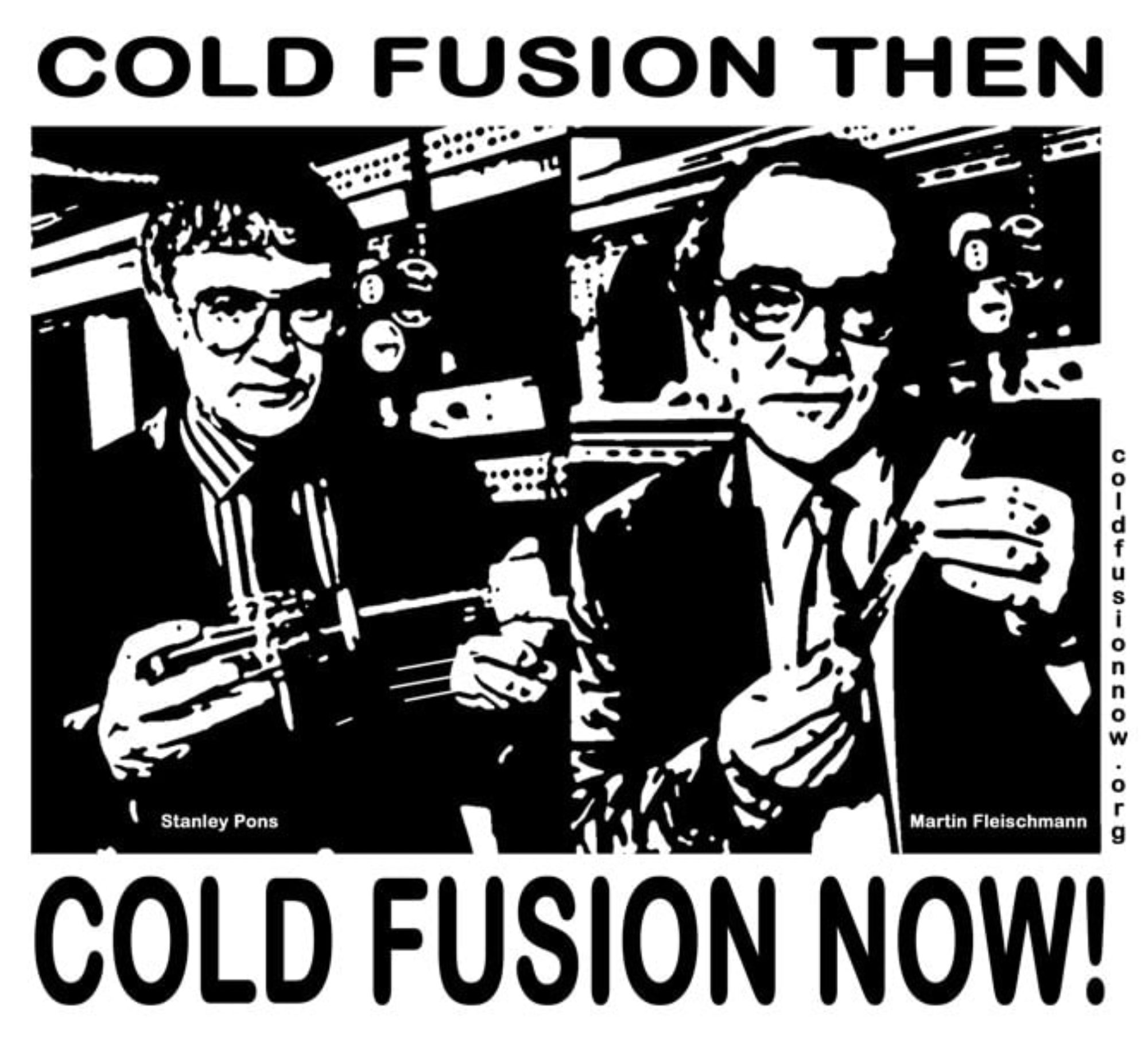
I introduced myself to the Festival organizers as a representative from one of the pro-cold fusion groups in the film, and that I was a colleague of James Martinez. I gave them t-shirts with Martin Fleischmann and Stanley Pons‘ stencil-style images, and they let me put some t-shirts, calendars, and stickers on my table, which drew a few excellent conversation, though sadly only a handful of folks showed up for the movie.
Unfortunately, I was unable to represent Cold Fusion Now in San Jose.
After the show, dragging a giant green recycle Co-op “We’re stronger together” bag stuffed with goodies, I felt orphaned like the little match girl.
Most of the audience left right after the film, while I stayed to record the Q&A with the directors. By the time I got out of the theater, only a small crowd remained in the small second-floor lobby area.
I went around, “Hi, would you like a free Cold Fusion Now sticker?”
“No” was the answer I got more often than not.
Huh?
I did get a chance to say hi to new pals Bob Ellefson and his wife Yvonne who both attended the show in support of this science. They were pretty much the only cold fusion-friendly faces in the leftover crowd that I saw.
Oracle at DelphiSave us Goddess of the Machine
In the earliest form of Greek tragedy, the protagonist is often miraculously rescued at the end by deus ex machina, or ‘god by machine’, referring to the sudden appearance of a god or goddess swooping down on-stage in a crane-like contraption to save the day.
The Believers concludes with a finale of woe.
Park’s last arrows include a shallow disclosure that he doesn’t care whether or not the deluded believers continue their research. “It may not be good science, but it’s science.”
Then, in a kind of opposite-deus ex machina, MIT theorist Peter Hagelstein, who had barely shown up in the movie thus far, is in full-screen close-up, offering a dark vision of defeat, where future historians pick through the early rubble of failure only to see that some good had been done.
It is true that without the support of mainstream science, whose financial and intellectual resources have been entirely absent in this field for twenty-four years, only a lucky breakthrough seems able to shake the torpor. People do not yet realize the extent to which we’ve been robbed of a peaceful, clean-energy lifestyle.
“Tragedy, then, is an imitation of an action that is serious, complete, and of a certain magnitude; in language embellished with each kind of artistic ornament, the several kinds being found in separate parts of the play; in the form of action, not of narrative; with incidents arousing pity and fear, wherewith to accomplish its katharsis of such emotions. . .” AristotlePoetics 350BC translated by S. H. Butcher
The Believers is Act 1, displaying fully the pity and fear generated by a profound discovery.
This story won’t be complete until catharsis, and Act 2, in which a multitude of Heroes realize their Nature, and save a world of species from sacrifice.
Cold Fusion Now is en route to the San Jose Film Festival screening of The Believers, a new cold fusion documentary from 137 Films.
The 80-minute sample of cold fusion history focuses on the aftermath of the March 23, 1989 announcement of cold fusion by Drs. Martin Fleischmann and Stanley Pons. Video of Martin Fleischmann in declining health makes for an emotionally-tough portrait.
Cold Fusion Now will offer free goodies to patrons after the Friday night show as antidote to anguish.
But there’s plenty of sunshine to spread all the way to San Jose.
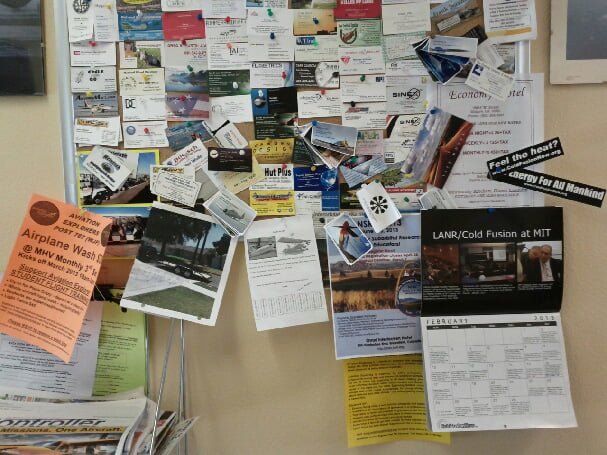
I posted up a calendar on their bulletin board for all the spaceship engineers to see at lunch.
It was a crowded spot, but you can sure see it, and plenty of people pass by on their way to the restaurant overlooking the runway.
Rolling over to Scaled Composites, I dropped off a handful of calendars for the designers of SpaceShipOne and Two.
The Secretary at the Front Desk really dug all the info packed into each page.
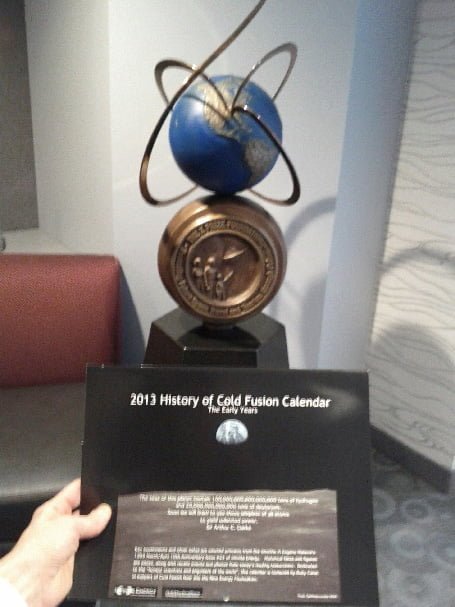
I took a picture of the calendar in front of their X-prize that commands the lobby.
I had to sigh, if only there was an X-prize for new energy…
Then I slid over to Xcor, a small, independent company making their own spaceship – “the whole thing”, said the young engineer who answered the door. I said cold fusion promises a clean, dense, power solution, though no technology is available just yet.
Showing him the pictures of cold fusion cells, he said “I need a power plant – not two guys with a test-tube!”
I had to laugh at that one, and told him “it’s in the works…”
Driving cross the port to BAE Systems, I saw for the first time the big, new hangar for Virgin Galactic. It was almost like spotting a used bookstore from the road – I made a beeline to their facility.
Walking through the lobby doors, I had to remember that I was walking through the doors of a commercial space enterprise – with real spaceships – for people!
“Hi, I do clean energy advocacy for cold fusion and wanted to drop off a few calendars for your engineering team,” I said to the woman at the Virgin Galactic Front Desk.
“Well thank you, nobody ever gives us calendars!” she kindly replied.
I sure was happy to break the mold.
“Are you an engineer?” I asked a young man standing around watching our exchange.
“Uh, I’m one of ’em,” he said.
“Here, have a calendar!”
He started paging through the “facts, fotos, and fun” right away!
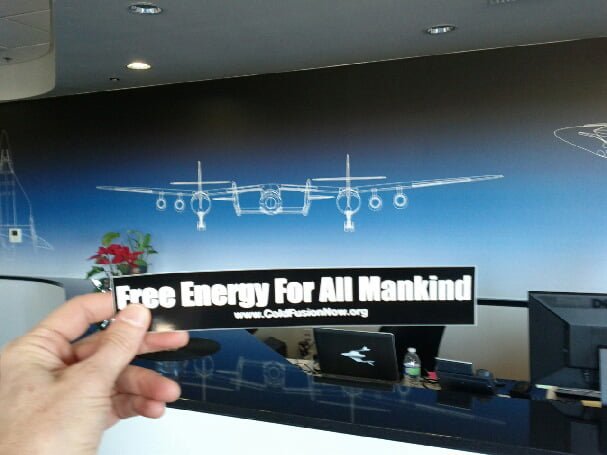
I wasn’t allowed to take photos of the place, only the lobby backdrop. I was so excited, I forgot to ask about the graphics, but that sure looks like a WhiteKnight to me.
I pulled out of Mojave satisfied that cold fusion will be on the lips of at least a few engineers tonite – one way or another, and they’ve got a handy reference too. I’ll look forward to stopping in again on my way back down to Los Angeles in another week or two.
Will the calendar on the bulletin board still be there? How many were recycled? How many were ridiculed? How many inspired?
Hey Mojave, hope you dig it, and check out George Miley‘s GPHS designed to replace RTGs as presented in Session 462 Advanced Concepts at the NETS last year.
 The European Parliament’s Industry, Research and Energy (ITRE) committee chaired by Amalia Sartori met yesterday in Brussels with scientists and business leaders from the new energy community to discuss the status of the Fleischmann-Pons Effect (FPE), the generation of anomalous excess heat from a reaction between hydrogen and various transition metals.