Pre-loaded hydrogen fuel an engineering answer for efficiency, ease and safety

Multiple independent labs are racing to produce a commercial product based on the Fleischmann-Pons Heat Effect (FPHE), most working quietly in their labs. But since the public demonstration of Andrea Rossi‘s E-Cat in January 2011, we’ve witnessed on the global theater the grueling process of actualizing a revolutionary technology.

Early prototype E-Cat had external hydrogen tank for fuel.
It has been amazing to watch. A thermal generator based on nickel-hydrogen exothermic reactions, E-Cat design changes have been guided by efforts to make an efficient, easy-to-use, and safe commercial product.

The earliest prototypes were fueled by hydrogen gas from a canister connected to the unit. For obvious reasons, the danger of hydrogen tanks in a domestic environment present a problem, and having the fuel pre-loaded inside the new E-Cat HT removes a huge liability.

But a pre-loaded fuel cartridge also makes a compact device easy to use.

Previous announcements have set the life for a single charge at six months, after which time the contents can be recycled and a new one installed. As this first generation of new-energy technology filters out to the public, we can expect much longer life-cycles in the future.

How is this fuel pre-loaded into the less-than-a-gram nickel-powder mixture? The answer is proprietary at the moment. But what is possible?

Perhaps a material that absorbs hydrogen and then releases it slowly is used. Metallic-hydrides can do exactly that. Could there be amongst the nickel-powder another transition metal that serves this function?

While we wait to see what’s next for the E-Cat, there are others in the field that have discovered the pre-loaded reactor benefits, each having different designs.

Pre-loaded solid wire works to make heat

Scanning Electron Microscope image of treated Celani wire by MFMP.
SEM image of treated Celani wire by MFMP.
Francesco Celani used a pre-loaded wire for his live demonstrations last year at ICCF-17 and NIWeek 2012. A very different design than Rossi’s, this solid-cathode type cell is being reproduced by the Martin Fleischmann Memorial Project as an open-source enterprise with step-by-step activity documented and available online.

The group showed the results of loading hydrogen in their wire and how it affected resistivity and temperature. Stunning scanning electron microscope (SEM) images reveal close-up views of the metal and its bumpy surface.

Separating loading from activation for Pd-D systems solved by pre-loading

Pre-loading of hydrogen has also benefited palladium-deuterium (Pd-D) systems, helping to hasten initiation of the reaction, which can sometimes take weeks or even months to begin. Waiting so long for a reaction to occur makes data acquisition burdensome, and discoveries difficult.

Ideally, multiple cells would run at the same time, allowing several variables to be monitored and determined simultaneously. At one point, Drs. Fleischmann and Pons were running up to 32 cells, an expensive and still time-dependent undertaking.

SRI International experimented with pre-loading of hydrogen in fine wires as described in Calorimetric Studies of the Destructive Stimulation of Palladium and Nickel Fine Wires [.pdf]. From the paper, a description of how they did it:

SRI electrolytic cell with pre-loaded cathode.
1. Loading. When Pd wires were used as a substrate or as test objects these were pre-loaded electrolytically with either H or D in low molarity SrSO4 electrolytes (50μM) using procedures developed previously at SRI [8] and elsewhere [9].

2. Sealing. The atomic loading of H or D can be sealed inside the Pd lattice for extended periods (several hours or days) with the addition of very small concentrations of Hg2SO4 to the SrSO4 electrolyte and continued cathodic electrolysis [8,9]. The deposited Hg at monolayer coverage is a highly effective poison for hydrogen atom recombination, effectively preventing= desorption by inhibiting molecule formation.

The outcome?

The results show clearly that excess energy is generated both from Pd and Ni wires loaded either with deuterium or natural hydrogen5. However, data from Pd/D codeposited onto highly loaded Pd wires (solid triangles) sit on top of the plot, indicating that this category of wires generates the most excess heat. Interestingly, the Ni codeposited system also yields significant amounts of excess heat.

Pre-loaded NANOR devices can be electrically driven

Separating the long loading times from the activation of the reaction was achieved by Dr. Mitchell Swartz of JET Energy, Inc. with his nano-composite ZrO2-PdNi-D cell that is pre-loaded with hydrogen fuel creating a “reproducible active nanostructured cold fusion/lattice-assisted nuclear reaction (CF/LANR) quantum electronic device.”

In the paper Energy Gain From Preloaded ZrO2-PdNi-D Nanostructured CF/LANR Quantum Electronic Components [.pdf] by Mitchell Swartz, Gayle Verner, and Jeffrey Tolleson, the authors write:

The importance is they enable LANR devices and their integrated systems to now be fabricated, transported, and then activated. They are the future of clean, efficient energy production.

A sixth-generation NANOR was publicly demonstrated in the office of Dr. Peter Hagelstein on the campus of Massachusetts Institute of Technology (MIT) during the 2012 IAP Cold Fusion 101 course, operating from January 30 to mid-May. Swartz also described the technology in the 2013 IAP short course captured on video by Jeremy Rys.

Designed to run at low-power due to safety considerations for a multi-month demonstration on a public campus, “over several weeks, the CF/LANR quantum device demonstrated more reproducible, controllable, energy gain which ranged generally from 5 to 16 [14.1 while the course was ongoing].”

With the core smaller than 2 centimeters containing less than a gram of active material, this device produced LANR excess power density “more than 19,500 watts/kilogram of nanostructured material.”

From the paper, Swartz describes the “proprietary self-contained CF/LANR quantum electronic component, called a two terminal NANOR™-type of LANR device”:

The NANOR represents the pre-loaded core of the reactor.
At LANR’s nanostructured material “core” is an isotope of hydrogen, usually deuterons, which are tightly packed (“highly loaded”) into the binary metals, alloys, or in this case, nanostructured compounds, containing palladium or nickel, loaded by an applied electric field or elevated gas pressure which supply deuterons from heavy water or gaseous deuterium.

Loaded are isotopes of hydrogen -protons, protium, deuterons, deuterium, and hydrogenated organic compounds, deuterated organic compounds, D2, H2, deuterides and hydrides. Precisely for these NANOR-type LANR devices, the fuel for the nanostructured material in the core, is deuterium.

The preloaded nanostructured material is placed into the hermetically sealed enclosure which is specially designed to withstand pressure, minimize contamination, enable lock on of wires connecting to it. The enclosure is tightly fit with the electrodes.

Described in the paper, the production of the preloaded core material involves “preparation, production, proprietary pretreatment, loading, post-loading treatment, activation, and then adding the final structural elements, including holder and electrodes.”
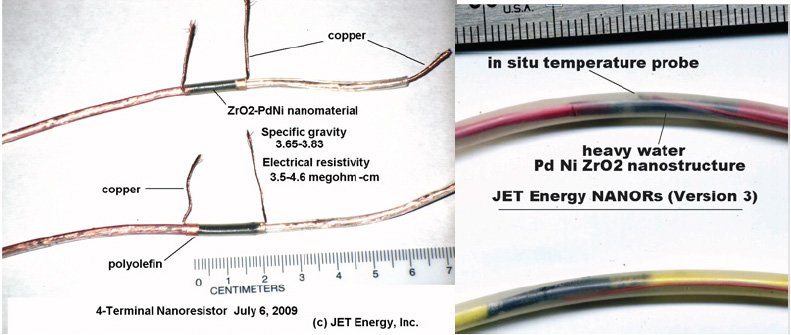
Fig. 2 – Series II and III two terminal NANOR™-type devices containing active ZrO2-PdNiD nanostructured material at their core.

Very pure materials are also required. “Contamination remains a major problem, with excess heat potentially devastatingly quenched,” the paper states.

The ratios of the NANOR’s composite elements are “in the range of Zr (~60-70%), Ni (0-30%), and Pd (0-30%) by weight, with the weights being before the oxidation step, and several later additional preparation steps. The additional D2 and H2 yield loadings (ratio to Pd) of up to more than 130% D/Pd.”

After several bakes, eventually an oxidized zirconia “surrounds, encapsulates, and separates the NiPd alloy into 7-10 nm sized ferromagnetic nanostructured islands located and dispersed within the electrically insulating zirconia dielectric.”

Each nanostructured island acts as a short circuit element during electrical discharge. These allow deuterons to form a hyperdense state in each island, where the deuterons are able to be sufficiently close together.”

The latest Series VI NANORs have had energy gains beyond 30.

More than basic science, it’s an engineering development

Pre-loaded core reactors have “a decreased size, decreased response time, improved and dual diagnostics, and increased total output energy density.”

They are compact, portable and durable. Suitable for small power needs, they can respond on-demand with scalable power.

It’s a ragged course to a next-generation clean energy technology. Even as the science is still uncertain, the new pre-loaded hydrogen reactors are an engineering development that brings us closer to that goal.


Cold Fusion Radio James Martinez on Rossi report: “This is a gift for humanity”

“Sit back, relax and prepare yourselves for the great news that the world’s been told.”

JamesFinalBW10 (2)Cold Fusion Radio’s James Martinez devotes a special broadcast to the recent third-party report on Andrea Rossi‘s E-Cat HT technology which confirms big anomalous heat from hydrogen-infused nickel powder.

Listen now on .mp3

Martinez rails against politicians for ignoring this, but offers avenues for people to get involved. He is particularly critical of US leadership, which has consciously turned away from cold fusion, also called low-energy nuclear reactions (LENR), lattice-assisted nuclear reactions (LANR), and quantum fusion.

“This technology will be coming out, and those who have been in control for all these years, their days are numbered,” says Martinez. “You the public are now in a position to take back your power. It is time to now assert yourselves onto your local officials who have failed us – for not talking about it, not supporting it.”

“There are cold fusion companies still looking for financing. That tells you how far and gone we are in terms of our priorities.

“Our leaders have failed us in informing the public on what is possible, and where our R&D money should be going.”

“There is massive amounts of money being wasted on nothing.”

Martinez walks listeners through Marshall McLuhan‘s Tetrad applied to cold fusion, to better understand the tectonic effects of this technology on our society, so that we do not become its slave.

This October he intimates the release of a huge news story on this subject matter, and that a well-known figure will publicly support the science and technology.

He also discusses the movie The Believers, a documentary on the early controversy of cold fusion, and its relevancy now that the Fleischmann-Pons Effect (FPE) is real. Martinez is featured in the film, soon to be released on DVD.

The Experimental Investigation of the E-Cat HT, and Heuristics

Heuristic: relating to the general strategies or methods for solving problems

Recently an experimental investigation of possible anomalous heat production in a special type of reactor tube named E-Cat HT was carried out and published (“Indication of anomalous heat production in a reactor device containing hydrogen loaded nickel powder,” http://arxiv.org/abs/1305.3913 ).

Data was collected in two experimental runs lasting 96 and 116 hours respectively, and anomalous heat production was indicated in both experiments. Computed volumetric and gravimetric energy densities were found to be far above those of known any chemical source. Even by the most conservative assumptions as to the errors in the measurements, the result is still one order of magnitude greater than conventional energy sources.

Pretty strong words, this “sanity test” seems to have pretty conclusively proven that the E-Cat HT is everything Rossi has claimed. On the other hand, looking at the comments on various web articles on the subject, it hasn’t seemed to convince the “skeptics.” Why?

Apparently, the strongest criticism is that the tests were not independent, that the reactor was built by, controlled, and was ran in Rossi’s lab. Furthermore, since Rossi has told lies in the past, according to some critics, he can’t be trusted now. Finally, big claims need overwhelming evidence, which this investigation didn’t provide.

Hot Cat reactor coreIn the first of the two runs, a energy density of around 5 orders of magnitude was calculated, as well as a COP of nearly 6, which would make this tested device revolutionary. Many well respected scientists participated in this investigation. The methodology was straightforward, and even the second run demonstrated results far above those of any chemical reaction. Again, why aren’t the “skeptics” convinced?

A heuristic is a mental shortcut that allows people to solve problems and make judgments quickly and efficiently. These rule-of-thumb strategies shorten decision-making time and allow people to function without constantly stopping to think about the next course of action. While heuristics are helpful in many situations, they can also lead to biases.

Examples of faulty heuristics are “mental filter” (focusing on the negative detail and ignoring the big picture), “confirmation bias” (accepting only information that agrees with our conclusion), “emotional reasoning” (believing something because it feels true, ignoring contradictory evidence),“disqualifying the positive” (looking at only the negative information we have), “over-generalization” (drawing huge conclusions that don’t fit the evidence), “all-or-nothing” (seeing only the extremes in a situation), and “tunnel vision” (failing to see any positives in a situation).

Distorted thinking is recognized by its characteristics: narrow, resistant to change, biased toward negativity, and often irrational.

It is my premise that those “skeptics” that continue to believe that Rossi is a fraud, and discount the above investigative report, suffer from distorted thinking caused by faulty heuristics. I referred earlier to the investigative report as a “sanity test.” What I mean is that the experimental investigation was aimed at only confirming or denying if anomalous heat was produced by the E-Cat HT.

When “skeptics” claim that the tests weren’t independent, I believe they were using the mental filter faulty heuristic by focusing on the negative detail, and ignoring the big picture. No doubt the experimental investigation could have been more independent, but short of outright blatant fraud, the results prove that anomalous heat could not be explained by simply a chemical exothermic reaction.

Furthermore, if the “skeptics” are claiming outright fraud, especially given the credibility of the scientists participating in the experimental investigation, then I believe they are using the confirmation bias, and emotional reasoning faulty heuristics of accepting only information that agrees with their conclusion, and believing something is false because it feels false and ignoring the contradictory evidence.

When some “skeptics” say that Rossi has told lies in the past and therefore can’t be trusted now, so we ought not trust the experimental investigation, I believe they are using the disqualifying the positive, and over generalization faulty heuristics of looking only at the negative information that we have, and drawing huge conclusions that aren’t justified by the evidence.

Finally, when some “skeptics” say that big claims need overwhelming evidence which this investigation didn’t provide, I believe that they are using the all-or-nothing, and tunnel vision faulty heuristics of seeing only the extremes, and failing to see any positives in the situation.

In other words, I see those “skeptics” as having distorted thinking. In other words, their demonstrated skepticism is irrational. That is not to say that skepticism in general is irrational, quite the contrary. Skepticism is healthy, but is often cited to justify undue skepticism, which is distorted, narrow, and biased toward negativity.

To summarize, the recent experimental investigation of the E-Cat HT pretty conclusively proved that anomalous heat was produced that can’t be explained by any conventional energy source. Furthermore, this report didn’t satisfy the “skeptics.” My belief is that the reason those “skeptics” were swayed is that they are using faulty heuristics resulting in bias against the clearly logical conclusion that the E-Cat HT is everything that Rossi said it was. It is certainly true that those “skeptics” will view my paper as indulging in name calling, and my criticism of their heuristics as faulty. We’ll just have to agree to disagree. As Rossi has said, the time for talk is over, and the market will be the final arbitrator.

That is why this experimental investigation is so significant: it wasn’t conducted on some experimental device, it was validating a product that Leonardo Corporation will be selling in the very near future.

Rossi E-Cat HT energy density “off-the-chart”

A third-party report on tests performed by European scientists has confirmed anomalous excess heat from Andrea Rossi‘s E-Cat HT, a thermal energy generator based on nickel-hydrogen exothermic reactions developed by Leonardo Technologies.

The Energy Catalyzer first came to public attention in January 2011 when the unit was demonstrated at the University of Bologna in Italy. Since then, in a drive for control, stability and certification, the E-Cat has gone through multiple design changes with the latest version, the E-Cat HT operating at high-temperature.

The tests were performed by scientists from Italy and Sweden who had access to the unit and conducted their investigation independently. The team included:

Giuseppe Levi, Bologna University, Bologna, Italy
Evelyn Foschi, Bologna, Italy
Torbjorn Hartman, Uppsala University, Uppsala, Sweden
Bo Hoistad, Uppsala University, Uppsala, Sweden
Roland Pettersson, Uppsala University, Uppsala, Sweden
Lars Tegner, Uppsala University, Uppsala, Sweden
Hanno Essen, Royal Institute of Technology, Stockholm, Sweden

Data was gathered over two four-day tests, one in December 2012 and another in March of this year. For each test, the E-Cat HTs performed continuously while measurements were taken.

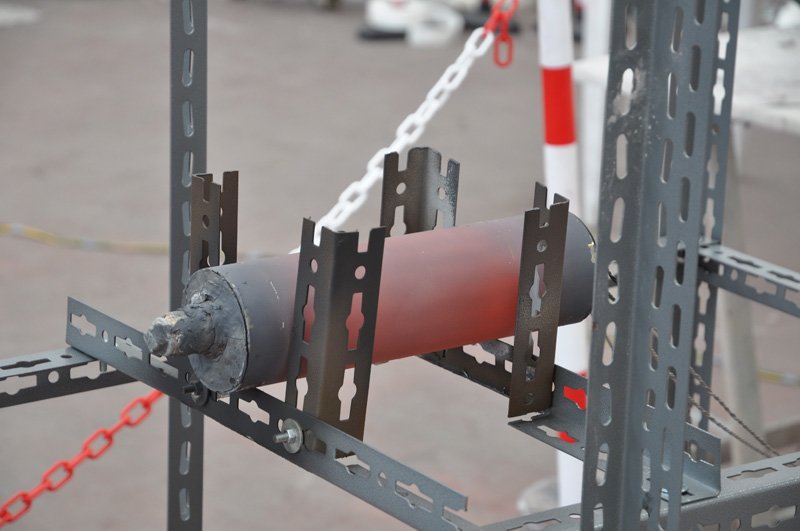
The E-Cat HT operates from an “as yet unknown reaction” in a chamber of hydrogen-infused nickel powder containing some additional catalyst. The nickel powder is enclosed by a hermetically-sealed steel cylinder 3 centimeters in diameter and 33 centimeters long. Surrounding this inner cylinder are resistor coils that heat up the core, initiating the reaction.

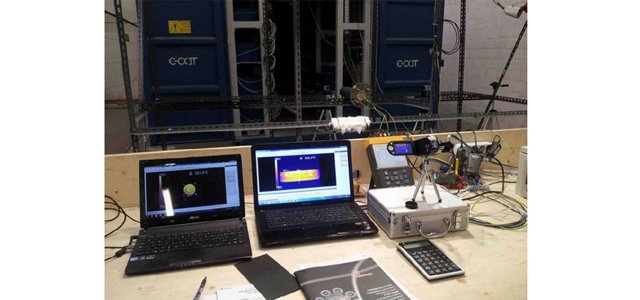
nov-test-tempAll of this is housed in an outer cylinder made of steel and ceramic that varies depending on the experiment. A thermal camera imaged the surface of the reactor over time, determining the temperature of the outer steel casing.

A first test occurred in November 2012, but that unit overheated, melting the stainless-steel inner chamber. While the data was incomplete, it was clear the reactor made significant heat beyond any chemical reaction. After re-designing the experiments for the second and third tests, computations of Coefficient of Performance (COP) and thermal energy density were strong and impressive.

“The procedures followed in order to obtain these results were extremely conservative, in all phases…. it is therefore reasonable to assume that the thermal power released by the device during the trial was higher than the values given by our calculations”, the report states.

December test gives COP of ~5.6

For the December test, the E-Cat HT ran for 96 hours.

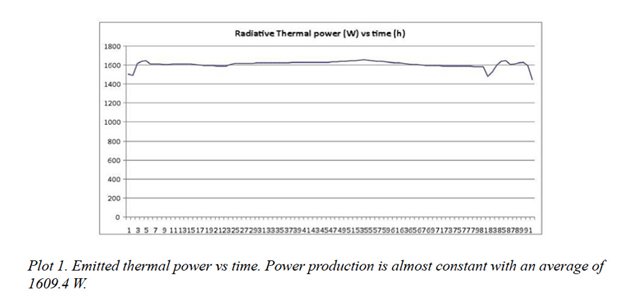
Input power to the heating coils was modulated “with an industrial trade secret waveform”, with the average hourly power consumption used by the heating coils at 360 Watts.

The average thermal Output Power of ~ 2034 +/- 203 Watts assumed a 10% error.

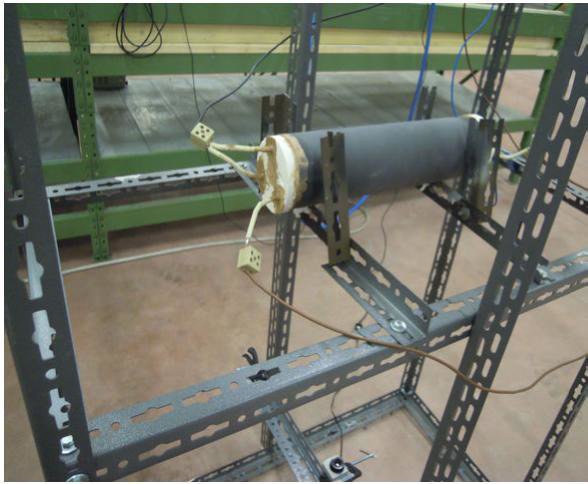
E-Cat HT on support frame from December test
E-Cat HT on support frame from December
A simple ratio of thermal output power/ input power gives a COP of

COP
= 2034 Watts / 360 Watts
~ 5.6 +/- 0.8.

Power density, defined as watts per kilogram of fuel, is the ratio of thermal excess power generated in watts to the mass of nickel powder fuel in kilograms.

Excess power is the thermal output power minus the input power. The amount of fuel used for the calculation was 0.236 kilograms, an overweight value that included the mass of the caps of the inner chamber. This over-value for fuel gives a lower limit for power density, so we can assume that the power produced by the E-Cat HT was even greater than that computed in the report.

Thermal Power Density
= (2034 – 360) / 0.236
= 7093 +/- 709 Watts/kilogram, again assuming a 10% error.

Thus, power density is about 7 kilowatts per kilogram of nickel powder fuel.

To get the thermal energy density, the power density is multiplied by the total number of hours the E-Cat HT ran, giving:

Thermal Energy Density
=7093 * 96
~ 681,000 Watt-hours/kilogram
= 681 kilowatt-hours/kilogram

After 96 hours, this unit was shut down to end the experiment.

E-Cat HT2 is self-sustaining

A new generator was employed in the March test, one with a slightly different design called the E-Cat HT2.

The inner reactor core was the same size as the previous one, but an added control system for the E-Cat HT2 allowed this experiment to run in self-sustained mode, whereby the input power is turned off, while the reaction continues to provide output power.

This unusual feature commences with an ON/OFF phase, as described in the report “where the resistor coils were powered up and powered down by the control system at regular intervals of about two minutes for the ON state and four minutes for the OFF state.”

Most of the four-day March test was conducted in this mode where it was shown that the reactor continued to increase heat output “for a limited amount of time” when switched OFF.

Input power to the resistor coils was increased steadily over the first two hours of the test until the ON/OFF mode was reached. After that, input power to the coils then averaged within a range of 910-930 Watts when ON. Subsequent data analysis showed that the resistor coils were on approximately 35% of the time, and off 65% of time over the duration of the test.

Since the control box was estimated to consume 110 Watts, the Instantaneous Power Consumption, the power input when ON, was computed as

Instantaneous Power Consumption
= 920 Watts – 110 Watts
= 810 Watts

But since the input power to the coils was only on 35% of the time, an Effective Power Consumption is computed by

Effective Power Consumption
= 0.35 * 810
= 283.5 Watts

where the authors again assume a 10% error, to take into consideration any unknown uncertainties.

For this experiment, the average thermal output power was approximately 816 +/- 16 Watts, using a computed 2% error.

Thus, total energy produced over the 116-hours March test is then

Produced Energy
= (816 -283.5) * 116
~ 62,000 Watt-hours
= 62 kilowatt-hours

Energy density is off-the-chart

In this experiment the amount of nickel powder fuel mixture was determined by first weighing the inner reactor core cylinder loaded with fuel. Then, the proprietary nickel mixture was extracted from the inner reactor core “by the manufacturer”, and the empty cylinder returned and weighed. From the difference, the fuel amount was computed as 0.3 grams. To compensate for any uncertainties, the authors of the report used a value of 1 gram to compute the power and energy density.

Fig. 15 Ragone Plot showing energy densities for various sources; E-Cat HT2 is off-the-scale here.
Ragone Plot of energy densities for various sources; E-Cat HT2 is off-the-scale here.
Thermal Power Density
= (816 -283.5) Watts / 0.001 kilograms
= 532,500 W/kg
~ 532 kilowatts/kilogram

Over the full 116-hours March test, the thermal energy density is then computed as

Thermal Energy Density
= (532,500 W/kg)(116 hrs.)
= 61,770,000 Watt-hours/kg
~ 62,000 kilowatt-hours/kg

The energy density of the E-Cat HT2 places it
“about three orders of magnitude beyond any other conventional chemical energy source.”

This thermal energy density for the HT2 is larger than that computed for the December HT test by a factor of three. According to the authors, this this is due to the overestimation of the amount of fuel in the December test, where the steel cylinder caps were included. Still, both E-Cats performed off-the-chart.

For this experiment, the COP is computed as

COP
= 816 Watts / 283 Watts
= 2.9 +/- 0.3 again assuming a generous 10% error

This COP is noticeably different from the COP of the E-Cat HT in the December test of 5.6. This difference is attributed to the fact that the COP tends to increase as the temperature increases.

The average temperature of the E-Cat HT was 438 C while the average temperature of the E-Cat HT2 was 302 C, leading the HT to have a higher COP.

But the authors note that as they did not inspect the nickel powder fuel in either case, so perhaps the disparity in COP may be the result of differences in the two samples.

After 116 hours, the March HT2 test was shut-down and the experiment ended. It is made clear in the report that the fuel was not exhausted, and the tests could have gone on longer, increasing the value of thermal energy production and density.

To quote the report, “… energy densities were found to be far above those of any known chemical source. Even by the most conservative assumptions as to the errors in the measurements, the result is still one order of magnitude greater than conventional energy sources.

In addition, both tests were monitored for radiation by David Bianchini, and no dangerous emissions were found. Again, from the report:

The measurements performed did not detect any significant differences in exposure and CPM (Counts per Minute), with respect to instrument and ambient background, which may be imputed to the operation of the E-Cat prototypes”.

This summer, a new test will be conducted for a six-month period. Together with this report, a data set is emerging that proves without a doubt the E-Cat is leading the race for ultra-clean energy-dense power for the people. When global energy policy will catch up with the reality of new energy, no one knows. Congratulations to Mr. Rossi for bringing us one step closer to that free, green, technological future we imagine.

Andrea Rossi’s Third Party Report RELEASED

“3rd party report shows anomalous heat production – The Rossi Effect”

“Indication of anomalous heat energy production in a reactor device containing hydrogen loaded nickel powder”

The long awaited “3rd Party Verification Report” on Andrea Rossi‘s E-Cat has been released. The .pdf can be downloaded from ecat.com HERE or arxiv.org

The announcement, which provides the abstract and the conclusion is posted here on Rossi’s E-Cat website.

Hot Cat reactor coreThe conclusion reads positive, yet also reads that much more testing is in the works, the next of which is slated to start this summer, and last 6 months.

This is just a breaking news post, thoughts or further commentary will be added here, or in a new post. Or better yet, share your own thoughts in the comments section.

Plasma engine reproduced; now optimizing for efficiency

This is a power source that mankind needs to have. We need to make a push and get this energy out in the hands of people.Dr. Michael McKubre TeslaTech 2012

A revolutionary new engine powered by the pulsing of plasma has been successfully reproduced from an earlier lost technology and now needs an increase in efficiency to make a usable generator, say engineers from RG Energy, developers of the device.

They’ve launched a fundraising campaign at Indiegogo to accomplish this.

Cross-section from Papp patent; watch historical video at pappengine.com
Cross-section from 1984 Papp patent; watch historical video at RGEnergy.com

The design is derived from Josef Papp‘s noble gas engine, its secret inert gas mixture lost when he died. Granted a patent in 1984 for his invention, Papp was not explicit about the precise mix required.

Bob Rohner of RG Energy built those engines for Mr. Papp along with his brother Tom and worked closely with Papp over several years beginning in 1979. Owning successful businesses in Iowa, they had experience with large machinery and controls. “I pursued it because it was such a remarkable invention.”

“We’re trying to clean up the environment, we’re trying to get away from carbon-based fuels to clean up our atmosphere. We need to maintain the energy so we can have our quality of life,” Rohner said in a recent interview. [.mp3]

“These engines are capable of operating for long periods of time on charges of inert gases. They’re totally sealed, easy to build, economical to operate, and they’re totally clean,” says Bob, the mechanical engineer of the team.

“They have no emissions whatsoever to the environment.”

“We have proven to ourselves, and to many savvy observers, that we are capable of firing the single-cylinder, the two-cylinder, and a rotary fixture with inert gas pulses for hours on end, lifting large amounts of weight with no heat build-up.”

An astonishing claim, as inert gases do not readily react with other elements, and though a plasma performs work in pushing a piston, there is no exhaust to vent, and no heat generated. The engine appears to defy the laws of thermodynamics and what is known about heat cycles.

“One of my physicists Frank Andres believes there is a kind of re-absorption going on. Myself, I don’t believe heat is ever created to begin with,” attests Bob.

“To drive that piston up against a 300-lb load like I’m doing would take something like 1200-1400 degrees flash heat, and the Teflon insulators have a highest temperature rating of maybe 600 degrees, so it doesn’t appear as if the high-temperature is ever there to begin with. It amazes me that universities aren’t jumping all over this.”

Energy-dense plasma power

Witnesses to demonstrations of Papp’s engines, including aerospace executives, engineers and Navy scientists, have publicly testified to its capability of producing great amounts of power, without knowing exactly how it works.

“When I first heard of the Papp Engine, I was intrigued because it’s clearly impossible,” said Dr. Michael McKubre, a senior scientist at the forefront of research in new energy from metal-hydrides who spoke at TeslaTech 2012 in support of the project.

But after himself interviewing witnesses from Papp’s engine demonstrations where “observations of tests running hours or days in a closed room, no exhaust, with negligible temperature rise,” McKubre got interested.

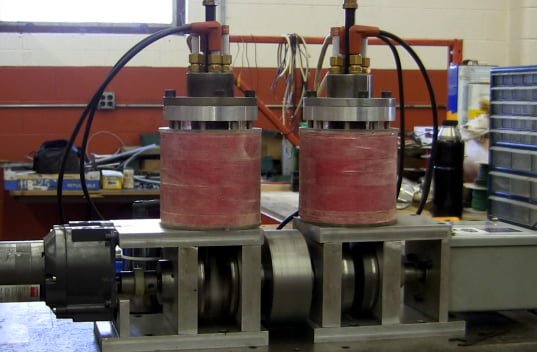
Bob watched Papp’s engine produce between 5-10 times over-unity on a few ccs of inert gases and an electrical input. He and Tom finally developed the Twin Cylinder Dual Piston Engine as an experimental set-up that has, they believe, reproduced Papp’s process using a mere 200 ccs of a gas mixture.

The power generated by the inert gas plasma is convertible, meaning power can be extracted as electricity or mechanical force, depending on how the inputs are adjusted, but now they must increase the efficiency of the engine.

“We’re quite confident we can complete the recovery of this technology,” says Rohner, “our progress is steady and much has been achieved, but we have essentially three major items to complete yet.”

1 Build Papp’s gas mixer

One time Bob started the motor and got a huge amount of power; the next time, not nearly as much. It’s been hypothesized that impurities in the gas mixture prevent a full reaction.

“I didn’t believe it at first, but small amounts of contamination will have a stark effect on power output,” says Rohner.

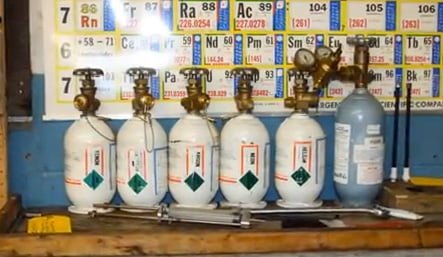
Pre-mixed gas fuel canisters have 5% inaccuracy
Pre-mixed gas canisters are accurate to about 5%

“It turns out that 1/10,000 contamination has a major effect on plasma formation. Now it’s time to make a fuel mixture more accurate and clean.”

Papp’s last patent was for an apparatus that apparently filtered the gases as well as made sure the mixture was exactly correct. When the Rohners first went to Florida, they saw Papp’s glass-tube mixer “all busted-up on the floor”, damaged from shipping. For years afterwards, Bob didn’t think much of it.

“About six months ago, I found a bunch of these old pictures and started going through them, and I realized Papp had not only replaced that mixer once, he actually built two new ones. Nobody has adequately researched or rebuilt this fuel mixing apparatus yet, and it’s looking like a worthwhile thing, probably the most important element to get completed as soon as possible.”

2 Big step with the crossover

“It was described in Papp’s patent that the engine could run as one-cylinder, but only in an inefficient manner, and the evidence is proving that statement correct. To run efficiently you always have to be in pairs,” says Bob. “You can’t be on a teeter-totter with one person, you got to have both.”

Twin Engine
The Twin Cylinder will have crossover

With electrical crossover, one cylinder powers the other, and vice-versa.

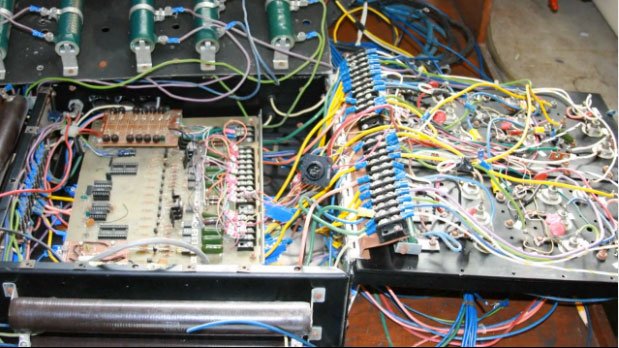
“As the plasma collapses in one cylinder, it generates a large amount of electricity, and as the piston travels through the coils, it creates a back EMF. The back EMF and this generated electricity needs to be transferred at the proper time to the opposite cylinder, to one, excite the gases, and two, trigger the plasma pulse in the opposite cylinder.”

3 Re-assemble the original Papp engine

Videos of Papp’s original engine running on the dynos are posted online, but the machine that Bob and Tom built years ago now sits in their workshop waiting resurrection. Results of electrical crossover on the Twin Cylinder will be applied to Papp’s original to complete a serial engine.

“It’s perfectly capable of handling several hundred HP, which is what we need to do. The structure is good, it needs the electrics re-built and some of the stainless sleeves re-honed. Everything on the engine is custom, so it’s very expensive to do.”

Help wanted

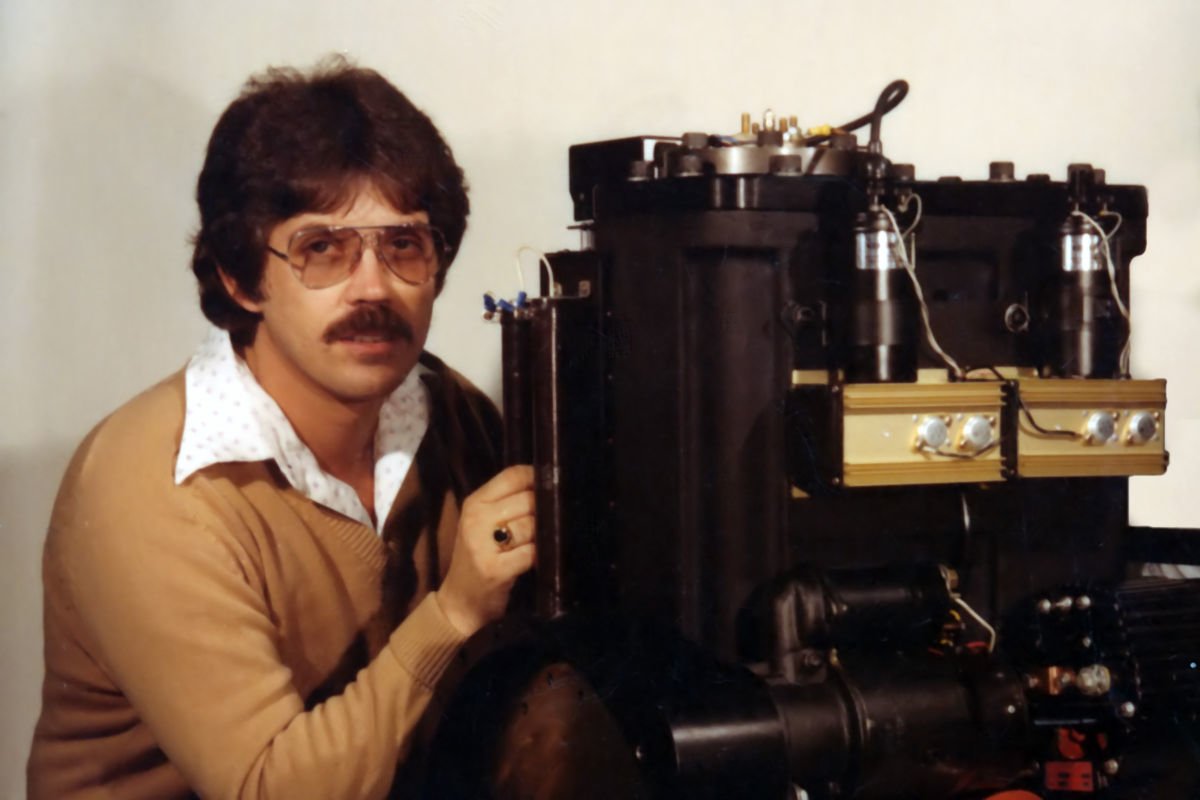
Classic photo of Tom Rohner and early plasma engine
Tom Rohner and early plasma engine.

Bob’s brother Tom Rohner had a career as a Chief Software Architect at both Compaq and HP Computers besides working on plasma engines. A year and a half ago, Tom succumbed to pancreatic cancer. Bob lost his best friend as well as Tom’s extensive skills as a computer and electrical engineer.

RG Energy is now looking for a talented full-time Electrical Engineer to complete the sophisticated Twin Cylinder crossover.

“Buckets have to switch from being both anodes to being an anode-cathode, at certain times you’re handing 1000 Volts and at other times you’re handling 40 Volts at high currents, and so this stuff is precise. We’re looking for somebody to fill Tom’s shoes.”

Experienced electrical engineer needed for crossover
With a good electrical engineer, it should take 8-12 months to get the gas mixer, the cross over and the build of the serial model completed. These engines could then penetrate the market quickly, complementing cold fusion technology.

Bob adds, “This is a compact energy source that can be mobile, it can run in outer space or the bottom of the ocean. The difference between this engine and cold fusion is that cold fusion is heat-driven. To generate electricity you instantly drop to a 30- 40% loss in production. Then you have to take that electricity to some storage source, to batteries, and yet, here’s a generator that you can run for thousands of hours on one charge. The flexibility of this power source is more important than anything.”

“I hope cold fusion is developed, but to base our future on one solution isn’t that smart.”

“We have odd electricity and odd energy, both real and I believe, coupled,” says Michael McKubre. “To really do the job well, we need a well-equipped lab and able experts willing to suspend disbelief. I’ve been following Bob around ever since, waiting for him to produce his machine, and he’s getting close.”

Learn more about this project at the Gyrokinetic Plasma Engine on IndieGoGo


    Related

http://www.RGEnergy.com/

Bob Rhoner special guest on Wide Awake News Monday May 6 Hour 1 [download .mp3] on the Rense Network.

The Mystery and Legacy of Joseph Papp’s Noble Gas Engine by Eugene Mallove Infinite Energy Magazine


Top