
Trends Journal taps new energy again

Gerald Celente has once again brought new energy to the attention of investors and policy-makers by including a story on Defkalion Green Technologies in his Trends Journal, according to a post by Peter Gluck.

Trends Journal Institute 2013-Spring-JournalThe publication is of the Trends Research Institute.

It has been quite a while since Celente has spoke publicly on cold fusion and other new energy technologies. Sterling Allan‘s Pure Energy Systems has a Top Five Exotic Free Energy Technologies listing of breakthrough technologies that got the attention of Celente, and made it into the Trends Journal 2011.

In 2011, Celente put new energy as a top trend for 2011 and called cold fusion the greatest investment opportunity of the 21st century. While the earlier inclusions focused on Andrea Rossi‘s Ecat technology, this piece focuses on the differences between Rossi and Defkalion’s prototypes.

This excerpt is from Gluck’s posting New Energy trends paper about Defkalion Green Energies:

Alex Xanthoulis, Defkalion’s CEO, is quick to emphasize that the company’s products differ sharply from Rossi’s. An unnamed “major US organization,” he says, has compared Rossi’s and Defkalion’s devices on 14 points. “It found only two the same – the use of hydrogen and the use of nickel,” he says. “Otherwise, the two are completely different.”

There are other points of departure.

Rossi’s early devices, like the inventor himself, also were quirky. The temperatures they would reach weren’t predictable; they produced only a few watts of excess energy; and, when shut off, took varying lengths of time to stop producing heat.

In contrast, Defkalion’s machines reportedly produce heat at precise temperatures that customers require and can be shut off within a few seconds. The devices also produce energy up to 10 kilowatt-hours, not single watts as others have. The nickel-hydrogen fuel modules can easily be pulled out and replaced when depleted, a task that should need to happen only every few months.

Defkalion’s first product is called “Hyperion” and will enter the market early next year. A cube about 20 inches on a side, it will be marketed as a heater or boiler for homes and light industry needing up to five megawatts of power.

The second product is a larger-scale reactor that can be used to drive turbines or even cars, trains, ships, space satellites, and planes. Defkalion reports fielding inquiries from hundreds of companies around the world and has chosen to partner with at least 10 large ones – including three vehicle manufacturers, a utility company, telecommunications firms, and a maker of aircraft – to continue research and development. Some of the companies already are testing commercial devices using the reactor as a power source.
–THE SEARCH FOR AN OIL-FREE FUTURE by Bennett Daviss The Trends Journal Spring 2013, pp 30-34

Defkalion Green TechnologiesThe mention of proposed Hyperion generators contradicts earlier statements implying Defkalion would not focus on consumer products per se, but license their technology for others to manufacture. However, as technological developments rush forward, adapting to new information is required and plans and strategies change at light-speed. All pathways to a marketable generator must remain open.

ecatdotcom-logoRossi’s heat output seems somewhat low according to reports by European scientists who have witnessed public demonstrations of the Ecat. However, it does appear that many spectators to this drama confuse the two rival technologies and distinctions must be made.

Hopefully, Defkalion’s first public demonstration planned this August at National Instruments NIWeek 2013 will make those distinctions clear.

New energy trend is strong

It has been three years this month that Cold Fusion Now was activated to promote clean energy from the hydrogen in water. Turning the science into a commercially-scaled technology still eludes new energy researchers, yet wider awareness and support has been generated, and more private investments made. The Trends Research Institute has been one of the few forecasting agencies who recognize the importance of this technology.

It is unknown how many new labs are opening up. I know of at least two fresh and fairly well-funded ventures in the U.S. which prefer to remain under the radar without publicity, and probably more than that, with at least that many in multiple countries around the world. The number of people working on solving the problem of cold fusion, also called low-energy nuclear reactions (LENR), lattice-assisted nuclear reactions (LANR), quantum fusion and the anomalous heat effect (AHE), has increased dramatically over the last three years, most of whom have dreams of a marketable device, despite the lack of a definitive theory describing the reaction.

While a large-scale coordinated research strategy would most likely accelerate the engineering of a usable technology, the absence of funding and patent protection forces hopes on the efforts of small independent labs, most of whom are working in isolation from each other.

Google’s search trends results reveals the general interest over the last 12 months. The most popular search term remains “cold fusion”, the name we choose for describing all the multiple terms listed above. Highest peaks occurred during July and August when the International Conference on Cold Fusion ICCF-17 met in South Korea and National Instruments celebrated LENR at NIWeek 2012. A third big bump happens over the MIT IAP Cold Fusion 101 course in late-January.

Ecat, the proprietary name of Rossi’s steam generator, is the second most popular term, a word which many people mistake for the entire field of research. Ecat search interest peaked last fall around the time of the Ecat Conference in Zurich, Switzerland.

LENR, LANR, quantum fusion, and AHE all have devotees, but LENR is most used by the institutions who eschew the stigma of cold fusion.

Google searches have trended flat or slightly downward since the big conferences last year. But the enthusiasm is global, beyond borders and regional dialects. We expect the search engines to be maxing out on cold fusion for this year’s conferences.

Gerald Celente and The Trends Research Institute are bold enough to call it as they see it, without concern for appearances. While giants sleep, the underlings continue to build the intellectual infrastructure of a new energy tomorrow. Usually, being on the leading edge is lonely and frustrating. But if trends continue, this edge will be the springboard for many in the field to not only pay their rent, but provide a clean source of energy in a people-powered world.

Cold Fusion Now!

Spam Allstars with new atomic jam

Cold Fusion Now Associates will have greater supervision in new location.
Cold Fusion Now is on the move again, back to lovely Eureka, California.

We left our residence in Eureka two years ago to do interviews and advocacy in support of the new energy movement, and we succeeded. Using movies, art and activism, we turned a myriad of people on to the possibilities offered by cold fusion energy.

Now, all efforts are focused on locating the new HQ. With all the stress, I listen to alot of music.

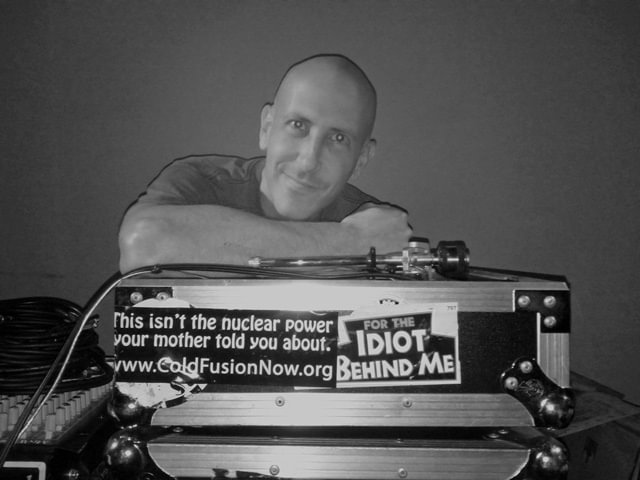
Last year in Florida, I hooked up with my old pal Andrew Yeomanson, a Miami DJ and bandleader of the Spam Allstars who spins with a CFN sticker on his gear.

DJ Le SPAM
Miami, Florida DJ Le SPAM has fusion-powered gear
He played me some tracks of a tune he was mixing in his City of Progress Studio.

About a month ago, he finished the mix and together with filmmaker Juan Maristany, made a video titled, er… Ruby Carat!

Woo hoo! Thank you Spam Allstars and Juan Maristany.

Yeah, I dance around just like that.

Cold Fusion Now!

Related Links

DJ spins with Cold Fusion Now on NCC6 Miami

Cold Fusion Now Cross-Country Tour 2012

Cold Fusion Now Cross-Country Tour 2011

Widespread destruction of ecosystems and wildlife from tar sands

This is a re-post from the Post Carbon Insitute, dedicated to documenting the last moments of the Chemical Age and who unfortunately does not yet realize the potential of the New Energy Age.

Original article is here.

Tar Sands Is Worse Than You Can Imagine: Incredible Images You Have to See
Posted Apr 19, 2013 by Leslie Moyer

The Suncor Energy upgrading refinery, on the banks of the Athabasca River.     Photo Credit: Copyrighted image; photographer not disclosed.
The Suncor Energy upgrading refinery, on the banks of the Athabasca River.
Photo Credit: Copyrighted image; photographer not disclosed.

Post Carbon Institute and Alternet have partnered to shed a powerful light on the true costs of our addiction to fossil fuels, starting with the Alberta tar sands .

Every powerful photo is linked to three meaningful actions that you can take right now to fight back against tar sands mining. We need your help getting the word out; please take a look at the images, take a stand, and share far and wide with your friends, colleagues and neighbors.

The mining of the Alberta tar sands is the biggest industrial project on earth and quite possibly the world’s most environmentally destructive. The visuals are hard to stomach, but the story is an important one to tell.

Click to see the slideshow

As conventional oil and gas deplete, the energy industry must resort to unconventional resources that are more expensive, more technically challenging to access, and pose far greater risks to ecosystems and communities than ever before. The result is destruction on an unprecedented level.

The tar sands tale is told frame by frame in the image deck, guiding us from the clear-cutting of pristine Boreal forest and creation of vast open-pit mines all the way to the pipelines that transport diluted bitumen across the continent.

The connection between the astounding environmental destruction taking place in Canada and the debate over approval of the Keystone XL pipeline here in the USis clear. As the recent rupture of the Pegasus Pipeline in Arkansas makes abundantly clear, the transport of diluted bitumen from Alberta via pipelines to oil refineries thousands of miles away poses unacceptable environmental risks.

As important, the Keystone XL Pipeline is a key litmus test for the Obama Administration and the country as a whole. And the rest of the world is watching.

Although the Canadian tar sands contribute a small percentage of total global oil production and the Keystone XL Pipeline is just one of many contested fossil fuel projects in the world (in fact, First Nations and thousands of other Canadians are fighting an equally dangerous tar sands pipeline, the Northern Gateway Pipeline), this decision by President Obama is a keystone of a different kind – representing the kind of energy future we want for ourselves and our loved ones.

For that reason, it’s not mere hyperbole to say that this is a life and death decision.

We’re reaching out to you to speak up against the Keystone XL Pipeline by sharing these images with your friends, family, and neighbors, and by clicking on one of the calls to action associated with each image.

End Post Carbon article*************

Begin Cold Fusion Now commentary*************

Cold Fusion Now!


NASA Technology Gateway – Spinoff – LENR Cold Fusion


The Technology Gateway and Spinoff Magazine by NASA

Congress mandates that NASA offer licensing of patented technologies to U.S. industry. NASA meets this requirement through the NASA Technology Gateway where LENR patent licensing opportunities are offered. NASA publishes Spinoff magazine annually, showcasing the technologies from previous years’ licensing process, and their benefits to industry.

The Technology Transfer and Partnership Program

 A place to purchase LENR technology

Why is it important for Langley Research Center (LaRC) to transfer its technology?
“The U.S. Congress and the NASA Administrator are putting great emphasis on transferring NASA-developed technology and expertise to U.S. industry to increase U.S. industrial competitiveness, create jobs, and improve the balance of trade. In addition, there is an emphasis on bringing technologies and expertise into NASA that can facilitate achievement of space program goals.”

To purchase licensing agreements for LENR, go to the  NASA Technology Gateway – link .

NASA Technologies Benefiting Society (Spinoff 2012-pdf pg 34)

Since its founding, NASA has been charged, not only with expanding humanity’s reach into space and its knowledge of the universe, but also with finding ways for the technology it develops to benefit the Nation and world. NASA research and development has tangible, secondary benefits beyond supporting mission needs—creating jobs, generating revenue for businesses large and small, reducing costs, and saving lives. Through software innovations, fuel-saving capabilities for small aircraft, healthy beverages at your local grocery store, and more—NASA spin-offs are improving daily life in your hometown and beyond.


The NASA Technology Gateway is for technologies in the applied engineering research phase entering the marketplace.

What patented LENR energy technology does NASA have to offer for licensing purchase?

Who is purchasing LENR technology at the Technology Gateway?

NASA and LENR Applied Engineering

Has LENR advanced to the applied engineering and product development phase? Yes.

At the Technology Gateway, NASA is promoting LENR power technology.

Langley’s Low-Energy Nuclear Reaction (LENR) Technology AvailableNASA

“Check out our latest video on our homepage featuring a novel, clean energy technology.”

View the Promotional Video

Method for Enhancement of Surface Plasmon Polaritons to Initiate and Sustain LENR in MHS

(Metal Hydride Systems) – NASA

A quote from the end of the video: “NASA’s method for enhancement of surface plasmon polaritons to initiate and sustain low energy nuclear reactions in metal hydride systems, a clean nuclear energy for your power operated technology.”

MORE

These also provide evidence that LENR has advanced to applied engineering and product development.

  • In the document “Low Energy Nuclear Reaction: The Realism and Outlook”—NASA links—Dennis Bushnell Chief Scientist at NASA Langley Research Center states that “We are still far from the theoretical limits of the weak interaction physics for LENR performance and are in fact inventing (in real time) the requisite engineering, along with verifying the physics.
  • In this NASA contract, pdf- “Subsonic Ultra Green Aircraft Research – Phase II” – N+4 Advanced Concept – NASA Contract NNL08AA16B – NNL11AA00T, the Working Group report from May 2012 states:

    Even though we do not know the specific cost of the LENR itself, we assumed a cost of jet fuel at $4/gallon and weight based aircraft cost. We were able to calculate cost per mile for the LENR equipped aircraft compared to a conventional aircraft (Figure 3.2). Looking at the plots, one could select a point where the projected cost per mile is 33% less than a conventionally powered aircraft.”… pg 24.

  • LENR Requirements Analysis… pg 24. View Figure 3.1

  • Potential Heat Engines for LENR Systems… pg 25. View Figure 3.2

  • Parametric LENR and Heat Engine Performance Parameters… pg 25. View Figure 6.2

  • Low Energy Nuclear Reactor Technologies …pg 82.

  • LENR Technologies Success Criteria …pg 86.

  • Also LENR at pgs 15, 18, 19, 20, and 21.

  • The NASA Working Group Report also makes public the following list of organizations and individuals working on the advanced concept contract: Bradley (Boeing) * Daggett (Boeing) * Droney (Boeing) * Hoisington (Boeing) * Kirby (GT) * Murrow (GE) * Ran (GT) * Nam (GT) * Tai, (GT) * Hammel (GE) * Perullo (GT) * Guynn (NASA) * Olson (NASA) * Leavitt (NASA) * Allen (Boeing) * Cotes (Boeing) * Guo  (Boeing) * Foist (Boeing) * Rawdon (Boeing) * Wakayama (Boeing) * Dallara (Boeing) * Kowalski (Boeing) * Wat (Boeing) * Robbana (Boeing) * Barmichev (Boeing) * Fink (Boeing) * Sankrithi (Boeing) * White (Boeing) * Gowda (GE) * Brown (NASA) * Wahls (NASA) * Wells  (NASA) * Jeffries (FAA) * Felder (NASA) * Schetz (VT) * Burley (NASA) * Sequiera (FAA) * Martin (NASA) * Kapania (VT)

Thank you NASA, and a thank you to all of the people and organizations who worked on developing the NASA, “LENR equipped aircraft” – Advanced Concepts Working Group Report. Each of them are aware of the opportunities offered by patented LENR energy technology from NASA.

How much money might NASA make through the licensing of LENR technology?

THE NASA LENR ENERGY PATENT

The NASA LENR patent is for a device to produce heavy electrons thereby sustaining LENR and ensuing energy generation. In  this slideshow, a Widom Larson theorist reviews the NASA patent. “NASA files USPTO patent application on LENRs” slideshow – by Lewis B. Larson.

View and research at Google Patent Search: Titled, “Method for Creating Heavy Electrons” or download the (pdf at lenr-canr.org)

Method For Creating Heavy Electrons – NASA LENR Patent

STATEMENT REGARDING FEDERALLY SPONSORED RESEARCH OR DEVELOPMENT [0002] The invention was made by an employee of the United States Government and may be manufactured and used by or for the Government of the United States of America for governmental purposes without the payment of any royalties thereon or therefor.

  • BACKGROUND OF THE INVENTION [0003] 1. Field of the Invention [0004] This invention relates to the production of heavy electrons. More specifically, the invention is a method of making a device, the device itself a device, and a system using the device to produce heavy electrons via the sustained propagation of surface plasmon polaritons at a selected frequency.
  • ABSTRACT A method for producing heavy electrons is based on a material system that includes an electrically-conductive material is selected. The material system has a resonant frequency associated therewith for a given operational environment. A structure is formed that includes a non-electrically-conductive material  and the material system. The structure incorporates the electrically-conductive material at least at a surface thereof. The geometry of the structure supports propagation of surface plasmon polaritons at a selected frequency that is approximately equal to the resonant frequency of the material system. As a result, heavy electrons are produced at the electrically-conductive material as the surface plasmon polaritons propagate along the structure.
  • [0019] A method for selective enhancement of surface plasmon polaritons to initiate and sustain low energy reaction in material systems, comprising the steps of: providing a material system comprising an electrically-conductive material, said material system having a resonant frequency associated therewith for a given operational environment; and forming a structure having a surface, said structure comprising a non-electrically-conductive material and said material system, said structure incorporating said electrically-conductive material at least at said surface of said structure, wherein a geometry of said structure supports propagation of surface plasmon polaritons at a selected frequency that is approximately equal to said resonant frequency of said material system, and applying energy to a portion of said structure to induce propagation of said surface plasmon polaritons at said portion, wherein heavy electrons are produced at said material system as said surface plasmon polaritons propagate along said structure.
  • [0028] The above-described tuned structure -14- incorporating material system -12- can exist as particles, in two-dimensional geometries, three-dimensional geometries, and even fractal geometries. Several non-limiting examples will be discussed below.
  • [0029] Individual particles, by themselves, are the simplest embodiment of a material system used by the present invention. Spherical or nearly spherical particles naturally resonate at a frequency where the particle circumference is equal to a multiple of the SPP wavelength. Similarly, long and thin, needle-like particles or whiskers can resonate in modes analogous to small antenna when the length of the particle is an integer multiple of one-half the SPP wavelength.
  • [0030] Two-dimensional embodiments are comprised of periodic textures or arrayed structures that, by design, resonate at specific SPP frequencies. Examples include triangular, rectangular, or hexagonal arrays of posts (e.g., cylinders, truncated cones, or derivatives of these with more complex, non-circular bases) where the array of objects creates and reinforces a natural SPP resonance at the desired frequency either in the array elements themselves or on the surface in the voids between array elements.
  • 0032] The advantages of the present invention are numerous. Devices/systems made in accordance with the present invention control the frequency of the SPP resonance and its uniformity over large surface or volume regions.
  • This will allow an entire device to participate in heavy electron production and ensuing energy generation.
  • The present invention is adaptable to a variety of physical states/geometries and is scalable in size…
  • …thereby making it available for energy production in a wide variety of applications (e.g., hand-held and large scale electronics, automobiles, aircraft, surface ships, electric power generation, rockets, etc.)


In the Next Year or So, a NASA Spinoff LENR Report?

So, who is purchasing LENR technology from NASA at the Technology Gateway?

Spinoff Magazine will, at some time, report the LENR licensing agreements that are taking place.

When? Perhaps in next years’ edition, or so.

NASA… Spinoff… LENR…

Cold Fusion Now!


METHOD  of  SCIENTIFIC

Straighten…. untangling

Concept… bound

Better… yet

Always… found

Still.. questing


Crack hypothesis gets community response


Today’s successes in cold fusion energy generators have been hard-won by trial and error, with each system developed by a select criteria amassed over years of painstaking success and failure.

Ironically, the many labs with commercial prototypes each follow a different mental model of how their system works, a problem for developing a technology, as the criteria to enable the anomalous effects of excess heat and transmutations are not universal over all cells.

Prototypes appear to suffer from either one of two extremes: i) there is control of the reaction, but not high-enough power output, or ii) there is plenty of thermal output, but engineering control and/or stability are at issue. No definitive theory describing how to make cold fusion happen on-demand with maximal efficiency exists, for any type of system.

When an accurate model of the reaction is finally articulated, it will spell-out exactly how to build energy-dense, ultra-clean batteries charged for life.

While there are many researchers in condensed matter nuclear science (CMNS) modeling the reaction, few can agree on what the features of a theory should be, and the lack of consensus is keeping a revolutionary new-energy technology from a world in need of a solution.

The names given to cold fusion over the years reflect various streams of focus:

  • low-energy nuclear reactions (LENR) differentiates the phenomenon from hot fusion and is the most commonly used term today.
  • lattice-assisted nuclear reactions (LANR) focuses on the crystal-lattice structure as enabling excess heat.
  • quantum fusion attempts to describe the reaction using 20th-century physics.
  • nickel-hydrogen exothermic reactions describe the elements involved in generators being developed for commercial use.
  • anomalous heat effect (AHE) labels a reaction without any reference to cause.
.

Finding the recipe

“This is the most ideal energy you could possibly imagine,” says Dr. Edmund Storms, a former-Los Alamos National Lab nuclear chemist and long-time researcher in cold fusion.

Describing the conditions needed to make the reaction happen is essential to producing a usable technology. To move forward, “what are the basic theoretical criteria that we can collectively agree upon?”

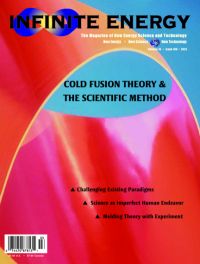
iecover108Issue #108 of Infinite Energy magazine attempts to answer that question by gathering leading researchers and moderating a discussion on the properties a theory should have.

Edmund StormsCold Fusion from a Chemist’s Point of View begins the process by asking the community to justify where the location of the reaction is.

David J. Nagel, Xing Zhong Li, Jones Beene, Vladimir Vysotskii, Jean-Paul Biberian, Andrew Meulenberg, and Ed Pell all responded to the call, each writing their thoughts with various focus.

But for all that brain power, and a seemingly simple question – where does the reaction occur? – there is little agreement on the answer.

The NAE is something special

Storms notes that nuclear reactions don’t generally spontaneously erupt in ordinary materials. He asks, what changes occur in the chemical environment of a regular piece of metal to make a reaction happen? He describes those special conditions as the Nuclear Active Environment (NAE).

An array of atom constitutes a solid.

Many theories today apply to only one system, either Pd-D or Ni-H, and put the reaction within the metallic lattice. Mathematics is utilized to explore how enough energy might accumulate at one spot to overcome the Coulomb barrier, or initiate electron-capture.

Storms asks these theories to explicitly state how it is that enough energy can spontaneously accumulate locally in the lattice without first affecting the chemical bonds that hold the atoms together, or, violating the laws of thermodynamics? Justifying all theoretical assumptions is essential to weeding out dead-end ideas and accelerating those that appear more promising.

Whereas Storms sees physicists by-and-large concentrating on the cause of the reaction, asking ‘what possibilities exist that could start a nuclear reaction inside a metal?’, he differentiates his chemist’s approach to modeling by remaining tethered to the known chemical properties of solids, and how materials are witnessed to behave in the lab.

“Any theory of cold fusion must begin and end with the experimental results,” says Storms. “A theory that does not explain what we see and measure in the lab must be abandoned.”

Where does the reaction occur?

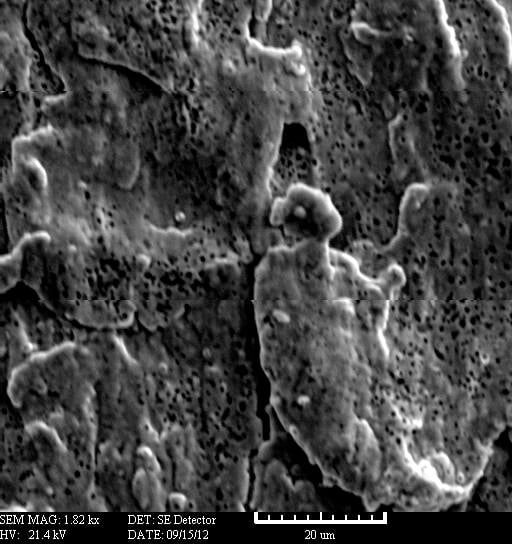
In palladium-deuterium systems, which have been most studied, and for which there is the most publicly available data, measurements of nuclear products helium, tritium, and transmutation products point to origins within a few microns of the metal’s surface.

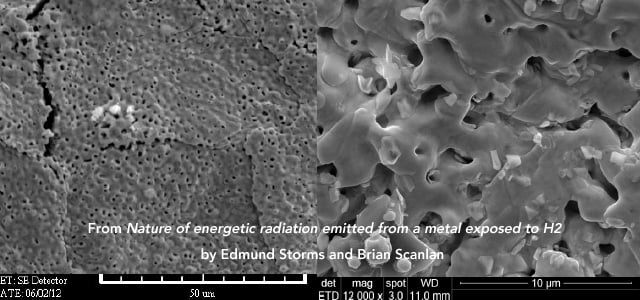
Ni surface on which Cu was deposited
Following a chain of reasoning commanded by the experimental data, Storms hypothesizes that the NAE are cracks that form on the surface of bulk metals due to stress. Expanding the idea of cracks to apply to all types of systems, he includes the tiny nano-spaces that exist within metallic powders and biological organisms.

Nano-sized cracks and spaces satisfy the criteria that puts the reaction near the surface in metal-hydrides and they can be found in all types of systems. In addition, a nano-space provides a special environment separate from the rest of the solid, relieving the burden that the chemical environment imposes, allowing the space to respond differently from the lattice, subject to appropriate stimuli.

Still, questions remain. For instance, David J. Nagel asked how could these cracks be formed so perfectly as to be just the right-size for a string of hydrons to form? And where is the mathematics to quantitatively model this hypothesis?

The nuclear mechanism

Getting these questions out in the open and discussed is the point of IE’s exercise and Storms plans to respond in the next issue, but he has made clear he does not find it fruitful to provide a mathematical argument before first describing the location of the NAE.

“If you don’t know what the initial conditions are to make the reaction happen, how can you describe what is actually happening quantitatively?”

Storms believes if theorists first focus on finding the location of the reaction, and can describe the initial conditions that make the reaction happen, then a theory of the nuclear mechanism will begin to take shape.

Supposing Storms’ idea of the NAE is confirmed, he does speculate qualitatively on the nuclear mechanism by first having the tiny cracks and spaces become filled with hydrogen to form hydrotons.

Subject to some stimulus, the hydrotons in the crack resonate, beginning a process whereby mass is slowly turned to energy according to Einstein’s E=mc2 without the dangerous radiation associated with hot fusion. This nuclear mechanism would be a new type of reaction not yet understood in the context of conventional theory.

Testing theory

Only experimental results will confirm or deny any proposed theory. However, the lack of coordinated research programs amongst the community, exacerbated by an absence of funding and patent-protection, is a huge problem.

Peter H. Hagelstein has attempted to model cold fusion since 1989, chewing through multiple versions of ideas, and abandoning them when they are no longer feasible. For all his work, he has endured two-and-a-half decades of isolation from mainstream science.

In IE#108, he opens the series on theory with a guest editorial On Theory and Science Generally in Connection with the Fleischmann-Pons Experiment [.pdf], available free compliments of Infinite Energy and lenr.org.

If his closing statement to The Believers movie was a devastating admission of defeat by SNAFU, this new essay shows a wit that won’t back down despite the massive challenges. With unblunted satire, Hagelstein deconstructs the scientific method, updating the hallowed steps-to-discovery for 21rst century conditions.

While the scientific method might lead to unambiguous data, its effectiveness is lost in an atmosphere of hostility.

Storms’ hypothesis on the NAE leads to twelve new predictions, providing a rubric to test the idea. The simplest test is to detect deuterium from Ni-H systems; a mass spectrometer on an active cell would suffice for that one. But who with access is willing to perform these experiments? Money is now being raised by interested parties to pay for co-operation.

Infinite Energy magazine is undertaking this effort to bring theorists together over a model of cold fusion with a series of issues. Jean-Paul Biberian, a researcher from Universite Sciences de Luminy and Editor-in-Chief of the Journal of Condensed Matter Nuclear Science will be leading the next issue focused on theory this winter. We hope it begins a productive renaissance in collaborative science on the greatest scientific question of our time.

A world is waiting.

Cold Fusion Now!

Related Links

Nature of energetic radiation emitted from a metal exposed to H2 by Edmund Storms and Brian Scanlan [.pdf]

An Explanation of Low-energy Nuclear Reactions (Cold Fusion) by Edmund Storms [.pdf] from Journal of Condensed Matter Nuclear Science 9 (2012)

An Explanation of Low-energy Nuclear Reactions video interview with Edmund Storms by Ruby Carat summer 2012.

The Nuclear Active Environment and Metals That Work video interview with Edmund Storms by Ruby Carat summer 2011.

The Believers – the Movie

A local Association devoted to Product Management who is considering showing the the above film at their final monthly meeting in June asked me if it would be appropriate material within their theme of supporting the cause of Product Management. Along with providing a private showing of the film to the Board of Directors, I also prepared the following Synopsis of the movie for possible distribution to members.

__________________________________________________________

Synopsis

Released in October, 2012 The Believers is a documentary that tracks the dark side of the March 1989 announcement at the University of Utah that two respected chemists had solved the world’s energy problems. They had discovered “Cold Fusion”. Within days Martin Fleischmann and Stanley Pons were on the covers of numerous magazines worldwide. But three short months later their science has been discredited and their reputations ruined. The established community of physicists refuse to accept the alleged experimental results. Retreating to France the two pioneers pursue their researches for another five years before retiring into twilight. Meanwhile “Cold Fusion” has become synonymous with “pathological science” within the general scientific community.

There could not be a better modern example of a combination of hubris and bad public relations for a product launch. Understanding what went wrong makes this story worthy to be the central focus of courses in marketing, or more precisely bad marketing, for years to come.

Meanwhile, twenty-three years later, laboring under the disdain of their peers, a small group of faithful scientists still persist in trying to resolve the un-answered Mystery of where the incontrovertible unexplained heat of the Fleischmann & Pons Effect comes from. Once solved, this scientific breakthrough may yet become the salvation of civilization providing an unending supply of low-cost energy.

The movie is not, however, so much about the science as it is about the tragedy of the personal lives of the two original discoverers. It is also about the tragedy of the rejection by established institutions of the opportunity to pursue a discovery of unparalleled importance. This assumes that its riddles can be solved and the science applied to produce its potentially vast technological rewards. But the Believers themselves are not organized. Without the presence of overseeing management and meaningful financial resources, they are all struggling with their individual theories and personal myopic experiments leaving little hope that a breakthrough is imminent.

No one can leave the theater without asking themselves: “How could this have happened?”
__________________________________________________

The movie, a documentary, is definitely focused on the tragic impact of the unfolding scenario on the lives of the two original scientists. In fact, the movie is rather dark. Martin Fleischmann is shown in his declining years suffering from Parkinson’s disease. He is also caught in moments of reflection that are quite poignant. This is particularly true when he ponders how to answer the question: “What happened between you and Stanley Pons?” He never does answer that question properly, but the look in his eyes as he stares off into the distance searching back in his memory is telling. We see the panorama of opportunities lost and dreams dashed. In Martin’s stare we can imagine the closeness that must once have existed between these two collaborators, and the gulf that now separates them.

Fleischmann until his death in August 2012 was living in England and Pons is presently, 2013, living in the South of France. In one short scene while being interviewed with his wife, Pons seriously contemplates giving-up his American citizenship.

But the movie is not just about these two individuals. It is also about the tragedy of the lost opportunity to resolve the challenge of understanding the “Fleischmann & Pons effect”. And it is indeed remarkable that in our present times with all the tools and acquired knowledge available, that those still researching in the Cold Fusion field have not determined how to reliably produce heat at a level that will boil a cup of coffee.

No doubt the scientists assembling for the next annual world conference for the Cold Fusion community, ICCF-18 to be held in July, 2013 on the campus of the University of Missouri in Columbus Missouri, will wince at the description that they are all “struggling with their individual theories and personal myopic experiments”. Unfortunately, I cannot help but lean towards that colorful image in my personal struggle to answer the question: “How could this have happened?” Why has there been no breakthrough even after 24 years?

It may well be that the puzzle is indeed complex. But there is a vast amount of data available for those who wish to accept a challenge. Reported experiments in the field showing the generation of unexplained excess heat must by now have exceeded the millennium level. A half a dozen potentially practical theories already exist and a dozen more less- credible concepts regularly float up into the air. But surely there’s enough information assembled now for some genius to hit upon the solution. What is the source of the excess energy – heat – that flows from Cold Fusion experiments??

There is an analogy in history. In 1898 Pierre Curie and his wife isolated for the first time a quantity of Radium. To their great surprise, 1 gram of radium produced heat apparently endlessly! (Ra226 half-life: 1601 years; 1000 joules per gram per year when pure.) It was not, however, until 1938-39 when Lise Meitner, an Austrian Jew exiled to Sweden by Nazi politics, solved the source of the heat based experimental results for uranium reported to her by her former associate, Otto Hahn. She identified the source of this heat as: Nuclear Fission and the mass difference of the nuclei. The elapsed time was 40 years. But that was in the first half of the 20th century. Surely in the last and first decades spanning the 20th and 21st century a similar unexplained source of energy, albeit intermittent and unreliable, should have been explained by now.

The movie The Believers is not just about Martin Fleischmann and Stanley Pons. It’s a story about the failure of the scientific community to resolve the puzzle that these two electro-chemists presented to the world. The movie depicts the toxic condemnations that descended on the heads of these two gentlemen, primarily because many laboratories could not duplicate their results, and additionally because the theory that nuclear fusion was the source of the energy was incompatible with nuclear fusion as understood by the physicists. The physicists believed that if fusion were occurring then there had to be an associated emission of high-energy particles. In the case of Cold Fusion, there was no substantial demonstration of energetic particle emissions associated with the process. The fact that there was an unexplained supply of heat, a phenomenon that would otherwise violate one of the most fundamental laws of thermodynamics, the Conservation of Energy, was simply ignored. This is a travesty of the highest order.

The movie ends with a tone of despair expressed by one of the eminent theoreticians laboring in the field: Dr. Peter Hagelstein of the Massachusetts Institute of Technology. Peter, with the demeanor of a defeated man but probably intending ironic humor, speculates that when the present generation of Believers has passed on (most of them are elderly having adopted this as their career back in 1989-1990), the field will fall into neglect only to be discovered at some future date by scientific archaeologists. These are the words of a man holding tenure at MIT who nevertheless has no grants to spend and no students to do experiments. That is the burden that these Believers labor under.

While these observations are in keeping with the tone of the movie, exploring a theme which is dark and depressing, there is hope. So many favorable experimental results have now accumulated that a breakthrough in theoretical understanding in this field must occur in the near future. At least that will be the hope of all those attending ICCF-18 this coming July. In expressing such expectations and hopes myself, I have disclosed my own membership in a group that I’m sure one day will be honored for their loyalty to the cause, – The Believers.

Top