Video: Robert Godes speaking at ICCF-18 in the Entrepreneurs session.
Brillouin Energy Corporation and SRI International continue their association cooperatively on experiments towards a commercial quantum fusion energy generator.
“We are solving engineering problems with the Hydrogen Hot Tube (HHT™) and expect to have a solid system by the end of 2014,” says President and Chief Technical Officer Robert Godes. “We also bounce ideas about the next-gen WET™ system. They [SRI] are great to work with.”
A relationship with investment firm Sunrise Securities is ongoing, but Godes says, “I don’t see Brillouin Energy going public. We may start a subsidiary corp with Sunrise for power plant operations with the HHT™ system at some point.”
Most importantly, Brillouin’s cell test equipment is dressed for success with a message that properly focuses the effort:
Brillouin Energy test equipment at SRI International
Interview with Engineer and New Energy Pioneer Moray B. King. The first portion of the interview features focused discussion on John Wheeler’s model of the quantum vacuum and how topological vortex structures are permitted to self-organize out of a turbulent, orthogonal electromagnetic flux.
During the middle part of the interview Moray further elucidates how this flux might be coherently abstracted into our dimension to do work. He outlines the discoveries of Yull Brown (Brown’s Gas Torch), Ken Shoulders (Plasmatic Exotic Vacuum Objects) and Mark LeClair (Crystalline Water Cluster Jets), and goes on to explain why their experiments demonstrate substantive evidence for Zero Point Energy (ZPE) extraction.
Toward the tail-end of our dialogue Moray ventures into the arena of LENR-Cold Fusion theory. He visualizes a scenario where cracking in the crystalline lattice creates an environment where micron-scale ball lightning (aka self-organized ZPE plasmoid) is being generated and released. Micron-sized ball lightning has been demonstrated to be highly energetic and capable of transmuting elements during laboratory studies in at least three countries. Also worth considering is that amplified ZPE interactions are known to occur within reflective Nano-domains during Cavity-QED experiments. While the ZPE explanation for LENR still remains undefined and speculative in certain important respects, further investigation of ZPE fluctuations in Nano-cavities may provide us with better understanding of what goes on within the Nuclear Active Environment (NAE) to produce the Pons-Fleischmann Excess Heat Effect.
In closing we spend some time focusing on the philosophical side of the Breakthrough Energy Movement and what will be required for a paradigm shift to occur.
Thank you for taking an interest. A more detailed outline can be found @ my blog if so desired.
Issue #112 of Infinite Energy Magazine presents a collection of nine papers covering a selection of current theories of cold fusion, also called low-energy nuclear reactions (LENR), lattice-assisted nuclear reactions (LANR), quantum fusion, heat energy from nuclear reactions (HENI), and nickel-hydrogen exothermic reactions, among other terms.
The bevy of names describing the effects generated when hydrogen interacts within various metals reveals the variety of theoretical models that purport to explain what was originally called cold fusion. Each theory circulating today is as different as the list of names for this Rumpelstiltskin reaction. The lack of consensus among scientists on what makes the fusion-sized excess heat and transmutations has been a major stumbling block to developing a commercial product.
Some labs have a controlled, on-demand reaction, but are challenged by low thermal output. Other labs have high thermal output, but are lacking some aspect of stability or control. All successes have been hard won by trial-and-error, and each lab follows a different model.
A varied set of models attempting to describe the reaction were given at the 18th International Conference on Cold Fusion (ICCF-18), amidst the mostly experimental results presented. David J. Nagel, formerly of the Naval Research Lab and now at George Washington University in Washington, D.C. contributes a Scientific and Commercial Overview of ICCF-18 that summarizes the talks. The article is an excellent summary of the state of the field as disclosed by many of the top scientists in the field and is available to read free-of-charge as a service to the community. [.pdf]
Longtime researcher Dennis Letts contributes an article A Method to Calculate Excess Power and George H. Miley talks about his new book, recounting events in his long research career, as well as what’s happening regarding his new company LENUCO in an interview by IE’s Christy Frazier. [.pdf].
You can also read my personal account of the Second Annual Global Breakthrough Energy Movement Conference compliments of Infinite Energy [.pdf], but buying the issue supports the work of the New Energy Foundation.
Edward Tsyganov of Cold Fusion Power, International and OSNovation Systems, Inc. presents Cold Nuclear Fusion at RASA.Edward Tsyganov forwards a report Cold Nuclear Fusion on his research presented at the Russian-speaking Academic Science Association (RASA) meeting held 8-10 November 2013, Clearwater Beach, FL.
Currently, humanity has reached a stage of development at which the struggle for energy resources is particularly important, because all the known sources of energy in the near future will not be able to provide our needs. Chemical energy, in addition, is limited on account of the so-called greenhouse effect. Nuclear energy is based on the use of fissile materials, and is not a solution, because the stock of these materials is limited. The initial optimistic expectation of the transition to the process of controlled nuclear fusion has not yet materialized. Technical difficulties in obtaining sustainable superhot plasma and the damaging effects of the enormous neutron flux arising as a result of fusion reactions back down the solution to this problem on a more distant and uncertain future.
Recently there was the belief that the problem of controlled nuclear fusion could be solved in a completely different way. It has been shown experimentally that the cross-barrier synthetic processes depend greatly on the physical state of the matter that reactive atoms are placed in. Distance convergence of two deuterium nuclei through the mechanism of the Rydberg crystal cell in metals occurs by an order of magnitude smaller than the size of a free atom of deuterium. Coulomb barrier permeability in this DD fusion process increases greatly (by the 50–60 orders of magnitude) as compared with a permeability barrier to free molecules of deuterium. In this recent work, we discuss the possibility of detecting the “cold” DD fusion process experimentally by detecting low-energy electrons resulting from the fusion reaction of two deuterons in palladium crystals with very small (thermal) excitation energies of the intermediate compound nucleus 4He*. This process is made possible by the exchange of the excited compound nucleus with electrons of the crystal lattice that results from virtual photons.
It happens historically that the process of DD cold fusion was studied in more detail than other, similar processes. In this regard, we have restricted ourselves to this particular process. Presented below is a summary report of the situation that has now developed, in a cold DD fusion.
Accelerator experiments have shown that the value of screening potential for the impurity atoms in metallic crystals reaches up to 300 eV or even more. This means that, during DD reaction occurring in the medium of the metal crystal, impurity atoms are excited, and deuterium has not circular but elliptical electron orbits, which are oriented relative to each other a certain crystallographic manner. In this case, the nuclei of these atoms can approach each other by a distance substantially less than the size of the unexcited atom, yet still without Coulomb repulsion. Such processes are known in the art and are the cause of chemical catalysis. The processes were first quantitatively described by Johannes Rydberg in 1888.
Thus:
1. The existence of the phenomenon of cold fusion is now conclusively proved by experiments, including experiments on low-energy accelerators.
2. The observed absence of nuclear products for cold fusion can be explained by the decay of a compound nucleus 4He* slowing through nuclear channels as its excitation decreases in energy. The release of energy in this connection is mediated by virtual photons.
3. Prejudice of many nuclear experts to the phenomenon of cold fusion is due to the unusual nature of the nuclear process, in which cold fusion forms an intermediate compound nucleus 4He* in a metastable state.
4. The accumulated empirical rules of nuclear physics seem indisputable to the nuclear community, while the range of their application is merely limited.
—E.N. Tsyganov
VIDEO: Nicolas Chauvin presenting LENR Cars as part of Entrepreneurial Efforts at the 18th International Conference on Cold Fusion (ICCF-18).
Nicolas Chauvin, research scientist, innovator and entrepreneur, is up for the Future Energy Startup Investment opportunity with his LENR Cars, and he needs your vote now.
Chauvin is an EPFL engineer licensed in business school and co-founder of two other start-ups before LENR Cars. He has worked for NASA, Nestlé and Logitech.
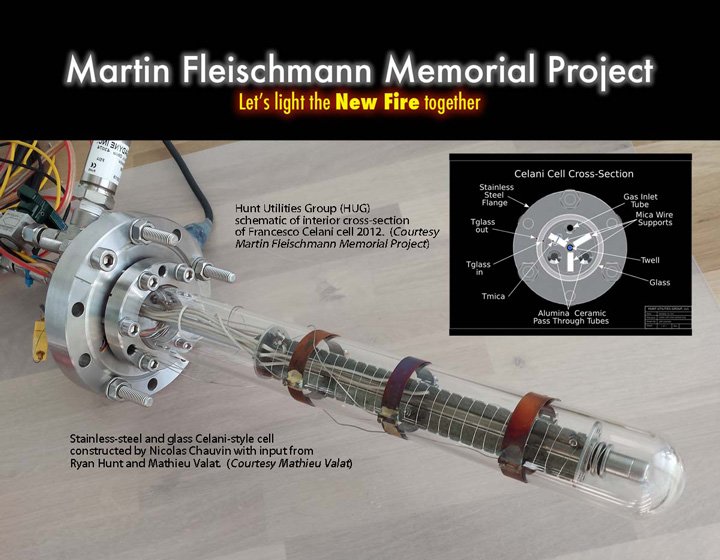
Steel-glass Celani-style cell is MFMP’s newest by Nicolas Chauvin, together with Mathieu Valat and Ryan Hunt. (From the 2014 History of Cold Fusion Calendar)He is currently working with the Martin Fleischmann Memorial Project (MFMP), an open-source science group collaborating across continents to reproduce LENR experiments. Chauvin recently completed a steel-glass cell design derived from the Francesco Celani-style reactor, a picture of which is the December photo for the 2014 History of Cold Fusion Calendar.
LENR cars might be an early entry into this nascent technology, but engineering applications will drive the science forward, too.
LENR Cars is developing two technologies to reduce carbon emission: – Waste heat recovery system producing electricity from heat based on Rankine microturbines – Condensed matter hydrogen fuel cell that can consume 4000 times less hydrogen than conventional fuel cells for the same electrical output power thanks to LENR process LENR Cars is currently focusing on the transportation market with high tech collaborations in motor racing. Rankine microturbines are expected to reduce the fuel consumption of vehicles (cars, trucks and boats) by 15% while being affordable for mass production. On a long term, condensed matter hydrogen fuel cells are expected to be able to power electric vehicles for over 20’000 km per hydrogen charge with a lower cost of ownership compared to fossil fuel vehicles.
In Japan, Fukushima Daiichi Nuclear Plant is continuing to generate radioactively contaminated water and leak it out. On September 10, 2013, the Ministerial Meeting on Contaminated Water and Decommissioning Issues discussed “Policies and Concrete Actions for Addressing the Contaminated Water and Decommissioning Issues”, and concluded that a team to collect expertise from all over the world and to invite proposals of countermeasures would be established. (The detail is here in English.)
The issued Request for Information (RFI) was closed on October 23. The overview of result of RFI is here in English. The number of proposals submitted is 779 and they are published as PDF files in here in Japanese. (Some proposals from overseas are written in English.)
removing radioactive particles from the earthA few proposals seem to be based on LENR or LENT (Low Energy Nuclear Transmutation). For example, Dr. Shin Iwasaki proposed LENT technology by nano silver particles (No.210 and No.211) which I have introduced at here.
Another LENT technology described in No.396 (in Japanese) is very interesting and may attract LENR watchers’ attention. This is proposed by JAPAN TECHNO CO., LTD. The company is famous for OHMASA-GAS that is very stable and easy storable oxygen and hydrogen mixed gas. OHMASA-GAS was featured in NHK WORLD NEWSLINE as here.
OHMASA-GAS is generated by electrolysis while the water is being stirred by “super vibration” wings. No.396 is related with the super vibration in water but not related with OHMASA-GAS itself.
JAPAN TECHNO claims that the super vibration in water generates many nano bubbles which cause nuclear transmutation. As the result, radioactive materials, for example radioactive cesium, are transmuted to non-radioactive materials. While the paper of No.396 does not describe detail, Dr. Ryushin Ohmasa, the president of JAPAN TECHNO, seems to be very confident because he got the result of elementary analysis of contaminated water before and after the super vibration when I talked to him.
In this context, a very interesting patent application was applied on July 27, 2007 in Japan by Dr. Ohmasa. (The Japanese patent application is published here.)
In the application, Dr. Ohmasa claimed that over 100 Hz vibration to water for over 100 hour caused increase of Mg, Zn, Ca, Al, Cu, Na, K and Se in the water. The following table shows the result of ICP Mass Spectrometry of pure water before and after the vibration in 200 hours.
(unit: ppb)
Mg
Al
Se
Cu
Zn
Na
Ca
K
1st experiment
Pure Water
Before Vibration
0.00
0.00
0.00
0.00
0.00
0.11
0.12
0.00
Pure Water
After Vibration
583.47
6.30
0.36
6.74
133.44
3.53
12.17
1.84
2nd experiment
Pure Water
Before Vibration
0.00
0.00
0.00
0.00
0.00
0.14
0.00
0.02
Pure Water
After Vibration
621.29
7.48
0.97
7.33
147.35
4.36
8.85
1.94
This phenomenon is very interesting and one of hopes that can decontaminate huge radioactive water. I hope the committee will study seriously the phenomenon and technology.