LENR subject of Italian Parliament query

Cold Fusion: the new parliamentary question Written by Roberta De Carolis
Thursday, March 13, 2014

Original Italian
http://nextme.it/scienza/energia/7349-fusione-fredda-interrogazione-parlamentare-e-cat

Google translate English
http://translate.google.com/translate?sl=it&tl=en&js=n&prev=_t&hl=en&ie=UTF-8&u=http%3A%2F%2Fnextme.it%2Fscienza%2Fenergia%2F7349-fusione-fredda-interrogazione-parlamentare-e-cat

An excerpt:

Cold fusion. The ‘E-Cat and LENR all devices subject of a new parliamentary question. The act formally presented to the Minister of Education, Universities and Research on March 4, was signed by some members of the 5 Star Movement, including Ivan Della Valle, currently the spokesperson of the party in the Chamber of Deputies.

The ladies, in particular, ask if the Minister “considers it appropriate to take action to allocate adequate funding for the activities taking place at universities and public research sector Italians LENR” and “if it intends to promote new research in the field of LENR.” The query joins previous signed by other political parties .

Della Valle and his colleagues start from the premise that the field of LENR now arouses great interest in the international arena, which is “the field of research in many laboratories around the world” and that there are concrete evidences that justify these efforts. A clear reference to the studies of Francesco Celani (quoted in fact the INFN).

And Rossi? The question he founded the premises, in fact, academic studies, probably because it addressed to the Minister of Research. And what by many is considered a problem, or the poor reproducibility of the results for Della Valle and his is an ‘opportunity, which should drive investment in the sector.

While waiting for the response of the Department, in the U.S. we are preparing for a large meeting on the occasion of the 25th anniversary of the conference of Fleischmann and Pons, dated March 23, 1989, during which the British researchers announced to the world that cold fusion was a reality, and therefore the energy problem of our planet might have a solution soon……

Related Links

Italian Senator lobbies Parliament for action

European Parliament ITRE committee meets over Fleischmann-Pons Effect

Read and rate: “Cold Fusion May Have Revolutionary Potential” by Jed Rothwell


Rate this essay on cold fusion submitted to the Foundational Questions Institute, and give new energy your vote!

Cold Fusion May Have Revolutionary Potential by Jed Rothwell of LENR-CANR.org was submitted to the FQXi How Should Humanity Steer the Future? 2014 Essay Contest. Open to entries until April 18, 2014.

Go to http://fqxi.org/community/forum/topic/2000 to read the essay and comment.

Essay Abstract

Cold fusion is a form of nuclear energy produced in metals saturated with hydrogen or heavy hydrogen (deuterium). It has been replicated in hundreds of major laboratories, and these replications have been published in mainstream, peer-reviewed journals. This literature shows that cold fusion can generate heat at temperatures and power density equivalent to a fission reactor core. It has sometimes produced high power, 20 to 100 watts, in reactions that produced roughly 100,000 times more energy than any chemical fuel.

Download Cold Fusion May Have Revolutionary Potential [.pdf]

Author Bio

BA Cornell U. 1976 in Japanese language and literature Programmer and technical writer. Librarian at lenr-canr.org, an on-line library of 1,200 full text documents and a bibliography 3,500 items. Rothwell edited many cold fusion papers, especially for several ICCF conference proceedings. He translated several papers and one book from Japanese into English.

Seldon Technologies, NASA, and LENR

The present disclosure combines the unique properties of nanotubes and in one embodiment carbon nanotubes, in a novel manifestation designed to meet current and future energy needs in an environmentally friendly way. Devices powered with nanotube based nuclear power systems may substantially change the current state of power distribution.” 
–Retired U.S. Rear Admiral Craig E. Steidle of Seldon Technologies on cold fusion nanotube-based nuclear power systems.

Rear Admiral Craig E. Steidle – USN, NASA, DoD
Admiral Craig E. Steidle served as the first Associate Administrator of the Office of Exploration Systems at NASA (now known as the Exploration Systems Mission Directorate), an organization formed to implement NASA’s human exploration of the solar system as announced in the Vision for Space Exploration.

Adm. Steidle served as the Director of the Department of Defense (DoD) Joint Advanced Strike Technology Office and was the Director of the Joint Strike Fighter Program, DoD’s largest program.

Admiral Steidle officially resigned from the position of associate administrator for exploration systems in June 2005. He served as a Visiting Professor in Aerospace Engineering at the U.S. Naval Academy for five years and then briefly as the President of the Commercial Spaceflight Federation before fully retiring in 2011.

Craig Steidle NASA’s Future Is Rising From ‘the Swamp’
by Guy Gugliotta, Washington Post, Dec.15, 2004
At NASA headquarters, they call it “the swamp,” a broad expanse of the fifth floor where experts gather to figure out how to accomplish the most ambitious space feat ever: a multi-decade plan to send humans from Earth to the moon and ultimately to Mars.

The master of this domain is Associate Administrator Craig E. Steidle, the retired Navy rear admiral who runs NASA’s not-so-new-anymore Office of Exploration Systems and who went to work for NASA after the top brass lured him in as a consultant….

Craig Seidle and Dennis Bushnell were each highlighted in 2008 American Society for Engineering Education Conference. I imagine each know of each others works, Admiral Steidle as board-member of cold fusion company Seldon Technologies and Dennis Bushnell as a leader in NASA cold fusion.

Distinguished Lectures Presentation Title: “The Future(s) of Energetics” by Dennis Bushnell was sponsored by the Mechanical Engineering Division. This talk summarizes the increasingly dire and ever nearer term implications of Global Warming and Peak Oil and then considers the spectrum of “Green” and the “Ways Forward” to replace Fossil Carbon Energy Sources. There are four approaches possible in the nearer term. These include approaches with the capacity to replace petroleum for transportation and coal/natural gas for base load. While they require research, they are both feasible and affordable.

The lecture also considers the “frontiers of the responsibly imaginable” in energetics going forward, and “Wild Card” approaches which proffer revolutionary possibilities. Energetics issues considered include Generation, Storage, Conservation and Transmission. Lecture concludes with a brief discussion of “Second Law Warming”, which will follow Atmospheric Warming and constrains the solution options for Atmospheric Warming.

Best Paper Award – NSEE 2008 “The Loss of the Space Shuttle Columbia: Portaging the Leadership” by Robert Nieweoehner, Craig Steidle, and Eric Johnson, sponsored by the Engineering Management Division.

December 2008 “The Energetics Futures Brief” with NASA Chief Scientist Dennis M. Bushnell” for the University of Alberta Energy Club.
This presentation will focus on the advanced and futuristic technologies already at the laboratory stages or on the horizon that have the potential to shape how we will live and conduct our activities. The urgency for humanity to change energy consumption, and the types of energy that is used will form part of this presentation leading to a discussion on the following topics:

  • Nano-plastics for the conversion of solar energy into electricity
  • Thermo-electrics (i.e., the direct conversion of temperature differences), tidal-current turbines and geothermal sources for electricity production
  • Production of food biomass and biofuels by means of genetically modified halophytes (salt tolerant plants) and algae growing in saline or brackish waters
  • Robotics replacing higher-level human labour, machine intelligence and human life extension
  • Carbon dioxide (CO2) to carbon monoxide (CO) conversion and hydrogen production by artificial photosynthesis
  • Photo-catalytic electrolysis of water for hydrogen production
  • Low-radiation nuclear fusion, such as proton – Boron 11 aneutronic fusion
  • Low energy nuclear reactions

Seldon Technologies
Now, Craig Steidle is on the board of directors of Seldon Technologies, Inc. The two following Seldon patents are noteworthy.

Methods of Generating Energy and/or he-4 Using Graphene Based Materials
Publication date: Oct 30, 2013

Inventors Christopher H. Cooper, William K. Cooper, James F. Loan
From the Patent:

Deuteron-Based Reactions

[0050] Fusion of two deuterons that are confined in a solid can theoretically result in three different outcomes as shown in the following equations (V. E. Kim, Purdue Univ., The 15th International Conf. on Condensed Matter Nuclear Sci. (ICCF-15) Oct 5 -9, 2009)

[0052] For each 4He produced by two deuterons 23.8 MeV energy is released because of the well-known relationship between change in mass during a fusion process and energy release (E=mc2). It is speculated that the energy released is in the form or electromagnetic radiation with wavelengths ranging from Gigahertz to extreme UV, sometimes referred to as “soft x-rays”

[0053] It has been discovered that graphene materials have an unusual electronic structure making it an ideal candidate for a variety of applications, primarily in the field of electronics. In particular, it has been discovered that the single atomic layer of carbon, characteristic of graphene materials, effectively screens Coulomb interactions, causing graphene to act like an independent electron semimetal. Furthermore, one particular graphene material, carbon nanotubes, can be grown with remarkable uniform diameters, number of walls, and atomic structure. See, “The Effective Fine-Structure Constant of Freestanding Graphene Measured in Graphite,” Science, Vol. 330 no. 6005 pp. 805-808 5 November 2010, which is herein incorporated by reference

[0058] The results presented herein are, in general, consistent with other reported low-energy nuclear reaction (LENR) experimental results, most notably the work of McKubre at Stanford Research Inst, who reported a peak 4He concentration of 1 ppm after 20 days of aging palladium powder in D2 gas (APS meeting, Denver CO, March 5, 2007)

Methods of Generating Energetic Particles Using Nanotubes and Articles Thereof
US 20130266106 A1 – Publication date Oct 10, 2013

Inventors: Christopher H. Cooper, James F. Loan, William K. Cooper, Alan G. Cummings Original Assignee: Seldon Technologies, Llc

From the patent:
ABSTRACT

There is disclosed a method of generating energetic particles, which comprises contacting nanotubes with a source of hydrogen isotopes, such as D2O, and applying activation energy to the nanotubes. In one embodiment, the hydrogen isotopes comprise protium, deuterium, tritium, and combinations thereof.

There is also disclosed a method of transmuting matter that is based on the increased likelihood of nuclei interaction for atoms confined in the limited dimensions of a nanotube structure, which generates energetic particles sufficient to transmute matter and exposing matter to be transmuted to these particles.

DESCRIPTION

This application claims the benefit of domestic priority under 35 USC §119(e) to U.S. application Ser. No. 60/741,874, filed Dec. 5, 2005, and Ser. No. 60/777,577, filed Mar. 1, 2006, both of which are incorporated by reference herein.

Disclosed herein are methods of generating energetic particles, by contacting nanotubes with hydrogen isotopes in the presence of activation energy, such as thermal, electromagnetic, or the kinetic energy of particles. Also disclosed are methods of transmuting matter by exposing such matter to the energetic particles produced according to the disclosed method.

A need exists for alternative energy sources to alleviate our society’s current dependence on hydrocarbon fuels without further impact to the environment.

The inventors have developed multiple uses for nanotubes and devices that use such nanotubes. The present disclosure combines the unique properties of nanotubes and in one embodiment carbon nanotubes, in a novel manifestation designed to meet current and future energy needs in an environmentally friendly way.

Devices powered with nanotube based nuclear power systems may substantially change the current state of power distribution. For example, nanotube based nuclear power systems may reduce, if not eliminate, the need for power distribution networks; chemical batteries; energy scavenger devices such as solar cells, windmills, hydroelectric power stations; internal combustion, chemical rocket, or turbine engines; as well as all other forms of chemical combustion for the production of power.

It’s Still All About Energy

Japan marks the third anniversary of the Fukushima tsunami-quake disaster from Deutsche Welle.

“We have to engage in the preventative care” for the planet, says U.S. Senator Ed Markey, during an all-night filibuster towards a new energy policy. Markey has been contacted multiple times about the solution that cold fusion offers, but he has yet to take any action.

So on this sad day when the world careers from one disaster to another and solutions are ignored, and denied, Ralph Nader cuts through the image created by media programming to expose the mechanisms that operate to make that situation turn in favor of the powerful, instead of the wise.

http://www.democracynow.org/2014/3/12/nader_on_senates_climate_stance_insanity

Nader responds to the seemingly impending Keystone pipeline, the U.S. Nuclear Regulatory Agency, and Fukushima, a tragedy still unfolding. Amateur-lenr blogger and author Toshiro Sengaku has updated English readers with news about an effort to use nano-particles in radioactive waste clean-up.

“It’s not worth the risk! Just to boil water – just to produce steam! … Shut down the aging nuclear plants!” says Ralph Nader.

Unfortunately, he uses the word nuclear as a reference to all bad, all the time.

He says on Democracy Now with Amy Goodman how we need “fusion power … from the sun”.

He mentions Al Gore, who we know has openly offered cold fusion as a path to a green economy, but Mr. Nader said nothing about that.

Still, he inspired me to write about the opportunity we have to change our way living, change our bad habits – change everything, with any one of several breakthrough energy technologies, and the suffering that will only increase unless we do choose a different path for our species.

I haven’t been blogging lately, and there have been recent losses to the community of scientists with the passing of Emilio Del Giudice and Peter Graneau.

But Cold Fusion Now continues activities off-the-Internet. (Try it!) I will attend the 2014 LANR/CF Colloquium this March 21-23 to gather video for a feature film on the field. Along with Jeremy Rys, we will interview and document the historic 25-year anniversary of the announcement of cold fusion by Drs. Martin Fleischmann and Stanley Pons, who endured the hostility from their peers reserved only for the most courageous and bold of humans, those who dare speak the truth, honestly, and though disruptive a truth it may be, do not shy away from challenge and mystery, but act without malice and without fear to follow that truth wherever it may lead.

Twenty-five years and going stronger than ever, the breakthrough energy community is growing, and getting closer to a technology that will revolutionize our world and offer a second chance for humanity. The colloquium will bring some of the world’s top researchers together to talk about the progress, and the problems that remain.

From the New Energy Movement Seattle chapter’s John Coelho, here is a list of just some of the groups who are working on this science:

GROWING LIST OF CREDIBLE MAINSTREAM PEOPLE AND ORGANIZATIONS AFFIRMING WITH FIRST HAND KNOWLEDGE THAT LENR (COLD FUSION) IS REAL AND PRODUCES A NET ENERGY GAIN

· Vladimir Vysotskii, doctor of sciences, http://www.iccf17.org/popup/bio_23.htm

· Olga Drimitriveya, Phd. research scientist at Cool Essence http://www.linkedin.com/pub/olga-dmitriyeva/4/b72/910

· Arik L. Boher, physicist, University of Missouri Group Leader- Research https://www.youtube.com/watch?v=Yb2M4a-gDyY

· David J. Nagel, physicist, Naval Research Lab, Professor George Washington University http://coldfusioninformation.com/personalities/david-j-nagel/

· John Fisher, physicist https://www.youtube.com/watch?v=3jQ_xDqHfQM

· Pamela Mosier-Boss, visiting scientist at MIT. https://www.youtube.com/watch?v=HbA6ZH8AiN4

· Dr. Larry Forsley, physicist’ is president of JWK International Corporation and CTO of Global Energy Corporation (GEC). Previously, he was a group leader with the Laboratory for Laser Energetics engaged in inertial confinement fusion (ICF, or, laser fusion) at the University of Rochester in Rochester, NY. He was a consultant to the Lawrence Livermore National Laboratory mirror fusion program, TMX-U, in Livermore, California and a visiting scientist on the ASDEX Tokamak at the Max Planck Institut fur Plasmaphysik in Garching, Germany. http://iccf17.org/popup/bio_6.htm

· Dr. Mitchell Swartz, physicist https://www.youtube.com/watch?v=5Oab9COjOvM

· DR. Brian Josephson, Nobel Prize Theoretical physics, Cambridge https://coldfusionnow.org/nobel-laureate-brian-josephson-affirms-support-for-e-cat-ht/

· •Dr. Julian Schwinger, Nobel Prize Physics, Berkeley, Purdue, deceased http://en.wikipedia.org/wiki/Julian_Schwinger

· •Dennis Bushnell, NASA chief scientist, Langley Research Center, LRC http://www.lenrnews.eu/dennis-bushnell-lenr/

· •Dr. Joseph Zawodny, NASA senior research scientist Langley Research Center http://climate.nasa.gov/news/864

· •Dr. Michael A Nelson, NASA LENR Space Applications Lead http://www.youtube.com/watch?v=djBIWTsnwjY&noredirect=1

· •David Wells, NASA LRC, Aeronautical engineer

· •Gustave C. Fralick, Arthur J. Decker, and James W. Blue, NASA Lewis Research

· •George Miley, University of Illinois, Department of Nuclear, Plasma, and Radiological Engineering http://en.wikipedia.org/wiki/George_H._Miley

· •Dr. Mike McKubre, SRI (Stanford Research Institute), Director Energy Research Center, University of Missouri http://en.wikipedia.org/wiki/Michael_McKubre

· •Dr. Francis Tanzella, SRI, PhD chemistry, senior electrochemist http://www.iccf17.org/popup/bio_22.htm

· •Dr. Brian Ahern , Ames National Laboratory http://nextbigfuture.com/2011/06/brian-ahern-getting-8-watts-in-low.html

· •Prof. Peter Hagelstein, Electrical Engineering, MIT http://en.wikipedia.org/wiki/Peter_L._Hagelstein

· •Dr. James Truchard, National Instruments founder, President and CEO https://coldfusionnow.org/james-truchard-opening-niweek-2012-ni-gives-free-labview-to-cold-fusion-scientists-since-1989/

· •Edmund Storms, Los Alamos National Laboratory http://www.infinite-energy.com/images/pdfs/stormsinterview.pdf

· •Dr. Mace, Los Alamos National Laboratory

· •John Bockris, electrochemist Texas A&M University http://en.wikipedia.org/wiki/John_Bockris

· •Dr. Francesco Piantelli, University of Siena, Considered the father of modern LENR, filed original patents in 1995 for Ni/H based LENR http://coldfusion3.com/blog/piantelli-files-international-lenr-patent-application

· •Dr. Sergio Focardi, emeritus professor University of Bologna http://en.wikipedia.org/wiki/Sergio_Focardi

· •Dr. Giuseppe Levi , University of Bologna http://coldfusion3.com/blog/giuseppe-levi-goes-on-record-to-discuss-e-cat

· •Dr. David Bianchini, University of Bologna

· •Dr. Christos Stremmenos, University of Bologna, Dept of. Physical and Inorganic Chemistry, retired

· •Francesco Celani, National Institute of Nuclear Physics (Italy’s equivalent of Los Alamos http://www.iccf17.org/popup/bio_5.htm

· •Dr. Frank Gordon, US Navy’s Space and Naval warfare systems (SPAWAR), retired

· •Eugene Mallove (late), Professor of science MIT http://en.wikipedia.org/wiki/Eugene_Mallove

· •Dr. Mastromatteo, STMicroelectronics http://www.lenrproof.com/slide_05.html#sthash.opm2RlWn.dpuf

· Hanno Nessen, Chairman of Swedish Royal Academy of Science , board member and previous chairman of Swedish Skeptics Society http://coldfusion3.com/blog/swedish-scientists-think-e-cat-is-for-real

· Cherokee Investment Partners/Industrial Heat (http://ecat.org/tag/cherokee-investment-partners/ )

· DARPA Defense Advanced Research Projects Agency http://energycatalyzer3.com/news/leading-researcher-says-he-has-replicated-at-least-five-lenr-technologies-for-us-government-admits-working-for-darpa-2

· NASA http://climate.nasa.gov/news/864

· MIT http://www.lenr-coldfusion.com/2013/01/26/mit-cold-fusion-101-videos/

· Los Alamos National Laboratory http://searcher-green.lanl.gov/search?q=cold+fusion&btnG=Search&client=outside_lanl&proxyreload=1&proxystylesheet=outside_lanl&output=xml_no_dtd&x=8&y=5&ulang=en&sort=date%3AD%3AL%3Ad1&entqr=3&entqrm=0&entsp=a&oe=UTF-8&ie=UTF-8&ud=1)

· SRI International http://coldfusioninformation.com/organisations/sri-international/

· University of Missouri http://energycatalyzer3.com/news/cold-fusion-research-starts-at-the-university-of-missouri

· The British Columbia Provincial Government and Canadian Federal Government working with:

· Defkalion a private LENR corporation http://nickelpower.org/2013/04/10/my-visit-to-defkalion-canada/

· Robert Duncan, physicist, vice president for research at Texas Tech (http://en.wikipedia.org/wiki/Robert_Duncan_(physicist) http://coldfusion3.com/blog/lenr-champion-to-leave-post-at-university-of-missouri

· Ray Bradbury (late)_, science fiction writer with uncanny predictive powers in terms of scientific developments (http://en.wikipedia.org/wiki/Ray_Bradbury

· The Space Naval Warfare Systems unit of the US Navy. http://coldfusioninformation.com/organisations/spawar/

· Garrett Moddel, professor University of Colorado- Boulder http://ecee.colorado.edu/fac_staff/personnel_pages/moddel.html

· John Dash, PhD professor emeritus of physics Portland State University http://www.pdx.edu/physics/john-dash-0

· The Mitsubishi Corporation http://indico.cern.ch/event/177379/material/slides/5

· The American Chemical Society http://www.newenergytimes.com/v2/books/2009-LENR-Sourcebook/2009-LENR-Sourcebook.shtml

· Cool Essence LLC 2450 Central Avenue # F, Boulder, CO 80301

Compiled by John Coelho
NEW ENERGY MOVEMENT-Seattle

Contact

NASA LENR Aircraft and Spaceplanes

It’s mind-boggling to imagine the numbers of people who have viewed the NARI Low Energy Nuclear Reaction Aircraft Seedling Seminar by Doug Wells – people from companies serving the aerospace industries, to leaders in engineering and research. The seedling seminar is even being reported in aviation magazines worldwide. Wow!

Doug Wells Low Energy Nuclear Reaction Aircraft [.pdf]

Doug Wells will also present a paper at the AIAA Aviation 2014 Conference, a Study Webinar by Marty Bradley available through the American Institute of Aeronautics and Astronautics, and a paper was presented in January, at the 52nd Aerospace Sciences Meeting, by Robert A. McDonald from Cal Poly.

Thousands upon thousands of savvy people are now grasping that cold fusion is emerging as a source of clean energy beyond our most promising dreams, with the power to move humanity through our next evolution. With popular cold fusion/LENR science, we are on the verge of an epic technological advancement with the concurrent personal, social, economic, environmental, spiritual, and philosophical advancements.

With that change in energetics, the paradigm changes, and we begin building an ecologically sustainable society.

 “-given the truly massive-to-mind boggling benefits – solutions to climate, energy and the limitations that restrict the NASA Mission areas, all of them. The key to space exploration is energetics. The key to supersonic transports and neighbor-friendly personal fly/drive air vehicles is energetics, as simplex examples of the potential implications of this area of research.”
–Dennis Bushnell, Chief Scientist NASA Langley on the energetics of LENR.

Low Energy Nuclear Reaction Aircraft Investigator
Doug Wells, NASA Langley Research Center

Purpose
The purpose of this research is to investigate the potential vehicle performance impact of applying the emergent Low Energy Nuclear Reaction (LENR) technology to aircraft propulsion systems.

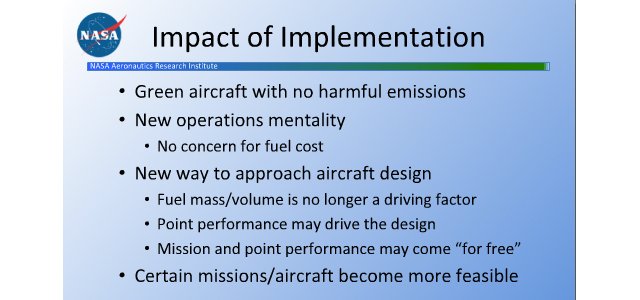
LENR potentially has over 4,000 times the density of chemical energy with zero greenhouse gas or hydrocarbon emissions. This technology could enable the use of an abundance of inexpensive energy to remove active design constraints, leading to new aircraft designs with very low fuel consumption, low noise, and no emissions.

The objectives of this project are to gather as many perspectives as possible on how and where to use a very high density energy source for aircraft including the benefits arising from its application, explore the performance impacts to aircraft, and evaluate potential propulsion system concepts.

Background
LENR is a type of nuclear energy and is expected to be clean, safe, portable, scalable, and abundant. The expected benefits make it an ideal energy solution. When it is applied to aircraft, LENR removes the environmental impacts of fuel burn and emission from combustion. Excess energy could be used to reduce noise so that all three of NASA’s technology goals for future subsonic vehicles are either eliminated or addressed.

Furthermore, aviation impacts almost every part of our daily lives, civilian and military.

A revolutionary technology like LENR has the potential to completely change how businesses, military, and the country operate as a whole, giving a tremendous financial, tactical, and resource advantage to anyone that utilizes it in the most effective way.

High-density energy sources create some unique capabilities as well as challenges for integration into aircraft.

An LENR concept that has reported some success generates heat in a catalyst process that combines nickel metal (Ni) with hydrogen gas (H). The initial testing and theory show that radiation and radioisotopes are extremely short lived and can be easily shielded.

Although nuclear fission has been looked at for use in aircraft, LENR is different. LENR has a higher energy density and no radioactive by products.

Success of this research will provide a firm foundation for future research and investment for high-density energy source technology integration into aircraft.

FIVE EMERGENT EXAMPLES

NASA LENR Aircraft 2014 Seedling Technical Seminar
The Team

California Polytechnic State University

  • Dr Rob McDonald
  • Advanced Topics in Aircraft Design Course
  • Sponsored Research Project Team

NASA Glen Research Center

  • Jim Felder, Cris Snyder

NASA Langley Research Center

  • Bill Fredericks, Roger Lepsch, John Martin, Mark Moore, Doug Wells, Joe Zawodny

The Application of LENR to Synergistic Mission Capabilities
Submitted by Doug Wells for publication and presentation at the AIAA Aviation 2014 Conference. Date: 16 – 20 June 2014.
Location: Atlanta, Georgia. (we must wait to view it)

The American Institute of Aeronautics and Astronautics (AIAA) is the world’s largest technical society dedicated to the global aerospace profession.

Lessons Subsonic Ultra Green Aircraft Research (SUGAR)
Study Webinar Recorded 18 December 2012 – Martin K. Bradley
Available at the American Institute of Aeronautics and Astronautics
1801 Alexander Bell Drive, Suite 500 – Reston, VA 20191-4344

Synopsis
This webinar summarizes the work accomplished for NASA by the Boeing Subsonic Ultra Green Aircraft Research (SUGAR) team during a continuing two-phase study, which started in 2008. Results through February 2012 are reported.

In Phase I, the team completed the development of a future scenario for world-wide commercial aviation in 2030, selected baseline and advanced configurations, generated technology suites for each, conducted detailed performance analysis, calculated noise and emissions, assessed technology risks, and developed technology roadmaps. Five concepts were evaluated in detail including a high span strut braced wing concept, a gas turbine battery electric concept, and a hybrid wing body.

In Phase II, the study was extended to the N+4 2040 timeframe and considered the following additional technologies: Liquefied Natural Gas (LNG), Hydrogen, fuel cell hybrids, Low Energy Nuclear (LENR), boundary layer ingestion propulsion (BLI), unducted fans, and advanced propellers.

Presenter
Dr. Marty Bradley is a Technical Fellow for The Boeing Company, working in the Boeing Research and Technology organization in Huntington Beach, California. For Boeing, he is the leader for a variety of projects related to green aircraft technologies, aviation environmental life cycle analysis, and propulsion integration for advanced technologies. Marty has 28-years of experience in vehicle design, propulsion integration, and technology studies for a wide variety of commercial and military aerospace applications. He has led and conducted projects for green aircraft design, alternative fuels, and environmental life cycle analysis (LCA).

Marty is the Principal Investigator for this NASA funded study looking at advanced technologies for future commercial aircraft, which will be discussed. Marty has a B.S., M.S., and Ph.D. in Aerospace Engineering, all from the University of Southern California.

LENR-Spaceplane-2-Parts-of-aircraftImpact of Advanced Energy Technologies on Aircraft Design
Robert A. McDonald, California Polytechnic State University
American Institute of Aeronautics and Astronautics
Publication Date: 13-17 January 2014
Chapter DOI: 10.2514/6.2014-0538

The impact of low energy nuclear reaction (LENR) technology on the design of aircraft is examined. Energy conversion possibilities considered and a Brayton cycle engine with an LENR heat exchanger is selected.

Potential aerospace applications of LENR devices are discussed and a high altitude long endurance (HALE) unmanned ariel vehicle with multi-year endurance is conceptualized with primary focus on (LENR) energy management.

SpaceWorks Engineering Advanced Concepts Group
Key customers and partners are NASA, Air Force Research Laboratory, DARPA, JPL, Pratt Whitney a United Technologies Company, ULA United Launch Alliance, Orbital, IHI AeroSpace, National Institute of Aerospace, UDRI University of Dayton Research Institute, UTC Universal Technology Corporation, and SI Satrec Initiative.

LENR Spaceplanes
Advanced Propulsion System Concept Studies
Customer: NASA LaRC
Duration: 6 months
Date: 2009-2010

SpaceWorks conducted separate vehicle design studies evaluating the potential impact of two advanced propulsion system concepts under consideration by NASA Langley Research Center:

The first concept was an expendable multistage rocket vehicle which utilized an advanced Air-Augmented Rocket (AAR) engine. The effect of various rocket thrust augmentation ratios were identified the resulting vehicle design where compared against a traditional expendable rocket concept

The second concept leverage Low Energy Nuclear Reactions (LENR), a new form of energy generation being studied at NASA LaRC, to determine how to utilize an LENR-based propulsion system for space access. For this activity, two LENR-based rocket engine propulsion performance models where developed jointly by SpaceWorks and LaRC personnel.

The Complete NARI 2014 Seedling Seminars  (click people tab to view investigators)

The NASA Aeronautics Research Institute (NARI) presented a 6-day virtual technical seminar on February 19–21 and February 25–27, 2014 to showcase innovative concepts developed by NASA researchers, primarily featuring work from the Seedling Phase 2 (Round 1) and Seedling Phase 1 (Round 3) funds.

http://nari.arc.nasa.gov/sites/default/files/attachments/SeedlingWELLS.pdf

http://nari.arc.nasa.gov/sites/default/files/attachments/SeedlingCOGAN.pdf

NARI awards the ARMD Seedling Fund grants to make deliberate investments in early-stage and potentially revolutionary aviation concepts and technologies that are aligned with NASA’s mission. These grants go to civil servant-led teams at NASA Research Centers. This seminar was an opportunity for members of the NASA aeronautics community to view the results of this research and see how these innovative concepts might complement and benefit their work and projects across the agency. The results were presented in 33 talks: 30 minutes for each presentation and 10 minutes for discussion and questions. Each session featured a special guest NASA leader as Keynote Speaker and Moderator.

The NASA seminar was free and open to all. Watch the archive and download the slides.

Amazing and fantastic!

*****************************************************************************************

BUILDING AN ECOLOGICALLY SUSTAINABLE SOCIETY

XXXVII INDIAN SOCIAL SCIENCE CONGRESS – December 27-31, 2013
Published by Indian Academy of Social Sciences – 380 page pdf
Iswar Saran Ashram Campus, Allahabad 211004, INDIA
Telefax: 0532-2544170, 2544245

Website: www.issaindia.org.in

Here is a small yet important part of their wonderful work. Enjoy.

“Why Science is Social”

What is social?
An act or result of an act involving two or more than two individuals is called social. Since science is produced by two or more than two individuals, it is social. In other words basic character of science is social.

What does it mean?
It means that very notion of science is social. It means the notions of verify-ability and repeatability, reliability, validity, precision, exactness, isomorphism, measurement, methods, hypothesis, inference and theory are social notions. It means there is close connection between society and science and between social conditions and science. As humans and their societies develop so does science.

It also means that proclivity of all humans to social influence and their inability to free themselves wholly from the social and personal prejudices tend to influence objectivity of science. It means science is ‘primitive’ to some extent and ‘precious’ to large extent. It is ‘primitive’ to some extent because it is never cent percent objective. It is, ‘precious’ to a large extent because there is no other system of better objective knowledge.

What is its implication?
It implies that the division of science between science and social science is no longer correct. Today there is no dichotomy between Nature, humans and society or between living matter and non-living matter. Through long and arduous pursuits humans discovered their origin and connections with Nature. Today the term Nature connotes all non-living and living objects including humans and their societies. The 18th century notion of Nature and science or basic science is no longer a valid notion. It might be convenient to fragment science into various subcategories for the sake of study, but it will not serve its social purpose if it is not put together.

Science of Nature, therefore, is necessary for modern humans and their societies. Science of Humans and their societies is integral to the science of Nature. It also means that science is never eternal or static. All objects/things are in constant motion. Since all objects/things keep on changing so does their science. Also, each object is divisible into two because of mutually opposite attributes inherent in it. That is to say, nature of nature, be it non-living or living is dialectical. There is nothing like linearity in Nature.

Science, therefore, is dialectical and not linear. The need for verification and repetition makes science authority free. There is no place for authority in science. Any one and every one enjoys the right to challenge science. Democracy, therefore, is necessary for science. Science grows in democratic conditions and dies in undemocratic or authoritarian conditions.

***************************************************************************************

A bit of Prose

REAL ENERGY

Not so far in the near distant future…

The next generation in fact.

Will look back at our generation as the last of the fire era.

And know the term energy shortage was…

A term for unenlightened minds.

gbgoble2009

 

ColdFusionNow.org Accepting Bitcoin Donations

ColdFusionNow.Org is pleased to announce that is has started accepting donations in the form of Bitcoin.

Our bitcoin address is: 1MHZ9JQ2mD4CSQN7bYuqM2sTFDey5YJ9Zx

Your donation supports news analysis, education, and advocacy for the science and technology of Cold Fusion aka Low Energy Nuclear Reactions (LENR).

CFN takes great pride accessing primary sources without bias. Exclusive interviews with leaders in the field, conferences, and lab tours provide rare views of a revolution in the making. Best of all, it’s freely available to you as a public service.

Dedicating the time and equipment for high such high-quality coverage and interviews, and developing relationships with the individuals and groups solving the scientific question of our time, has come at a cost. Your donation can help us continue.

Donations in other forms are of course still welcome.


Cold Fusion Now will be reporting from the 2014 LANR/CF Symposium in Cambridge, Massachusetts on March 21, 22, 23, 2014 on the 25th Anniversary of the Announcement of Cold Fusion, an announcement offering an ultra-clean, energy-dense source of power for a green technological future on Earth, should we choose to develop it.

As the science is now slowly emerging, and a technology being developed, Cold Fusion Now will be there to monitor progress. Let us know you like what we’re doing!

Top