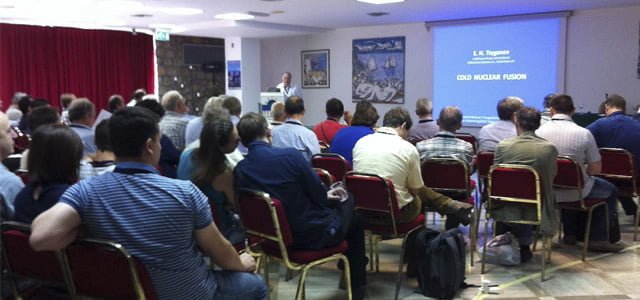
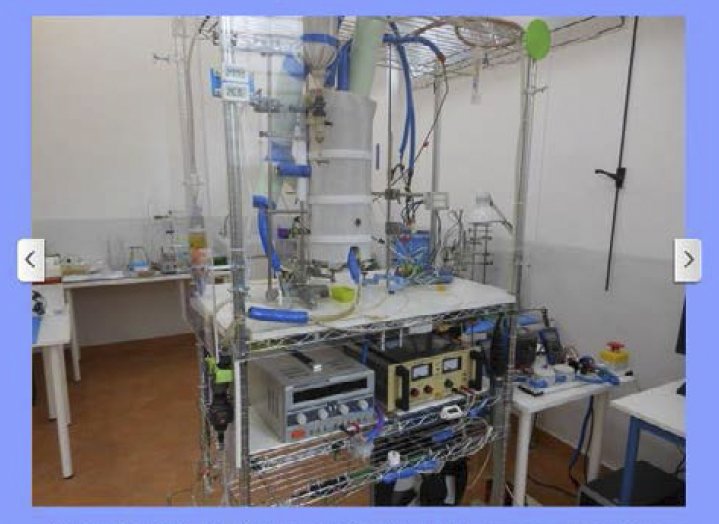
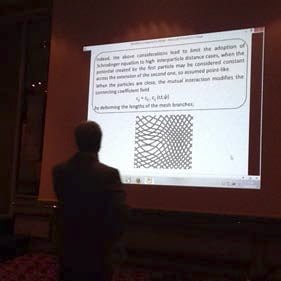
Edward Tsyganov presented Cold Nuclear Fusion at the Channeling 2014 Conference held October 5-10, Capri, Italy.
During the Oct. 8 roundtable session, Dr. Tsyganov has reported that “some of the participants suggested that we avoid rushing to promote cold fusion and, therefore, prevent any interference with the implementations of international tokamak ITER.”
Tsyganov explained, “… it is difficult to ignore the cold fusion process because it is much less expensive and much more practical than traditional thermonuclear fusion.”
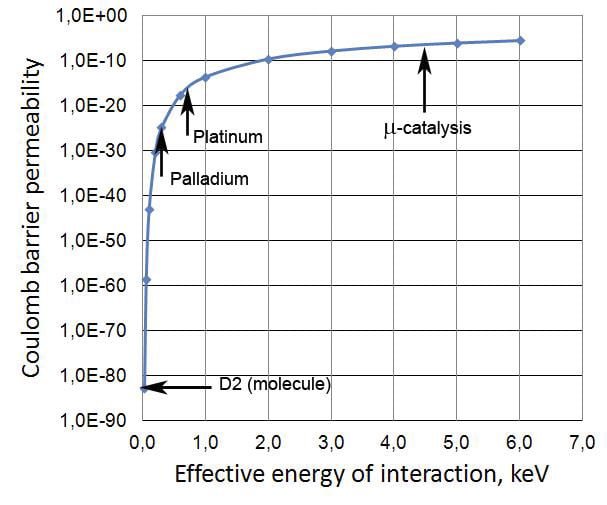
Fig. 8. The transparency of the Coulomb barrier for the reaction of DD in the crystal depending on the effective interaction energy Eeff.The scientific community has always had trouble adapting to truly new knowledge. The current paradigm of nuclear physics does not contain effects such as cold fusion, although this phenomenon does not contradict any of the fundamental laws of nature. Attempts to generate controlled nuclear fusion, which have been conducted for nearly half a century, have already come a long way. The most advanced attempt, ITER, a tokamak of cyclopean size and corresponding value is currently under construction. Realists assess that this facility will take 35-50 years to complete and commence operations. It is only considered as a research project and is expected, after its launch, to start even more gargantuan industrial tokamak. The prospect of huge financial and material spends for another half century looms.
Oil and gas can no longer serve as global fuel, due to its exhaustion, while the companies will try to fight back. This way also may well lead to climate change, a population reduction, and social upheavals.
Cold fusion is a real alternative to this tragic scenario. We believe that in the coming years, the scientific success of cold nuclear fusion will be realized and a radical change in the applied nuclear research will come.
Unfortunately, cold fusion still seems to be quite distant from wide recognition, even though the issue is now practically solved in experimental and theoretical terms. At the moment we are facing a problem that is not scientific but sociological. It is difficult to predict how fast events will develop in this direction. A paradigm shift in science has never been an easy task for society. We should propose the optimal behavior for scientists in these circumstances.
Find Powerpoint presentation slides and photos of the event here:
The ebook includes a new Appendix that answers the questions readers have posed to Dr. Storms since the book’s release in July, and contains a further description of hydroton formation.
There is also a newly formatted References section.
Those who already purchased The Explanation of LENR can download the newly added Appendix and References here:
New graphic from updated version of The Explanation of Low Energy Nuclear Reaction depicting resonating hydrogen nuclei upon approach in region where photon emission occurs.
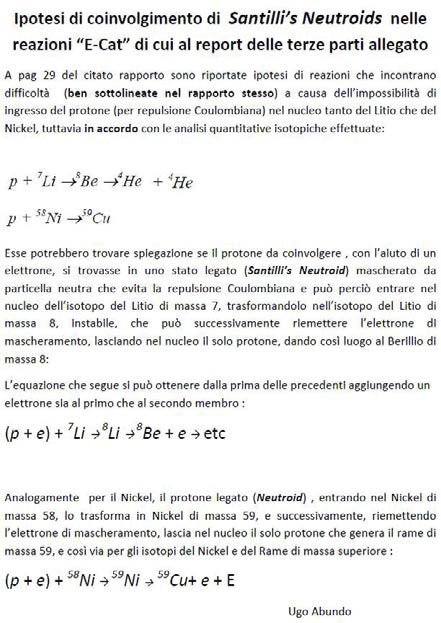
Open Power Association Newsletter #14 has been released. The newsletter is archived in Italian here. The following are a few google-translated and slightly modified excerpts that refer to cold fusion-related activities.
Ugo Abundo speaking in RhodesOur Scientific Director: Prof. Ugo Abundo at the International Conference of Rhodes
From 22 to 28 September was held in Rhodes (Greece) International Conference 2014 on Numerical Analysis and Applied Mathematics. Ugo Abundo was invited to participate in the proceedings as a representative of Open Power, to discuss the results of the activities that are part of the Association.
The work has been focused on the re-establishment of new mathematical foundations of physics, able to address the many issues currently unresolved, through change of paradigms in force. The new isomatematica (and evolutions “geno” and “hyper”) Professor Ruggero Maria Santilli presented as the appropriate tools to deal with maps deformed intrinsic irreversibility fields to ipervalori.
By means of these tools, it has been shown by speakers from all over the world, in view of industrial development, advanced applications in the field of energy, and in particular, in regards to the structure of the neutron and the atomic behavior for the purpose of nuclear synthesis. In the previous treatment of such areas, the math, as well as Quantum Mechanics appears inadequate. Hadronic mechanics, specifically developed by Prof. Santilli as an evolution of the above when both distances between particles comparable to the size of the nuclei, is revealed adequate to treat nuclear-type energy situations, where the particles can not be assimilated to material points, as in Quantum Mechanics.
Ugo Abundo presented in two separate reports, the LENR experiments conducted in the Open Power laboratory, and a neural network model generalized setting from the field of Artificial Intelligence, which makes homogeneous Quantum Mechanics and the Hadronic, justifying the applicability conditions of each of them, showing from the mathematical point of view, what happens in terms of internal information to physical systems when the first turns in the second.
Abundo’s report, entitled “An intrinsically Irreversible, Neural-network-like Approach to the Schrödinger Equation and some Results of Application to Drive Nuclear Synthesis Research Work” [.pdf] has been accepted for publication as part of the American Institute of Physics in the Proceedings of the Conference. Hence, the conditions for collaboration with other mathematicians (mainly French, Indian, Greek) to jointly pursue such studies about the applications of AI in the field isomatematica and subsequent transferability to modeling of elementary particles in interaction.
(L) Prof. Santilli, (R) Prof. Abundo at Rhodes ConferenceNew web site nuovascienza.org dedicated to the work of Prof. Ruggero Maria Santilli
It is certainly easy to understand and explain briefly the complex thought articulated by Prof. Ruggero Maria Santilli, developed in the ‘arc of 40 years of work, both theoretical and experimental. Remarkable also is the amount of writings, conference papers, and scientific publications, he authored. This website has as main purpose to spread all those materials, video lectures, writings, etc.. In which Santilli describes in clear words and straightforward His theories and their mathematical models; His experimental paths (and industrial), and insights for the future of scientific research and experimentation in the field of new energy …
Here lists the work and thought of Santilli, who (unlike many academics pigtails Italian or not), does not miss at all courage in an attempt to place in certain areas more correct and the same theories of Eintein (Holy Grail?), and even quantum mechanics, from certain points of view. He did not even hesitate to take a picture of the “Science Today”; a photograph very brave, uncomfortable, and merciless; in substance, very critical …
In fact, he argues more explicitly that “the greatest responsibility for the crisis of physics should be seen in the press as a result of the total subservience to the centers of scientific power, while the political responsibility is only indirectly, as the political world uses print as a medium of information and action.”
This website has been designed so as a sort of very concise and articulate “compendium”, the enormous scientific thought and work Santilliano not yet sufficiently known and disclosed, and therefore unappreciated by the general public (at least in Italy, in my opinion), but certainly well-known and much appreciated from a small circle of experts and professionals, even in Italy, for his innovative value; a “compendium” I said for the use of those Italian researchers thirsty and with the critical spirit of true knowledge, but alas mè, with little time available to study the large amount of material and information that the Internet provides us every day.
Third-party report on ‘E-CAT released — Andrea Rossi
Observation of abundant heat production from a reactor device of and isotopic changes in the fuel [.pdf]
Giuseppe Levi
Bologna University, Bologna, Italy
Evelyn Foschi
Bologna, Italy
Bo Höistad, Roland Pettersson and Lars Tegnér
Uppsala University, Uppsala, Sweden
They Essén
Royal Institute of Technology, Stockholm, Sweden
ABSTRACT
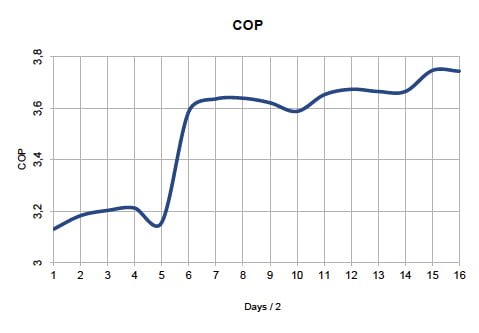
New results are presented from an extended experimental investigation of anomalous heat production in a special type of reactor tube operating at high temperatures. The reactor, named E-Cat, is charged with a small amount of hydrogen-loaded nickel powder plus some additives, mainly Lithium. The reaction is primarily initiated by heat from resistor coils around the reactor tube. Measurements of the radiated power from the reactor were performed with high-resolution thermal imaging cameras. The measurements of electrical power input were performed with a large bandwidth three-phase power analyzer. Data were collected during 32 days of running in March 2014. The reactor operating point was set to about 1260 ºC in the first half of the run, and at about 1400 °C in the second half. The measured energy balance between input and output heat yielded a COP factor of about 3.2 and 3.6 for the 1260 ºC and 1400 ºC runs, respectively. The total net energy obtained during the 32 days run was about 1.5 MWh. This amount of energy is far more than can be obtained from any known chemical sources in the small reactor volume.
A sample of the fuel was carefully examined with respect to its isotopic composition before the run and after the run, using several standard methods: XPS, EDS, SIMS, ICP-MS and ICP-AES. The isotope composition in Lithium and Nickel was found to agree with the natural composition before the run, while after the run it was found to have changed substantially. Nuclear reactions are therefore indicated to be present in the run process, which however is hard to reconcile with the fact that no radioactivity was detected outside the reactor during the run.
Read the full report: http://www.hydrobetatron.org/files/ROSSI.pdf
Ugo Abundo on the E-Cat
Newsletter compiled by L.S. and the Open Power Association
Intro: You are listening to the Q-Niverse podcast. Let me just say, before we get started, that today’s episode is being brought to you in part by ColdFusionNow.org who helped facilitate the dialogue you are about to listen to. Today I have with me Andrea Rossi. Mr. Rossi is an inventor and entrepreneur who, for many years, has worked to develop the Energy Catalyzer, also known as the E-Cat – a reactor fueled by nickel and hydrogen that allegedly harnesses “cold fusion”, or low-energy nuclear reactions, on an industrial scale. Mr. Rossi has been working on this technology for well over a decade and has recently partnered with a highly-credible commercial investor to take the technology to the “next level”. A recent third-party analysis of the E-Cat, carried out by a coalition of European professors and engineers over the course of the past year, reports that the technology is in fact producing energy well in excess of any known chemical reaction. Andrea Rossi, thank you for being with me today.
Andrea Rossi: Thank you.
John Maguire: Starting off, can you explain your thoughts and feelings over the past year waiting for the new analysis of the E-Cat? Has this been a tense time for you, or have you been too busy refining the reactor to worry much about it?
Rossi: Basically I am focused on my work which is Research and Development, and direction of the manufacturing of the E-Cat and plant. This has been, as always, a period just of work. For what concerns the report – it is for sure an important report. [It] has been made by a third, independent party. The results are interesting, [and] very problematic, and we are studying these results.
JM: Now, were you worried at all that [analysis/report] might come up with negative results? Did you have any indication over the course of the year? Or were you pretty much in the dark like everyone else?
Rossi: This report is in the hands of the professors that made it.
JM: Sure…fair enough. What do you think the ultimate impact of the report will be? Can it possibly persuade the larger scientific community or other major industrial players beside ELFORSK to get interested in LENR generally speaking, in your opinion?
Rossi: This is difficult to say…this is difficult to say. Honestly, I do not know. But our target is not to convince anybody. Our target is to make a plant that works properly. Now we have finished [with all the tests] and we are focusing exclusively on the market and on the production that we have to set up. This report is no doubt very interesting and we are studying it because, as you probably know, there is a surprising result regarding the Nickel-62 in particular, and we are studying it because we are strongly directed, under a theoretical point of view, to understand these kinds of results that was unexpected. But our main focus remains the operation of industrial plant.
JM: Now you mentioned theory there real quick, so maybe we can talk about that really quick. Do you think that the reaction can be explained within the Standard Model or do you think we’re gonna have to go well beyond that to account for what’s going on, because as you noted there were some strange changes in the powder – which we don’t really have time to get into too much – but can you put it in a theoretical context, or do you any ideas theory wise that you’re able to share?
Rossi: No, we are starting on it. It will take time because the reconciliation is not an easy task. And we are studying with specialists.
JM: You’re working with a team to develop the theory, is that the idea?
Rossi: Yes.
JM: Now getting back to the report. In regards to excess heat, the measured coefficient-of-performance, or COP, came out to be around 3.2-3.6 over a very prolonged period of time. Some experts argue the calorimetry was suitable, while others remain unsatisfied for various reasons. So first, what did you make of the review group’s methodology and excess heat measurements?
Rossi: Well the calculations have been made by the professors. I know that some of them are very well [experienced with] that kind of measurement. They have also [made a core] with manufacturer of thermal chambers. I suppose they know what they did. I want not to enter into this question because I just accept the results [I have been given]. I have nothing to comment about that. About the various opinions [out there] we do not consider them real [objections] because what’s of interest to us, again, is that the plant we have in operation works properly. Honestly we have no more time to lose in this discussion. [Concerning] the COP – you have seen in the report the COP has been calculated in a very conservative way. Every number has been calculated [within] the most conservative margin. Actually, I think [the COP] could be maybe increased but again, this is not a theoretical issue, this is a technological issue that can be seen only at a fixed point in an industrial, operational plant — no more theoretical suppositions.
JM: The new version of the E-Cat that was tested this time had an alumina casing on it. Now this as far as my understanding goes acted as an insulator…
Rossi: It has been described in the report. I don’t want to say anything about that. The report has been very well described [elsewhere] – the casing of the reactor.
JM: You brought up the 1MW plant – how is progress going on that? And to be more specific how is the new design superior to the old version, and how long do you think it will take to get to market or, at the very least, be demonstrated publically for people?
Rossi: Well, yes, the new 1MW plant has gotten a strong evolution with [regard] to the older one — mainly under the reliability point of view; under the industrial point of view. The control system is enormously more sophisticated. Basically the plant is governed by a robot. Nevertheless it will take at least one year of operation in the factory of the customer of Industrial Heat, to whom the plant has been supplied…it will take at least one year before they complete the analysis [and] all possible errors have been adjusted. After this year with the permission of the customer, because industry is not a showroom or a theatre, so we cannot just open access to the public and say, “Alright guys, come and see!” It will not be that simple, but selected visits for a person who has title to that will be open – [but] not before we consider the plant absolutely [finished] under an industrial point of view. I suppose it will take about one year…about one year from now I suppose. But when you are in this field you cannot be sure about the scheduling because you can be sure of one thing now today, and tomorrow discover you were wrong and have to change something. This is the first time – and this is important to underline – this is the first time we had the possibility to see in operation 24-hours-a-day continuously the plant because before we could only operate on it for a couple of days or three before [we encountered] a lot of problems. The [past manufacturing facilities that we installed the old 1MW plant were not in full operations]. There was not a load to supply all the energy to. So now in the real industrial operation/situation we can see all the problems that are generated from this real operation.
JM: Now you say you’ve seen it running longer than a few days can you give some idea of how long one has been running, or how long one has been tested for? Are we talking weeks?
Rossi: You know in our factory the one megawatt plant that had been presented in October 2012 — it worked at that time. Then, we could work with it for some [amount of time], but you cannot put in exercise for long a plant like that if you don’t have a real load and if you do not have a real operation going on.
JM: Can you give us an idea of how many people are working to develop the E-Cat? Obviously you have your hands on it in some capacity, but is this a rather large team or just a small group of engineers?
Rossi: We are working with a complex team where there are specialists for any issue.
JM: Can you give an idea of how many scientists are working on [the project]?
Rossi: I prefer to not answer in detail, but what I can say is that for any single matter, we have a specialist to take care of [that].
JM: Getting a bit more personal,I’m sure people are wondering what exactly has driven you all these years, and what do you hope to ultimately achieve by bringing this technology to the world? How do you hope to be remembered?
Rossi: The first stone has been put in the building so, you know, the first industrial plant, not working in an experimental warehouse, but working in the factory of a customer to produce a profit is already in operation. So this process of industrialization has begun already.
JM: What do you hope to accomplish personally? What drives you to keep pushing this forward?
Rossi: Well, you know, I just go one step at a time. My biggestaspiration now is to make the 1 MW plant perfect, absolutely and totally reliable, with all the defects corrected. This is my aspiration now. After this, I do not know.
JM: Briefly, can you speak on your past work with the now-deceased Professor Sergio Focardi of the University of Bologna. I think he might be one of the unsung heroes after the story is told, along with many others of course, but he was one of the pioneers in the nickel-hydrogen work, along with [Francesco] Piantelli and others, most notably Italians. How significant in your opinion were his contributions to the genesis of the E-Cat, your work, and just your general thoughts on him?
Rossi: Focardi has been a strong collaborator with me, mainly in the period between 2007 and 2010. I have been lucky to be helped by him with his strong theoretical preparation. For sure, he has contributed to the development of this work, and we absolutely have to be grateful forever for his precious contribution and he is always present in our memory.
JM: I know he was in a special situation in one sense because he was retired, and though his career wasn’t behind him, he could come out and support controversial work that he might not have been able to do while he was still a teaching professor, and that’s the kind of pressure many academics face in dealing with these new technologies or this new science.And so, we need people like Sergio Focardi, we need people like Hano Essen, like Sven Kullander, who are willing to stick their necks out for new science to discover something new. Without pioneers, without people taking these kind of risks, both economic on your end, and sociologically, say in the scientific community, on the professors’ end.So I wish people were more open-minded [and] would follow their example. I think a lot of the barriers to people understanding this new technology, this new science, is again the academic pushback, so I am always encouraged by these men of integrity, whether they are sure or unsure of what’s going on, they say, “let’s look”, “let’s investigate”. That’s why I’m always in inspired by those kinds of people, and that’s why I brought him up.
Rossi: Yes, I agree with you.
JM: I know you don’t have a lot of time today. We appreciate all the time you afforded to us. I know there are things you can talk about, and things you cannot talk about. So before we go our separate ways, do you have any parting thoughts? Any words of wisdom or anything you think is appropriate?
Rossi: What I can say is that, at this point, we have to focus on the industrial plant in operation, because at this point in the story we are in a situation similar to the one at the dawn of the computers. At the very beginning it was important to have the theoretical discussion on microchips, etcetera, but at a certain point, the development, and the importance of the computer, has been determined by the market, not by the scientific community.
JM: Absolutely. Thank you for taking the time out of your very busy schedule to speak to us.
Rossi: Thank you very much. It has been a pleasure and an honor to be with you today.
Conclusion: That does it for today’s episode. Thanks again to Andrea Rossi, Ruby Carat at Cold Fusion Now.org, and thanks to you for listening. Take care, and stay tuned for more episodes in the near future.
* More of Interviews/Essays on Cold Fusion/LENR & other topics can be found at Q-Niverse.
“I have never been an optimist or a pessimist. I’m an apocalyptic only. Our only hope is apocalypse. Apocalypse is not gloom. Its salvation.” –Marshall McLuhan
Apocalypse – Old English, via Old French and ecclesiastical Latin from Greek apokalupsis, from apokaluptein ‘uncover, reveal,’ from apo- ‘un-’ + kaluptein ‘to cover.’ –Google
A report released Wednesday on a test of the E-Cat Energy Catalyzer concludes a large amount of heat was generated using a fuel of one gram of nickel powder, with no radiation detected at all.
The authors describe details of the equipment, the experimental set-up, and how heat measurements were taken, along with an analysis of the outer shell material and fuel, in the paper Observation of abundant heat production from a reactor device and of isotopic changes in the fuel [.pdf]
The paper was authored by scientists who had performed tests on an earlier version of the E-Cat, releasing the report Indication of anomalous heat energy production in a reactor device containing hydrogen loaded nickel powder [.pdf] last year. During one November, 2012 experiment, the E-Cat generated so much thermal power, it melted the steel inner core body and the ceramic casing. This second test purposefully kept the input power moderate to ensure a longer life for the newly designed E-Cat.
As in the previous test, David Bianchini monitored radiation from the unit “before, during, and after operation”. No radiation was reported from the E-Cat, or from the fuel charge.
Over the last year, E-Cat intellectual property and licensing rights were acquired by private company Industrial Heat, LLC, an affiliate of Cherokee Investment Partners, with investment in the project reported at over $10 million. The group has retained inventor, designer, and Chief Engineer of the E-Cat, Andrea Rossi to lead the development of the energy generator.
Andrea Rossi participated in the experiment by fueling, starting the E-Cat, stopping the E-Cat, and removing the fuel from inner chamber. At these times, members of the evaluation team were present, and observing the activity.
Observation of abundant heat production from a reactor device and of isotopic changes in the fuel [.pdf]
The report was organized into sections with the lead authors writing the Abstract and main body of the report. Five other authors contributed four appendixes describing radiation monitoring and fuel analysis, including scanning electron microscope SEM and x-ray spectroscopy studies.
Giuseppe Levi
Bologna University, Bologna, Italy
Evelyn Foschi
Bologna, Italy
Bo Höistad, Roland Pettersson and Lars Tegnér
Uppsala University, Uppsala, Sweden
Hanno Essén
Royal Institute of Technology, Stockholm, Sweden
Abstract
1. Introduction
2. Reactor characteristics and experimental setup
3. Experimental procedure
4. Data analysis method
5. Analysis of data obtained from the dummy reactor
6. Analysis of data obtained from the E-Cat
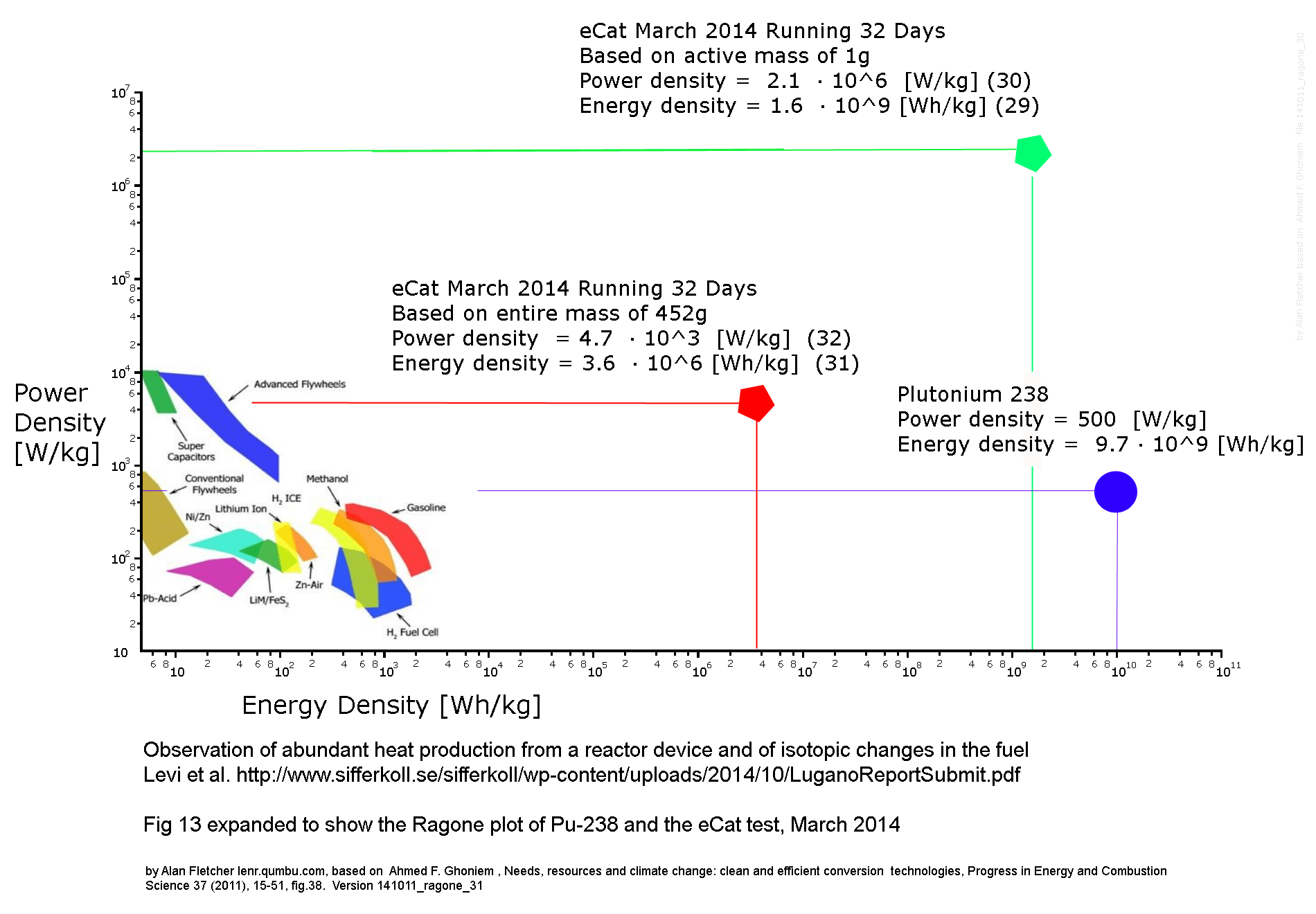
7. Rangone Plot
8. Fuel analysis
9. Summary and concluding remarks
Acknowledgements
References
Appendix 1
Radiation measurements during the long-term test of the E-cat prototype. D. Bianchini
Bologna
Appendix 2
Alumina sample analysis Ennio Bonetti
Department of Physics and Astronomy
University of Bologna
Appendix 3
Investigation of a fuel and its reaction product using SEM/EDS and ToF-SIMS Ulf Bexell and Josefin Hall
Materialvetenskap, Hogskolan Dalarna
Appendix 4
Results ECAT ICP-MS and ICP-AES Jean Pettersson
Inst. of Chemistry-BMC, Analytical Chemistry
Uppsala University
Comparing E-Cats
E-Cat HT on test bed November 2012The E-Cat has undergone many design changes since 2011 when the public got their first glimpse of the Energy Catalyzer.
Last year, the E-Cat appeared as a smooth, silicon nitride ceramic shell cylinder 33 cm in length and 10 cm in diameter, painted black. Inside was a second cylinder made of corandom, which contained resistor coils to heat the reactor with an “industrial trade secret waveform”. The innermost cylinder was made of steel, 33 mm long and 3 mm in diameter and contained the fuel charge of treated nickel powder with the secret catalyst.
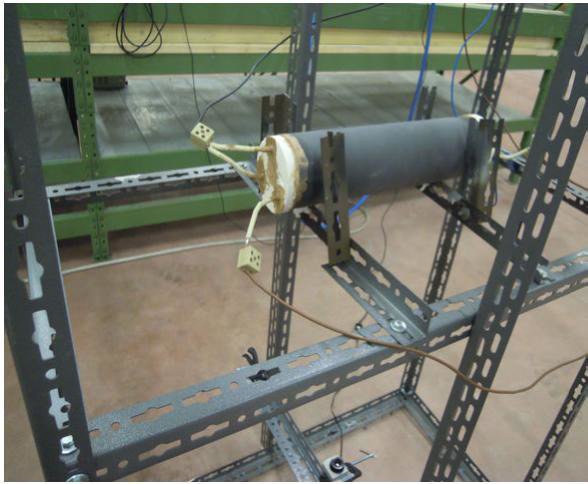
E-Cat on scale February 2014This year, the E-Cat is less than two-thirds the length, appearing as “an alumina cylinder, 2 cm in diameter and 20 cm in length, ending on both sides with two cylindrical alumina blocks (4 cm in diameter, 4 cm in length), non-detachable from the body of the reactor…”
The outer surface of the body of the E-Cat is no longer smooth, but “molded in triangular ridges, 2.3 mm high and 3.2 mm wide at the base, covering the entire surface and designed to improve convective thermal exchange…”
Design changes allowed for improved features, says the report. This year’s 2014 model E-Cat thermal generator can attain higher temperatures, while avoiding internal melting of the powder.
To initiate and control the reaction, resistor coils surrounding the inner fuel cylinder heat up from “specific electromagnetic pulses”. The authors report the reactant is a micron-sized nickel-powder mixture and that once heated, “it is plausible” that a lithium hydride delivers the hydrogen fuel for the reaction.
Last year, the E-Cat had a cyclic input power, which appeared to regulate the heat-producing reaction. On one end of this year’s new bone-shaped generator, a hole that allows for re-charging of the reactant also holds a temperature sensor that sends data to the controller. If the inner chamber gets too hot, the pulse is dialed down.
Measuring E-Cat Heat
Previous model E-Cat HT from 2013 reportAs in the previous test, heat was measured by thermal imaging and computing the convection away from the surface of the generator.
Two thermal image cameras mapped the heat data of the generator across its surface as the E-Cat operated. Thermal imaging is a well-developed technology with a strong track record in many applications, but not in the field of cold fusion, which has relied on calorimeters and direct contact thermocouples.
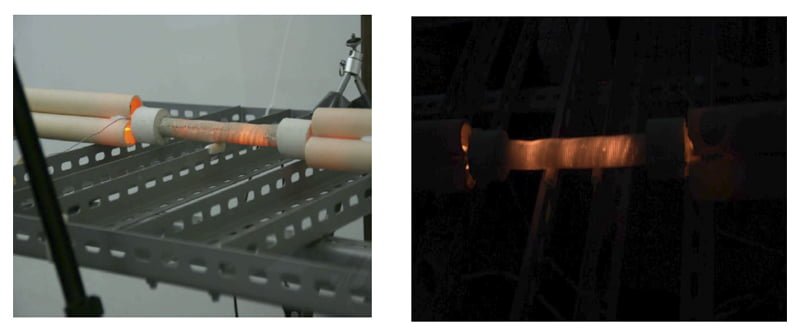
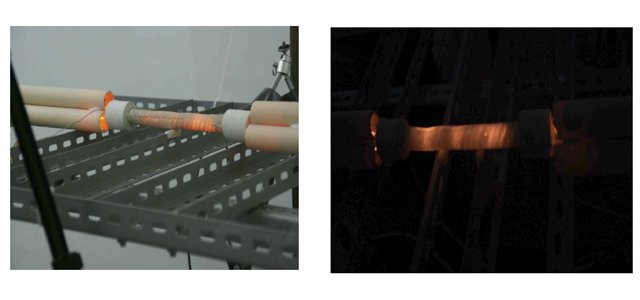
Optical photo of new model E-Cat in operation.
The authors of the report state that they wanted to use a thermocouple, but that “the ridges made thermal contact with any thermocouple probe placed on the outer surface of the reactor extremely critical, making any direct temperature measurement with the required precision impossible.”
An empty E-Cat played the dummy to check that power in would match power out, as was observed.
The infrared camera’s temperature readings were converted to radiant power in watts by the Stephan-Boltzmann formula, an equation with parameters dependent on the emissivity ε of the material as well as the temperature. The outer shell of 99% alumina was divided into sections, and ε assigned to each area.
The issue of emissivity of alumina is still under discussion in the scientific community. Some believe there may be a larger source of error in the value ε. Aware that the emissivity of Alumina is temperature-dependent, the authors plot the emissivity ε over temperature saying that ε “has been measured at +/- 0.01 for each value of emissivity; this uncertainty has been taken into account when calculating radiant energy.”
E-Cat Power and Energy
Plot 6: Net thermal power produced by E-Cat Plot 6 shows a graph of the Net Power Out. The horizontal axis marks every two days and the vertical axis showing average Watts produced.
Net Power Out is the power produced by the E-Cat, minus the power inputs, and shows the amount of watts generated solely by the E-Cat.
As described in the report, after the first ten days, the input power was lowered by the controller. The team then decided to increase the input power about 100 Watts, which over six minutes, activated a large jump in temperature, equating to a net thermal power output of about 2.3 kilowatts. At peak usage, a large home may require 1-3 kilowatts electrical power.
The area under the graph over the next twenty-days represents just over 1 Megawatt-hour of energy. According to the report, the total energy produced over the month of testing was a remarkable 1.5 MWh generated from 1 gram of nickel-powder fuel.
Thus, E-Cat energy density – 1.6 billion +/- 10% Watt hours/kilogram – is much greater than any energy derived from the chemical burning of gasoline, oil, or coal.
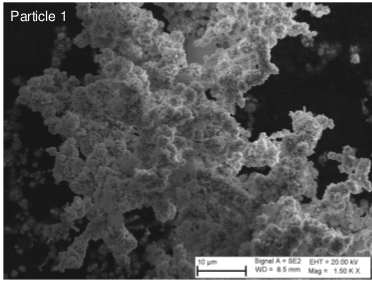
SEM of fuel “sample granule” Particle 1Of the 1 gram total in the reactor, a 10 mg sample was removed from the reactor and analyzed for content.
Materials analysis revealed natural nickel grains of a few microns in size as the bulk of the material. Other elements included Lithium, Aluminum, Iron, and Hydrogen. “Large amounts” of Carbon and Oxygen were also found.
But after the reaction, the ash had a “different texture than the powder-like fuel by having grains of different sizes”, and there was an unusual and unexpected shift in isotopic composition for the Nickel and Lithium grains.
Quoting from the report:
The Lithium content in the fuel is found to have the natural composition, i.e. 6Li 7 % and 7Li 93 %. However at the end of the run a depletion of 7Li in the ash was revealed by both the SIMS and the ICP-MS methods. In the SIMS analysis the 7Li content was only 7.9% and in the ICP-MS analysis it was 42.5 %. This result is remarkable since it shows that the burning process in E-Cat indeed changes the fuel at the nuclear level, i.e. nuclear reactions have taken place.
The shift in Nickel is reported as:
Another remarkable change in the ash as compared to the unused fuel is the identified change in the isotope composition of Ni. The unused fuel shows the natural isotope composition from both SIMS and ICP-MS, i.e. 58Ni (68.1%), 60Ni (26.2%), 61Ni (1.1%), 62Ni (3.6%), and 64Ni (0.9%), whereas the ash composition from SIMS is: 58Ni (0.8.%), 60Ni (0.5%), 61Ni (0%), 62Ni (98.7%), 64Ni (0%), and from ICP-MS: 58Ni (0.8%), 60Ni (0.3%), 61Ni (0%), 62Ni (99.3%), 64Ni (0%). We note that the SIMS and ICP-MS give the same values within the estimated 3% error in the given percentages.
Possible reaction pathways to these stunning results are provided in the report, but the authors caution that “reaction speculation above should only be considered as an example of reasoning and not a serious conjecture.” There is as yet no explanation for these findings.
What to think
The E-Cat has attracted financial investment, and inventor Andrea Rossi has given rights to the technology to private company Industrial Heat. They are in to win. Engineering changes are improving control of the reaction and the E-Cat is shrinking in size, now down to a breadstick.
While discussion of procedure and parameters continues, it won’t change the fact that we are within epsilon of a revolution in energy technology. Whether it is the front-running E-Cat, or another start-up that finds the right recipe, the E-Cat test report gives a peek at what is possible to achieve.
On multiple occasions, the E-Cat has publicly demonstrated steam, heat, and energy, once producing one-half megawatt power. Even if the net power out were 50% less, this E-Cat test run would still be making excess heat.
Global research, as presented at these conferences here and here, is focused on understanding the science, and finding a theory to describe this newly discovered phenomenon. Swedish research and development institute Elforsk, a partial sponsor of the test along with the Royal Swedish Academy of Sciences, will begin a ‘research initiative’ as stated by Elforsk CEO Magnus Olofsson.
Companies like Industrial Heat and men like Andrea Rossi are pushing the frontiers of engineering to create a product to re-make the world. Safe, non-polluting, with the energy-density to free a planet from the present destructive paradigm, there is nothing that will change our world more than new energy technology.
Renewing a civilization by empowering local communities, restoring our wildspaces and the wildlife that lives there, powering the hot tub in my backyard (that’s not my backyard in the picture), we are at the break-boundary. Are you ready for Apocalypse???
Cold Fusion Now!
“The most important thing that can be learned from the work that we are doing is that we will overcome any critical moment, so in this difficult moment for everybody, if anybody works, believing in what he does, and works with all his efforts, we can build up a new, strong economy.” —Andrea Rossi in interview with James Martinez December 2011
Photo: New model E-Cat in operation from the report Observation of abundant heat production from a reactor device and of isotopic changes in the fuel [.pdf]
Observation of abundant heat production from a reactor device and of isotopic changes in the fuel [.pdf]
This is an update on the status of the above patent application. A previous comment on that US filing was made on ColdFusionNow – here.
This filing in the United States is descended from an original filing made in Italy on April 9, 2008. That Italian filing served as a priority filing for a PCT application, PCT/IT2008/000532, filed August 4, 2008, claiming the benefit of the earlier Italian filing date. (The original Italian filing resulted in the issuance of an Italian patent just before the Italian patent law was changed from a non-examination system to an examination system).
Following the procedures of the Patent Cooperation Treaty – PCT, the International PCT application was delivered to the US as a national entry filing on September 16, 2010. This application was duly published as serial number 12/736,193 and was placed in the queue for examination. As reported in the earlier ColdFusionNow article, a US Examiner’s Office Action issued on March 26, 2014. As is typical, this Office Action was an initial rejection, giving the applicant, 3 to 6 months to file a Response overcoming the Examiner’s objections. Such a Response, dated September 25, 2014, was filed on September 29, 2014. This posting reports on that Response.
Before addressing the Response in detail, the covering letter expresses thanks to the Examiner for the opportunity for Dr. Andrea Rossi and the attorney to have had a personal interview with the Examiner on April 22, 2014. Apparently no decisions were reached between the parties at that interview.
The Examiner’s Office Action of March 26, 2014 included a number of rejections:
Invention Inoperable
The Examiner asserted that “there is no evidence in the corpus of nuclear science to substantiate the claim that nickel will spontaneously ionize hydrogen gas and thereafter ‘absorb’ the resulting proton”. He went on to say that the nuclear conversion of nickel 58 into copper 59, while known, has only been observed experimentally “in the context of an accelerated (proton) beam into a nickel target. The element of acceleration is necessary in this matter as the only way for the proton to overcome the basic Coulomb repulsion between the proton and nickel nuclei.” The Examiner also observed that if the reaction were possible, as claimed by Rossi, it would also occur spontaneously in nature.
The Examiner also made a perfunctory further objection that, since the invention was inoperable, the disclosure that was provided was necessarily insufficient to enable workmen after the patent expired to reproduce the invention. The Examiner then requested evidence that the invention actually worked.
In the response by Rossi’s attorneys no evidence of operability was filed. Instead, the attorneys asserted that the Examiner had failed to establish a basis that would justify a request for evidence of operability. Citing In re Mitchell R Swartz, a year 2000 decision by the US Court of Appeals for the Federal Circuit, the attorneys submitted that the Examiner had failed to follow the Guidelines for Examination of Applications for Compliance with the Utility Requirement provided by the US Patent Office in its Manual of Practice and Examination Procedure. In particular, the attorneys asserted that the Examiner, in alleging that the utility described in the patent disclosure was not credible, had failed to:
a) provide support for factual findings relied upon by the Examiner in reaching this conclusion, and
b) provide an evaluation of all relevant evidence of record, including utilities taught in the closest prior art sufficient to support the basis for requiring proof of operability.
The attorneys referred to the description of the procedures provided in the patent disclosure for producing the described reaction, saying that no basis had been established for departing from the normal presumption that such descriptions are true and that the Examiner had not pointed out any deficiencies in that description.
Comment: Challenging the right of the Examiner to provide evidence of utility is an alternative to actually providing such evidence. Such a challenge provides grounds for objecting on appeal to the requirement by the Examiner that such evidence be filed. If the Board on appeal agrees that the Examiner’s requirement was legitimate and no evidence was filed, then the application will be rejected. If the Board concludes that the Examiner’s objection was unsupported, it’s unclear whether the application will be returned to examination with instructions for the Examiner to provide a better justification for such a requirement; or whether the application will be allowed to go forward on the basis that such evidence need not be filed, assuming that all other legitimate objections are overcome.
Butler describes a process for accelerating protons into a silver-plated nickel target. The attorneys for Rossi pointed out that Claims 1 and 7 as now pending (the only 2 independent claims) stipulated that nanometric nickel powder is exposed in a metal tube to hydrogen gas at high temperature and pressure. This, it was said, was sufficiently different from Butler that the rejection of Claims 1 and 7 on the basis of “obviousness” was not justified.
Claims 1 and 7 as amended and now pending read as follows:
1. A method for carrying out an exothermal reaction of nickel and hydrogen, characterized in that said method comprises the steps of providing a metal tube, introducing into said metal tube a nanometric particle nickel powder and injecting into said metal tube hydrogen gas having a temperature much greater than 150°C and a pressure much greater than 2 bars.
7. A modular apparatus for providing an exothermic reaction by carrying out the method according to claim 1, characterized in that said apparatus comprises a metal tube (2), including an nanometric particle nickel powder (3) and a hydrogen gas at high temperature and pressure.
Comment: If these two claims were valid the dependent claims otherwise present in the patent filing would be irrelevant. Further, apart from the objections of inoperability and obviousness both of these claims are indefinite. Claim 1 refers to: “hydrogen gas having a temperature much greater than 150°C and a pressure much greater than 2 bars”. The words “much greater than” make the claim indefinite. Similarly in Claim 7, the reference to “hydrogen gas at high temperature and pressure” is indefinite. This could easily be corrected in another Response, and the attorneys for Rossi are probably quite aware of this indefiniteness deficiency.
Additionally, both of these independent claims stipulate for the presence of a “metal tube”. In the absence of such a component, a competing construction would not infringe these claims. For example, if a ceramic tube were employed, it would not fall under the language of the claim. Neither would a metallic containment chamber if, for example, a cubic chamber were employed. These distinctions might be described as “loopholes”.
Loopholes cannot be closed by any of the dependent claims. Every dependent claim adopts the limitations of the independent claim to which the dependent claim refers back.
Unusually, the Response terminates by observing that the applicant has filed a petition to suspend prosecution of this application under the provisions of Rule 1.103 of the US Patent Rules. This reference occurs in the Response available at the US Patent Office website, but the documentation in support of this petition is not available over the Internet. This particular Rule provides as follows:
37 C.F.R. 1.103 Suspension of action by the Office.
a) Suspension for cause. On request of the applicant, the Office may grant a suspension of action by the Office under this paragraph for good and sufficient cause. The Office will not suspend action if a reply by applicant to an Office action is outstanding. Any petition for suspension of action under this paragraph must specify a period of suspension not exceeding six months. Any petition for suspension of action under this paragraph must also include:
(1) A showing of good and sufficient cause for suspension of action; and
(2) The fee set forth in § 1.17(g), unless such cause is the fault of the Office.
One can speculate as to reasons that might be provided in support of such a Petition.
Overall Commentary
This Response has the look of a buy-time initiative by the attorneys acting on behalf of Rossi. No attempt has been made to file evidence of operability as requested by the Examiner. If the Examiner simply reiterates his request for such evidence, possibly providing further observations in support, then Rossi will be able to file the evidence in response. If he fails to do so, it is likely that the Examiner will make his rejection of this application final. In such event, Rossi will have the option of filing an appeal to the Patent Trial and Appeal Board or refiling the application as a “Continuation”. Either initiative will likely suspend disposition of this application for a period of 2 to 4 years.
Although not addressed by the attorneys filing this Response, this application may possibly also be defective for failing to provide a description of how to implement the invention sufficient to “enable” workmen to reproduce the results as claimed. If this were true, it would be fatal to the application, or any patent that might issue thereon in error. It is too late for Rossi to add any subsequently acquired information to this filing. Any further filings will be subject to any novelty limitations that have arisen since 2008.