Which Nobel laureates gave speeches in support of cold fusion?
Are any federal agencies involved in cold fusion research?
Who did reproduce the Fleischmann-Pons Effect (FPE) early on, and just where in the world were positive results generated?
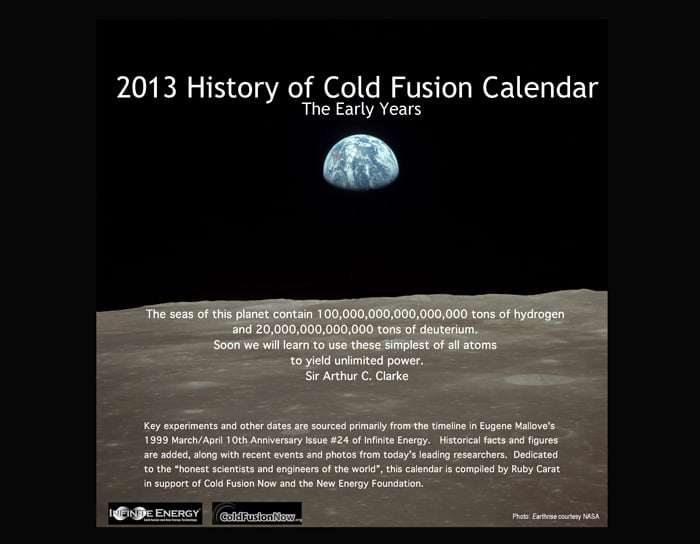
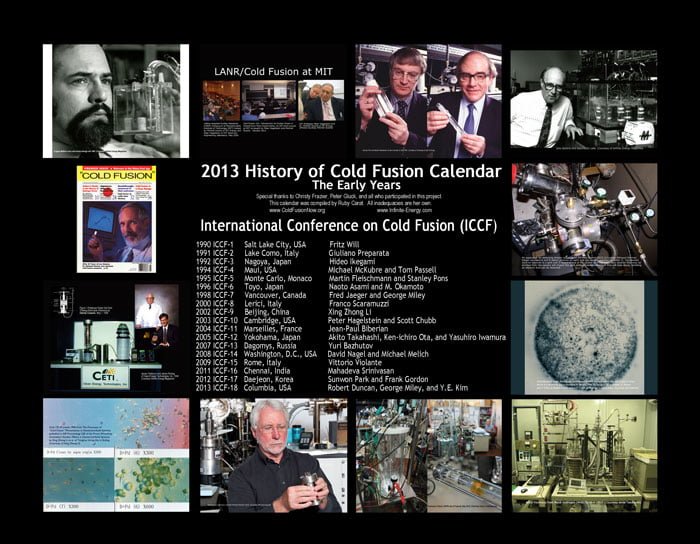
When you need a couple of quick facts showing cold fusion is not only real, but nearing commercial potential, the 2013 History of Cold Fusion Calendar can be your source for evidence!
It’s chocked full of historical facts that answer questions like ‘what physicist and famous science fiction author called “ignoring cold fusion one of the greatest scandals in scientific history”?’.
The 12-month wall hanging objet d’art et l’utilité used as a base the timeline published in Eugene Mallove‘s March/April 1999 Infinite Energy Magazine issue #24 commemorating the 10th Anniversary of the announcement of Drs. Martin Fleischmann and Stanley Pons‘ discovery of fusion-sized energy from water in a test-tube.
The IE published timeline itself was an update on previously published timelines in F. David Peat‘s Cold Fusion: The Making of A Scientific Controversy and Hal Fox‘s Cold Fusion Impact in the Enhanced Energy Age. The timeline in Tadahiko Mizuno‘s Nuclear Transmutations The Reality of Cold Fusion was also noted. Other sources were Edmund Storms‘ The Science of Low Energy Nuclear Reaction and early Infinite Energy issues.
The discovery of ultra-clean energy-dense power from the hydrogen in water languished amid mainstream hostility towards the experimental facts. While many of the smart, capable people who tried the experiment in 1989 saw nothing, there were plenty of positive results, and this calendar highlights those achievements. This calendar does not trace the many theoretical models that scientists are still formulating, but focuses on the early experimental data that showed anomalous effects.
It is not a complete “History” per se. All dates in previously published timelines were not used. Many events have exact dates, but too many events on one day forced some dates to be “thereabouts”. In future editions, we would like to rotate through all names and events with a different theme each year.
Who around the world continues to probe this Rumpelstiltskin-reaction, now called low-energy nuclear reactions (LENR), lattice-assisted nuclear reactions (LANR), the anomalous heat effect, or quantum fusion?
And what companies are attempting to commercialize an ultra-clean next-generation nuclear power?
The 2013 History of Cold Fusion Calendar can provide a few answers, as well as be a resource for those conversations that turn to repeating twenty-year-old manufactured myth as fact.
This calendar can be sent to schools, colleges and universities, chemistry, physics, and engineering departments, policy makers, investors, environmental groups, friends and family for education and awareness. Why even detractors could benefit!
Long-time cold fusioneers, LENRites, LANRists, Qua-Fus, and those who are just plain Anomalous will enjoy feasting upon the lavish photos of laboratory set-ups and cold fusion experimental apparatus. The early images from India and China are no less-then art, and portraits of researchers show the humanity behind the metal.
I hope the CMNS community will support this effort to educate and entertain. Log in your big days, keep track of what’s missing, to be collected into the spreadsheet of dates that will form the core data of a complete historical record which can be accessible through a super-cool digital 3D-holographic interactive timeline that has EVERYTHING!
I had never made a calendar before, let alone one that had science papers instead of holidays. I acted fast. (Who wants a calendar in March?) I am particularly grateful to Peter Gluck and Christy Frazier for kindly tolerating a quick last minute bid for dates and photos. Steve Featherstone generously donated his photos. A huge thank you to the scientists who graciously responded to my photo and date requests. I hope you are all happy with the result.
I look forward to your feedback. We have a whole year to put together the 2014 version, and it will be even better.
All proceeds will go to Cold Fusion Now and the New Energy Foundation to further clean energy advocacy and the direct financial support of cold fusion research.
Scientific American has published a piece of typing on cold fusion that would have founder Rufus Porter rolling in his grave with its glaring, unsagacious bias.
After twenty-three years of research confirming the phenomenon, in-the-dark and over-40-somethings continue to type the same old myths they once heard about twenty-years ago, and this author from a Scientific American-sponsored blog is no exception.
Jennifer Ouelette‘s assemblage Genie in a Bottle: The Case Against Cold Fusion is a sad collision of two-decades old gossip, Hollywood scripts, and misinformation, which she has casually repeated without batting a false eyelash. She claims to “well remember the controversy” when it first erupted, and has “followed it on and off” since then.
Or, perhaps it was from her CalTech physicist husband Sean Carroll‘s colleagues that she obtained such errant perspective. (This is innuendo with intent to gossip.)
CalTech was one of the labs to emotionally denounce the discovery, and the persons, after they failed to reproduce the effect. (This isn’t gossip.)
The article claims recycled twenty-year-old statements, twenty-years-ago refuted. None of the last two decades of increasingly advanced results were considered.
Who doesn’t like fun, light science? But this is no ordinary “Bad Moon Rising: The Science of Werewolves”, her next follow-up post for Halloween night. This is representing Scientific American on one of the greatest discoveries since fire.
Ouelette types “.. wanting something to be true isn’t the same as something actually being true in the rigorous experimental sense of the word.” We suggest Ouelette, whose avatar shows a woman having a cocktail, imbibe a few more before pontificating on this topic again. Seeing straight, she might encounter the catalog of scientists in the field speaking about their research.
U.S. Naval researcher Melvin Miles has spent twenty years successfully reproducing the experiments and analyzing early flawed data from CalTech and MIT showing clear mistakes in their hasty attempts to emulate the effect.
Critical comments to the article were deleted, including those by former Los Alamos National Lab nuclear chemist Edmund Storms, who has been researching cold fusion, also called low-energy nuclear reactions (LENR), lattice-assisted nuclear reactions (LANR), and quantum fusion for two decades.
Jed Rothwell, longtime researcher and writer wrote a response on his science archive site lenr.org and we reproduce that here.
Scientific American censors discussion of cold fusion, including statements by its own editors
–October 31, 2012 by Jed Rothwell
The Scientific American published another attack on cold fusion, Ouellette, J., Genie in a Bottle: The Case Against Cold Fusion, in Scientific American 2012. The author ignores the scientific literature and looks instead at movies, popular culture and mythology surrounding the 1989 announcement. She concludes that cold fusion does not exist.
In the on-line discussion of this article, the author allowed only skeptical arguments against cold fusion. She erased all rebuttals, and all messages supporting it, including: proof that many scientists support the research; that the effect has been widely replicated; and that over a thousand peer-reviewed papers on the subject have been published in mainstream journals. Finally, she erased messages quoting the editors of the Scientific American, and a message saying that peer-reviewed replicated experiments are the standard of truth in experimental science, which cited the Chairman of the Indian AEC and other distinguished scientists.
To paraphrase Marx, the opposition to cold fusion began as a tragedy and it is ending as a farce.
Edmund Storms wrote this response to this column:
The scientific proof supporting the claims made by Fleischmann and Pons is now overwhelming. This is not the opinion of a “handful of diehard supporters” but of several major universities and corporations. The information is easily obtained at LENR.org and in many books written about the history and the science. We are no longer in 1990 when the claims were in doubt and many people attempted to replicate them, some with success. Many of the reasons for success and failure are now known. An explanation for the phenomenon is being developed and claims are being demonstrated for commercial-level power. Surely a writer for a magazine as important as Scientific American would know these facts and not continue using the myth that was created before the facts were known.
The author first erased it, but later restored it, adding, “With all due respect to Dr. Storms, I stand by my post.” She erased several messages from many different contributors. Here are two by Jed Rothwell:
“If you are going to quote Robert Park, it seems to me you owe it to your audience to quote him when he brags publicly that he has never read a single paper. That is what he has said, repeatedly. He said it to a large crowd of people at the APS. If you do not believe me, ask him yourself. It is misleading to quote him as some sort of expert when he brags about the fact that he knows nothing.
The editors of the Scientific American also told me that they have read no papers on this subject, because ‘reading papers is not our job.’ Their assertions about cold fusion are also technically wrong. I published their comments here: http://lenr-canr.org/wordpress/?p=294 ”
Further quoting Rothwell:
[Quoting a skeptical attack] Cude wrote: “I’m not aware of a single major university that has expressed the opinion that evidence for the claims of P&F is overwhelming.”
Professors at universities and at other institutions express that opinion. For example, the Chairman of the Indian Atomic Energy Commission said that, as did the world’s top expert in tritium at the Princeton Plasma Physics Laboratory (NSF p. 13-3). In 1991, The Director of the Max Planck Institute for Physical Chemistry in Berlin wrote: “. . . there is now undoubtedly overwhelming indications that nuclear processes take place in the metal alloys.”
Hundreds of other distinguished experts in nuclear physics and other related disciplines have said they are certain cold fusion is real. They know this because they have conducted experiments and detected the reaction at high signal to noise ratios, and their experiments have survived rigorous peer-review. That is the only way anyone ever knows anything for sure in science. Replicated, high sigma experiments are the only standard of truth.
Jennifer Ouelette, you might never have dreamed repeating someone else’s twenty-year-old claims would hurt so much!
As our planet careens towards resource wars, ecocide, and economic collapse, the stakes for a clean, powerful, new source of energy are as high as they can be. Cold fusion offers a solution, so total, it’s hard to imagine.
Contact me! Let’s go for a cocktail, and you will be surprised at what has transpired over the last two-decades, and why the cold fusion myth persists today. I’ll meet you at your favorite haunt.
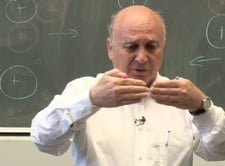
Till then, here’s Dr. Edmund Storms discussing how the myth got started.
A new generation is not prejudiced by authoritative decrees from a previous era.
Thus, when Andrea Rossi burst upon the digital environment 01/11/2011 with his demonstration of the Energy Catalyzer, or E-cat, a thermal energy generator powered by some as-yet-unknown nuclear process in a safe environment, without any dangerous radioactive materials, and far away from the seething core of the Sun, the planet tuned browsers and iPhones to northern Italy servers to sample the digitally-cloned experience. Public awareness has been accelerating ever since.
The new cold fusion documentary film The Believers by 137 Films won the Hugo Gold award for Best Documentary of the Chicago Film Festival, just as two science/technology magazines publish articles on cold fusion in their print versions, joining virtual versions of Forbes and Wired, among other online news and blogs, reporting on the topic.
They even went so far as advertising the fact on their covers, albeit small, and in the corner, revealing a cautious endorsement of the stories.
Two writers were tasked with presenting the cold fusion field, also called low-energy nuclear reactions (LENR), lattice-assisted nuclear reactions (LANR), and quantum fusion, in a few pages of text with a photo or two. I can hear the Editing team now. “What’s all this chatter about cold fusion?” and “what’s up with this Rossi fellow?”
The assignment is no piece of cake. Divining the truth of this underground science and imminently about-to-change-the-world technology is as complex and mysterious as the reaction itself.
The convoluted history can only emerge into a visible figure over time, piece-by-piece. Without a theory, there is no consensus. The science itself is entrenched amidst a ground of disinformation and outright hostility from otherwise very smart people who hold positions of power and authority in science, and whose behavior betrays emotional chains to immovable preconceptions.
Applying what Marshall McLuhan noted for all new environments, one of the great discoveries in the history of humankind was kept secret by “public incredulity”. Thus, cold fusion science is categorized as cultural fiction, alongside UFOs and Atlantis.
Max Planck, one of the discoverers of quantum mechanics wrote “Science advances one funeral at a time”, and for a new generation, the idea of transforming mass into energy (by whatever means) inside a solid material at room temperature is not a startling concept.
“Like, why not?”, say the kids.
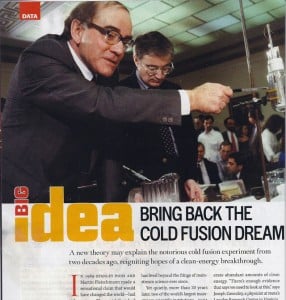
The article by Mark Anderson for Discover magazine was two full pages describing one of the more popular theories that propose to model the reaction at the nuclear level.
Developed by Lewis Larsen and Allan Widom, the Widom-Larsen Theory proposes a reaction whereby protons “capture” electrons, absorbing them, and becoming neutrons. A neutron could then interact more easily with other nucleons as it is charge neutral, and has no Coulomb force to overcome.
Dr. Joseph Zawodny is a physicist at NASA Langley Research Center in Virginia and is testing technology based on the Widom-Larsen theory, which may confirm or deny the hypothesis.
Whenever a cold fusion theory is finally confirmed by experiment, and the recipe for the reaction spelled out, the field of new energy technology will break wide open. Then, generators will be designed not as they are now, by painstaking trial-and-error, without full knowledge and control of the variables, but by intentional engineering that optimizes the system into what Peter Gluck calls LENR+.
Chief scientist at Langley Dr. Dennis Bushnell is quoted from his essay saying “LENRs could potentially satisfy the world’s energy needs at a quarter the cost of coal.”
This Discover magazine article about Widom-Larsen theory inadvertently used “cold fusion” vocabulary.The authors of the Widom-Larsen theory are adamant not to call the reaction “cold fusion”, but the phrase is not dismissed so easily. The Discover article’s title on page 10 is Big Idea Bring Back The Cold Fusion Dream, and the front cover states It’s Back: Cold Fusion.
Cold Fusion Now has long recognized the importance of vocabulary when talking to the public about nuclear reactions, and perhaps the magazine staff intuited similarly.
Scientists will eventually understand this Rumpelstiltskin reaction, and when the public finally gets a hold of it, they will name it with monikers not even dreamed of by the brightest marketing minds of today, and call it their own.
Steve Featherstone compiled a broader review of the cold fusion landscape for Popular Science.
Featherstone first sampled the community by attending the ILENRS-12 Conference held in June at William and Mary College in Virginia which attracted a number of leading figures in the field, and by visiting Italy, where he (finally) met with Andrea Rossi in his Bologna lab. He also met with other Italians skeptical of Rossi’s work, but who apparently think conventionally and know nothing of the two-decades old LENR experimental data.
Surveying conference attendees, Featherstone sums up the scientific community’s feeling of Rossi’s work by writing honestly:
“To my astonishment, after three days of asking every cold fusion researcher in the house, I couldn’t find a single person willing to call Rossi a con man. The consensus was that he had something, even if he didn’t understand why it worked or how to control it.”
They understood that Rossi is using a nickel-hydrogen type system historically known to produce large amounts of excess heat. His demonstrations have been witnessed by scientists who confirm temperature readings showing significant heat was generated.
The issue of openness, and the sharing of scientific data is another matter, and researchers will tell you fully-detailed, third-party tests and original data should be made available to the community for the sake of advancing the field. But without patent protection, those who have sacrificed decades of labor are not giving it up so easily.
But let’s forget about what’s typed as words, and look at what really communicates understanding, pictures. Popular Science gave the art department a whole page to illustrate this story.
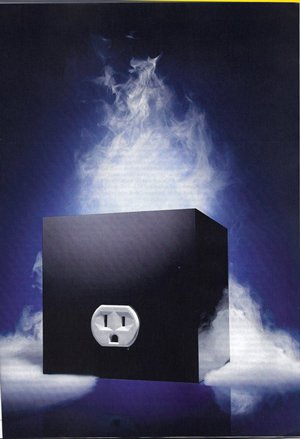
This image they came up with reflects what people want most from this technology, electricity. Prominently featured right in the front, the century-old three-prong household plug represents the “current” need for electrical power.
The black box doubly represents the mysterious cold fusion reaction, as well as the secrecy that surrounds the object of Featherstone’s focus, Mr. Rossi’s generator, and the secrecy that blankets a sector where the Patent Office refuses to give scientists the attention demanded of a paradigm-changing energy technology.
This Popular Science illustration accompanied Andrea Rossi’s Black Box by Steve FeatherstoneWithout patents, without academic support, without a process that encourages honesty, a developing technology will growing haltingly, in isolated pockets, and in secret.
The black box floats in the sky, like “pie in the sky”, and thus trepidation adds to the uncertainty. Like Wile E. Coyote spinning off a cliff, the unsettling feeling that you could drop like a rock at any moment, is the “ground” upon which the steam rises.
Steam is the object of the first planned cold fusion products in the form of hot water boilers for both hot and clean water, and steam generators for heating. Like a cloud, suspended, and slowly wafting behind the black box, steam rises into the deep blue, a technology within sight, but just out of reach on the horizon.
The box has a reflection below it. You can see the reflection of the electrical plug faintly just at the bottom of the of the picture, as if the box floats above water, a religious connotation associated with the highest of spiritual beings, reflecting the idealistic possibilities for a green and peaceful technological future for humans, if only we would just accept it.
The title page of Andrea Rossi’s Black BoxThe facing title page uses the same square box shape to enclose the type. Infinite Energy is typed in a light-gray font, and functions as ground for the bold black type of Andrea Rossi’s Black Box title.
Eventually, steam generators would turn turbines to generate the electricity, enough to feed the box and more, creating an infinite coefficient of performance (COP), one measure of the energy return.
Is this configuration of symbols more happenstance than design? Was the reflection just because a box was photographed on a glass table? Knowing the talent of artists who generate image for a living, I imagine the brainstorming session that came up with this image, and how, in art, serendipity can allow unconscious choices that come together as coherent message only acknowledged after the piece is finished. For these images, the simplicity is a success.
Poet Ezra Pound called artists “the antennae of the race”, intuiting a future, from the now, but the interpretations of illustrators and artists can also provide a valuable report on the current milieu.
As more minds awaken to the possibilities of cold fusion technology, surveying the state of understanding includes not just reading the written words, but reading the images, and the actions taken, too. They have always “spoken louder than words”.
UPDATE October 20 The Believers wins Hugo Gold award for Best Documentary at Chicago Film Festival. [Movie City News]
The first premiere of “The Believers“, a new cold fusion documentary produced by 137 Films occurred last night at the Chicago Film Festival.
From their F-book page, we have a photo of Directors Clayton Brown and Monica Long Ross on the red carpet.
At the time of this writing, the only review post-screening is by Lisa Nesselson from Screen Daily, who noted Cold Fusion Radio’s James Martinez‘ participation:
“The doc begins with James Martinez, a California DJ who broadcasts on internet-based Cold Fusion Now Radio. While enthusiastic, he has nothing of the bug-eyed loony about him when making pronouncements such as “This is the key to liberating the human race.” ”
The review continued fairly neutral, noting “The filmmakers leave viewers to draw their own conclusions, but there’s much here to pique the interest of any layman.”
Containing quotes by Martin and Sheila Fleischmann, Ms. Nesselson concludes with:
“Either there’s some delicate variable or the chemists were mistaken. A man who was a grad student in Fleischmann and Pons’ department at the time says “I will defend them at every turn. What we did was real.” ”
Europe has been a leader in the arts for centuries, creating 3D perspective and ushering in the Renaissance that gave us modern science.
Europe is also a fertile region for cold fusion science, with almost every country represented by some agency-funded or independent research lab. And now, in 2012, European youth culture and the broader arts community are ramping up creative efforts to spread the meme of cold fusion and new energy science.
Writer/Blogger Daniele Passerini provided Italian scientists with a worldwide platform.The tremendous successes of Italian scientists Andrea A. Rossi, Francesco Celani, and the historic, continuing work of Sergio Focardi, Francesco Piantelli, Vittorio Violante and their numerous talented laboratory partners, have altogether demonstrated publicly both the anomalous heat effect and reproducibility on-demand from cold fusion cells. Thanks to Mats Lewan reporting for NYTeknik and writer/blogger Daniele Passerini of 22Passi, northern Italy has become the center of the universe for E-cat and LENR watchers around the world.
But not long after the U.S. excoriated the pair, virtually kicking them out of the country for announcing a discovery that few could reproduce, the godfathers of cold fusion Drs. Martin Fleischmann and Stanley Pons operated a laboratory in the south of France, funded by Japanese corporation Toyota.
Today, Dr. Jean-Paul Biberian, who serves as Editor of the Journal of Condensed Matter Nuclear Science, the peer-reviewed periodical serving the cold fusion community, researches cold fusion at the University near Marseille, France [visit].
Dr. Biberian recently presented a review of research in a paper Cold Fusion [.pdf] at the 17th International Conference on Cold Fusion (ICCF-17) held recently in Daejon South Korea, and collaborated with Dr. Melvin Miles and Dr. Iraj Parchamazad on a paper titled The Possible Role of Oxides in the Fleischmann-Pons Effect [.pdf].
Jean-Paul Biberian from Fusion FroideNow, there is a new documentary about Biberian’s research by filmmaker Jean-Yves Bilien entitled Fusion Froide Transmutations Biologiques et Autres Reflexions Sur La Science. The film is in French and for purchase, but you can watch the trailer for free. (For a Google translated site to English, go here.)
Views of Biberian in his scientific element with close-up shots of his cold fusion experimental cells, as well as the gorgeous natural landscape occupied by explorers for millennia are worth watching, even if you don’t speak French – and you just might be able to catch a few of the scientific phrases more recognizable to students of new energy.
Bilien is a filmmaker with a number of documentaries to his credit, specializing in breakthrough science. Filming Dr. Biberian appears to be his first production featuring cold fusion, and it is very professionally done; makes me wanna do better myself!
An earlier documentary on Biberian’s work by Master-Pro-documentaire bears a similar style to Jean-Yves Bilien, with slow-panning camera work and close-ups of cold fusion cells, yet also includes early French TV news broadcasts of the 1989 discovery. Watch the 30-minute L’ aventure de la Fusion Froide in French here.
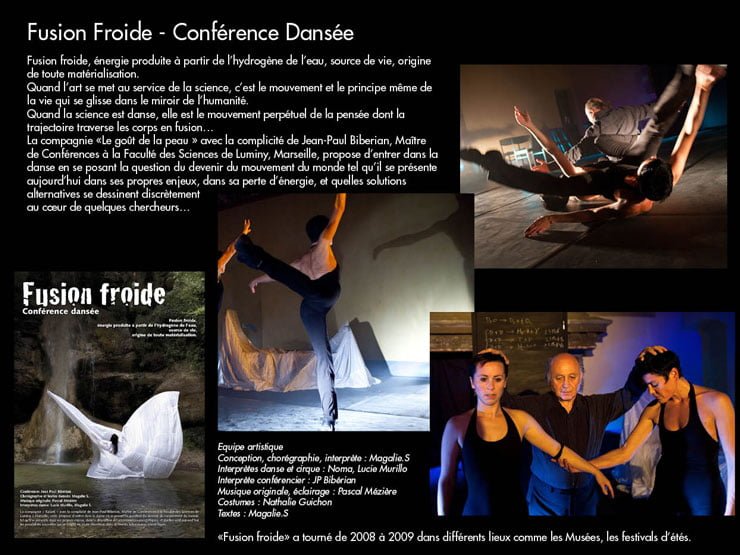
Biberian has also collaborated with the broader arts community. This photo shows him working with members of the troupe who performed Fusion Froide from an arts festival several years ago.
But the arts aren’t just for scientists.
“We are the primitives of a new era.”
—Aldo TambelliniThe Cell Grew 1961
The upcoming Global Breakthrough Energy Movement Conference in Hilversum, Holland November 9, 10, 11 has attracted a number of speakers from the leading edge of alternative science, technology, and social sciences including Cold Fusion Radio’s James Martinez.
The GlobalBEM YouTube Channel houses submitted video statements from a few of the scheduled speakers describing the landscape of new energy research, making their vision a world unto itself.
The conference is being organized by a collective of creatives: artists, musicians, technologists, all engaged in what Wyndham Lewis, the original Vorticist of Great Britain, recognized as the truly modern art – beyond the conventional manipulation of color and sound: the manipulation of whole environments.
Follow the art, and feel the future. The “Distant Early Warning” has been sounded.
Just listen to GlobalBEM conference speaker Fernando Vosso:
So I’m riding my bike down Main Street in Santa Monica, and a fellow pedals up along side and starts a conversation, right there in the bike lane. He wanted to compliment me on my bungy-corded box strapped to the back rack that transports my load.
Seeing my Cold Fusion Now sticker deftly placed street-facing on the frame, and the new T-shirt I’m wearing (available SOON!), he remarks, “Wow, you’re really into this…”
You have no idea, I think to myself. “I do clean energy advocacy for cold fusion.”
At once, the young man (who identified himself as “d’Artagnan”, a science-fiction screenwriter) proceeded to tell me that cold fusion wasn’t real, and was shown years ago, to be a mistake.
Some hero!
Taking a deep breath, (and watching for the red light coming up), I told him that if his knowledge of the situation stopped in 1989, then he’s missed the last two-decades of development, and could use an update.
I rattled off a few facts that contradicted the myth he was stifled by.
What did I say?
Essentially, I listed a few well-known companies, agencies, and universities, actively engaged in serious research on cold fusion, also called low-energy nuclear reactions (LENR), lattice-assisted nuclear reactions (LANR), and quantum fusion.
NASA is testing technology based on a LENR theory at Langley Research Center, and testing experimental cells at the Glenn Research Center.
National Instruments, a billion-dollar multinational corporation that manufactures science equipment and laboratory software, featured LENR at their recent NIWeek, and has set up a lab testing cold fusion cells in Austin, Texas.
University of Missouri has set up an Institute of Nuclear Renaissance with a $5.5 million grant to study LENR.
University of Illinois Urbana-Champagne runs a LENR research laboratory under Dr. George Miley studying both excess heat and transmutations. Purdue University has LENR theorist Dr. Yeong Kim; University of LaVerne has researcher Dr. Iraj Parchamazad; Portland State University has Dr. John Dash; and Massachusetts Institute of Technology has Dr. Peter Hagelstein, all actively pursuing research experimentally or theoretically.
SRI International, a world-renowned science lab based in Menlo Park, California operated under Dr. Michael McKubre, has been experimenting for over two-decades, amassing a huge database of results.
Brillouin Energy Corporation, an independent new energy lab under the direction of Robert Godes in Berkeley, California, recently received private venture capital funding, and is now working with SRI International testing a new gas-loaded boiler design.
The Electric Power Research Institute (EPRI), the Defense Advanced Research Projects Agency (DARPA), and the Defense Threat Reduction Agency (DTRA) have funded cold fusion/LENR research.
The Naval Research Lab continues to research the phenomenon; the Army Research Lab has conducted workshops.
Corporations Toyota and Mitsubishi partner with their government and have fully-funded labs experimenting with both theory and cells, and are now dramatically increasing their support due to the recent technological advances.
Researchers in Italy, India, France, Germany, Ukraine, China, Russia, Greece, and Canada, are among nations around the world racing to develop this science into a usable technology.
Well, of course I didn’t get through all of them before this man’s protestations continued, and I took a left turn, and he took a right.
In addition, this list is not exhaustive.
There are more recognizable entities engaged in clean energy research from cold fusion, and some who do not want to be recognized.
Some have been pursuing research for twenty-three years, while newer groups are flocking in as development nears commercial potential.
Why would these heavyweights carry on research and development if it wasn’t real? The stakes are so very high.
If you’re talking to a non-believer, someone who has faith in their own twenty-three-year-old knowledge, then this is a good list to start off with when attempting to update their dusty synapses.
And if that doesn’t work, pedal on; there are many without prejudice, and who are willing shed any out-dated notions with new information.
The open-minded are our kin, and it’s those we gather to demand peace and freedom with a clean energy economy, for a technological human future, on a green planet, for all the inhabitants of Earth.