
Trends Journal taps new energy again

Gerald Celente has once again brought new energy to the attention of investors and policy-makers by including a story on Defkalion Green Technologies in his Trends Journal, according to a post by Peter Gluck.

Trends Journal Institute 2013-Spring-JournalThe publication is of the Trends Research Institute.

It has been quite a while since Celente has spoke publicly on cold fusion and other new energy technologies. Sterling Allan‘s Pure Energy Systems has a Top Five Exotic Free Energy Technologies listing of breakthrough technologies that got the attention of Celente, and made it into the Trends Journal 2011.

In 2011, Celente put new energy as a top trend for 2011 and called cold fusion the greatest investment opportunity of the 21st century. While the earlier inclusions focused on Andrea Rossi‘s Ecat technology, this piece focuses on the differences between Rossi and Defkalion’s prototypes.

This excerpt is from Gluck’s posting New Energy trends paper about Defkalion Green Energies:

Alex Xanthoulis, Defkalion’s CEO, is quick to emphasize that the company’s products differ sharply from Rossi’s. An unnamed “major US organization,” he says, has compared Rossi’s and Defkalion’s devices on 14 points. “It found only two the same – the use of hydrogen and the use of nickel,” he says. “Otherwise, the two are completely different.”

There are other points of departure.

Rossi’s early devices, like the inventor himself, also were quirky. The temperatures they would reach weren’t predictable; they produced only a few watts of excess energy; and, when shut off, took varying lengths of time to stop producing heat.

In contrast, Defkalion’s machines reportedly produce heat at precise temperatures that customers require and can be shut off within a few seconds. The devices also produce energy up to 10 kilowatt-hours, not single watts as others have. The nickel-hydrogen fuel modules can easily be pulled out and replaced when depleted, a task that should need to happen only every few months.

Defkalion’s first product is called “Hyperion” and will enter the market early next year. A cube about 20 inches on a side, it will be marketed as a heater or boiler for homes and light industry needing up to five megawatts of power.

The second product is a larger-scale reactor that can be used to drive turbines or even cars, trains, ships, space satellites, and planes. Defkalion reports fielding inquiries from hundreds of companies around the world and has chosen to partner with at least 10 large ones – including three vehicle manufacturers, a utility company, telecommunications firms, and a maker of aircraft – to continue research and development. Some of the companies already are testing commercial devices using the reactor as a power source.
–THE SEARCH FOR AN OIL-FREE FUTURE by Bennett Daviss The Trends Journal Spring 2013, pp 30-34

Defkalion Green TechnologiesThe mention of proposed Hyperion generators contradicts earlier statements implying Defkalion would not focus on consumer products per se, but license their technology for others to manufacture. However, as technological developments rush forward, adapting to new information is required and plans and strategies change at light-speed. All pathways to a marketable generator must remain open.

ecatdotcom-logoRossi’s heat output seems somewhat low according to reports by European scientists who have witnessed public demonstrations of the Ecat. However, it does appear that many spectators to this drama confuse the two rival technologies and distinctions must be made.

Hopefully, Defkalion’s first public demonstration planned this August at National Instruments NIWeek 2013 will make those distinctions clear.

New energy trend is strong

It has been three years this month that Cold Fusion Now was activated to promote clean energy from the hydrogen in water. Turning the science into a commercially-scaled technology still eludes new energy researchers, yet wider awareness and support has been generated, and more private investments made. The Trends Research Institute has been one of the few forecasting agencies who recognize the importance of this technology.

It is unknown how many new labs are opening up. I know of at least two fresh and fairly well-funded ventures in the U.S. which prefer to remain under the radar without publicity, and probably more than that, with at least that many in multiple countries around the world. The number of people working on solving the problem of cold fusion, also called low-energy nuclear reactions (LENR), lattice-assisted nuclear reactions (LANR), quantum fusion and the anomalous heat effect (AHE), has increased dramatically over the last three years, most of whom have dreams of a marketable device, despite the lack of a definitive theory describing the reaction.

While a large-scale coordinated research strategy would most likely accelerate the engineering of a usable technology, the absence of funding and patent protection forces hopes on the efforts of small independent labs, most of whom are working in isolation from each other.

Google’s search trends results reveals the general interest over the last 12 months. The most popular search term remains “cold fusion”, the name we choose for describing all the multiple terms listed above. Highest peaks occurred during July and August when the International Conference on Cold Fusion ICCF-17 met in South Korea and National Instruments celebrated LENR at NIWeek 2012. A third big bump happens over the MIT IAP Cold Fusion 101 course in late-January.

Ecat, the proprietary name of Rossi’s steam generator, is the second most popular term, a word which many people mistake for the entire field of research. Ecat search interest peaked last fall around the time of the Ecat Conference in Zurich, Switzerland.

LENR, LANR, quantum fusion, and AHE all have devotees, but LENR is most used by the institutions who eschew the stigma of cold fusion.

Google searches have trended flat or slightly downward since the big conferences last year. But the enthusiasm is global, beyond borders and regional dialects. We expect the search engines to be maxing out on cold fusion for this year’s conferences.

Gerald Celente and The Trends Research Institute are bold enough to call it as they see it, without concern for appearances. While giants sleep, the underlings continue to build the intellectual infrastructure of a new energy tomorrow. Usually, being on the leading edge is lonely and frustrating. But if trends continue, this edge will be the springboard for many in the field to not only pay their rent, but provide a clean source of energy in a people-powered world.

Cold Fusion Now!

Spam Allstars with new atomic jam

Cold Fusion Now Associates will have greater supervision in new location.
Cold Fusion Now is on the move again, back to lovely Eureka, California.

We left our residence in Eureka two years ago to do interviews and advocacy in support of the new energy movement, and we succeeded. Using movies, art and activism, we turned a myriad of people on to the possibilities offered by cold fusion energy.

Now, all efforts are focused on locating the new HQ. With all the stress, I listen to alot of music.

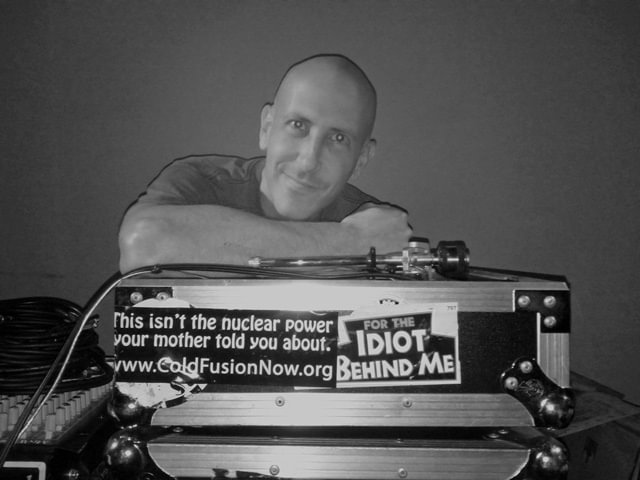
Last year in Florida, I hooked up with my old pal Andrew Yeomanson, a Miami DJ and bandleader of the Spam Allstars who spins with a CFN sticker on his gear.

DJ Le SPAM
Miami, Florida DJ Le SPAM has fusion-powered gear
He played me some tracks of a tune he was mixing in his City of Progress Studio.

About a month ago, he finished the mix and together with filmmaker Juan Maristany, made a video titled, er… Ruby Carat!

Woo hoo! Thank you Spam Allstars and Juan Maristany.

Yeah, I dance around just like that.

Cold Fusion Now!

Related Links

DJ spins with Cold Fusion Now on NCC6 Miami

Cold Fusion Now Cross-Country Tour 2012

Cold Fusion Now Cross-Country Tour 2011

Widespread destruction of ecosystems and wildlife from tar sands

This is a re-post from the Post Carbon Insitute, dedicated to documenting the last moments of the Chemical Age and who unfortunately does not yet realize the potential of the New Energy Age.

Original article is here.

Tar Sands Is Worse Than You Can Imagine: Incredible Images You Have to See
Posted Apr 19, 2013 by Leslie Moyer

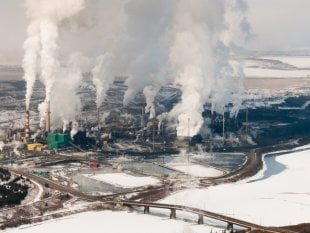
The Suncor Energy upgrading refinery, on the banks of the Athabasca River.     Photo Credit: Copyrighted image; photographer not disclosed.
The Suncor Energy upgrading refinery, on the banks of the Athabasca River.
Photo Credit: Copyrighted image; photographer not disclosed.

Post Carbon Institute and Alternet have partnered to shed a powerful light on the true costs of our addiction to fossil fuels, starting with the Alberta tar sands .

Every powerful photo is linked to three meaningful actions that you can take right now to fight back against tar sands mining. We need your help getting the word out; please take a look at the images, take a stand, and share far and wide with your friends, colleagues and neighbors.

The mining of the Alberta tar sands is the biggest industrial project on earth and quite possibly the world’s most environmentally destructive. The visuals are hard to stomach, but the story is an important one to tell.

Click to see the slideshow

As conventional oil and gas deplete, the energy industry must resort to unconventional resources that are more expensive, more technically challenging to access, and pose far greater risks to ecosystems and communities than ever before. The result is destruction on an unprecedented level.

The tar sands tale is told frame by frame in the image deck, guiding us from the clear-cutting of pristine Boreal forest and creation of vast open-pit mines all the way to the pipelines that transport diluted bitumen across the continent.

The connection between the astounding environmental destruction taking place in Canada and the debate over approval of the Keystone XL pipeline here in the USis clear. As the recent rupture of the Pegasus Pipeline in Arkansas makes abundantly clear, the transport of diluted bitumen from Alberta via pipelines to oil refineries thousands of miles away poses unacceptable environmental risks.

As important, the Keystone XL Pipeline is a key litmus test for the Obama Administration and the country as a whole. And the rest of the world is watching.

Although the Canadian tar sands contribute a small percentage of total global oil production and the Keystone XL Pipeline is just one of many contested fossil fuel projects in the world (in fact, First Nations and thousands of other Canadians are fighting an equally dangerous tar sands pipeline, the Northern Gateway Pipeline), this decision by President Obama is a keystone of a different kind – representing the kind of energy future we want for ourselves and our loved ones.

For that reason, it’s not mere hyperbole to say that this is a life and death decision.

We’re reaching out to you to speak up against the Keystone XL Pipeline by sharing these images with your friends, family, and neighbors, and by clicking on one of the calls to action associated with each image.

End Post Carbon article*************

Begin Cold Fusion Now commentary*************

Cold Fusion Now!


Crack hypothesis gets community response


Today’s successes in cold fusion energy generators have been hard-won by trial and error, with each system developed by a select criteria amassed over years of painstaking success and failure.

Ironically, the many labs with commercial prototypes each follow a different mental model of how their system works, a problem for developing a technology, as the criteria to enable the anomalous effects of excess heat and transmutations are not universal over all cells.

Prototypes appear to suffer from either one of two extremes: i) there is control of the reaction, but not high-enough power output, or ii) there is plenty of thermal output, but engineering control and/or stability are at issue. No definitive theory describing how to make cold fusion happen on-demand with maximal efficiency exists, for any type of system.

When an accurate model of the reaction is finally articulated, it will spell-out exactly how to build energy-dense, ultra-clean batteries charged for life.

While there are many researchers in condensed matter nuclear science (CMNS) modeling the reaction, few can agree on what the features of a theory should be, and the lack of consensus is keeping a revolutionary new-energy technology from a world in need of a solution.

The names given to cold fusion over the years reflect various streams of focus:

  • low-energy nuclear reactions (LENR) differentiates the phenomenon from hot fusion and is the most commonly used term today.
  • lattice-assisted nuclear reactions (LANR) focuses on the crystal-lattice structure as enabling excess heat.
  • quantum fusion attempts to describe the reaction using 20th-century physics.
  • nickel-hydrogen exothermic reactions describe the elements involved in generators being developed for commercial use.
  • anomalous heat effect (AHE) labels a reaction without any reference to cause.
.

Finding the recipe

“This is the most ideal energy you could possibly imagine,” says Dr. Edmund Storms, a former-Los Alamos National Lab nuclear chemist and long-time researcher in cold fusion.

Describing the conditions needed to make the reaction happen is essential to producing a usable technology. To move forward, “what are the basic theoretical criteria that we can collectively agree upon?”

iecover108Issue #108 of Infinite Energy magazine attempts to answer that question by gathering leading researchers and moderating a discussion on the properties a theory should have.

Edmund StormsCold Fusion from a Chemist’s Point of View begins the process by asking the community to justify where the location of the reaction is.

David J. Nagel, Xing Zhong Li, Jones Beene, Vladimir Vysotskii, Jean-Paul Biberian, Andrew Meulenberg, and Ed Pell all responded to the call, each writing their thoughts with various focus.

But for all that brain power, and a seemingly simple question – where does the reaction occur? – there is little agreement on the answer.

The NAE is something special

Storms notes that nuclear reactions don’t generally spontaneously erupt in ordinary materials. He asks, what changes occur in the chemical environment of a regular piece of metal to make a reaction happen? He describes those special conditions as the Nuclear Active Environment (NAE).

An array of atom constitutes a solid.

Many theories today apply to only one system, either Pd-D or Ni-H, and put the reaction within the metallic lattice. Mathematics is utilized to explore how enough energy might accumulate at one spot to overcome the Coulomb barrier, or initiate electron-capture.

Storms asks these theories to explicitly state how it is that enough energy can spontaneously accumulate locally in the lattice without first affecting the chemical bonds that hold the atoms together, or, violating the laws of thermodynamics? Justifying all theoretical assumptions is essential to weeding out dead-end ideas and accelerating those that appear more promising.

Whereas Storms sees physicists by-and-large concentrating on the cause of the reaction, asking ‘what possibilities exist that could start a nuclear reaction inside a metal?’, he differentiates his chemist’s approach to modeling by remaining tethered to the known chemical properties of solids, and how materials are witnessed to behave in the lab.

“Any theory of cold fusion must begin and end with the experimental results,” says Storms. “A theory that does not explain what we see and measure in the lab must be abandoned.”

Where does the reaction occur?

In palladium-deuterium systems, which have been most studied, and for which there is the most publicly available data, measurements of nuclear products helium, tritium, and transmutation products point to origins within a few microns of the metal’s surface.

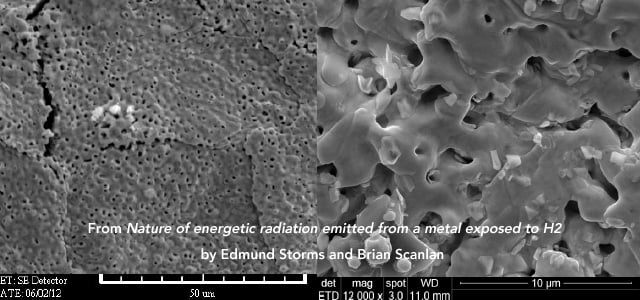
Ni surface on which Cu was deposited
Following a chain of reasoning commanded by the experimental data, Storms hypothesizes that the NAE are cracks that form on the surface of bulk metals due to stress. Expanding the idea of cracks to apply to all types of systems, he includes the tiny nano-spaces that exist within metallic powders and biological organisms.

Nano-sized cracks and spaces satisfy the criteria that puts the reaction near the surface in metal-hydrides and they can be found in all types of systems. In addition, a nano-space provides a special environment separate from the rest of the solid, relieving the burden that the chemical environment imposes, allowing the space to respond differently from the lattice, subject to appropriate stimuli.

Still, questions remain. For instance, David J. Nagel asked how could these cracks be formed so perfectly as to be just the right-size for a string of hydrons to form? And where is the mathematics to quantitatively model this hypothesis?

The nuclear mechanism

Getting these questions out in the open and discussed is the point of IE’s exercise and Storms plans to respond in the next issue, but he has made clear he does not find it fruitful to provide a mathematical argument before first describing the location of the NAE.

“If you don’t know what the initial conditions are to make the reaction happen, how can you describe what is actually happening quantitatively?”

Storms believes if theorists first focus on finding the location of the reaction, and can describe the initial conditions that make the reaction happen, then a theory of the nuclear mechanism will begin to take shape.

Supposing Storms’ idea of the NAE is confirmed, he does speculate qualitatively on the nuclear mechanism by first having the tiny cracks and spaces become filled with hydrogen to form hydrotons.

Subject to some stimulus, the hydrotons in the crack resonate, beginning a process whereby mass is slowly turned to energy according to Einstein’s E=mc2 without the dangerous radiation associated with hot fusion. This nuclear mechanism would be a new type of reaction not yet understood in the context of conventional theory.

Testing theory

Only experimental results will confirm or deny any proposed theory. However, the lack of coordinated research programs amongst the community, exacerbated by an absence of funding and patent-protection, is a huge problem.

Peter H. Hagelstein has attempted to model cold fusion since 1989, chewing through multiple versions of ideas, and abandoning them when they are no longer feasible. For all his work, he has endured two-and-a-half decades of isolation from mainstream science.

In IE#108, he opens the series on theory with a guest editorial On Theory and Science Generally in Connection with the Fleischmann-Pons Experiment [.pdf], available free compliments of Infinite Energy and lenr.org.

If his closing statement to The Believers movie was a devastating admission of defeat by SNAFU, this new essay shows a wit that won’t back down despite the massive challenges. With unblunted satire, Hagelstein deconstructs the scientific method, updating the hallowed steps-to-discovery for 21rst century conditions.

While the scientific method might lead to unambiguous data, its effectiveness is lost in an atmosphere of hostility.

Storms’ hypothesis on the NAE leads to twelve new predictions, providing a rubric to test the idea. The simplest test is to detect deuterium from Ni-H systems; a mass spectrometer on an active cell would suffice for that one. But who with access is willing to perform these experiments? Money is now being raised by interested parties to pay for co-operation.

Infinite Energy magazine is undertaking this effort to bring theorists together over a model of cold fusion with a series of issues. Jean-Paul Biberian, a researcher from Universite Sciences de Luminy and Editor-in-Chief of the Journal of Condensed Matter Nuclear Science will be leading the next issue focused on theory this winter. We hope it begins a productive renaissance in collaborative science on the greatest scientific question of our time.

A world is waiting.

Cold Fusion Now!

Related Links

Nature of energetic radiation emitted from a metal exposed to H2 by Edmund Storms and Brian Scanlan [.pdf]

An Explanation of Low-energy Nuclear Reactions (Cold Fusion) by Edmund Storms [.pdf] from Journal of Condensed Matter Nuclear Science 9 (2012)

An Explanation of Low-energy Nuclear Reactions video interview with Edmund Storms by Ruby Carat summer 2012.

The Nuclear Active Environment and Metals That Work video interview with Edmund Storms by Ruby Carat summer 2011.

New energy solution from Nobel laureate ignored by NYTimes

1973 Nobel laureate Dr. Brian Josephson responded to the April 3 New York Times letter Invitation to a Dialogue: Action on the Climate by Robert W. Fri asking for social scientists to become more engaged in promoting low-cost energy alternatives.

Fri is Chairman of the American Academy of Arts and Sciences’ Alternative Energy Future project and a visiting scholar at Resources for the Future.

Read 2011 report on the topic: Beyond Technology: Strengthening Energy Policy Through Social Science [.pdf]

Josephson’s letter answered with the solution offered by low-energy nuclear reactions (LENR) and it did not appear with the other responses published in the Sunday Dialogue, so we post it here:

For publication
—————

Robert W. Fri (Apr. 3rd.) asks, in regard to climate change, for ‘steps that will make useful progress at low cost’. I suggest his committee look carefully into so-called cold fusion, a good source for which is the Library at lenr.org. (corrected from lenr.com)

In retrospect the conventional view, that the claims of Fleischmann and Pons in this regard were erroneous, can be seen to have been based on a number of faulty assumptions, some of which were discussed in a lecture by Peter Hagelstein at MIT (see http://www.infinite-energy.com/images/pdfs/VernerIAP2013.pdf). The claim that in such systems heat is generated far in excess of what can be explained in conventional terms has by now been confirmed in very many investigations, though reproducibility on demand has been a problem. The factors determining how much heat will be generated in any given sample are at present poorly understood; thus modest funding to address these issues should pay dividends. Once these factors are understood, there is a real possibility that fusion processes at ordinary temperatures in suitable materials can contribute significantly to energy resources in the future, and thereby help to combat the problem of climate change.

Prof. Brian Josephson
Emeritus Professor of Physics, University of Cambridge
Foreign Honorary Member, American Academy of Arts and Sciences

Cold Fusion Now asks all readers to respond in writing, by phone, or in person, to their local media and political offices whenever alternatives are put forth that ignore the cold fusion solution.

Cold Fusion Now!

Defkalion: “We’re not selling products, we sell technology”

SterlingAllanJuly24_2004_head_150sSterling Allan of the Pure Energy Systems network follows multiple types of new energy technologies, including cold fusion.

Last year he traveled to Greece to check on the progress of Defkalion Green Technologies Hyperion steam-generator, a prototype commercial product based on low-energy nuclear reactions (LENR) that utilizes nickel and light hydrogen.

Recently, Allan interviewed Defkalion‘s CEO Alex Xanthoulis and Director of Communication and Business Development Symeon Tsalikoglou on developments since moving their headquarters to Vancouver, B.C.

While the Hyperion domestic unit has been “put on the back burner”, Defkalion has been approached by hundreds of companies wanting to license their technology for various products. The company has narrowed those proposals down to 20 which they will pursue.

“They let the professionals in the industry work out the details of fitting the technology to the myriad of applications out there,” writes Allan.

One of the applications cited is shipping. “A large cargo ship (18,000 to 20,000 tons) can go through $20,000 worth of fuel each day, but with Defkalion’s technology, those costs would go down to $500/day — a 40-fold reduction in price.”

Savings on fuel costs, weight, space, and time (since ships won’t have to stop and refuel as often) are all benefits of this technology. No fossil fuels on board mean no nasty spills either.

Another high-priority project is replacing the dirty and dangerous radioactive fuel rods in today’s nuclear power plants with clean cold fusion steam generators. “The price for a retrofitted nuclear plant will be 12 times lower than what they presently operate at,” producing power at $0.35 per kilowatt-hour.

Eventually, home units will be available, and the energy cost for this off-grid technology “is expected to be less than $300 for six months, for a 550 square meter (6000 ft2) home” with the charge lasting six months.

All licensees for applications are required to test the technology on their own.

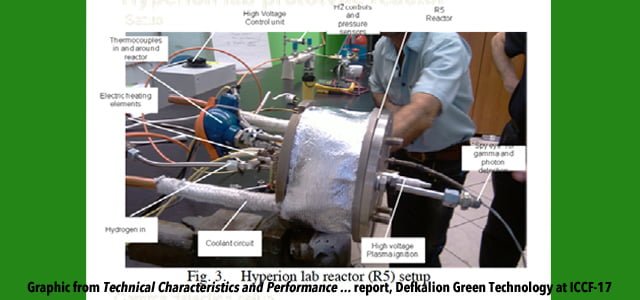
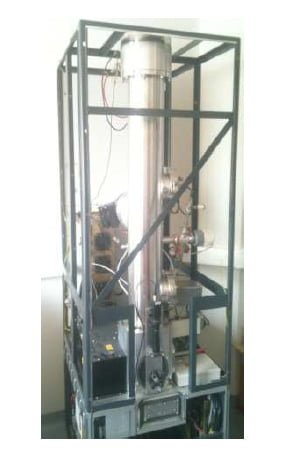
A mass spectrometer surrounds Hyperion reactor.
Allan writes, “One US Company tested the Defkalion technology for about six months and reported that there was no harmful radiation emitted whatsoever (they thoroughly tested the full spectrum), and that only some gamma rays are emitted during the reaction — but no more than you get from a household toaster — well within safety limits. And sometimes, it doesn’t even emit any harmless gamma radiation while it is operating — puzzling the scientists who haven’t yet figured that one out, who think that with every transmutation event there should be a gamma emission.”

Currently, their demonstration model generates 5 kilowatts of thermal energy and it is claimed that one unit has been operating for 8 months.

Last August, a Technical Characteristics and Performance report [.pdf] was released at ICCF-17, the International Conference on Cold Fusion where Defkalion presented.

Details of the unit given to Allan recently were:

Excess heat graph from Defkalion nickel-hydrogen system.
“Most of the input energy is up front when it is brought up to 180 C, then the input is tapered off until it is just a quick pulse from a spark plug every 10-15 seconds. It takes about 1-2 hours to stabilize. So in the first 24 hours, the COP is 1:5 (five times more energy out than what is put in). But over time it gets so good that Alex doesn’t like to say what it is because it comes across as unbelievable.”

“The output temperatures range from between 350 and 500 degrees Celsius. It once went up to 860 C in just 30 seconds, but that was an accident, and caused damage because the materials are not designed for that, so they cap it at 500 C.”

Seven regional labs around the globe are working on next-generation models, with each lab developing a particular application. The core team is currently engineering R5, a reactor designed specifically for controlling while the next reactor R6 will be for “pure performance”.

One avenue which won’t be pursued is military contracts. Apparently, current business agreements have a clause that says the technology “won’t be used for military purposes”, good news for civilians around the planet. However, the company realizes that after release, these generators will be copied and they won’t have control over it’s purpose.

Defkalion plans a public demonstration of their work at NIWeek 2013 this August at National Instruments in Austin, Texas. Till then, as a business entity, they will follow Alexander the Great’s model, attempting to be first to market. Alexander had “45,000 soldiers compared to the foes 500,000 that were superior in knowledge and skill. He won by being first.”

Read the full article Defkalion lying low, preparing for some big splashes by Sterling Allan here.

Top