1 gram of nickel can generate E-Cat energy equivalent to the energy generated by 517 kilograms of oil. [Here]
If the world consumes 89 million barrels of oil per day, how many ounces of nickel does that correspond to in E-Cat energy?
First, a barrel is a unit of volume and a gram is a unit of weight (technically mass).
A barrel of oil will weigh differently than a barrel of cotton because of the density of the material in it. (Density is mass per unit volume.)
So we need to know how many kilograms a barrel of oil weighs.
To find how much a barrel of oil weighs, we must know the density of the oil.
The density of oil varies.
We will take an average crude oil density value as $\rho = \frac{850 \text{\hspace{0.7 mm} kilograms}}{1 \text{\hspace{0.7 mm} cubic meters}}$.
Since $1 \text{\hspace{0.7 mm} cubic meter} = 264.17 \text{\hspace{0.7 mm} gallons}$ and there are $42 \text{\hspace{0.7 mm} gallons} = 1 \text{\hspace{0.7 mm} barrel}$, we can find the number of kilograms of oil in one barrel by converting
So the daily energy from 12 trillion grams of oil corresponds to the daily E-Cat energy from 23 million grams of nickel.
If the world uses 23 million grams of nickel every day, that is
$(23 \text{\hspace{1 mm} x \hspace{1 mm}} 10^{6}) (365) \approx 8.4 \text{\hspace{1 mm} x \hspace{1 mm}} 10^{9} \text{\hspace{0.7 mm}grams nickel annually}$.
Therefore, replacing our current consumption of oil with E-Cat energy would consume an estimated 8.4 billion grams of nickel annually.
Now annual nickel production is roughly on the order of 1,300,000 tonnes.
Since one tonne = 1000 kilograms = 1,000,000 grams, we have that annual nickel production is about 1.3 trillion grams. This means that
$\frac{1.3 \text{\hspace{1 mm} x \hspace{1 mm}} 10^{12}}{8.4 \text{\hspace{1 mm} x \hspace{1 mm}} 10^{9}} \approx 155$.
In other words, the current annual production of nickel is 155 times the amount of nickel we would use annually to replace oil at our current level of use.
Not only that, estimated reserves of nickel worldwide are on the order of 140 trillion grams, enough nickel for
$\frac{140 \text{\hspace{0.5 mm} x \hspace{0.5 mm}} 10^{12}}{8.4 \text{\hspace{0.5 mm} x \hspace{0.5 mm}} 10^9} \approx 16,667 \text{\hspace{0.5 mm}years}$
using the current energy-equivalent consumption of nickel.
Of course this is static reserve, and not exponential reserve, but as a rough estimate, 16,667 years of nickel fuel for E-Cat energy sounds pretty good. Remembering that nickel is a very common element in our solar system means that we would be able to mine all the nickel we need or want for this ultra-clean power.
These are huge numbers.
How about something more tangible – like pocket change?
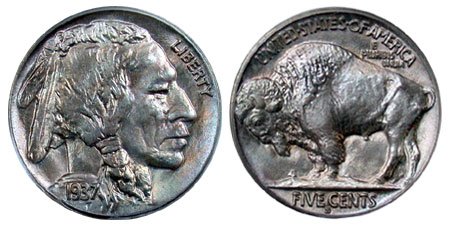
The US has a unit of money called a nickel which is a 5 cent piece, or 1/20 of a dollar (since 1913 called a Federal Reserve Note). First introduced in 1866, the Shield nickel was a 5 gram coin of 75% copper and 25% nickel. Later, other designs for the nickel were introduced, including my favorite, the Buffalo nickel, minted from 1913 to 1938.
1.25 grams of nickel = 5 barrels of oilNow 25% of 5 grams is 1.25 grams. Thus, using the E-Cat energy nickel equivalence, a Buffalo nickel containing 1.25 grams of nickel could generate the same amount of energy as 646,250 grams of oil.
In other words, this small piece of change has the energy density of close to 650 kilograms of oil!
Since there are about 135 kilograms of oil in one barrel, we have discovered that, E-Cat energy-wise, one little
5-cent coin $\approx$ 5 barrels of oil.
Holy cow.
Start saving!
******************************************************************************* Related Links
Our Top Five reasons to support cold fusion technology are listed as:
1. Cold fusion energy technology is ultra-clean.
2. The fuel is abundant.
3. The reaction has a high energy density.
4. New energy technology accompanies new economic paradigm.
5. Cold fusion technology empowers local communities.
Learning about these effects of cold fusion/LENR/LANR/CANR/”nickel-hydrogen exothermic reactions” technology, and describing each effect above with a short sentence and an example, is a good way to start talking about this technology with your friends and local officials.
As the economic and ecological state of our world deteriorates, we the people need to find the words that describe a path forward, words that we are not used to saying, or thinking.
If we are to discover our power as human beings, and flip this civilization into a positive, harmonic component of Earth’s biosphere, a new vocabulary for our life, and a way to communicate that vocabulary, is critical.
It is in this spirit that we continue forward, groping for a framework, a model, that can allow all humanity a chance to live in peace and harmony with all life on Earth, and beyond.
Ruby Carat wrote and recorded the audio back in June, before her cross-country tour to South Florida. Eli Eliott put images to that audio.
Brad Arnold read Mario Menichella‘s Secrets of E-Cat almost immediately after the English version was released so we asked him for his impressions. Following his review is a Q&A with author Mario Menichella.–CFN
“The aim of this essay, therefore, is not to determine whether the E-Cat is an amazing product or the scam of the century – this verification and the scientific validation is only a secondary theme of the book, although it is treated in some depth – but to bring an understanding of how it works to all those who, like me, would like to try to replicate it.” –Mario Menichella Secrets of E-Cat [pg 6].
The 144 page e-book “Secrets of E-Cat” is a good read. It doesn’t dwell on the politics or gossip surrounding Rossi – in fact the author is friends with both Rossi and Focardi – but instead it analyzes the mechanics of the E-Cat, or Energy Catalyzer. Since Mr. Menichella is an inquisitive physicist, he was able to lend more light than heat to the subject.
What is the E-Cat, how much energy does it produce, how is an E-Cat made, what is the secret catalyst, and what are possible theories for why LENR Ni-H (Low-energy nuclear reactions Nickel-Hydrogen systems) work. These are the questions the book explores. Safe to say that Rossi’s secret Italian sauce is still secret, but never the less several interesting possibilities are raised. It really isn’t fair to the author that I steal his thunder by going into specifics, but it is curious that iron is found in some of the products of Rossi E-Cat reactions.
There is an analysis of Rossi’s treatment of the nickel before it goes into the reaction chamber – what size particles and if he selects for isotope. Rossi said he tried about 10,000 experiments – there are a lot of combinations. What the book made clear was that Rossi was the first to be able to get a large amount of energy from nuclear fusion reactions at relatively low temperatures.
If you want to build a LENR Ni-H device, the book could very well help you do that, even fingering a nickel powder distributor, but don’t expect 6 (to 200) over unity. It feels good to know the basic working principles behind the E-Cat, but I wish the author had been more specific about the energy density of nickel (this is an important subject, because the more energy dense nickel is, the more spectacular LENR technology is).
At one point, the book mentioned that Rossi’s 5kW E-Cat used one gram in 5 days of continuous use. Then later, it was theorized that a 10kW E-Cat would use the same. That would mean that (as the book says) nickel was 100,000 times as energy dense as diesel fuel. I’d like to contrast that with the claim Rossi made on his patent application, which was that a gram of nickel was equivalent to 517 tons kilograms of oil. That would mean nickel was over 5 hundred million thousand times as energy dense (according to my calculations).
Editor’s note: Yes, Mr. Arnold’s calculations were correct. However, there is an error in the patent application that has been addressed; the available energy is equivalent to 517 tons kilograms of oil per gram of nickel. [NYTeknik]
Thus, the calculations in the book are correct. “1 gram of oil can gives a chemical energy in the order of electron Volts, while 1 gram of nickel can give – in a typical nuclear reaction – an energy in the order of MeV, which is about 10^6 larger.”-Mario Menichella
By the way, all you need to do to figure out energy density is to calculate how many grams of (for instance) oil would be the same as a gram of nickel. Just go to this site and plug in 517 kilograms, and you get the answer 517,000, which means that 517,000 grams of oil equals a single gram of nickel in terms of producing the same amount of heat energy (the nickel in a LENR reaction, and the oil by burning it).
Also according to the book, Rossi was sometimes getting 200 times the return energy. In public demonstrations, Rossi’s E-Cat was only getting a little over 6 from unity. The issue is safety. Right now the E-Cat is limited to lower temperatures and more electrical usage because the reaction (which, by the way, takes a few minutes to initiate) must be controlled, or it could spike and explode (any pressured container, even a small one, is a danger).
I suppose a lot of this will become clear as the mass media picks up on the story. We are all looking forward to Rossi’s 1 megawatt E-Cat being introduced to the public the last week of October. Until then, Mr. Menichella’s book “Secrets of E-Cat” is a good substitute and primer. — Brad Arnold
Author Mario MenichellaQ&A with Secrets of E-Cat
author Mario Menichella
CFN Mario, you are the first to write a book on the E-Cat. What are your impressions of the technology?
MM Your question would require a long answer. I think that the E-Cat produces excess energy, but in this moment we do not know, through an official test or certification, how much it is. However, the machine is able to function in a self-sustained mode, as declared in an interview by the Italian physicist Giuseppe Levi: he saw the machine operating for a long time without electric energy provided in input during a private test lasted 18 hours, at the beginning of 2011.
A few weeks ago, on September 8, I met Andrea Rossi in a meeting I organized in Bologna and he told me that his 1-MW prototype is guaranteed to have a 1:5 input/output power ratio: i.e. if, I have 5 thermal kWh in output for every electric kWh provided in input.
CFN This is very exciting news…
MM Yes, I do not want to bore your readers with calculations, but I am a physicist working also as energy consultant, so I have made an accurate estimate, for a customer, of the cost of 1 thermal kWh produced with a 10-kW E-Cat sold at a reasonable price of about 20,000 euro, corresponding to 2,000 euro/thermal kWh, as Rossi has always hypothesized.
The result I found is surprising, because such cost is less than the half that in the case of the alternative technologies in the heating field: heat pumps, solar panels, Diesel boilers, natural gas boilers, wood chip boilers, electric stoves. So, the E-Cat, with the current 1:5 input/output power ratio, has already the potential to revolutionize the heat market, especially in the temperature range 175-500 °F (80-250 °C). It can also be used, with savings, for medium or large cogeneration applications. The above power ratio, instead, is not enough for a pure electricity production.
CFN What prompted you to write this book on the E-Cat?
MM The obvious answer is because I am a writer on science and this is my job. However, I wrote my last book in 2006, and I did not plan to write a new book in my life. But a series of coincidences led me to change my decision. When, on February 2011, I read about the first public presentation of the E-Cat made on January 14 in Bologna (Italy), I immediately understood the potential of such a machine. So, I write to Rossi to compliment with him. But I was really involved in this adventure only when I was contacted by Claudio Puosi and his wife, Vessy Nikolova, to organize a popular conference on cold fusion and E-Cat in Viareggio, an event which held on July 23, 2011, with the contribute of Sergio Focardi (through a long recorded interview) and Andrea Rossi (interviewed in real-time by phone). Then I decided not to disperse the information I had on this argument, and I wrote an instant book, with a somewhat investigative approach.
CFN Who is the audience you wrote for?
MM I wrote for many years long articles on single scientific hobbies in Italian magazines and in dedicated web sites, describing interesting fields like: amateur seismology, model rocketry, search for meteorites with a metal detector, and so on. My model was the old famous book “The amateur scientist” by C. L. Stong. The E-Cat is one of the most intriguing topic for an amateur scientist, because it is an object with a huge potential and a fascinating mystery regarding its core, the “secret catalyst”. But my public is not composed only of amateurs. Due to the economic importance of such invention, I think that small, medium and big companies could be interested in trying to reproduce a similar device, not to say about many open-minded researchers in Universities and other scientific institutions, who are now changing their opinion on cold fusion (and LENR).
CFN Is it really possible for a competent amateur to replicate the E-Cat technology?
MM Theoretically, yes, because you can split the problem in two parts. The first is to replicate the old apparatus developed by Focardi-Pianteli in Siena, with its input/output power ratio of 1:2. It is well described in many scientific articles, so it is not an impossible task. The second part of the problem is to discover the “secret catalyst” used by Rossi, and this is more difficult: you need to be very lucky!
However, it is a fascinating enterprise, and you can also try, in your experiments on the Ni-H cell, non-standard routes to achieve an energy gain: world literature on low-energy nuclear reactions is full of different kinds of techniques for loading the gas in the metal and for providing some forms of excitation to the system, and they are the two typical key-factors to trigger a cold fusion nuclear reaction.
CFN Can you confirm that NASA is interested in Francesco Piantelli’s nickel-hydrogen system?
MM Yes, I can confirm, but not from news coming from Piantelli or collaborators: our sources of information are in USA. However, you are touching a very “hot” topic. Behind cold fusion there are big interests both in the civil and military field, but I am not authorized to reveal the entire information I have. Today, public information is only a little part of the “reality” on cold fusion: everything else is covered by some kind of secrecy. For example, some of the hypothesis on the secret catalyst used by Rossi – that you can find in my book – are supported by confidential information that I could not reveal explicitly. I can only say that, probably, Piantelli will be – directly or indirectly – involved in experiments/research funded by the USA through NASA.
CFN How does Mr. Piantelli’s work differ from Mr. Rossi’s?
MM Piantelli described quite precisely the experimental apparatus in his patents, and anyone was able (or tried) to replicate it. The main differences from Rossi’s work are two. The first is that he does not use a catalyst, like in the old Focardi-Piantelli experiments. The second difference is that we know for sure he uses nanostructured nickel, created through a very expensive dedicated machine. He works mainly on the nickel geometry, even if in his experiments other 5-6 factors are important to trigger the nuclear reaction.
CFN What is it that makes Italian researchers so successful at LENR?
MM The mean level of Italian research in physics is very high: Italy is the main contributor, in terms of people involved at every level, in the experiments of nuclear physics performed at CERN (Geneve). Another factor is creativity, which is quite typical of the Italian researchers. Also luck, obviously, has a big role. We do not know how Rossi discovered his secret catalyst, so we are missing an important piece of information about his “route to success”. However, success requires also patience and many unsuccessfully attempts.
CFN Thanks for the good news, Mr. Menichella!
****************************************************************************** Related Links
Know the Secrets of E-Catpress release by Ruby Carat CFNSeptember 23, 2011
“Advertising is the greatest art form of the 20th century.”
–Marshall McLuhan
As advertising grew up post-WWII North America, it attracted the best and the brightest of the society to work on campaigns that sold consumer products to a giddy nation looking audaciously towards a future of plenty for all. The new technology of television swelled the ranks of consumers and changed the message of advertising: simplistic, straight-forward information about a product was replaced by iconic image evoking an environment. One didn’t buy the product, you purchased the image that the product summoned.
If that was true in the 20th century, how about the 21rst?
Psychology, brain imaging, and market focus groups are all elements of advertising research that seeks to penetrate and forecast the purchase habits of a consumer society using all available digital technology. With billions of dollars spent in marketing research, is it then surprising that cold fusion is found in the imaginative elements of the TV landscape? The talented “creatives” that put these moments together on shows like Fringe and commercials for FedEx are tapping into a collective unconscious that now resides outside our bodies in data clouds amongst the noosphere.
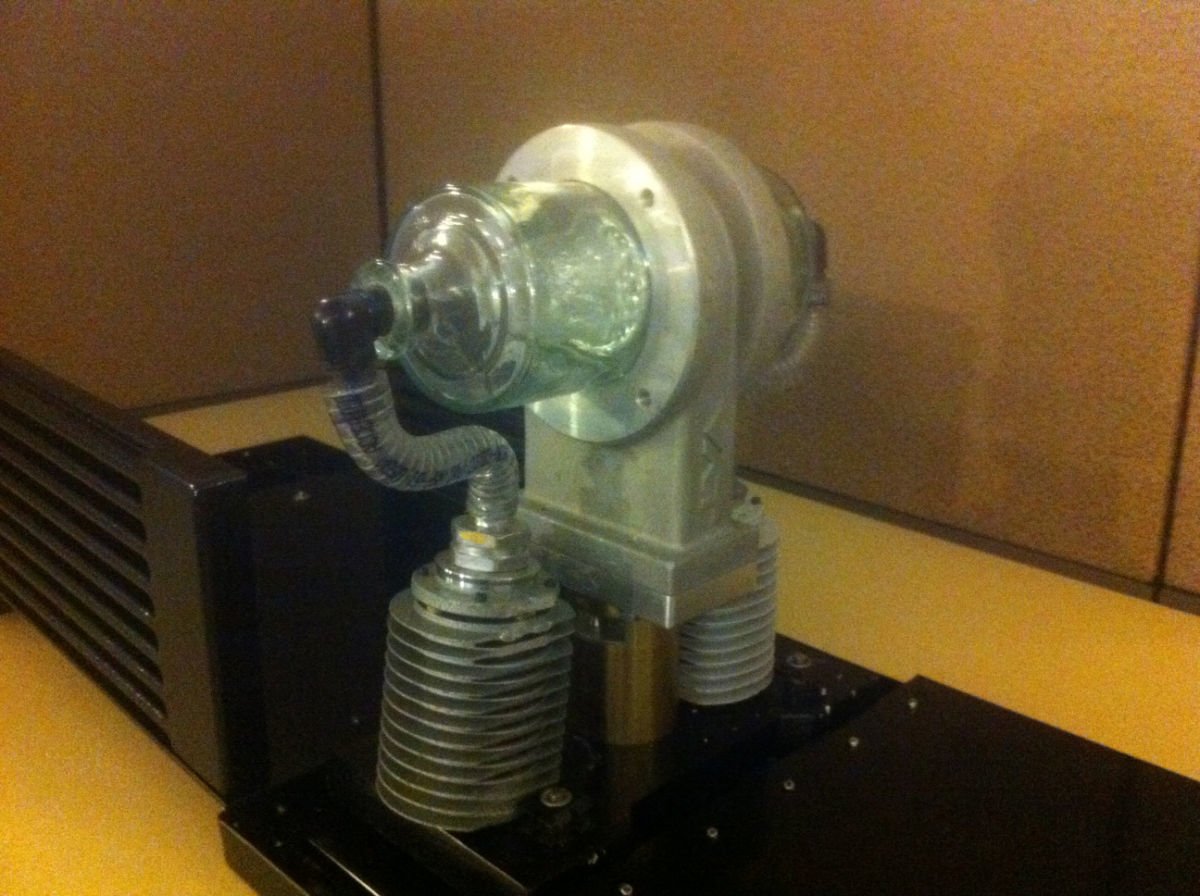
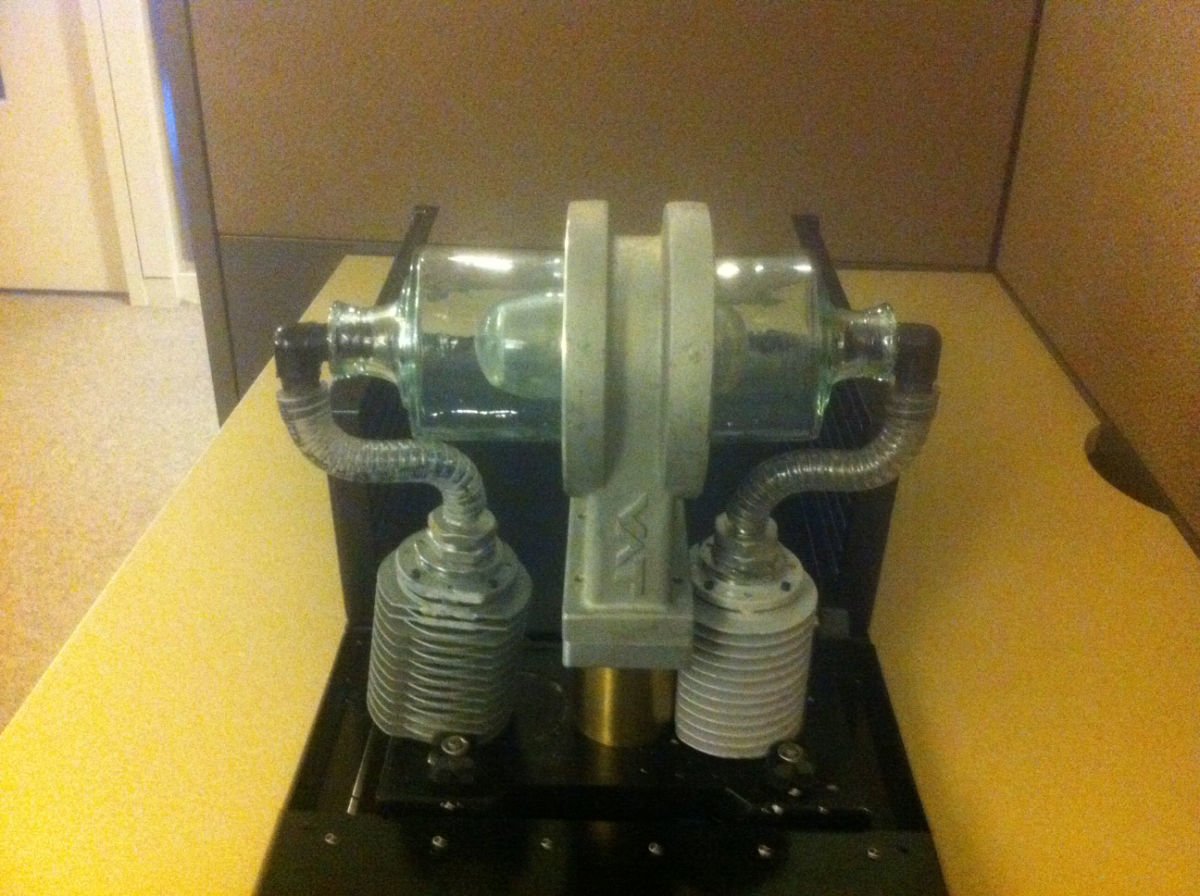
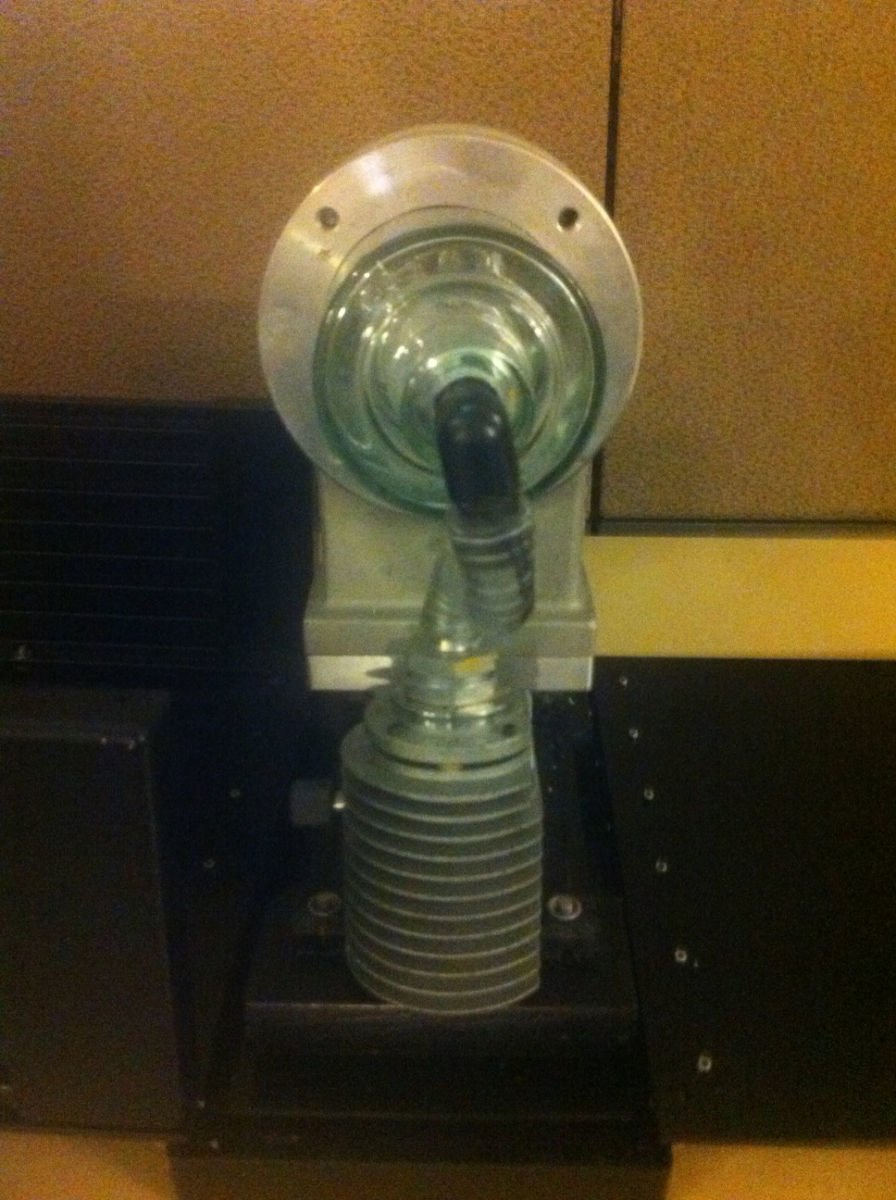
A recent FedEx TV commercial called Test Shipment aired on the Golf Channel and featured a glowing blue cold fusion device that would test the integrity of transport before sending the real treasure of golf clubs.
Thanks to BBDO New York for sharing these photos of the device that was designed and built by Station Film.
In Understanding Media: Extensions of Man, McLuhan wrote:
“Ideally, advertising aims at the goal of a programmed harmony among all human impulses and aspirations and endeavors. Using handicraft methods, it stretches out toward the ultimate electronic goal of a collective consciousness.
When all production and all consumption are brought into a pre-established harmony with all desire and all effort, then advertising will have liquidated itself by its own success” [pg 202]
Cold fusion has seeped out into the commons, soon to be as familiar as Coca Cola. Two decades of labor without positive recognition will be just a memory when The Product materializes from the marketplace, and high-density ultra-clean energy from the hydrogen in water spawns a merchandise line that Billy Mays could only dream of.
Cold Fusion Now!
“Ads are the cave art of the twentieth century.” –Marshall McLuhan
Paleolithic Caver Art Main Chamber at Lascaux, France dated 15,000BCE-9000BCE
Related Links
FedEx flies cold fusion device by Ruby Carat August 31, 2011
TV show “Fringe” Features “Cold Fusion” in Opening Title Sequence by Eli Elliott February 25, 2011
Understanding Media: Extensions of Man by Marshall McLuhan from Wikipedia
A new book called Secrets of E-Cat by Mario Menichella, has just been released in English.
Trained as a physicist, Mr. Menichella writes on science topics and has several published books with titles such as “Interstellar Travel” and “Future Worlds“. He worked as a press officer at the headquarters of Italy’s Instituto Nazionale di Fisica Nucleare (INFN) and was an organizer of the conference Has cold fusion become a reality? held in Viareggio, Italy this past July.
Mario MenichellaIn the book’s Preface, free to download here, Mr. Menichella recalls how as a child he was attracted to
“an “eighth-century” physics – a kind of physics that allows you to make an important discovery in a one-room laboratory while spending only a little money – exactly the opposite of today’s physics, which requires research machines that are increasingly large and expensive, and have to be run by ever-larger teams of scientists.”
He contrasts the increased complexity of scientific experiments over the last millenia with the relatively simple components of Andrea A. Rossi’s Energy Catalyzer; his book is, in part, intended as an aid to the curious and capable in their attempts to re-construct the revolutionary energy-producing device. Chapters like How Is An E-Cat Made? and Discovering The Setup are a compilation of the publicly known information organized as an orderly reference, while Towards A Possible Theory surveys the ideas that have been offered as an explanation of the phenomen.
Ever wonder what the special ingredient that makes the E-Cat have such a high thermal energy ratio is?
You have only to turn to Chapter 5 The Secret Catalyst for Mr. Menichella’s input.
Sergio Focardi, a physicist whose long-time research in nickel-hydrogen systems makes him one of a handful of experts in this technology, was interviewed by by Mr. Menichella during the conference in Viareggio. You can watch a video of that interview in Italian here.Sergio Focardi interviewed by Mario Menichella in Viareggio, Italy July 2011
It’s not easy to keep track of all the E-Cat clues. Message board posts, emails, and YouTubes are constantly updating the cloud with freshly revised data. Maybe “the book arrives too late”, but this early effort at summarizing what is known about the Energy Catalyzer is sure to be one of many undertakings that attempt to document this revolutionary energy technology in book form, and Mr. Menichella’s background makes him ideal to detail this process, as well as the figures leading it forward.
And as this technology matures from Mystery Science to Household Appliance, we can look forward to many sequels.
Keith Owens of Cold Fusion Energy, Inc. asked the Department of Energy DoE what their “stand” on cold fusion was.
The response was a clear statement of their policy: cold fusion does not merit any attention:
From: Afzal, Shahida [mailto:Shahida.Af…@science.doe.gov] On Behalf Of Opdenaker, Albert
Sent: Monday, September 19, 2011 4:05 PM
To: ‘Ke…@cfeis.com’
Subject: Cold Fusion
Dear Mr. Owens:
This is in response to your e-mail message to Secretary Chu dated September 13, 2011 in which you asked to know where the Department of Energy stands on “cold fusion.”
In 1989, a review panel that had been charged by the Department concluded that reports of the experimental results of excess heat from calorimetric cells did not present convincing evidence that useful sources of energy will result from the phenomena attributed to “cold fusion.” To quote the panel, “Hence, we recommend against the establishment of special programs or research centers to develop cold fusion.”
In 2004, the Department organized a second review of the field and that review reached essentially the same conclusion as the 1989 review. The Department’s Office of Sciences does not provide any funding support for “cold fusion” research.
Al Opdenaker
Fusion Energy Sciences
Office of Science
US Department of Energy
301-903-4941
albert.opdena…@science.doe.gov
Recently, a second letter from Cold Fusion Now to the Department of Energy response saying “it is clear the topic of low energy nuclear reactions remains highly speculative and that the purported mechanism has not yet been validated by the physics community as a reality.”
Sigh.
It seems hopeless to solicit funding from this crew at the DOE with Under-secretary Koonin, a known cold fusion opponent.
“We are suffering from the incompetence or delusions of Fleischmann and Pons.”
—Current Under-secretary Steve Koonin quote from 1989
And it is interesting to note that the respondent here writes from the department’s Fusion Energy Science office, the hot fusion wing.
But these letters are not in vain. Writing a letter is a lesson in expressing a complicated issue in a one-page petition; collecting signatures is a fun time talking with the people on the streets; we learn more science, and made new pals along the way. Every action adds to the momentum of cold fusion as a clean energy reality. And we are on the verge of new technology that will change the world!
The Department of Energy will be the last in line for their device – and it’s going to be a long line.
Next up: the Energy committees in the House and Senate….
Supporting Links
Documentation of Department of Energy Review of Cold Fusion from LENR Library at www.lenr-canr.org.
Cold Fusion Energy, Inc.homepage Under Construction