
Patenting Cold Fusion Inventions before the US Patent & Trademark Office – Part 2

The following is Part 2 of a paper prepared By David J French in support of a Poster Presentation at ICCF-18, the 18th International Conference on Cold Fusion held in Columbia, Missouri over July 21 – 27, 2013. Part 1 is available at ColdFusionNow here. Part 2 now follows.

Patenting Cold Fusion Inventions before the US Patent and Trademark Office

. Part 2

Treatment of Cold Fusion Inventions before the USPTO

With the USPTO receiving over one half million applications a year, Examiners do not customarily require applicants to file proof that their alleged invention will work as represented. However, the USPTO has classified Cold Fusion and LENR technology in the same category as “perpetual motion”, anti-gravity, time travel, universal Cancer cures and guaranteed cures for baldness. These are considered to be cases where there is doubt that the alleged invention will work. In these fields Examiners are expected to require applicants to demonstrate that the alleged invention actually works. To impose this requirement the Examiner must establish a basis for a legitimate doubt in a communication to the applicant before requiring the applicant to provide proof of operability. Unfortunately, Examiners faced with Cold Fusion applications have in many instances used excessively negative and inflammatory language regarding the history of Cold Fusion science in attempting to place such a doubt on record.

Persons filing patent applications in this field have to be prepared to face a prove-it-works requirement. They do not have to prove that Cold Fusion works per se; they only have to prove that what they represent in their application is true. The disclosure accompanying their patent application must be sufficient to enable ordinary but knowledgeable workers in the field to reproduce what is promised in the patent application. This is not an area where a patent can be obtained on the basis of a prediction or prophetic insight.

Responding to a Prove-it Challenge

The best procedure to follow in answering such a requirement from a US Examiner is to place the original patent disclosure in the hands of an independent agency that will follow the instructions in that document and report-back, hopefully, that they obtained the results as predicted in the patent filing. Such evidence may not rely on after-developed understandings or procedures but must be based on the original document as filed, together with publicly available knowledge existing as of that date.

Relevant message: Make sure your Disclosure is complete when you make your formal patent filing. Be sure the invention works. Don’t promise too much. You may have to prove it!

Example that failed

James H Cook, a retired 80 year old engineer residing in Simi-Valley, California filed an application on August 19, 2009 before the US Patent Office for an invention entitled: “Energy Generation by Nuclear Acoustic Resonance”
This application became abandoned on March 9, 2013 for failure to respond to the US Patent Office Examiner’s first office action of September 9, 2012. Before addressing the reasons for the abandonment the nature of the invention and the filing will be explored. Here is an extract from the Abstract:

“(This invention) solves the problems of reliably initiating a low energy fusion reaction by loading deuterium into palladium metal via the process of electrolysis and by initiating the fusion reaction via the application of nuclear acoustic resonance. Affixed on each side of an electrolysis cell are piezoelectric transducers driven by corresponding frequency synthesizers. Surrounding the cell is a magnetic field produced by a magnetic field generator. The application of nuclear acoustic resonance, i.e. the combined application of an alternating magnetic field and of high frequency acoustic waves causes the deuterium atoms resident in the closely packed palladium metallic lattice to fuse into helium atoms with the consequent release of energy that is inherent to the fusion process.”

This is an example of a Prophetic invention: it is based on a prediction that something will happen rather than on actual tests. No data was given reporting test results. Instead the disclosure stated that this idea arose when the inventor heard about a reported melt-down in a Fleischman and Pons’s original pre-1989 experiment. He surmised that this was due to:

• “a low-level alternating magnetic field in the vicinity of the experiment caused by a transformer (presumably 60 Hz.) on the opposite side of the wall against which the fume hood containing the experiment was mounted”
• “An unrelated experiment in another part of the room was generating ultrasonic acoustic waves in the Megahertz range. It is believed that two frequencies, differing only slightly from each other, are necessary. (See the article, The Truth About DNA, subheading “A past experiment that was incomplete,” published on the Internet at www.kryon.com/k chanelDNA04.html.)”
• “This application of high frequency acoustic waves causes the hydrogen atoms packed within the crystal lattice of the palladium cathode to undergo spin transitions. Upon reaching the Larmor frequency of the hydrogen atoms and achieving resonance, transitions between spin energy levels are generated. This produces a resonance scan. (See Inventor’s Theory of Operation, infra.) It is believed that for reliable initiation of the low energy fusion reaction, the first and second acoustic wave generators (17, 21) must operate at different frequencies. The specific frequencies required remain to be determined by experimentation.”
Note the frank statement that the “specific frequencies required remain to be determined by experimentation”. This was fatal.

The Examiner’s objections

Here is what the Examiner said about this application:

• “…..this “ColdFusion concept is still no more than just an unproven concept or theory.”
• “The general consensus by those skilled in the art and working at these various laboratories is that the fusion conclusion made by Fleischman and Pons was based on experimental error”
• “The general consensus by those skilled in the art is that there is no reputable evidence to support the claims of excess heat production, or the production of fusion by-products such as neutrons, gamma rays, tritium, or helium.”
• (this is) “a field that the general scientific community considers fraudulent.”
• “Since Fleischman and Pons’ 1989 announcement, there has been a continuing stream of publications demonstrating that virtually none of the ’Cold Fusion’ claims are valid.”

The Examiner summed up by reciting that he had provided a reasonable and sufficient basis for challenging the adequacy of the disclosure, concluding that the specification failed to meet the requirements of the Patent Act in terms of enabling workmen to implement the invention as promised.

The Applicant`s dilemma

The requirements for sufficient disclosure allow that it is OK to impose some modest degree of experimentation on future workmen if such experimentation will inevitably produce the right answer without undue effort on the part of an ordinary workman. However in this case, the existence of the specific frequencies that make the invention work is critical: the admission that such parameters remain to be established placed this invention in the category of an “unfinished work”. As well as imposing a prove-it requirement the Examiner rejected this filing for having an insufficient disclosure.

The applicant was given an opportunity to reply. He then decided to abandon his application. Ironically he might have been right. But his application did not meet the required standards and it could not be amended
An inventor can make an invention based upon a prediction, but

• the prediction has to be true
• the prediction has to be supported by instructions on how the benefits of the invention can be delivered reliably by others, once the patent comes to an end.
• Patents do not, however, issue for proposals which are, essentially, a suggestion that others pursue a specific line of research.

Relevance of Examiner`s condemnation of Fleischmann & Pons

The Examiner`s comments regarding Fleischmann & Pons are not relevant in the sense of requiring a response. The Examiner’s criticisms were only presented to justify his requirement that the applicant prove that the invention as described works and that the description of how to make it work was sufficient.
Filing evidence that the invention really works and that the disclosure is enabling would have resulted in an Allowance (so long as the Claims were worded to avoid the Prior Art). Unfortunately the disclosure was irreparably inadequate: it failed to teach the special acoustic frequencies that would initiate the Cold Fusion effect.

Conclusion

It’s very easy to obtain a US patent for Cold Fusion. Just file an application:

For a useful idea that works,

that includes a description on how to make it happen, and which

specifies a feature that is new (done in one or more “claims”).

Easily said, but challenging to fully understand.

David French is a retired patent attorney and the principal and CEO of Second Counsel Services. Second Counsel provides guidance for companies that wish to improve their management of Intellectual Property. For more information visit: www.SecondCounsel.com.

Patenting Cold Fusion Inventions before the US Patent & Trademark Office – Part 1

The following is a paper prepared by David J French in support of a Poster Presentation at ICCF-18, the 18th International Conference on Cold Fusion held in Columbia, Missouri over July 21 – 27, 2013. The paper as reproduced on ColdFusionNow is divided into two parts. Part 2 is available here. Part 1 now follows.

Patenting Cold Fusion Inventions before the US Patent and Trademark Office – USPTO

Part 1

This paper is about the challenge of obtaining a patent before the United States Patent and Trademark Office – USPTO. The USPTO has developed a reputation for refusing applications directed to “Cold Fusion” technology. There is a general belief amongst the Cold Fusion community that some staff members at the USPTO have been hostile to granting patents in this field. In fact, the experience of almost every applicant in this field is that Examiners have a strong prejudice against granting patents for Cold Fusion inventions.

However I had some personal exchanges with the USPTO in the fall of 2012 that ended with a declaration that the USPTO will issue properly drafted patents which are directed to new technology in the field of Cold Fusion/generation-of-unexplained-excess-energy if accompanied by a proper disclosure and a demonstration that the asserted procedures will work as represented. The communication from the USPTO stated:

“As you noted in the email, Cold Fusion or Low Energy Nuclear Reactions (LENR) is the subject of intense study and interest of many. Clearly, further investigation into this area could be useful and will hopefully one day will provide a major source of energy.

“You note that the USPTO can require patent applicants to provide evidence that the invention works and that the disclosure is sufficient to enable others to make and or use the invention. The United States Code requires as much, and defines the requirements for patentability in 35 U.S.C sections 101, 102, 103 and 112. Particularly, the enablement requirement, which refers to the requirement of 35 U.S.C. 112, first paragraph that states the specification, must describe how to make and how to use the invention. The invention that is defined by the claim(s) of the particular application is the invention that one skilled in the art must be enabled to make and or use. (See MPEP 2164) This is the requirement of law in order to obtain a valid patent. These requirements are applied to all inventions whether they are ground breaking technology or incremental improvements.

“We also thank you for your suggestion to have a message that “The USPTO is open for business in the field of Cold Fusion for properly prepared patent filings” before the Cold Fusion revolution arrives. This is already the case. Any non-provisional application, including those in the area of Cold Fusion, is eligible for patenting also long as it meets the requirements of 35 U.S.C. Sections 101, 102, 103 and 112.” [end quote]

The basic requirements for the granting of a patent as referenced are that an application must address:

1. Proper subject matter for patenting,
2. A technology that works in the sense of being useful for humanity in some way,
3. A disclosure that will enable knowledgeable but uninventive workers to reproduce the invention, and
4. A stipulation (in the form of one or more Claims) as to what will be controlled by the exclusive rights to be granted, rights that must apply only to things that are new.

Many patent attorneys add a further requirement namely that the patent must be directed to something which is inventive, or in the terms of the statute, a feature that is “not obvious”. Non-obviousness is judged in view of what has been known previously. I like to include that requirement as really being a sub-characteristic of being “new”.

New US Law from March 16, 2013

As from March 16, 2013 the requirement for being “new” under US patent law is that the thing being patented must not have been “previously available to the public”. This means previously available anywhere in the World, at any time, in any manner whatsoever. The United States has finally joined Europe and the rest of the world in defining patent entitlement in this manner. If you think about these words, you will probably agree that this means that your invention must be “pristine on the planet Earth”! Never having been made available to the public anywhere not only requires that your applied technology be new, but it also must not be obvious in view of what was previously known. That is how inventive character or non-obviousness can be included under this new definition and requirement for patent novelty.

Patent novelty item 4 above, is a big issue. It cannot be addressed in this paper. But the remaining numbered items are relevant to “cold fusion” inventions and will now be addressed.

Subject matter for patenting – Science vs Technology

Patents are about technology rather than scientific discovery. In Europe under the European Patent Convention (EPC Article 52) and under the international Patent Cooperation Treaty – PCT inventions must be “susceptible of industrial application” in order to be patentable. This expression is further defined in EPC Article 57 which provides: “An invention shall be considered as susceptible of industrial application if it can be made or used in any kind of industry, including agriculture.” This emphasizes that patents are not about theories. Patents are about technology. The difference between science and technology is that science delivers understanding – from the Latin scienter, “to know”, and technology delivers something that is useful for human beings. Often, technology is the application of science.

In the past, it has been thought in the United States that there must be something tangible or mechanical about an invention. However, the US definition for something which is patentable, called “patentable subject matter” is: “any new and useful process, machine, manufacture, or composition of matter, or any new and useful improvement”(35USC101). In the last 20 years we have seen an explosion of patents in the world of business activities and relating to human behavior in general. These patents have issued on the premise that inventions in these fields can be characterized as “processes”, now often called “methods”. The argument is still ongoing as to whether this opening-up of patenting to non-tangible arrangements that focus on human behavior, eg “business methods”, fits within the patentability requirements of the US statute. But for purposes of the Cold Fusion community, patenting has to focus on a technical, that is a mechanical or chemical, arrangement or procedure that is useful and reproducible.

The next two issues address why Cold Fusion patents have been encountering serious difficulties at the USPTO.

Utility and Disclosure Requirements

For an invention to be useful, it must “work”. This means that it has to deliver a useful result.

Not only does the invention have to work but the application has to describe how others can build something useful that works. The written document accompanying a patent filing must include a description that will “enable” competent workmen, after the patent expires, to carry out the instructions and obtain the promised useful result. The disclosure must “enable” others to obtain the benefits of the invention. The disclosure must provide a “recipe” that is complete.

If the instructions are inadequate, then a patent application will be refused. If the patent slips through it can still be canceled before a Court on the grounds that it should not have been issued in the first place.

You must write the Specification so that your invention may be practiced by a Person Having Ordinary Skill in the Art (POSITA) without undue experimentation. This individual is assumed to be knowledgeable, but he/she is not inventive. If the invention either intrinsically does not work, or the instructions to create it are inadequate, then a patent application will be refused.

What are the lessons to be learned from these points? One lesson is that it is a false triumph to slip something past the Patent Office. Any oversights of an Examiner can be addressed by a Court. The test of litigation is a very hot furnace. Only the sturdiest steel can take the heat. So you want to obtain your patent on a legitimate basis and do it right at the very beginning. Consequently, if you assert that you have a method for delivering unexplained excess heat based on what you believe to be a “Cold Fusion effect”, you must be absolutely certain that you are achieving this result. Furthermore, you have to provide a description that will reliably allow others to achieve the same result.

Warning: there is a deadline to get the “story” right in the Disclosure. Once a final patent application has been filed, the “story” contained in the disclosure cannot be changed. You can change your claims as long as they are restricted to things already described in the original filing. But you cannot make changes to the text in order to upgrade your description, your “recipe”, for making the invention work.

Reproducibility

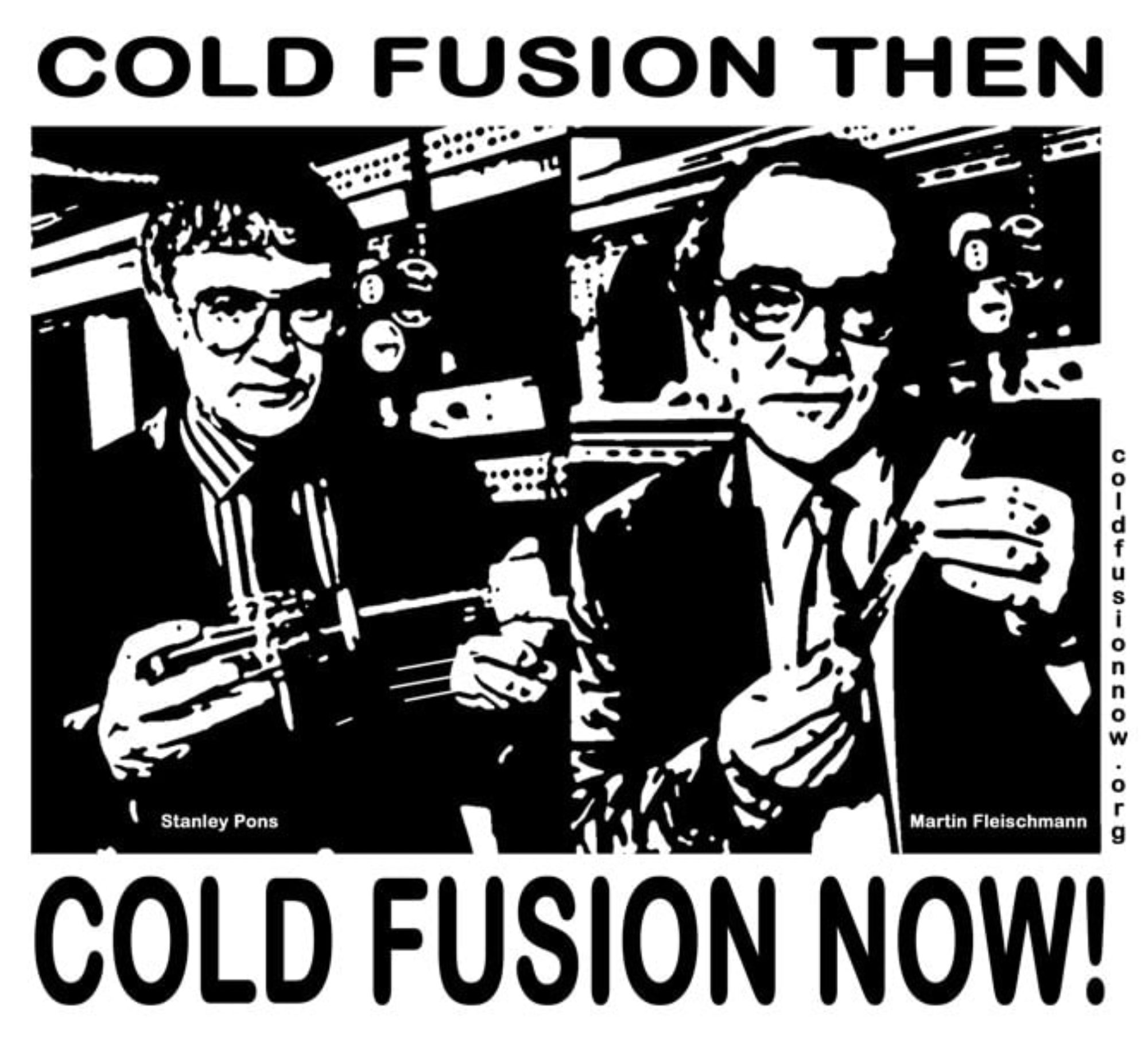
The history of ColdFusion is shot through with examples of intermittent replication right from the very beginning, starting with Fleischmann & Pons. I am not focusing on the failure of various illustrious institutions to duplicate the Fleischmann and Pons test results. Martin Fleischmann and Stanley Pons had trouble duplicating their experimental demonstrations themselves. James Patterson in the 1990’s until his death in 2008 represented that he produced remarkable results from plastic, glass or ceramic micro-spheres coated with various layers of hydrogen-saturated metal, including both nickel and palladium. That was with his first batch of spheres. But when he subsequently prepared further batches he did not get the results he got before. Patterson obtained patents anyway, several in the US including No US 5,607,563 entitled “System for Electrolysis” issued on March 4, 1997, now expired. Other Patterson patents can be located through the hyperlinks in this reference. But these were never tested in Court. Shaky results have arisen in laboratory results around the world over the last 23 years. They are still happening today. This is part of the part of the mystery of this science. How does this affect patenting?

It is pretty clear that the USPTO should not be issuing patents for things that do not work. A little thought is required as to whether they should issue patents for things that work only some of the time. There are many technologies that might fall into this latter category. When you strike a flint on a bar of iron to create a spark and start a fire, it does not work with every blow. But the invention is profoundly useful. Similarly, in the field of pharmaceuticals medicines may exist that only work some of the time, but are well worth administering when there are no other alternatives and there is a real prospect that they may work in an individual case. Vaccines fall into this category.

On the other hand, I would not consider a heart valve to be useful if it has any substantial incidence of failure once installed in a patient. I am referring to failure due to a design fault such as accumulating scar tissue. Still, patents have issued for mechanical hearts that have kept Patients alive for only a limited period of time. In truth, the utility of an invention covered by a patent is highly dependent upon the representations made in the patent disclosure document as to what the invention will achieve.

This is leads to a big message. The utility requirement under patent law does not require that an invention be better or superior. It does not require that it deliver high-value. Anything that is “useful” to some degree will pass the utility requirement. But if an inventor extols the benefits of their invention, they are creating potentially serious problems for the validity of their patent. If you represent that your invention delivers a certain result claiming exclusive rights in such an outcome, and it does not indeed deliver that result, then such claims might possibly be invalidated for failing to meet the utility standard. At a minimum such defaults will be emphasized before a jury. You set the standard yourself in claiming rights over something that you say you can deliver. The conclusion is: Do not try to claim rights in more than your invention will deliver! In fact, as a general policy it is preferable to avoid making any more representations than the minimum needed to obtain a patent grant.

The utility requirement for an invention is met if you simply state an instance where it can be used to produce a useful result of even modest value. Do that, but go no further.

Example of Success

It is time for an example. Assume you have an experimental setup that produces unexplained excess heat. Rather than representing the technology as a solution to mankind’s energy requirements, it is sufficient to describe your invention as an assembly of hardware which demonstrates how excess heat can be produced from an artful combination of Palladium and deuterium. Just because you have described your invention as a demonstration apparatus does not mean that your patent claims cannot cover the use of the same apparatus to supply heat for your house indefinitely in the winter or heat for your air-conditioning system indefinitely in the summer, so long as the same principles are being used in the scaled-up system. But do not promise house heating and air-conditioning unless you also disclose how to build what is needed to do the job.

Here is an example of a successful patent granted on an invention for which Melvin Miles was a co-inventor:

United States Patent 7,381,368 issued June 3, 2008

Title: Palladium-boron alloys and methods for making and using such alloys

Inventors: Miles; Melvin H. (Ridgecrest, CA), Imam; M. Ashraf (Great Falls, VA)

Assignee: The United States of America as represented by the Secretary of the Navy (Washington, DC)

And here are the key claims:

Claims:

1. An alloy comprising palladium and boron;

wherein at room temperature the alloy has a two-phase structure, comprising crystallites of a first phase and crystallites of a second phase;

wherein both the first phase and the second phase are solid solutions of palladium and boron;

wherein the crystallites of the first phase and the crystallites of the second phase are free of hydrogen;

wherein the first phase and the second phase have the same crystal structure;

wherein the first phase and the second phase have different lattice parameters;

wherein the alloy is free of palladium-boron intermetallic compounds; and

wherein the alloy is free of hydride compounds.

11. The alloy of claim 1, wherein said alloy is in the form of a membrane.

12. A method of hydrogen purification comprising the steps of: providing the membrane of claim 11, providing a gaseous sample comprising hydrogen on one side of the membrane, providing a vacuum on the other side of the membrane, and allowing the hydrogen to pass through the membrane.

13. The alloy of claim 1, wherein said alloy is in the form of an electrode.

14. A method of generating energy comprising the steps of: providing the electrode of claim 13, connecting the electrode to a cathode, immersing the electrode and the cathode in water containing deuterium, and applying a current to the electrode and the cathode.

Based on the above claims, anybody who has possession of the alloy described by claim 1 and uses it for any industrial purpose will violate the claim. There are multiple uses for this alloy. Claim 12 addresses using the alloy as a hydrogen-pass filter to permit hydrogen to enter a vacuum. Claim 14 addresses a clear example of generating energy by carrying out a Fleischmann & Pons type of procedure.

Note that there is no theory of operation included in the claims. If fact there is no theory of operation included in the patent. Why would you want to include theory that might not be right? And including the theory in the claims creates a terrible problem: to enforce the claim you would have to prove that the process being carried-out by an infringer complies with the theory. These are good crisp claims, directed to what they should be: a description of assembled hardware or processes for manipulating tangible substances. If you have described something that works, you do not have to explain why.

How did this application get through?

In the course of the prosecution of this application the Examiner never challenged the application on the basis that it is addresses a Cold Fusion invention. This may be for several reasons. One reason may be that the Examiner was working in an art where he was not accustomed to receiving Cold Fusion inventions. A further possibility is that the application focused on other uses for the alloy, mentioning the generation of energy as a collateral utility. In the case of a new compound, if it has an acceptable utility, the fact that the inventor believes it might also be the useful for other purposes, e.g. cold fusion, is not a bar to patentability. Once you patent an article or compound for one purpose, an article or compound that is new, then you are entitled to control its circulation in commerce no matter how it is used. A further possible reason for the easy treatment of this application is that it was filed on behalf of the Department of the Navy. And the last possible reason is that the application was generally well drafted, without making any extravagant claims or assertions of extraordinary benefits. This last possibility is to be contrasted with how many other applications directed to Cold Fusion innovations are drafted by attorneys, with the cooperation of or under pressure from the inventors.

This ends Part 1 of a paper prepared in support of a Poster Presentation at ICCF-18, the 18th International Conference on Cold Fusion held in Columbia, Missouri over July 21 – 27, 2013. Part 2 follow as a subsequent posting on ColdFusionNow.org here.

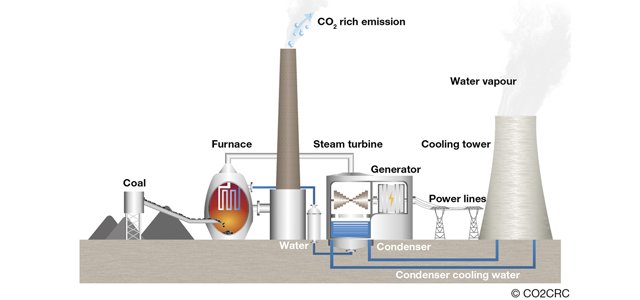
How could cold fusion reactors replace coal-fired steam power plants?

Graphic: copyright CO2CRC

Because the grade of heat generated [and recoverable] from the cold fusion processes [as of now] is modest in relation to furnace temperatures of conventional power plant [ which are in the range of 2500- 3500 deg.F (1400C-1900C)], it is not obvious to me how the existing furnace/ boiler plant can be efficiently utilized for the cold fusion processes.

However, if the CF energy cell is used directly to generate saturated steam at pressures in the range of 500-3000 psig. (pounds per square inch gauge) where boiling temperatures would be in the range of 470-700 deg.F (240C-370C) [respectively for the pressure range] and then, a separate CF energy cell is used to directly superheat that steam to 750 deg.F (400C) for a 500 psig. and to say 1000 deg.F (540C) for the 3000 psig. boiler, then that superheated steam [for what ever steam pressure system is used] could be routed to an existing steam turbine plant [with the return treated and de-aerated condensate returned as feed to the new CF fired boiler.

In summary, the existing fossil-fired boiler plant [including all fuel/ combustion air/ furnace/boiler/ash systems/flue gas systems, are all deactivated and preferably removed, and the new cold fusion powered boiler together with the cold fusion powered superheater would be integrated into the existing steam turbine generating plant [including the steam condensing plant and, of course, a modified control room].

This whole project would certainly drastically reduce emmissions to zero, but would be very costly, I suspect, because of labour costs of dismantling the majority of the power station.

It may be a better option to build new power station using the new CF boiler and superheater plant with a custom designed and compact steam turbine/ generator plant in a small modern compact building.

With the most appropriate and efficient small 25MW cold fusion powered station I would suggest the following :

Boiler outlet conditions : 500 psig. sat. steam [at 470 deg. F (240C)]
Superheater outlet conditions : 470 psig. steam at 750 deg. F (400C)
Steam Turbine outlet conditions [to steam condenser] : 1 psia. @ 10% wetness.

The practical steamrate for generating electrical power with this relatively simple, small and compact station is about 9 lbs/ kwhour so the total steamrate from the small boilers serving a single multi-stage steam turbine/generator system which exhausts to a steam condenser is 225,000 lbs/hour.

Scientists would decide how much steam capacity each boiler/superheater combo would have and that would determine how many units would be required to meet the total steam demand.

Note: The use of steam for electric power generation [via boiler and steam turbine as presently done] is really 20th. century technology and all forms of cold and hot fusion should seek to find DIRECT electrical generation processes that harness ion transfer in conjunction with an external excitation field.

The use of steam at high pressure as an electrolyte, may however make use of an abundant commodity that facilitates extreme process efficiency, and this applies to the pressurized CIHT unit where high pressure steam is extremely efficient as an electrical conductor [the electrolyte] permeating the catalyst fill [consisting of back to back catalyst discs] through micro gaps in the catalyst structure. Further the basis of direct electric power is when a stream of ions or electrons flowing and driven by an existing voltage potential, will interact with an external excitation field thus creating export electric power.

Addendum:

This proposed and detailed [perhaps speculative] bold upgrade to the original BLP – CIHT unit could be a blockbuster in that a compact direct energy CIHT based system, offered in a wide range of sizes and used in multi-module applications for the power generation industry, but more importantly, for the shipping industries [from private and recreational craft to commercial shipping and naval shipping including surface vessels and submarines].

This conceptual unit [or units] could be installed in the ships engine room and bypass the existing electric generating plant with out the costly removal of that plant [or in the case of nuclear powered vessels deactivate and bypass the entire systems of the existing reactor compartment].

See details on The PRESSURIZED CIHT Unit [.pdf]

Open Power Association Newsletter #12: 400+ parameter tests and a model

The Open Power Association at Hydrobetatron.org published Newsletter #12. The original newsletter N 012_Luglio_2014_Ottimizzato in Italian is here.

Excerpts below are google-translated to English, then, in some cases, slightly smoothed out.

********************************************
Dear Friends, there is much news this month!

open-power1
It is a matter of pride for us, as well as honor, be able to announce that Our Scientific Director Ugo Abundo has been officially invited as a speaker at: “First International Workshop on on Nuclear Syntheses Without Harmful Radiations”
Organizers: A. Bhalekar (India), C. Rope (Italy), and T. Vougiouklis (Greece)
http://www.santilli-foundation.org/ICNF-ECNAAM-2014.php

Session 110 of the ICNAAM meetings in Rhodes, Greece, September 22 to 26, 2014
http://www.icnaam.org/sessions_minisymposia.htm
TITLE: An Intrinsically Irreversible, Neural-network-like Approach to the Schrödinger Equation and some Results of Application to Drive Nuclear Synthesis Research Work

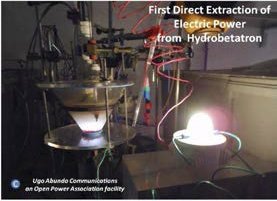
Direct-Extraction-Electricity2
010 NEW REPORT: Open Power Association Main aspects in the modeling of an electrolytic cell: effect of parametricoinvolti.

Study of Anomalies [.pdf]
Theoretical Analysis: Prof. Michele Di Lecce
Experimental Campaign: Prof. Ugo Abundo

It is also experimental evidence for the presence of anomalies that existing partial models do not wholly explain, first of all the “negative resistance” that many cite as a condition for the possibility of direct extraction of electrical energy from the natural oscillations of the plasma.

This report also analyzes the main aspects of the behavior of an electrolytic cell, in order to gain a following consistent pattern that frames the role of the parameters involved, and operational status, the complexity of the response to the operating conditions.

The data of the experimental campaign (more than 400 structured tests) conducted by varying the interelectrode voltages, the exposed electrode surfaces, the interelectrode distance, the temperature, the concentration of electrolyte, reading the resulting intensity of the circulating current and detecting any scintillations to the cathode and electromagnetic waves (frequency and intensity) show different anti-intuitive aspects.

It will be the task of a subsequent report grant the concomitant phenomena, and often antagonists, in order to obtain a model of the mechanisms, with some parameters to be estimated by means of ad-hoc tests, usable as a forecasting tool for the design and operation of equipment for plasma electrolytic.

To a classical scheme of the electrolytic cell and its power supply system, is added, in parallel to the electrodes, a series RC circuit with the load (lamp), to which the alternating voltage is monitored extremes generated, which turns on the lamp.
Full report: http://www.hydrobetatron.org/files/REPORT-n.-10_Ottimizzato.pdf

3
We are pleased to announce that by unanimous decision the Executive Our Association “Open Power” resolved to ‘inclusion as Honorary Member of: Prof. Walter A.N. Valeri “For scientific merit and Scholars”

MFMP-nominated-Nobel-Peace-Title

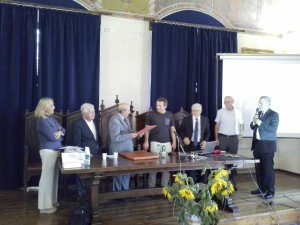
MFMP-NOBEL-PEACE-NOMINATION4 In the scope of the conference “Innovation and Research” held in Assisi June 28 last was the official candidate of the MFMP (Martin Fleischmann Memorial Project) and Francesco Celani for the Nobel Peace Prize.

“Innovation Research Conference on the trails of Matter and Spirit,” Gen. Murace delivery to Bob Greenyer, Francesco Celani and Ubaldo Mastromatteo for Live Open Science for Peace.
video: http://www.francescocelanienergy.org/

5
ALWAYS PRESENT! Interviews with major initiators of cold fusion in Italy:
Profs. Giuliano Preparata, Emilio Del Gudice and other researchers with limited funds braving the hostility of the official academic culture and started the first fundamental studies that have contributed to the present results. The interviews were extracted from a RAI program: Format of a few years ago.
VIDEO: http://www.youtube.com/watch?v=0_sHXk2ixbc

Brown6
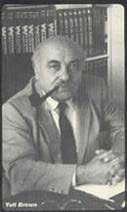
WE ARE PLEASED TO ANNOUNCE ALSO THE MANAGEMENT OF OPEN POWER HAS RESOLVED THE ‘START OF A TRIAL ON THE BROWN GAS

Segnialimo ‘s article by Luciano Saporito on Brown’s Gas: Yull Brown (an Energy for the Future)
Full article: http://www.hydrobetatron.org/files/GAS-DI-BROWN_Articolo.pdf


gravity7
ARTICLES PUBLISHED IN THE SECTION OF HYDROBETATRON.ORG
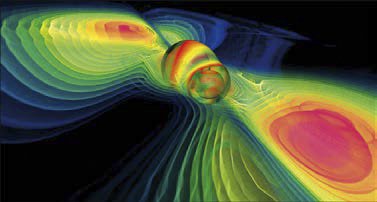
PROF. CHRISTIAN ROPE ON GRAVITATIONAL WAVES “GRAVITATIONAL RADIATION OF FUND AS SNAPSHOT OF THE UNIVERSE PRIMORDIAL” Much has been made recently of the so-called gravitational waves, also because of the ‘”Antenna” for the detection of the same which is under construction in Cascina, near Pisa, the famous Project VIRGO …
Full article: http://www.hydrobetatron.org/files/ChristianCorda.pdf

8
“Turn Tesla patents car open-source” Elon Musk, we free the way for the creation
ARTICLE copleto: http://www.ansa.it/sito/notizie/tecnologia/hitech/2014/06/13/svolta-tesla-brevetti-auto-open-source_53a6368d-06f9-4db0-ac03-0b569dd6d28b.html

“Bicycles in the anti-aircraft bunker, when saved the life cycle”
The ancestors of our bike-generators come from the bunker of World War II, where pedaling meant to ensure the continuity of ventilation systems and ventilation
Full article: http://www.tzetze.it/2014/07/biciclette_nei_bunker_antiaerei_quando_pedalare_salvava_la_vita/

9
“Environmental Crimes 213 billion a year”
Did you know that the global environment-related crime in the name of profit goes over to any rules and rule on the enforcement of ecosystems has a turnover of about 213 billion dollars every year?
photo: unimondo.org
Full article: http://www.tzetze.it/2014/07/crimini_ambientali_per_213_miliardi_di_dollari_lanno/

New Law on Forests: Here comes the green light in the Lombardy Region for minorities and associations: “Easier to cut the woods»
Full article: http://milano.corriere.it/notizie/cronaca/14_luglio_09/nuova-legge-foreste-arriva-via-libera-regione-bda1f196-073f-11e4-99f4-bbf372cd3a67.shtml

10
“Greenhouse gas emissions: just 18% from the livestock sector”
The FAO report: “In his 2006 report ‘Livestock’s Long Shadow’, – true milestone on the subject – FAO had found that 18 per cent of all greenhouse gas emissions were caused by the livestock sector, taking into account the entire life cycle aggregate. The final report on greenhouse gas emissions will take the same approach, but using updated data and providing a disaggregated analysis of the different production systems, as well as indicating solutions for manufacturers, for the processing industry and for the political organs. ”
Full article:
http://www.lafucina.it/2014/07/09/emissioni-di-gas-serra-18-solo-da-settore-zootecnico/

“THE SECRET OF SHAME ALEMA” FEPES (Foundation for European Progressive Studies
2008 to present, the FEPS has received 16.7 million Euros!
Massimo D’Alema is committed to the FEPS, Foundation for European Progressive Studies. The former prime minister has been president since 2008.

And the public support for our Open Power Association, which is responsible for identifying energy “cheap, clean, inexhaustible”? ZERO EURO! How so?? This type of research study is unimportant? Or maybe we are not as good as those of the “FEPES”?!

“But all this confirms the mechanism of a double-track EU austerity for citizens and then payments to parties and foundations” … D ‘Alema help you …
Full article: http://www.tzetze.it/redazione/2014/06/il_vergognoso_segreto_di_dalema/index.html

11
DOES NOT SEEM REAL: “At the expense of our 70 nuclear warheads on the Italian territory”
According to a survey by L’Espresso, Italy is by far the country which holds the highest number of U.S. nuclear weapons.
Full article: http://www.tzetze.it/2014/07/a_spese_nostre_70_testate_nucleari_presenti_sul_territorio_italiano/

******************

See also:

Open Power Association Newsletter #11

Open Power Association Newsletter #10

Q&A with Ugo Abundo on forming the Open Power Association

Edmund Storms’ “The Explanation of LENR” provides “physical science based model”

Graphic: Artist rendition by Ruby Carat of Edmund Storms’ hydroton structure just before fusion.

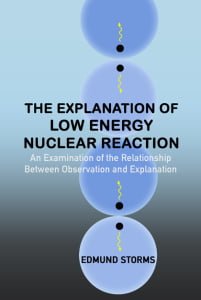
Front-cover-300ppi-420x626A new book by Edmund Storms reviews the top contenders for the scientific prize of the century, the theory of cold fusion, and analyzes the assumptions on which each different model rests with the critical glare of the scientific method.

The Explanation of Low Energy Nuclear Reaction: An Examination of the Relationship between Observation and Explanation published by Infinite Energy Press, juxtaposes today’s theories with the observed laboratory results, and applies the basic laws of physical nature and materials science to the metallic host of the reaction.

Unsatisfied that the current explanations of cold fusion do not address the wide variety of data, and require unsupportable assumptions, Dr. Storms then offers another idea – how to initiate the reaction, essentially describing the nuclear active environment (NAE), the set of necessary and sufficient conditions needed for the reaction to occur.

Where does the reaction occur?

This is a contentious issue, as researchers in the field still do not agree on where the reaction actually occurs. Storms believes it occurs outside the chemical structure of the host metallic lattice in tiny nano-cracks that trap hydrogen nuclei and electrons in an unusual configuration. When the hydroton resonates, a form of fusion occurs whereby the mass is transformed to heat energy in smaller portions, and photons are released along the axis of the column of hydrogen. Make the right-sized space, fill it with hydrogen, apply resonance, and the reaction will happen straightaway.

His recipe was constructed from the grass roots of science – lab measurements collected over twenty-five years by a global community. In those years, Storms has conducted multiple surveys of the field, as both a Los Alamos National Lab nuclear chemist, and an independent researcher, giving him a broad familiarity with the observations.

In the book’s Foreword, Dr. Michael McKubre (SRI) writes: “The opportunity to learn directly from the most knowledgeable person in arguably the most important emerging field, and to share his concise and well considered condensation of a difficult and scattered literature, are not the only or primary reasons to comprehend The Explanation of Low Energy Nuclear Reaction. Laid out clearly and gently in Chapter 5, ‘Description of an Explanation,’ is the first physical science based description of a potential explanation for cold fusion.”

Different model for every lab

While cold fusion has been an experimental fact for two-and-a-half decades, a generally accepted theory has eluded scientists, and it hasn’t helped that the laboratory phenomenon of cold fusion is in complete disagreement with conventional nuclear theory. That, and the ragged history of reproducibility (now ended), has revealed a completely new frontier in condensed matter nuclear science (CMNS): the apparent creation of fusion-sized heat and other transmutation elements in and around metallic solids like palladium and nickel, among other materials.

It means a source of ultra-clean energy, super dense and long-lasting, decentralized and off-grid. With a virtually limitless supply of fuel from hydrogen, it means a second chance for a green technological future for the planet. As all systems re-tool to accommodate the new energy technology, it means a new economy as well. The tiny reactors are now being engineered for consumer devices, yet the pace is slow.

Each lab with a working generator follows a different model of the reaction. JET Energy has the NANOR device, engineered by Dr. Mitchell Swartz in association with theorist Dr. Peter Hagelstein of the Massachusetts Institute of Technology. The Brillouin Hot Tube is based on engineer Robert Godes‘ Quantum Fusion Theorem. Andrea Rossi‘s E-Cat was developed with the thinking that nickel-to-copper transmutations as described by Sergio Focardi provided the powerful thermal output. In Japan, Technova, Inc is associated with theorist Dr. Akito Takahashi of Kobe University, and the list goes on.

All these models have gone through revisions as new ideas arrive. Still, none of the proposed explanations have fostered the winning coup of both control of the generator and a commercially-viable energy output. Only a complete theory will describe how to maximize the potential of this reaction and point to an optimally engineered technology.

Soliciting wider participation to find a solution

From the book’s website http://lenrexplained.com/:

The Explanation of Low Energy Nuclear Reaction: An Examination of the Relationship between Observation and Explanation attempts to bridge the gap between what is thought to be true and possible by conventional scientists and what is claimed by people advocating the reality of the cold fusion phenomenon.”

“Hopefully, the approach used in the book will help more people understand how cold fusion might function as a real phenomenon and will show how the phenomenon is now too important as a potential source of ideal clean energy for rejection to continue,” writes Storms.

Cold Fusion Now’s Ruby Carat helped to edit the book and rocked the cover with an artist’s representation of the hydroton.

IEPressLogo-200x57The 351-page book includes over 900 references to relevant literature and begins shipping today.

Order a copy of The Explanation of Low Energy Nuclear Reaction from Infinite Energy Press here.

Read an interview with author Edmund Storms conducted by Christy Frazier of Infinite Energy Magazine here.

Open Power Association Newsletter #11: New Office in London Opens

Newsletter #11 for the Open Power Association at Hydrobetatron.org has been released. A google-translate of selected excerpts follows.

The full issue in Italian is here.

Newsletter No. 011 – June 2014
**********************************
Dear Friends,
Also there are many news this month!

CONTENTS:
page. 2 “OPEN POWER” has opened an office in London
page. 3 “Survey of the occurrence of species of symbiotic algae subjected to weak electric stress (microvoltaggi)”
page. 4 “OPEN POWER” START OF AN EXPERIMENT ON ‘SYSTEM’ ROTOVERTER ”
page. 5 “Historic 25th Anniversary Meeting at MIT Cold Fusion”
page. 6 “Cold fusion: the E-cat greek has come to an end”
page. 7 we indicate the website: circolotodeschini.com
page. 8 Please note the website: centrolakhovsky.com
Page 9 Please note a wonderful website!
Page 10 There segnialimo’s website: “Foundation Homa”
Page 11 There segnialimo the website: “GasPiro”
Page 12 Please note with pleasure the Blog: Marco Giai-Levra
page. 15 “Energy Festival 2014”: interviews with protagonists
Page 16 “Unidentified Flying Objects Crashes in a small Village in China!”
Page 17 “Siam three small tubicin …”
Page 18 “Archeology, Anthropology, and interstellar communication”
Page 20 “The animals are born libei!” 1

1-View-from-London1
We are pleased to announce that Our Association “OPEN POWER” has opened an office in London with these references:

Ugo Abundo Communications, an Open Power facility
3rd Floor
207 Regent Street
London
W1B3HH

2-Puppies-cell2
“Detection of occurrence of species of symbiotic algae subjected to weak electric stress (microvoltaggi).”
Experiments conducted by researcher Quirino Puppies, a member of the Open Power.
The system under study is composed of three elements:
a) A cell containing biological substance, which acts similarly to a stack;
b) a system for the transmission of electrical signals;
c) a culture of algae, and in electrical connection with the system), by means of the system b).
TO READ THE FULL DOCUMENT:
http://www.hydrobetatron.org/files/Rilevazione-di-comparsa-di-speci-simbiontiche.pdf

 
3-Rotoverter3
THE MANAGEMENT OF OUR OPEN POWER ASSOCIATION BEGINNING OF AN EXPERIMENT: “ROTOVERTER”
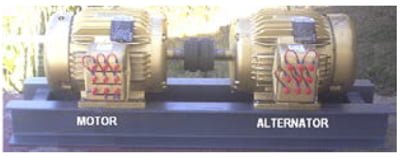
The device Rotoverter (RV) + Alternator is a device consisting of two identical three-phase electric motors connected to each other by a joint where the first (PM) serves as the main motor and the second from the alternator. It is a technology that modifies an electric motor making it capable of producing much more power, using less energy than normal.
In addition, modifications can be applied to “rotoverter generators,” in an attempt to obtain overunity …

4-Mitchell-Swartz-CF-LANR-MIT4
“Historic 25th Anniversary Meeting at MIT Cold Fusion” by Christy L. Frazier
Sincere appreciation is extended to the speakers for reviewing summaries of Their Work. Photos are courtesy of Ruby Carat at Cold Fusion Now.
TO READ THE FULL DOCUMENT:
http://www.hydrobetatron.org/files/MIT2014Colloq.pdf
 

5
“Cold fusion: the E-cat greek has come to an end”
Interview by Roberta De Carolis (NextMe) Franco Cappiello (Mose Ltd)
TO READ THE FULL INTERVIEW:
CLICK HERE

Final technical report on calorimetric measurements used in the demo Defkalion GT
Luke Gamberale – CTO Mose Ltd.
TO READ THE FULL REPORT:
http://www.hydrobetatron.org/files/DGT-faulty-demo-131115.pdf

6
VI SEGNALIMO WEBSITE: circolotodeschini.com
particularly in the materials section, you can read: “Space full or empty space” by Marco Todeschini, Edited by Fiorenzo Zampieri.
READ THE ESSAY:
http://www.circolotodeschini.com/materiali/

7
We inform you with pleasure: “Bioenergy Research Centre Georges Lakhovsky”
http://www.centrolakhovsky.com/ Directed by: Gianfranco Galvani
You can also download free of charge from the center of interesting notebooks in PDF format:
http://www.centrolakhovsky.com/pubblicazioni.php

9
The Foundation Homa
The foundation Homa was born in Novara May 4, 2009, from ‘initiative of a group of friends, united by gratitude for the infinite potential and wealth that nature provides to humans every day. Its purpose, therefore, is to endeavor to facilitate the spread of a lifestyle distinguishing trait of the coexistence between humans and nature on the basis of mutual respect.
The activities that pursues Homa, in Italy and abroad, aiming to raise awareness and education of individuals to environmental issues. To work to raise awareness, Homa combines an active part of research that aims to design simple purificazionedell’acqua technologies for the production of renewable energy and the promotion of natural farming.
http://www.homafoundation.org/index.php?option=com_content&view=frontpage&Itemid=1&lang=it

10
GasPiro
GasPiro is a “green idea” where they merge together innovation, ecology, economy, issues more relevant than ever, especially in this period, themes, this, that a more careful observer have always been the pillars of our “modern civilization”, which should co-exist in harmony, but often we do prevail one over the other.

GasPiro, in about a year, has evolved since its prototype base for cooking / pitched to his older brother for use on energy requirements, demonstrating that the road taken, even if uphill is the right one. The research done in recent years has absorbed times and charges; Research is expensive, even the failures they are, but they can always go back to their mistakes, which if accepted humbly open to new solutions.
http://www.gaspiro.com/home-it.html

14
energy-festival“Energy Festival 2014”: interviews with protagonists
TO VIEW VIDEO:
http://www.greenstyle.it/festival-dellenergia-2014-le-interviste-ai-protagonisti-88700.html?utm_source=newsletter&utm_medium=email&utm_campaign=Newsletter:+Greenstyle&utm_content=20-05-2014+festival-dellenergia-2014-le-interviste-ai-protagonisti

18
Help support Our research and experimentation on LENR. We remind you that you can join the ‘Association “Open Power” by connecting to hydrobetatron.org at:
http://www.hydrobetatron.org/domanda-di–adesione.html

or please make a simple donation:
https://www.paypal.com/it/cgi-bin/webscr?cmd=_flow&SESSION=0q132hSEMx74NkMXi2l1rCYmFbG9RbYmBfRVqUSOVXdeFBiqGpaUY-FT3T0&dispatch=5885d80a13c0db1f8e263663d3faee8d8cdcf517b037b4502f6cc98f1ee6e5fbI

This section of the site accessible from the main menu is published interesting news:
http://www.hydrobetatron.org/blog/index.php

“Articles” are accessible from the main menu here:
http://www.hydrobetatron.org/articoli.html

19
HEADING: “Pills of Wisdom”
PILL 008
“THE ANIMALS WERE BORN FREE”!
PETS ARE NOT BORN TO DO SHOWS AT THE CIRCUS! ENOUGH animals in circuses!
DO NOT HURT TO ANIMALS! PROTECT ANIMALS, AND THE LIFE OF ALL LIVING BEINGS.
Animals as living beings have the right to be respected and loved. Their freedom must be defended! Animals should not be used, enslaved. Also the respect for human life passes through respect of life of all other living beings. The ‘Man will make an evolutionary leap and realize true peace only when also learn how to protect the lives of animals. We are not owners of the lives of animals. Our animals are often also friends, and they give us so much love and joy … You do not need to eat animals! There are alternatives: cereals, legumes, various seeds, fruits and vegetables. We live very well from vegetarian to http://www.centrolakhovsky.com/ … C ‘is then the milk and its derivatives, and then there are also eggs, which give us the cows and chickens, both animals can be raised with love and respect, in the wild … What need c ‘is therefore to inflict suffering and death on animals? In slaughterhouses, with hunting (hunting would be a sport?) … Not to mention that the so-called “scientific research”, which is just business, and that involves practices of real torture against so-called “animal Laboratory “(guinea pigs?). There are no laboratory animals! There are only living beings, in this case animals, which have their own sensitivity, which are born free and on earth! A “science” that inflicts pain is not worthy of the name, but only a tool in the hands of ignorant people, poor and often sadistic …
L. S.

Top