
Steam Punk


Our greatest blessings come by way of madness, indeed of a madness that is heaven-sent.
–‘Socrates’ on the Oracle of Delphi in Phaedo

A test of the first commercial cold fusion technology held on October 6 at the University of Bologna, Italy continues to draw debate on just how much excess heat was generated.

Excess heat is the condition of more heat energy created than equivalent energy put in a device and is the sought-after effect in cold fusion research for its potential to generate ultra-clean power to replace dirty fossil and dangerous radioactive fuels.

Energy Catalyzer 1 Megawatt
E-Cats link together to scale up for a 1 MW unit. Photo: Daniele Passerini
Andrea A. Rossi‘s Energy Catalyzer, or E-Cat as it is called, is essentially a hot-water boiler expected to be marketed as a thermal energy device. A small version of the reactor, which can be scaled to various levels, was the object of the test last Thursday that brought scientists from around the world to observe and measure its properties.

Preliminary data revealed that excess heat was produced; though just how much will remain unknown until reports from the various scientists in attendance are released.

An early tweet from Robert Zreick and subsequent report by NYTeknik science journalist Mats Lewan showed a lower limit of excess heat between 2-3 kilowatts. This value is a lower limit as a small amount of hot water and steam were removed from the system without measurement. Had that heated mass of water and steam been measured and the energy added to the system, the total excess heat measured would be higher.

In this particular demonstration, a heat exchanger cooled and condensed the steam emitted from the E-Cat transferring the heat to a secondary flow of water. The change in temperature of that secondary flow of water gives one measure of the energy provided by the E-Cat.

This video posted by ecatdotcom channel has an overview of the test.

Using the data provided by Mats Lewan, this graph generated by Eric Hustedt (see below; my addition includes the arrows and text.) Both the input energy curve and the output energy curves are plotted together. Input power is in the form of electrical power and used to start the reaction between the fuel of hydrogen and its nickel powder environment. Output power was measured by the difference in temperatures of the water in a secondary loop of heated water.

At first, it appears the input power is turned on and off a few times. The output power drops during this initial (loading?) period, then begins to rise rapidly, settling on a bumpy plateau. After about four hours, around mark 15:37, the output power appears to increase rapidly again, rising almost vertically to over 6 kilowatts. The input power is then turned off to zero.

October 6 E-Cat Data Graph
E-Cat input and output power October 6, 2011. Graph: Eric Hustedt

After the input power is turned off, notice the output power eventually reaches a maximum of 8 kilowatts. After a short decline, there are two more instances of increased output power, with a final decline after which the demonstration is ended.

The total area underneath the power output curve appears greater than the total area underneath the input power curve. Therefore, we conclude that excess heat was generated. However, the up-and-down nature of the power generated may show possible instability. Until reports from scientists who attended the demonstration are released, these musings are merely speculations.

One of the best features of cold fusion research is that there are many such systems that generate excess heat, not just nickel and hydrogen.

Excess heat graph
Excess heat graph for Pd-D system from JET Energy
Here you can see a graph of excess heat production from a palladium-deuterium system from Dr. Mitchel SwartzJet Energy, Inc. lab using his Phusor.

Notice the blue line of the output power is above the red graph of the input power. The difference in height of the two curves represents the excess heat energy generated; the Phusor cell is producing more energy than it is consuming.

The LENR-CANR Library contains thousands of papers from scientists worldwide investigating the properties of multiple types of similar energy-producing systems. Editor Jed Rothwell has a graph from Dr. Michael McKubre‘s lab at SRI International on the homepage.
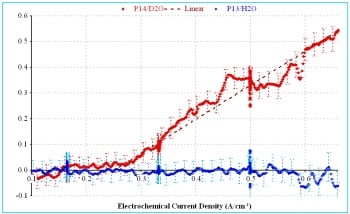
Excess heat graph
Excess heat graph for Pd-D system from SRI presented at ICCF10
For this palladium-deuterium system, a steady increase in measured current (in red) is compared with no increase in electrical current using a hydrogen and palladium system (in blue) control cell.

Both Dr. Swartz and Dr. McKubre are just two cold fusion researchers who have repeatedly witnessed the creation of large amounts of energy in small, tabletop ‘cells’ that use a fuel of hydrogen and/or its isotopes, and various transition metals as host to the reaction. There are many other labs, and many other scientists on the verge of unlocking the power of these systems. The enigmatic theory behind the effect may elude researchers, but the results are empirical and undeniable despite mainstream science’s refusal to acknowledge this field.

Mr. Rossi is the first to bring this science into the realm of a usable technology. Yet, even among the cold fusion community, ostracized as it is from conventional scientific circles, Mr. Rossi is an outsider, criticized for lacking discipline and method. Tensions are elevated as the emotional investment over two decades, with a corresponding lack of financial support, has reached the limit of tolerability, and the need for this technology is so great.

27 kilowatt E-Cat module
27 kilowatt E-Cat module. Photo: video frame by Mats Lewan

You don’t like those ideas? I got others.
–Marshall McLuhan

The fact is there is no map outlining the process of rolling out a revolutionary breakthrough technology. The personal computer was dispersed into the population under the noses of Mainframe, Inc. by two young guys with their parents in the next room. The New Fire is emerging from a just-as-unconventional lone inventor who plays jazz drums and knows a good samba when he hears it.

Early-steam-engine-scan
Early steam engine diagram scanned from single sheet bought for $1.

Yes, this engineer of The New Fire demonstrates the energy of humanity’s future using a carburetor-sized heat exchanger, bathroom scales, and duc tape. A perfect scientific method performed on ideal spheres has encountered the spontaneity of jazz drums and electric tweets in a science fiction environment of artificial intelligence so pervasive it goes unnoticed. Science is being done in a world-wide lab where all times are happening at once.

Marrying high and low technologies from various ages has a name – Steampunk. The Steampunk artist rides the collision of centuries and translates that reality into objects that fuse hand-made efforts with factory-made design and modern electronics.
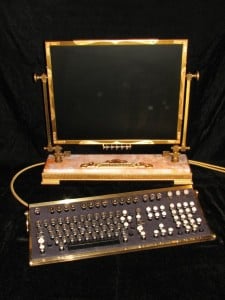
Steampunk Computer
Steampunk Computer Photo: Steampunkworkshop.com
As our world is increasingly medievalized with parochial legislation and stiffened standards attempting to prop-up a declining civilization, Steampunk retrieves the early industrial efforts before fossil fuels, painting the Josephson junctions and digital chips with a veneer of human scale.

Steam Punk Andrea Rossi has brought world attention to a new energy technology that is in its first stages of actuality and which draws on the simple elements of hydrogen from water and a metal powder that combine to create a powerful energy that defies conventional theories of “modern” physics promising clean, abundant energy for the whole world.

Whether the device demonstrated on October 6 generated power of X kilowatts or Y kilowatts pales to the fact that we have a new energy technology – confirmed by science – that needs support for development, and promptly.

It is our best chance for a technological future on Earth.

Cold Fusion Now!

Related Links

What is Steampunk? http://www.steampunk.com/what-is-steampunk/

New test of the E-cat enhances proof of heat by Mats Lewan from NYTeknik

E-Cat October 6 Test: Questions on the Day After by Raymond Zreik from Focus.it

22 Passi d’amore e dintorni Daniele Passerini from http://22passi.blogspot.com/

Leonardo Corporation homepage

Jet Energy, Inc homepage

LENR-CANR Library homepage

Updates Part 2 – E-CAT Test Aftermath

photo from radio24
Photo from Radio24

After the October 6th Energy Catalyzer test, there’s been continual updates, graphs, number crunching, and speculation on what is next, trickling in throughout the web.

For a good summation of the test as being positive, yet could have been better, and a really good part on the psychological aspects of “inventor” versus “outsiders” which helps understand the possible nature of the testing set up which has been criticized, check out Hank Mills article – E-Cat Test Validates Cold Fusion Despite Challenges

Now an update on the U.S. partnership which I wrote yesterday that it appeared to be no longer. According to a comment on e-catworld it may still be on and the issue could be the shipping of the plant, and the partner wanting to write Rossi’s name on the U.S. bound “send to” portion of the shipment, but due to the serious U.S. legal implications regarding the shipping and hence production of, what they would see as, a “nuclear plant”, lawyers could have advised Rossi against having his name as receiver, and advised that the U.S. company should take responsibility for shipping. The commentator speculates the contract would still be signed, but the inauguration would be in Europe, not U.S.

The U.S. partner? I’ve been seeing speculations on a few sites that it could be Kleiner Perkins Caufield & Byers, as for one that’s where the URL “E-Cat.com” redirects to. On the surface it might not sound as big as the NASA or GOOGLE speculations, but then again:

Kleiner Perkins is not a consulting company. It is a premier venture capital company with several technology funds. They were key to starting Google and Amazon and a number of other major companies. Their Green Fund is headed by Al Gore (former us VP under Clinton), and another major fund is headed by former General Colin Powell.

They are “top dog” in the VC world. If they are actually behind this, then this is as real as it gets.

“If”
(NewVisions comment from E-catWorld)

Any designers in the house?

Some updated information on projected pricing, designing, and longevity of the E-Cat from Rossi posts.


Projected pricing-
500euro per kw. (2500 euro for an E-Cat?)

Projected Longevity – “life of the E-Cat is 20 years”

And finally a call out for designers:

Andrea Rossi
October 8th, 2011 at 1:43 AM

Dear Francesco Toro,
The E-Cat basic module “for the People”, that we will put in commerce within months, will be 40 cm long, 40 cm large, 40 cm high, will weight 60 kg, the shape of a cube. I need a design cheap ( I want to put it in commerce at a price of 500 euros per kW) but nice, very nice. I will buy the design which I will choose and everybody has my honour word that I will not use designs not paid. I need it within two months.
Go to the report of Nyteknik (google “Nyteknic E-Cat Test October 6″) to see the pipes position: that will be it.
Please send proposals to
info@leonardocorp1996.com
I am sure that from the enthusiasm od our Readers will pop up a masterpiece.
Warm Regards,
Andrea Rossi

Updates on the OCT. 6 E-Cat Test

On October 6th the E-Cat was tested in Bologna, and initial reports back were positive: The E-Cat ran in self sustain mode for over 3 hours.

NyTeknik promised a more thorough follow up article the next day and that, along with a new video of the E-Cat from the demonstration can be found here – NyTeknik article + video

Within this article is a link for a more detailed report and temperature data as well.

Also of note in the article, is the business side of things. The U.S. partner, to whom the one megawatt heat plant was to be shipped to for the end of October test, is no longer. The shipment was blocked due to the final agreement not being satisfactory to Mr. Rossi and his legal team. So it appears the partnership is off, as of now. But, he still maintains that the October launch is on, though the whereabouts not announced.

PESWiki continues to provide updated accounts of the October 6th aftermath, including an email they received today from Rossi – PESWiki Updates

Stay tuned, and in the meantime enjoy the E-Cat music video by The Tom and Doug Show in the post below. Andrea Rossi saw it and responded:

VERY, VERY NICE SONG AND VIDEO!
ANDREA

First commercial cold fusion reactor tested in Bologna

[latexpage]
The Energy Catalyzer technology, engineered by Andrea A. Rossi and based on the nickel-hydrogen exothermic reactions pioneered by physicist Francesco Piantelli, Sergio Focardi, and others since the 1990s, was tested in Bologna, Italy.

Around the world, scientists active in cold fusion research, along with new-energy enthusiasts, waited for word from the invitation-only demonstration participants. It was believed that scientists from several countries, including a European patent examiner would be attending the reactor run, taking measurements and disassembling the reactor to prove the design’s integrity

E-Cat 1 MegaWatt unit October 6, 2011 by Daniele Passerini
A regular attendant of the European events surrounding the E-Cat, blogger Daniele Passerini, muted his tweets so as not to ‘steal the thunder’ from the much anticipated report by science journalist Mats Lewan of NYTeknik expected on Friday. Mats Lewan has chronicled the E-Cat demonstrations almost exclusively throughout the many public demonstrations and generated several reports detailing scientific data that have been analyzed throughout the cold fusion community. See all Mats Lewan’s NYTeknik coverage here.

Continuous real-time updates can be found at the Pure Energy Systems special page dedicated to this demonstration.

While the bulk of the information and photos are scheduled for Friday release, 22Passi’s tweets describe an E-Cat running for about 4 hours in self-sustain mode, the condition where the E-Cat is not connected to any external source of power, and the reaction continues indefinitely. If true, and there is no reason to doubt the veracity of that report, this will be a huge victory for Mr. Rossi and his partners, and a successful show of the first cold fusion clean energy technology.

Self-sustain mode was ended purposefully in order to allow the device to cool down for disassembly. Allowing scientists to view the inner components of the E-Cat will prove, at least to those present, that there is no additional input power to the reactor other than the nickel-hydrogen reaction chamber itself.

Some as yet unconfirmed data compliments of Raymond Zreick’s tweets include “the steam was always kept above 110 degrees” and a cryptic “from 15 to 19 the difference in average temperature was 5 ° C (water inlet and outlet water), for 0.6 cubic meters / hour”. That sentence may mean from 15:00 hours to 19:00 hours the difference between the ambient temperature of the incoming water and the Energy-Catalyzed hot outgoing water was 5 degrees with a volumetric water flow of 0.6 cubic meters per hour. This is the data needed to compute the thermal energy generated by the E-Cat reactor and, if true, indicates a very good output of energy.

Multiplying the total mass of the water that went through the reactor in self-sustain mode with the specific heat of water and the change in temperature will give you the amount of energy used to perform that work in joules.

Change in temperature of $\Delta T = 5^\circ$ for $2400$ kilograms of water, using a specific heat of water of $4.2 \text{\hspace{0.7 mm}kJ/kg \hspace{0.7 mm}} \cdot \text{\hspace{0.7 mm}}^\circ C$ gives

$(5^\circ) (4.2) (2400 ) = 50,400 \text{\hspace{0.5 mm} kiloJoules of energy}$.

These preliminary numbers show an energy of 50.4 Megajoules of energy expended to heat the water. Dividing the energy above by the total time 4 hours = 14,400 seconds gives

$\frac{50.4 \text{\hspace{0.7 mm} x \hspace{0.7 mm}} 10^6 \text{\hspace{0.7 mm} Joules}}{14,400 \text{\hspace{0.7 mm} seconds}} = 3500 \text{\hspace{0.5 mm} Watts}$

or, a power of 3.5 kiloWatts, where power is the energy delivered each second of operation. We look forward to confirmed details tomorrow from Mats Lewan.

Some of the media in attendance included Radio24’s Mauricio Melis, Irene Zreick and Raymond Zreick of Focus Magazine, and Radio Città del Capo who interviewed Greek scientist and former ambassador to Italy Christos Stremmenos also there to see the demonstration. Confindustria, an organization representing the manufacturing and service industries in Italy, and Enrico Billi was also reported in attendance.

Italian scientists Sergio Focardi, Giuseppe Levi and Loris Ferrari from the University of Bologna, where the event was held, were also joined by other unnamed physicists invited by Professor Focardi.

Corporate media in the US have ignored developments in cold fusion and there appears to be no coverage on Mr. Rossi’s E-Cat technology at all. However, Wired magazine published an article about today’s demonstration online at their UK site “Cold fusion rears its head as ‘E-Cat’ research promises to change the world“.

When one nickel in your pocket can generate E-Cat energy equivalent to 5 barrels of oil, you can be sure it will change the world.

Cold Fusion Now!

Specific Heat of Water from Engineering Toolbox

Oil to Nickel: The E-Cat Energy Equivalence

[latexpage]

The claim:

1 gram of nickel can generate E-Cat energy equivalent to the energy generated by 517 kilograms of oil. [Here]

If the world consumes 89 million barrels of oil per day, how many ounces of nickel does that correspond to in E-Cat energy?

First, a barrel is a unit of volume and a gram is a unit of weight (technically mass).

A barrel of oil will weigh differently than a barrel of cotton because of the density of the material in it. (Density is mass per unit volume.)

So we need to know how many kilograms a barrel of oil weighs.

To find how much a barrel of oil weighs, we must know the density of the oil.

The density of oil varies.
We will take an average crude oil density value as $\rho = \frac{850 \text{\hspace{0.7 mm} kilograms}}{1 \text{\hspace{0.7 mm} cubic meters}}$.

Since $1 \text{\hspace{0.7 mm} cubic meter} = 264.17 \text{\hspace{0.7 mm} gallons}$ and there are $42 \text{\hspace{0.7 mm} gallons} = 1 \text{\hspace{0.7 mm} barrel}$, we can find the number of kilograms of oil in one barrel by converting

$\frac{42 \text{\hspace{1 mm} gallons}}{1 \text{\hspace{0.7 mm} barrel}} \cdot \frac{1 \text{\hspace{0.7 mm} cubic meter}}{264.2 \text{\hspace{0.7 mm} gallons}} \cdot \frac{850 \text{\hspace{0.7 mm} kilograms}}{1 text{\hspace{0.7 mm} cubic meter}} \approx 135 \text{\hspace{0.7 mm} kilograms oil} \text{\hspace{0.7 mm}barrel}$

So there are about 135,000 grams of oil in one barrel of oil.

Supposing the world consumes 89 million barrels of oil each day, we have

$\frac{135,000 \text{\hspace{0.5 mm} grams oil}}{1 \text{\hspace{0.5 mm} barrel}} \text{\hspace{0.5 mm}} \cdot \text{\hspace{0.5 mm}} 89 \text{\hspace{0.5 mm} x \hspace{0.5 mm}} 10^{6} \text{\hspace{0.5 mm}barrels oil per day} \approx 12 \text{\hspace{0.5 mm} x \hspace{0.5 mm}} 10^{12} \text{\hspace{0.5 mm}grams oil per day}$

The world consumes over 12 trillion grams of oil each day!

Now, if 517,000 grams oil = 1 gram nickel (E-Cat energy-wise),
then 12 trillion grams of oil translates to

$\frac{1 \text{\hspace{1 mm} gram nickel}}{517,000 \text{\hspace{1 mm}grams oil}} \cdot \text{\hspace{1 mm}} 12 \text{\hspace{0.5 mm} x \hspace{0.5 mm}} 10^{12} \text{\hspace{0.7 mm} grams oil} \approx 23,210,831.72 \text{\hspace{0.7 mm}grams nickel}$

So the daily energy from 12 trillion grams of oil corresponds to the daily E-Cat energy from 23 million grams of nickel.

If the world uses 23 million grams of nickel every day, that is

$(23 \text{\hspace{1 mm} x \hspace{1 mm}} 10^{6}) (365) \approx 8.4 \text{\hspace{1 mm} x \hspace{1 mm}} 10^{9} \text{\hspace{0.7 mm}grams nickel annually}$.

Therefore, replacing our current consumption of oil with E-Cat energy would consume an estimated 8.4 billion grams of nickel annually.

Now annual nickel production is roughly on the order of 1,300,000 tonnes.

Since one tonne = 1000 kilograms = 1,000,000 grams, we have that annual nickel production is about 1.3 trillion grams. This means that

$\frac{1.3 \text{\hspace{1 mm} x \hspace{1 mm}} 10^{12}}{8.4 \text{\hspace{1 mm} x \hspace{1 mm}} 10^{9}} \approx 155$.

In other words, the current annual production of nickel is 155 times the amount of nickel we would use annually to replace oil at our current level of use.

Not only that, estimated reserves of nickel worldwide are on the order of 140 trillion grams, enough nickel for

$\frac{140 \text{\hspace{0.5 mm} x \hspace{0.5 mm}} 10^{12}}{8.4 \text{\hspace{0.5 mm} x \hspace{0.5 mm}} 10^9} \approx 16,667 \text{\hspace{0.5 mm}years}$

using the current energy-equivalent consumption of nickel.

Of course this is static reserve, and not exponential reserve, but as a rough estimate, 16,667 years of nickel fuel for E-Cat energy sounds pretty good. Remembering that nickel is a very common element in our solar system means that we would be able to mine all the nickel we need or want for this ultra-clean power.

These are huge numbers.
How about something more tangible – like pocket change?

The US has a unit of money called a nickel which is a 5 cent piece, or 1/20 of a dollar (since 1913 called a Federal Reserve Note). First introduced in 1866, the Shield nickel was a 5 gram coin of 75% copper and 25% nickel. Later, other designs for the nickel were introduced, including my favorite, the Buffalo nickel, minted from 1913 to 1938.

1.25 grams of nickel = 5 barrels of oil
Now 25% of 5 grams is 1.25 grams. Thus, using the E-Cat energy nickel equivalence, a Buffalo nickel containing 1.25 grams of nickel could generate the same amount of energy as 646,250 grams of oil.

In other words, this small piece of change has the energy density of close to 650 kilograms of oil!

Since there are about 135 kilograms of oil in one barrel, we have discovered that, E-Cat energy-wise, one little

5-cent coin $\approx$ 5 barrels of oil.

Holy cow.
Start saving!

*******************************************************************************
Related Links

Density of Oil from Engineering Toolbox

Short-term Energy Outlook from Energy Information Administration

International Nickel Study Group homepage

Nickel melt value for coin from Coinflation

Top Five Reasons to Support Cold Fusion

Our Top Five reasons to support cold fusion technology are listed as:

1. Cold fusion energy technology is ultra-clean.
2. The fuel is abundant.
3. The reaction has a high energy density.
4. New energy technology accompanies new economic paradigm.
5. Cold fusion technology empowers local communities.

Learning about these effects of cold fusion/LENR/LANR/CANR/”nickel-hydrogen exothermic reactions” technology, and describing each effect above with a short sentence and an example, is a good way to start talking about this technology with your friends and local officials.

As the economic and ecological state of our world deteriorates, we the people need to find the words that describe a path forward, words that we are not used to saying, or thinking.

If we are to discover our power as human beings, and flip this civilization into a positive, harmonic component of Earth’s biosphere, a new vocabulary for our life, and a way to communicate that vocabulary, is critical.

It is in this spirit that we continue forward, groping for a framework, a model, that can allow all humanity a chance to live in peace and harmony with all life on Earth, and beyond.

Ruby Carat wrote and recorded the audio back in June, before her cross-country tour to South Florida. Eli Eliott put images to that audio.

Thanks to Robert E. Godes of Brillouin Energy for his description of “the ultimate renewable energy”.

Cold Fusion Now!

Top