The JET Energy Solid State NANOR ‘IAP Cold Fusion/LANR Demonstration’ Continuously Operated at the Massachusetts Institute of Technology in Cambridge Massachusetts for One Month!
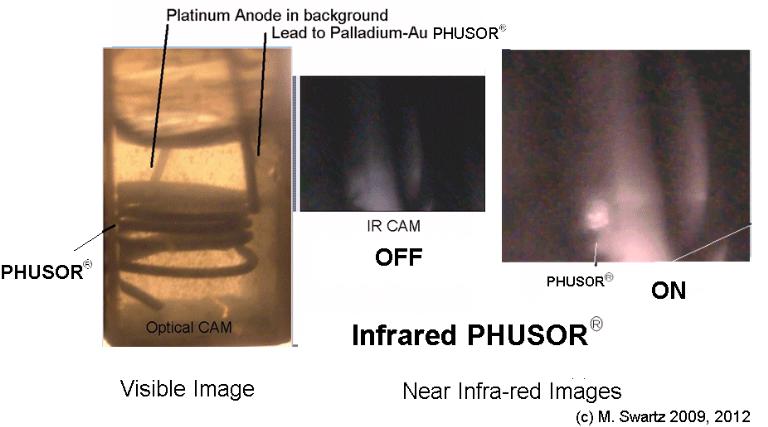
Phusor by Dr. Mitchell Swartz
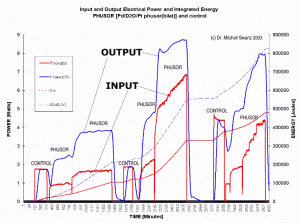
“For hot fusion and particle physicists and students, the background (input) are the blue (control) and green (NANOR), and the foreground (output, read off the left) are the red curves (control and NANOR, plotted as input-power-normalized temperature deviation (delta-T). Compare these to others in the CF/LANR field, and note that these curves have a thermal (ohmic) control and also time integration to determine energy, and thus rule out energy storage, chemical sources of the induced heat, and other sources of possible false positives. Here, the tiny, active CF/LANR quantum electronic device shows significant improvement in thermal output compared to a standard ohmic control (a carbon composition resistor).” —Dr. Mitchell Swartz Jet Energy
– February 2 The NANOR used in the open MIT Demonstration is a ZrO2-PdD Cold Fusion/LANR solid state quantum electronic device – now ongoing for five days straight!
Excess heat graph for Pd-D system from JET Energy
“Cambridge, MA – The IAP Short Course (7 days) on Cold Fusion and Lattice Assisted Nuclear Reactions [at Massachusetts Institute of Technology MIT] has meticulously developed the salient point that skeptics of cold fusion were wrong, and that scientific theories do exist for understanding the difficult to achieve reactions.”
Dr. Mitchell Swartz of JET Energy, Inc and Dr. Peter Hagelstein of the Department of Electrical Engineering and Computer Science collaborated on the Short Course, held between semesters, which offered students a full one-week introduction to the discipline of condensed matter nuclear science.
“January 30-31, 2012 – Cambridge, MA. – As part of the IAP Course on COLD FUSION at the Massachusetts Institute of Technology, Dr. Mitchell Swartz, JET Energy, and Prof. Peter Hagelstein demonstrated cold fusion openly for scientists and engineers. The demonstration was a two day part of the detailed, yet overview, seven day course run by Prof. Hagelstein and Dr. Swartz, and followed the first open demonstrations of cold fusion at MIT since 2003. This JET Energy NANOR(TM) demonstrated a significant energy gain greater than 10, much larger than the previous open demonstration. This exhibition is also remarkable because it confirmed the role of the nanoengineered lattice in enabling the CF/LANR activity. It followed Prof. Hagelstein sharing his breakthrough explanatory theory of cold fusion during the first 5 days. The NANOR technology of JET Energy may have already begun to shatter a few preconceived notions of skeptics and cold fusioneers.”
Given the potential for new discoveries in this field, skilled scientists, engineers, and inventors in condensed matter nuclear science stand to be at the forefront in creating an entire new economy based on clean, abundant energy.
New jobs from a new industry will need an educated group to carry the development forward. Which institutions of higher learning will be the first to begin programs in this area?
Bachelor of Science Condensed Matter Nuclear Science, anyone?
“We are liquidating the earth’s natural assets to fuel our consumption.”
In World on the Edge, Lester Brown of the Earth Policy Institute, writes
“The world’s ever-growing herds of cattle, sheep, and goats are converting vast stretches of grassland to desert. Forests are shrinking by 13 million acres per year as we clear land for agriculture and cut trees for lumber and paper. Four fifths of oceanic fisheries are being fished at capacity or overfished and headed for collapse. In system after system, demand is overshooting supply.”
Lester Brown Chapter 1 On the Edge
Human expansion into the environment for shelter, food, and fuel, exacerbated by the sprawl around cities, is squeezing wildlife into the last remaining islands of shrinking habitat.
What is at stake?
In 1979, 1.2 million elephants roamed the African continent. That number currently is 300,000 elephants. We have lost 75% of the elephant herds mainly due to poaching, loss of habitat and human conflict. Wildlife DirectElephant Slaughter is Recurring
North America inexplicably began losing bee colonies. Chemicals in the water supply cause small amphibians to show mutations. A giant Garbage Patch in the Pacific floats unnoticed by humans, but putting plastics into the DNA of birds.
Birds fill up on plastic, then starve to death.
The list is long and depressing.
But this conflict that threatens the futures of both wildlife and humans has a solution – with abundant cold fusion energy technology.
Growing food locally and sustainably is economically viable using cold fusion energy.
The first commercial device of this revolutionary technology is essentially a steam generator, which could provide affordable clean water, as well as hot water and heat, off-grid in the remotest locations to support agriculture, horticulture, aquaculture, and domestic needs.
Designed to run on hydrogen and a recyclable nickel powder, only one gram of nickel can provide 10 kilowatts of thermal energy from a small portable unit, recharging in about six-months.
Agriculture, horticulture, and aquaculture all benefit from clean water, and hot water.
Even in cold climates, steam generators can heat greenhouses for organic food all year long.
With plentiful energy, it becomes economically viable to recycle all waste, reducing the need for more virgin resources, and no more plastic into the environment!
With clean and abundant cold fusion energy, we can stop the pollution from fossil fuels and the end resource wars limited supplies engender.
Carbon-burning steam power revolutionized farming in the 19th century. Nickel-Hydrogen Exothermic Reaction steam power can revolutionize world agriculture in the 21rst century.
In the ancient Mediterranean villages where philosophy and science began, problems associated with increasing population in were taken care of by shipping off a portion of the tribe to a new location, sometimes forcefully, and founding a new colony.
21rst century humans do not have that same opportunity. There is no ‘Unknown’ area on Earth to expand into. Moon base 2020? Not likely without cold fusion energy.
Where else can humans go?
On Earth, there is only what we choose to programas Nature. ‘Nature’ can only be a work of Art with the participation of All.
Why should we care about the wildlife of this world?
One of the first philosophers in the Greek world was Empedocles. He lived around 450BC and came from the island of Sicily. In one of his surviving fragments of writing, he relates to his student Pausanias the importance of listening carefully to the words his teacher Empedocles is saying.
And why is listening to the teacher Empedocles’ words so important?
“If you press them down
underneath your dense-packed diaphragm
and oversee them with good will and with
pure attention to the work, they will all
without the slightest exception stay with you
for as long as you live. And, from them,
you will come to possess many other things.
For they grow, each according to its
own inner disposition, in whatever way their
nature dictates.
But if you reach out instead after
other kinds of things – after the ten thousand
worthless things that exist among humans,
blunting their cares – then you can be sure
they will only too gladly leave you with the
circling of time, longing to return to their
own dear kind. For you need to know that
everything has intelligence and a share
of awareness.” Empedocles 450BC translated by Peter Kingsley inReality
You can help animals and birds in your neighborhood by providing fresh drinking water, putting bird seed in feeders, and plant indigenous to feed local wildlife. Refrain from toxic chemical use in and around your home, and recycle even the tiniest of plastic pieces.
In the beginning was the Word, and the Word was with God, and the Word was God. –John 1:1 Holy Bible
The name cold fusion describes the biggest technological advance in energy since humans tamed fire. It also continues to generate intense emotional responses, both positive and negative.
Such is the Power of Word.
Michael McKubre presents “What happened to cold fusion?”In his presentation at Cafe Scientifique, Dr. Michael McKubre discussed the various names that have been given to the Fleischmann-Pons Effect of excess heat, as well as the myriad of subsequent phenomenon since discovered that confirm nuclear reactions when hydrogen infuses certain types of metals.
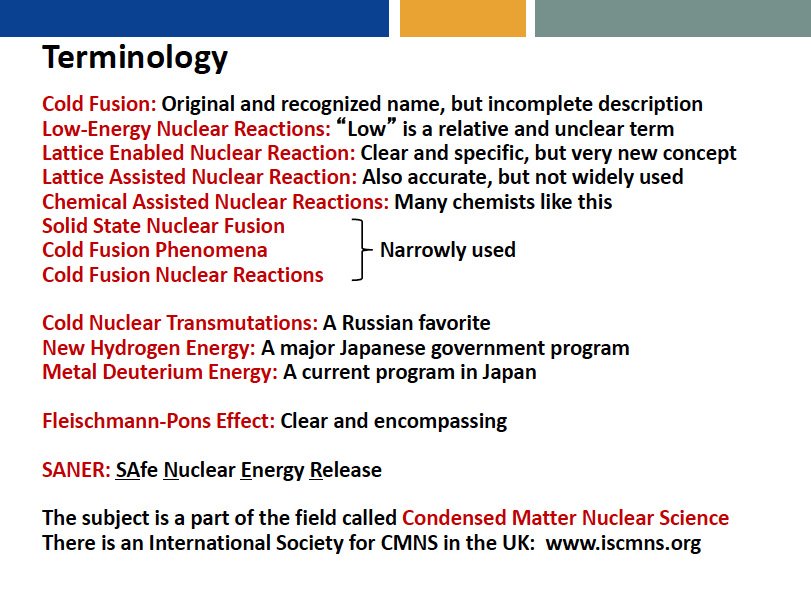
In this presentation slide below, he notes the vocabulary characterizing various aspects of condensed matter nuclear science. Dr. McKubre described a few of the terms during the introduction of the lecture.
“All of these terms in red are used to describe what was announced on March 1989 as cold fusion. The term cold fusion actually came from previous work in hot fusion – muon catalyzed hot fusion.
The term stuck, it’s unfortunate, it irritated the physicists. I think the physicists would have been irritated anyway, but this didn’t help.
In attempts to soften the blow we’ve called it low energy nuclear reactions or lattice assisted nuclear reactions – LENR/LANR. Those terms are not very good. Low is subjective and pejorative – you know we don’t really want to produce low energy.
And nuclear is always a bad word. We took the nuclear out of nuclear magnetic resonance and called it magnetic resonance imaging because sociologically, nuclear is not a good term.
Chemically assisted nuclear reactions. A whole slew of things.
The Japanese rather coyly called it new hydrogen energy which really conceals a wealth under that phrase.
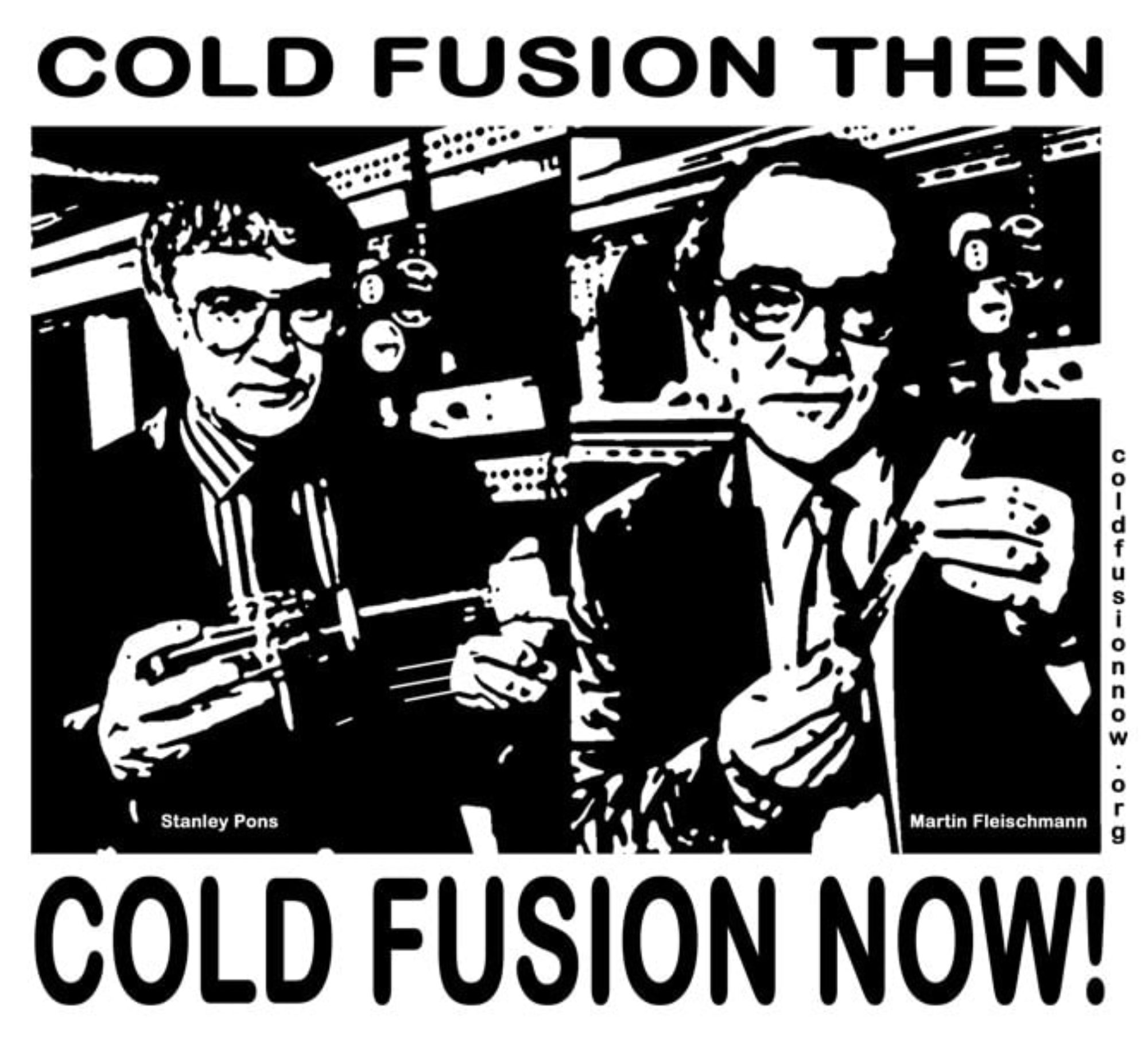
If we’re talking about the Fleischmann-Pons Effect, the effect that Martin Fleischmann and Stanley Pons announced to the world on March 23 which was the electrolytic production of excess energy from a cell containing heavy water D20 and a palladium cathode, then the Fleischmann-Pons Effect is an accurate descriptor.
But the field has expanded vastly beyond that, and we now have an overall terminology condensed matter nuclear science attempting to distinguish what we do from what physicists do with high-energy particles or high-temperature plasmas.” –Michael McKubre
Each name expresses a particular aspect of a highly elusive process that has defied explanation for more than two decades.
As long as there is no definitive theory and scientists are still not sure how this special excess heat effect is initiated, or what the Nuclear Active Environment really is, there will be no definitive name.
The element Helium is correlated with excess heat from the consumption of the hydrogen isotope Deuterium.
One reason the moniker ‘cold fusion’ has “stuck” is that, as the Palladium-Deuterium Pd-D systems have shown, deuterium in can give rise to measurements of Helium out.
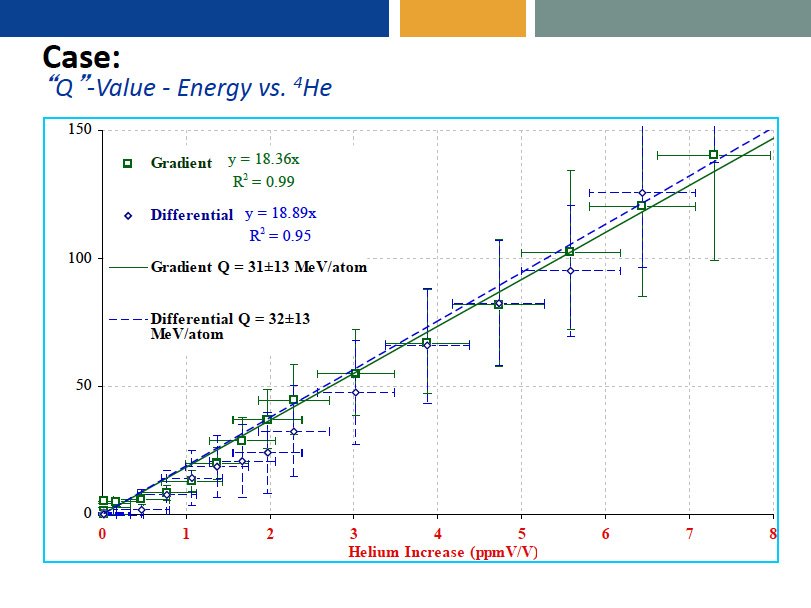
In this slide from Dr. McKubre’s presentation, we see excess heat is positively correlated with the production of Helium. The slope of the line represents the rate of change of energy per helium measured and is close to 31 MeV, +/- the error.
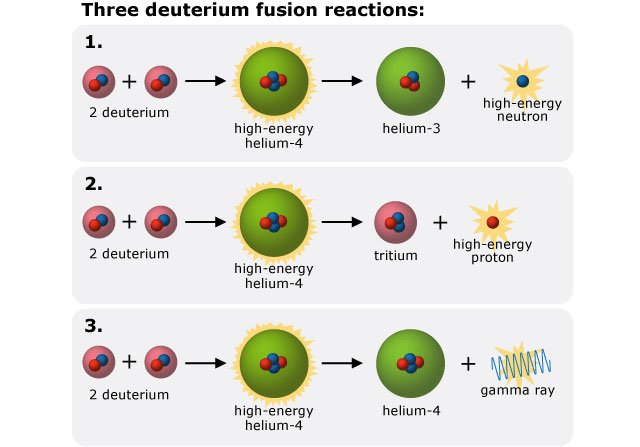
Assuming two deuterium nuclei pair up to form a helium nuclei, the measure of the heat generated, or Q-value, would be 24 MeV. Dr. McKubre believes that the observed higher bias may be due to experimental design elements, and that a value closer to the expected 24 MeV Q-value is possible.
These models are based on last century's hot fusion theory of nuclear reactions and do not occur the same way in cold fusion. High-energy particles and dangerous radiation, by-products of hot fusion, are not seen in cold fusion.
In Pd-D systems, two deuterium nuclei are somehow ending up to form a Helium nuclei, which is the essence of fusion, but not fusion as we know it now.
That can’t be all that’s going on either, for the excess heat effect is also generated from Nickel-Hydrogen Ni-H systems, which do not use a fuel of deuterium, but the simplest form of hydrogen, protium.
And because elements not originally present in a cell can be created during the process, there is also a transmutation effect, which could be from either fusion or fission inside the atomic matrix, or, some other new nuclear process.
For these outcomes to occur in different systems, creating multiple different effects, implies nuclear reactions occurring beyond conventionally known theories from 20th century physics.
Nevertheless, the name cold fusion reflects this idea of fusion occurring in “cold” circumstances, i.e. not hot plasmas.
“The future of the future is the present.” Marshall McLuhan
In ancient times, before science, words were magic. Uttering a name gave power and dominion over that thing. Saying a word could bring whole universes into existence.
It will be remembered that Thoth is called the “scribe of the gods,” the “lord of writing,” the “master of papyrus,” the maker of the palette and the ink jar,” the “lord of divine words,” i.e., the holy writings or scriptures, and as he was the lord of books and master of the power of speech, he was considered to be the possessor of all knowledge both human and divine.
Ancient Egyptian god Thoth was a master of words of power.
At the creation of the world it was he who reduced to words the will of the unseen and unknown creative Power, and who uttered them in such ways that the universe came into being, and it was he who proved himself by the exercise of his knowledge to be the protector and friend of Osiris, and of Isis, and of their son Horus. From the evidence of the texts we know that it was not by physical might that Thoth helped these three gods, but by giving them words of power and instructing them how to use them.
–E. Wallis Budge Egyptian Magic 1901
What we choose to call this transformational new energy technology will continue to evolve, until the secret formula is unlocked. In an instant, the simple, clear, perfect vision of our clean energy future will be summoned by a new and powerful Name. Scientists in every basement lab and every DOE office will be able to relax for a bit, and then get down to the hard work of implementing a revolution across the globe.
But the kids won’t care. They make up their own names. Change nouns to verbs, verbs to nouns, mess up the plural, create their own magic.
For this year, we’ll stick with Cold Fusion Now, not just cause we mean it, because it fits – and the kids dig it too!
Related Links
SRI International: “What happened to cold fusion?” video lecture with Michael McKubre at Cafe Scientifique by Ruby Carat November 21, 2011
Andrea Rossi speaks with Massachusetts State Legislators about manufacturing E-Cats.In the beginning of the interview, James mentioned Nikola Tesla as one of the greatest inventors that ever lived, and introduced Mr. Rossi similarly for his revolutionary technology.
When James asked about the pressure on him and his team to produce a good product, Mr. Rossi replied “What you call pressure, I translate as responsibility.”
“This is why we are working without limits of time to achieve the targets that we wanted to reach in due time. Absolutely, yes, we feel the responsibility. But this feeling of responsibility is also a source of energy to make our work and to overcome the stakes we have to pass through everyday.”
Mr. Rossi gets a lot mail from all over the world and responds “very fast”, dedicating 2-3 hours each day to answering inquiries, because he “can learn a lot from this”.
James believes the entire planet will benefit from this technology saying “We are at a great new time in the world, right now”, and “this is some of the best news for the entire world.” He wanted to give Mr. Rossi a chance to reiterate how safe and clean this new energy technology is:
“The planet will benefit immensely. Eventually, we won’t have the pollution and problems we’ve had from nuclear energy ever again.
We do not use toxic material, we do not use radioactive material, we do not produce radioactive material, and in the thousands of tests that we have made with specialists from the University of Bologna, we never have found any emission of radiation. We have no emission of smoke, no emission of waste of any kind, we have no CO2 emissions, no noise emissions and no liquid emissions.”
James asked: Is it easier to integrate your technology in a developing country, or, do you think it is easier to do it in a more “modern” venue like the United States?
“This is a very good question. There are pros and cons in either case. Because, of course, in a developing country, the pro is that there is less resistance, because you have a blank paper to write upon. In this sense, there is a pro. But the con is that there is less “???” preparation to accept a very new thing.
The contrary is in the developed countries… I can say this, I have an extreme high level interest for this technology in countries like USA, North America, and Europe mainly. Of course, also interest in other areas, but less intense.
Your question is very good, and I am not sure I’m able to answer. In the beginning we will diffuse our work better in developed countries, but would be delighted to go wherever we will be called, absolutely.”
When James asked which countries will have access to the technology first, Mr. Rossi replied they were organizing a network around the world, but the “first point of development and the main center of production will be in the United States.”
On the topic of implementation, James asked whether he had met any resistance from power companies.
“I think that all the energy sources will be integrated. I do not think that we will displace other energy sources. I think that we will reinforce the energy network of the world.
Maybe other sources will be employed in the fields where they are more “???”. I think that we can be integrated in the global energy system. Of course there will be some competition, and this will be better for the public.”
Looking forward, James asked if this technology would be able to be used in an automobile. Mr. Rossi replied that it was a difficult question to answer right now, but he thought that ships and trains would most likely be an easier application.
“To be applied to an automobile, I think yes, but the application of this kind of energy to the cars or trucks will need not less than 10-15 years because there are very big problems to be resolved
with electricity.”
Asked if he was using an E-Cat in his own home, Mr. Rossi said:
“Yes. Yes, because it’s a test. Of course yes, I am using it. This is important. There are some that are working in some houses of my team and I and we have to collect all the data and analyze all the problems. They are our guinea pigs.”
Dr. Edmund Storms, cold fusion energy scientist and author of The Science of Low Energy Nuclear Reaction, spoke to Cold Fusion Now last summer.
This segment has Dr. Storms discussing the idea of the Nuclear Active Environment, an idea that consolidates elements of the cold fusion/LENR/LANR/CANR reaction, through both geometry and processes, in an attempt to describe the reaction theoretically.
Note: This article has been updated several times. Apologies to all. It is an effect of the digital environment that nothing can be known (Jean Baudrillard and Bob).
A second commercial product based on cold fusion technology is planned for release next year.
Yesterday Praxen-Defkalion Green Technologies released a Technical Specifications Sheet detailing elements of the Hyperion thermal energy generator that creates heat using a nickel-hydrogen exothermic reaction Ni-H, the same technology that the Energy CatalyzerE-Cat generates.
Marketed for industrial and agriculture uses, the Hyperion will come in two models. A larger model will produce a thermal output power ranging from 10-45 kiloWatts and require at most 310 W electrical input power to run. That’s an energy return between 32-145 times the energy input.
The smaller model is a 5-11 kiloWatt output of steam power and requires an input of at most 200 W input of electrical power, giving an energy return ranging from 25-32 times the energy input.
The 5 kW unit has a reactor of dimensions 12 cm x 12 cm x 12 cm (12 cm = 4.7 in).
Internal view of Hyperion thermal energy generator. Photo Praxis-Defkalion Press Release Nov. 14A 2 liter bottle of hydrogen fuel and the nickel powder that hosts the reaction will need to be recharged approximately every 6 months for the 5 kW model.
The 45 kW unit can last up to one year on a hydrogen fuel charge and almost 3 years for the nickel powder.
More than 98% of the material weight of the Hyperion is made from recycled materials, and the nickel is recyclable when spent.
According to their website, the Praxen company is located in Cyprus and holds “full rights to its own technologies and will sell exclusive rights globally for the production of its proprietary products (Hyperion).” Defkalion Green Technologies is based in Greece and will license the product.
They also claim the Hyperion patent is pending, as are most patents in this area of new-energy research. The lack of patents granted in this field has stifled development of a technology that promises ultra-clean energy for a fraction of the cost of fossil fuels.
Private investment has eschewed the mostly small, independent companies developing cold fusion energy generators because the intellectual property has not been secured. Inventors, engineers, and scientists working in this area have been largely self-funded and forced to operate in an environment of secrecy.
There is speculation that the Hyperion is based on Andrea A. Rossi’sE-Cat invention, even to the extent of improperly procuring technology without his consent. Defkalion was associated with Mr. Rossi earlier this year and had a distribution contract for the E-Cat before their partnership dissolved over the summer.
Mats Lewan of NYTeknik has been regularly reporting on the E-Cat and recently wrote of an August telephone conversation with Alexandros Xanthoulis, a Defkalion representative who said, “I know what he’s got in the reactor, I know everything. It was a spectroscopy made by the University of Siena Padua.”
Spectroscopy of the interior of an E-Cat would reveal the elements within, thereby exposing the “secret catalyst” that made the E-Cat generate such high levels of thermal energy.
If true, litigation may be the news for 2012, and the years to come.
Praxen-Defkalion is one of the larger groups to enter this fast-developing area of new-energy technology. The specifications released yesterday show an advanced proto-type generator and that they are well positioned to deliver strong research and development. They admit “an incomplete proof of theories” to describe the reaction, nevertheless, Defkalion engineers have been very busy determining the conditions to keep the generator strong and stable.
Combined with access and support from the Greek government and European business community, they will be a formidable competitor in this still wide-open market for new energy technology.
Where their technology originated remains a question.
What is clear is they are serious about the Hyperion as a commercial product, hoping Greece can become “the global centre for R&D on LENR technologies.”
 “Cambridge, MA – The IAP Short Course (7 days) on Cold Fusion and Lattice Assisted Nuclear Reactions [at Massachusetts Institute of Technology MIT] has meticulously developed the salient point that skeptics of cold fusion were wrong, and that scientific theories do exist for understanding the difficult to achieve reactions.”