
Exponential production using LENR, LENT, and 3D Printing

Exponential Growth is an immensely powerful concept. To help us grasp it better let us use an ancient Indian chess legend as an example.

The king was a big chess enthusiast and had the habit of challenging wise visitors to a game of chess. One day a traveling sage was challenged by the king. To motivate his opponent the king offered any reward that the sage could name. The sage modestly asked just for a few grains of rice in the following manner: the king was to put a single grain of rice on the first chess square and double it on every consequent one.

Having lost the game and being a man of his word the king ordered a bag of rice to be brought to the chess board. Then he started placing rice grains according to the arrangement: 1 grain on the first square, 2 on the second, 4 on the third, 8 on the fourth and so on.

Following the exponential growth of the rice payment the king quickly realized that he was unable to fulfill his promise because on the twentieth square the king would have had to put 1,000,000 grains of rice. On the fortieth square the king would have had to put 1,000,000,000 grains of rice. And, finally on the sixty fourth square the king would have had to put more than 18,000,000,000,000,000,000 grains of rice which is equal to about 210 billion tons and is allegedly sufficient to cover the whole territory of India with a meter thick layer of rice. At ten grains of rice per square inch, the above amount requires rice fields covering twice the surface area of the Earth, oceans included.” ( http://www.singularitysymposium.com/exponential-growth.html ).

Exponential Growth is a difficult concept to imagine, but it is extremely powerful. This paper is devoted to utilizing three technology to achieve exponential production. The conceptual framework I am constructing is not just abstract, but reality based and achievable. In other words, this paper is a prescription for an almost unimaginably powerful result.

The three factors of production required for industrialization are capital, labor, and land. In other words, goods devoted to the production of other goods, activity that provides the goods, and raw materials.

“As opposed to traditional “subtractive” methods of carving or sculpting, 3D printing is an “additive” method of manufacturing that builds up solid objects one thin layer at a time. The basic concept is the same as an inkjet printer, only instead of spraying ink onto paper, 3D printers use liquids that solidify or set. Liquid plastic or resin are the usual materials, but there are others: for example, industrial 3D printers can make metal objects by laying down a pattern of metal powder and then fusing it with a high-powered laser or electron beam. You can 3D print in ceramic, glass, or concrete or other composite materials by depositing layers of sand or gravel and then spraying a binding agent…Truly revolutionary advances often come quietly at first, and I believe this is one of these. 3D printing as a technology is in its very early stages, but even in what it’s accomplished so far, we can glimpse the contours of the future.”
(http://bigthink.com/daylight-atheism/weekend-coffee-the-3d-printing-revolution). 3D printer technology is the quintessential “goods devoted to the production of other goods,” a virtual magic lamp.

Low energy nuclear reaction (LENR) is a clean, very cheap, and super abundant energy technology using (for instance) nickel and hydrogen. It has been estimated that evaporating hydrogen in a nickel lattice, applying heat, pressure, and a vibrational wave (i.e. “Q-wave”) produces 355,000 times the heat from hydrogen than an equal amount of gasoline. Furthermore, hydrogen and nickel are very plentiful elements in our universe. Such plentiful energy utilized by mechanical devices would fuel the activity that provides the goods.

Finally, low energy nuclear transmutation is a technology to turn one element into another. In the nickel lattice of a LENR reactor, hydrogen atom protons and electrons collide forming ultra-low momentum neutrons. Those neutrons are absorbed by surrounding atoms. Those surrounding atoms that have absorbed the extra neutron(s) shed heat and transform into other elements. Such a method for producing one element from another would allow the production of any needed raw material.

Sounds like science fiction. To digress slightly, I first was clued into the practicality of 3D printing when I was researching a new Nobel gas engine: “They recently purchased a 3-D printer in order to build the proper pipe sizes on which to wind the coils that go on their cylinders (and to play around). The 3-D printers only cost $5000. I remember back when we paid that much for a regular copy machine,” he said. ( http://theeestory.ning.com/forum/topics/inteligentry-manufacturers-gearing-up-for-noble-gas-engine-roll ). The main content of the article (about an engine that runs on “plasmic transition” process using noble gases to create the plasma) is amazing enough, but I didn’t realize how far 3D printer technology had come.

“President Obama’s nationwide push for innovation in manufacturing reaches across agencies from the National Science Foundation to the Department of Energy, and now it’s reaching all the way into the Pentagon where $60 million is being set aside for investment in 3-D printing technologies. The DoD will fund a network of agencies, academic institutions, and companies to build on 3-D printing tech with the overarching goal of building aerospace and weapons technology faster.

Of that $60 million, half will be allotted to researchers between now and fiscal 2014, with more than half of that–some $18.8 million–being handed over in fiscal 2012 alone. That means, adjusting for the usual bureaucratic waste, there should be somewhere between many and many-many millions spent to advance 3-D printing tech this year alone under a framework that will hopefully push for the meeting of meaningful benchmarks.

Three-dimensional printing (or additive manufacturing, or rapid prototyping) is of course a fairly nascent technology that nonetheless holds great promise. While private companies like Makerbot, Stratasys, and even Hewlett-Packard have pushed the boundaries of the technology by developing less-expensive and more accessible printing systems to more people, the industry on the whole hasn’t really benefited from a huge injection of investment or a meaningful mandate from a body like the DoD–one that, when it puts its mind and money to something, can actually enable technological leaps forward.

The 3-D printing industry was already doing fine–some analysts expect it to grow to $3.1 billion by 2016–but a little help from Uncle Sam can’t hurt.”
( http://www.popsci.com/technology/article/2012-05/pentagon-investing-millions-advance-future-3-d-printing-tech ).

While the “overarching goal of building aerospace and weapons technology faster” is a short term goal that is easily achievable, a much more powerful goal would be for 3D printers to produce other 3D printers, increasing production capacity exponentially.

Suppose for example a 3D printer and toner were to be transported to an asteroid. The printer can start manufacturing equipment to mine for fuel and raw materials, and as production was scaled up could duplicate the production economy. One production economy, two, four…limited only by time and the land. By the way, 3D printers are transforming digital data into goods, so innovation and adaptation from afar can be input via telecommunications, re-directing a production economy to produce different goods (like space craft to transport a spare 3D printer and toner to another piece of extra-terrestrial land to repeat the cycle).

This is where I go off the deep end. Remember we started this paper with a story of Exponential Growth (“And, finally on the sixty fourth square the king would have had to put more than 18,000,000,000,000,000,000 grains of rice which is equal to about 210 billion tons and is allegedly sufficient to cover the whole territory of India with a meter thick layer of rice.”):

“In astronomy and cosmology, dark matter is a type of matter hypothesized to account for a large part of the total mass in the universe. Dark matter cannot be seen directly with telescopes; evidently it neither emits nor absorbs light or other electromagnetic radiation at any significant level. Instead, its existence and properties are inferred from its gravitational effects on visible matter, radiation, and the large scale structure of the universe. Dark matter is estimated to constitute 84% of the matter in the universe…” ( http://en.wikipedia.org/wiki/Dark_matter )

I am making the following outrageous and totally unintuitive claim: using the above suggestion for exponential production, the dark matter could plausibly be spaceships filled with aliens. That is how powerful Exponential Growth is (both in terms of population and production).

To summarize, Exponential Growth is an immensely powerful concept. The three factors of production required for industrialization are capital, labor, and land. Using 3D printing, LENR, and LENT, exponential production potential can be achieved. While each of these are fairly nascent technologies, they nonetheless hold great promise. Furthermore, you can expect in the future that each of these technologies will have directed at them tremendous R&D resources – and a little help from Uncle Sam can’t hurt. Finally, using the concept of Exponential Growth you can even plausibly explain such inscrutable things as Dark matter. We really are primarily limited by our imagination.

The future is so bright we’ll have to wear shades – the only catch is we have to believe.
Petition: Cold Fusion Renewable Energy Development

A renewed Cold Fusion Renewable Energy Petition is still alive at Change.org.   Sign this petition now.

Cold Fusion atomic energy has been ignored and pushed aside in discussions/ presentations about alternative energy for too long. Advantages include little/no radioactive decay matter, and extremely high energy output. As an example, 1 or 2 future-generation generators themselves could power a metropolis city the size of Los Angeles, California for a month on one small supply of common inexpensive elements. Current energy generation comes from more than 5-sources. World leaders in nations/unions such as Japan, The United States of America, Russia, South Africa, The European Union, and so on have the ability and power to fully engage in the building mass energy production plants now.  “Nuclear fission power plants and weapons are dangerous.”

As of 07/02/2012 this is now an international petition.

This is among the safest, cleanest, and most powerful energy resources that has been proven to be as or more productive than coal, and nuclear fission; which is more commonly known. Other technologies based on science fiction stories like the various Star Trek television series from the 1960’s through recent series, offer multiple ideas that need to be officially explored further. Use of this energy source has the potential of replacing oil, coal, and natural gas use worldwide. The nation that does this first would likely reduce foreign dependence by 100%, erase it’s own and most other nations trade debts and retain all funds used towards purchasing foreign energy resources. The conservative powers that currently exist and the energy corporations that want to hold onto their dominance are fighting this in every way possible.

An accommodating resource of energy using a smaller cold fusion engine can also power vehicles of all sizes.  World leaders need to endorse this safer alternative too. Job losses may initially be massive but 3x to 10x more jobs would be created. Worldwide unemployment would drop dramatically due to increased lower cost energy availability.

We are in a new and more open time to succeed. Let’s make them listen and act for the people, our planet, not the corporate billionaires and subservient politicians!

Please sign this worlwide petition and forward this article: (Click Here)

NASA Information (Link)  …More proof!

“Explaining LENR”

A new idea of what creates the cold fusion reaction has been articulated by Edmund Storms of Kiva Labs. Storms describes his hypothesis with the simplest terms in the updated Student’s Guide to Cold Fusion [.pdf] and in a recent paper submitted to the Journal of Condensed Matter Nuclear Science called Explaining LENR. [.pdf]

There are three distinct parts to his model.

1. The Nuclear Active Environment NAE of a crack or hollow is formed.
2. Hydrogen enters the NAE.
3. Applied power at the resonant frequency of the NAE/hydrogen combo turns mass into energy.

Storms does not say what nuclear mechanism is at work, only that it is instigated by resonance.

Peter Gluck, one of the earliest scientists to look into cold fusion/LANR/LENR, and what he has termed LENR+ for the new commercial products now being engineered, asked how this proposal answers seven crucial questions, and got Storms to answer. Re-published here from his blog EgoOut is their exchange.

Question #1: What are the consequences if the New Theory is successful?

Storms: The consequences of my theory being correct are twofold. First, the ability to replicate LENR at robust levels will improve. Once the required cracks can be manufactured on demand, the energy could be made on any scale, from that required to power a computer to a space craft.

Second, the phenomenon can be applied to solving the solar defect of neutrinos. This will cause a new understanding of the Standard model. But right now, we can only hope.

Question #2: What about the completeness of the New Theory? Is it a “transtheory”?

Storms: The model will be a “trans-theory” only to the extent that it is acknowledged as plausible and worth exploring. This acceptance is not assured at this time. As for whether one or many theories are required depends on how many ways Nature has to cause LENR. I assume only one basic method is possible. Therefore, only one theory is needed, i.e. the correct one. We will have to wait until the proper tests are made to determine which theory is correct. My model shows exactly which tests need to be done.

Question #3: Is the theory valid for all the existing LENR systems?

Storms: I base my model on hundreds of observations that show several very robust patterns of behavior. These behaviors include both the presence and absence of expected behavior. I rely on using a large number of combinations of behaviors, all of which are consistent with the logic of the model.

In addition, the model can be applied to both deuterium and hydrogen systems using any method for causing LENR. Of course, less support for the idea exists in the hydrogen system, which makes it the ideal system to use as a test of the predictions.

Question #4: Does the New Theory explain the serious problems of control, characteristic to all the LENR systems?

Storms: Control is a problem that the model addresses. I assume the rules controlling chemical behavior apply to the process that precedes the nuclear reaction, regardless how the nuclear reaction operates. Once the preconditions are understood, the controlling variables can be identified and used in the same manner they would be used to control a chemical processes. In other words, chemistry determines the rate of the nuclear reaction.

Once the required conditions are formed, the nuclear process occurs very rapidly and without any additional effort. This is similar to how energy is made in a gas furnace. The rate of energy production is determined by how fast the fuel is applied, in this case D+, and the subsequent flame does its thing without any additional effort or control.

Question #5: Does the New Theory explain the huge enhancement of energy achieved in the LENR+ systems of Rossi and Defkalion?

Storms: Rossi has succeeded in increasing energy production by finding a way to create many active cracks in the fine nickel powder. Presumably the powder has just the right size to support exactly the correct size crack. As a result, the concentration of NAE is higher than Piantelli was able to achieve in solid nickel. The secret of the process involves the method and/or the material that needs to be added to Ni to cause the cracks to form.

Question #6: Piantelli had a self-sustaining cell working for some 4 months and Rossi speaks about an active life time of the material of 6 months. It seems Ni is not destroyed but transmuted. My guess from the very start (1993 paper) was that the active sites are formed in some way by “surface dynamics”- the movements of the atoms at the very surface of the metal – many degrees of freedom.

If the NAE are active cracks in the metal and many/more active cracks mean more energy, then isn’t LENR an inherently destructive process? Is there is a concurrent process by which the structure of the metal is rebuilt, the “wounds” are healed or is the metal, in a certain sense, ‘sacrificed’, structurally speaking?

Storms: I propose that a limited and relatively constant number of active cracks can form because these result from stress relief. Once all the stress is relieved, no more cracks can form. Of course, most of the cracks made this way will be too large to be active, so that only a small number of NAE sites are making the detected energy.

The life time will be determined by variables independent of the number of active sites. For example as deuterium accumulates in the E-cat, the reaction rate will drop because the less active tritium formation reaction will start. When deuterium is used to make helium, the helium will accumulate and block access to the active sites for the deuterium.

I do not believe that any significant transmutation takes place. All measurements of this process show that this reaction is rare, except for the claim by Rossi.

Question #7: Based on the New Theory, what would you recommend as a strategy for the LENR field? On what should research and development focus as much as they can; palladium-deuterium Pd-D systems or nickel-hydrogen Ni-H systems?

Storms: This question involves politics, which makes it difficult to answer. On the one hand, the Pd system has a great deal of experimental support while the Ni system can apparently produce significant power, but based on very little understanding of the process.

If the crack model is correct, the metal is not important except that it be able to form active cracks and dissolve D or H as the required reactants. In fact, Ni might be a better host for the D reaction than Pd because it is cheaper and the D is more active than H because each D makes more energy than each H.

So, my advice is not to focus on the metal but on understanding the process. Once the process is mastered, the claims will be accepted regardless of the metal used. In fact, I think neither Ni nor Pd is the best host for the reaction.

Related Links

A Crack in the Code by Ruby Carat May 24, 2012

REAL POPULAR COLD FUSION

Graphic: LENR beta-decay in the lattice.

LENR/LENT science is known as cold fusion in popular vernacular for many reasons. There is the well-remembered worldwide media flurry over the wondrous announcement by Pons and Fleishman in 1989; the decades long discourse exemplifying it as the fringe of fringe sciences; the repeated high-profile dirty-dealt blows to cold fusion science by established energy concerns aimed at debunking it once and for all. Even movies and sci-fi have helped put cold fusion in the public vernacular. Basically anything that is ‘less hot than the sun’ fusion, involving some sort of nuclear reaction, is cold fusion in the minds eye of the public. It’s a popular name with a nice ring to it, Cold Fusion, and it is about to become the most popular sweet source for energy.

Now the chief scientist at NASA – Langley has released a paper to help us better understand this art. It is densely written, each sentence packed with meaning. Even the title bears a closer look, REALISM and OUTLOOK.

In order to better understand the paper we can look at each part of every sentence and categorize it as the title suggests, under Realism or Outlook. It is best to list only those parts that qualify as definitive when kept in context; parts based on ‘maybe’ or ‘what if’ are not included.

Thanks are given to ‘we’ll stick to our guns’ Pons and Fleischman and to all the dedicated scientists who continued the research: now we have a fantastic science emerging as the ‘Solution to All Energetics’, through low-energy nuclear reactions.

LENR/LENT Science – popularly known as Cold Fusion.

READ NASA and VIEW THEIR VIDEO PRESENTATIONS

Low Energy Nuclear Reactions, the Realism and the Outlook (read)
by Dennis Bushnell, Chief Scientist, NASA Langley Research Center

REALISM

  • hundreds of experiments worldwide indicating heat and transmutations with minimal radiation and low energy input
  • evidence indicates something real is occurring
  • with effects occurring from using diverse materials, methods of energy addition etc
  • This is far from a “Narrow Band” set of physical phenomena
  • several labs have blown up studying LENR and windows have melted, indicating when the conditions are “right” prodigious amounts of energy can be produced and released
  • are in fact inventing (in real time) the requisite engineering, along with verifying the physics


OUTLOOK

  • NASA Langley, the epiphany moment on LENR was the publication of the Widom-Larsen Weak Interaction LENR Theory
  • theory indicates energy densities, some several million times chemical. The current experiments are in the 10’s to hundreds range
  • still far from the theoretical limits of the weak interaction physics for LENR performance
  • given the truly massive-to-mind boggling benefits – solutions to climate, energy and the limitations that restrict the NASA Mission areas, all of them. The key to space exploration is energetics. The key to supersonic transports and neighbor-friendly personal fly/drive air vehicles is energetics, as simplex examples of the potential implications of this area of research
  • 1% of the nickel mined on the planet each year could produce the world’s energy requirements at the order of 25% the cost of coal
  • it is worth far more resources than are currently being devoted to this research arena


ENTER THE COLD FUSION MARKETPLACE

http://www.blacklightpower.com

http://www,brillouinenergy.com

http://www.ecat.com

http://www.defkalion-energy.com

With NASA and many others we are able to quickly replace all major sources of energy with cold fusion. At a cost savings, both in implementation and future use, ad infinitum.

Every friend, neighbor, coworker, student, teacher, politician and activist, liberal and conservative, both young and old should become aware of this as soon as possible.

Then the harm caused from continued use of dirty crippling coal, asthma inducing oil, or birth defective radioactive nuclear becomes a matter of criminal negligence. Do all you can to both get the word out and enable this energy transition. It is the most important topic of our time.

1994 Cold Fusion Sourcebook dedicated to “Children of Chernobyl”

The Salt Lake City, Utah Fusion Information Center founded by Hal Fox was the first research center dedicated to researching and publishing about cold fusion. Newsletters such as Fusion Facts, the New Energy News, and Journal of New Energy all emanated from this organization beginning in mid-1989 and running through 1999.

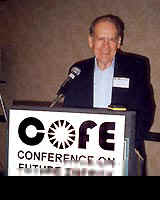
Hal Fox speaks at Conference on Future Energy
Hal Fox was the director of the first research laboratory at the University of Utah Research Park. Realizing the benefits of this new form of energy, he became a strong advocate, creating several companies and organizing many publication efforts to advance the field. The Cold Fusion Sourcebook edited by Hal Fox coalesced The Proceedings of the International Symposium on Cold Fusion and Advanced Energy Sources held in Belarus, Minsk May 24-26, 1994.

The book is dedicated to three classes of people:

1. To those international scientists, engineers, and inventors that have diligently pursued the truth; who have trusted the integrity of other scientists who reported on their new discoveries; who have replicated, and improved, and, in turn, reported on this new science of cold nuclear fusion and other enhanced energy devices.

2. To the new scientists, engineers, inventors, and scholars who now can follow in the footsteps of those who have led, and become leaders of others. You will be the individuals and the generation who will develop, install, and use the new non-polluting, inexpensive energy systems that will help improve our homes, our countries, and our world.

3. To the Children of Chernobyl.

Cold Fusion Sourcebook edited by Hal Fox [download .pdf]
from New Energy Times

Fox’s Introduction follows here:

“When I first learned of the devastation to Belarus (and parts of the Ukraine) from the Chernobyl nuclear power plant disaster, I was strongly distressed at the intense penalty that was imposed upon the nation, its people, and especially its children. I determined to do something for the last “Children of Chernobyl”. I desire to express my commendations to those who risked their lives to tell the world about the silent killer in their land and all of us express our thanks to the concerned citizens from many nations that are trying to help. There is no nation on earth that is in a better location for the international conference on new energy than Belarus. There is no nation on earth that deserves and needs a new non-polluting source of energy more than Belarus. That is why I am here with you at this conference.”

“I’m pleased to be the editor of the English version of the proceedings of this important international conference early this year I want to over 50 cold fusion scientists whom I call my friends, and asked them to provide reports on their work. Each one was asked to write an article which would become part of a “Cold Fusion Source book”. In addition, my friend Ben Filimonov of Belarus invited papers from leading scientists from his part of the world who had been successful in the development of this exciting new technology of cold nuclear fusion. With the help of excellent translators, especially Ms. Tamara Grinevich, those papers, mainly from CIS (Commonwealth of Independent States), have been included in this publication. In addition, we have also included some invited papers that deal with some other enhanced energy systems (new energy systems that provide more energy out then used as input or driving energy).”

“The first article in the Cold Fusion Sourcebook is mine and is meant to set the stage with the articles that follow by providing a review of the many new methods, in addition to the original Pons-Fleischmann cold fusion cells, by which nuclear reactions and/or excess thermal energy can be produced in relatively simple “table-top” experiments. The second paper is by Dr. Ben Filimonov, who categorizes the many phenomenon of cold nuclear fusion and provides us with a new way of looking at this rich phenomenon.”

“To the attendees of this conference and those who read our work: we challenge you to make use of this knowledge, improve what we have done, and solve the energy problems so that there will never again be anymore “children of Chernobyl”.
–Hal Fox Introduction Cold Fusion Source Book 1994

Chorus: Will we ever learn?

Courageous new energy scientists continue the effort to develop clean energy technology from cold fusion as our planet is again threatened with the horrific damage of radioactive poisoning that alters the genetic code for generations. Along with pollution from fossil fuels devastating our world wildlife and biodiversity, and war and terror rampant in our streets, there is little more important than working for change in our arrangement for living and peace on planet Earth.

Talk to your friends, family, educators, and legislators about clean energy from the hydrogen in water, and demand

Cold Fusion Now!

Chernobyl Legacy by Paul Fusco [watch] will be disturbing.

Interview with a “Liquidator” from Chernobyl and Eastern Europe [read]

Top