LENRG Youtube Channel has uploaded video shorts of the recent meeting in Oxford bringing together scientists, advocates, planners, and designers to envision and create a living environment based on clean Low Energy Nanoscale Reactions (LENR) energy technology.
LENR Cities is the focal point for the assemblage. LENR-Cities “accelerates market transformation and fosters LENR demand” by being a “bridge between VC/investors and those who develop LENR tech and product innovations”.
From their website:
Low Energy Nanoscale Reactions research will become a new field of engineering capable of addressing world challenges regarding Energy with a global impact. It is therefore clear that any LENR project intersects with multiple interests and issues which create the conditions for their failure. To address this main issue, it is necessary to enable industries and actors to concurrently integrate their industry into LENR industry, that is to say, to define open capabilities to securely enable any player to come into the game.
LENR-Cities, a Swiss organization, is leading the LENRG Ecosystem. Each project is run independently, with its own objectives, but contributes to the achievement of the overall project which itself is reinforcing everyone’s capabilities and interest to support the overall project. We are now building the core of the Ecosystem with a small group of key scientists, investors and industrialists, individuals and public or private organizations. The objective of this group is to be the catalyst of the whole project.
Cold Fusion 101: Introduction to Excess Power in Fleischmann-Pons Experiments starts tomorrow morning 10:30AM Cambridge-time Tuesday, January 20 on the campus of Massachusetts Institute of Technology and runs through Friday, January 23.
LIVESTREAM ON ColdFusionNow Youtube Channel google+ here!
Led by Dr. Peter Hagelstein of MIT and Dr. Mitchell Swartz of JET Energy, Inc, the course examines the experimental work of Martin Fleischmann and Stanley Pons, and theorizes on an explanation. For more, see Cold Fusion 101 at MIT for 2015
Cold Fusion Now’s MIT Special Correspondant Jeremy Rys will be attending the course to document the lectures – and possibly live-stream from the event.
Go to the Cold Fusion Now Youtube channel tomorrow Tuesday morning January 20 at 10:30AM-2:30PM MIT-time (4:30PM-8:30PM Paris, 12:30AM-4:30AM Tokyo) and see and hear the lecture live.
The World Wide Web now traffics a new model of scientific collaboration as a group of young researchers tested a revolutionary energy technology live online today.
The Martin Fleischmann Memorial Project at quantumheat.org formed in 2012 at ICCF-17 in Daejon, Korea, to find a reproducible cold fusion experiment, a task that no leading science institution had the sense or courage to try. The collective has tested replications of energy cells designed by Francesco Celani, Tadahiko Mizuno, as well as designs of their own.
Mathieu Valat (L) of MFMP and Francesco Piantelli (R) of Nichenergy discuss partnership.They are now focused on working with Francesco Piantelli, one of the first to explore excess energy from nickel-light-hydrogen systems, and, the “dog bone” model E-Cat, so named for the reactor’s appearance in the test report Observation of abundant heat production from a reactor device and of isotopic changes in the fuel [.pdf]
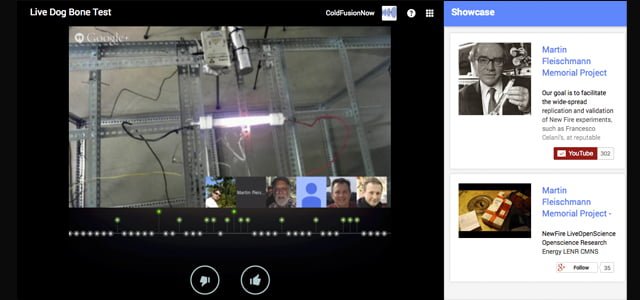
Andrea Rossi’sE-Cat was repeatedly demonstrated producing excess heat. Now owned by Industrial Heat, the technology appears to have been reproduced by well-respected Russian scientist Alexander Parkhomov [.pdf]. MFMP began to organize Project Dog Bone in October, and the group is now working with Parkhomov to reproduce his set-up. Today, a calibration test took place live on Youtube and Google hangouts, the online venues all the participation Silicon Valley can muster for this field.
Where are visioneers?
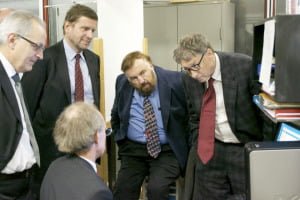
Bill Gates (far right) listens to Dr. Vittorio Violante at ENEA.Bill Gates‘ visit to ENEA labs, one of the leading institutions in the world on LENR materials science, was investigatory. How much he was told, we do not know. No further information was forthcoming from ENEA.
Nevertheless, the creators of this reality are keeping tabs on the field, but have not made funding available. Why would Bill Gates, who seeks solutions to energy problems, not see the solution cold fusion offers?
Why haven’t the daring entrepreneurs of Silicon Valley jumped on what Gerald Celente calls “the greatest investment opportunity of the 21st century”: an ultra-clean energy source that could power their technological fantasies for millenia?
David Niebauer, a lawyer who represents technology firms in California says Silicon Valley is not ignoring the field, but taking a “wait and see” attitude.
“VCs do not invest in research; they are looking for commercialization and sound go-to market strategies,” he says. “Until LENR has a viable commercial product, they will remain on the sidelines. I know a number of VCs and Silicon Valley tech companies that are watching the field with interest. Some small investments are also trickling in in the form of angel investments from individuals inside these institutions.”
Robert Godes, President and Chief Technology Officer of Brillouin Energy Corporation (BEC), a commercially-minded company based in Berkeley, California developing their own Brillouin Hot Tube reactor has met with difficulty convincing Silicon Valley capital to migrate across the bay. When asked if the Digerati were stepping up to fund new work, the answer was a flat, “No! – but we’re doing OK.”
Brillouin captured around $2 million in funding over the last couple years, money spent on hiring engineers and lab staff, and funding a collaboration with SRI International in Menlo Park, California to test their technology. They’re getting a lot of science on the way to a product.
“We have gotten results back on 3 of 5 electrolyte samples we sent out for analysis”, says Godes, “and I am hoping to get the last two soon. We can reliably produce Tritium which is a step in the process. At the same time we are also using T so that it does not build up in the system to the point where it becomes a concern for users of the technology.”
Says Godes, “We need to sell less of the company to obtain the capital required. We are close to completion of a new manufacturing process that will allow us replicate the demonstration we ran for Mike McKubre [the director of the Energy Research Lab at SRI]. That will provide another big boost to the valuation of BEC.”
A little support could make a big impact
Companies like Industrial Heat and Brillouin Energy Corporation (and there are more) represent the small independent start-ups in the new energy field, and a handful of staff is all most of these companies have. Even ENEA, the institute Bill Gates visited in Italy, is a company with perhaps less than 500 employees. How would an investment from the Gates Foundation effect their research?
Gates and Khosla both support Terra Power for next-generation nuclear technology.“We do know that Gates often invests along side his friend Vinod Khosla, one of the wealthiest and most successful VCs in the world”, says Niebauer. “Khosla is famous for his “Black Swan” theory of investing and if ever there was a “Black Swan” it is LENR.”
“If Gates and Khosla took an interest and investment position in the field, it would be huge. What we need is more investment to speed up and expand the research being conducted on a shoestring by a handful of private companies. Also, not to be underestimated is the simple acceptance [of LENR] as a valid field of research. More physics and engineering students need to be encouraged to study the field – a Gates/Khosla bet would spur research and development on many levels.”
Still, some researchers in the field say too much is still unknown to engineer a product and money is better spent on an all-out science lab where experiments would reveal nature of the reaction. Former Los Alamos National Lab nuclear chemist and author of The Explanation of LENREdmund Storms would like to see funding for lab that would have tens of experiments going at once to “breakdown each parameter space.”
“Theory guides the optimal engineering of LENR,” says Storms.
Figure emerges from ground
Cold Fusion is the Mystery Landscape that Bob Dobbs described in his model of cultural evolution. A usable technology is not yet publicly available, but the ground is forming to support it, and MFMP Live Open Science is a vital component.
While the bulk of Silicon Valley intelligence, creativity, and capital is focused on developing the next phone app, the new pioneers of technology are utilizing the network for a collaboration of global scale, and doing it on fly specks. The Martin Fleischmann Memorial Project is making our clean energy future a reality, and inviting you to participate.
Says Michael McKubre, “It would not take much to turn the LENR/CMNS field from resource-limited to talent-limited. I am looking forward to a very exciting 2015.”
The Cold Fusion 101: Introduction to Excess Power in Fleischmann-Pons Experiments course will run again on the campus of Massachusetts Institute of Technology (MIT) over the IAP winter break Tuesday through Friday Jan. 20-23, 2015.
Professor Peter Hagelstein of Electrical Engineering and Computer Science at MIT, and Dr. Mitchell Swartz of JET Energy, Inc., will present the course with topics such as:
Excess power production in the Fleischmann-Pons experiment;
lack of confirmation in early negative experiments;
theoretical problems and Huizenga’s three miracles;
physical chemistry of PdD;
electrochemistry of PdD;
loading requirements on excess power production;
the nuclear ash problem and He-4 observations;
approaches to theory;
screening in PdD;
PdD as an energetic particle detector;
constraints on the alpha energy from experiment;
overview of theoretical approaches;
coherent energy exchange between mismatched quantum systems;
coherent x-rays in the Karabut experiment and interpretation;
excess power in the NiH system;
Piantelli experiment;
prospects for a new small scale clean nuclear energy technology.
The material presented is different each day. Mid-day sessions are scheduled, with the room location to be announced.
Photo: Participants of the 15th meeting of Japan CF-Research Society courtesy Clean Planet, Inc.
Hideki Yoshino of Clean Planet, Inc co-hosted the event.The 15th Meeting of the Japan CF-Research Society was held November 1-2, 2014 at the Hokkaido Citizens Activities Promotion Center in Sapporo, Japan.
This year’s event was co-hosted by Hideki Yoshino, Founder of Clean Planet, Inc, a company providing resources to the LENR research community there, and Dr. Tadahiko Mizuno, scientist with Hydrogen Engineering Application & Developing Company and author, Nuclear Transmutation: The Reality of Cold Fusion. [buy].
Members from academia, business, government policy makers and industry in Japan were present. Dr. Akira Kitamura, an experimentalist associated with Technova, Inc and Kobe University, listed about ten active cold fusion research projects active in the country during his presentation in 2013 at ICCF-18 in The Way Forward panel [watch]. It was representatives from these groups who reported at the JCF-15 conference.
The program alternated between sessions on experiment and sessions on theory.
Co-organizer Hideki Yoshino said, “Emeritus Professor Takahashi from Osaka Univerisity presented his theories based on the results of Professor Kitamura and Dr. Iwamura from Mitsubishi Heavy Industries. These parities demonstrated the spirit of cooperation needed and the importance of collaboration by delivering tangible results.”
Yoshino described the “passionate” atmosphere of collaboration, and hints at a possible set of benchmarks to be delivered:
“Due to the relatively remoteness of Saporo, the conference attracted passionate and committed individuals from their respective fields to contribute in a manner which at times became very intense. This passion and intensity translated to the exchanges, which raised the bar for all those who attended to deliver on goals which otherwise wouldn’t have been set. These exchanges not only raised the bar on measurable and deliverable targets but also made each individual accountable to the collective group.”
“The attendance of Emeritus Professor Kasagi from Tohoku University further demonstrated the quality of the the attendees. He aggressively challenged each one of the presenters on their respective theories and the results of their experiments. His strong demeanor insured the validity and accountability of factual information of theories and processes.”
Proceedings from the meeting have not yet been released, however previously published papers describe some of the research tracks.
Experimentalist Tadahiko Mizuno of Hydrogen Engineering A&D Co. gave the Opening Address and presented Analysis of Heat Generation using Pd and Ni Fine Wires. Recently, archivist Jed Rothwell of lenr.og spent time with Dr. Mizuno and produced Report on Mizuno’s adiabatic calorimetry [.pdf].
Theorist Akito Takahashi of Technova Inc. presented Background for Condensed Cluster Fusion. Dr. Takahashi’s Physics of Cold Fusion by TSC Theory was also published in JSCMNS Vol 13. [DOWNLOAD and go to Acrobat page 575]
Yasuhiro Iwamura et al. of Mitsubishi Heavy Industries presented Increase of Transmutation Products by Electrochemical Deuterium Permeation through Nano-Structured Pd Multilayer Thin Film. A paper on this research program Increase of Reaction Products in Deuterium Permeation-induced Transmutation by Iwamura, Y., T. Itoh, and S. Tsuruga, can be found in the Journal of Condensed Matter Nuclear Science Vol. 13 published May 2014. [DOWNLOAD and go to Acrobat page 252]
Theorist Ken-ichi Tsuchiya of the National Institute of Technology, Tokyo College spoke on Convergence Aspect of the Self-consistent Calculations for Quantum States of Charged Bose Particles in Solids. Quantum States of Charged Bose Particles in Solids from JCF-5 describes the groundwork.[.pdf] See also, JCMNS Vol. 13 published A Self-Consistent Iterative Calculation for the Two Species of Charged Bosons Related to the Nuclear Reactions in Solids [DOWNLOAD and go to Acrobat page 604]
Akira Kitamura et al. of both Technova Inc. and Kobe University presented Comparison of some Ni-based nano-composite samples with respect to excess heat evolution under exposure to hydrogen isotope gas at the meeting. JSCMNS Vol 13 published Recent Progress in Gas-phase Hydrogen Isotope Absorption/Adsorption Experiments by A. Kitamura, Y. Miyoshi, H. Sakoh, A. Taniike, Y. Furuyama, A. Takahashi, R. Seto, Y. Fujita, T. Murota and T. Tahara. [DOWNLOAD and go to Acrobat page 287]
Says Yoshino, “This ongoing cooperation and collaboration among the members of JCF towards a single vision of creating clean, abundant and safe energy for all mankind, is essential for the realization of our collective goal.”
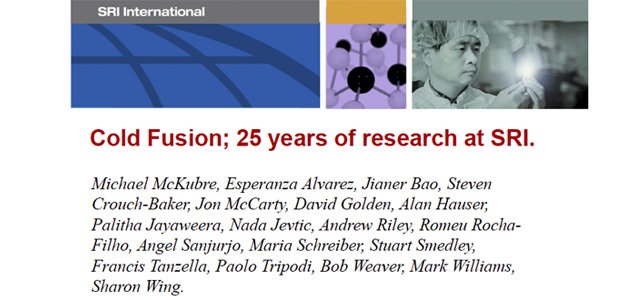
Dr. Michael McKubre describes his career researching cold fusion/LENR/CMNS at SRI, in Cold Fusion; 25 years of research at SRI presented November 5, 2014 in Oslo, Norway.
The Norwegian Academy of Technological Sciences (NTVA) and The Norwegian Society of Graduate Technical and Scientific Professionals (Tekna) sponsored the event as part of a one-day seminar Can LENR provide cheap and clean energy? drawing a capacity-crowd of around 60 people.
Former-head of Norway Defense Research Establishment and Nuclear Engineer Nils Holme chaired the committee, inviting speakers Sten Bergman of Stone Power AB in Sweden, and Hanno Essén of the Department of Mechanics, Royal Institute of Technology (KTH), Stockholm, Sweden, and Øystein Noreng, an economist from Norway.
Photo: Hanno Essen speaking in Oslo. Courtesy Infinite Energy Magazine
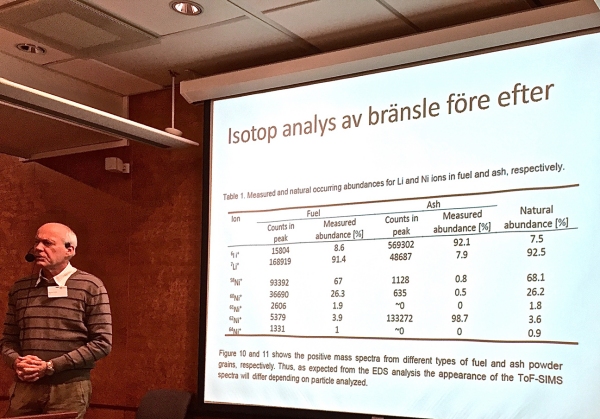
Hanno Essen, the past Chair of the Swedish Skeptics Society, recently released a report describing tests made of the E-Cat reactor, and spoke about “the various Rossi replications”.
Sten Bergman represented the energy industry perspective on LENR and Øystein Noreng spoke on “economic and other challenges of bringing any kind of LENR technology to the marketplace.”
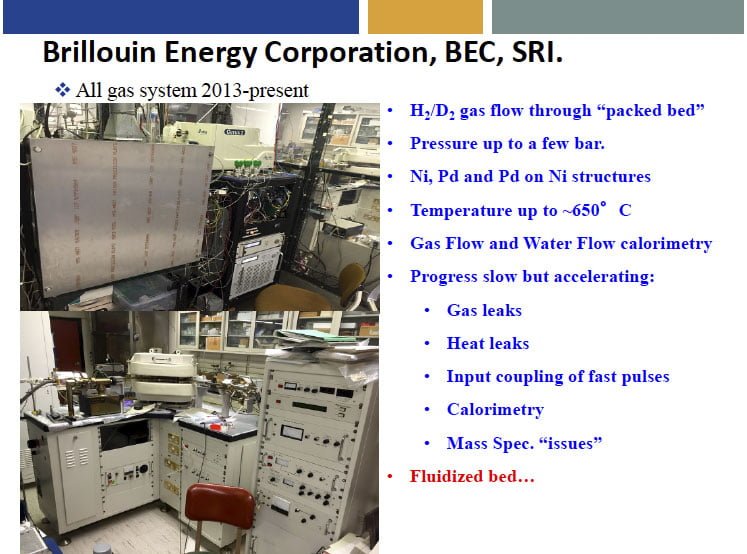
McKubre also gave “the up-to-date status of Brillouin Energy’s latest technical progress”. SRI has been working with Brillouin Energy Corp. on the testing and design of an evolving energy cell. The design’s on-demand control of the reaction needs only a higher thermal output to be commercially viable.
Slide from M.McKubre: Brillouin Energy gas flow cell gets up to 650 degrees
McKubre lists Blacklight Power, Francesco Piantelli, Andrea Rossi, Defkalion, and Brillouin Energy Corporation all as working towards a commercial product using “small dimension nickel” and light-hydrogen. As small start-ups try to piece together a product, smart communities are preparing for a world without fossil fuels. McKubre writes that the seminar was called for to help Scandinavians educate themselves and plan for a future after the rich, local oil and gas resources run out.
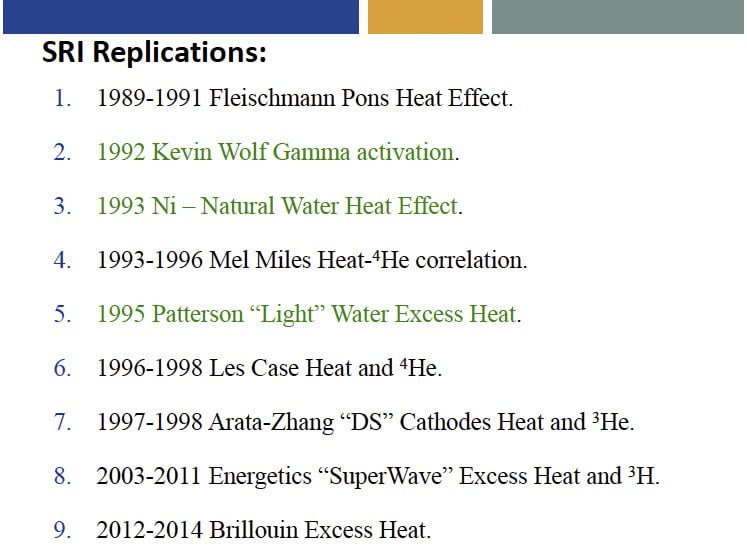
“The object was to inform the possibility that Martin Fleischmann was right (and, by implication, Randy Mills, Mel Miles, Francesco Piantelli, Les Case, Yoshio Arata, Andrea Rossi, Tadahiko Mizuno, Defkalion, Brillouin and a host of others afterwards),” writes McKubre.
Slide from M.McKubre 25 Years Research at SRI: Successful replications of six different types of cold fusion experiment.McKubre writes, “I believe what my hosts would like to see is at least one active, productive research project established in a Nordic country (Norway, Sweden, Finland, Denmark) that would allow this community to “pay to play” in the LENR/CMNS world and thus be prepared for any sudden advances. A secondary purpose would be to train young people to be the next leaders of any ensuing technology.”
“This is a reasonable and rational approach that I certainly support. Let me say that more strongly. Any major country or company that does not engage now, or soon, runs a serious risk of missing the start of the revolution and being trampled.”
“That is not to say that I know that LENR will contribute significantly to primary power generation in any form in the near future, or that I know how.
But having studied the field closely now for more than 25 years (more than 35 years if you count our earlier studies of the Pd-D system for other reasons), nothing I know stands as significant impediment to this achievement…
… and the hoped-for goal of the “good guys” appears to be rapidly approaching. For a long time now corporations have been “lining up to be second” — afraid of the stigma, afraid to be left behind, but with insufficient courage to go first.[2]”
“With this in mind the Norwegian strategy of “hedging” seems to be entirely appropriate with no risk attached and very little cost associated. In the worst case young people can be trained in relevant disciplines of physical sciences and physics that will have high value in a wide range of applications and implementations. In the best case Norway, Sweden and whichever Nordic country chooses to be involved can position themselves to be at or near the front of the coming wave.”