Cold Fusion: A Big Idea for Minnesota Energy Research! A Better Comet: Post Bulletin Beats New York Times

That was a nice comet last week… a more spectacular one is due to appear in December

“Cold Fusion: A Big Idea for Minnesota Energy Research” Friday, February 8, 2013, by Tom Robertson, Post Bulletin. (view) The Post-Bulletin is the largest  daily newspaper in Southeastern Minnesota.

From Tom Robertson’s article:

  • The Hunt’s focus on sustainable living is supported by profits from a wildly successful invention Paul devised in the 1990s. The self-taught inventor patented the “turtle meter,” which allows utility companies to remotely read electric power meters.
  • Hunt sold his invention for tens of millions. His company now is using the money for research and development, searching for the next breakthrough invention to sustain the company and its 20 employees.
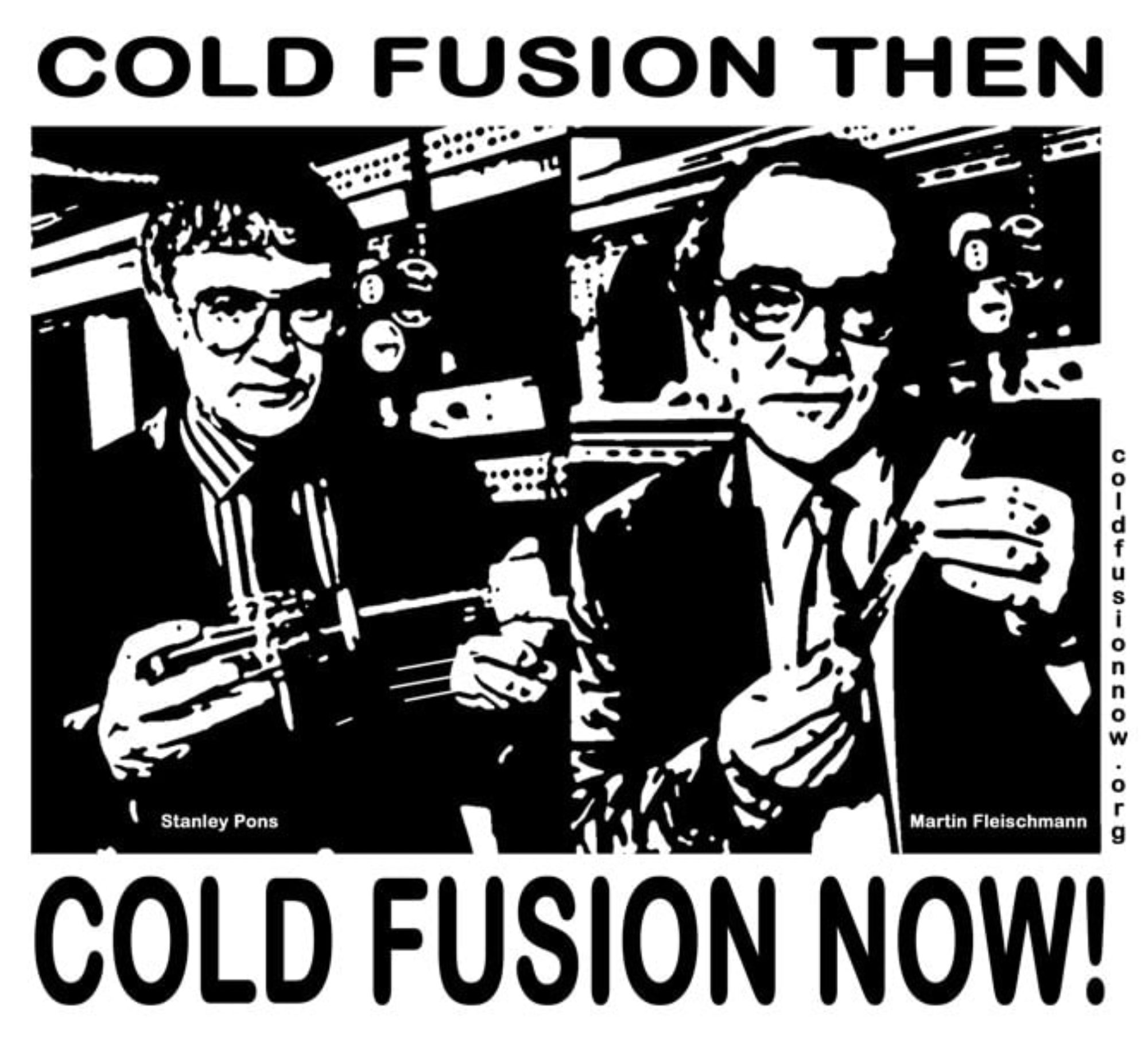
  • That’s where cold fusion comes in. The technology was first introduced in 1989 by two scientists who claimed they were able to produce excess heat from an experiment that combined hydrogen and electricity with various metals.
  • When other scientists were unable to consistently replicate the effect, mainstream scientists largely rejected cold fusion.
  • When Paul Hunt first started looking into the technology two years ago, he and his son, Ryan, the company’s head of research and development, were skeptical.
  • “Both of us looked at each other here and said ‘cold fusion, I thought that was dead. I thought that was fake,'” Hunt said. “We started paying attention to it. And then we started looking at the history of it, and found out that it really is real. It’s being done in labs all over the world.”
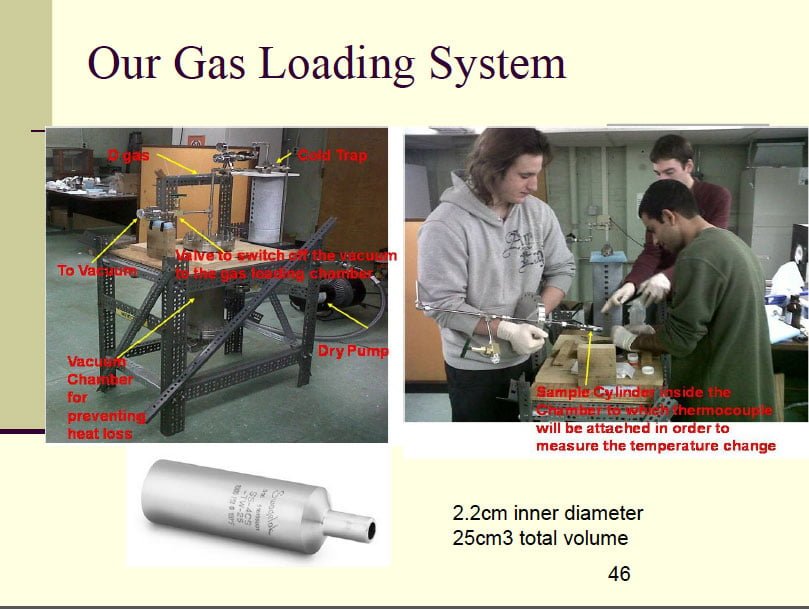
  • In the company’s research lab, Ryan Hunt, who holds a degree in chemical engineering from the University of Minnesota, recently stood over a pair of small, transparent tubes containing ceramic structures that hold pairs of hair-thin wires. The apparatus is similar to ones he saw demonstrated by an Italian scientist at a conference in Korea last summer.
  • Hunt said he and his team achieved the cold fusion effect for the first time just last month.
  • The same unexplainable effect has reportedly been achieved at more than 100 other laboratories worldwide. Most have ditched the term “cold fusion” in favor of the term “low-energy nuclear reactions.”
  • Hunt Utilities Group has teamed with scientists in Europe to collaborate. They post their data on low-energy nuclear reactions online and invite other researchers to review and comment on their methods.


YET… The following New York Times article appears (with no mention of cold fusion). Was the Hunts’ cold fusion research edited out of the interview material?

New York Times – January 11, 2013, Environment section – Green: A Blog About Energy and the Environment – “In Rural Minnesota, a 70-Acre Lab for Sustainable Living” By Bryn Nelson (post)

Within this laboratory of energy-efficient housing, the Hunt Utilities Group, or HUG, mixes high-tech ingenuity with homespun practicality and a touch of whimsy in its drive toward what Mrs. Hunt laughingly dubs “decadent sustainability. ” 

WEIRD… Didn’t the NYT folks go to the Hunt Utilities Group site for background research? Didn’t they realize they were nibbling at the scoop of the millennium?

Did the NYT people read any of the related material… LENR by Paul Hunt or NASA? (NASA)

HUG quote, “For 10 years we have been focused on solar, wind, super insulation, etc. This new energy could make all those things obsolete.”

I doubt that Mr. and Mrs. Hunt, or their son, failed to mention cold fusion research to the NYT interviewers.

What do the Hunts think about cold fusion? Visit the HUG site… (Hunt Utilities Group site) Read the (Feb 2013 coldfusionnow article) which contains the following…

  • “Paul Hunt and his son Ryan formed the Hunt Utilities Group (HUG) and initiated the Martin Fleischmann Memorial Project to reproduce and test cold fusion experiments.”


and…

  • “They announced the project at the most recent International Conference on Cold FusionICCF-17 in Daejon, South Korea, and since then, have been experimenting with Francesco Celani‘s nickel wire, making surprising discoveries about the material. Their work is open-source and can be found at quantumheat.org.”


NOW…

New York Times is closing its’ “Green: A Blog…” site.  They ask, “Follow Our Environmental Coverage” (link)

WHY should I do so?

I wonder what the NYT “Green: A Blog…” writers feel about this? (list)  Also at…(list)

Or Andy Revkin? “A Farewell to Green” By Andrew C. Revkin, March 2, 2013 (article)

Readers of the New York Times may want to ask the editors… “What’s up with cold fusion now?”

The New York Times editors may answer…

“Censorship of cold fusion research and LENR engineering is our policy.”


How else is it that the Post Bulletin Beats the New York Times coverage of the ‘cold fusion comet’ appearing brightly in labs…

Like the 70-Acre Lab for Sustainable Living In Rural Minnesota?

“Within science is the art of appreciation; the source of all true inspiration.” – gbgoble2013

Paul et al, Thanks for the HUG! Hunt Utilities Group… LENR research and engineering.

Thank you, Tom Robertson and the folks at Post Bulletin.

Thanks, Christopher Johnson and Journal of the History of Ideas, Harvard University.

Cold Fusion Now

Comet… A long haired star that appears from the unknown.

Comet Etymology

c.1200, from Old French comete (12c., Modern French comète), from Latin cometa, from Greek (aster) kometes, literally “long-haired (star),” from kome “hair of the head” (cf. koman “let the hair grow long”) [Middle English comete, from Old English comta, from Late Latin, from Latin comts, from Greek komts, long-haired (star), comet, from kom, hair.] comet·ary (–tr), co·metic (k-mtk) adj.

Word History: Comets have been feared throughout much of human history, and even in our own time their goings and comings receive great attention. Perhaps a comet might seem less awesome if we realized that our name for it is based on a figurative resemblance between it and humans. This figurative name is recorded first in the works of Aristotle, in which he uses kom, the Greek word for “hair of the head,” to mean “luminous tail of a comet.” Aristotle then uses the derived word komts, “wearing long hair,” as a noun meaning “comet.” The Greek word was adopted into Latin as comts, which was refashioned in Late Latin and given the form comta, furnishing Old English with comta, the earliest English ancestor of our word comet.

“Epistemology and Intertextuality in Early American Cometography”

Christopher Johnson


In the winter of 1680-81 an enormous comet appeared in the nighttime skies of Europe and the Americas. This “blazing star” occasioned numerous treatises, poems, pamphlets, broadsides, ballads, engravings, and woodcuts. Evaluating this cometary copia, the historian of science, Pingré, in 1783 observes:

The world was inundated with writings on these phenomena, on their nature, on their significations; for there were still astrologers and cometomantics [Cométomantiens] … I believe that the languages were not even as confused at the Tower of Babel, as were the sentiments concerning this famous comet.

Pingré’s belated impatience with the discursive flood of “astrologers and cometomantics” echoes of course the more general Cartesian objection to the confusion of words and things, a confusion that L’Académie des Sciences and Royal Society dedicated themselves to eliminating. But the arduous nature of this effort in seventeenth-century Europe is exemplified by the numerous, often-conflicting interpretations of the 1618, 1665, and 1680 comets—to say nothing of the unprecedented “new stars” or novas of 1572 and 1604, which were often treated as cometary phenomena.


 

LENR generator is “crowdvoting” favorite

The LENR Distributed Power Units project up on the Future Energy “crowdvoting” platform is the favorite with just hours to go, though the Printable Photovoltaics is still hanging on for a last minute surge.

If you haven’t yet, there’s still time to vote!

George Miley is Professor Emeritus of University of Chicago Urbana-Champagne, Illinois, and the intellect behind LENUCO and the LENR-Gen unit.

He describes the “core technology” presented in a statement on the front page:

1.25 grams of nickel = 5 barrels of oil
1.25 grams of nickel can make energy like 5 barrels of oil
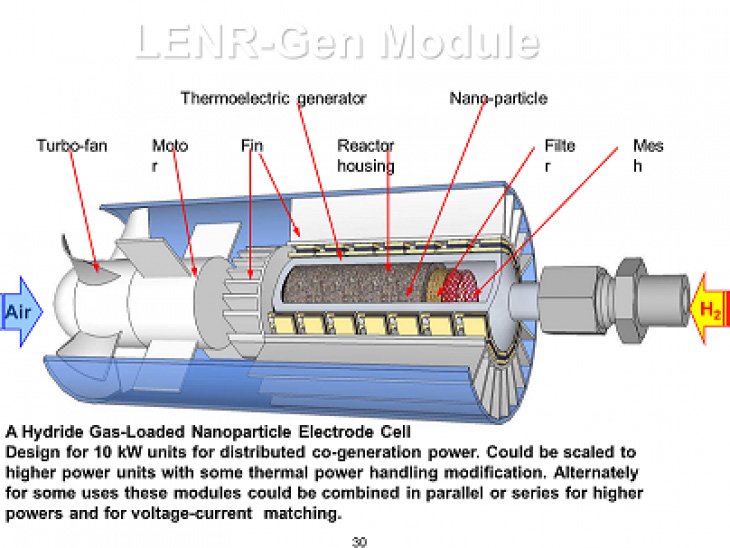
LENR Power Units use pressurized hydrogen –nickel nanoparticles undergoing low energy nuclear reactions to create a very high energy density heat source configured for co-generation power for home or industrial distributed power
–George Miley LENR Distributed Power Units

That means that tiny particles of nickel – the very same nickel in your pocket as change – are exposed to hydrogen H, the simplest element in the universe, and found in water.

In a small chamber that has a higher-pressure than normal, the hydrogen interacts with the nickel atoms to make heat.

At the NETS conference last year, Miley presented a design for a LENR generator that could replace the dirty radioactive fuel currently used by NASA for spacecraft power in the General Purpose Heat Source with clean nickel and hydrogen heat source.

RTG-GPHS

The heat is closer in magnitude to Einstein’s E = mc2 energy than it is to burning hydrocarbons, and a lot cleaner.

Mass changing to energy is a nuclear phenomenon, not a chemical phenomenon, but no radioactive materials are used.

A reaction based on the metal nickel and hydrogen, there is no dangerous radiation from the LENUCO power unit.

This source of this heat power is called the new fire.

While the current handful of startups around the world is almost wholly focused on hot-water heaters, LENUCO plans to make electricity with this device.

The smaller 10K units would be for civilian use, though a military customer is in the plan as well:

The recent discovery of practical applications of low energy nuclear reactions (LENR) has created much activity and interest worldwide. Several companies, including LENUCO, have entered this business. Our approach using hydrogen loaded nanoparticles to produce heat that is converted to electrical output offers many advantages. Lenuco was founded to commercialize this technology and has a two-pronged business model. One prong is to manufacture small to medium range distributed power sources for home and industrial use.

The second prong is to provide develop the technology for use by in Army bases, both homeland and in forward facilities, for a main power source.

Both uses capitalize on the high power density and low maintenance, radiation free, long lifetime characteristics of LENR power cells.

University students work on similar LENR experiments under Dr. Miley's instruction.
University students work on similar LENR experiments under Dr. Miley’s instruction.
LENUCO’s LENR power source is a revolutionary new technology based on high pressure hydrogen loading of nickel-alloy based nanoparticles.

Heat is produced by the resulting low energy nuclear reactions through a process which avoids any significant radioactivity.

Uses range from home heating to central heating units.

Compared to other renewable energy, LENR power units offer two distinct advantages: 24/7 operation and higher power density, hence significantly smaller units per unit power.

LENR cells also provide power without greenhouse emissions and with no significant wastes.

These advantages plus minimum maintenance and long lifetime result in a distinct economic advantage over other renewable energy sources as reflected by shorter pay-back times than solar, wind or fuel cells. –George Miley LENR Distributed Power Units

If you haven’t voted yet, there’s still time but you must act now:
VOTE-LENUCO

Related

U.S. Schools with Cold Fusion-Friendly Faculty by Ruby Carat

LENR-Gen Module needs your vote by Ruby Carat

Andrea Rossi on Tom and Doug Show: “It is a very important moment”

Tom and Doug are two musicians who have a weekly radio show where they regularly discuss Andrea Rossi and the Ecat.

They’ve written songs on the topic, including I Believe in the Ecat, and LENR Revolution, complete with Rossi audio samples and a saxophone player inserted in the Ecat demonstration video.

An interview with Andrea Rossi conducted by Doug in mid-February opens this video where Rossi talks about plans for industrial Ecats and the third-party testing of the Hot Cat.

Some of the points made were:

  • After the delivery of the 1MW Ecat to the military last year, work ensued on engineering the industrial plants for certification.
  • Now, work continues on “manufacturing some industrial plants that are close to being delivered”, and the certification process continues.
  • The independent test of the Hot Cat, the Ecat that works at high-temperature, should be finished by the end of March.
  • It will be an important validation, but manufacturing of the industrial Ecats will continue regardless of the independent report. The third-party test and the industrial production are independent, but parallel. Rossi is very curious to learn what the report says, and will apply any new information to the engineering process.
  • He’s in contact with the third-party once or twice a week, but the main daily focus is completing the industrial plants that have already been sold.
  • He continues to work long hours, and will continue “pressing” until delivery.
  • After the industrial plants are delivered and working in their factory location, data from their operations will guide work on the domestic Ecat. The industrial plants are “basically assemblies of domestic plants”.
  • Domestic units for the home need to be easy to use and held to a high standard of safety.

Tom and Doug interview Andrea Rossi on Ecats future by Ruby Carat

Oilprice.com links COT and new energy breakthrough

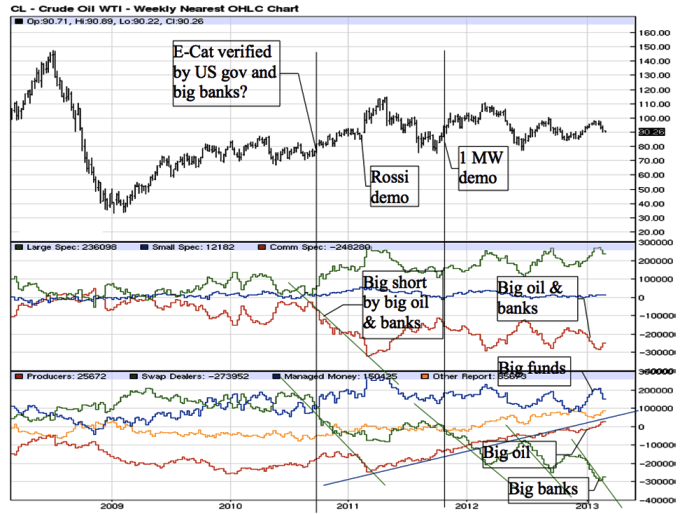
In Why Are the Big Financial Institutions Selling Oil BIG?, Oilprice.com author Torkel Nyberg links oil and low-energy nuclear reactions (LENR) in his analysis of a recent Commitment of Traders (COT) reports.

It is a provocative thesis of his that the largest of corporations and financial institutions have inside knowledge of a breakthrough in LENR via Andrea Rossi‘s Ecat.

AE1620

From the article:
At some point during the fall of 2010 there was a large policy shift in hedging crude oil on the NYMEX futures exchange by the big banks and the oil companies. Up to that point the hedgers of crude have largely been the producers as they want to hedge their production against future price movements. On the buy side there was the big financial institutions (Swap Dealers = JP Morgan, Goldman Sachs, etc), and the money managers (large pension funds, hedge funds, etc.), that speculate in a price increase.

But during the fall of 2010 this state of affairs changed. From being net-long 200 thousand contracts, the banks became net-short in a couple of months. Their selling has since continued. And now, by March 2013, they are net-short 300 thousand contracts (300 million barrels of oil = $30 billion). See the green lines in the chart above.

At the same time the producers have liquidated their 200 thousand contract short position (blue line above). They are no longer hedging as they used to. And they’ve done it in a very consistent way. It looks almost unreal, buying an equal amount of contracts each month for two years.

During this time the banks have consistently been using a strategy to buy weakness and sell strength during their massive net-selling. As if their strategy was to build a huge short position and at the same time stabilize price. The conclusion is that the banks are now net-short about 300 thousand contracts at a price about $90-$95.

On the buy side the money managers went from being neutral by fall of 2010 to being net-long 250 thousand contracts as of today. This is of course the big funds, and in the end pensions and savings. They are now net-long oil and of course net-long all the producers (oil stocks).

Researching this strategy change has given very little information. One article though, from July 2012, touches on the subject. No answers and no explanations though. [Insidefutures.com]

Following the Commitments of Traders Report (CoT) does however reveal a great deal of information. The standard report shows the commercial traders, (oil companies and banks), large speculators (big funds) and smaller speculators (the rest). The disaggregated report also shows the position of banks and producers respectively. Both these reports are shown in the graph above. The combination does tell us that something is going on, but what?

Something real is going on, but what?

Continue reading here.

The realization of Peak Oil looms large in any examination of the oil business, and will figure in any industry moves.

But as incremental successes in experimental new energy cells from LENR accelerate, the potential Black Swan of cold fusion should not be far from any energy study either, and we are beginning to see that here.

LENR-Gen Module needs your vote

George Miley‘s LENUCO company is vying for a chance to speak and “pitch” for funding to develop the LENR-Gen module, this time, from private investment representatives.

LENUCO has previously attempted to access ARPA-E funding at the ARPA-E Energy Innovation Summit.

LENR-Gen modules are, according to Miley, “LENR Power Units [that] use pressurized hydrogen–nickel nanoparticles undergoing low energy nuclear reactions to create a very high energy density heat source configured for co-generation power for home or industrial distributed power.”

Support LENR research and VOTE HERE.

Then check for confirmation email so your vote counts. Didn’t get it? Check your Junk (Spam) folder.

Voting ends March 15.

From the website’s http://futureenergy.ultralightstartups.com/pages/timeline:
To participate in the Future Energy Pitching Event at MIT on April 4, 2013, companies must apply for consideration. Future Energy is opening the selection process to the public and the energy community through a crowdvoting contest. The two startups that receive the most votes during the crowdvoting contest will receive automatic bids to present at the Future Energy event at MIT on April 4, 2013.

March 1: Crowd Voting Opens
Future Energy will pre-select startups to take part in the crowdvoting contest
Pre-selected startups will be invited to create profiles on the Future Energy crowdvoting platform. Sign In Here
Voting and rating opens to the public

March 6: Pitching Application Closes
Last day to apply to pitch at the April 4 Future Energy event at MIT.
Click here to apply to pitch at other Future Energy events

March 15: Crowd Voting Contest Ends
The startups with the most votes will be announced. These companies will be guaranteed two of the eight pitching spots at the Future Energy Pitching Event at MIT on April 4, 2013.

Give LENR a hearing – vote NOW!

ARPA-E has failed its claimed mission to support experimental research on new energy, and now forces scientists to get crowdfunding votes. U.S. Energy Secretary Steven Chu recently stepped down, choosing not to serve a second term.

Cold Fusion Now expects ARPA-E Director Arun Majumdar to fund LENR research, or do the same.

“LENR Distributed Power Units” from George H. Miley


New company LENUCO first reported here on Cold Fusion Now a year ago is now releasing more on its new LENR technology.

Designed by George H. Miley and his team, the LENR-Gen Module is conceived for 10 kw units, but can be scaled up for larger power needs.

VOTING has ended. No further info is to be found at this time…
Please Vote Now at Future Energy to give this project attention from ARPA-E.

Your vote will allow George Miley to speak at the ARPA-E Energy Innovation Summit Future Energy Pitching Session on February 25, 2013 6:30-8:30pm.

From the website:

Provide one sentence describing your core technology.

LENR Power Units use pressurized hydrogen –nickel nanoparticles undergoing low energy nuclear reactions to create a very high energy density heat source configured for co-generation power for home or industrial distributed power.

Short description of your technology

The recent discovery of practical applications of low energy nuclear reactions has created much activity and interest worldwide. Several companies, including LENUCO, have entered this business. Our approach using hydrogen loaded nanoparticles to produce heat that is converted to electrical output offers many advantages. Lenuco was founded to commercialize this technology and has a two-pronged business model. One prong is to manufacture small to medium range distributed power sources for home and industrial use. The second prong is to provide develop the technology for use by in Army bases, both homeland and in forward facilities, for a main power source. Both uses capitalize on the high power density and low maintenance, radiation free, long lifetime characteristics of LENR power cells.

What is the key element of your technology that differentiates it from existing solutions

LENUCO’s LENR power source is a revolutionary new technology based on high pressure hydrogen loading of nickel alloy based nanoparticles. Heat is produced by the resulting low energy nuclear reactions through a process which avoids any significant radioactivity. Uses range from home heating to central heating units. Compared to other renewable energy, LENR power units offer two distinct advantages: 24/7 operation and higher power density, hence significantly smaller units per unit power. LENR cells also provide power without greenhouse emissions and with no significant wastes. These advantages plus minimum maintenance and long lifetime result in a distinct economic advantage over other renewable energy sources as reflected by shorter pay-back times than solar, wind or fuel cells.

LENUCO

Related

George Miley: “Let’s find out what’s there” by Ruby Carat

Session 462 Advanced Concepts: LENR, Anti-matter, and Advanced Physics

ARPA-E wants “Transformational Energy Technologies”

U.S. Schools with Cold Fusion-Friendly Faculty

Top