On the way to San Jose

Cold Fusion Now is en route to the San Jose Film Festival screening of The Believers, a new cold fusion documentary from 137 Films.

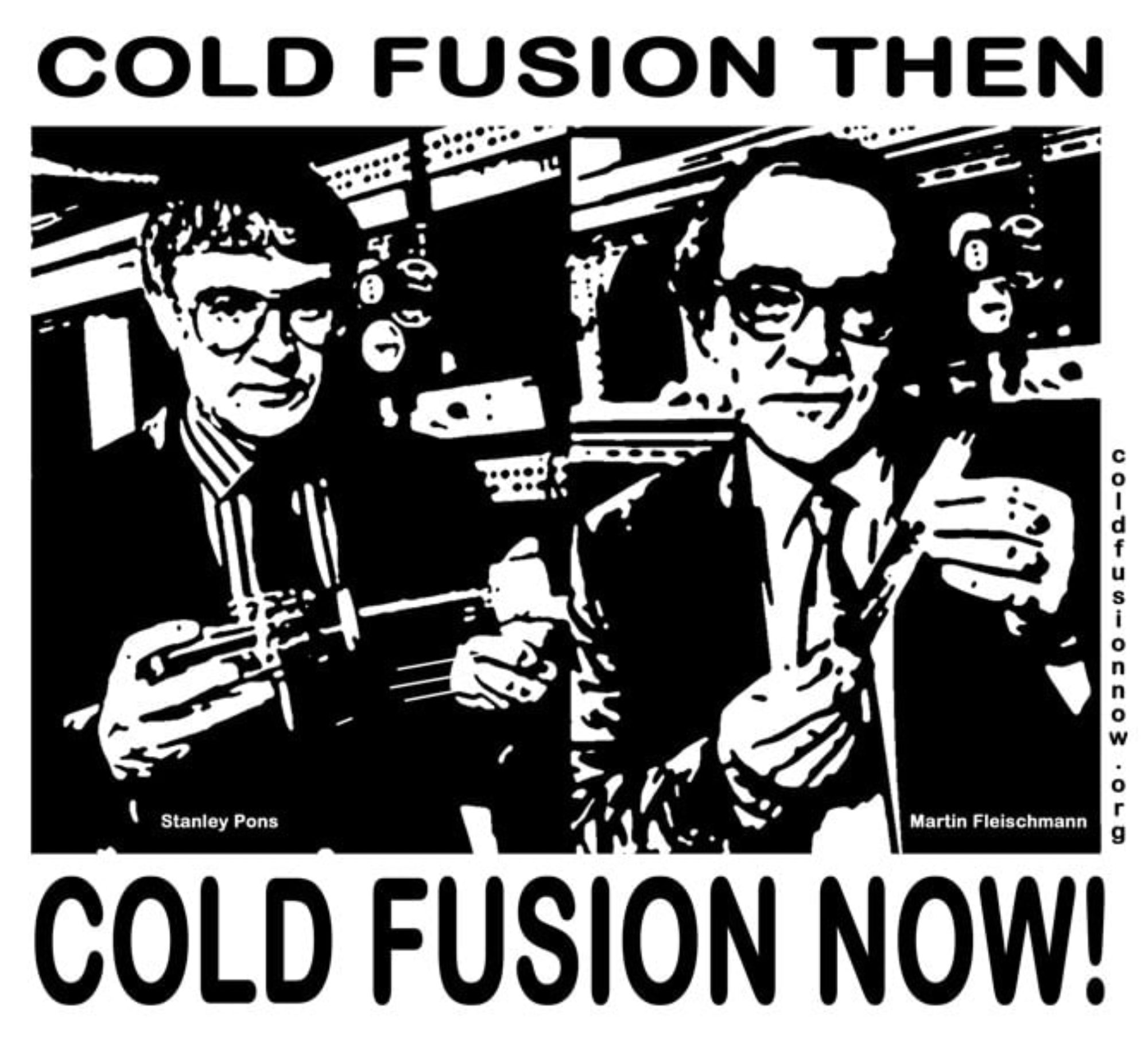
The 80-minute sample of cold fusion history focuses on the aftermath of the March 23, 1989 announcement of cold fusion by Drs. Martin Fleischmann and Stanley Pons. Video of Martin Fleischmann in declining health makes for an emotionally-tough portrait.

Cold Fusion Now will offer free goodies to patrons after the Friday night show as antidote to anguish.

But there’s plenty of sunshine to spread all the way to San Jose.

I made a stop at my favorite Spaceport in Mojave and dropped off History of Cold Fusion Calendars to rocket scientists.

Voyager-Bulletin-Board-124331Voyager Restaurant got the first visit.

I posted up a calendar on their bulletin board for all the spaceship engineers to see at lunch.

It was a crowded spot, but you can sure see it, and plenty of people pass by on their way to the restaurant overlooking the runway.
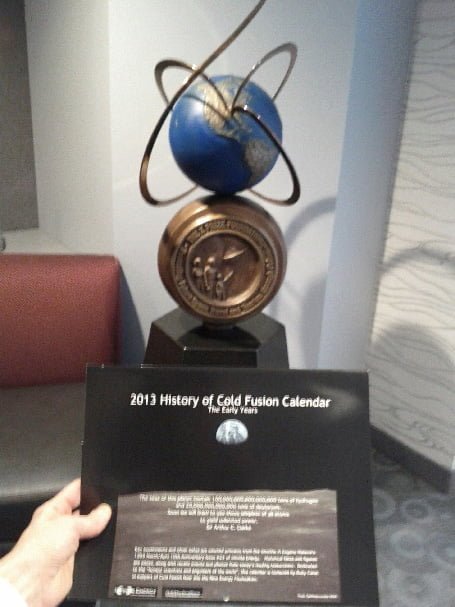
Scaled-X-Prize-125700Rolling over to Scaled Composites, I dropped off a handful of calendars for the designers of SpaceShipOne and Two.

The Secretary at the Front Desk really dug all the info packed into each page.

I took a picture of the calendar in front of their X-prize that commands the lobby.

I had to sigh, if only there was an X-prize for new energy…

Then I slid over to Xcor, a small, independent company making their own spaceship – “the whole thing”, said the young engineer who answered the door. I said cold fusion promises a clean, dense, power solution, though no technology is available just yet.

Showing him the pictures of cold fusion cells, he said “I need a power plant – not two guys with a test-tube!”

I had to laugh at that one, and told him “it’s in the works…”

Driving cross the port to BAE Systems, I saw for the first time the big, new hangar for Virgin Galactic. It was almost like spotting a used bookstore from the road – I made a beeline to their facility.

Walking through the lobby doors, I had to remember that I was walking through the doors of a commercial space enterprise – with real spaceships – for people!

“Hi, I do clean energy advocacy for cold fusion and wanted to drop off a few calendars for your engineering team,” I said to the woman at the Virgin Galactic Front Desk.

“Well thank you, nobody ever gives us calendars!” she kindly replied.

I sure was happy to break the mold.
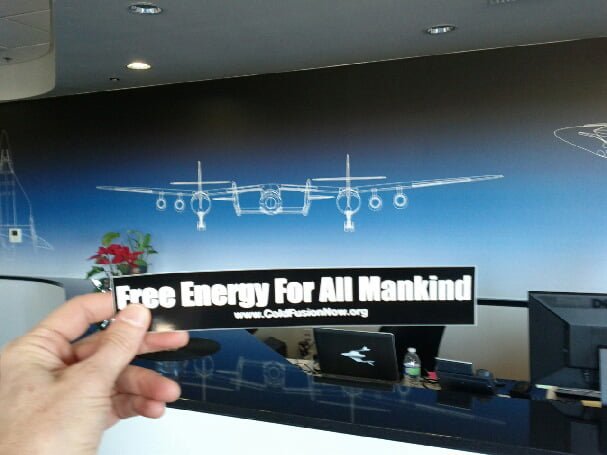
Virgin-Galactic-Lobby-133501“Are you an engineer?” I asked a young man standing around watching our exchange.

“Uh, I’m one of ’em,” he said.

“Here, have a calendar!”

He started paging through the “facts, fotos, and fun” right away!

I wasn’t allowed to take photos of the place, only the lobby backdrop. I was so excited, I forgot to ask about the graphics, but that sure looks like a WhiteKnight to me.

I pulled out of Mojave satisfied that cold fusion will be on the lips of at least a few engineers tonite – one way or another, and they’ve got a handy reference too. I’ll look forward to stopping in again on my way back down to Los Angeles in another week or two.

Will the calendar on the bulletin board still be there? How many were recycled? How many were ridiculed? How many inspired?

Hey Mojave, hope you dig it, and check out George Miley‘s GPHS designed to replace RTGs as presented in Session 462 Advanced Concepts at the NETS last year.
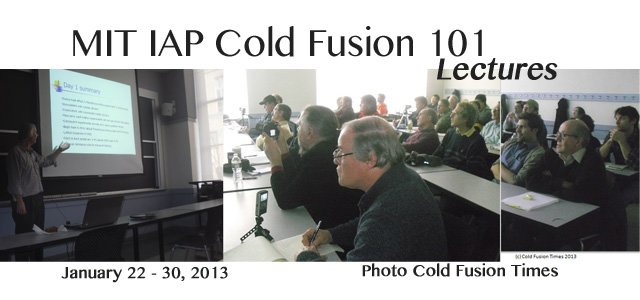
Peter Hagelstein Intro to Excess Power (with Enhanced Audio)

Introduction to Excess Power in Fleischmann-Pons Experiments lectures by Dr. Peter Hagelstein now with enhanced audio compliments uploadJ.

What follows are Jeremy Rys‘ classroom video series with the processed audio track by uploadJ.

Watch the second week’s lectures with JET Energy engineer and co-teacher Dr. Mitchell Swartz, who describes experimental results on their NANOR technology here.

ALSO: Gayle Verner‘s Synopsis of Cold Fusion 101 courtesy Infinite Energy Magazine.

New Energy Emerging at LASER

Photo Ruby Carat at LASER courtesy Michael Shields

Cold Fusion Now spoke at the LASER event hosted by Art/Sci on Thursday, February 21 on the UCLA campus.

laser-logo-2_150-borderAkin to speed dating for your corpus callosum, the salon where artists meet scientists (and vice versa) attracts a wide range of creative individuals who present their ideas in 5-minute intervals.

The title of my five minutes was New Energy Emerging.

Too bad I didn’t even get through half of it, and not even to the Newly Emerging part. Was I sleepin? Next 5-minute gig – step it up!

The vibe was positive, and Cold Fusion Now has made a connection. Putting more minds to the questions of cold fusion can only be a good thing. We can figure this out collectively, so let’s get some more brain power on it!


New Energy Emerging

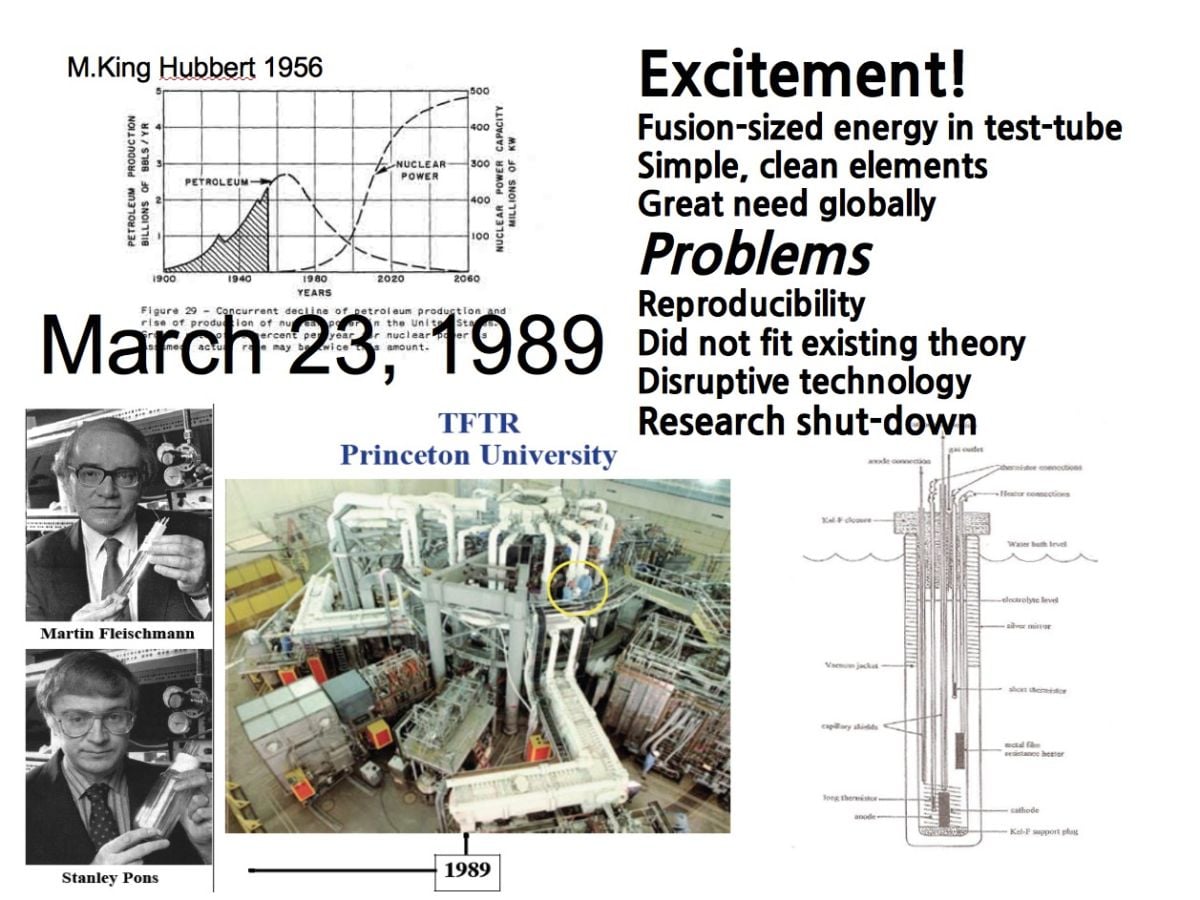
LASER-Feb-21-talk-slides-1M. King Hubbert’s 1956 prediction that nuclear power would carry human civilization far in a technological future became a real possibility in 1989 when Drs. Martin Fleischmann and Stanley Pons announced their discovery of fusion-sized excess heat generated in a small table-top electrolytic cell.

A charge applied to a palladium cathode and a platinum anode immersed in a heavy water solution creates excess heat with magnitude so great, it must be of nuclear origin, though little to no radiation is measured.

Scientists around the world dropped everything and became electro-chemists overnight attempting to reproduce their results.

Unfortunately, only about 15% of those attempts were successful, and, it doesn’t fit the conventional theory of nuclear reactions of one hundred years ago based on fusion in hot plasmas.

The pair was denounced and cold fusion was abandoned by mainstream science.

LASER-Feb-21-talk-slides-2
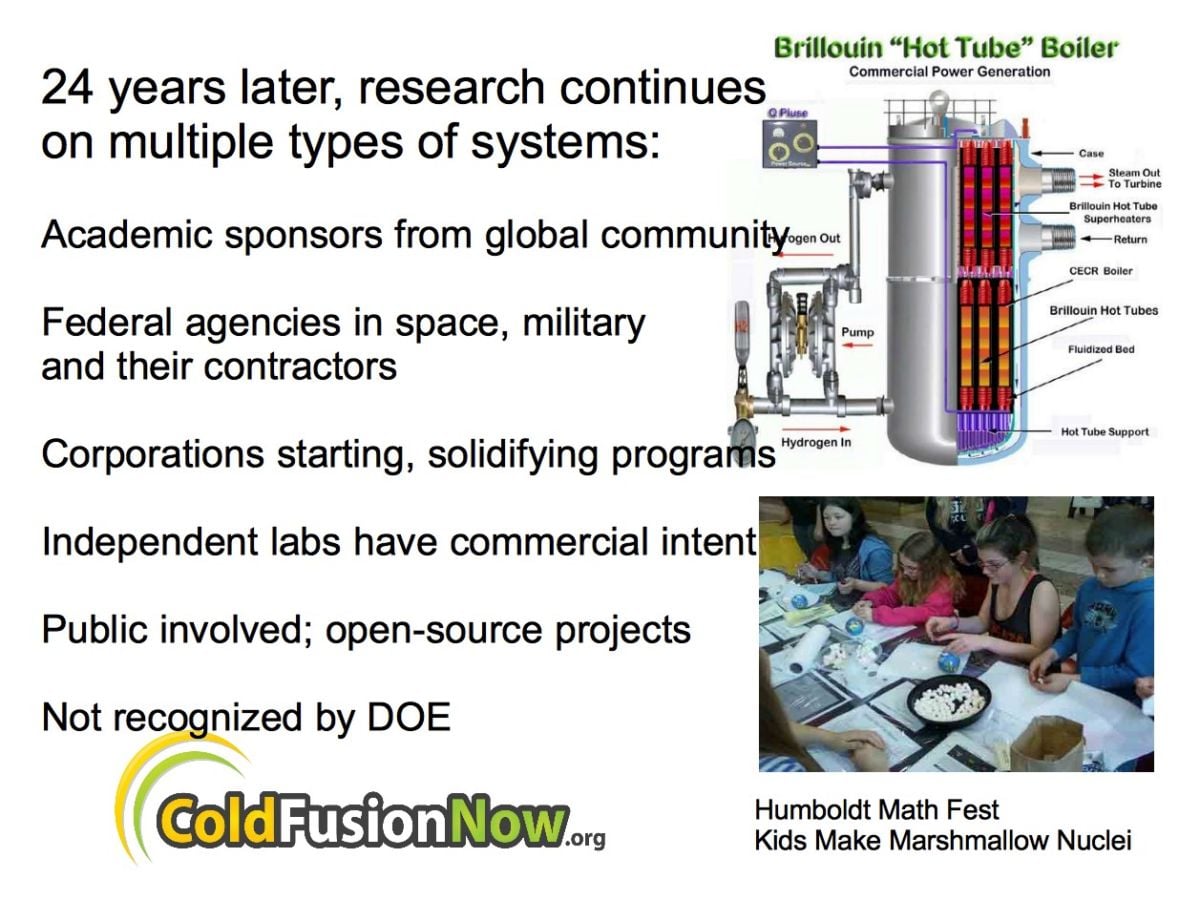
2 24 years later, the 15% who did reproduce the effect have gradually understood many of the things that prevented earlier success.

Multiple materials are known to initiate excess heat and transmutation products. Gas-loaded cells and nano-particles have become a focus. One local researcher at University of LaVerne uses nano-palladium loaded zeolites exposed to D gas to initiate excess heat.

Public, open-source projects are linking nuclear scientists with skilled citizens world-wide to reproduce results, and while the governments of China, Japan, Italy, Sweden and others are supportive, the US Department of Energy does not acknowledge this science.

LASER-Feb-21-talk-slides-3

3 Why is this so important? With a water fuel, there’re no CO2 emissions.

This is nuclear power, but no radioactive materials are used, and the transmutation effect offers a path to ridding the planet of nuclear waste.

Nuclear products are so little and few, they are difficult to detect. Some cells produce only helium.

One estimation for ERoEI was 3000 to 1; a unit the size of a microwave can power your home, no electrical grid needed.

We can remove hydro-electric dams, restore waterways and wilderness, and it becomes economically-viable to recycle all waste.

So what’s the problem?

And that’s where the room was left hanging!

Here’s what I didn’t get to:

LASER-Feb-21-talk-slides-4

4 There is no definitive theory that describes these effects; no recipe defining how to make the reaction happen; advances have been hard-won by trial-and-error.

A different theory guides each commercial prototype. The many names trace the various models.

But lack of theory won’t stop commercial development which suffers from two issues:either control of the reaction, or stability of the high-power output.

Cold fusion is not hot fusion, and we need a coordinated research strategy to solve this.

5 Put the power of your minds to collectively form a solution to one of the greatest scientific questions before us.

Experts in the field can provide a full survey of the experimental evidence over two-and-half-decades, along with an overview of how these measurements have been made. Reach out to local scientists in this field.

Marshall McLuhan taught the greatest changes to society are due to new technologies.

Look at this not just for the excitement of discovery, but to secure the chance for a green, technological human future on Earth and beyond.

Thank you.

Did the 2004 US DoE review reject cold fusion?

No.

“Cold fusion,” as reviewed in 2004, was primarily the Fleischmann-Pons Heat Effect, with palladium deuteride, through electrolytic or gas loading.

The review panel was evenly split on the issue of anomalous heat, half considering the evidence for a heat anomaly “compelling.”

The only direct evidence that the FP Heat Effect is “nuclear” is the production of helium correlated with heat, first reported by Miles in 1991, and confirmed by other groups later. There are other reported nuclear effects, such as tritium, but none of these have been correlated with heat, so far, and none are at levels  allowing them to be a major part of the reaction producing measurable heat.

On the question of whether or not the FPHE was nuclear, only one reviewer considered nuclear evidence “convincing.” About a third considered it “somewhat convincing.”

It is easy, reading the review and the related documents carefully, to understand the conclusions. The review contained this:

Results reported in the review document purported to show that  4He was detected in five out of  sixteen cases where electrolytic cells were reported to be producing excess heat.The detected 4He was typically very close to, but reportedly above background levels. This evidence was taken as convincing or somewhat convincing by some reviewers; for others the lack of consistency was an indication that the overall hypothesis was not justified. Contamination of apparatus or samples by air containing 4He was cited as one possible cause for false positive results in some measurements.

Given that summary, were it accurate on fact, the conclusion of “unconvincing” was rational and sound. Notice the “lack of consistency” in five out of sixteen.

However, there were two errors. The minor error was that 5/16 is from the  Case Appendix, which is about gas-loaded palladium on a carbon catalyst base, not “electrolytic cells.”

The major error is the claim that these cells were “producing excess heat.” However, in that Appendix, heat data was given for only one cell. The Case Appendix was seriously defective, missing crucial information. If provided, it would have shown a stunning correlation between heat and helium.

However, the panel had other heat/helium evidence before it. Miles was referenced. However, the reviewers had 130 papers to consider in a short time.

Only one reviewer showed clear signs of having read Miles, the one convinced as to “nuclear.” Miles is, stand-alone, conclusive, needing only confirmation. Because Miles, and other reports as being confirmations of Miles, were missed, the crucial nuclear evidence was missed.

Instead, as is with cold fusion, a mass of data was presented on “other nuclear evidence,” all of which is relatively weak and circumstantial. The theory-du-jour was presented, quite where the panel lost interest.

Cold fusion requires a paradigm shift, and scientists do not accept paradigm shifts unless presented with conclusive evidence that they are required.

The original discovery was of a heat anomaly. The panel, for the first time, showed that there was substantial reason to consider the heat real, a major advance over the 1989 review.

Because of the theoretical implications, and because of the native unreliability of the heat effect, there is a substantial segment of the scientific community that will continue to think “there must be some mistake” with the heat evidence, until there is proof (and heat/helium is proof).  The opportunity to consider the only convincing nuclear evidence was missed, because of how the information was presented.

Had the review paper gone through peer review, the omissions would have been noticed. Had the DoE review included a substantial back-and-forth, the omissions would also have been noticed.

The 2004 DoE review demonstrates what has been missing in the consideration of cold fusion, a careful look at heat/helium.

Storms covers the issue of heat/helium in his Naturwissenschaften “Review of cold fusion (2010).”

There is lengthier coverage of the DoE review and critique of heat/helium at

Single incredible experiment

and that post links to examination of the attempted rebuttals of Miles by Jones and Shanahan.

As a community, we will prepare to return to the Department of Energy with a focused and thoroughly vetted presentation. There are those who claim DoE prejudice, and behind-the-scenes torpedoing of all cold fusion research proposals.

However, we have not openly tested this, we have only rumor and circumstantial evidence.

It is time that we listen to the skeptics, who have been saying that we haven’t convinced them. They are right, because  we failed to communicate what was necessary.

We will remedy this, and, should heat/helium still be considered inconclusive, we will resolve the issues, with a more careful and precise investigation designed to address all rational criticism. This research is precisely in line with what both DoE reviews recommended. We will do what it takes.

From 2004:

The nearly unanimous opinion of the reviewers was that funding agencies should entertain individual, well-designed proposals for experiments that address specific scientific issues relevant to the question of whether or not there is anomalous energy production in Pd/D systems, or whether or not D-D fusion reactions occur at energies on the order of a few eV.

(We do not know that the FPHE  is the result of a D-D fusion reaction. The heat/helium ratio indicates, but does not prove, that the effect releases helium with heat at the level expected from D-D fusion, but other processes could do this. The premature assumption of d-d fusion has afflicted cold fusion from the beginning.)

People get ready, there’s a train a-coming.


Related

Miles, M., et al. Correlation of excess power and helium production during D2O and H2O electrolysis using palladium cathode J. Electroanal. Chem., 1993. 346: p. 99.

Miles, M., et al. Thermal Behavior of Polarized Pd/D Electrodes Prepared by Co-deposition. in The 9th International Conference on Cold Fusion, Condensed Matter Nuclear Science. 2002. Beijing, China: Tsinghua University: Tsinghua Univ. Press.

Miles, M. Correlation Of Excess Enthalpy And Helium-4 Production: A Review. in Tenth International Conference on Cold Fusion. 2003. Cambridge, MA: LENR-CANR.org.


Cold Fusion Now to speak at LASER UCLA

Cold Fusion Now will be representing at the next LASER event this Thursday Feb 21 at California NanoSystems Institute (CNSI) at UCLA in West Los Angeles, California. Talks begin at 7PM.

laser-logo-2_150-borderThe Leonardo Art Science Evening Rendezvous (LASER) series of lectures and presentations on art, science and technology is a project of Leonardo®/ISAST, started by Piero Scaruffi in San Francisco. Events take place at a number of venues: the University of San Francisco, Stanford University, UC Berkeley, UCLA and a New York Studio and bring scientists together with artists to foster inspiration and innovation between disciplines.

The CNSI series is led by Victoria Vesna, Chair of Design and Media Arts at UCLA and Director of Art/Sci Center and Lab along with co-director and Professor of Chemistry at CNSI UCLA James Gimzewski.

If you are on the West side, come on out and support Cold Fusion Now’s Ruby Carat speaking on “New Energy Emerging”.

Go early (West LA rush hour traffic alert!) and print the MAP – the room is deep in the campus!

http://www.chem.ucla.edu/Biomechanics2012/DirectionsCNSI.pdf

The UCLA Art|Sci center has two great events for you tonight and we’re looking forward to seeing you at both of them!

UPDATE: Thursday’s release:

First, from 5-7pm in our Art|Sci gallery (CNSI 5419), we’ll be exhibiting and play testing our board game, Dog Nose Knows! The game Dog Nose Knows evolved from the 2011 conference “Made for Each Other? Dog and Human Co-Evolution” as a fun and simple way to introduce the concept of a dog’s sensory world to people. In creating a game about a dog’s sense of smell, we hope to evoke the player’s curiosity in the sensory world of a dog – and how this sensory world differs from a human’s. Come check out the game art, meet the game designer, Adeline Ducker, and play the game yourself!

Later in the evening, we will be hosting our second UCLA Leonardo Art Science Rendezvous (LASER): Games People Play, from 7-9pm in the CNSI 5th floor presentation space! You’ll get to hear from the following people and interact with other Angelenos working at the intersection of art and science:

Nina Eidsheim (musicologist, UCSD)
Ruby Carat (Cold Fusion Now)
Blanka Earhart (independent media artist and author)
Douglas Campbell (Founder, ProjectFresh)
Adeline Ducker (Dog Nose Knows board game design / graphics)
Alex Groff (independent game and web designer)
Alison Lipman (co-founder of SELVA International)
Mathias Dörfelt (graduate student, Design | Media Arts)
Zac Harlow (graduate student in Ecology and Evolutionary Biology)

Martin Fleischmann Memorial Project brings cold fusion back to TV landscape

Paul Hunt and his son Ryan formed the Hunt Utilities Group (HUG) and initiated the Martin Fleischmann Memorial Project to reproduce and test cold fusion experiments.

They announced the project at the most recent International Conference on Cold Fusion ICCF-17 in Daejon, South Korea, and since then, have been experimenting with Francesco Celani‘s nickel wire, making surprising discoveries about the material. Their work is open-source and can be found at quantumheat.org.

While the reporter incorrectly states Paul Hunt as the originator of the name New Fire (that was Andrea Rossi), the story brings ultra-clean cold fusion energy news back to the TV landscape, and we love to hear it.

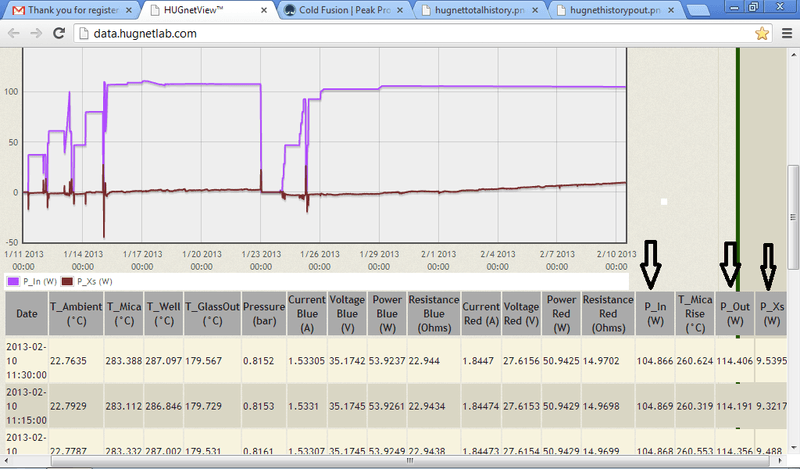
Cold Fusion Now associate Arthur Robey made this image from some of the Hunt’s publicly available data writing:

Choose the European cell, toggle all the lines off and then toggle excess power on.
Then choose dates from Jan 2nd to the present at 15 min sampling intervals. You will see a steady increase in the excess energy line.

Efficiency μ
=output power / input power (x100%)
=114.406/104.866
=1.091 p.u.
=109.1%

or nearly 110%!

HUG data history

Not quite commercial-ready technology, but for a project started only within the last year, it is a major accomplishment showing the reality of the science.

The self-funded project is seeking financial support and you can contribute. Make a donation at quantumheat.org and win a cold fusion “powder cell” constructed by the team!

Related

The New Fire by Ruby Carat

Top