Power equivalent to the Sun? – We already have it!

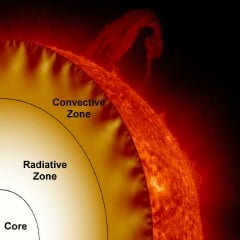
NASA Solar cross section 8Sept13By David J French

Although long, I believe that the following analysis is worth pursuing to the end.

While browsing through Wikipedia on the Internet I recently came across this interesting observation about the Sun:

“The power production by fusion in the core varies with distance from the solar center. At the center of the Sun, theoretical models estimate it to be approximately 276.5 watts/m3,[51] a power production density that more nearly approximates reptile metabolism than a thermonuclear bomb.[b] Peak power production in the Sun has been compared to the volumetric heats generated in an active compost heap. The tremendous power output of the Sun is not due to its high power per volume, but instead due to its large size.”
http://en.wikipedia.org/wiki/Sun – (under “Core”)

What is this? I always thought the Sun was a continuously self-fueled hydrogen bomb. Not only are these levels far below that of a hydrogen bomb, but the amount of heat being produced on a unit of volume basis is indeed a trickle.

A cubic meter contains 1,000,000 or 100 X 100 X 100 cubic centimeters. Therefore, according to this reference, the rate at which heat is flowing out of a cubic centimeter of the Core at the center of the Sun is 0.2765 milliwatts! This would hardly light an LED. But we must check the footnote reference; after all this is Wikipedia.

Footnote 55 links to a website operated by the Fusion and Plasmas Group of the Contemporary Physics Education Project (CPEP). CPEP is a non-profit organization of teachers, educators and physicists, with substantial student involvement. CPEP creates educational materials on contemporary physics topics for use in introductory physics classes. This website addresses introductory educational materials on fusion energy and the physics of plasmas. http://fusedweb.llnl.gov/CPEP/Chart_Pages/5.Plasmas/Sunlayers.html

This link starts by explaining that the Core, the innermost layer of the Sun where energy originates, has a density of 160 g/cm3, 10 times that of lead. At this density it might be expected that the Core would be solid. However the Core’s temperature of 15 million degrees Kelvin, virtually identical to degrees Centigrade at this temperature, or 27 million degrees Fahrenheit. This high temperature keeps the Core in a fluid plasma state.
This reference also includes a chart based on a Computer Model of the Sun at 4.5 Billion Years into its lifetime, i.e., today. This chart can be viewed at the end of the last link referenced above.

The key figure that we’re looking for is the rate at which heat is being produced in the center of the Sun, and there it is under the title: Fusion Power Density (joules/sec-m^3). At the very center of the Sun, the value is 276.5 joules/sec-m^3. This means 276.5 Watts per cubic meter just as cited in the Wikipedia article.
According to that chart, the production of energy peters out by about one quarter of the radius of the Sun (24% shown on the chart shows heat production at the rate 0.67 Watts per cubic meter.) This turns out to be a very important factor.

But wait a minute, this data is the result of a “Computer Model of the Sun”, attributed to B. Stromgrew (1965) reprinted in D. Clayton Principles of Stellar Evolution and Nucleosynthesis. New York: McGraw-Hill, 1968, and others. Maybe these mathematicians have gotten it wrong. There must be another way to verify if this set of data is correct.

United States National Aeronautics and Space Association – NASA

The Marshall Space Flight Center’s Solar Physics web site, operated as part of NASA, is an authoritative source for research about the Sun. At this site background facts about the Sun are given here: http://solarscience.msfc.nasa.gov/ . On the very opening page the following key data is provided:

Sun Facts

Solar radius = 695,990 km = 432,470 mi = 109 Earth radii

Solar mass = 1.989 1030 kg = 4.376 1030 lb = 333,000 Earth masses

Solar luminosity (energy output of the Sun) = 3.846 1033 erg/s

Surface temperature = 5770 K = 9,930° F

Surface density = 2.07 10-7 g/cm3 = 1.6 10-4 Air density

Surface composition = 70% H, 28% He, 2% (C, N, O, …) by mass

Central temperature = 15,600,000 K = 28,000,000° F

Central density = 150 g/cm3 = 8 x Gold density

Central composition = 35% H, 63% He, 2% (C, N, O, …) by mass

Solar age = 4.57 109 yr
________________________________________

Now we can do some calculations.

Objective: to calculate the energy flux/power density at the Core of the Sun per unit volume arising from nuclear synthesis

Calculation:

Volume of a sphere = 4/3 X 3.14 X radius3

Radius of Sun (from above) = 695990 km = 700000 km = 7 X 1010 cm

Radius of Core = 1/4 Radius of Sun = 1.75 X 1010 cm

Volume of Core = 4/3 X 3.14 X (1.75 X 1010 )3 cm = 22.437 X 1030 cm3

Solar luminosity (from above) = 3.846 X 1033 ergs/sec = 3.846 1026 joules/sec

Solar Heat Flux per unit volume = total heat flow/ volume = 3.846 X 1026 joules/sec / 22.437 X 1030 cm
= 0.01714 milliwatts/cm3 (or 17 Watts/m3)

Note: this is the heat flux averaged-out over the entire Core. Nuclear syntheses does not occur evenly throughout the Core. It is at a maximum at the center and tapers-off towards its outer limit at about one quarter of the solar radius, cf:

“The temperature at the very center of the Sun is about 15,000,000° C (27,000,000° F) and the density is about 150 g/cm³ (about 10 times the density of gold or lead). Both the temperature and the density decrease as one moves outward from the center of the Sun. The nuclear burning is almost completely shut off beyond the outer edge of the core (about 25% of the distance to the surface or 175,000 km from the center). At that point the temperature is only half its central value and the density drops to about 20 g/cm³.”
http://solarscience.msfc.nasa.gov/interior.shtml

This decline in the heat flux is not necessarily linear. The chart above shows an output power of 19.5 watts per cubic meter at a distance of 14% of the solar radius and 6.9 W per cubic meter at a distance of 19% of the solar radius, with heat generation tapering off to nothing at 25% of the solar radius. Accordingly, this calculated value from NASA as a source is consistent with the article and footnote in Wikipedia

Analysis – How can this be true?

Remarkable as this appears, it seems to be absolutely true: the matter at the Core of the Sun is generating heat at a rate that is less than a milliwatt per cubic centimeter. Indeed, the average rate at which heat is being generated within the Core, from the center of the Sun out to 25% of the Sun’s radius, is on the order of 0.01714 milliwatts/cm3 (or 17 Watts/m3). Astounding!

Someone else has noticed this fact and provided an annotation in the paragraph in the Wikipedia referenced above. That annotation reads as follows:

“A 50 kg adult human has a volume of about 0.05 m3, which corresponds to 13.8 watts, at the volumetric power of the solar center. This is 285 kcal/day, about 10% of the actual average caloric intake and output for humans in non-stressful conditions.”

Essentially, this says that human beings generate heat, or consume calories, at a rate that is 10 times greater than that at the center of the Sun.

How can this be true?

There are several factors that contribute. The first explanation is that the Core of the Sun is surrounded by a very large amount of matter that does not generate heat: three quarters of the solar radius. The solar radius is 700,000 km and therefore the heat generated at the center of the Sun has to pass through 525,000 km of matter in order to escape.

The NASA website states:

“Although the photons travel at the speed of light, they bounce so many times through this dense material that an individual photon takes about a million years to finally reach the interface layer. The density drops from 20 g/cm³ (about the density of gold) down to only 0.2 g/cm³ (less than the density of water) from the bottom to the top of the radiative zone. The temperature falls from 7,000,000° C to about 2,000,000° C over the same distance.”

This reference is with respect to photons traveling from the bottom to the top of the “radiative zone” between the Core of the Sun and the next layer up. This does not represent the distance to the surface of the Sun. Again, from the NASA website:

“The radiative zone extends outward from the outer edge of the core to the interface layer or tachocline at the base of the convection zone (from 25% of the distance to the surface to 70% of that distance). The radiative zone is characterized by the method of energy transport – radiation. The energy generated in the core is carried by light (photons) that bounces from particle to particle through the radiative zone.
“Although the photons travel at the speed of light, they bounce so many times through this dense material that an individual photon takes about a million years to finally reach the interface layer.”
http://solarscience.msfc.nasa.gov/interior.shtml

Accordingly, this 1 million years travel time applies to a mere 45% of the solar radius. However, this is a part of the Sun where the matter is very dense.

Now the Sun is 4.5 billion years old and if we will assume that it has been radiating at the same rate (not necessarily so) over that period of time, we can imagine that a lot of heat, in the form of photons, has spent a lot of time making the trip from the Core to the outer surface where it can escape. One million years is a long time for heat to accumulate even if it is only being generated at the rate of 100 or so watts per cubic meter in the Core. And 4 1/2 billion years is a very long time. Seen from this perspective, the phenomena is a little more believable.

And there is still another way to look at it.

The number of cubic meters inside a sphere can be much greater than the number of square meters on the surface. Imagine a square meter of the Sun’s surface sitting on a pyramidal wedge that extends 700,000 km all way back into the center of the Sun. Only the last quarter of this distance is generating heat. But one quarter of the radius of the Sun is still 175,000 km. Therefore, even though the pyramid is tapering to a point, there are 175,000,000 meters of heat-generating Core material backing up that single meter on the surface.

The same analysis can be carried out for all of the square meters on the surface of the Sun. On this basis, the value for the rate of heat generation within the Core of the Sun as contrasted with the rate of heat radiation on the surface of the sun at the surface of the sun becomes more understandable.

So the proposition that we started with, that the Core of the Sun generates heat at a rate that is less than 1 milliwatt per cubic centimeter, is probably true.

Consequences

Why have we done all this calculating? The answer is that we are concerned to compare solar fusion with cold fusion. But first a further observation on the issue of the “quality” of heat. Then we can compare hot and cold fusion.

My first reaction was that my concept that the Sun was a continuously self-fueled hydrogen bomb was totally wrong. Instead it represents the embers from a fire that has been smoldering for 4.5 billion years.
These are not ordinary embers however.

While the rate of heat generation in the center of the Sun is modest, the temperature is not. The NASA data provided above indicates that photons proceeding outwardly from the Core start on their journey with the temperature equivalent of 7,000,000°C. By the time they reach the surface, the temperature equivalent has dropped to 5600°C. The heat from the Core is then released into space in the form of high temperature photons. In this sense, the heat being generated in the center of the Sun is different in quality from the same amount of heat being generated in a heap of rotting manure. But this quality is lost when we use the heat of sunshine to warm our swimming pools.

One difference between hot and cold fusion is the quality of the heat being produced, at least so far. But at what cost?

This lead me to explore the efforts being made to create energy for mankind using fusion. A little bit about this topic can be found here: http://en.wikipedia.org/wiki/Fusion_power

Hot Fusion

For more than 30 years scientists have aspired to create usable energy using fusion. The latest version of effort is that of the International Thermonuclear Experimental Reactor – ITER: http://www.iter.org/

The costs have been remarkable:

“ITER was originally expected to cost approximately €5billion, but the rising price of raw materials and changes to the initial design have seen that amount more than triple to €16billion.[10] The reactor is expected to take 10 years to build with completion scheduled for 2019.[11]” http://en.wikipedia.org/wiki/ITER

The figures quoted are simply for this single project. Many billions more have been spent over the years by countries around the world to advance the goal of achieving useful energy output from hot fusion. There has been a lot of talk in support of this process of bringing the energy source of the Sun down to the surface of the earth. But these kinds of aspirations do not seem compatible with the calculated values for the rate of output of energy being generated within the Sun as examined within this article.

Essentially, the hot fusion scientists are not trying to emulate the Sun. They are trying to emulate a supernova! With that thought in mind, it is understandable why the United States withdrew as a primary participant from the international ITER project in 1998 although it did rejoin as a junior 9% partner in 2008.

Next is the issue of Cold Fusion

Cold Fusion

Cold Fusion has been in disrepute over the last 24 years. This is largely due to a rush-to-judgment that occurred in 1989 at a time when many laboratories around the world could not duplicate the effect.

However, particularly in the last 20 years, numerous scientists have been able to demonstrate the presence of “unexplained excess energy” arising from the Cold Fusion effect. Generally this comes from super-loading Palladium with deuterium, and more recently, Nickel with hydrogen and then stimulating the generation of unexplained heat energy by applying electrical current, ultrasound, magnetic fields or simply even higher gas pressures within the metal hydride. There is no doubt that unexplained excess energy is being produced. Now that sufficient experiments have ruled-out experimental errors and chemical effects, it is hard to imagine where this energy could come from if it were not for some form of fusion effect.

Experimental results have been producing energies at rates ranging from milliwatts to watts and even some assertions of kilowatts of output thermal power from this unexplained source of energy. The apparatus producing these outputs has always been of a table-top character. Focusing on the actual source of the reaction, the Nickel or Palladium, energy has been produced in these experiments at rates or power levels that are far higher than mere milliwatts per cubic centimeter.

The quality of this heat has been generally low, e.g. under 100°C. But recently, indications have appeared (without naming them) that much higher temperatures can be achieved, e.g. 600, 700°C. Heat of this quality is indeed valuable. Such temperatures can be used to make electricity!

Conclusion

Consequently, Cold Fusion has been achieving “stellar” performances over the past 24 years, at least in terms of specific power being generated! And there are now signs that the temperature potential of this process to deliver commercially valuable results is real. By these standards, it is incomprehensible why governments have not invested further support to bring this phenomenon to commercial availability.

This is probably the most important conclusion to be drawn from the very interesting facts explored in this essay. The disparity between the support for hot versus cold fusion is extreme, indeed scandalous. But this is already known, at least in one of these two communities.

David J. French Ottawa, Canada

Cold Fusion and Skeptopathy

skeptopathy
Web definitions
Pathological skepticism; an irrational belief that a phenomenon must be false merely because it is unusual.
en.wiktionary.org/wiki/skeptopathy

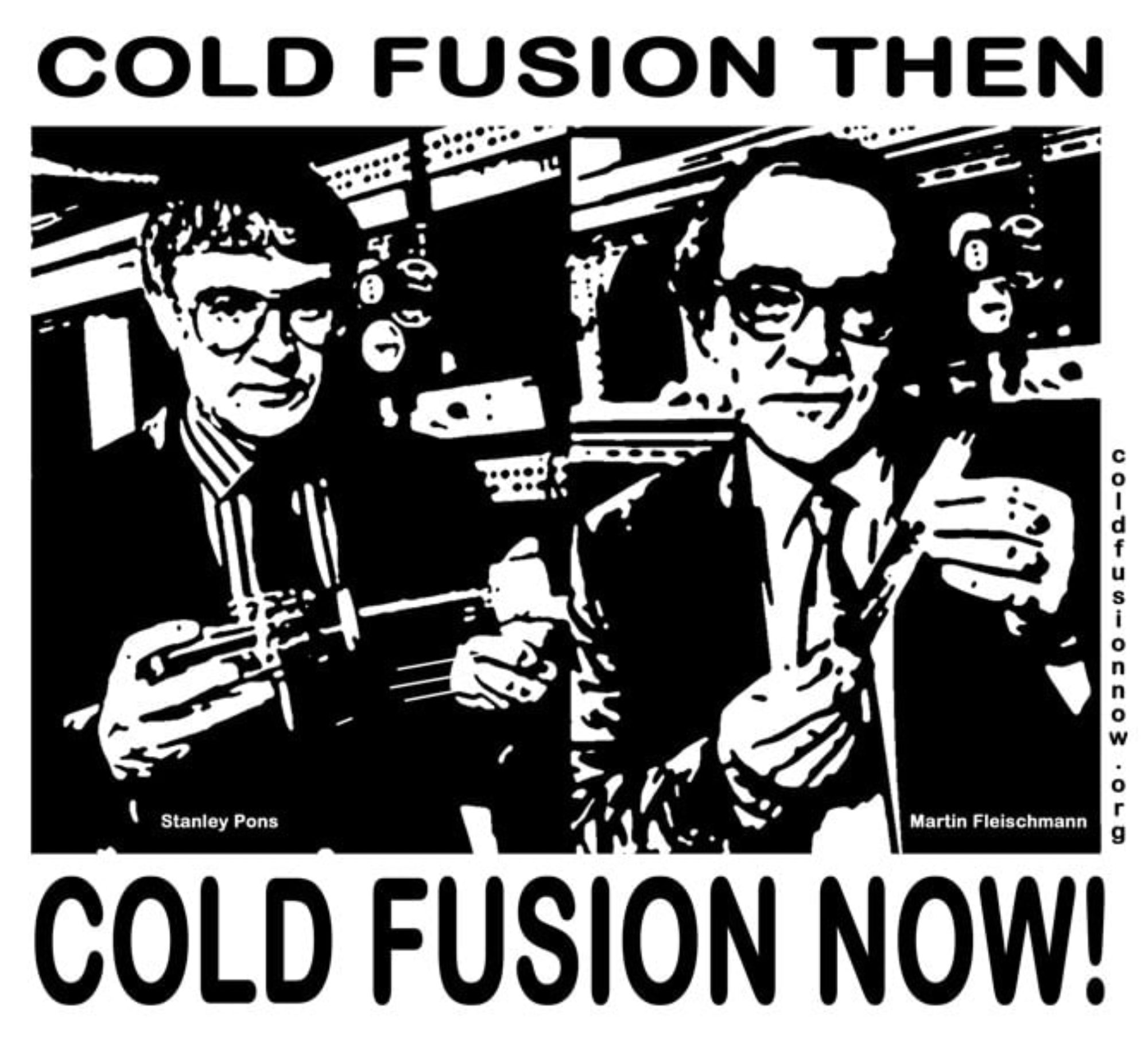
There is no better example of skeptopathy doing great harm to humanity than the history of cold fusion. Everyone is probably familiar with Fleischmann and Pons’ claim that they had discovered a nuclear reaction that occurs at (or near) room temperature, compared with temperatures in the millions of degrees that is required for hot fusion. Furthermore, I bet everyone is also under the impression that their claim had been discredited – wrong! Pons and Fleischmann never retracted their claim, but moved their research program to France after the controversy erupted. [1]

“I would sooner believe that two Yankee professors lied, than that stones fell from the sky” – Thomas Jefferson, 1807 on hearing an eyewitness report of falling meteorites.

In March of 1989 Stanley Pons and Martin Fleischmann introduced us to a new field of science called “Cold Fusion.” It appeared to contradict prevailing nuclear fusion theory. Nuclear reactions at room temperature were generally unheard of before Fleischmann and Pons (although they are not unheard of today – for instance crystal-piezo and acoustic inertial confinement fusion). The scientist’s claims were viewed as inconceivable and impossible, and they were accused of making reckless unsupported unscientific claims. Furthermore, they were shamed for discussing their claims in a press conference before their paper’s publication. [2]

“The more important fundamental laws and facts of physical science have all been discovered, and these are now so firmly established that the possibility of their ever being supplanted in consequence of new discoveries is exceedingly remote…. Our future discoveries must be looked for in the sixth place of decimals.” – physicist Albert. A. Michelson, 1894

Belief in the validity of Fleischmann and Pons’ claim ought to have been based solely upon the repeatability of their experiments. Unfortunately, scientific investigation is conducted by men who are prejudiced by their belief system, economics, and politics. Fleischmann and Pons’ claim was hard to believe, was a direct threat to hot fusion research, and it upset the status quo in many ways, so many people were upset. Furthermore, their experiments were difficult to replicate, and the effect called “cold fusion” turned out not to be the same as what we refer to as “hot fusion.” The stage was set for scientists, the media, and laymen to exercise pathological skepticism and prematurely label it a hoax rather than give Pons and Fleishchmann the benefit of the doubt that the effect was real. As a result of cold fusion being discredited few scientists dare work in this area of research for fear of being labeled crazy by their colleagues, and being starved of research funds. [1]

“All a trick.” “A Mere Mountebank.” “Absolute swindler.” “Doesn’t know what he’s about.” “What’s the good of it?” “What useful purpose will it serve?” – Members of Britain’s Royal Society, 1926, after a demonstration of television.

“The probably better experimental work…has been carried out in Siena since the Early Nineties, by a group of physicists composed by Sergio Focardi (University of Bologna), Francesco Piantelli (University of Siena), Roberto Habel (University of Cagliari), but it did not lead to a system capable of generation useful amounts of excess energy for normal industrial or domestic applications. In Siena, in fact, the three scientists – using hydrogen and nickel as the only “ingredients” of the reaction, plus an appropriate amount of heat supplied to the system – manage to get out a double thermal energy than the electrical energy provided in input. Obviously, if there were no some “unknown” reactions to produce this little but detectable result, you would get a lower thermal energy, due to the significant losses that you always have turning a form of energy into another.” [3]

On April 30, 1989, cold fusion was declared dead by the New York Times. The Times of London called it a circus that same day, and the Boston Herald attacked cold fusion the day after. Douglas R. O. Morrison, a physicist representing CERN, was the first to call the Pons and Fleischmann episode an example of pathological science. Scientific papers concerning cold fusion were then turned down for publication in peer reviewed journals. [1] Even though almost everyone in America “knows” that cold fusion has been “debunked,” is a “hoax,” and is “pathological science,” those scientists in Italy were getting DOUBLE the energy return using this effect. One would think that such news would have changed minds in the scientific community, but it did not.

“The energy produced by the atom is a very poor kind of thing. Anyone who expects a source of power from the transformation of these atoms is talking moonshine” – Ernst Rutherford, 1933

Fast forward to today. The International Conference on Condensed Matter Nuclear Science, (ICCF) has just wrapped up at the University of Missouri. Scientists from around the world reported on their “cold fusion” progress (the exothermic reaction is called by various names). [4] It is no longer a valid scientific question if cold fusion is legitimate, but only what is the scientific theory behind the effect. [5] For some it is still hard to believe because science can’t yet explain how it works, even though mankind used fire for tens of thousands of years before being able to explain how it works. A third-party verification report was recently published of a product that will hit the market this year, showcasing a cold fusion cell that was hot enough to create dry steam (which is necessary to generate electricity). The results show that energy density (i.e. the amount of energy by weight) was 5 orders of magnitude (tens of thousands of times) over that of fossil fuel. [6] That inventor has said that the time for words is over, and the proof will be when a cold fusion product is introduced to the market. If that is the case, then we won’t have to wait long for proof.

To wrap up, the history of cold fusion is a checkered one. It is an unusual phenomenon, and as such is open season for skeptopathy. I have talked to many people about the subject, and while a few strongly suggest that cold fusion is pathological science (based upon Wikipedia entries or Pons and Fleischmann’s treatment in the media), the vast majority are simply convinced that it will never emerge because powerful fossil fuel interests will bury it before it reaches the market. In other words, most people exhibit skeptopathy of a different form: they have heard rumors of revolutionary energy technologies before, but haven’t seen them emerge onto the market, and therefore irrationally believe cold fusion will never reach the market. Unfortunately, skeptopathy has done a number on cold fusion research and development because unless investors believe their investment will pay off, they are very hesitant to fund it.

Ironically, for those who still exhibit (what I would define as) skeptopathy toward cold fusion, you can read this paper that I wrote on the subject: https://coldfusionnow.org/the-evidence-for-lenr/

Notes

“Cold Fusion,” Wikipedia. 2. Krivit, S. “The Mistakes of Pons and Fleischmann and Why Their Discovery Was Initially Thought to Be a Mistake” New Energy Times, March 23, 2007. 3. Menichella, M. “Secret of E-Cat” pages 13-14, Consulente Energia Publisher, 2011, Pdf format. 4. “ICCF – 18 Day 5: Presentations and Awards,” Ruby Carat, Cold Fusion Now!, July 25, 2013. 5. “NASA Confirms Conclusive Evidence for LENR,” Hot & Cold Fusion, March 31, 2013. 6. “Indication of anomalous heat energy production in a reactor device,” Cornell University Library, June 7, 2013.

E-cat South Asia Technology Update

Press Release from Ecat Australia and Ecat South Asia – August 2013

TOMORROWS ENERGY, TODAY

Since we last wrote, there continues to be important developments. The rest of the world is waking up that L.E.N.R. is serious. A recent Forbes article emphasized the maturing of the technology.

And OilPrice.com journalist Brian Westenhaus thinks the industry may have reached the turning point and perhaps the last stages before widespread acceptance. This is further supported by an influx of universities in the US and afield that are now including LENR or Cold Fusion studies in their syllabus.

The 18th International Conference on Cold Fusion (ICCF-18) held last month also provided substantial details of the technology along with deepening understanding of the physics behind it. In practice no-one is yet able to match the COP that Rossi has attained: COP=6, but we hope that all parties do succeed because there is much need for more efficient and environmentally friendly energy sources.

Our focus has continued to be on working with interested parties, discussing their needs and recommending solutions. The following diagram shows the wide applicability of the Rossi E-Cat and Hot-Cat.

Heat-demand-process-industries-1

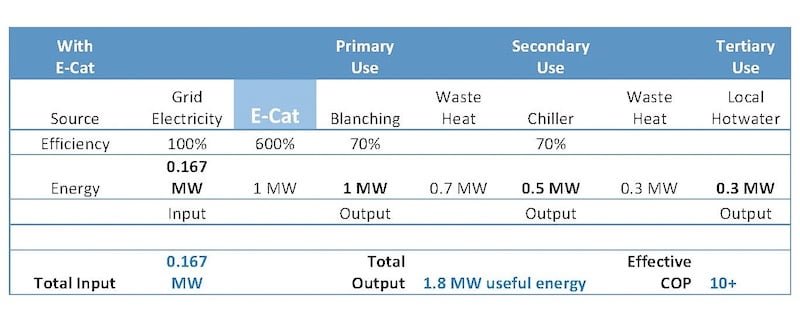
Many companies around the globe and in this region are starting to focus on co- and tri- generation, the situation where one heat source is used over and over again. To this end the actual effective COP can be much higher than 6, if one can re-use the heat. A typical co-generation use could be using the initial heat for a food manufacturing process, and the waste heat for a chilling/refrigeration process.

Consider a typical Co-Generation opportunity: Fruit and Veges industry.

Primary Application: Blanching. For this, typically they would be using grid electricity, or Gas. With the E-Cat they would enjoy a COP of 6 (i.e. for every unit of energy previously used, now they can consume just 1/6th of that energy, reducing their bill proportionately). Once used the energy they have consumed is typically wasted.

Secondary Application: By coupling the blanching process and its waste heat, to a chiller system, the company can convert this waste heat into chilling, allowing operation of cold rooms for holding vegetables, at almost no additional energy cost. Assuming a 70% efficiency on this leg, the company might be able to get an additional 50% re-use of the energy (allowing for inefficiencies).

Now the company may also consider that there is a third use for the same energy – output from the Chiller is hot water (approximately 50-70 degrees C). This is ideal for general use in bathrooms and kitchens for washing and cleaning.

Efficiency-comparison-1

Notice from the example table above, that there is substantial improvement of the facility’s energy use. Using the E-Cat, the company may be able to achieve upwards of 10 times the value of the input energy. (note this is a generalized example. Engineers will be able to estimate specific applications which depend on environmental conditions and other factors).

e-cat AustraliaE-Cat Australia and South Asia is working with manufacturers and distributors of allied equipment to assist our clients get additional benefit when they implement an E-Cat or Hot-Cat.

Regards

Roy Wise, B.Chem.E, MBA
www.EcatSouthAsia.com

and Roger Green
www.E-catAustralia.com

Related Links

Live Stream of E-cat Conference in Zurich September 7, 2012

E-Cat Australia launches new website July 16, 2012

Edmund Storms: At peak efficiency “no other source of power will be necessary”

John Maguire, a writer for J.C.M., interviews Dr. Edmund Storms, author of The Science of Low Energy Nuclear Reaction: A Comprehensive Compilation of Evidence and Explanations about Cold Fusion.

Storms discusses his early career at Los Alamos National Lab, and how in 1989, his team there got positive results, confirming the nuclear nature of the phenomenon. A brief primer on the early successes moves into a discussion on struggle to understand the science behind this reaction, and on efforts to commercialize this technology despite the lack of a definitive theory.

Storms talks about why this technology is so important to develop, and examines how the lack of a definitive, agreed upon theory slows the commercialization from this discovery.

“We have succeeded over the last twenty-four years in proving the effect is real, that the claims are not based upon incompetence, fraud, or error, they are based upon a true behavior of nature,” says Storms.

“Now the challenge is to make this happen at commercial levels, make it reproducible, because presently it is difficult to reproduce – not impossible – but difficult; it takes great skill, and it has to be produced at a rate with high enough power to be useful as a commercial application, and that aspect of it is presently underway by several companies.”

“Once the phenomenon is understood, and can be manipulated at will, then engineering will be applied to make it totally and most efficient. We haven’t reached that stage yet.”

“The efforts underway to make commercial power using nickel and light-hydrogen by Rossi and Defkalion are trying to improve the engineering, to improve the efficiency, but even they haven’t come close to the efficiency that will be possible.”

“Once this [reaction] is understood, the efficiency will be 100%.”

“In other words, these devices will make energy simply by sitting there. You’ll have to apply hydrogen, and you turn them off by taking the hydrogen away, you turn them on by putting more hydrogen in; no other source of power will be necessary.”

“We’ll have a source of power that will stay hot for years and years, or until you turn it off by pumping out the hydrogen.”

Asked why so many still ignore or belittle the science, given the huge benefits of clean, dense, power, Storms says this environment will continue because “This phenomenon will be immensely disruptive.”

“It’s a conflict of self-interest. Those people who are naturally threatened by it, will fight it. It’s a very large threat, and it’s a very large fight.”

Listen to the interview Dr. Edmund Storms: Cold Fusion, Nuclear Active Environments, and New Energy on Foks0904 Channel.

John Maguire also contributes essays on alternative energies to Blue Science.

Earth at Night: Act today for the long now

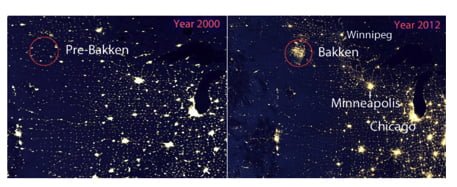
Photo: (L) Western and Central U.S. at Night, Year 2000, (R) Western and Central U.S. at Night, Year 2012. In one decade, fracking in the Bakken has created an expansive industrial infrastructure.

NASA’s Earth at Night series reveals the landscape of the Oil Age. Hydrocarbons such as coal supply most power plants around the globe. The lights imaged in the dark correspond to high-consumption regions.

“Here are two pictures of the same area from space. The area marked Bakken on the right shows were huge quantities of natural gas are being burned as oil is extracted.”

Bakken lights spring up

“In other words, CO2 generation does not start with the use of oil. It also results from extraction of oil. This happens where oil is extracted when the pipe line to get the gas to market is too costly to build.”

“Of course, all the other lights result from electric power from power plants where coal is frequently burned. This and other events make any effort to cut back CO2 generation useless.”

Comparing-US-at-night

“Cold fusion is the only solution, but it will come too late”, says Edmund Storms, author of Science of Low Energy Nuclear Reaction: A Comprehensive Compilation of Evidence and Explanations about Cold Fusion. “The consequences of this [CO2 production] will accelerate as time goes on, even with cold fusion now.”


No matter when the benefits come, an ultra-clean, energy-dense source of power is a requirement for a green technological future on Earth. Even as extreme, resource intensive extraction practices by the fossil fuel industry are increasing, so is the activism from a concerned community.

The Guardian covered an action against a hydraulic fracturing (fracking) operation by Cuadrilla Resources corporation at Balcombe, Sussex, in the U.K. The Telegraph reported Eva Ewajasiewicz from No Dash for Gas saying, “We cannot have a sustainable future, we cannot have a sustainable and cheap energy, if we go for fossil fuels.”

Fortunately, before leaving the country, Bob Greenyer of the Martin Fleischmann Memorial Project (MFMP) spent the weekend there, offering a solution.

“I spent my last day in UK with my daughter at the anti-fracking protest in Balcombe, just a few miles up the road from where QuantumHeat CIC is incorporated,” says Greenyer. “There I met a lead writer for Greenpeace and put up a banner with my daughter for MFMP on a tent directly opposite the entrance to the disputed operation.”

Balcombe-anti-frack-20130811_164331_HDR

Banner-Anon-20130816_153551

“I was surprised that neither Greenpeace or the Green Party (only UK party to be against unconventional HCs) knew about LENR.”

“It seems that when we have a lot of simple infographics and materials available, we have a lot of easy wins to make in terms of education,” Greenyer commented. “If we give the crowd the materials to spread a clear and consistent message, then they can run with it with more direct community action.”

“This needs to be grass roots, as it is unlikely to ever come from the top.”

“We would need to come back after about 5000 years to see the eventual benefits of cold fusion to the human mind and society,” says Storms. “Where is time travel when you need it?”

Related Links

What the frack is going on? with Suzy Williams

MFMP launches new charity for expansion of Live Open Science

LENR: The Debutante at the Ball


The Cold Fusion research of Fleischmann and Pons was an anomaly in and of itself. Two electrochemists, while having a bit of fun with the maximum loading of hydrogen into palladium in an electrolytic cell, ventured into a realm of subatomic phenomenon. No one had been there before in quite this way.

They hazarded to say it was nuclear, and got blasted.

These two electrochemists had no assistance from other branches of science in trying to figure it out. Nobody came to their assistance. In fact, those who should have joined in this scientific quest, ridiculed the pair as charlatans. Instead of helping out these two lone electrochemists with a scientific dilemma, leaders in the nuclear scientific community of the U.S. government-funded Department of Energy (DOE) labs ridiculed them to no end. This left the two fellows to fend for themselves while being kicked out of the tribe, so to speak.

Luckily, the few scientists who had found positive results during the DOE-sponsored race to replicate the Fleischmann-Pons Effect (FPE) persisted, mostly in obscurity and without funding, in this query of the unknown.

Cutting edge experimental science requires patience, honest sharing of data, and evaluation for a continued improvement of the experimenters’ ability to enter into an unknown realm; which is to actually observe and record aspects of a difficult to create phenomenon and thereby test theory. In this manner, our understanding within the unknown realm grows.

I publish. You review after working it a bit. Always improving experiments. Together with theorists, we collect data, analyze and implement sound suggestions, always moving forward, advancing the science. Open collaboration quickens this difficult quest into the unknown. Open and enthusiastic collaboration by all branches of the scientific community into the query of the unknown is the basis of good science and is essential for the birth of a new science.

These early cold fusioneers formed an association of the shunned and published in a few “unrecognized” trade journals which they had to create in order to continue the scientific process in this controversial field. The Internet had appeared before the observed 
Fleischmann-Pons Effect (FPE), freeing these researchers from the limitations of the printing press.

The printing press had advanced science simply by causing more researchers to be reading more researchers work, which caused a quickening of the scientific process. 

I publish. You review it after working it a bit (through meticulous experimentation and collection of data). Together with theorists, we improve our ability to observe and record phenomenon,  improve analysis of data, always moving forward.

Today’s scientists no longer face the hurdle of a publisher’s peer review to get work printed. If you have fallen into an unknown realm who is your peer? Obviously only those who you find there with you. The Internet allowed the peers of cold fusion research to publish, which is the first step in involving the larger community in your scientific endeavor. Only after publishing can true scientific review begin.

Many of the established branches of science could have assisted Fleischmann and Pons with a few of their questions. These two were wondering what was actually going on. They also were trying to figure out, why, during different runs of their experiments, some cells produced nuclear levels of energy while others did not. None of those in mainstream science helped them to answer any of the questions concerning the new realm they were entrusted with.

The people who are experts in atomic theory had nothing to add. The people doing high-energy subatomic research at CERN or Lawrence Livermore had nothing to add. Thermoelectric devices are almost like LENR devices, without the hydrogen. Yet the mainstream thermoelectric crowd offered no assistance even though their grandfather, Harold Aspden, had became a godfather to new cold fusion research. Even the emergent semiconductor field could have assisted this new science with their knowledge of dopants and understanding of the adolescent quantum field branch of science.

None of these folks showed even a bit of healthy scientific interest in this work. Almost all their curiosity evaporated into thin air. After the announcement of the birth of cold fusion research people were thrilled. Then to have virtually all curiosity evaporate within the whole scientific community, is an anomaly of such a magnitude that it is hard to comprehend. These lone researchers from a single branch of science, with their Internet printing, were left to care for this newly born area of research by themselves, held separate from the larger scientific community. They were left without communal guidance or assistance in their care of this new unknown scientific field, the infant known as cold fusion research.

Fleischmann and Pons were just trying to figure it out. Who knows how dirty their electrical currents were? Might there have been harmonic frequencies created upstream of their current supply, caused by any number of other electrical equipment being turned on, or turned off, at the same time? (My TV used to go fuzzy when the neighbor turned on his table saw.)

These electrical eddy currents could cause one cell to go positive, with nuclear dense energy being produced, while another, without this added focusing of energetics, would be a dud. Would there be pulsations created simply by a portional electrical on/off factor, thereby creating superwaves or standing wave formations? Are influential magnetic moments created within such electron dense environments? Are harmonic frequencies within the lattice the key?

What surface topography or nano engineering is required? Are the  proper fractal geometries essential for equilateral fusion firing and control throughout the system?  Do we need some dopants thrown in? Do we need to get the advanced materials folks engaged in doing some Edisonian style research with every known metal and alloy? Is an unknown source of energetics thrown into the mix, such as dark energy or gravity?

How might one capitalize on these many components within the atomic and the subatomic realm of the cold fusion nuclear reactive environment? Are angular eddy currents within the electron shell a key? Or specific angular thermal currents? Do subatomic transmutations within the molecular liquid crystal plasma create atomic transmutations, on an atom by atom basis? 

So many questions faced Fleischmann and Pons in their efforts to sustain this child that, unassisted by the larger community, the new science of cold fusion barely survived. Luckily the science did and she is growing up, as we shall see.

Science has been progressing nicely since the birth announcement of cold fusion research in 1989. Quantum physics and engineering has matured since then. After a battle for acceptance, it is now seen as a branch of science that will advance us beyond our present understanding of known Einsteinian physics. Nano-science has emerged fairly well developed, with exciting possibilities, being fully realized quite quickly.

Both of these branches of science have been openly courting cold fusion research and standing within the low energy nuclear reaction environment for some time. Once an ugly duckling, now a beautiful swan, LENR Energy is now considered to be exciting and full of potential. Highly energetic with no known faults LENR Energy attractive and much sought after.

LENR Energy Science and Engineering is finding herself best able to thrive as a multi-disciplinary field. LENR is the debutante at the ball. With some really great features: Clean inexpensive energy. Both LENR Electrical and LENR Thermal are embodiments of her grace.

We would certainly be amiss if we failed to mention the most attractive features. LENR energy transmutes radioactive waste while driving the turbines. My kinda gal. And when she steps onto the dance floor she actually flies, with the grace of a modern spaceplane and the beauty of a Boeing 747.

My hope is she will capture the attention of the semiconductor and thermoelectric crowd soon. Now that I stop and think on this, they are probably dancing together already. We will soon see.

Laboratoire de Physique Théorique – Toulouse – UMR 5152
A gauge theory picture of an exotic transition in a dimer model
http://www.lpt.ups-tlse.fr/spip.php?article432&lang=fr

We study a phase transition in a 3D lattice gauge theory, a coarse-grained version of a classical dimer model. The dimer model on a cubic lattice, first studied by F. Alet and collaborators, displays a continuous transition between an ordered columnar phase at low temperature and a disordered phase at high temperature where dimer-dimer correlations show an algebraic decay. This is rather unusual as the standard Ginzburg-Landau theory of phase transitions generally predicts an exponential decay of correlations in the disordered phase.

This phase transition is “exotic” in the sense that it cannot be simply explained by the spontaneous symmetry breaking of an order parameter. The existence of such unconventional continuous transitions is still very controversial, numerous authors pointing at an artifact due to a very weak first-order driven process.

To have a better understanding of the dimer model, we show, using duality arguments, that the classical dimer model can be mapped to a frustrated XY spin model coupled to a gauge field. The ordering transition is then naturally understood in terms of a Higgs mechanism. A Monte-Carlo study on large system sizes of the dual model indicates a second-order transition with exponents close but slightly different from those of the simple XY model. In order to confirm the type of the transition, we perform a flowgram analysis, a powerful numerical tool to test the nature of a transition. The results of the flowgram are unambiguously pointing toward a continuous transition.

Post-scriptum :

For more details, see the original paper Gauge theory picture of an ordering transition in a dimer model, by D. Charrier, F. Alet, P. Pujol in Phys. Rev. Lett. 101, 167205 (2008)

Mardi 12 fevrier 2013-14:00
Spin-dependent thermoelectric transport in HgTe/CdTe quantum wells
http://www.lpt.ups-tlse.fr/spip.php?article1000&lang=fr

Marine Guigou (LPS Orsay) par Bertrand Georgeot – 12 février

HgTe quantum wells are known to host, under a topological phase transition, the quantum spin Hall effect. The latter refers to the presence of metallic edge states moving in opposite direction for opposite spins. Recently, HgTe/CdTe quantum wells, among others topological insulators, have been proposed as good materials for thermoelectric conversion. The basic idea relies on the topological protection of the 1D edge states that prevents reduction of electrical transport in disordered systems. Their efficiency to convert heat into electricity is based on the dominance of the edge modes on transport [1,2].

During this presentation, I will discuss about the thermoelectric properties of HgTe/CdTe quantum wells through the analysis of Seebeck and spin Nernst coefficents in a four terminal cross-bar setup. As a lateral thermal gradient induces a longitudinal electric bias and a transverse spin current in such a system, each of them can be used as a probe of the topological regime as well as finite size effects of the quantum spin Hall insulator. Furthermore, I will present a qualitative relative between effective mass of particles and magnitude of spin Nernst signal which allows to provide an explanation of the observed phenomena based on anomalous velocities and spin-dependent scattering off boundaries[3]

[1] R. Takahashi and S. Murakami, Phys. Rev. B 81, 161302 (2010).

[2] O.A. Tretiakov, A. Abanov, S. Murakami, and J. Sinova, Appl. Phys. Lett. 97, 073108 (2010).

[3] D.G. Rothe, E.M. Hankiewicz, B. Trauzettel, and M.G., Phys. Rev. B 86, 165434 (2012).

When spontaneous transmutation of particles occurs in a quantum liquid.

Phys. Rev. Lett. 109, 016403 (2012)

par Carlos Lamas – 12 juillet 2012

Toutes les versions de cet article : English , français

The nature of doped insulators (where electrons experience strong repulsion) is a key issue that has been debated for years : it was first suggested that fermionic dopants (fermions are particles that can not share the same quantum mechanical state) can change into bosonic particles (bosons are particles that can occupy the same quantum mechanic state) – so-called statistical transmutation. This spectacular phenomenon is made possible by the exotic nature of the parent insulator, a quantum liquid which might be viewed as a “soup” of fluctuating close-packed dimers. Such a state is shown to exhibit emergent (topological) quantum defects that can bind to dopants and change their fundamental quantum properties and statistics (fermionic or bosonic statistics). In a recent Letter, C.A. Lamas, A. Ralko, D.C. Cabra, D. Poilblanc and P. Pujol have proven the existence of a “statistical transmutation” symmetry : the system is invariant under a simultaneous transformation of the statistics of the dopants and change of the signs of all the dimer resonances. The authors combine exact analytical results with high performance numerical calculations to clarify this issue. The exact transformation developed in the letter enables to define a duality equivalence between doped quantum dimer Hamiltonians, and provides the analytic framework to analyze dynamical statistical transmutations. These results constitute a fundamental step in the understating of a broad family of new phenomena in the large community of strongly correlated electronic systems.

Reference : C. A. Lamas, A. Ralko, D. C. Cabra, D. Poilblanc, and P. Pujol, Phys. Rev. Lett. 109, 016403 (2012)

Top