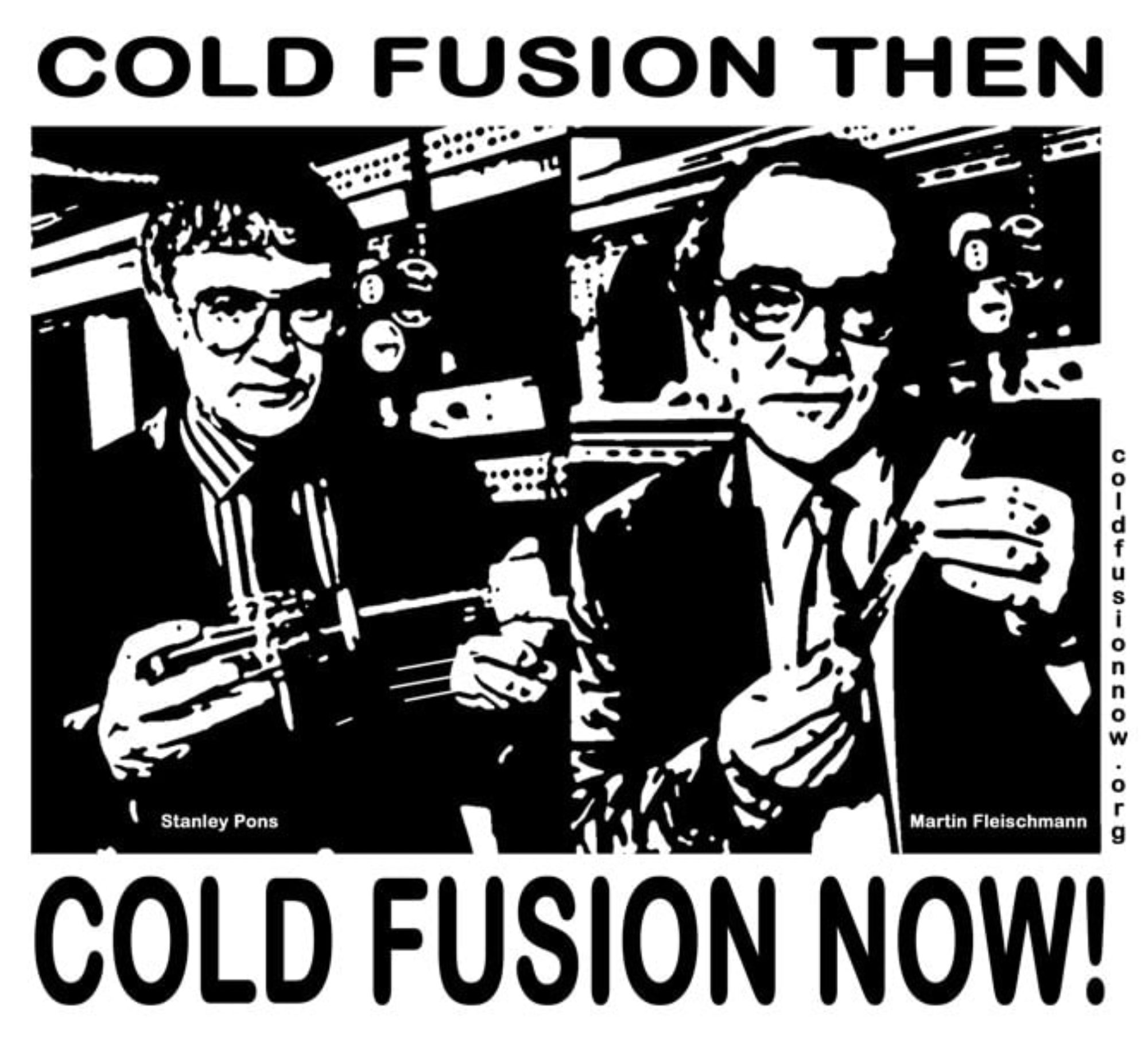
“Explaining LENR”
A new idea of what creates the cold fusion reaction has been articulated by Edmund Storms of Kiva Labs. Storms describes his hypothesis with the simplest terms in the updated Student’s Guide to Cold Fusion [.pdf] and in a recent paper submitted to the Journal of Condensed Matter Nuclear Science called Explaining LENR. [.pdf]
There are three distinct parts to his model.
1. The Nuclear Active Environment NAE of a crack or hollow is formed.
2. Hydrogen enters the NAE.
3. Applied power at the resonant frequency of the NAE/hydrogen combo turns mass into energy.
Storms does not say what nuclear mechanism is at work, only that it is instigated by resonance.
Peter Gluck, one of the earliest scientists to look into cold fusion/LANR/LENR, and what he has termed LENR+ for the new commercial products now being engineered, asked how this proposal answers seven crucial questions, and got Storms to answer. Re-published here from his blog EgoOut is their exchange.
Question #1: What are the consequences if the New Theory is successful?
Storms: The consequences of my theory being correct are twofold. First, the ability to replicate LENR at robust levels will improve. Once the required cracks can be manufactured on demand, the energy could be made on any scale, from that required to power a computer to a space craft.
Second, the phenomenon can be applied to solving the solar defect of neutrinos. This will cause a new understanding of the Standard model. But right now, we can only hope.
Question #2: What about the completeness of the New Theory? Is it a “transtheory”?
Storms: The model will be a “trans-theory” only to the extent that it is acknowledged as plausible and worth exploring. This acceptance is not assured at this time. As for whether one or many theories are required depends on how many ways Nature has to cause LENR. I assume only one basic method is possible. Therefore, only one theory is needed, i.e. the correct one. We will have to wait until the proper tests are made to determine which theory is correct. My model shows exactly which tests need to be done.
Question #3: Is the theory valid for all the existing LENR systems?
Storms: I base my model on hundreds of observations that show several very robust patterns of behavior. These behaviors include both the presence and absence of expected behavior. I rely on using a large number of combinations of behaviors, all of which are consistent with the logic of the model.
In addition, the model can be applied to both deuterium and hydrogen systems using any method for causing LENR. Of course, less support for the idea exists in the hydrogen system, which makes it the ideal system to use as a test of the predictions.
Question #4: Does the New Theory explain the serious problems of control, characteristic to all the LENR systems?
Storms: Control is a problem that the model addresses. I assume the rules controlling chemical behavior apply to the process that precedes the nuclear reaction, regardless how the nuclear reaction operates. Once the preconditions are understood, the controlling variables can be identified and used in the same manner they would be used to control a chemical processes. In other words, chemistry determines the rate of the nuclear reaction.
Once the required conditions are formed, the nuclear process occurs very rapidly and without any additional effort. This is similar to how energy is made in a gas furnace. The rate of energy production is determined by how fast the fuel is applied, in this case D+, and the subsequent flame does its thing without any additional effort or control.
Question #5: Does the New Theory explain the huge enhancement of energy achieved in the LENR+ systems of Rossi and Defkalion?
Storms: Rossi has succeeded in increasing energy production by finding a way to create many active cracks in the fine nickel powder. Presumably the powder has just the right size to support exactly the correct size crack. As a result, the concentration of NAE is higher than Piantelli was able to achieve in solid nickel. The secret of the process involves the method and/or the material that needs to be added to Ni to cause the cracks to form.
Question #6: Piantelli had a self-sustaining cell working for some 4 months and Rossi speaks about an active life time of the material of 6 months. It seems Ni is not destroyed but transmuted. My guess from the very start (1993 paper) was that the active sites are formed in some way by “surface dynamics”- the movements of the atoms at the very surface of the metal – many degrees of freedom.
If the NAE are active cracks in the metal and many/more active cracks mean more energy, then isn’t LENR an inherently destructive process? Is there is a concurrent process by which the structure of the metal is rebuilt, the “wounds” are healed or is the metal, in a certain sense, ‘sacrificed’, structurally speaking?
Storms: I propose that a limited and relatively constant number of active cracks can form because these result from stress relief. Once all the stress is relieved, no more cracks can form. Of course, most of the cracks made this way will be too large to be active, so that only a small number of NAE sites are making the detected energy.
The life time will be determined by variables independent of the number of active sites. For example as deuterium accumulates in the E-cat, the reaction rate will drop because the less active tritium formation reaction will start. When deuterium is used to make helium, the helium will accumulate and block access to the active sites for the deuterium.
I do not believe that any significant transmutation takes place. All measurements of this process show that this reaction is rare, except for the claim by Rossi.
Question #7: Based on the New Theory, what would you recommend as a strategy for the LENR field? On what should research and development focus as much as they can; palladium-deuterium Pd-D systems or nickel-hydrogen Ni-H systems?
Storms: This question involves politics, which makes it difficult to answer. On the one hand, the Pd system has a great deal of experimental support while the Ni system can apparently produce significant power, but based on very little understanding of the process.
If the crack model is correct, the metal is not important except that it be able to form active cracks and dissolve D or H as the required reactants. In fact, Ni might be a better host for the D reaction than Pd because it is cheaper and the D is more active than H because each D makes more energy than each H.
So, my advice is not to focus on the metal but on understanding the process. Once the process is mastered, the claims will be accepted regardless of the metal used. In fact, I think neither Ni nor Pd is the best host for the reaction.
Related Links
A Crack in the Code by Ruby Carat May 24, 2012
Too Close To The Sun: 1994 BBC doc profiles early history of “cold fusion underground”
“If it had been anything else, we would have said, ‘Oh, people don’t want us to do it, forget it, just leave it alone.’ But this is not in that category. This is interesting science, new science.
If you’ve got any integrity, you don’t give it up.” — Martin Fleischmann
Too Close to The Sun from BBC Horizon recounts the story of cold fusion from the initial announcement in 1989 through developments in 1994 when the video was released. Multiple interviews with major players include Eugene Mallove speaking on the Massachusetts Institute of Technology’s bungling of cold fusion data, misrepresenting the actual creation of excess heat from their test cell by claiming they saw nothing. A later analysis by Mitchell Swartz of JET Energy revealed the blunder, though it was never corrected.
“The cold fusion episode will be looked upon as one of the greatest travesties against justice and understanding that has ever occurred in the history of science,” says Mallove.
Also profiled is Michael McKubre, whose Menlo Park lab SRI reported “up to 500 times excess heat” and Randall Mills then of Thermacore, now of Blacklight Power, “claimed 1000% excess heat” from light-water and nickel cells. At the time, that news prompted another “senior scientist at a national laboratory” to begin work on the phenomenon. In the film, that scientist remains unknown, speaking in the shadows, due to the stigma of this field and the backlash that clean cold fusion research brings.
Professor David Williams describes an early and earnest effort by Harwell Laboratory in Britain which found no effect from the experiments. He revealed his frustration on camera. “At first you assume it’s because you’re not smart enough, or not going long enough, or not doing things quite right, so you try yet more variations, and all the time all these claims are coming in from all sorts of people saying Oh they could do the first time around! You know, you feel like a right bird! Here are all these people saying they switched this cell on and bang, it works…..and we found nothing.”
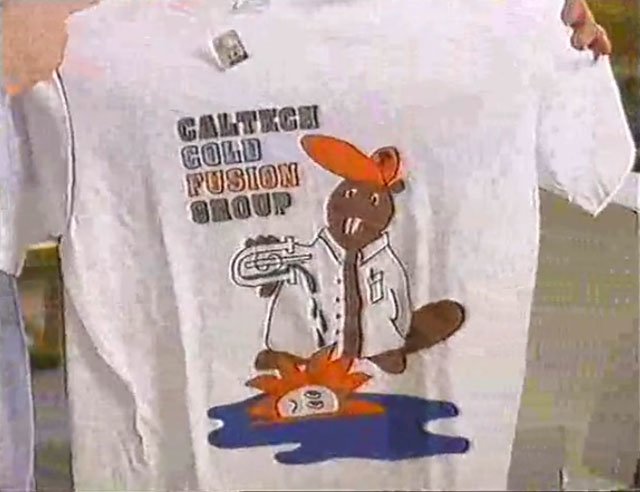
The ERAB panel selectively chose what evidence to allow by claiming that anything that didn’t fit their conventional theory of nuclear science was impossible. “We wrote a very negative report and concluded that the results that were being presented to us were contrary to everything we had found out about nuclear physics over the last fifty years”, Huizenga said.
He authored the book Cold Fusion: The Scientific Fiasco of the Century claiming an untruth that defined the misinformation campaign’s motto to this day: “There’s no experimental evidence at this point that any nuclear reaction products have been formed. Therefore the claim that cold fusion is a nuclear reaction process without a commensurate amount of nuclear reaction products is simply pathological science.”
Though he attended several cold fusion conferences, and eventually went to a lab with a working cell at Cal Poly Pomona where Professors Robert Bush and Robert Eagleton were researching the effect, Huizenga refused to look at the data showing excess heat, first claiming he was “retired”. Then, after an invitation to stay a while and examine the cell with all his newly freed time, he hemmed, saying he had some “consulting” work to do.
Selectively ignoring data was rampant among the so-called “objective” science community. John Maddox, editor of science journal Nature had decided one year later that cold fusion was over. “I think it will turn out, after two, three years more investigation, that this is just spurious and just unconnected with anything that you would call nuclear fusion. I think that broadly speaking it is dead and it will remain dead for a very long time.”
Speaking on those early days in the U.S., when members’ vitriol stained the American Physical Society, Stanley Pons recalls, “You forget things in time. I can remember that was extremely bitter at that time. I thought we’d been treated extremely unjustly, which I still do. I think the critics were not operating in the bounds of sanity, and I think we were victimized in that respect. So I was quite bitter at the time and I’ve just chose to ignore it and just go on. I really don’t have any feelings about it anymore; it’s just a non-issue now.
“I think you become numb,” added Martin Fleischmann.
“You become numb to it, yeah.”
Keiji Kunimatsu, a former student of Martin Fleischmann persuaded Minoru Toyota, of the famed Toyoto car corporation, to fund the pair’s research, setting them up in a lab in the south of France near Nice. Toyota had already been learning about what cold fusion was. Kunimatsu had learned from Fleischmann that “Scientists must do something new which nobody has done before. That way is the spirit of science.”
Fleischman said, “It was a relief to get away from the terrible atmosphere in the United States and to have the opportunity to work totally without public attention for a period of time.”
Although reproducibility of this mercurial reaction continues to plague many labs to this day, a handful of researchers have made huge advances; a few to the point of developing a commercial technology. For these few labs, the clean energy of cold fusion is available on-demand: turn it on when you want, turn it off when you want. When the engineering of these devices finally produces a product, the over two decades of smug pontifications of an errant orthodoxy by the conventional scientific community will at last end.
In 1993, twenty Japanese corporations including Toyota, Hitachi, and Mitsubishi, financed the New Hydrogen Energy Laboratory for a five-year program called Icarus. Martin Fleischmann consulted on the new project.
In celebration of the inauguration of this project, he toasted “To Icarus One, and all the other Icarus’s to follow. And don’t forget, our wings are stuck on with superglue.”
Thank you Martin Fleischmann.
Thank you Stanley Pons.
Thank you Eugene Mallove.
Thanks to you, we will have Cold Fusion Now!
1994 Cold Fusion Sourcebook dedicated to “Children of Chernobyl”
The Salt Lake City, Utah Fusion Information Center founded by Hal Fox was the first research center dedicated to researching and publishing about cold fusion. Newsletters such as Fusion Facts, the New Energy News, and Journal of New Energy all emanated from this organization beginning in mid-1989 and running through 1999.
The book is dedicated to three classes of people:
1. To those international scientists, engineers, and inventors that have diligently pursued the truth; who have trusted the integrity of other scientists who reported on their new discoveries; who have replicated, and improved, and, in turn, reported on this new science of cold nuclear fusion and other enhanced energy devices.
2. To the new scientists, engineers, inventors, and scholars who now can follow in the footsteps of those who have led, and become leaders of others. You will be the individuals and the generation who will develop, install, and use the new non-polluting, inexpensive energy systems that will help improve our homes, our countries, and our world.
3. To the Children of Chernobyl.
Cold Fusion Sourcebook edited by Hal Fox [download .pdf]
from New Energy Times
Fox’s Introduction follows here:
“When I first learned of the devastation to Belarus (and parts of the Ukraine) from the Chernobyl nuclear power plant disaster, I was strongly distressed at the intense penalty that was imposed upon the nation, its people, and especially its children. I determined to do something for the last “Children of Chernobyl”. I desire to express my commendations to those who risked their lives to tell the world about the silent killer in their land and all of us express our thanks to the concerned citizens from many nations that are trying to help. There is no nation on earth that is in a better location for the international conference on new energy than Belarus. There is no nation on earth that deserves and needs a new non-polluting source of energy more than Belarus. That is why I am here with you at this conference.”
“I’m pleased to be the editor of the English version of the proceedings of this important international conference early this year I want to over 50 cold fusion scientists whom I call my friends, and asked them to provide reports on their work. Each one was asked to write an article which would become part of a “Cold Fusion Source book”. In addition, my friend Ben Filimonov of Belarus invited papers from leading scientists from his part of the world who had been successful in the development of this exciting new technology of cold nuclear fusion. With the help of excellent translators, especially Ms. Tamara Grinevich, those papers, mainly from CIS (Commonwealth of Independent States), have been included in this publication. In addition, we have also included some invited papers that deal with some other enhanced energy systems (new energy systems that provide more energy out then used as input or driving energy).”
“The first article in the Cold Fusion Sourcebook is mine and is meant to set the stage with the articles that follow by providing a review of the many new methods, in addition to the original Pons-Fleischmann cold fusion cells, by which nuclear reactions and/or excess thermal energy can be produced in relatively simple “table-top” experiments. The second paper is by Dr. Ben Filimonov, who categorizes the many phenomenon of cold nuclear fusion and provides us with a new way of looking at this rich phenomenon.”
“To the attendees of this conference and those who read our work: we challenge you to make use of this knowledge, improve what we have done, and solve the energy problems so that there will never again be anymore “children of Chernobyl”.
–Hal Fox Introduction Cold Fusion Source Book 1994
Chorus: Will we ever learn?
Courageous new energy scientists continue the effort to develop clean energy technology from cold fusion as our planet is again threatened with the horrific damage of radioactive poisoning that alters the genetic code for generations. Along with pollution from fossil fuels devastating our world wildlife and biodiversity, and war and terror rampant in our streets, there is little more important than working for change in our arrangement for living and peace on planet Earth.
Talk to your friends, family, educators, and legislators about clean energy from the hydrogen in water, and demand
Cold Fusion Now!
Chernobyl Legacy by Paul Fusco [watch] will be disturbing.
Interview with a “Liquidator” from Chernobyl and Eastern Europe [read]
Protected: Next-generation ERoEI
What if?
Peter Gluck, a long-time researcher in cold fusion/LANR/LENR and contributor to the first issue of Infinite Energy magaizine with his “Why Technology First”, asked a simple question: What if twenty-three years ago, the scientific authorities moved to fully investigate and develop cold fusion technology?
What would have happened?
It’s your chance to write a sci fi story.
From his EgoOut site:
An alternative history of Cold Fusion.
November 1989- the state authorities for research in
the US and in all the other industrialized countries take a
historic decision: “We will go Cold!”.
That means- all the funding and forces used for Hot Fusion
will go starting from now to search and develop Cold Fusion.
Great money, thousands of scientists, many hundreds
of labs worldwide, a million of Pd-D cells (soon) all
specialized and dedicated to cold fusion. The best theorists
worldwide publishing Cold Fusion papers in peer reviewed
journals. Patent Offices following the example of US developing
fast methods for the approval of the Cold Fusion patents.
Cold Fusion has successfully climbed all the Everests of high priority.
So it has started, can you tell how it has continued up to today? –Peter Gluck
http://egooutpeters.blogspot.com/2012/05/sequel-to-my-way-to-lenr-truth.html
An early paper from 1992 from Dr. Peter Gluck attempting to identify the nuclear active environment:
Understanding Reproducibility: Topology is the Key download .pdf