Cold fusion-powered car engineer has history of discovery

Dennis Cravens has a crowd-funding campaign to work on a cold fusion-powered car.

He doesn’t expect steam from cold fusion to be able to power the vehicle directly, but electricity generated from the steam would “trickle-charge” a battery to operate the vehicle.

Can he do it?

For twenty-four years, Dr. Cravens has been experimenting with the anomalous heat effect (AHE), and in that time, he has focused attention on gathering criteria and methods to initiate and trigger excess power.

Heat, pressure, current, radio-frequency, chemical, laser, acoustic, magnetic field – all were investigated by Cravens and longtime research partner Dennis Letts.

Cravens presented Factors Affecting The Success Rate of Heat Generation In CF Cells at ICCF-4 in Maui 1993, and together Cravens and Letts presented The Enabling Criteria of Electrochemical Heat: Beyond Reasonable Doubt at ICCF-10 in 2003, both works referring to palladium-deuterium Pd-D systems.

But it was investigating the various triggering methods that the collaborators made a surprising discovery.
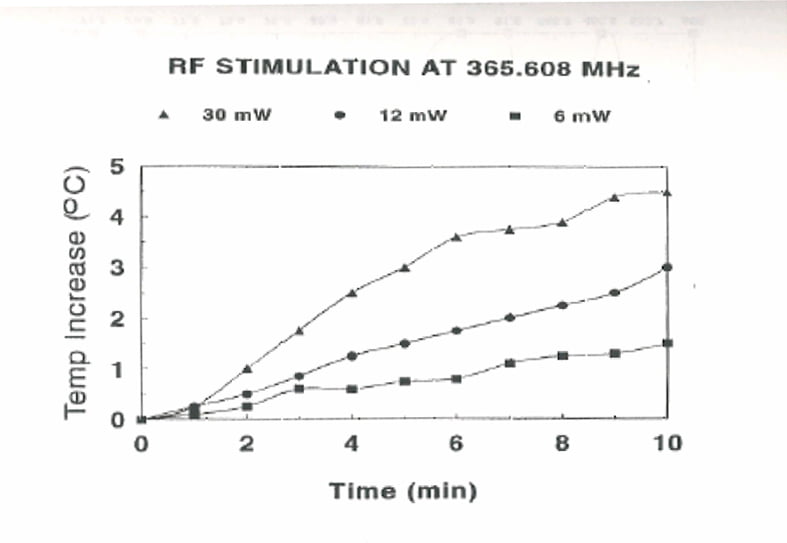
Excess heat can be triggered by radio frequency.
RF-triggered excess heat experiments had been ongoing since 1992, and Letts’ collaborations with R. Sundaresan, Z. Minevski, and J.O’M. Bockris, the Texas A&M chemistry professor who nearly lost his job because of his research into cold fusion, were presented at ICCF-4.

Radio frequencies stimulated the reaction, but as usual with cold fusion, “it was difficult to reproduce”.

In Letts, D. and Cravens D. Laser Stimulation of Deuterated Palladium: Past And Present, PowerPoint slides presented at ICCF-10 2003, the authors describe one early experiment designed to test the effect of RF radio frequencies on excess power.

laser-cell-diagram-1A standard palladium-deuterium Pd-D electrolytic cell was modified to use the more-economical gold metal as an anode, instead of platinum.

During electrolysis, the gold dissolved into the solution, settling on the surface of the palladium cathode, and ruining the experiment.

A pocket laser pointer, emitting the familiar red-light at 670 nanometers, was directed at the cathode, just to see what would happen.

The cell temperature of the 75-gram electrolyte “rose several degrees, in a short time”.

In fact, a 3-degree increase in the electrolyte suggested that the 1 milliWatt laser pointer initiated heat in excess of 500 milliWatts.

An afterthought of directing laser-light saved an experiment.  Graph annotations by Ruby Carat
An afterthought of directing laser-light on the cathode saved an experiment.
Graph annotations by Ruby Carat.

In subsequent experiments, other frequencies were found to initiate a thermal effect, at 681 and 685 nm. “Most of the time this results in triggering a thermal response 10-30 times larger than the thermal output of the laser.” —Laser Stimulation of Deuterated Palladium Past and Present

The keywords there are not “10-30 times laser power”, but “most of the time”. Like RF, the laser triggering method did not guarantee 100% reproducibility.

However, one successful laser-triggered experiment ran live at ICCF-10.
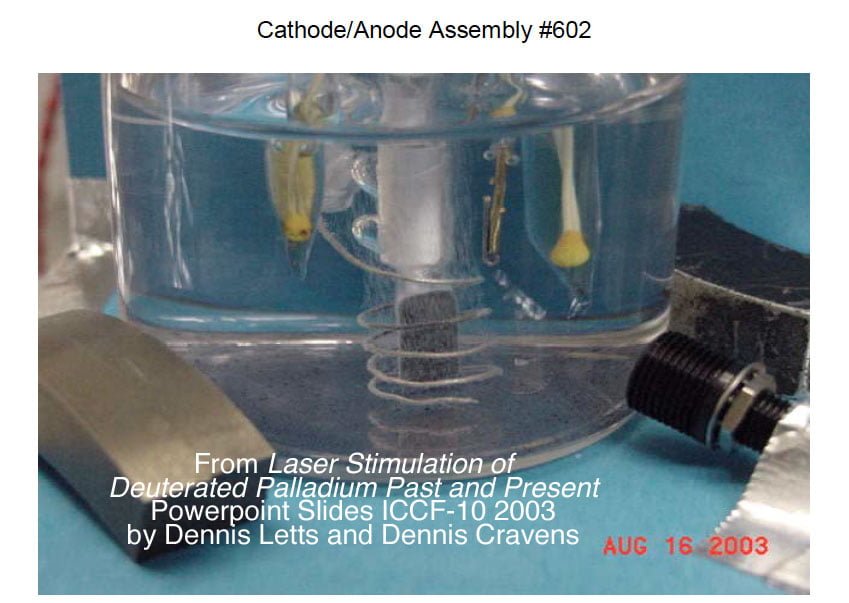
demo-cell-602

After days of loading, a 681 nm laser irradiated a 1mm spot on the cathode of demo cell #602; excess power jumped immediately. The laser was turned off, and excess power decreased. Power to the cell was 500 mW, and with a 30 mW laser stimulation, 500 mW excess power was generated.

Demo cell 602 power graph
Demo cell 602 excess power graph

Laser stimulation to initiate anomalous heat reflects the criteria that many researchers find critical: dynamic conditions must exist in the chamber. Energetics’ Technologies used Superwaves, Brillouin Energy uses Q-pulses, and even nickel-hydrogen Ni-H systems produce higher thermal power output when the chamber is heated.
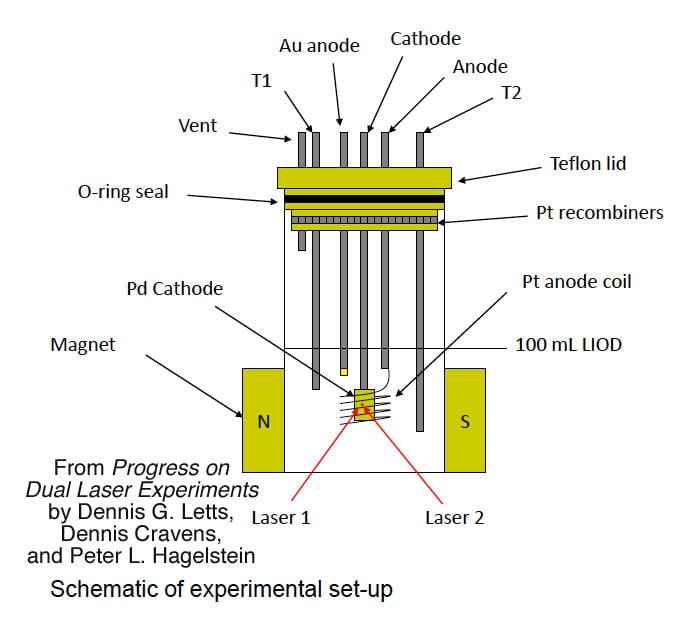
dual-laser-cell-diagramResonance by laser-light was further studied by Cravens and Letts with Peter Hagelstein, when two lasers were operated together to mix optical frequencies, creating beats to stimulate phonons in the Pd-D lattice that would initiate the reaction. Excess heat was associated with beat frequencies at 8.3 and 15.3 THz and 20.4 THz.

In addition, the size of the active regions was also compared to the laser’s region of impact. From their paper, it appears that the Nuclear Active Environment (NAE) is “larger than the laser spot in previous single laser experiments.”

While these undertakings describe basic science research, Cravens is no stranger to commercial efforts.
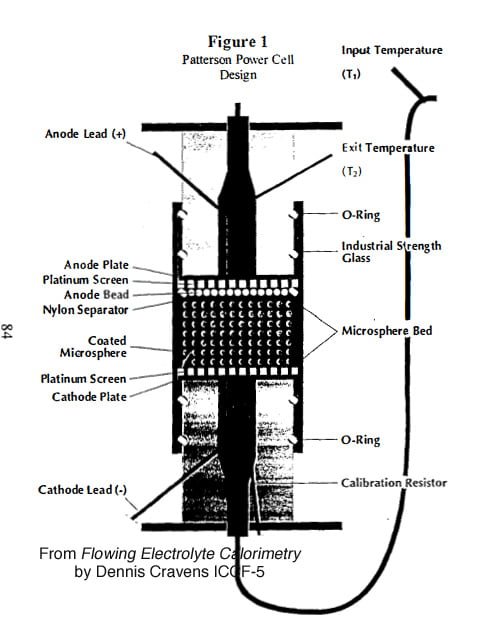
Patterson-Cell-diagram-CravensRepresenting ENECO, an early new-energy company initially formed to develop the Fleischmann-Pons work, Cravens was hired to provide an independent evaluation of the Patterson Power Cell, a proto-type commercial thermal generator designed by James Patterson of Clean Energy Technologies, Inc. (CETI) that utilized “plastic microspheres” layered with transition metals. Cravens reported on this investigation in Flowing Electrolyte Calorimetry at ICCF-5 in 1995.

Attendees at that conference were also treated to a live demonstration of the Patterson Power Cell. Here’s what Hal Fox of the New Energy Institute and publisher of Fusion Facts wrote in April of that year:

BEHIND THE SCENES AT ICCF-5 by Hal Fox

One of the most impressive presentations at the ICCF-5 was
given by Dr. Dennis Cravens and supported by a working
cold fusion cell set up in the foyer by Clean Energy
Technologies, Inc. (CETI) of Dallas Texas. Attendees at the
conference could take their own data, compute the results,
and show that a cold fusion cell was operating at 200 to 400
percent excess thermal power. This cold fusion system
utilized the patented inventions of James A. Patterson. This
invention consists of small plastic beads coated with copper,
nickel, and palladium. These beads provide a uniform large
surface area (of either palladium or nickel) to catalyze the
nuclear processes that are the heart of cold fusion
phenomena. The CETI patents cover both light and heavy
water electrolysis using the metal-coated microspheres.

Writing for the second issue of Infinite Energy magazine, Jed Rothwell provided further details of the demo.

Patterson’s company, Clean Energy Technologies, Inc. (CETI), got together with Dennis Cravens and brought to the conference a demonstration cell in a flow calorimeter. It worked spectacularly well. Cravens [2] discussed it on the first day. The device output 3 to 5 times input energy, ignoring energy lost to electrolysis gases, and as much as 10 times input if you include various factors such as electrolysis gases and the heat lost from the cell container.

As a demo, the Patterson cell output power was only a few Watts, but the durability was impressive. Rothwell continued:

The CETI demo system is fairly predictable, well controlled, and well-behaved, although it did get a bit quirky in the harsh conditions of the ICCF5 hallway. During breaks, the hotel coffee pots kept tripping the circuit breakers. This sent jolts of power through the transformer, which crashed the experiment. The CF reaction started up again every time, usually in about 10 minutes. The high precision flowmeter unfortunately did not survive the beating; the batteries and power supplies in it burned up. Fortunately, the low-precision flowmeter—a 10-ml laboratory supply graduated glass cylinder plus stopwatch—cannot be affected by power outages and excess voltage. The experiment was subjected to other abuses: the cart holding the experiment was wheeled up to a hotel room every night, carried on elevators, and pushed around. Cravens even lifted the cell from its container to show it to people while it was running! Yet in spite of this, the reaction started up in the morning after 10 or 20 minutes of electrolysis, although on the last day it took about a half hour, and the power was turned up higher than before. The fact that the cell survived this treatment at all demonstrates that this is one of the most robust and practical electrochemical CF systems yet developed.

Unfortunately, when Patterson’s beads ran out, the next batch didn’t work; the mystery of cold fusion had claimed another honest effort.

Yet the work of Dennis Cravens has persisted, and in his latest project, powering a 1928 Model-A with cold fusion, the aesthetic of a longtime researcher in anomalous effects marries the old with the new. Why?

“It is bold. It is daring. It is crazy but I have to try,” he writes.

Want to participate in something truly extraordinary? Go to Dennis Craven‘s Cold Fusion Powered Car Part 2 before April 20 to contribute.

The quote on his page says it best:

You don’t have to see the whole staircase, just take the first step.
Dr. Martin Luther King

Cold Fusion Now!

“Crowdvoting” not enough for LENUCO

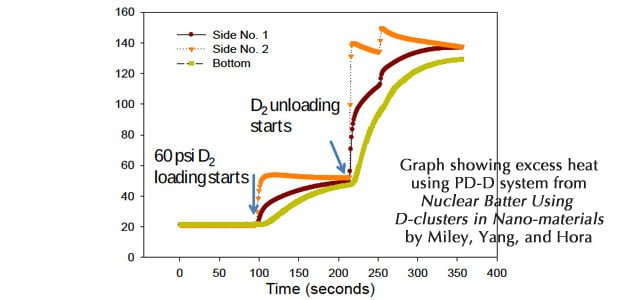
Graphic: Temperature (oC) vs. Time from Nuclear Battery Using D-Clusters in Nano-materials … by Miley, Yang, and Hora.

New energy advocates rallied behind George Miley‘s LENUCO at the Future Energy site, but it wasn’t enough to put the LENR-Gen module project over the top to win the chance to speak before venture capital firms at a Boston, Massachusetts event.

In the lead for most of the ten-day “crowdvoting” contest, LENUCO slipped to third by the last day, while SmartPwrGrid and Printable Photovoltaics took first and second place with a surge of votes.

The projects page is gone now, but at my last check all vote counts were under 1000, though SmartPwrGrid was approaching that mark fast.

During the last day, a reader found evidence of vote-buying from at least one of the contestants which, according to the organizers, disqualifies them. The two winners are not implicated in that vote-buying scheme.

index-2

That the LENR community couldn’t muster 1000 votes shows the need for further outreach.

Whatever the feeling, the fact that a revolutionary solution to our energy, environmental, and economic problems is forced to submit to “crowdvoting” to be heard reveals the absurdity of our societal priorities at the close of the Chemical Age.

A Game-Changing Power Source Based on Low Energy Nuclear Reactions (LENRs) .pdf presented at last year’s NETS conference shows the beginnings of this current LENR-Gen module.

University students work on similar LENR experiments under Dr. Miley's instruction.
University students work on similar LENR experiments under Dr. Miley’s instruction.
Researching both excess heat and transmutations has been the focus of Miley’s works for decades, and has involved students throughout.

Helping a new generation of scientists is well-worth the funding this technology deserves, and we will continue to support the efforts of labs who struggle to bring a clean energy future forward.

LENR generator is “crowdvoting” favorite

The LENR Distributed Power Units project up on the Future Energy “crowdvoting” platform is the favorite with just hours to go, though the Printable Photovoltaics is still hanging on for a last minute surge.

If you haven’t yet, there’s still time to vote!

George Miley is Professor Emeritus of University of Chicago Urbana-Champagne, Illinois, and the intellect behind LENUCO and the LENR-Gen unit.

He describes the “core technology” presented in a statement on the front page:

1.25 grams of nickel = 5 barrels of oil
1.25 grams of nickel can make energy like 5 barrels of oil
LENR Power Units use pressurized hydrogen –nickel nanoparticles undergoing low energy nuclear reactions to create a very high energy density heat source configured for co-generation power for home or industrial distributed power
–George Miley LENR Distributed Power Units

That means that tiny particles of nickel – the very same nickel in your pocket as change – are exposed to hydrogen H, the simplest element in the universe, and found in water.

In a small chamber that has a higher-pressure than normal, the hydrogen interacts with the nickel atoms to make heat.

At the NETS conference last year, Miley presented a design for a LENR generator that could replace the dirty radioactive fuel currently used by NASA for spacecraft power in the General Purpose Heat Source with clean nickel and hydrogen heat source.

RTG-GPHS

The heat is closer in magnitude to Einstein’s E = mc2 energy than it is to burning hydrocarbons, and a lot cleaner.

Mass changing to energy is a nuclear phenomenon, not a chemical phenomenon, but no radioactive materials are used.

A reaction based on the metal nickel and hydrogen, there is no dangerous radiation from the LENUCO power unit.

This source of this heat power is called the new fire.

While the current handful of startups around the world is almost wholly focused on hot-water heaters, LENUCO plans to make electricity with this device.

The smaller 10K units would be for civilian use, though a military customer is in the plan as well:

The recent discovery of practical applications of low energy nuclear reactions (LENR) has created much activity and interest worldwide. Several companies, including LENUCO, have entered this business. Our approach using hydrogen loaded nanoparticles to produce heat that is converted to electrical output offers many advantages. Lenuco was founded to commercialize this technology and has a two-pronged business model. One prong is to manufacture small to medium range distributed power sources for home and industrial use.

The second prong is to provide develop the technology for use by in Army bases, both homeland and in forward facilities, for a main power source.

Both uses capitalize on the high power density and low maintenance, radiation free, long lifetime characteristics of LENR power cells.

University students work on similar LENR experiments under Dr. Miley's instruction.
University students work on similar LENR experiments under Dr. Miley’s instruction.
LENUCO’s LENR power source is a revolutionary new technology based on high pressure hydrogen loading of nickel-alloy based nanoparticles.

Heat is produced by the resulting low energy nuclear reactions through a process which avoids any significant radioactivity.

Uses range from home heating to central heating units.

Compared to other renewable energy, LENR power units offer two distinct advantages: 24/7 operation and higher power density, hence significantly smaller units per unit power.

LENR cells also provide power without greenhouse emissions and with no significant wastes.

These advantages plus minimum maintenance and long lifetime result in a distinct economic advantage over other renewable energy sources as reflected by shorter pay-back times than solar, wind or fuel cells. –George Miley LENR Distributed Power Units

If you haven’t voted yet, there’s still time but you must act now:
VOTE-LENUCO

Related

U.S. Schools with Cold Fusion-Friendly Faculty by Ruby Carat

LENR-Gen Module needs your vote by Ruby Carat

Andrea Rossi on Tom and Doug Show: “It is a very important moment”

Tom and Doug are two musicians who have a weekly radio show where they regularly discuss Andrea Rossi and the Ecat.

They’ve written songs on the topic, including I Believe in the Ecat, and LENR Revolution, complete with Rossi audio samples and a saxophone player inserted in the Ecat demonstration video.

An interview with Andrea Rossi conducted by Doug in mid-February opens this video where Rossi talks about plans for industrial Ecats and the third-party testing of the Hot Cat.

Some of the points made were:

  • After the delivery of the 1MW Ecat to the military last year, work ensued on engineering the industrial plants for certification.
  • Now, work continues on “manufacturing some industrial plants that are close to being delivered”, and the certification process continues.
  • The independent test of the Hot Cat, the Ecat that works at high-temperature, should be finished by the end of March.
  • It will be an important validation, but manufacturing of the industrial Ecats will continue regardless of the independent report. The third-party test and the industrial production are independent, but parallel. Rossi is very curious to learn what the report says, and will apply any new information to the engineering process.
  • He’s in contact with the third-party once or twice a week, but the main daily focus is completing the industrial plants that have already been sold.
  • He continues to work long hours, and will continue “pressing” until delivery.
  • After the industrial plants are delivered and working in their factory location, data from their operations will guide work on the domestic Ecat. The industrial plants are “basically assemblies of domestic plants”.
  • Domestic units for the home need to be easy to use and held to a high standard of safety.

Tom and Doug interview Andrea Rossi on Ecats future by Ruby Carat

Oilprice.com links COT and new energy breakthrough

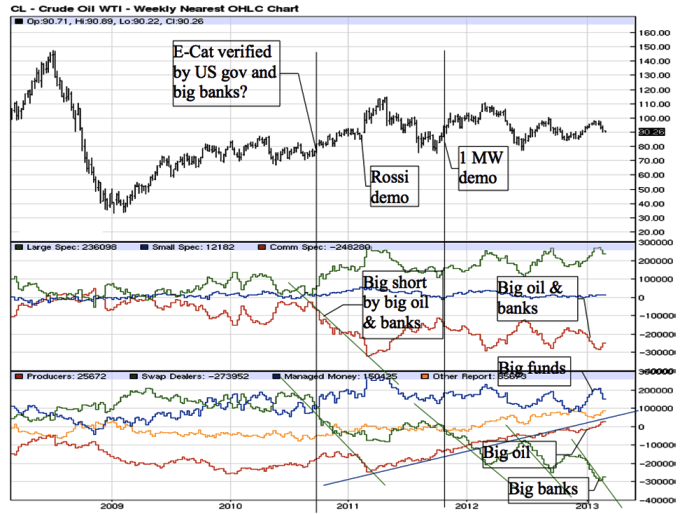
In Why Are the Big Financial Institutions Selling Oil BIG?, Oilprice.com author Torkel Nyberg links oil and low-energy nuclear reactions (LENR) in his analysis of a recent Commitment of Traders (COT) reports.

It is a provocative thesis of his that the largest of corporations and financial institutions have inside knowledge of a breakthrough in LENR via Andrea Rossi‘s Ecat.

AE1620

From the article:
At some point during the fall of 2010 there was a large policy shift in hedging crude oil on the NYMEX futures exchange by the big banks and the oil companies. Up to that point the hedgers of crude have largely been the producers as they want to hedge their production against future price movements. On the buy side there was the big financial institutions (Swap Dealers = JP Morgan, Goldman Sachs, etc), and the money managers (large pension funds, hedge funds, etc.), that speculate in a price increase.

But during the fall of 2010 this state of affairs changed. From being net-long 200 thousand contracts, the banks became net-short in a couple of months. Their selling has since continued. And now, by March 2013, they are net-short 300 thousand contracts (300 million barrels of oil = $30 billion). See the green lines in the chart above.

At the same time the producers have liquidated their 200 thousand contract short position (blue line above). They are no longer hedging as they used to. And they’ve done it in a very consistent way. It looks almost unreal, buying an equal amount of contracts each month for two years.

During this time the banks have consistently been using a strategy to buy weakness and sell strength during their massive net-selling. As if their strategy was to build a huge short position and at the same time stabilize price. The conclusion is that the banks are now net-short about 300 thousand contracts at a price about $90-$95.

On the buy side the money managers went from being neutral by fall of 2010 to being net-long 250 thousand contracts as of today. This is of course the big funds, and in the end pensions and savings. They are now net-long oil and of course net-long all the producers (oil stocks).

Researching this strategy change has given very little information. One article though, from July 2012, touches on the subject. No answers and no explanations though. [Insidefutures.com]

Following the Commitments of Traders Report (CoT) does however reveal a great deal of information. The standard report shows the commercial traders, (oil companies and banks), large speculators (big funds) and smaller speculators (the rest). The disaggregated report also shows the position of banks and producers respectively. Both these reports are shown in the graph above. The combination does tell us that something is going on, but what?

Something real is going on, but what?

Continue reading here.

The realization of Peak Oil looms large in any examination of the oil business, and will figure in any industry moves.

But as incremental successes in experimental new energy cells from LENR accelerate, the potential Black Swan of cold fusion should not be far from any energy study either, and we are beginning to see that here.

Top