Video: Robert Godes speaking at ICCF-18 in the Entrepreneurs session.
Brillouin Energy Corporation and SRI International continue their association cooperatively on experiments towards a commercial quantum fusion energy generator.
“We are solving engineering problems with the Hydrogen Hot Tube (HHT™) and expect to have a solid system by the end of 2014,” says President and Chief Technical Officer Robert Godes. “We also bounce ideas about the next-gen WET™ system. They [SRI] are great to work with.”
A relationship with investment firm Sunrise Securities is ongoing, but Godes says, “I don’t see Brillouin Energy going public. We may start a subsidiary corp with Sunrise for power plant operations with the HHT™ system at some point.”
Most importantly, Brillouin’s cell test equipment is dressed for success with a message that properly focuses the effort:
Brillouin Energy test equipment at SRI International
Issue #112 of Infinite Energy Magazine presents a collection of nine papers covering a selection of current theories of cold fusion, also called low-energy nuclear reactions (LENR), lattice-assisted nuclear reactions (LANR), quantum fusion, heat energy from nuclear reactions (HENI), and nickel-hydrogen exothermic reactions, among other terms.
The bevy of names describing the effects generated when hydrogen interacts within various metals reveals the variety of theoretical models that purport to explain what was originally called cold fusion. Each theory circulating today is as different as the list of names for this Rumpelstiltskin reaction. The lack of consensus among scientists on what makes the fusion-sized excess heat and transmutations has been a major stumbling block to developing a commercial product.
Some labs have a controlled, on-demand reaction, but are challenged by low thermal output. Other labs have high thermal output, but are lacking some aspect of stability or control. All successes have been hard won by trial-and-error, and each lab follows a different model.
A varied set of models attempting to describe the reaction were given at the 18th International Conference on Cold Fusion (ICCF-18), amidst the mostly experimental results presented. David J. Nagel, formerly of the Naval Research Lab and now at George Washington University in Washington, D.C. contributes a Scientific and Commercial Overview of ICCF-18 that summarizes the talks. The article is an excellent summary of the state of the field as disclosed by many of the top scientists in the field and is available to read free-of-charge as a service to the community. [.pdf]
Longtime researcher Dennis Letts contributes an article A Method to Calculate Excess Power and George H. Miley talks about his new book, recounting events in his long research career, as well as what’s happening regarding his new company LENUCO in an interview by IE’s Christy Frazier. [.pdf].
You can also read my personal account of the Second Annual Global Breakthrough Energy Movement Conference compliments of Infinite Energy [.pdf], but buying the issue supports the work of the New Energy Foundation.
Edward Tsyganov of Cold Fusion Power, International and OSNovation Systems, Inc. presents Cold Nuclear Fusion at RASA.Edward Tsyganov forwards a report Cold Nuclear Fusion on his research presented at the Russian-speaking Academic Science Association (RASA) meeting held 8-10 November 2013, Clearwater Beach, FL.
Currently, humanity has reached a stage of development at which the struggle for energy resources is particularly important, because all the known sources of energy in the near future will not be able to provide our needs. Chemical energy, in addition, is limited on account of the so-called greenhouse effect. Nuclear energy is based on the use of fissile materials, and is not a solution, because the stock of these materials is limited. The initial optimistic expectation of the transition to the process of controlled nuclear fusion has not yet materialized. Technical difficulties in obtaining sustainable superhot plasma and the damaging effects of the enormous neutron flux arising as a result of fusion reactions back down the solution to this problem on a more distant and uncertain future.
Recently there was the belief that the problem of controlled nuclear fusion could be solved in a completely different way. It has been shown experimentally that the cross-barrier synthetic processes depend greatly on the physical state of the matter that reactive atoms are placed in. Distance convergence of two deuterium nuclei through the mechanism of the Rydberg crystal cell in metals occurs by an order of magnitude smaller than the size of a free atom of deuterium. Coulomb barrier permeability in this DD fusion process increases greatly (by the 50–60 orders of magnitude) as compared with a permeability barrier to free molecules of deuterium. In this recent work, we discuss the possibility of detecting the “cold” DD fusion process experimentally by detecting low-energy electrons resulting from the fusion reaction of two deuterons in palladium crystals with very small (thermal) excitation energies of the intermediate compound nucleus 4He*. This process is made possible by the exchange of the excited compound nucleus with electrons of the crystal lattice that results from virtual photons.
It happens historically that the process of DD cold fusion was studied in more detail than other, similar processes. In this regard, we have restricted ourselves to this particular process. Presented below is a summary report of the situation that has now developed, in a cold DD fusion.
Accelerator experiments have shown that the value of screening potential for the impurity atoms in metallic crystals reaches up to 300 eV or even more. This means that, during DD reaction occurring in the medium of the metal crystal, impurity atoms are excited, and deuterium has not circular but elliptical electron orbits, which are oriented relative to each other a certain crystallographic manner. In this case, the nuclei of these atoms can approach each other by a distance substantially less than the size of the unexcited atom, yet still without Coulomb repulsion. Such processes are known in the art and are the cause of chemical catalysis. The processes were first quantitatively described by Johannes Rydberg in 1888.
Thus:
1. The existence of the phenomenon of cold fusion is now conclusively proved by experiments, including experiments on low-energy accelerators.
2. The observed absence of nuclear products for cold fusion can be explained by the decay of a compound nucleus 4He* slowing through nuclear channels as its excitation decreases in energy. The release of energy in this connection is mediated by virtual photons.
3. Prejudice of many nuclear experts to the phenomenon of cold fusion is due to the unusual nature of the nuclear process, in which cold fusion forms an intermediate compound nucleus 4He* in a metastable state.
4. The accumulated empirical rules of nuclear physics seem indisputable to the nuclear community, while the range of their application is merely limited.
—E.N. Tsyganov
VIDEO: Nicolas Chauvin presenting LENR Cars as part of Entrepreneurial Efforts at the 18th International Conference on Cold Fusion (ICCF-18).
Nicolas Chauvin, research scientist, innovator and entrepreneur, is up for the Future Energy Startup Investment opportunity with his LENR Cars, and he needs your vote now.
Chauvin is an EPFL engineer licensed in business school and co-founder of two other start-ups before LENR Cars. He has worked for NASA, Nestlé and Logitech.
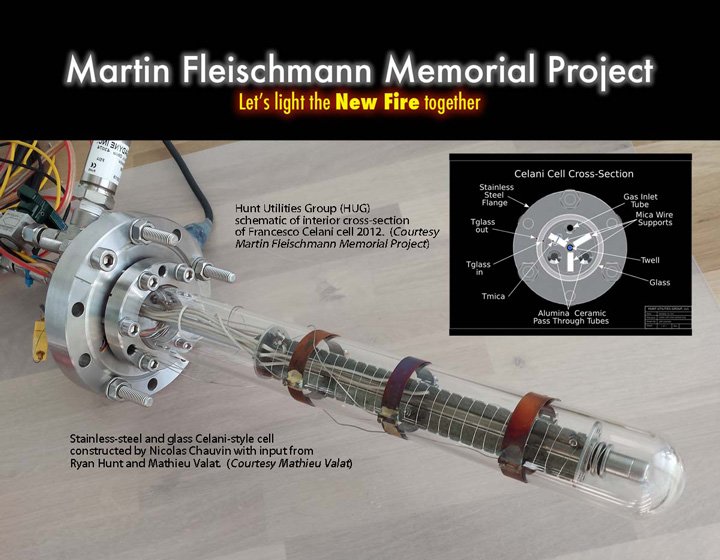
Steel-glass Celani-style cell is MFMP’s newest by Nicolas Chauvin, together with Mathieu Valat and Ryan Hunt. (From the 2014 History of Cold Fusion Calendar)He is currently working with the Martin Fleischmann Memorial Project (MFMP), an open-source science group collaborating across continents to reproduce LENR experiments. Chauvin recently completed a steel-glass cell design derived from the Francesco Celani-style reactor, a picture of which is the December photo for the 2014 History of Cold Fusion Calendar.
LENR cars might be an early entry into this nascent technology, but engineering applications will drive the science forward, too.
LENR Cars is developing two technologies to reduce carbon emission: – Waste heat recovery system producing electricity from heat based on Rankine microturbines – Condensed matter hydrogen fuel cell that can consume 4000 times less hydrogen than conventional fuel cells for the same electrical output power thanks to LENR process LENR Cars is currently focusing on the transportation market with high tech collaborations in motor racing. Rankine microturbines are expected to reduce the fuel consumption of vehicles (cars, trucks and boats) by 15% while being affordable for mass production. On a long term, condensed matter hydrogen fuel cells are expected to be able to power electric vehicles for over 20’000 km per hydrogen charge with a lower cost of ownership compared to fossil fuel vehicles.
Videos from the 18th International Conference on Cold Fusion ICCF-18 Thursday and Friday sessions are posted on the Cold Fusion Now Youtube Channel and linked below.
On Youtube, switch quality to “720P” for HD quality.
Closing SessionRobert Duncan, University of Missouri,
ICCF-18 General Chair and Annette Sobel Program Organizer
ICCF-18 Organization [.pdf]
ICCF-18 Program Overview [.pdf]
ICCF-18 Statistics [.pdf]
If you have enjoyed these videos, show us that you value our commitment to making this information public. Show us that you care about our work.
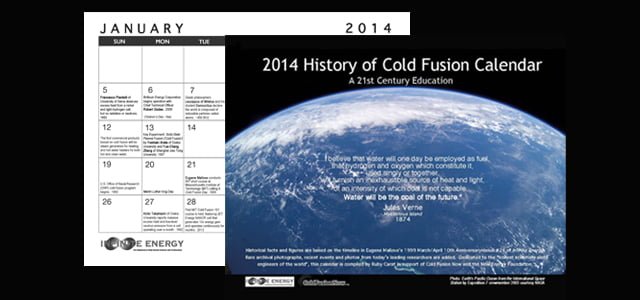
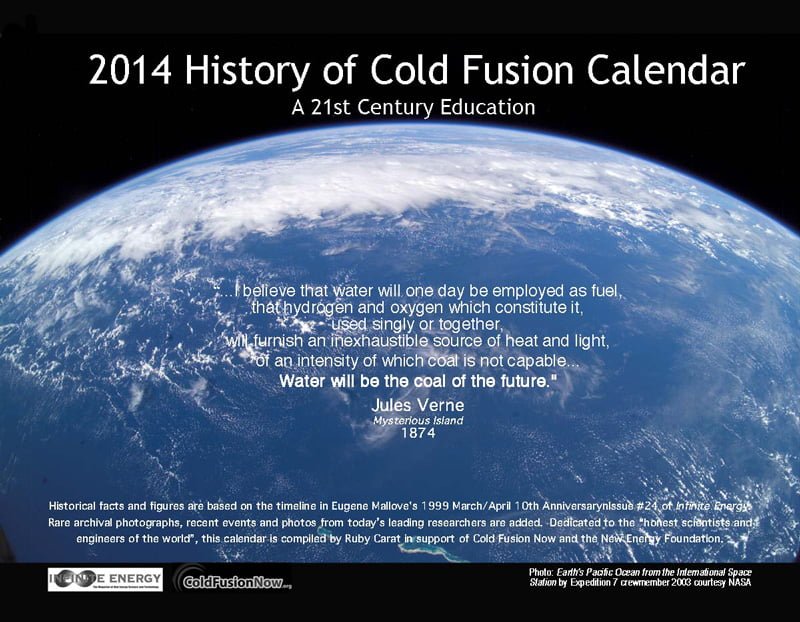
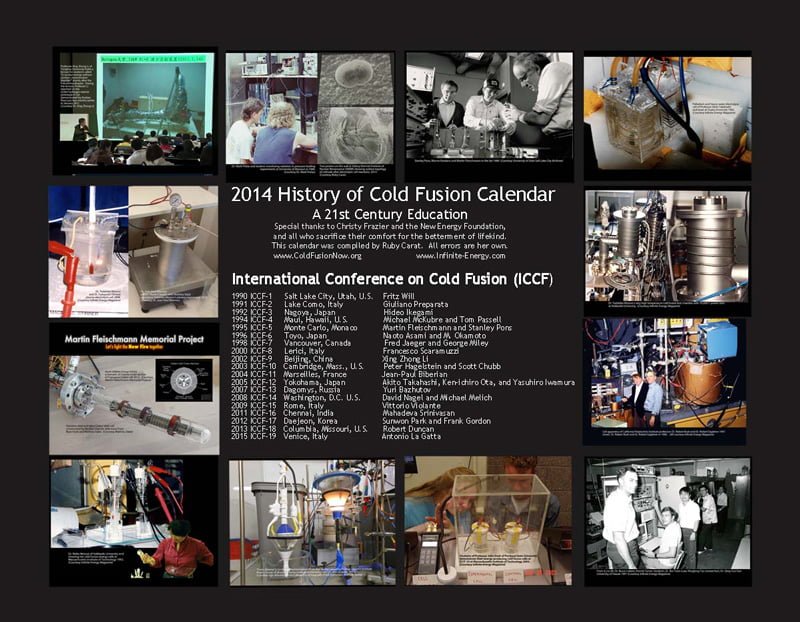
You asked for it, and now it’s here: the 2014 History of Cold Fusion Calendar!
Jam packed with lots of new info and quotes, this year’s must-have gift for your new energy enthusiast is sure to please.
Twelve gorgeous full-color images from leading researchers of today, as well as rare photos from the New Energy Foundation archives, grace the pages. Energy cells are lavishly displayed in close-up panoramic color!
But the 2014 History of Cold Fusion Calendar isn’t just a pretty piece of art, it’s got the facts you need to back up your advocacy.
Find out who first speculated on the existence of atoms! (See January 7)
Do you know how much energy could be released by each gram of deuterium? (Find out March 31)
When did the Electrochemical Society designate F-Day? (See May 8)
What’s the melting point of nickel? (You’ll know on June 17)
Follow a special narrative of Tadahiko Mizuno‘s 1989 massive “heat-after-death” event, as he fills bucket after bucket of water around the cell that won’t quit, and it mysteriously steams away!
Last year’s 2013 calendar was a huge success, and presented the field of cold fusion to newbies with prestige. Order a bunch to send to policy-makers and news media. They won’t be able to ignore the technology for long!
Send a few to your local schools, and encourage students to experiment with their teachers. They’ll be in good company with one high-school that has an inter-disciplinary program and working cells right now! (See September!)
Order now, and they’ll be ready just in time for the holidays to give the techies in your family the gift of a lifetime!
All proceeds go to support Cold Fusion Now and the New Energy Foundation, serving the new energy community with education, advocacy, and funding.