Robert Duncan interview on Cash-Flow: “Public investment means public ownership.”

He was supposed to be the keynote speaker at the 16th Annual International Conference on Condensed Matter Nuclear Science in Chennai, India which brings low-energy nuclear reaction scientists from the International Society of Condensed Matter Nuclear Science together from around the world, but the massive snowstorms in the U.S. prevented Dr. Robert Duncan from attending.

James Martinez took that as an opportunity to interview Dr. Duncan, the University of Missouri Vice Chancellor for Research, on his Cash-Flow show. The hour-long interview revealed a thoughtful and deliberative researcher who is exploring a science that could potentially solve all of the world’s energy problems. The development of a table-top nuclear-sized power generated from a small piece of metal, like palladium or nickel, infused with hydrogen, found in water, could power the entire planet for tens of millions of years.

Dr. Duncan had not been involved in any related research until he was asked by the 60 Minutes television program in 2009 to investigate Energetics Technologies’ cold fusion claims. Energetics Technologies is a young energy company that had at that time made some outstanding claims of excess heat using a modified Fleischmann/Pons cold fusion cell. Dr. Duncan was chosen by CBS to investigate, having made a career on “making extremely accurate measurements of heat output in open thermodynamic systems”.

Dr. Duncan, initially skeptical, reviewed the data and realized “there was something going on here”. His first review of the literature, and talks with some of the researchers involved, documented at least 200 instances of the excess-heat effect, and this is what prompted him to accept CBS’s offer to examine Energetics’ lab. Today, Dr. Robert Duncan is a strong and active researcher in the field of cold fusion, technically called low-energy nuclear reactions.

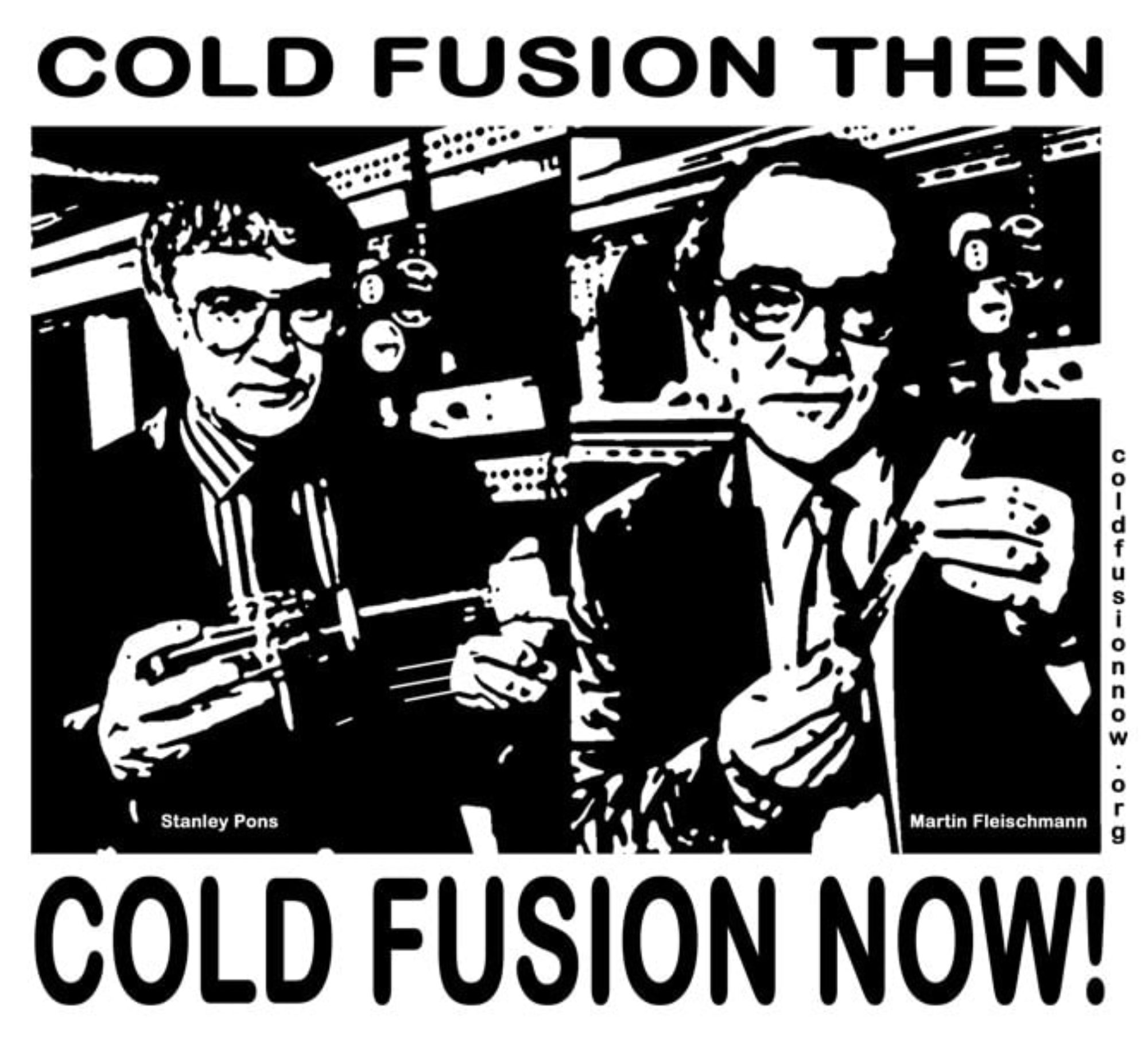
Describing his first impressions of the announcement of Drs. Fleischmann and Pons back in 1989, he noted that the claims were not accepted by the physics community because of the initial problems in reproducing the experiment, even though it was not the first time this had occurred.

The first report of a possible nuclear reaction using a deuterium-palladium system occurred on September 17, 1926 in Berlin, Germany when the very well respected scientists Friedrich Paneth and Kurt Peters saw something anomalous. When they could not reproduce the effect, they had to retract their findings.

Dr. Duncan continued with analogy when he described the first silicon transistors and superconductors. In both cases, technology was being developed before understanding of the underlying processes of material science was understood.

In the 1950s when silicon transistors were discovered, materials science was just beginning. During those first years, batches of transistors were made and tested, and the ones that worked were kept, while the ones that didn’t work were thrown away. As much as 80% of the batches had to be thrown away because they didn’t know what was causing them to work or not.

Today the process control in fabricating silicon transistors is well-known. The certainty in quality comes from the purity of silicon and added dopants, but this knowledge is the result of decades of research and hundreds of billions of dollars. A similar situation occurred with superconductors.

Duncan says this may be the same thing happening again with cold fusion research. If this is some kind of fusion process, the scale in which the reaction takes place is very tiny, distances of 1/10,000 the size of a hydrogen atom and time scales on the order of an attosecond, a duration of 10e-18 seconds. Given these extremely small scales involved, the coarseness of control makes the materials environment difficult to determine. This may be why using nanoparticles of palladium, super-small particles sized on the order of a billionth of a meter, and heavy hydrogen (deuterium) appear to now give a 100% reproducibility rate of excess heat, as they seem to load-up automatically.

But Dr. Duncan also cited the recent announcement from Andrea A. Rossi‘s group in Bologna, Italy on January 14 that used a different system of light hydrogen (regular hydrogen) and nickel.

Differences and similarities between the palladium-deuterium and hydrogen-nickel systems are not fully understood.  The elements palladium, nickel, as well as platinum, another metal important to low-energy nuclear reactions, are in the same column of the periodic table, and thus should behave similarly.

He has not closely examined the Italians’ system, and since they are withholding information about their device, citing trade secrets, he cannot yet determine the validity of their claims.  The patent process has been a problem for scientists developing these clean energy technologies to protect their intellectual property, he said.

In the interview, Dr. Duncan responded to the fundamental question of how this technology will be developed. Will a few elite own this new energy technology, withholding it from the world through, as James described “red-tape and bureaucracy”, or will the entire planet benefit with a “free flow of information” from an ultra-clean power source that uses a fuel of water?

Responding, Dr. Duncan said he “has a basic commitment to the open exchange of information”, but this is why the patent and trademark office was established. “You need to have an openness for exchange of information, but at the same time you had to protect substantial private equity investments and efforts as well.”

He said a company building a better mousetrap may have spent hundreds of thousands, or millions, of dollars to do so, and it’s important that those who sacrificed to help create a new invention get their investment back.

The main point is the United States Patent and Trademark Office was established with that understanding. Because when you prepare a patent, you are actually making a publication, and you are required to disclose openly all aspects that are necessary to repeat your invention. By doing so, you do exactly what we are discussing, you’re keeping in the public domain for public scrutiny and improvement, the major advance that you’ve obtained. And that’s the whole concept of being able to patent; it couples respect for private equity with an opportunity for open exchange which, certainly I know as a scientist, is critical for the advancement of any discipline.

Doing research in a modern lab today is an expensive undertaking, and “money is never in academia, or never in scientific pursuits, an end in itself, but it’s always an important means to that end, it’s a way of moving forward.”

Promoting openness while respecting private investment is critical for the development of science. Dr. Duncan thinks “it’s unfortunate that the Patent Office in the United States rejects without review any cold fusion patent applications because, again, that makes it so people [scientists, inventors]…, many of them feel they have nothing but secrecy to fall back on. Whereas if they were able to make an open patent disclosure and be assured market protection for their private equity investors, then they’d feel much more confident about just putting everything out there and letting it be scrutinized by the open scientific method.”

It really all comes down to the scientific method. The ability to describe very clearly what you’ve done, to have like-minded scientists scrutinize it and try to understand it and make improvements upon it.

That openness, that open exchange of information and ideas, inviting full scrutiny, criticism, skepticism, repetition of experiments as we’re starting to see in some cases today with the nanoparticle work, especially, and better repetition with some of the other methods of realizing this excess heat effect in cold fusion. As we start to see that occur, we must have that sort of open scientific exchange and I’d say that It’s really thriving fairly well today, because of the dedicated effort of the many scientists you’ve just mentioned.

Since there’s been so much angst developed, and this has become kind of like a pariah science unfortunately, I think that it’s unlikely we’re going to see much public investment in this in the United States, and let me say I’d love to be proven wrong. I think it would be a very good idea to see more funding of this.

It’s interesting that when this was reviewed in 2004 by the National Academy of Sciences, the NAS came back and recommended that well-controlled experiments in cold fusion be funded by public money just to avoid the the problem you’re mentioning and what surprises me is not only did that never happen, when you go and look at Wikipedia and other sources they’ll say that when this was reviewed by the government in 2004, they came to essentially the same conclusions as 1989. Well that’s not true. In 1989, there was alot more angst and people were ready to pronounce it completely a debunked area of research.

But in 2004, that committee came back and said where well-controlled experiments can be defined, they should be funded. But none have, to my knowledge, on public money. And that’s unfortunate, because just as you say, if the public invests in it, then the public owns it, whereas if its privately invested in, then you have to find some means like a patent to respect the private equity of those that have put either their money or other people’s money on the line.

And it’s not just some greedy person investing in science and trying to keep it secret. Alot of these major investments that made the silicon industry for transistors take off were securities that got bundled in very successful retirement accounts over many many years.

But with the patent office not being willing to review these applications even from the start, then that opportunity to respect private equity an get a similar open transparent discussion going where people can learn on and approve from inventions that others have made, will be very hard to achieve.

Now my prediction would be that, unfortunately, this will probably be done again with people resorting to trade secrecy, and again, …. I know alot of scientists who have been involved in this, naturally want to be open and transparent, but without patent protection, they’re left with nothing but trade secrecy to fall back on, and to protect, again, the private equity of their investors, and given that that’s the case, then I imagine what will happen, is this will remain a kind of opaque, kind of not transparent science, for that reason until, someone, possibly Rossi, or someone whose claiming such an outstanding result really proves it, and shows a black box that really does put out 20 times more energy than it consumes.

When somebody does that, then nobody really cares about the science, just the total energy output demonstration will be enough to kind of convince the world to jump in, but unfortunately, I wish we could get more of a public funding investment in this area of research, given how interesting and intriguing it is and I wish the patent office would review and scrutinize and potentially approve cold fusion patents.

Now, granted we still don’t know fundamentally what’s going on in detail, but that’s again not too surprising because science is always in its own right, empirical, meaning its based on repeatability of experiments, rather than on whether you have confirmation in a theoretical model.

Dr. Duncan says that scientists are always trying to rule out their hypotheses. He believes that if an idea can withstand repeated attempts to disprove it, then there must be something there.

While he declined to make a “magic prediction”, he did say it was quite likely that this [science] will someday lead to something of “technical significance”.

And he guaranteed one thing:

If given these really tantalizing, empirical observations, that now hundreds of scientists have made all over the world, if we just say ‘wow that’s kind of interesting but we’re going to stick out heads in the sand and not explore it’, then I think we’d be remiss socially. I think we’d be failing our responsibility as scientists to tease out and understand these empirical results that we don’t understand because again, they often lead to things beyond our wildest imagination…

To listen to the full Dr. Robert Duncan interview, go to our Audio page or download the .mp3 here.

Dr. Robert Duncan on James Martinez’ Cash-Flow this Thursday.

Dr. Robert Duncan will be interviewed on James Martinez’ Cash-Flow show this Thursday, February 3, 2011 at 12:00PM Pacific time (20:00 UT).

Tune in and listen live at Cash-flow on Achieve Radio. Flash-message your questions in for Dr. Duncan, or listen later on the Archives.

Download the full interview on the Cold Fusion Now Audio page after broadcast.

Dr. Robert Duncan is the Vice Chancellor for Research at University of Missouri. He was recruited by CBS 60 mins to investigate the claims of cold fusion technology as developed by the private company Energetics Technologies, and which resulted in the April 2009 television broadcast of Cold fusion: More than Junk Science.

Originally a skeptic, after his investigation, he realized “Wow, they’ve done something very interesting here…. I found that the work done, was carefully done, and that the excess heat, as I see it now, is quite real.”

Clearly, Dr. Duncan saw the importance of developing this science as he subsequently brought Energetics Technologies to the University of Missouri’s Business Incubator Park and set them up in a freshly funded lab.

Here’s a talk by Dr. Duncan at the UM 2009 Energy Summit speaking about his experience investigating cold fusion using deuterium and palladium.
[youtube=http://www.youtube.com/watch?v=0nNRB0K_dw0&w=425&h=349]

While cautioning the public against “speculating wildly” and getting their hopes up about new technological solutions before the science is even understood, he says to those who would deny this new kind of science as worthy of study, “Read the published results. Talk to the scientists. Never let anybody else do your thinking for you.”

Put cold fusion on PBS with your thumbs up

Planet Forward is a consortium including PBS, National Geographic and George Washington University, set-up seemingly to create dialogue on innovative energy solutions.

They are planning a special PBS broadcast on innovative energy for this year’s Earth Day, and they want you to decide what innovative ideas should be featured..

From their website http://planetforward.org/vote-pbs/:
On April 8, 2011 PBS will air a Planet Forward special…made by you. Our members have submitted their ideas about how we generate or use energy more efficiently, and YOU decide if they get on the show. Learn more about the special….

WHAT CAN YOU DO?
On October 26, Cold Fusion Now posted the CBS 60mins video clip on Cold Fusion: More than Junk Science as an innovative energy idea.

If you vote for this idea, cold fusion could be featured on the special broadcast to be aired for Earth Day 2011.

Follow this link and scroll down to October 26, 2010. (Fifth row of submissions down. You will see the greenish cold fusion cell bubbling.)

Click the thumbs up to add to the “Viability” of cold fusion energy. The more votes, the better.

Here’s the link:
http://planetforward.org/question/what-theory-behavior-or-norm-are-you-or-your-team-researching-that-will-lead-to-an-improvement-in-how-we-generate-or-use-energy/

Very few ideas even have votes – and it ain’t hard to beat zero.

Cold fusion is creeping from ground to figure, and nothing will stop that. But a little push, and low-energy nuclear reactions could be a feature of Earth Day 2011.

From Planet Forward:
The days are counting down. Nominations close on February 4 and voting closes a week later on February 11.

Cold Fusion Now!

Gerald Celente: Cold fusion “to be the greatest investment opportunity of the 21rst century.”

Gerald Celente, lauded prognosticator of Trends Research Institute, recently put new energy and cold fusion as #6 on his Top Trends for 2011 in the Trends Research Journal.

As a regular guest on cable news and contrarian financial radio shows, we can expect lots more cold fusion talk on the virtual landscape.

And, it’s started.

An interview conducted by Chris Waltzek of Goldseek Radio has Mr. Celente mentioning the recent demonstration of Dr. Rossi’s Ecat boiler at the University of Bologna.

He also mentions the trouble with getting patents with anything related to cold fusion.

For the full interview, go to http://radio.goldseek.com/ for this Saturday’s January 29 broadcast. Listen to this exert here.

Gerald Celente on Goldseek Radio January 26, 2010 by Cold Fusion Now

Answering “Nine Critical Questions to Ask About Alternative Energy”

Whether you are a scientist or just a regular Jane, how do you evaluate the claims of a new energy technology?

Michael C. Ruppert CollapseIn 2003, Michael C. Ruppert, author of Crossing the Rubicon: The Decline of the American Empire at the End of the Age of Oil and star of the movie Collapse, posed “Nine Critical Questions to Ask About Alternative Energy“.  You can read these queries on his old website From the Wilderness. His new site is Collapsenet.com.

The questions created criteria for evaluating the claims of alternative energies like the renewables: wind, solar, and hydro, as well as ethanol.  It was his response to those who advocated replacements for oil and gas which produced flat or negative energy return on energy investment EROEI, like ethanol.

Of concern was M. King Hubbert’s Peak Oil, the condition of reaching maximum production capacity for oil, after which is irreversible decline.  The need for solutions to a looming, deep energy deficit had many hoping for an alternative energy solution, but their expectations did not match the realities.

Eight years later, the possibility of a clean energy technology marketed to the world moved closer to physical reality with the recent demonstration in Italy of a cold fusion “steam engine”.  Inventor Dr. Andrea Rossi’s ECat boiler produced 12 Kilowatts of power over an hour, using a fuel of hydrogen and nickel.

Low-energy nuclear reactions have been a science for the last 22 years.  Now, it seems that a technology is in sight, a technology that promises a nuclear-sized power with no emissions or radio-active waste.  How do these claims  stand up to Mr. Ruppert’s Nine Questions?

Jed Rothwell of lenr.org has long been involved with low-energy nuclear reactions research, and is the author of Cold Fusion and the Future, a look at the implications of cold fusion technology and the changes and challenges it may bring.  We asked Mr. Rothwell to respond.

(Note: Question 9 had multiple parts which we numbered to fifteen questions!)

1. How much energy is returned for the energy invested (EROEI)?

With oil or coal there is significant “energy overhead” meaning it takes energy to extract energy. With oil this is roughly 10% to 20% depending on where the oil is extracted, the type of well, how far the oil is shipped, and what grade of fuel the refinery produces.) Coal is more efficient; the overhead is around 8%.  (Pimentel, D. and M. Pimentel, Food, Energy, and Society, Revised Edition. 1996: University Press of Colorado, p. 17.)

The only significant energy overhead with cold fusion is the energy used to extract heavy water from ordinary water. This is 0.05% with today’s heavy water extraction techniques, and it will probably be less in the future, because the techniques should improve.  (Rothwell, J, Cold Fusion and the Future, p. 46.)

Total worldwide production of energy will consume roughly 6,000 tons of heavy water per year, which is enough to fill 2.4 Olympic size pools. Some additional heavy water will be needed to cover losses from evaporation, broken cells and so on.  (Rothwell, J, Cold Fusion and the Future, p. 34.)

2. Have the claims been verified by an independent third party?

Yes. Roughly 200 major laboratories have verified many aspects of cold fusion, especially excess heat and tritium. A small number of laboratories have confirmed neutrons and helium production. These are much more difficult to measure.

3. Can I see the alternative energy being used?

If you visit the laboratory you can see experiments producing cold fusion. This is what Prof. Robert Duncan did on the “60  Minutes” segment broadcast in 2009. There is only one commercial or practical scaled device. It was demonstrated by Rossi et al. at U. Bologna on January 14, 2011.

Watch CBS 60mins Cold Fusion More than Junk Science

4. Can you trace it back to the original energy source?

The energy comes from nuclear fusion.

5. Does the invention defy the Laws of Thermodynamics?

Nothing defies the laws of thermodynamics. That is impossible. Cold fusion is measured using calorimetry, which is predicated upon the laws of thermodynamics.

6. Does the inventor make extravagant claims?

No. All major claims confirmed by mainstream peer-reviewed journal process. The claims may seem extravagant to people unfamiliar with the scientific literature, but that is a subjective state of mind.

7. Does the inventor claim zero pollution?

Cold fusion produces minute amounts of helium, far smaller than the existing background, and low levels of tritium which is dangerous but can be contained. It produces far less nuclear waste and radioactivity than uranium fission, and roughly 11 million times less radioactivity than plasma fusion.

8. Can I see the blueprints, schematics or a chemical analysis of how it works?

Yes. Thousands of papers about cold fusion have been published, including roughly 1,000 in mainstream peer-reviewed journals.

9. Infrastructure requirements: Does the energy source require a corporation to produce it?

Yes. Cold fusion cells are similar to batteries. They require precision manufacturing and careful handling of some toxic materials. Tritium must be removed during recycling. Mildly radioactive substances when handled correctly are not a hazard. Tritium is used today in some wristwatches and in emergency exit signs in buildings. Radioactive americium is used in smoke detectors.

10. How will it be transported and used?

If cold fusion can be made practical, it will be built into devices. There is no need to transport it. Both cold fusion and plasma fusion produce roughly 1.5 million times more energy per gram of fuel than chemical energy sources, so there is no need to transport fuel. An average automobile will use roughly 1 g of heavy water per year.

11.  Will it require new engines, pipelines, and filling stations?

It will require new engines, but no pipelines, filling stations or any other distribution infrastructure.

12. What will these cost?

Cold fusion generators and engines should cost roughly as much as a conventional chemical ones now do. They probably will not require rare or expensive materials, and they should require roughly as much precision and cleanliness as NiCad batteries do. The fuel for cold fusion generators — heavy water or deuterium gas — is virtually free. U.S. per capita annual fuel costs are presently $2,499 according to the Energy Information Administration, U.S. DoE. The deuterium fuel needed to replace this would cost roughly $1.

13. Who will pay for them and with what?

Consumers will pay for them. Since the fuel is virtually free the overall cost of owning these machines will be lower than today’s models.

14. How long will it take to build them?

Once commercial devices become available they will replace most major energy consuming devices such as automobiles, heating and air-conditioning units, and appliances as rapidly as these machines wear out and are replaced. These machines normally last 10 or 20 years. Some heavy equipment such as railroad locomotives and aircraft last longer than 20 years. Large centralized power generators last much longer than 20 years, but these will not be needed with cold fusion.

15. What do you think of these questions in regards to evaluating alternative energy?  Are they sufficient?

Some of these questions are not applicable to cold fusion. The questions that should be asked of any scientific claim about energy (or any other subject) are: Has the claim been peer-reviewed and independently replicated? In the case of cold fusion, the answer to both is yes.

12 kW cold fusion reactor demonstrated

Download the report from Prof. Giuseppe Levi, Dr. David Bianchini and Prof. Mauro Villa (Bologna University) about the experiment.

The blow-by-blow by Daniele Passorini.

This past weekend, a cold fusion reactor was demonstrated in Italy by scientists Sergio Focardi and Andrea A. Rossi. In this demonstration, about 18 liters of water went into the device, and turned into steam.

Speak Italian?  Watch their video release on their Youtube channel:
[youtube=http://www.youtube.com/watch?v=u-Ru1eAymvE&fs=1&hl=en_US&color1=0x006699&color2=0x54abd6]

Of course creating steam means creating heat to turn a turbine, and that means creating electrical power. The device apparently ran for an hour giving off an estimated 23,000 Kilojoules of thermal energy!


LENR.org News and analysis.

See Jed Rothwell’s report and preliminary analysis on the News page at his LENR News site http://www.lenr-canr.org/News.htm.

This demonstration is still being confirmed, but many respected researchers are lining up in support of the results, in spite of rumors of inventor and engineer Mr. Andrea Rossi’s background.

The demonstration would be a difficult one to fake with members of the University of Bologna physics department measuring power inputs and outputs, and, with one of the scientists measuring the heat generated being the former president of the Italian Chemical Society. See the Advisors for this project here.

Sterling Allan of PESwiki.com has followed this group of scientists and has posted a comprehensive article on his site here that addresses the issues with Mr. Rossi’s past.

This demonstration, when fully confirmed, will be remarkable as the reaction is not from a deuterium and palladium system, but a reaction involving hydrogen and nickel. The theory of this reaction is outlined in this article “Hydrogen/Nickel cold fusion probable mechanism” from the scientists’ group blog.

Using nickel, as well as other less expensive metals and alloys, will bring the cost of cold fusion power devices much lower than if they had to use palladium, a precious metal that is more costly to mine and produce.

Also, using hydrogen, instead of its isotope deuterium, means that the fuel for this type of reaction consists of the most abundant material in the universe, and on planet earth in the form of water!

From Mr. Allan’s article, he quotes an estimated cost for electricity generated from a device using this technology:
Rossi estimates that the cost of energy made with this system will be below 1 cent/kWh, in case of electric power made by means of a Carnot cycle, and below 1 cent/4,000 M J in case of thermal power production for heating purposes. That is several times cheaper than energy from fossil fuel sources such as coal or natural gas.

According to Rossi, the demonstrated device shown last Friday is their industrial product that is claimed to be reliable and safe. In normal operation it would produce 8 units of output for every unit of input. Higher levels of output are possible, but can be dangerous. They will soon start serial production of their modules. Combining the modules in series and parallel arrays it is possible to reach every limit of power. The modules are designed to be connected in series and parallels.

As we learn more about new energy technologies, we find that there are many ways to tap the power of the atom, and even the vacuum of space. Imagine a power device that gives a nuclear-sized power and runs on water? Ultra-clean nuclear power will take humanity to a new level of evolution. There is no reason to continue to subsidize oil, gas, and coal when these new technologies are about to blow! It’s time to get educated and get on board.

If you are in the US, call President Obama on the Whitehouse Comment Line 1-202-456-1111. Call your Congressperson.

If you are elsewhere, call your government officials.

Tell them “there is a clean energy solution: fund LENR research now. We want ultra-clean nuclear power from water. It’s been demonstrated many times over. You said that alternative energy was a high priority. Please demonstrate your commitment to new energy technologies by publicly stating your support and putting dollars into researching this science and engineering the technology of the future.”

Top