Davids vs. Goliath In A Race to Replace Hydrocarbons With Nuclear Fusion As The World’s Dominant Energy Source

Davids vs. Goliath
In A Race to Replace Hydrocarbons With Nuclear Fusion As The World’s Dominant Energy Source
[.pdf]
by Douglas A. Pinnow, Ph.D.

There is only so much oil, coal, and natural gas remaining to supply the energy needs for humanity. What to do when it runs out? And perhaps more relevant: What should be done if a disruptive alternative energy source takes everyone, including the entrenched hydrocarbon industries, by surprise?

It’s unlikely that nuclear fission will become the replacement energy source of choice with the negative legacy of Chernobyl, Three-Mile Island, and Fukushima along with a limited supply of uranium that many view as analogous to limited oil supplies. Perhaps renewable energy sources like wind and solar will evolve to fill the gap when oil runs out. But, these are still “fair weather” sources because the energy that they produce cannot yet be economically stored on the vast scale required to supply the needs of the entire civilized world after dark and on windless days.

The another possibility on the horizon is fusion energy that might be produced by taming the power of the sun and by using plentiful fuel available from the seas – specifically, an isotope of hydrogen, known as deuterium, which can be extracted from normal water. However, recreating the sun in a box on earth has proven to be very problematic. This article is to report on a rather exciting race to be the first to commercialize the fusion energy alternative. The race participants include a well-funded but slow moving international consortium, the Goliath, and a number of nimble companies, the Davids, which are financed primarily by venture capital.

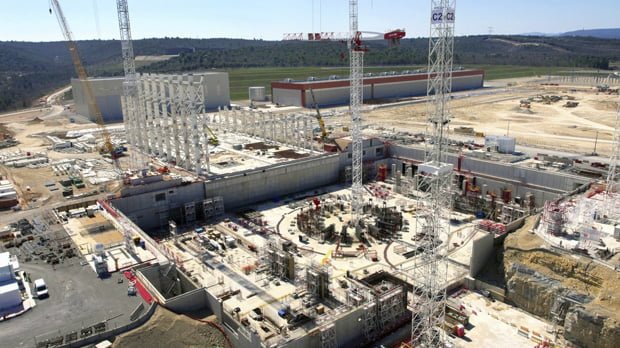
While fusion energy is not a hot daily topic for the publishing and broadcast media, it is, nevertheless, impressive that the world’s most expensive machine (presently projected to cost $16 billion) is currently being built in Cadarache, France to advance the prospects for fusion energy. This machine is called the ITER (International Thermonuclear Experimental Reactor) and, as can be seen in Figure 1, it is really big – the Goliath of the fusion energy research efforts
ITER
Figure 1. Construction site for the $16 billion ITER located in Cadarache, France (near Monaco) that is sponsored by seven participants; the European Union, India, Japan, China, Russia, South Korea, and the United States. The circular structure in the center-right is the footing for a 500 Megawatt hot fusion plasma reactor that is projected to become operational around 2027.

This massive project was launched as a Reagan-Gorbachev initiative in 1985 to consolidate the efforts being conducted by thousands of scientists around the globe to harness fusion energy using extremely hot gas plasmas contained in a large donut shaped reactor vessel. The temperatures in the plasma must reach approximately 100 million degrees Centigrade to duplicate the fusion reactions in the sun. This is so hot that it would melt all known materials. So, the strategy is to contain the plasma inside of an intense magnetic field that is suspended in free space within the donut.

The “E” in the ITER name clearly establishes this machine as an Experimental project. Its goal is limited – to sustain a fusion reaction for only eight minutes! If successful, there will still be years, if not decades of research required to perfect a viable power producing machine. To put this all into perspective, the French Nobel laureate in physics Pierre-Gilles de Gennes said of nuclear fusion, “We say that we will put the sun into a box. The idea is pretty. The problem is, we don’t know how to make the box.”

If this Goliath were the only contender in the race to replace hydrocarbons as the world’s preferred energy source, the race would, indeed, be a slow-motion event that might work to the benefit of established global energy and financial interests. No one would be concerned about the Goliath introducing a disruptive technology with an early and unexpected success.

But, things changed in 1989 when two chemistry professors at the University of Utah, Stanley Pons and Martin Fleischmann, held a press conference and announced to the world that they had succeeded in producing useful fusion energy inside of an inexpensive glass jar in their laboratory. The jar contained a rod of palladium metal with a surrounding platinum wire and both were immersed in heavy water (deuterium oxide, D2O). The palladium rod was connected to the negative terminal of a 12 Volt car battery and the platinum wire was connected to the positive terminal. It was reported that this simple set-up produced four times more energy than the electrical input from the car battery for sufficiently long periods that the only viable explanation could be a nuclear reaction.

Not surprisingly, such a potentially transformative and disruptive technology was attacked very hard from many quarters, including established energy and banking interests, and many scientists who were convinced that their hot plasma fusion approach (that is well funded by government agencies) is the only scientifically viable approach. The press dubbed the work of Professors Pons and Fleischmann “cold fusion”, and within a relatively short period of time (1992) a book was published by one of the most vocal opponents, John Huizenga, titled Cold Fusion: The Scientific Fiasco of the Century. He persuasively attacked cold fusion on the basis that Pons and Fleischmann’s work was difficult to reproduce and it didn’t result in the harmful radiation from energetic neutrons that was expected based on known results from hot plasma fusion reactions.

By the way, elimination of harmful radiation would be a wonderful result if it could be achieved. But, character assassination by discrediting those who reported positive results was a stronger factor during the early years after the press conference announcing cold fusion. A good example to convey the flavor of those times can be gleaned from the title of an article that appeared in the April 15, 1992 issue of the Wall Street Journal, “Physicist to Report Cold Fusion Findings from Japan at MIT’s Bastion of Skeptics”. The Japanese visitor, Professor Takahashi, was not well received but he stuck to his guns saying “I will say what I observed, …That is the only thing I can do.”

Discrediting of cold fusion was so thorough during those early days that even the U.S. Patent & Trademark Office announced that no patents would be granted to inventions in the field of cold fusion because it was too speculative. Cold fusion was relegated to the same category as a “perpetual motion machine” that everyone knows is nonsense.

As a consequence, legitimate scientists who might otherwise have been interested in conducting research in cold fusion realized that they would likely lose their government support, become ostracized by their colleagues, and not even be able to benefit by the grant of a patent if they did make a breakthrough.

But, in spite of all of this, work in cold fusion continued around the world for the past 26 years by a small group of dedicated scientists – and convincing progress has been made. So convincing, in fact, that politicians in Washington are actively in process of ditching the name “cold fusion” because it has been so thoroughly discredited. Now, it is more acceptable to call the technology by a new name ‘Low Energy Nuclear Reaction’ or just LENR. Apparently, it is no longer important to Washington’s elite if the reaction is cold, tepid, or warm.

In 2009, an unclassified assessment was made by the U.S. Defense Intelligence Agency in their report DIA-08-0911-003. Quoting from this report:

Although much skepticism remains, LENR programs are receiving increased support worldwide, including state sponsorship and funding from major corporations. DIA assesses that Japan and Italy are leaders in the field, although Russia, China, Israel, and India are devoting significant resources to this work in the hope of finding a new clean energy source. Scientists worldwide have been reporting anomalous excess heat production [for years], as well as evidence of nuclear particles and transmutations.

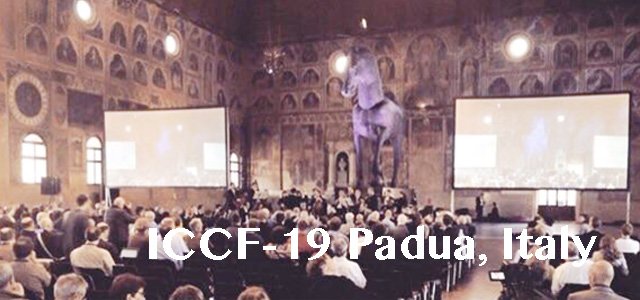
The dedicated scientists who did brave the stigma of the ‘cold fusion’ name and related consequences proudly held their 19th International Conference on Cold Fusion (19-ICCF) in Padua, Italy in mid-April, 2015. And they plan to meet again next year in Sendai, Japan. Figure 2 is a photo of some of the attendees in the main conference hall. Take a close look at this picture and see if it appears to be a group of individuals gathered to advance the “nonsense” that the patent office has branded their science.
ICCF19-Day-4-J-P-Biberian-Title
Figure 2. Photograph of some of the attendees at the 19th International Conference on Cold Fusion (ICCF) held April 13-17, 2015 in Padua, Italy.

Perhaps, the most intriguing aspect of the cold fusion (LENR) work is that there appears to be a number of different processes involved in a growing number of reported successful experiments. However, there is not yet an accepted theory that encompasses this work. Nevertheless, young companies are emerging with names like Brillouin Energy Corp. and Industrial Heat that are receiving venture capital support with hopes of becoming the ‘Davids’ who might slay the ‘hot fusion Goliath’ in spite of the U.S. Patent Office’s continued reluctance to grant cold fusion patents.

It’s too early to tell if the Davids will win or even survive. It is also too early to tell if the name change to LENR will work any magic at the patent office. But pressure is building there. A ‘cold fusion’ patent titled FLUID HEATER was actually issued to Andre Rossi (U.S. 9,115,913) on August 25, 2015 using the subterfuge of totally avoiding the use of the words ‘fusion’ and ‘isotope’ that might otherwise raise a red flag leading to rejection. And a patent application (U.S. 14/696423) titled SPONTANEOUS ALPHA PARTICLE EMITTING METAL ALLOYS AND METHOD FOR REACTION OF DEUTERIDES was filed earlier this year by the present author who is a patent agent as well as a Ph.D. physicist. This patent application addresses the reluctance of the patent office to grant cold fusion patents head-on by making a solid case for granting patents on the basis of advancing the state-of-the-art in this field even if an application does not disclose a fully working apparatus.*

And now, eager young students at MIT can take an introductory course in Cold Fusion presented by highly respected faculty members. The chemistry and physics are intriguing, but the secrets of the sun have not yet been fully revealed. So, the big question is will LENR become that disruptive and transforming fusion energy technology or just remain the ‘fiasco of the century’? I believe that it will be big – but stay tuned.

* PERSPECTIVE [Extracted from patent application U.S. 14/696,423]

The inventor is well aware that the subject matter in a patent application must be ‘useful’ and satisfy the requirement of utility. Further, as stated by the U.S. Patent & Trademark Office, “the term ‘useful’ in this connection refers to the condition that the subject matter has a useful purpose and also includes operativeness, that is, a machine which will not operate to perform the intended purpose would not be called useful, and therefor would not be granted a patent”.

In this regard, the inventor makes no claim that the subject matter in this patent application will solve or mitigate the present or future energy problems facing humanity. Nor does the inventor represent that the subject matter in this patent application can be used to produce any commercially useful amounts of energy. Rather, the subject matter is “useful” for two reasons, (1) it would be generally agreed by persons of normal skill in nuclear arts and also based on the teachings of conventional physics that purposely triggering a LENR by employing the subject matter in this patent application would enhance the reaction rate (thereby making the subject matter operative) – even though the magnitude of the enhancement is not presently known, and (2) the subject matter is expected to contribute to a better understanding of the LENR process that will likely continue to be explored by researchers throughout the world for years to come. In this regard, the availability and use of spontaneous alpha particle emitting metal alloys, encouraged by this invention, should be useful in advancing the understanding of LENRs and may also lead to possible future commercial applications. These factors are considered to be more than sufficient to satisfy the criteria of utility.
Douglas A. Pinnow, Ph.D. Contact

Next two months packed with LENR/AHE science

There are four LENR/AHE meetings – over the next two months!

US, Russia, Switzerland, and France – Can you make it???

See this listing on our new Upcoming Events page, too.

IEEE-logo
IEEE Meeting at Teradyne

LENR Phenomena and Potential Applications
Professor Peter Hagelstein and Dr. Louis DeChiaro

Wednesday Sept. 23, 2015 05:30PM to 08:15PM (US/Eastern)
North Reading, Massachusetts, US

https://meetings.vtools.ieee.org/m/35303


ras
Conference at RUSSIAN ACADEMY of SCIENCES

22nd Russian Conference on Cold Nuclear Transmutation of Chemical Elements and Ball Lighting
Chairman of the RCCNT&BL-22 Organizing Committee
Yury Bazhutov
Vice-Chairmen
Vladimir Bychkov, Nikolai Samsonenko

Sept 27-October 4, 2015
Dagomys, Sochi, Krasnodar region, Russia

Abstracts


ISSOLDE-Seminar-2015-420x276
Seminar at CERN

The anomalous heat effect on D/H loaded Palladium: Exploration at an atomic level, preliminary perturbed angular correlations studies
by Juliana Schell, Vittorio Violante, Graham K. Hubler
and Collaborators: Moustapha Thioye, Jinghao He, João G. M. Correia, Iberê R. S. Junior, Izabela T. Matos, Michel Zoghby

Wednesday, 14 October 2015 from 14:30 to 15:30 (Europe/Zurich)
Geneva, Switzerland

Abstract [.pdf]

https://indico.cern.ch/event/440482/


ISCMNS

LENR-Cities

HERA

AIRBUS_Group_3D_Blue_RGB.2015-01-16-09-20-05Workshop at Airbus

11th International Workshop on Anomalies in 
Hydrogen Loaded Metals
Conference Chair Jean-François Geneste
Organizing Committee W. Collis, J.D. Vinko, S.Valin-Le-Gouellec, M.Valat

Thursday and Friday, 15-16 October, 2015
Toulouse, France

http://workshop.wonderevents.fr/

http://www.iscmns.org/work11/


To list an Event, contact Ruby Carat at ruby@coldfusionnow.org.

SCIENCE from ICCF19

Bits and pieces of new energy news continues to trickle from Padua, Italy where the 19th International Conference on Condensed Matter Nuclear Science is being held.

Cold Fusion Dog Dr. Bob wrote, “I would go so far to say that what we hear from the podium, is far from the most relevant and interest knowledge.”

Brillouin Energy Presentation Powerpoint was posted by Frank Acland

Klee Irwin of Quantum Gravity Research spoke with Cold Fusion Dog Dr. Bob; posted by Frank Acland


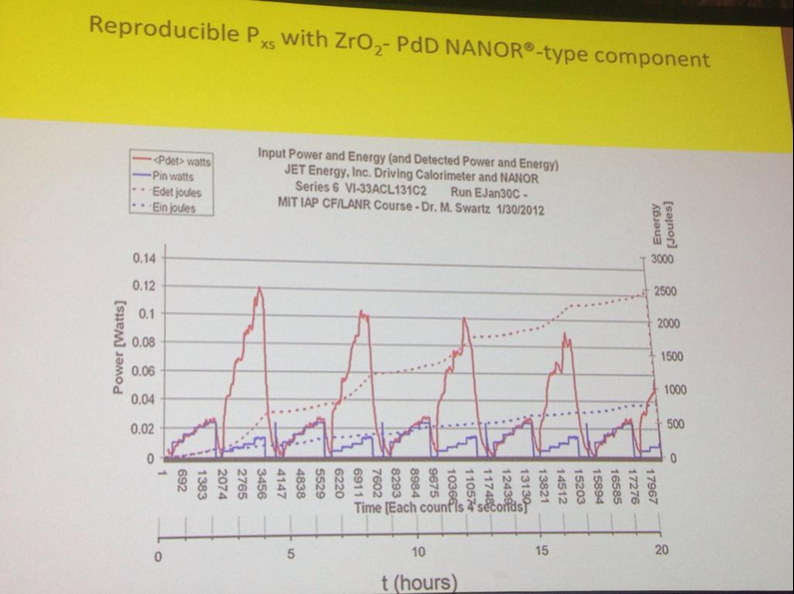
Photo: Poster on JET Energy, Inc NANOR reactor.

Dr. Mitchell Swartz of JET Energy was supposed to present at ICCF-19 on his NANOR technology but was unable to attend, and Dr. Peter Hagelstein stepped in and spoke about the tiny reactor. Dr. Swartz posted on his Cold Fusion Times this translation from Dr. Jean-Paul Biberian‘s original post in French about Day 1:

“David Knies of American society Coolescence studied the influence of the crystal orientation of the palladium surface and the addition of impurities on the loading of deuterium. It appears that the crystal orientation is not important. For cons, the addition of some metallic elements in very small quantities increases the load. David Nagel of George Washington University has studied the case of electrochemical cells explosions. It seems that in certain circumstances, unclear, chain reactions occur. He began by recalling the 1988 episode experienced by Pons and Fleischmann of the merger of the cubic electrode 1cm3 of palladium has melted and through the work plan. He then toured the other experiences that took place in different laboratories, and the Rossi reactor that exploded. Obviously, before placing on the market of such equipment will need to understand what happened.

Jean-Luc Payet, retired from the University of Aix-Marseille developed the theory of relativistic electrons deep could explain some of the cold fusion reactions. Francesca Sarto ENEA in Rome, has developed an in situ analysis method of the electrode surface by cyclic voltammetry which allows to know the electrode surface.

“Melvin Miles has had close relations with Martin Fleischmann, and has a large number of letters with him, he will publish soon. He revealed in particular that Martin Fleischmann had told him that the experience could not occur below 60 ° C. He also announced that in 1988 he and Stanley Pons had measured the production of helium. Peter Hagelstein, a very high level theorist MIT showed the production of X-rays with a high frequency vibration system on metallic films.

Vittorio Violante, ENEA in Frascatti showed the effect of pulsed magnetic fields in the production of excess energy in electrochemistry experiments. David Kidwell of the Washington Navy measured significant excess heat with gaseous deuterium absorption of palladium powders coated ZrO2. Orchideh Azizi, University of Missouri found that different pretreatments palladium electrodes did not change at the margin the rate of final loading of hydrogen palladium electrodes.

Jirohita Kasagi has shown that the deuterium-deuterium reactions with low energy beams of deuterium on a solid or liquid metal target occurred with reaction yields much higher than predicted by standard theories. There has low energy an anomaly. Dmitrii Filippov of the Kurchatov Institute, Russia, and collaborator Leonid Urutskoev showed that heavy nuclei could transmute under the influence of very strong magnetic fields.

Hioki Tatsumi, Toyota in Japan has studied the loading of deuterium in mesopores loaded palladium. Akira Kitamura of Technova company in Japan showed excess heat in experiments with palladium alloy powders and coated in a ZrO2 mass flow calorimeter cooled with oil.”

Read original report on DAY 1 in French.

Here is Day 3 from Jean-Paul Biberian google-translated from French into English:

The third day was a little short at the scientific level, as the morning was dedicated to tourism.

David Knies of American society Coolescence studied the influence of the crystal orientation of the palladium surface and the addition of impurities on the loading of deuterium. It appears that the crystal orientation is not important. For cons, the addition of some metallic elements in very small quantities increases the load.

David Nagel of George Washington University has studied the case of electrochemical cells explosions. It seems that in certain circumstances, unclear, chain reactions occur. He began by recalling the 1988 episode experienced by Pons and Fleischmann of the merger of the cubic electrode 1cm3 of palladium has melted and through the work plan. He then toured the other experiences that took place in different laboratories, and the Rossi reactor that exploded. Obviously, before placing on the market of such equipment will need to understand what happened.

Jean-Luc Payet, retired from the University of Aix-Marseille developed the theory of relativistic electrons deep could explain some of the cold fusion reactions.

Francesca Sarto ENEA in Rome, has developed an in situ analysis method of the electrode surface by cyclic voltammetry which allows to know the electrode surface.

Mitchell Swartz posted Jean-Paul Biberian‘s report on Day 4 in English:

“Steven Katinsky created with David Nagel “the Industrial Association for LENR” whose objective is to return the area alongside other professional associations of energy. The construction site will lenria.org

Mitchell Swartz (JET Energy) could not come to the conference and his presentation was made by Peter Hagelstein. He outlined the latest developments in the Nanor, this small reactor compound powder or palladium, palladium-nickel or nickel coated with zirconium oxide, and charged deuterium. By passing an electric current through the powder, it gets energy by orders of magnitude gains. This method, although small is very interesting for future developments.

Alexander Gromov, was a reminder of the history of transmutations starting with biological transmutations, but also with the reactions in plasmas. He showed that the plasma electrolysis possible to obtain hydrogen production 8 times higher than those provided by Faraday’s law, because of the very high temperature electrodes that breaks the water molecules.

Anatoly Klimov of Russia Inflow Company has studied the effect of the plasma on the transmutations, and energy savings from February to October in spherical reactors.

Vladimir Vysotskii of the University of Kiev showed how with bacteria, he could transmute the cesium barium. In particular, it was able to reduce the radioactivity of Cs-137 by 50% in 4 days, turning it into Ba-138.

Changlin Liang Tsinghua University in Beijing showed the importance of lithium in cold fusion experiments.

Igor Goryachev of Technology showed radioactive products transmutations by plasma Sr-90, Cs-137, Pu-239.

In the afternoon, we had an informal presentation of Alexander Parkhomov who gave us information on the experience that produces large amounts of heat with a mixture of powder and nickel powder LiAlH4.”

****End Jean-Paul Biberian

Alain Coetmeur posted slides from Akira Kitamura’s presentation and Akito Takahashi’s presentation, both from Technova.

Alain also summarized Vladimir Vysotskii’s presentation on Biological remediation of radioactive cesium:

Vladimir Vysotskii presented his work in transmutation of Cesium 133 by anaerobic sea bacteria. This is so fantastic that it deserve an independent post.

He explained first that Cesium, 133 and 137 were the most dangerous nuclear waste in fission, because of their biological characteristics.

Previously he observed some transmutations of cesium to barium, at rate allowing reduction by half in 200 to 500days.

The problem is that to decontaminate place like Fukushima you needed bacteria living in seawater. He decided to use anaerobic methanogenic bacteria form the sea sludge.

His experiments was designed with 3 control experiments, without either the bacteria, the cesium, or the nutrient.

The result was amazing, and he observed 50% reduction of cesium in 8 days.

I thought about possible contamination by bottle, but we should not forget there are 3 control experiment that should be impacted by any artifact you imagine…fascinating!

Another example of the quality of Russian science, in LENR especially.

Clean Planet and Friends at ICCF-19 in Padua, Italy 2015.

Clean Planet posted on their Facebook page how they and their team were interviewed by Italian radio after their presentations.:

We are in Podova in Italy for ICCF-19 (The 19th International Conference on Condensed Matter Nuclear Science) this week.

Our Professor Iwamura and Professor Kasagi successfully made inspirational presentations.

Brazilian Minter of Economics is at the conference to seek for the way to utilize this new clean energy technology in Brazil.

See more photos on Clean Planet Facebook page.

Claudio Pace, a blogger in Italy, has posted the slides from Yasuhiro Iwarmura’s presentation outlining the new collaborative effort in Japan focused on energy production and the amelioration of radioactive waste. In Italian:
http://www.claudiopace.it/iccf19-primo-giorno/

Read Pace’s second day journal google-translated in English here:
https://translate.google.com/translate?sl=it&tl=en&js=y&prev=_t&hl=en&ie=UTF-8&u=http%3A%2F%2Fwww.claudiopace.it%2Ficcf19-secondo-giorno%2F&edit-text=

LENR-Cities releases document outlining business plan:
https://www.scribd.com/doc/262037614/LENR-Cities-White-Paper-En-April-14-1

22Passi reports
that:

During the conference that is taking place in Padua , the directors of ‘ ISCMNS – reported premiered this morning at 22 steps his vice-president Francesco Celani – decided that the next international conference on cold fusion will be held in October 2016 Japan Sendai, at Tohoku University (as was rumored since last month), but that soon after followed by a post-conference in China. In the arm of iron for the allocation ICCF-20, of which there was referring few days ago , is therefore a compromise is reached, demonstrating in all cases than the international interest on the cold fusion – also witnessed all’ICCF -19 underway in Padua – is incredibly high.

PS Yesterday Radical Radio interviewed Iwamura and Takagi. The interview will air next week.

And the second hippest place on the planet?

The MFMP Facebook page. where they posted this SEM of Alexander Parkhomov’s fuel, saying, “Preliminary, single source SEMs and Elemental assay of Dr. Alexander Parkhomov’s 3 day experiment shown at ICCF19”

[]=Project Dog Bone=[]

Fuel - Nickel (bright), LiAlH4 (grey)
Fuel – Nickel (bright), LiAlH4 (grey)

Finally, the new movie from Cold Fusion Now! Following Nature’s Documents Stan Szpak LENR Co-deposition made the news of Fusione Fredda today. Grazie Fusione Fredda!

Vindication: MFMP granted original Fleischmann-Pons palladium wire

More exciting news from the 19th International Conference on Condensed Matter Nuclear Science (ICCF-19) in Padua, Italy today.

button-MFMP-200x200_3From the Martin Fleischmann Memorial Project Facebook page:

Vindication – Part 3

MAJOR ANNOUNCEMENT

The MFMP has been offered something no one knew existed, something priceless and which could reveal critical secrets many in the LENR field have been seeking for over a quarter century.

Before Martin Fleischmann left the US, he personally gave a trusted friend an original pre-1989 Johnson Matthey palladium wire – the very same as used in experiments that led to that fateful announcement of a new primary energy source that came to be known as cold fusion.

He has held this secret all these years until now. We checked today with Mike McKubre, Vitorio Violante and Melvin Miles if there was any known public metallurgical and elemental / isotopic characterisation of this material, the answer was a resounding no.

It is known that the early attempts to replicate the Pons and Fleischmann effect mostly failed due to the purity and processing of ‘palladium’ used. In fact ENEA has been trying to establish what additives and structures are critical to creating the effect for more than 2 decades. Many of the principal research labs working in the field are trying to establish the correct crystal shapes, sizes, orientation etc. and chemistry.

In our own nickel powder / hydrogen research, we have tried to get the purest nickel possible – but have failed to see any excess heat. Now we know from our recent isotopic analysis of Dr. Parkhomov’s Nickel, that there is high concentrations of Carbon and Oxygen on the surface, elements also found in Rossi’s fuels.

The unique opportunity we have been honoured with is profoundly important, and there is not a person we asked at the conference that were not falling over themselves to help in what ever way they could. Ultimately it is down to the current owner to decide exactly what happens but from the available piece, which is about the thickness of a toothpick and between 7 and 8 cm long, the current plan is to

1. Use 3 X 2mm samples to characterise structure, isotopic constitution etc.

2. Run at least two 2cm segments in Pons and Fleischmann cells, copied from the original and/or use the original cell.

3. Reserve remainder

We will auction the ownership rights of the post run, post analysis 2cm segments in a one of a kind, never to be repeated auction. This is an unrepeatable opportunity to own the only known samples of this historic precious metal.

This auction, along with the auction of the donated 1 ounce Pd 1989 “Cold Fusion” coins is design to raise enough money the help ensure a fully faithful replication that will be conducted by someone who is not currently a member of the MFMP and who is a very experienced experimentalist. The work will be conducted in France with the help of Jean-Paul Biberian and all data will public.

We must work with the best resources on the planet to ensure that this materials secrets are revealed for all. It is wonderful to be a part of something that will yield critical data for advancement of the field.

More information to be published about the Vindication program.

The name of the current owner and how he came to be entrusted with the electrode will be revealed in time, right now, given the incredible importance to maintain security, we have been asked to hold off on publishing that information.

We want to take this opportunity however, to publicly thank the donor and curator of this material for coming forward.

Vindication MFMP


ICCF-19 Program for Tuesday

Also from the MFMP Facebook page, that “Carl Page is in Padua, as is Bill Gates – apparently…”

22Passi caught an old photo in todays newspaper in Padua ICCF19: “Bill Gates belives in perpetual motion?”

Dr. Bob is perplexed and asks Bill Gates to visit Padua?

E-Cat World provided a report on Day 2 by Robert Ellefson.

Peter Gluck has a news round-up sometimes before it happens.

Cold Fusion Dog Dr. Bob summed up ICCF19 – Day 2

New video of Tom Darden was posted on MFMP Youtube:

Yesterday Alain Coetmeur of LENR-forum.com provided summaries of these talks from Day 1:

Brillioun reactor core
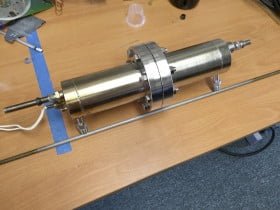
David Nygren obtained a photo earlier in the day from Robert Godes, who was presenting at poster session. Godes described the photo, “That is a 3rd generation Brillouin Energy HHT reactor system…. we are now on gen 4. The Nickel rod fits inside the tube that goes all the way through the vessel with the bolted ring. We flow inert gas through the largest tube with the bolted ring and fill the second tube with H2 gas. We then pass high current pulses through the Ni rod. This system has produced 4X more thermal energy out than Q -pulse energy deposited in the core. We have performed this with the same core in both our lab in Berkeley, CA and at SRI.”

What will tomorrow bring?

Top