Brillouin Energy “Quantum Fusion” Animations


Robert E. Godes is the man behind Brillouin Energy, a company developing a hot-water boiler based on cold fusion. But he doesn’t stop at experimentalist; he is also the originator of Quantum Fusion Theory, a theory of the atomic and nuclear events that comprise the reaction. Published in Infinite Energy #82, you can download a copy here.

Recently released animations seek to visualize the phenomenon.
Four videos have been uploaded to the new QuantumFusionChannel on YouTube.

Ain’t nuthin like a video to help imagine a dense, clean, and safe new energy technology.

Related Links

Funding dam almost breaks for Brillouin Boiler that uses – water! by Ruby Carat July 7, 2011

The Rossi 45MW LENR Power Plant is a Real Bargain Compared to Nuclear

Rossi made the following comment on his blog:

Dear Dr Joseph Fine:
– In a 45 MW plant, if Siemens gives us 30% of efficiency, the COP is not 6, is infinite: the energy to drive the resistances will be made by the E-Cat: if we make 45 thermal MWh/h, 15 electric MWh/h will be made, of which 7.5 will be consumed by the plant, 7.5 will be sold, together with30 thermal MWh/h.
– The price of a 45 MW plant will be in the order of 30 millions.
– the price of the energy made by our industrial plants will be made by the owners and by the market.
Warm Regards,
A.R

To put the above into perspective, the following is a chart listing the power density of typical engine types:

Power density of typical engine types
combustion gas turbine 2.9 kg/kw
medium speed diesel 10 kg/kw
nuclear gas turbine (including shielding) 15 kg/kw
nuclear steam plant (including shielding) 54 kg/kw

A Rossi 45MW LENR power plant is estimated to weigh 200 tonnes (in other words about 180,000 kilograms). Since 45 megawatts is 45000 kilowatts (I always got marked down in math class when I didn’t show my work on the test, but just wrote down the answer), a Rossi 45MW LENR power plant yields a 4 kg/kw power density.

Furthermore, a nuclear plant averages about 1,000MW of heat, the heat generated by about 22 Rossi 45MW power plants. The cost of a 1,000MW nuclear plant is conservatively estimated to be around 2.4 billion dollars, while the cost of 22 Rossi E-Cat plants (at 30 million dollars each) is 660 million dollars – a little more than a third of the price! With no cost for nuclear fuel, no cost to clean up and get rid of the nuclear waste, and no risk of Fukushima type of accident!!

I think it is safe to say that the Rossi 45MW LENR power plant will be in heavy demand both by the maritime and utility industries. It is difficult to understand why both the US military and international corporations aren’t beating a path to Rossi’s door.

At the very least, you would think that the Japanese, who suffered terribly when their nuclear power plants (that furnish something like one third of Japan’s electricity) suffered catastrophic damage during the recent natural disasters, and who still suffer from the after-effects of the nuclear bombs dropped on their cities during WWII, would be intrigued by Rossi’s business plan.

Storms and Scanlan: “What is Cold Fusion and Why Should You Care?”

A paper that seeks to give the interested reader some background on what cold fusion is and how one might put recent developments into context has been released by Edmund Storms and Brian Scanlan, both of Kiva Labs, an independent energy research company with labs in New Mexico and Connecticut.

Dr. Storms has been researching cold fusion, also known as LENR low-energy nuclear reactions, LANR lattice-assisted nuclear reactions, and CANR chemically-assisted nuclear reactions, since the initial announcement by Drs. Fleischmann and Pons in 1989. Formerly of Los Alamos National Labs, he is the author of The Science of Low Energy Nuclear Reaction, a comprehensive survey of the field published in 2007 by World Scientific.

Download the paper What Is Cold Fusion and Why Should You Care? .pdf here.

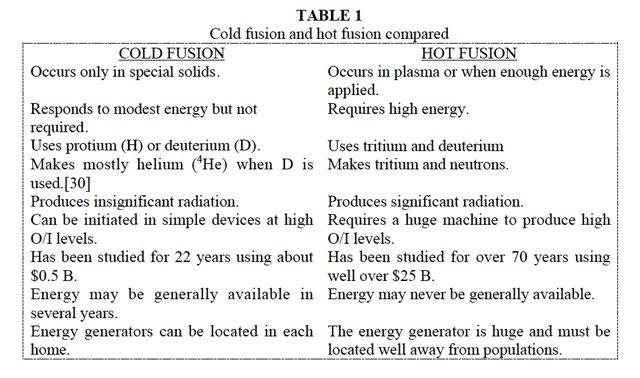
In one part, the paper takes special note of the difference between hot and cold fusion. Hot fusion produces dangerous radiation products, has cost tens of billions of dollars, and has not produced any viable energy technology over six decades of research.

“The circumstances of cold fusion are not the circumstances of hot fusion”, said Nobel prize-winner Julian Schwinger, before resigning from the American Physical Society due to their complete rejection of cold fusion research. Cold fusion does not produce radiation the way hot fusion does, nor does it use any radioactive or toxic materials.

Table 1
Table 1 from What Is Cold Fusion and Why Should You Care?

Read: What Is Cold Fusion and Why Should You Care? by Edmund Storms and Brian Scanlan

Why ColdFusion/LENR has not been seized upon by private industry

The following is a further posting in a series of articles by David French, a patent attorney with 35 years experience, which will review patents of interest touching on the field of Cold Fusion.

In my last posting I started Part 1 of what was to be a two-part reference to the initiatives of Randall Mills  and Blacklight Power in respect of  producing energy through exploitation of a shrunken hydrogen atom, the “Hydrino”.   Part 2 will soon follow.  Meanwhile I wish to now address a consideration respecting what will be needed to make Cold Fusion a commercial success.

It’s been 23 years since Pons and Fleischmann made their initial announcements. Hundreds if not thousands of examples of unexplained excess heat have now been identified in the laboratories of heroic “cold fusion” researchers struggling around the world on very modest budgets. Yet industry has not picked-up the baton to join in the race. Why is this?

There are no doubt many reasons but this article addresses the issue of thermal efficiency. It is proposed that industry will not be interested in ColdFusion technology until energy gains well in advance of 3:1 are achieved. Something higher e.g., 6:1 or 8:1 is a minimum in order to activate commercial interest in the exploitation of the excess energy phenomena associated with condensed matter physics. It all starts with the Carnot cycle.

Nicolas Léonard Sadi Carnot (1 June 1796 — 24 August 1832) was a French military engineer who, in his 1824 book Reflections on the Motive Power of Fire, gave the first successful theoretical account of heat engines, now known as the Carnot cycle. He is often described as the “Father of thermodynamics”, being responsible for such concepts as Carnot efficiency, Carnot theorem, the Carnot heat engine, and others.

The Carnot theorem applies to engines converting thermal energy to work. This is to be contrasted with fuel cells and batteries which convert chemical energy into work. The theorem states that the maximum efficiency that any heat engine can obtain depends on the difference between two hot and cold temperature reservoirs that are its “source” and its “sink”.

The principles behind Carnot’s theorem are as follows:

• there is a maximum limit to the efficiency by which work that can be extracted from heat;

• only an engine operating on the Carnot cycle can achieve the maximum efficiency possible in extracting energy from heat in order to produce work

• only a perfect, reversible, heat engine operating between a heat source and a heat sink can equal the efficiency of a Carnot engine operating between the same reservoirs

• all irreversible heat engines operating between two heat reservoirs are less efficient than a Carnot engine operating between the same reservoirs.

Generally, for an engine to operate “reversibly”, it has to function very slowly and have not heat loss through “leakage”. Virtually all practical heat engines are of the irreversible kind.

The formula for this maximum efficiency is:

Efficiency = 1 – T(cold)/T(hot)

where T(cold) is the absolute temperature of the cold reservoir, T(hot) is the absolute temperature of the hot reservoir, and the Efficiency is the ratio of the energy-value of the work done by the engine to the heat drawn out of the hot reservoir.

Using the above formula to demonstrate an example, and recalling that 0°C is 273° Kelvin, the ideal Carnot efficiency of a heat engine operating between 273°C and a block of ice at 0°C is 50% i.e. 1- 273°K/546°C. This is ideal. This is perfection. Typical gasoline automobile engines operate down in the range of 20% thermal efficiency. Power generation stations achieve typical thermal efficiencies of around 33% for coal and oil-fired plants, and up to 50% for combined-cycle gas-fired plants.

Using the above figure of 33 1/3%, it takes 3 barrels of oil to make one barrel of electricity in terms of heat value. This is a shocking thought for national planners who see citizens using electricity for heating. Nevertheless, electricity is an amazingly convenient energy source that is delivered apparently effortlessly to the door of the consumer and is available at the turning of a switch. Only the cost of electricity limits its consumption as a source of heat.

Because electricity is such a special form of energy, ready to do work directly with 98% efficiency through electric motors, it can be used in some applications to recover a portion of the heat value used to create it. And if you do not demand too much, it can provide even more. Heat pumps are designed to extract heat from the environment and raise the temperature of the extracted heat to certain modest target levels.

If the object is to heat a room with 30°C hot water, then this heat can be pumped out of the ground from a depth of 30, 40 or more feet, where the temperature is generally a constant 10° to 15°C. Heat pumps are rated based on their “coefficient of performance” – COP.  Depending on the temperature spread between the heat source and the heat sink, the co-efficiency of performance for an electrically driven heat pump can be higher than 3:1, for example 4.5:1. Thus it is possible to recover some of the heat value used to generate electricity if the object is to provide only a moderate boost in the temperature of the heat being pumped.

If on the other hand, you aspire to re-create the furnace temperatures used when the oil or natural gas is combusted to create electricity in the first place, then a heat pump just won’t do the job.

Meanwhile, in the field of cold fusion, virtually all of the experimentation that has been going on has been using electricity as the source of heat to stimulate the low energy nuclear reaction, (if that’s what is occurring). On this basis, if the reaction does not produce a 300% output of heat for 100% input of electricity, then that technology has failed to achieve even a bare minimum recovery of the value that it has consumed. In addition, there are always system inefficiencies. That’s why a ColdFusion reactor is not really going to make sense until it has a gain, or coefficient of performance – COP, in excess of 6:1 and preferably 8:1 and more.

The original question posed was: Why has industry not picked-up the challenge to develop ColdFusion into a working industrial resource?  One reason is that a large number of experiments done around the world have not shown a COP of 6, 7 or 8. In fact, many of the scientific results have shown excess energy gains of 20%, 30%, etc. rather than the 600%, 700% or 800% that would make investors sit up and pay attention.

If an LENR reaction were to produce heat at the temperature of 500°C, or preferably 600-800°C and do so with a COP for the input electrical energy of even just 600%, then interest may suddenly arise. The Carnot efficiency, that is the ideal theoretical capacity to generate electricity from thermal energy for a source at a temperature of 850°C, relying on a cold-water sink at 27°C would be just under 67%.  Allowing for production losses, a thermal efficiency of 25-30% might be achievable for the production of electricity.

Electricity is like “White Gold”. It can be sold instantly. There is always a market for it. This removes one major uncertainty from the business case for investing in ColdFusion technology. You know that you will have something to sell that people will buy.

But this hasn’t happened. We still haven’t had a demonstration of the sustained production of high-grade heat for an extended period of time.

This is not to say that the production of steam, “wet” steam if it still contains water droplets and is only at a temperature of 100°C, is not valuable. It can be used for low temperature applications throughout our society. Heating homes is only just one application. Running air conditioners is another. Industry consumes a lot of hot water. And the desalination of water is a big application that will change the lives of hundreds of millions of human beings.

Let us hope that demonstrations at higher levels of COP will soon attract the interest of industry and provide the breakthrough that every fan of ColdFusion has been hoping for, for so long.
The Graph that Changed the World

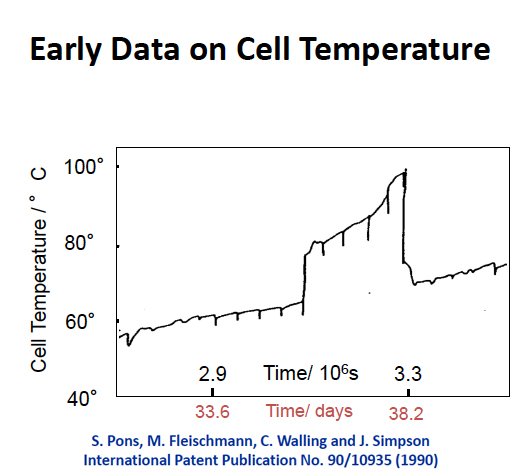
[latexpage]In 1989, Drs. Martin Fleischmann and Stanley Pons announced results of their largely self-financed research into palladium-deuterium electrolytic systems. In one of the early patent applications, they included a graph documenting the surprising increase in temperature of a cell over time.

This graph is taken from Dr. Michael McKubre‘s public talk What happened to cold fusion?

Fleischmann and Pons Early Data Graph

As a scientist involved in this research since that very day back in 1989, Dr. McKubre described some of the main features of this graph.

“This result, by itself, with no more explanation really, is sufficient – if you believe Martin Fleischmann – to convince you that there is a real thermal heat effect in a deuterium-palladium system.” -Michael McKubre

Acknowledged as one of the greatest electro-chemists that ever lived, there was good reason to accept Dr. Fleischmann’s, and his partner Stanley Pons’, data.

In the graph, the temperature begins in the upper-50s$^{circ}$ C, and then begins to increase at a steady pace, represented by the slowly climbing line in the graph, as their electro-chemical cell is held at constant power.

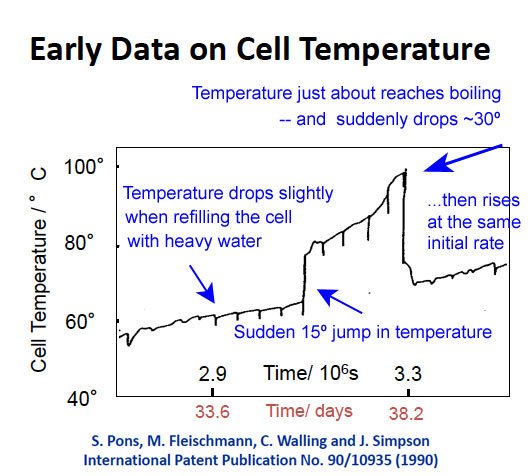
“You see the little downward spikes in the rising areas”, said Dr. McKubre, “Fleischmann and Pons ran their electro-chemical cells open, that is, the products of electrolysis, in this case deuterium D2 gas and oxygen O2 gas, leave the cell, so they have to refill the cell every so often with the amount of heavy water that’s left. So these downward spikes are the times once each day when heavy water was added to the cell to make up for lost electrolytes.”

In their paper that circulated after the 1989 announcement, some of the early Fleischmann-Pons experiments that created excess heat were described.

… standard additions of 1 ml of the electrolyte were made following sampling. Losses of D2O due to electrolysis in these and all the other experiments recorded here were made up by using D2O alone. A record of the volume of D2O additions was made for all the experiments.
Electrochemically induced nuclear fusion of deuterium, J. Electroanal. Chem., 1989

Fleischmann and Pons Early Data Graph AnnotatedThe steady increase in temperature, punctuated by small, temporary drops, continues for days. Dr. McKubre relayed what happened next,

“All of a sudden, one day it goes down alot, and then it kicks up to a new level – it kicks up in temperature by 10 degrees or more. So all by itself, at constant input power, steady operating systems, the cell suddenly started to produce 15 degrees more temperature. There’s clear evidence of excess heat and it builds.


It builds up asymptoting at 100-degrees Centigrade, so it comes up very close to the boiling point, and then all by itself – and this all-by-itself is why its taken us twenty-two years to understand this thing – the cell switched off and went back to its initial trajectory.” -Michael McKubre

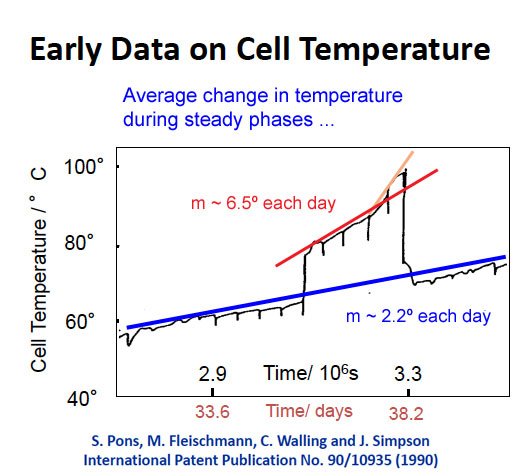
Fleischmann and Pons Early Data Graph with SlopesWhen the temperature “kicked-up”, the rate of change increased to about 6.4$^{circ}$ C higher each day, and rose parabolically as it got closer to boiling. After the big drop, the rate of temperature increase returned to about 2.2$^{circ}$ C each day.

What caused these sudden temperature increases, and temperature drops, has occupied scientists for the past 23 years.

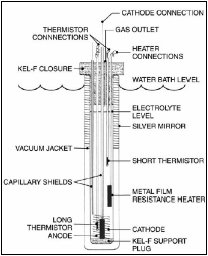
“This is an electrode being electrolyzed in a heavy-water electrolyte”, said McKunbre, “a palladium cathode, the negative electrode. The line is rising, the temperature is going up in the cell at constant power. Now, electro-chemical cells will generally rise in voltage, so that’s not necessarily surprising or interesting.”

Fleischmann and Pons Electrolytic Cell
Continuing,

“All you need to do is wrap a calorimeter around that and measure the amount of heat to determine whether this is possible by any chemical scheme or not. And the answer is it’s absolutely not possible by any chemical scheme. This amount of heat is 100 or 1000 times more than you could get from the sum of all possible chemical reactions in that particular experiment.” -Michael McKubre

In his 2007 summary of cold fusion research The Science of Low Energy Nuclear Reaction, Dr. Edmund Storms described one early FP experiment using a 1-cm cube of palladium which “melted through the beaker and bench after an explosion stopped the current.” [p 128] In their initial paper, the Fleischmann-Pons team wrote “WARNING! IGNITION?” for that particular run. Had they experienced “heat after death”, a phenomenon whereby the cell keeps on generating heat energy even after it’s been unplugged, and the current to drive electrolysis is no longer applied?

The control of this particular reaction leads directly to “self-sustain mode” in the newer nickel-hydrogen gas-loading steam generators, leading to huge thermal energy returns that are safe and clean.

“This [early data] was available for discussion and interrogation”, said Dr. McKubre. “Thoughtful people looked at it and said, ‘My god, how can that possibly happen?'”

Unfortunately, for various reasons, some of which Dr. McKubre discusses in the lecture, many bright scientists did not reproduce the results. Dr. Edmund Storms related the irrationality of the broader scientific community in accepting their negative conclusions over the positive results.

“Accepting these negative studies as evidence against anomalous power being real would be like having many groups each collect random rocks from a beach, have the sample carefully tested for diamonds, and then when only a few diamonds are found, conclude that diamonds do not exist anywhere in nature because the observations could not be reproduced when other random rocks were examined. Such an approach would be considered absurd in any other field of study, yet it was applied to claims of Fleischmann and Pons.” Edmund Storms The Science of Low Energy Nuclear Reaction [p 52]

This early data “was preliminary, as Fleischmann and Pons readily acknowledged”, and they had not at the time intended to make it public. Yet, it was this early data and graph that “triggered” all the work in the newly created field of condensed matter nuclear science since.

Dr. Storms wrote,

“Nevertheless, the excessive response encouraged intense studies in many laboratories and a willingness of a few scientists to acknowledge anomalous results. Without this over-reaction, such unexpected behavior would have been completely ignored as error. Instead, people were encouraged to report behavior thought to be impossible-behavior that now has been witnessed hundreds of times in dozens of laboratories.” Edmund Storms The Science of Low Energy Nuclear Reaction [p 62]

This Early Data graph was dismissed by the mainstream science minds of the day. The small group of researchers around the world who continued to investigate the anomalous heat generated by these simple electrolytic chemical cells have done so despite isolation and derision from their less-than-curious peers. Now, major advances in this field are leading to commercial products which hold the promise of changing all planetary systems, social, economic, and ecological.

As this field develops from an obscure science to a worldwide technology, this graph represents a turning point, when humanity was given a second chance for a peaceful future, with clean, abundant energy for all, even if nobody knows it yet.

Cold Fusion Now!

Related Links

SRI International: What happened to cold fusion? (See part 2 of the video for the Fleischmann and Pons Early Data) by Ruby Carat November 21, 2011

The Science of Low Energy Nuclear Reaction by Edmund Storms published by World Scientific

Top