When you come to a fork in the road, take it! — Yogi Berra
Being able to replicate a scientific discovery is one of the mainstays of the scientific method. Difficulty in replicating the Fleischmann and Pons experiment in 1989 has given rise to the widely held myth that cold fusion in fact has never been replicated. Of course this is not true. The number of documented replications runs in the thousands. Yet, even a number in the 1000s is small in the grand scheme of things. The reasons for this are myriad, including the lack of a clear theoretical understanding of the phenomenon, poor funding, the complicated nature of the calorimetry setup, etc. Aside from those things, there is often the desire to keep important parts of replication process out of the public domain because of lack of patent protection. Because cold fusion has been forced to fly commercial because of a lack of access to funding and support through traditional scientific channels, the technology is being developed under a different model than most scientific discoveries of this significance. Cold fusion is now being developed like a business, including reluctance to share information to potential competitors and closely guarded trade secrets and, concomitantly, absolutely no obligation to the public at large to share findings or methods.
However, things have begun to change in this regard with the emergence of Francesco Celani’s cold fusion wires, and the continuing development of the Athanor/Hydrobetatron of Ugo Abundo and his students and colleagues at the Pirelli High School in Rome. Although these cells may never prove to be commercially viable, both may provide a replication pathway that serves to provide answers as to how and why, and subsequently disseminate that knowledge widely. When this happens, widespread replication can truly begin.
The recent 8-page article in Popular Science may serve to plant the seed of interest in the general public. While the article did not endorse the technology per se, it did lend it a sense of credibility that has been sorely lacking for 2 decades. Popular Science has been a publication read by the educated layman since its inception in 1873. The importance of establishing some degree of credibility with that demographic cannot be understated. It was this demographic that brought us the personal computer. It was after reading an article in a similar publication, Popular Electronics, in 1975 about the Altair 8800, that set Bill Gates out to start a company that would eventually become Microsoft. In addition, the co-founders of both Microsoft and Apple (Gates/Allen & Job/Wozniak) were members of Homebrew Computer Clubs, which were bands of computer hobbyists and enthusiasts who met regularly to exchange information, parts and ideas. In essence, Homebrew Clubs were an early form of crowdsourcing, wherein small groups of technically savvy people worked independently, but in a collaborative fashion, to solve problems and overcome technical difficulties as related to early manifestations of the PC.
Altair 8800
With the recent release of the “The Believers” and several balanced articles in mainstream magazines including Popular Science (Scientific American notwithstanding), the seeds of credible interest are being sewn to a wider audience. As more people become aware that there is something to cold fusion, interest will surely grow and the desire to replicate will surely follow. We saw a wave of replication efforts of the e-Cat last year as word of Rossi spread across the web. However, these efforts were mostly shots in the dark because Rossi provided so few details. The next wave of replication attempts will be among people with much more information, as both Abundo and Celani have made a concerted effort to provide a great deal of detail with the precise goal of enabling widespread replication.
The Martin Fleishmann Memorial Project is currently sponsoring three groups attempting to replicate the Celani cell. The slide show below outlines the rationale and plan for sponsoring replications.
The three groups enlisted in this replication effort so far are working separately but will be collaborating, sharing information and discussing technical issues. These are the seeds of cold fusion crowdsourcing. In the video below, a member of the EU replication team receives a shipment prepared by another team, the Hunt Utilities Group. The shipment includes all the necessary equipment to set up a replication, including the cell itself and a PC with custom software to monitor experimental results. Per the video description:
“This is a trial run for when we are ready to ship second generation reactors around the globe in the event of successful internal Celani replications”.
As you watch Matthew of the EU team unbox the cold fusion kit from HUG, he looks like a youngster at Christmas opening up one of his presents. Now imagine, if you will, hundreds, perhaps thousands, of others being able to purchase a similar setup for their own replication attempts. Per quantumheat.org:
“We will be setting up a Crowd-sourcing initiative soon. It will be listed right here and elsewhere when we do. The idea of a global, grass roots effort overcoming the institutional biases and bringing this to the attention of mainstream science and industry is so cool. Of course, a visionary philanthropist who recognizes the potential of this and funds the whole historic initiative also makes a good story.”
One of the groups involved in this replication attempt is, as mentioned, the Hunt Utilities Group of Pine River, MN. This group is dedicated to fostering sustainable living, and has been involved in different alternative energy technologies for at least a decade. On the HUG site there is a section that describes how the group became interested in LENR. Members of this group became aware of Rossi in January of 2011 and have been following the developments regarding the e-Cat ever since. Eventually, it became obvious that something very real and significant was happening and members of HUG decided to transition from watching on the sidelines to active participation.
“So, we started studying, built a safety lab to handle hydrogen and nano-powder safely, built a clean room (relative to the rest of the shop) and started gathering and building test equipment. The fun part is that the learning curve is so steep, we need mountain climbing gear. Our shop staff quickly evolved from a loose bunch of individuals into a focused team. We feel lucky. We also feel a sense of destiny that we happen to have the right team with the right tools at the right time.”
Furthermore, the Hunt Utilities Group embraces the collaborative, crowdsourcing model:
“HUG envisions a unique approach to collaboration in the LENR field that would ideally catalyze progress for the encumbered information sharing process. With open information sharing via crowdsourced blogging, ideas can be traded quickly without delay. Live data could be posted for review, criticisms, interpretation, and suggestions from peers and collaborators. At the expense of immediate intellectual property rights, the accelerating benefits could prove an invaluable asset leading to certified patents.”Source.
To help those attempting to replicate Celani, Earthtech.org of Austin, TX (home of NI), has set up a cold fusion device verification service. Per a recent comment on E-Cat World, the service works thusly:
“Harold Puthoff, the CEO, would pass the making of the Celani device to Scott Little, for lab replication and testing, if asked, and have the costs absorbed by the Institute for Advanced Studies at Austin.
Any cold fusion device that passes their testing would be immediately recognized world-wide as “officially” verified.”
In addition to the replication of Celani, replication attempts of the Athanor/Hydrobetatron cell of Ugo Abundo of the Pirelli High School in Rome have spread to North America. There is now a replication attempt of that cell being undertaken at the Gladstone Secondary School, in Vancouver, British Columbia. This is of course the same city where Defkalion Green Technologies is making its new home.
In a comment posted a couple of weeks ago on the Defkalion Forum, a user with the screen name “HappyRocker,” announced the school’s involvement in an Athanor replication attempt. A member of the faculty of that school posted a comment on the DGT Forum and requested a visit to the new Defkalion offices in Vancouver. Short of that, this commenter requested a visit by a Defkalion representative to the school to explain the basics and/or lend a hand with the calorimetry setup of their replication attempt. It should be noted, aside from any support from Defkalion with issues regarding calorimetry, the Vancouver school has enlisted the services of an expert in calorimetry from Vancouver’s Simon Fraser University to assist them with this important aspect of the experiment.
Since the original posting, more details have emerged about this work. The school has named their project the EC2, or EC squared (short for electro-chemistry electron capture). They have setup a project blog for students involved with the work, which can be viewed here. In the future they also plan to set up a fundraising effort through Kickerstarter.com, and they hope to sell coffee mugs, T-shirts and quite possibly even replication kits. Preliminary testing in regards to the EC2 project is to begin very shortly.
Gladstone Secondary School – Vancouver, BC
I think the promise of widespread, crowdsourced replications of some cold fusion cell were summarized recently by Jed Rothwell on Vortex-l. His comments were primarily in regards to the Celani cell but the same could be said of the Athanor, or any other potential cold fusion replication kit meant for a more general audience.
We can hope that the Celani device, replicated by 5 or 10 labs, will convince hundreds more researchers than we now have.
Many of them will replicate, triggering thousands more. Once you get up to a million people who believe it, money starts pouring in, and thousands get to work frantically developing the technology.
At that point it does not matter how many people still do not believe the technology is real.
Tyler has created an honest to goodness Engineer’s perspective of the veracity of Lattice assisted Nuclear Reactions which he shared with us at Daejeon.
It might take your mind off the howling wind outside. Our thoughts are with you. Let us hope that you are warm and comfortable.
The videos of the lecture from Daejeon ICCF-17 have arrived. I must lay out the ground rules and provisos. I am not allowed to rebroadcast the lectures. I am not allowed to release the password. These are the wishes of the conveners and I have to respect them. They, the Cold Fusion, experimenters and presenters of the lectures are the heroes of this story, not I. I am but a member of the peanut gallery.
I feel that I am at liberty to give my impression of the lectures, however you must understand that my comprehension is very limited. If that is unsatisfactory you only have yourself to blame. You should have been there.
The first lecture I shall write about is that given by Professor Hagelstein. Here is what I understood of his lecture. Professor Hagelstein is a theoretician. He is tasked with creating models explaining the empirical results of the Experimenters. The gold standard of a model is it’s predictive power.
Model 281 did not work and had to buried out in the back yard. However it was intuitively correct. It predicted a coupling of phonon energy and nuclear energy. Takahashi objected to the model on the grounds that it was not reversible. It would not transmit energy in both directions. Professor Hagelstein thought this might be due to losses.
There are two elements in the coupling process: the nucleus and the phonons. The nuclear energy is too large and the phonon energy is too small. What Professor Hagelstein needed was a nuclear energy 100 times smaller, so he turned to Quarks. And then things began to look a lot brighter. How bright? 1.5keV x-ray bright. You see Karabut had been rabbiting on at a previous ICCF meeting that he was obtaining 1.5keV x-rays from his gas discharge experiments.
And then events began to make Professor Hagelstein fall off his chair in amazement and delight. He fell off his chair three times to be exact. I would love to tell you why he fell off his chair but he began to babble mathematics and so I was lost.
However all was not lost because I managed to get something about a lossy spin Boson chopping his energy up into small enough pieces so that they were digestible by the phonons. I have a picture of a carrier wave of a radio signal that might help you visualize the coupling of the two elements. The short signal wave is the energetic nuclear and the longer carrier signal is the low energy of the phonons.
Professor Hagelstein described the process creating the x-rays was as if a little hammer was striking the surface of the mercury repeatedly.
The energy distribution of the collimated x-rays fit professor Hagelstein’s equations beautifully. The more energetic the hammer blows the broader the x-ray, which makes sense to me.
OK. Let’s pull this thing together.
We now have a channel for energy to flow from the nucleus to the matrix and vice versa. So, mass in the Nucleus can be annihilated and the energy transmitted to the “outside world” beyond the Coulomb barrier, and energy can also flow into the nucleus from phonons coupled to the nucleus. This energy is stored as Mass. And we all know what happens if you increase the mass of a nucleus, don’t we. It transmutes.
I am guessing either to another isotope if the mass is large enough to be a neutron, or into another element. Professor Hagelstein said that a geologist told him that there is more aluminum along fault lines and less iron.
Your homework is to figure out why. And that is as good as it gets for now.
As has been pointed out previously, as developments regarding LENR continue to occur at an increasing pace, and from a growing number of individuals and companies, it is sometimes difficult to keep track of relevant news. In the last article, I tried to bring everybody up-to-date with news regarding Defkalion as they transitioned from Greece to Canada. Now I would like to take a closer look at Brillouin Energy Corporation.
For those who have been following the story closely, there is nothing new to report per se. Many are already aware that Brillouin, as reported first here on Cold Fusion Now, has received a patent for their technology from the Chinese government. They have also entered into a formal agreement with SRI International to further develop and scale up their NHB (New Hydrogen Boiler) technology as the next step towards commercialization. BEC has also negotiated with Sunrise Securities of New York, NY, for a “second stage” $20 million conditional investment agreement. If Brillouin meets the conditions set out in the agreement, which includes making a preliminary agreement to retrofit a small (5-10 MW) conventional power plant, the $20 million investment from Sunset Securities will make Brillouin the most robustly capitalized company in the LENR field.
In this article I would like to bring attention to two presentations given by Brillouin in the last few months. The first is a document the company presented at ICCF-17. Most readers of this site were unable to attend the conference in South Korea and may have missed Brillouin’s disclosure of recent experiments done with Michael McKubre of SRI International. Many have heard of this collaboration but have been unable to look at the data. A PDF of this presentation has been available on-line but many are not aware of it or have not had the access or inclination to view it. With the permission of Robert Godes, CTO and president of Brillouin, I have reformatted the PDF to fit on this web site in order to provide access to a greater number of people. Secondly, at the bottom of the page, I have included a slide show presentation released by Brillouin that outlines the technology and gives an overview of their plans for commercialization. This presentation also includes details of their agreement with Sunrise Securities (see slide #14).
I hope readers find this information enlightening and that it will foster a better understanding of the important and careful work being done by BEC. I hope you will refer interested friends and colleagues to this article for that same purpose.
Controlled Electron Capture and the Path Toward Commercialization
Robert Godes[1], Robert George[1], Francis Tanzella[2], and Michael McKubre2 [1] Brillouin Energy Corp., United States, reg@brillouinenergy.com [2] SRI International, United States
Abstract
We have run over 150 experiments using two different cell/calorimeter designs. Excess power has always been seen using Q pulses tuned to the resonance of palladium and nickel hydrides in pressurized vessels. Excess energies of up to 100% have been seen using this excitation method.
Index Terms– Cold Neutrons, Electrolysis, Electron Capture, Excess Heat.
I. BACKGROUND
We started with the hypothesis that metal hydrides stimulated at frequencies related to the lattice phonon resonance would cause protons or deuterons to undergo controlled electron capture. If this hypothesis is true then less hydride material would be needed to produce excess power. Also, this should lead to excess power (1) on demand, (2) from light H2O electrolysis, and (3) from the hydrides of Pd, Ni, or any matrix able to provide the necessary confinement of hydrogen and obtain a Hamiltonian value greater than 782KeV. Also, the excess power effect would be enhanced at high temperatures and pressures.
Brillouin’s lattice stimulation reverses the natural decay of neutrons to protons and Beta particles, catalyzing this endothermic step. Constraining a proton spatially in a lattice causes the lattice energy to be highly uncertain. With the Hamiltonian of the system reaching 782KeV for a proton or 3MeV for a deuteron the system may be capable of capturing an electron, forming an ultra-cold neutron or di-neutron system. The almost stationary ultra-cold neutron(s) occupies a position in the metal lattice where another dissolved hydrogen is most likely to tunnel in less than a nanosecond, forming a deuteron / triton / quadrium by capturing the cold neutron and releasing binding energy.
This would lead to helium through a Beta decay. The expected half-life of the beta decay: if J_(4H)=0−, 1−, 2−, τ1/2 ≥ 10 min; if J_(4H)=0+, 1+, τ1/2 ≥ 0.03 sec[1]. Personal correspondence with Dr. D. R. Tilley confirmed that the result of such a reaction would be β¯ decay to 4He.
Early Pd/H2O electrolysis experiments used a well-mixed, open electrolysis cell in a controlled flowing air enclosure. The temperature probes were verified to +/- 0.1°C at 70°C and +/- 0.3°C at 100°C. We simultaneously ran live and blank (resistive heater) cells, maintaining identical constant input power in both cells. High-voltage, bipolar, narrow pulses were sent through the cathode and separately pulse-width modulated (PWM) electrolysis through the cell (between the anode and cathode). Input power was measured using meters designed to measure power high frequency (HF) PWM systems. NaOH solutions were used for high conductivity. Differential thermometry suggested excess power up to 42% and 9W (Fig. 4[2]).
II. EXPERIMENTAL METHODS
Fig. 1 Components of the Brillouin Wet Boiler
Our recent test data were generated autonomously through the use of a fully instrumented pressurized test vessel that permits much greater control over experiments than was possible using the “open container” test cells from Phase One experiments.
A. Reactor Components
The components of the most recent closed-cell Wet Boiler are shown in Fig. 1.
Those components include:
• A 130bar pressure vessel with a band heater
• A 28AWG (.31mm) Ni 270 cathode
• Ni 270 wire mesh anode
• 0.5 liter of 0.15 to .5M NaOH solution
• Thermal transfer oil coolant loop with a heat exchanger. MobilTherm 603
• Platinum resistive temperature detector’s (RTD’s) measuring input and output coolant temperatures.
• Mass Flow meter in the coolant line.
• An catalytic recombiner , used for safety.
• Resistance heater for calorimetric calibration
B. Power Measurements
We performed conservative measurement of the input power into the reaction chamber and the control board. All inputs, including inductive and logic circuits losses, are counted as power applied to the system All power used for stimulation and control of the cell is measured. The power delivered to the band heater is provided by a Chroma 61602 programmable AC source.
A 100 MHz Fluke 196C oscilloscope meter, operating in “AC (rms) + DC” mode, was used to measure the all input cell power applied to the primary control system. Output power is calculated from the heat removed from the inside of the test cell by pumping an organic fluid (MobileTherm 603) through a heat exchanger immersed in the electrolyte inside the cell. The electrolyte is heated by the stimulation of the electrodes. An external heat exchanger extracts heat from the circulating organic fluid. The net heat in and out is carefully measured and the difference is tabulated. The flow rate is measured by a positive displacement flow sensor (Kytola 2950-2-AKTN). 100Ω platinum RTD’s are used to measure the cooling fluid’s inlet and outlet temperatures, placed just before and just after the cooling loop, respectively. Room temperature in the immediate environment of the test cell is also measured using a 100Ω platinum RTD.
Heat also escapes from the test cell via conductive and radiative loses. Heat flows out of the test cell through the top of the test cell, its supporting brackets to a shelf, and through its insulation. This is accounted for in the software, following extensive calibrations of the cell running with out stimulation pulses (Q).
The bias of the measurement scheme is to under-report thermal output. The electrolysis recombination activity in the headspace of the vessel increases the amount of the conduction and radiative losses at the top of the cell as it heats up and conducts more thermal energy through its mechanical supports. These losses become less significant at higher operation rates as the recombination heat layer moves down to the point where the heat exchange can begin to pick up more of that recombination energy.
C. Cell Calibration and Operation
This system recovers 98% of the heat input by the control band heater alone. The circulating oil is not able to remove all of the recombination energy in the test cell. A significant amount of the recombination energy escapes by conduction through the brackets that secure the cell to the shelf that holds it in place. The method chosen to measure these parasitic heat losses is simple and accurate. The test cell has an electric resistance heating unit called the band heater. The band heater uses a known quantity of watts to heat the entire system to a selected temperature: 70, 80 or 100 degrees C. It takes 132 watts from the band heater to heat and hold the vessel to 70 degrees C with the cooling oil circulating in the cooling circuit. Measurements of the circulating oil show that the oil continuously removes 90 watts at this set point. The difference (delta) is 42 watts and this is the amount heat is “lost” from the vessel by thermal conduction and radiated heat. At 80 degrees C, the calculated parasitic loss figure is 45 watts and at 100 degrees C the parasitic loss is 47 watts.
Using this simple technique, at these three set points the amount of heat leaves the system in excess of that removed by the circulating oil is quantified to calibrate the measurements. This information is used in the data shown in the following slides. Table 1 shows the parasitic heat losses at 70, 80 and 100°C.
Table of Calibration Power Loss Terms
The cell/calorimeter is designed to operate at up to 200°C and up to 130bar. The pressurized cell is controlled using LabView® software (National Instruments, Austin, TX, USA) that continuously and automatically collects information about energy flow in and out of the test cell. All experimental data are methodically and systematically archived and recorded to disk. The thermal load due to radiative and conductive losses, in addition to that collected by the heat exchanger, are approximately 400 watts at a vessel temperature of 100°C but can achieve more than 2000 watts at 200°C. The working fluid’s inlet temperature is maintained using a re-circulating chiller (Neslab RTE111).
During operation we have applied up to 800 total watts. The only input to the system is electric power and the only output from the system is heat.
The AC stimulation consists of alternating high voltage positive and negative pulses, approximately 100ns wide, of duty cycles up to 1% or repetition rates of up to 100 KHz
III. RESULTS
Representative results of experiments operated in our pressurized cell/calorimeter are described below. Excess power is defined as the number of watts generated in the cell exceeding that supplied to the cell. The ratio of output to input power is often plotted as percentage.
When the output, for example, is twice that of the input, the amount of excess power is 100%.
The following experiments described herein were designed to measure excess power produced using proprietary electrical stimulation of nickel containing dissolved hydrogen.
A. Experiment 1
Experiment 1 yielded excess power of over 50% for approximately 2 days. Fig. 2 shows the calorimetric results and effect of stimulation frequency soon after 50% excess power was measured in the cell.
Fig. 2. Calorimetric results from experiment 1
The amount of excess power shown on the screen is approximately 59 %. During this time period there was 107 watts in, 170 watts out, yielding 63 watts excess power, with the cell temperature at 76°C and pressure of 84bar. Approximately 32 watts power was applied to the catalyst and is included in the 107W total input power.
B. Experiment 2
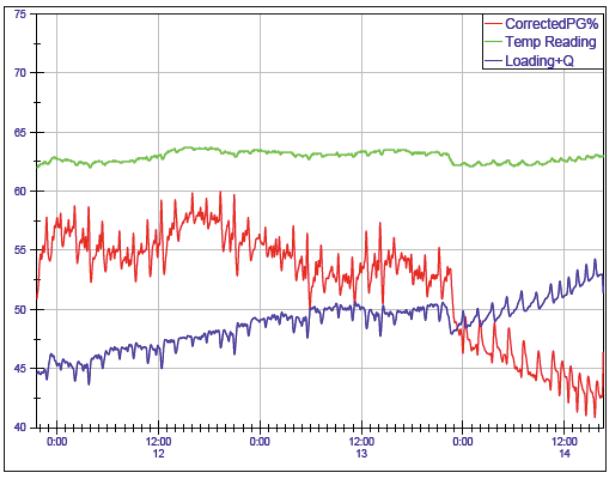
Fig. 3 plots the power and temperature recorded during a complete 66-hour Ni/H2O electrolysis experiment.
Fig. 3. Plot of power and temperature versus time for Experiment 1
Excess power of over 50% was recorded for much of this experiment. We repetitively swept Q repetition rate while stepping up Q amplitude and then a third parameter affecting Q shape to examine the effects and interplay among them.
The excess heat produced during this run shown in Figure 3 declined as additional power was applied. The red line plots the percentage of excess power, blue the sum of the electrical inputs, and green the temperature of the test cell. The repetitive spikes in the data are due to the cycling of Q repetition rate and the downward sloping trend indicates the increase in power to a change in the shape of the Q pulses. This slide indicates that the level of the production of excess power does not rely exclusively on input power since increasing input power reduced absolute amount of excess power. The automated test system now has the ability to automatically sequence 4 separate input variables. When the Q pulse shape stepped out of an optimal operating point the red and blue plots crossed.
C. Experiment 3
Fig. 4 plots the calorimetric and temperature data for a subsequent Ni/H2O electrolysis experiment.
Fig. 4. Calorimetric data for Experiment 3
In this experiment we examined the effect of changing specific input parameters. This plot shows a thermal output 50% greater than input for 14 hours. A gradual increase in temperature tracks small incremental increases in both the DC and AC currents. This continued for 12 hours past the end of this plot as seen in Fig. 5., which shows the sharp response of the system to input power while everything else was held constant.
Fig. 5. Calorimetric results from Experiment 3 continued
A jump in excess heat from less than 55% to almost 70% was produced using the settings input during the second half of the experiment on February 15th. Learning from this data, we modified electric inputs to exceed these results.
D. Experiment 4
Fig. 6 plots the calorimetric and temperature data for part of a Ni/H2O electrolysis experiment. While holding total input power constant Q pulse shape was changed, which yielded excess power production in excess of 75% for approximately 11 hours.
Fig. 6. Calorimetric results from Experiment 4
After achieving a thermal steady state, the system performed well for the duration of the test. Subsequently a new set of input parameters were utilized in this experiment, after which the excess power peaked at approximately 85% and was above 80% for more than seven hours.E. Experiment 5
Fig. 7 plots the calorimetric and temperature data for part of a Ni/H2O electrolysis experiment.
Fig. 7. Calorimetric results from Experiment 5
This was the first time the excess power exceeded 100%, meaning the “watts out” were twice the “watts in.” Certain electrical inputs to the cell were changed deliberately in a proprietary manner effecting Q frequency content.
This experiment is important because it shows both our upward discovery trend and because it exceeded the important 100% milestone. These set of representative experiments showed that we have progressed well beyond the results with the open-cell experiments described in the Background section.
F. Experiment 6
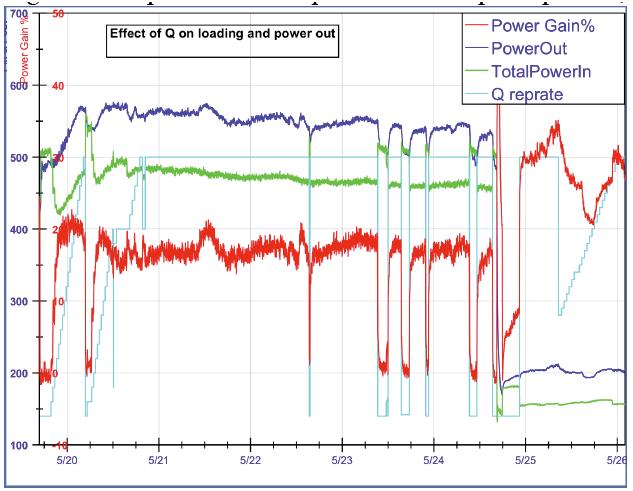
Experiment 6 shows the effect of changing the repetition rate of the high voltage stimulation pulses. Figure 8 plots the input and output powers, percent excess power, and the Q pulse repetition rate. Output power is shown in blue, input power is shown in green, and excess is shown in red as a percentage. The proprietary repetition rate of the pulses is plotted without scale in turquoise.
Fig. 8 Effect of Repetition Rate on Excess Power
For five days, excess power from the induced thermal reaction in nickel hydride averaged approximately 20% during times when the wave form at a given repetition rate was applied to the nickel hydride. Total applied power was above 450 watts. When the repetition rate was reduced excess power fell significantly, even though the input power rose. On seven different occasions when total applied power to the system was above 450 watts, and the repetition rate was reduced, excess power dropped from approximately 20% to close essentially 0%. Excess power returned quickly to approximately 20% when the repetition rate was restored to its original value.
This plot demonstrates a cause and effect relationship exists between the frequency of the applied waveform pulses (Q) and the amount of excess power produced in the test cell.
IV. CONCLUSIONS
We have demonstrated that the nickel-light-water system is able to achieve more than 100% excess heat production (“2X”). Recent data shows that excess heat production was in the range of 110% for 2 hours.
We ran over 150 experiments using two different cell/calorimeter designs. Excess heat was always seen[3] in experiments where Q pulses, which have been tuned to the resonance of the hydride conductors (“core”), are present. Using our open cell design it is now possible to get excess heat on demand using light water and hydrided nickel and palladium.
Pulsed power in the cathode is the preferred method to raise the energy of the Brillouin zones confining hydrogen nuclei in the metal lattice[1]. We postulate that conversion of this energy to mass, results in the production of cold to ultra-cold neutrons. The removal of charge from the system by absorption of an electron by a proton makes a current pulse the preferred source of pulsed power because it provides electrons for capture.
In all cases, the application of a suitable Quantum Compression waveform enables active hydrided materials to produce excess power on demand without regard to the grain structure. While it is common for “gross loading” systems to work with some pieces of material and not others from the same batch. We believe that the Quantum Reactor technology caused every centimeter in all 15 meters of Pd wire to immediately produce excess heat while exposed to properly pulsed currents in light water. Quantum Reactor technology also allows for significant modulation of the power out of the cell.
Leveraging the results of the open cell experiments, the proprietary circuitry was attached to hydrided conductors in high-pressure, high-temperature systems for the sealed cell experiments[2].
The data taken from nickel-hydrogen system that was stimulated by our proprietary electronic inputs show that the thermal output is statistically significantly greater than the electrical input. Measurable and repeatable surplus thermal output is found in the nickel-hydrogen system when all other inputs to the cells remain constant. We have shown 100% excess energy and hope to achieve 200%, which would make the technology industrially useful. We also believe that the moderately elevated pressure and temperature environment of the pressurized cell may increase the probability for proton-electron captures, than the conditions at ambient temperature and pressure, because the electrolyte can be heated to over the boiling point of the electrolyte at atmospheric pressure. In addition to elevated temperature and pressure, the dimensions of the metal cathode inside the test cell, is much larger than what was used in the “open container”, first- round experiments.
We conclude that the reaction producing excess power in the nickel hydride is related to and very dependent upon the frequency of the Q pulses applied. We have thus demonstrated that there is a repeatable and measurable relationship between excess heat production from the stimulated nickel hydride in the test cell and the repetition rate of the applied electronic pulses. When the repetition rate is changed from the optimum frequency, excess power production ceases in the nickel hydride lattice. When that repetition rate is restored, significant excess power production resumes.
V. FUTURE WORK
We are looking closely at the experimental data from Experiment 5 and will use it to attempt to break through the next threshold 200% (“3X”) hopefully soon.
We have started to perform experiments in a third cell/calorimeter design in collaboration with SRI International that we believe will lead to more useful heat by operating at higher temperatures. We feel that the first commercial applications expected will be hydronic heating systems that require grid power and produce lower quality heat as well as higher quality heat systems that will be used to re-power existing dirty generation assets.
In addition to Pd and Ni, the Q-pulse reactor system should work with other transition metals that confine hydrogen nuclei sufficiently in a lattice to effect electron capture events.
APPENDIX
A. Controlled Energy Capture Hypothesis
p + ~782KeV + e- » n + νe
(using energy for ultra-cold neutrons)
p + n » d + 2.2MeV
(making ultra-cold deuterons and energy)
d + (up to 3MeV) + e- » 2n + νe
(using energy to make di-neutron system)
d + n » T + 6.3MeV
(making tritum and energy)
2n + d » 4H + (?MeV)
3n + p » 4H + (?MeV)
(making short lived 4H nuclei and energy.)
4H » 4He + β¯+ νe + (17.06 to 20.6)MeV
(making helium and lots of energy)
In June 2012, I went to interview Dr. Melvin Miles on his career investigating cold fusion electrolytic cells as both a Professor and a Navy researcher, now retired.
I didn’t know I’d get two interviews that day.
We met in the office of Dr. Iraj Parchamazad, Chairman of the Chemistry Department at the University of LaVerne, in LaVerne, California, who is also studying low-energy nuclear reactions (LENR) using an unusual environment on the nano-scale: zeolites.
I was prepared for Dr. Miles‘ interview, and made two movies about him; one, discussing the early years of cold fusion and Why Cold Fusion Was Rejected and two, Dr. Miles talking about how his cell is put together and showing his calorimeter that measures highly-accurate temperature changes in How to Make a Calorimeter, both of which you can view here.
But, I wasn’t prepared for the discussion on how zeolite crystals host tiny particles of palladium in their unusual geometry, and make anomalous heat when exposed to deuterium gas.
Well, after over five hours of discussion, I knew a whole lot more about this new style of room-temperature, gas-loaded, zero input energy heat production from an expert in that particular application.
In this video, you too can see how LENR research is conducted in one U.S. university lab, complete with all the financial struggles that have characterized the study of new energy for two decades, and learn how scientists are finding new ways to generate useful heat energy that reveals yet another path to ultra-clean, energy-dense, and abundant power for the world.
There’s an upcoming film called THE WAVEMAKER which features Dr. Irving Dardik and his Superwave Principle and includes appearances by Martin Fleischmann, Robert Duncan, and Michael McKubre.
The filmmakers are seeking votes to get Indiewires “Project of the Month” which will win them a consultation with the Tribeca Film Institute.
They are only up against 3 other films and voting ends this Friday.
If you can throw down a vote for this film, cool…
Theory Purports Alternative to Mainstream Science and Medicine Applied to Health, Cold Fusion and Clean Energy
The official press release reads:
New Film The Wave Maker Chronicling Medical Maverick Dr. Irving Dardik’s SuperWave Principle, entering final weeks of Indiegogo Funding Campaign
Theory Purports Alternative to Mainstream Science and Medicine Applied to Health, Cold Fusion and Clean Energy
Indiegogo Extends The Wave Maker’s Funding Campaign to Sept. 28
New York, New York, September 19, 2012 – An Indiegogo funding campaign is entering its final weeks to start post-production of filmmaker Kiira Benzing’s THE WAVE MAKER, a feature documentary about medical maverick and former Olympics physician Dr. Irving Dardik’s quest to assert a paradigm shift in our understanding of the universe and of our own bodies – by making waves. Dardik’s radical SuperWave Principle, wherein the world is made up of “waves waving within waves,” is an alternative to mainstream science and medicine currently being applied to health, cold fusion and clean energy. THE WAVE MAKER follows Dardik as he battles to convince people that his SuperWave Principle is the Theory of Everything.
“There is a lot of science and theory behind Dardik and his SuperWave Principle, but at the end of the day this film is a human story about a man who believes so deeply in his theory and has sacrificed so much for it,” said Benzing. “I genuinely appreciate Dardik’s vision of the universe, and as much as I recognize he hasn’t convinced the scientific establishment to adopt his theory, I firmly believe that his ideas are reason enough to produce this film. I really hope it will open up minds and hearts to a greater discussion about new forms of clean energy and the scientific establishment.”
Benzing and her film team have intensively captured the radical world of Dardik, from his insights on the workings of nature, to his observations of the human body under stress; to mainstream media coverage of his ideas. Benzing interviewed the naysayers, captured the stories of those living with cancer and Parkinson’s that Dardik has inspired, and documented his medical work based in cyclical exercise and circadian rhythms. Benzing also engaged with his paradigm-shifting ideas about matter and the make up of the universe, interviewing a range of prominent physicists who candidly share their views, and captured how Dardik has successfully applied his principles concerning energy expenditure and recovery time (drawn from observing top athletes) to helping diseased bodies self-heal, as well as to cold fusion, to metallurgy and to particle physics.
Funds pledged by contributors to THE WAVE MAKER’s Indiegogo campaign will go toward shooting the final scenes, equipment, hiring editors, converting footage, recording the score and animation. This campaign will receive all of the funds contributed by Friday, Sept. 28 at 11:59PM PT.
Contributors receive perks that range from “Waves of Gratitude” at the $12 level receiving a postcard image from film with a handwritten note from Benzing, to “The Tsunami” at the $7,000 level receiving lunch with Dardik, a visit to the set during final shoot, two tickets to the premiere in New York, a “Special Thanks” credit in film, a hot air balloon ride, a DVD of the final film, an original song by composer Daniel Halle, a silver necklace and a postcard. Also offered are credits for the Associate Producer level at $30,000, the Producer level at $50,000 and Executive Producer level at $100,000. Your name will appear in the credits of the film. These donations are tax-deductible through the film’s 501(c)3 partner, NYFA.
Featured subjects in THE WAVE MAKER include: Martin Fleischmann (Co-Creator of Cold Fusion), Milt Campbell (First African American US Olympic Decathlete Gold and Silver Medalist), Alison Godfrey (CEO LifeWaves International), Dr. Rob Duncan (Vice Chancellor of Research at the University of Missouri), and Dr. Mike McKubre (Electrochemist at SRI).
THE WAVE MAKER is a production of Double Eye Productions. Attached to the production are producer Kim Jackson (“Blue Caprice,” “Children of God,” and “TUB”), cinematographer Alfredo Alcantara (“The View from Bellas Luces,” “An American Promise”) and composer Daniel Halle (ASCAP).
To make a pledge to THE WAVE MAKER on Indiegogo, visit:
As an international creator, Kiira Benzing has trained and organized projects at the Sorbonne in Paris, the National Theater Institute, and MXAT. Benzing holds a Post-Graduate degree in Classical Acting from LAMDA. In 2007 Verizon named her a “Local Hero.” In 2009 she founded Double Eye Productions. In tangent with “The Wave Maker” she created a web series “Finding The Wave” which she directed, wrote, and co-starred. She directed a short film “The Astra Approach” and is in post-production on “Matterspacetime” an experimental short. She has served as a Regional Emmy Awards Judge for the National Academy of Television Arts and Sciences.
###
For interview requests with filmmaker Kiira Benzing, please contact Brian Geldin (BGPR) at: 917-549-2953 or briangeldin@gmail.com.