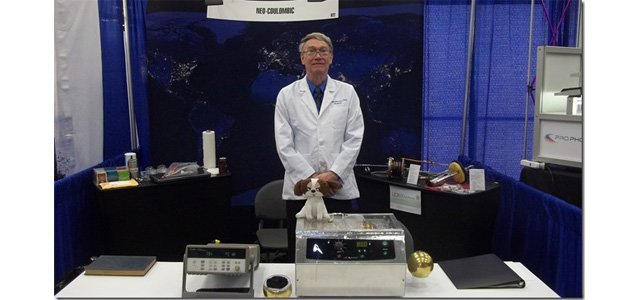
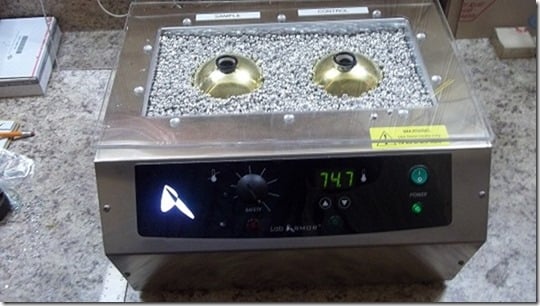
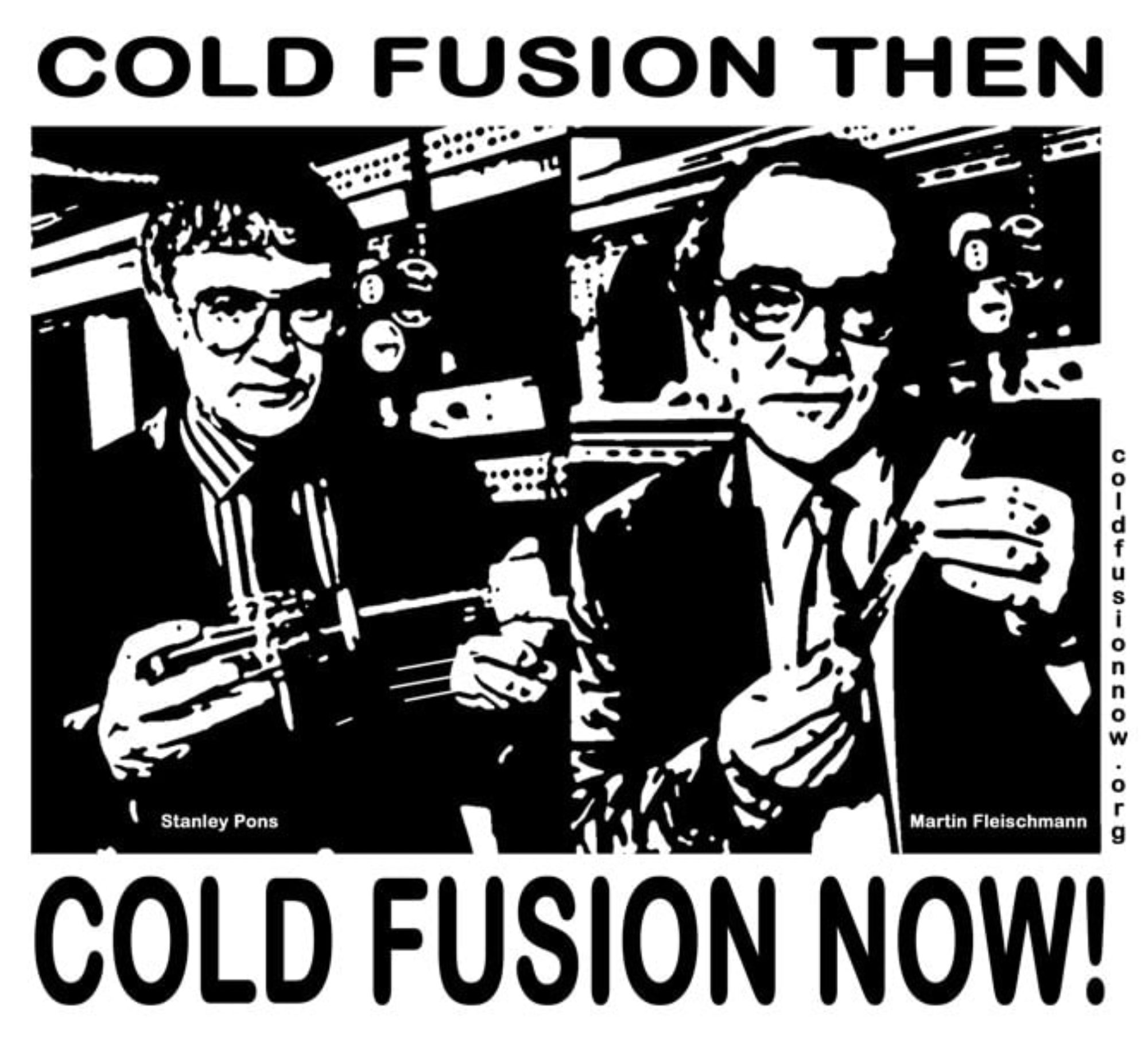
The Cold Fusion research of Fleischmann and Pons was an anomaly in and of itself. Two electrochemists, while having a bit of fun with the maximum loading of hydrogen into palladium in an electrolytic cell, ventured into a realm of subatomic phenomenon. No one had been there before in quite this way.
They hazarded to say it was nuclear, and got blasted.
These two electrochemists had no assistance from other branches of science in trying to figure it out. Nobody came to their assistance. In fact, those who should have joined in this scientific quest, ridiculed the pair as charlatans. Instead of helping out these two lone electrochemists with a scientific dilemma, leaders in the nuclear scientific community of the U.S. government-funded Department of Energy (DOE) labs ridiculed them to no end. This left the two fellows to fend for themselves while being kicked out of the tribe, so to speak.
Luckily, the few scientists who had found positive results during the DOE-sponsored race to replicate the Fleischmann-Pons Effect (FPE) persisted, mostly in obscurity and without funding, in this query of the unknown.
Cutting edge experimental science requires patience, honest sharing of data, and evaluation for a continued improvement of the experimenters’ ability to enter into an unknown realm; which is to actually observe and record aspects of a difficult to create phenomenon and thereby test theory. In this manner, our understanding within the unknown realm grows.
I publish. You review after working it a bit. Always improving experiments. Together with theorists, we collect data, analyze and implement sound suggestions, always moving forward, advancing the science. Open collaboration quickens this difficult quest into the unknown. Open and enthusiastic collaboration by all branches of the scientific community into the query of the unknown is the basis of good science and is essential for the birth of a new science.
These early cold fusioneers formed an association of the shunned and published in a few “unrecognized” trade journals which they had to create in order to continue the scientific process in this controversial field. The Internet had appeared before the observed
Fleischmann-Pons Effect (FPE), freeing these researchers from the limitations of the printing press.
The printing press had advanced science simply by causing more researchers to be reading more researchers work, which caused a quickening of the scientific process.
I publish. You review it after working it a bit (through meticulous experimentation and collection of data). Together with theorists, we improve our ability to observe and record phenomenon, improve analysis of data, always moving forward.
Today’s scientists no longer face the hurdle of a publisher’s peer review to get work printed. If you have fallen into an unknown realm who is your peer? Obviously only those who you find there with you. The Internet allowed the peers of cold fusion research to publish, which is the first step in involving the larger community in your scientific endeavor. Only after publishing can true scientific review begin.
Many of the established branches of science could have assisted Fleischmann and Pons with a few of their questions. These two were wondering what was actually going on. They also were trying to figure out, why, during different runs of their experiments, some cells produced nuclear levels of energy while others did not. None of those in mainstream science helped them to answer any of the questions concerning the new realm they were entrusted with.
The people who are experts in atomic theory had nothing to add. The people doing high-energy subatomic research at CERN or Lawrence Livermore had nothing to add. Thermoelectric devices are almost like LENR devices, without the hydrogen. Yet the mainstream thermoelectric crowd offered no assistance even though their grandfather, Harold Aspden, had became a godfather to new cold fusion research. Even the emergent semiconductor field could have assisted this new science with their knowledge of dopants and understanding of the adolescent quantum field branch of science.
None of these folks showed even a bit of healthy scientific interest in this work. Almost all their curiosity evaporated into thin air. After the announcement of the birth of cold fusion research people were thrilled. Then to have virtually all curiosity evaporate within the whole scientific community, is an anomaly of such a magnitude that it is hard to comprehend. These lone researchers from a single branch of science, with their Internet printing, were left to care for this newly born area of research by themselves, held separate from the larger scientific community. They were left without communal guidance or assistance in their care of this new unknown scientific field, the infant known as cold fusion research.
Fleischmann and Pons were just trying to figure it out. Who knows how dirty their electrical currents were? Might there have been harmonic frequencies created upstream of their current supply, caused by any number of other electrical equipment being turned on, or turned off, at the same time? (My TV used to go fuzzy when the neighbor turned on his table saw.)
These electrical eddy currents could cause one cell to go positive, with nuclear dense energy being produced, while another, without this added focusing of energetics, would be a dud. Would there be pulsations created simply by a portional electrical on/off factor, thereby creating superwaves or standing wave formations? Are influential magnetic moments created within such electron dense environments? Are harmonic frequencies within the lattice the key?
What surface topography or nano engineering is required? Are the proper fractal geometries essential for equilateral fusion firing and control throughout the system? Do we need some dopants thrown in? Do we need to get the advanced materials folks engaged in doing some Edisonian style research with every known metal and alloy? Is an unknown source of energetics thrown into the mix, such as dark energy or gravity?
How might one capitalize on these many components within the atomic and the subatomic realm of the cold fusion nuclear reactive environment? Are angular eddy currents within the electron shell a key? Or specific angular thermal currents? Do subatomic transmutations within the molecular liquid crystal plasma create atomic transmutations, on an atom by atom basis?
So many questions faced Fleischmann and Pons in their efforts to sustain this child that, unassisted by the larger community, the new science of cold fusion barely survived. Luckily the science did and she is growing up, as we shall see.
Science has been progressing nicely since the birth announcement of cold fusion research in 1989. Quantum physics and engineering has matured since then. After a battle for acceptance, it is now seen as a branch of science that will advance us beyond our present understanding of known Einsteinian physics. Nano-science has emerged fairly well developed, with exciting possibilities, being fully realized quite quickly.
Both of these branches of science have been openly courting cold fusion research and standing within the low energy nuclear reaction environment for some time. Once an ugly duckling, now a beautiful swan, LENR Energy is now considered to be exciting and full of potential. Highly energetic with no known faults LENR Energy attractive and much sought after.
LENR Energy Science and Engineering is finding herself best able to thrive as a multi-disciplinary field. LENR is the debutante at the ball. With some really great features: Clean inexpensive energy. Both LENR Electrical and LENR Thermal are embodiments of her grace.
We would certainly be amiss if we failed to mention the most attractive features. LENR energy transmutes radioactive waste while driving the turbines. My kinda gal. And when she steps onto the dance floor she actually flies, with the grace of a modern spaceplane and the beauty of a Boeing 747.
My hope is she will capture the attention of the semiconductor and thermoelectric crowd soon. Now that I stop and think on this, they are probably dancing together already. We will soon see.
Laboratoire de Physique Théorique – Toulouse – UMR 5152
A gauge theory picture of an exotic transition in a dimer model
http://www.lpt.ups-tlse.fr/spip.php?article432&lang=fr
We study a phase transition in a 3D lattice gauge theory, a coarse-grained version of a classical dimer model. The dimer model on a cubic lattice, first studied by F. Alet and collaborators, displays a continuous transition between an ordered columnar phase at low temperature and a disordered phase at high temperature where dimer-dimer correlations show an algebraic decay. This is rather unusual as the standard Ginzburg-Landau theory of phase transitions generally predicts an exponential decay of correlations in the disordered phase.
This phase transition is “exotic” in the sense that it cannot be simply explained by the spontaneous symmetry breaking of an order parameter. The existence of such unconventional continuous transitions is still very controversial, numerous authors pointing at an artifact due to a very weak first-order driven process.
To have a better understanding of the dimer model, we show, using duality arguments, that the classical dimer model can be mapped to a frustrated XY spin model coupled to a gauge field. The ordering transition is then naturally understood in terms of a Higgs mechanism. A Monte-Carlo study on large system sizes of the dual model indicates a second-order transition with exponents close but slightly different from those of the simple XY model. In order to confirm the type of the transition, we perform a flowgram analysis, a powerful numerical tool to test the nature of a transition. The results of the flowgram are unambiguously pointing toward a continuous transition.
Post-scriptum :
For more details, see the original paper Gauge theory picture of an ordering transition in a dimer model, by D. Charrier, F. Alet, P. Pujol in Phys. Rev. Lett. 101, 167205 (2008)
Mardi 12 fevrier 2013-14:00
Spin-dependent thermoelectric transport in HgTe/CdTe quantum wells
http://www.lpt.ups-tlse.fr/spip.php?article1000&lang=fr
Marine Guigou (LPS Orsay) par Bertrand Georgeot – 12 février
HgTe quantum wells are known to host, under a topological phase transition, the quantum spin Hall effect. The latter refers to the presence of metallic edge states moving in opposite direction for opposite spins. Recently, HgTe/CdTe quantum wells, among others topological insulators, have been proposed as good materials for thermoelectric conversion. The basic idea relies on the topological protection of the 1D edge states that prevents reduction of electrical transport in disordered systems. Their efficiency to convert heat into electricity is based on the dominance of the edge modes on transport [1,2].
During this presentation, I will discuss about the thermoelectric properties of HgTe/CdTe quantum wells through the analysis of Seebeck and spin Nernst coefficents in a four terminal cross-bar setup. As a lateral thermal gradient induces a longitudinal electric bias and a transverse spin current in such a system, each of them can be used as a probe of the topological regime as well as finite size effects of the quantum spin Hall insulator. Furthermore, I will present a qualitative relative between effective mass of particles and magnitude of spin Nernst signal which allows to provide an explanation of the observed phenomena based on anomalous velocities and spin-dependent scattering off boundaries[3]
[1] R. Takahashi and S. Murakami, Phys. Rev. B 81, 161302 (2010).
[2] O.A. Tretiakov, A. Abanov, S. Murakami, and J. Sinova, Appl. Phys. Lett. 97, 073108 (2010).
[3] D.G. Rothe, E.M. Hankiewicz, B. Trauzettel, and M.G., Phys. Rev. B 86, 165434 (2012).
When spontaneous transmutation of particles occurs in a quantum liquid.
Phys. Rev. Lett. 109, 016403 (2012)
par Carlos Lamas – 12 juillet 2012
Toutes les versions de cet article : English , français
The nature of doped insulators (where electrons experience strong repulsion) is a key issue that has been debated for years : it was first suggested that fermionic dopants (fermions are particles that can not share the same quantum mechanical state) can change into bosonic particles (bosons are particles that can occupy the same quantum mechanic state) – so-called statistical transmutation. This spectacular phenomenon is made possible by the exotic nature of the parent insulator, a quantum liquid which might be viewed as a “soup” of fluctuating close-packed dimers. Such a state is shown to exhibit emergent (topological) quantum defects that can bind to dopants and change their fundamental quantum properties and statistics (fermionic or bosonic statistics). In a recent Letter, C.A. Lamas, A. Ralko, D.C. Cabra, D. Poilblanc and P. Pujol have proven the existence of a “statistical transmutation” symmetry : the system is invariant under a simultaneous transformation of the statistics of the dopants and change of the signs of all the dimer resonances. The authors combine exact analytical results with high performance numerical calculations to clarify this issue. The exact transformation developed in the letter enables to define a duality equivalence between doped quantum dimer Hamiltonians, and provides the analytic framework to analyze dynamical statistical transmutations. These results constitute a fundamental step in the understating of a broad family of new phenomena in the large community of strongly correlated electronic systems.
Reference : C. A. Lamas, A. Ralko, D. C. Cabra, D. Poilblanc, and P. Pujol, Phys. Rev. Lett. 109, 016403 (2012)
 .
.