Charles Seife confuses reality and myth with attack on discoverers of cold fusion

If you want to study journalism, don’t go to New York University where you might get Professor Charles Seife.

NYU Journalism professor Charles Seife shows poor practice of fact-checking.
NYU Journalism professor Charles Seife fails on fact-checking.
His last book Sun in a Bottle: the Strange History of Fusion and the Science of Wishful Thinking published in October 2008 appears to be the fodder for his recently published article Fusion Energy’s Dreamers, Hucksters, and Loons posted on Slate.com, and he hasn’t researched the field since.

Primarily about the inability of plasma scientists to generate commercial power from hot fusion, the recent piece of typing contains gross inaccuracies about cold fusion stemming from the same falsities that pushed it out of the mainstream science community two decades ago.

For over half-a-century, hot fusion labs have received about a hundred billion dollars research funding under the auspice of producing clean abundant energy “in the future”. The joke is that the future always seems to be ‘thirty years away’. To date, hot fusion projects have not generated any useful energy.

However in the article, the author repeats the same myths about cold fusion that have long ago been dispatched by condensed matter nuclear scientists around the world. Scientists working out of U.S. Navy labs, national labs, nuclear agencies, and universities have confirmed the very reproducible reaction’s effects of excess heat and transmutations repeatedly.

Unfortunately, the Professor gets a D for not taking the time to review the facts, confusing the enormous energy gains in cold fusion with the lack of hot fusion success. He fails further by insulting two of the discoverers of cold fusion Martin Fleischmann and Stanley Pons, implying a criminal intent by equating them with the actions of Richard Richter.

Seife writes in his article:

For one thing, the history of fusion energy is filled with crazies, hucksters, and starry-eyed naifs chasing after dreams of solving the world’s energy problems. One of the most famous of all, Martin Fleischmann, died earlier this year. Along with a colleague, Stanley Pons, Fleischmann thought that he had converted hydrogen into helium in a beaker in his laboratory, never mind that if he had been correct he would have released so much energy that he and his labmates would have been fricasseed by the radiation coming out of the device. Fleischmann wasn’t the first—Ronald Richter, a German expat who managed to entangle himself in the palace intrigues of Juan Peron, beat Fleischmann by nearly four decades—and the latest schemer, Andrea Rossi, won’t be the last.

Seife is confusing the 100-year-old conventional theory of nuclear reactions with today’s low-energy nuclear reaction (LENR), lattice-assisted nuclear reaction (LANR), and quantum fusion, names used to describe the variants of cold fusion research taking place today.

As Nobel laureate Julian Schwinger said many years ago, “The circumstances of hot fusion are not those of cold fusion.”

Cold fusion reactions take place inside small spaces of solid material, like the metals nickel and palladium. Cold fusion also can be generated in the crystalline porous structures of zeolites, as well as other alloys and materials, including biological systems.

Reactions use a fuel of both plain hydrogen called protium (the H in H2O) as well as hydrogen isotope deuterium, a hydrogen atom with an extra neutron at the center, and found in seawater.

Cold fusion does not take place in a plasma and does not make the kind of radiation that hot fusion does.

In the conventional nuclear theory from one-hundred years ago, fusion can only occur in high-temperature plasmas, when the nucleons gain high-speeds to impact with enough force to stick together, overcoming the very powerful Coulomb barrier, the force that keeps the positively-charged nucleons apart. The collision, and subsequent fusion of nucleons, produces a burst of heat energy and deadly radiation, all at once.

While cold fusion has no definitive theory at this time, the experimental results point to a slower type of reaction that radiates heat over time with little to no dangerous radiation. Scientists in the field are healthy, and clearly not dead from radiation poisoning, though they have measured heat on nuclear levels.

Consistently documented are thermal energy returns of 3, 6 and 25, depending on the cell design and material. Unofficial energy returns of 400 were witnessed by credible European scientists at demonstrations of Andrea Rossi‘s Ecat, who Seife calls a “schemer”. As the technology develops, cold fusion may show energy returns of 3000 and more.

In some cells the only by-product is helium, while other cells produce products like tritium and neutrons on the order of thousands and millions of times less than hot fusion.

Read Edmund StormsA Student’s Guide to Cold Fusion for more on what’s known about the basic science of this reaction.

The article Seife has written is once again drawing on the twenty-year-old myths created by unimaginative drones who felt threatened their funding would be cut were cold fusion to be heralded.

And it probably would have, for the ultra-clean energy from cold fusion, packaged in a safe, portable unit, with no need for an electrical grid will wholly change the face of our society.

The now confirmed experimental science has transferred to the commercial sector as numerous independent labs and small companies race to develop a new energy technology for the public. The challenges are two-fold, and vary between companies.

Some cells have a high-enough excess heat needed to produce useful power, but lack the control and sustained operation needed to make a commercially-viable product.

Other companies have the control, but need to increase the excess heat return.

Despite public unawareness and MSM myth, the development continues. At this point, only a commercial product will bring the much-needed funding that these new energy labs require to engineer the next-generation nuclear power, and inaugurate a renaissance of human creativity and freedom based on green living.

The inability of conventional scientific minds to venture beyond the comfort and familiarity of the old theories they know so well is a recurring historical fact. But in this age, when innovative energy solutions are so desperately needed, the continuing suppression of new energy options endangers our species and our planet.

Let’s respond to Charles Seife and invite him to the open enrollment in Cold Fusion 101 to be held on the MIT campus January 22-30 where he can get an update from two of the top researchers in the field.

Contact the Professor at his website http://www.charlesseife.com/.

Cold Fusion and Cocktails

I think the whole cold fusion community, scientists, researchers and advocates alike, were outraged by the cold fusion hit piece that was recently posted on Scientific American.  Believe me, I was as perturbed as many of the rest of you.  I had an article full of righteous indignation and anger but never posted it.  While I am still perturbed, a couple of days of reflection have allowed me to gain a bit of perspective.

Scientific American is the oldest continuously-published monthly magazine in the United States.  It has been in circulation for 167 years.  Many famous scientists, including Einstein, have contributed articles to the publication during it’s over century and half of existence.  However, its reputation has been in a slow and steady decline for the past half-century.  The decline in its once stellar reputation has been even steeper in the last decade, where its contributors have taken questionable stances on a variety of issues, including commentary on political matters like the Iraq War.  The publication also did not endear itself to anyone when it raised its college library subscription rate by 500% in 2009.  No, this is not your great grandfather’s Scientific American, any more than cold fusion is the kind of nuclear power your mother told you about.

Cold Fusion Now Bumper Sticker

It is in this environment that we find the quasi-scientific blog of Jennifer Ouellette’s, Cocktail Party Physics.  That name alone should tell us that this is not really an overly serious endeavor.  The author herself admits her forte is “finding quirky connections between physics, popular culture, and the world at large.”  She has written several books in this vein, one of which extols her bravery in overcoming her fear of calculus.  On the other hand, most serious about science overcome their fear of calculus by the time they graduate high school. Cold Fusion Now’s own Ruby Carat would think it immodest to call herself a serious scientist but has an academic background in physics and a graduate degree in mathematics.  She obviously overcame any “fear of calculus” many moons ago and didn’t think it was such a big deal that she had to write a book about it.   If Ouellette is gracious enough to accept Ruby’s invitation for a chat about her article over cocktails, I hope it is live streamed over the Internet.  That is one conversation I would like to be privy to.

Yet, Jennifer’s approach to science and its relation to the world at large would have made her a perfect candidate to give us a review of  “The Believers.”  It would have been right up her alley.  Instead, when someone mentioned the film to her, she inexplicably choose to write a 3000 word article espousing every myth and sophomoric joke about cold fusion perpetuated for the last 20 years, and never actually bothered to see the film.  A bit curious to say the least.

The question is why? What was the purpose and point of doing this as a response to the release of a film that won top honors at the Chicago Film Festival?  Well, there are some interesting theories about that.  For example, Dr. Michael McKubre suspects the article is a “concerted effort by several leading members of the opposition.” This according to comments made recently by Jed Rothwell on Vortex-l.  Some might dismiss that notion as a cock-eyed conspiracy theory but, upon further review, there might be something to that suspicion.

For example, Ouellette’s husband is Sean Carroll, a senior research associate in the Department of Physics at the California Institute of Technology, or CalTech.  Yes, that would be the same CalTech whose failed replication attempts were largely conducted before many details of the original experiments have been released (as was the case with many reported replication failures).  It was CalTech physicist Steven Koonin that infamously said that Fleishmann and Pons were “psychotic and delusional.”  Indeed, the anti-cold fusion bias runs deep at CalTech.  One can imagine that Jennifer has heard many cold fusion stories over the years from her CalTech physicist husband and his colleagues.

Steven Koonin

It should also be noted that Ouellette writes a column for a publication of the American Physical Society, the APS News, entitled “This Month in Physics History.”  In an interview on the  “The Late Late Show with Craig Ferguson,” this author describes the nexus and ongoing association with the mainstream physics establishment:

I was actually a freelance writer in New York City trying to make a living , and it turns out the physicists would pay me.  It is really as simple as that.  They needed someone who could put physics concepts into plain English that would be able to appeal to a broader audience.

http://youtu.be/4J-8a2NPHUE

As any student of literature knows, many of the earliest written stories in human history where myths handed down through generations via the oral tradition practiced by story tellers.  The individual who actually put these myths to paper did not have to vouch for their accuracy or truthfulness.  That was not their role.  It seems that our “recovering English major,” Jennifer Ouellette, is playing the role of modern scribe for the myths of the mainstream physics community regarding cold fusion.  This may explain why she shut down the comment section of her blog with the quickness.  She was not able to appropriately counter the evidence provided that contradicted the 20 year old myths she strung together  in her article.  As pointed out previously, and as reiterated in the interview above, we are talking about an individual who, basic calculus aside, is “terrified of math and physics.”   Having to talk about things in ways that require critical thought and examination of all the evidence probably sends her running for her cocktail shaker or the neighborhood pub.

As the saying goes, when considering praise or criticism, consider the source.  Yes, I know, it is easier said than done.  For those who have done their research, to hear old myths repeated with ignorant certainty as scientific truths is infuriating. But we must keep in mind that if a 20 year old myth, regurgitated by a writer who is “terrified of math and physics,” is all there is to worry about, we are in pretty good shape. So, sit back, enjoy a cocktail of your own, and try not to let scientific fundamentalists and the ignorant make you see red. I have an inkling that very shortly (within months), there will be a significant LENR disclosure and those who continue to cling to tired old myths will look as foolish as the cocktail party attendee who has had one too many and ends up donning a lamp shade on their head.

Scientific American Attacks Cold Fusion Research with Twenty-Year-Old Claims

Scientific American has published a piece of typing on cold fusion that would have founder Rufus Porter rolling in his grave with its glaring, unsagacious bias.

After twenty-three years of research confirming the phenomenon, in-the-dark and over-40-somethings continue to type the same old myths they once heard about twenty-years ago, and this author from a Scientific American-sponsored blog is no exception.

Jennifer Ouelette‘s assemblage Genie in a Bottle: The Case Against Cold Fusion is a sad collision of two-decades old gossip, Hollywood scripts, and misinformation, which she has casually repeated without batting a false eyelash. She claims to “well remember the controversy” when it first erupted, and has “followed it on and off” since then.

Or, perhaps it was from her CalTech physicist husband Sean Carroll‘s colleagues that she obtained such errant perspective. (This is innuendo with intent to gossip.)

CalTech was one of the labs to emotionally denounce the discovery, and the persons, after they failed to reproduce the effect. (This isn’t gossip.)

The article claims recycled twenty-year-old statements, twenty-years-ago refuted. None of the last two decades of increasingly advanced results were considered.

Who doesn’t like fun, light science? But this is no ordinary “Bad Moon Rising: The Science of Werewolves”, her next follow-up post for Halloween night. This is representing Scientific American on one of the greatest discoveries since fire.

Ouelette types “.. wanting something to be true isn’t the same as something actually being true in the rigorous experimental sense of the word.” We suggest Ouelette, whose avatar shows a woman having a cocktail, imbibe a few more before pontificating on this topic again. Seeing straight, she might encounter the catalog of scientists in the field speaking about their research.

Remove Institutional Blocks at MIT and CalTech; Fund cold fusion programs now by Ruby Carat

How Nature Refused to Look at the CalTech Calorimetry by Jed Rothwell [.pdf]

MIT Special Report by Eugene Mallove [.pdf]

U.S. Naval researcher Melvin Miles has spent twenty years successfully reproducing the experiments and analyzing early flawed data from CalTech and MIT showing clear mistakes in their hasty attempts to emulate the effect.

Critical comments to the article were deleted, including those by former Los Alamos National Lab nuclear chemist Edmund Storms, who has been researching cold fusion, also called low-energy nuclear reactions (LENR), lattice-assisted nuclear reactions (LANR), and quantum fusion for two decades.

Jed Rothwell, longtime researcher and writer wrote a response on his science archive site lenr.org and we reproduce that here.


Scientific American censors discussion of cold fusion, including statements by its own editors
–October 31, 2012 by Jed Rothwell

The Scientific American published another attack on cold fusion, Ouellette, J., Genie in a Bottle: The Case Against Cold Fusion, in Scientific American 2012. The author ignores the scientific literature and looks instead at movies, popular culture and mythology surrounding the 1989 announcement. She concludes that cold fusion does not exist.

In the on-line discussion of this article, the author allowed only skeptical arguments against cold fusion. She erased all rebuttals, and all messages supporting it, including: proof that many scientists support the research; that the effect has been widely replicated; and that over a thousand peer-reviewed papers on the subject have been published in mainstream journals. Finally, she erased messages quoting the editors of the Scientific American, and a message saying that peer-reviewed replicated experiments are the standard of truth in experimental science, which cited the Chairman of the Indian AEC and other distinguished scientists.

To paraphrase Marx, the opposition to cold fusion began as a tragedy and it is ending as a farce.

Edmund Storms
wrote this response to this column:

The scientific proof supporting the claims made by Fleischmann and Pons is now overwhelming. This is not the opinion of a “handful of diehard supporters” but of several major universities and corporations. The information is easily obtained at LENR.org and in many books written about the history and the science. We are no longer in 1990 when the claims were in doubt and many people attempted to replicate them, some with success. Many of the reasons for success and failure are now known. An explanation for the phenomenon is being developed and claims are being demonstrated for commercial-level power. Surely a writer for a magazine as important as Scientific American would know these facts and not continue using the myth that was created before the facts were known.

The author first erased it, but later restored it, adding, “With all due respect to Dr. Storms, I stand by my post.” She erased several messages from many different contributors. Here are two by Jed Rothwell:

If you are going to quote Robert Park, it seems to me you owe it to your audience to quote him when he brags publicly that he has never read a single paper. That is what he has said, repeatedly. He said it to a large crowd of people at the APS. If you do not believe me, ask him yourself. It is misleading to quote him as some sort of expert when he brags about the fact that he knows nothing.

The editors of the Scientific American also told me that they have read no papers on this subject, because ‘reading papers is not our job.’ Their assertions about cold fusion are also technically wrong. I published their comments here: http://lenr-canr.org/wordpress/?p=294

Further quoting Rothwell:

[Quoting a skeptical attack] Cude wrote: “I’m not aware of a single major university that has expressed the opinion that evidence for the claims of P&F is overwhelming.”

Professors at universities and at other institutions express that opinion. For example, the Chairman of the Indian Atomic Energy Commission said that, as did the world’s top expert in tritium at the Princeton Plasma Physics Laboratory (NSF p. 13-3). In 1991, The Director of the Max Planck Institute for Physical Chemistry in Berlin wrote: “. . . there is now undoubtedly overwhelming indications that nuclear processes take place in the metal alloys.”

Hundreds of other distinguished experts in nuclear physics and other related disciplines have said they are certain cold fusion is real. They know this because they have conducted experiments and detected the reaction at high signal to noise ratios, and their experiments have survived rigorous peer-review. That is the only way anyone ever knows anything for sure in science. Replicated, high sigma experiments are the only standard of truth.

Original article by Jed Rothwell here.


Jennifer Ouelette, you might never have dreamed repeating someone else’s twenty-year-old claims would hurt so much!

As our planet careens towards resource wars, ecocide, and economic collapse, the stakes for a clean, powerful, new source of energy are as high as they can be. Cold fusion offers a solution, so total, it’s hard to imagine.

Contact me! Let’s go for a cocktail, and you will be surprised at what has transpired over the last two-decades, and why the cold fusion myth persists today. I’ll meet you at your favorite haunt.

Till then, here’s Dr. Edmund Storms discussing how the myth got started.

WATCH What is Cold Fusion and Why Should You Care? by Edmund Storms.

Cold Fusion Now!

THE BELIEVERS – Chicago Screening of the New Cold Fusion Documentary

Chicago Screening of The Believers from Eli Elliott on Vimeo.

The second premiere of the new Cold Fusion documentary, “The Believers” took place on Saturday, Oct. 20th as part of the Chicago International Film Festival. The night before, the film was awarded the Gold Hugo Award for Best Documentary Film of the Festival.

THE BELIEVERS focused mainly on the Martin Fleischmann – Stanley Pons story involving their announcement of Cold Fusion in 1989, and the aftermath to follow. Using this theme as a home base, the film weaved in some of the current crop of researchers, scientists, advocates and still skeptics.

We meet Edmund Storms, Robert Park, Martin Fleischmann, the assistant/grad student to Stanley Pons (Stanley declined to be interviewed), Irving Dardik, James Martinez, Eric Golab, and others.

Besides the event and aftermath of the ’89 Cold Fusion announcement, the film touches on patent issues, Hollywood’s fictional take on fusion, and ultimately the overall collision of media and science.

Having read and researched the subject of Cold Fusion for some years now, it was hard to judge or evaluate a portrait of such fitted into a 80 or so minute frame. Inevitably one will feel important aspects missing, or topics glossed over. But in the end, as a documentary which aims to tell a story, the filmmakers succeed in putting together a good film, likely turning on many people to Cold Fusion, the sordid history involved, and some of the main individuals, past and present.

The Approach.

Most seasoned Cold Fusion vets will likely have a problem with the chosen approach towards the subject matter. The filmmakers made the decision to go with the “mainstream viewpoint” established in the 90’s, now starting to seem archaic, of asking the “is it real or not” question. Many have already pointed out this viewpoint to be a purposeful slant that was perpetuated, propagated, from late ’89 into the 90’s, fueled by the usual suspects: politics, ego, greed, money, and more. I recall Melvin Miles in reference to the DOE report and their refusal to change his negative results to positive during that time even though he was now achieving positive results, saying how MIT was planning for negative results before they even wrote the paper and how politically they couldn’t have come out positive. Hence the myth of “junk science” was created. (And he later had work published showing the exact mistakes MIT made in their negative conclusions).

So it will be surprising to many, that now, after 20 years of positive published results from over 200 labs worldwide, published papers on the calorimetry mistakes at MIT, a positive light shown down from the mainstream 60 minutes news program, current companies developing prototypes with a strong push to go to market ASAP, that the real vs. non real angle would be chosen to paint the Cold Fusion picture, here in the year 2012.

As a YouTube comment pointed out for The Believers Trailer,

No belief necessary. Its now fact.

Nevertheless that was the chosen approach. Thankfully, with the very cool, calm and casual Edmund Storms frequently standing at the helm of the films pro Cold Fusion base, a convincing story is portrayed. Even a skeptic in the audience couldn’t help but describe Ed as the “fair minded man with the beard”.

The main naysayer was Robert Park, who likely came off to audience members as a legitimate voice in the discussion, though I’m not sure if the contradictions and unanswered accusations were picked up by said audience. Such as Park mentioning something to the effect that “if these guys want to question whether there is Cold Fusion then let ’em, I wouldn’t want to spend my life that way.” Yet he comes off as someone who has spent a good chunk of life engaged in trying to refute Cold Fusion, appearing in public as a naysayer, rather than residing in private to actually read the reports on CF results, something he’s apparently refused to do.

I should mention also, that the film carried a fairly heavy emotional sadness to it, mainly in respect to Martin Fleischmann; the abuse he had taken all those years in the field of his chosen livelihood, to the abuse he was now taking with Parkinsons. And of course the recent passing cements this sadness in further.

Besides Edmund, the film really shines with both James Martinez and the young high school aged Eric Gobal. These were two important figures in the film as James represented the current activism/advocate excitement of the Cold Fusion community, while Eric showed strong hope and added excitement as one who had already begun carrying the torch that Martin Fleischmann had handed off.

These two filled in some of the gap that the film left out from the absence of covering the very exciting current Cold Fusion scene, with various new companies and recent developments of LENR (just to add, a brief text update of Andrea Rossi was included at the very end). Much of which, as the filmmakers mentioned at the end of Q and A, could’ve meant at least an extra half hour tacked onto the film, and they questioned whether anyone would want to sit through more. But I believe viewers would gladly enjoy the exciting developments that Martin strongly helped inspire. And with civilization currently suffering so, any strong potential hope I feel could have been worth it; revealing just how far this has in fact currently come, and the closer than ever potential it now has to actually save the planet.

Nevertheless, as those will be some of the criticisms made, the main take away is a very engaging, very well made film (and now an “award winning” film meaning greater exposure), which included important figures as ground, and a much larger platform for further discussion. The reaction to the film overall seemed positive, though many questions I felt still hung in the air for many audience members.

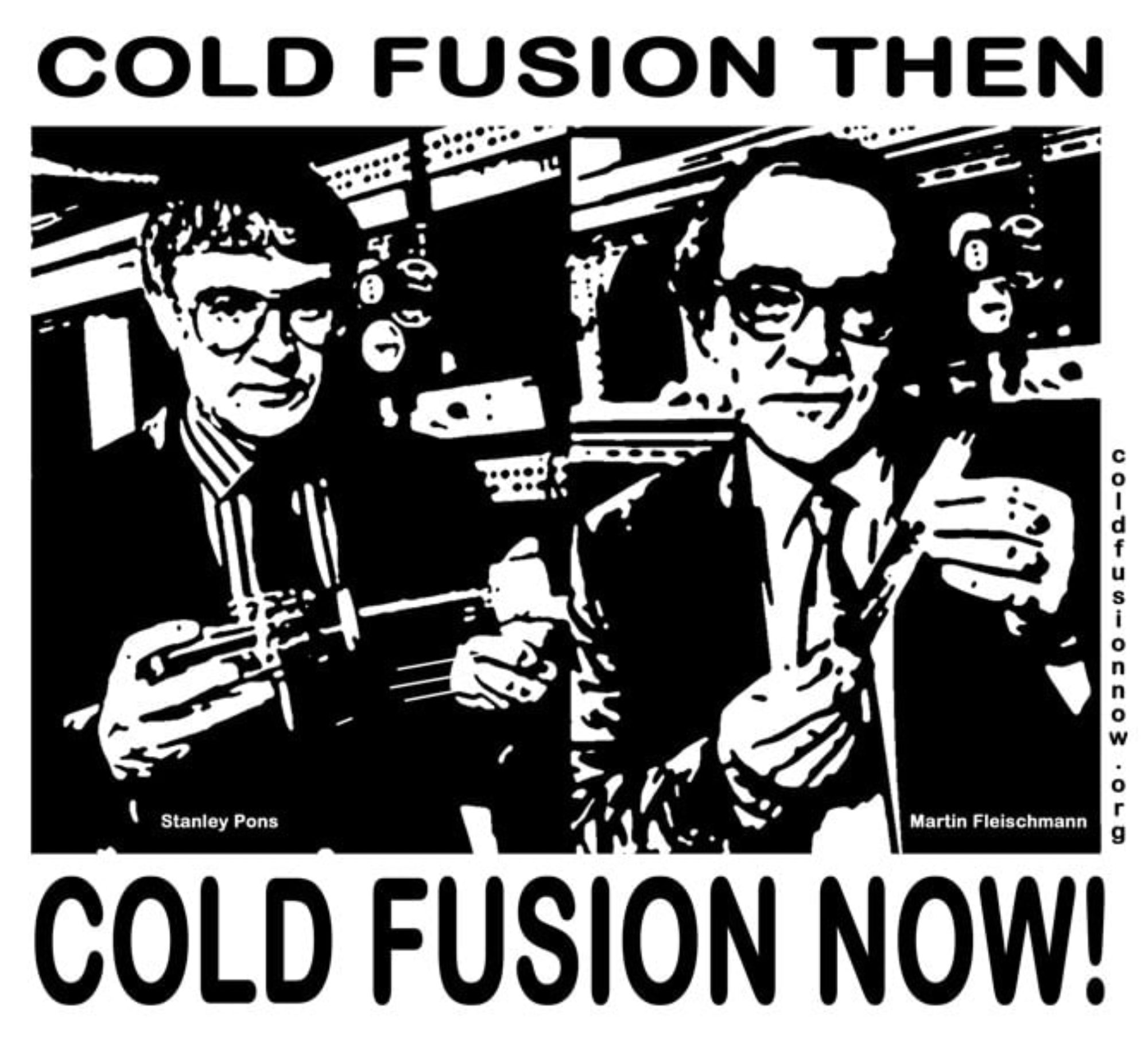
I handed out ColdFusionNow stickers at the end of the screening, and unloaded several of the brand new ColdFusionNow T-shirts featuring Pons and Fleischmann at the after party screening.

Where will The Believers be showing in the future? Can you get a copy? They are awaiting word on more festivals, as well as seeing what distribution deals arise. By early next year they are looking for the film to be available for purchase. We’ll keep posted.

Perceiving the new cold fusion landscape

A new generation is not prejudiced by authoritative decrees from a previous era.

Thus, when Andrea Rossi burst upon the digital environment 01/11/2011 with his demonstration of the Energy Catalyzer, or E-cat, a thermal energy generator powered by some as-yet-unknown nuclear process in a safe environment, without any dangerous radioactive materials, and far away from the seething core of the Sun, the planet tuned browsers and iPhones to northern Italy servers to sample the digitally-cloned experience. Public awareness has been accelerating ever since.

The new cold fusion documentary film The Believers by 137 Films won the Hugo Gold award for Best Documentary of the Chicago Film Festival, just as two science/technology magazines publish articles on cold fusion in their print versions, joining virtual versions of Forbes and Wired, among other online news and blogs, reporting on the topic.

They even went so far as advertising the fact on their covers, albeit small, and in the corner, revealing a cautious endorsement of the stories.

Popular Science Andrea Rossi’s Black Box by Steve Featherstone

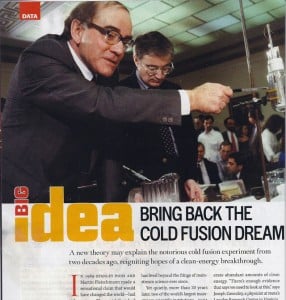
Discover Magazine Big Idea: Bring Back the “Cold Fusion” Dream by Mark Anderson

Two writers were tasked with presenting the cold fusion field, also called low-energy nuclear reactions (LENR), lattice-assisted nuclear reactions (LANR), and quantum fusion, in a few pages of text with a photo or two. I can hear the Editing team now. “What’s all this chatter about cold fusion?” and “what’s up with this Rossi fellow?”

The assignment is no piece of cake. Divining the truth of this underground science and imminently about-to-change-the-world technology is as complex and mysterious as the reaction itself.

The convoluted history can only emerge into a visible figure over time, piece-by-piece. Without a theory, there is no consensus. The science itself is entrenched amidst a ground of disinformation and outright hostility from otherwise very smart people who hold positions of power and authority in science, and whose behavior betrays emotional chains to immovable preconceptions.

Applying what Marshall McLuhan noted for all new environments, one of the great discoveries in the history of humankind was kept secret by “public incredulity”. Thus, cold fusion science is categorized as cultural fiction, alongside UFOs and Atlantis.

Max Planck, one of the discoverers of quantum mechanics wrote “Science advances one funeral at a time”, and for a new generation, the idea of transforming mass into energy (by whatever means) inside a solid material at room temperature is not a startling concept.

“Like, why not?”, say the kids.

The article by Mark Anderson for Discover magazine was two full pages describing one of the more popular theories that propose to model the reaction at the nuclear level.

Developed by Lewis Larsen and Allan Widom, the Widom-Larsen Theory proposes a reaction whereby protons “capture” electrons, absorbing them, and becoming neutrons. A neutron could then interact more easily with other nucleons as it is charge neutral, and has no Coulomb force to overcome.

Dr. Joseph Zawodny is a physicist at NASA Langley Research Center in Virginia and is testing technology based on the Widom-Larsen theory, which may confirm or deny the hypothesis.

Whenever a cold fusion theory is finally confirmed by experiment, and the recipe for the reaction spelled out, the field of new energy technology will break wide open. Then, generators will be designed not as they are now, by painstaking trial-and-error, without full knowledge and control of the variables, but by intentional engineering that optimizes the system into what Peter Gluck calls LENR+.

Chief scientist at Langley Dr. Dennis Bushnell is quoted from his essay saying “LENRs could potentially satisfy the world’s energy needs at a quarter the cost of coal.”

This Discover magazine article about Widom-Larsen theory inadvertently used “cold fusion” vocabulary.
The authors of the Widom-Larsen theory are adamant not to call the reaction “cold fusion”, but the phrase is not dismissed so easily. The Discover article’s title on page 10 is Big Idea Bring Back The Cold Fusion Dream, and the front cover states It’s Back: Cold Fusion.

Cold Fusion Now has long recognized the importance of vocabulary when talking to the public about nuclear reactions, and perhaps the magazine staff intuited similarly.

Scientists will eventually understand this Rumpelstiltskin reaction, and when the public finally gets a hold of it, they will name it with monikers not even dreamed of by the brightest marketing minds of today, and call it their own.

Steve Featherstone compiled a broader review of the cold fusion landscape for Popular Science.

Featherstone first sampled the community by attending the ILENRS-12 Conference held in June at William and Mary College in Virginia which attracted a number of leading figures in the field, and by visiting Italy, where he (finally) met with Andrea Rossi in his Bologna lab. He also met with other Italians skeptical of Rossi’s work, but who apparently think conventionally and know nothing of the two-decades old LENR experimental data.

Surveying conference attendees, Featherstone sums up the scientific community’s feeling of Rossi’s work by writing honestly:

“To my astonishment, after three days of asking every cold fusion researcher in the house, I couldn’t find a single person willing to call Rossi a con man. The consensus was that he had something, even if he didn’t understand why it worked or how to control it.”

They understood that Rossi is using a nickel-hydrogen type system historically known to produce large amounts of excess heat. His demonstrations have been witnessed by scientists who confirm temperature readings showing significant heat was generated.

The issue of openness, and the sharing of scientific data is another matter, and researchers will tell you fully-detailed, third-party tests and original data should be made available to the community for the sake of advancing the field. But without patent protection, those who have sacrificed decades of labor are not giving it up so easily.

But let’s forget about what’s typed as words, and look at what really communicates understanding, pictures. Popular Science gave the art department a whole page to illustrate this story.

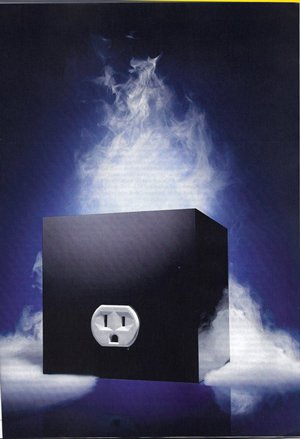
This image they came up with reflects what people want most from this technology, electricity. Prominently featured right in the front, the century-old three-prong household plug represents the “current” need for electrical power.

The black box doubly represents the mysterious cold fusion reaction, as well as the secrecy that surrounds the object of Featherstone’s focus, Mr. Rossi’s generator, and the secrecy that blankets a sector where the Patent Office refuses to give scientists the attention demanded of a paradigm-changing energy technology.

This Popular Science illustration accompanied Andrea Rossi’s Black Box by Steve Featherstone
Without patents, without academic support, without a process that encourages honesty, a developing technology will growing haltingly, in isolated pockets, and in secret.

The black box floats in the sky, like “pie in the sky”, and thus trepidation adds to the uncertainty. Like Wile E. Coyote spinning off a cliff, the unsettling feeling that you could drop like a rock at any moment, is the “ground” upon which the steam rises.

Steam is the object of the first planned cold fusion products in the form of hot water boilers for both hot and clean water, and steam generators for heating. Like a cloud, suspended, and slowly wafting behind the black box, steam rises into the deep blue, a technology within sight, but just out of reach on the horizon.

The box has a reflection below it. You can see the reflection of the electrical plug faintly just at the bottom of the of the picture, as if the box floats above water, a religious connotation associated with the highest of spiritual beings, reflecting the idealistic possibilities for a green and peaceful technological future for humans, if only we would just accept it.

The title page of Andrea Rossi’s Black Box
The facing title page uses the same square box shape to enclose the type. Infinite Energy is typed in a light-gray font, and functions as ground for the bold black type of Andrea Rossi’s Black Box title.

Eventually, steam generators would turn turbines to generate the electricity, enough to feed the box and more, creating an infinite coefficient of performance (COP), one measure of the energy return.

Is this configuration of symbols more happenstance than design? Was the reflection just because a box was photographed on a glass table? Knowing the talent of artists who generate image for a living, I imagine the brainstorming session that came up with this image, and how, in art, serendipity can allow unconscious choices that come together as coherent message only acknowledged after the piece is finished. For these images, the simplicity is a success.

Poet Ezra Pound called artists “the antennae of the race”, intuiting a future, from the now, but the interpretations of illustrators and artists can also provide a valuable report on the current milieu.

As more minds awaken to the possibilities of cold fusion technology, surveying the state of understanding includes not just reading the written words, but reading the images, and the actions taken, too. They have always “spoken louder than words”.

Cold Fusion Now!

Brian Josephson safeguards historic contribution of Martin Fleischmann

U.K. University of Cambridge Professor Dr. Brian Josephson, winner of the Nobel Prize in 1973 for the Josephson Effect, wrote the fine obituary published in The Guardian honoring Dr. Martin Fleischmann, co-discoverer of cold fusion who passed away earlier this year.

Focusing on Fleischmann’s life’s work, the essay was not a defense of cold fusion, though Josephson wrote, “However, progress seems to be occurring towards the application of cold fusion as a practical energy source. It may well transpire that, in the words of one cold fusion entrepreneur: “The market will decide.” (Including Josephson’s links).

Josephson then went to work dismantling some of the blundering misconceptions that reared up in the print landscape through the many unresearched and cliche obituaries scrawled by witless writers “walking backwards into the future”.

He responded to one of the more egregious pieces (and there were many) printed in Nature, the scientific journal with a long-standing policy of refusing to publish cold fusion research.

John Maddox, editor of Nature back in 1989, had decided within months that cold fusion was through.

“I think it will turn out, after two, three years more investigation, that this is just spurious and just unconnected with anything that you would call nuclear fusion. I think that broadly speaking it is dead and it will remain dead for a very long time” Maddox said in the 1994 BBC Horizon documentary Too Close To The Sun. [watch]

Fortunately, only subscribers of Nature were subjected to the current dreadful fiction by Fleischmann-obit author Philip Ball, and we are not privy to Professor Josephson‘s Letter to the Editor in reply due to copyright (unless you’ve got $16), but he has posted a narrative containing the major points of his response on his website which we reproduce below.


Ball’s obituary of Martin Fleischmann in Nature found wanting
by Brian Josephson [original here]

A letter published in Nature addressed itself to an obituary of Martin Fleischmann written by Philip Ball, the flavour of which can be judged from the following extracts:
“the blot that cold fusion left on Martin Fleischmann’s reputation is hard to expunge”

“cold fusion is now regarded as one of the most notorious cases of what chemist Irving Langmuir called pathological science; it was a lack of reproducibility that finally put paid to the cold fusion idea”

“once you have been proved right against the odds, it becomes harder to accept the possibility of error. To make a mistake or a premature claim, even to fall prey to self-deception, is a risk any scientist runs”

When I challenged Ball on this he replied naively that “those few that claimed success have never been able to demonstrate this sufficiently reliably and convincingly to persuade the majority. That is simply the situation as it stands”. Factually that may indeed be the case but the fact that the majority are not convinced hardly suffices to justify the dogmatic presumptions implicit in the extracts cited above.

In any event, a response was clearly called for and I was glad that Nature accepted the letter that I submitted to their Correspondence section. In that letter I noted first of all that

Ball’s obituary, in common with many others, ignored the large amount of experimental evidence contradicting the view that cold fusion is ‘pathological science’,

citing the library at www.lenr.org as providing a comprehensive listing of this research, including many downloadable papers. I also referred readers to my Guardian obituary.

I also noted that the situation at the time of the original announcement of cold fusion was confused because of errors in the nuclear measurements (this was not Pons and Fleischmann’s area of expertise), plus the difficulty others had with replication; however, problems with replication are not unusual in the context of materials science so this is not a strong objection and, further, in time

others were able to get the experiment to work and confirm both excess heat and nuclear products.

Ball included reference to ‘a Utah physicist who reported in Nature (see M.H. Salamon et al. Nature 344, 401–405; 1990) that he was unable to replicate the work’. Those who took the trouble to read this reference will note that the authors of that paper were much taken by the fact that there was a mismatch between the amount of excess heat claimed (which they did not measure) and the amount of radiation they measured. In case any readers were to draw the erroneous conclusion (which perhaps Ball hoped they would draw) that this refuted the possibility of nuclear reaction, I noted in my letter:

“experiment never excluded the possibility that the energy liberated might be taken up directly by the lattice”

I concluded by saying:

Had [this scenario] not happened, Fleischmann would have gained the credit due to him, rather than becoming a tragic figure in the manner of your correspondent’s account.

The above is provided as a service to those unable to access the complete obituary and comment in the journal itself.


Cold Fusion Now posted a series remembering Martin Fleischmann and turned one sorry obituary into art within ten minutes.

Top