LENR-powered Ecat car

Photo: Tesla Roadster Model S

We walk backwards into the future.
Marshall McLuhan

Greater than the digital revolution, a new energy technology will change the mental imprint of humanity beyond a global village, beyond a global theater, with the opportunity for a new humanism that recognizes the invisible, and walks a path through the impossible.

We are at the start of the New Energy Age and the creativity has not even begun.

The intersection of art and science, from Nicolas Chauvin CEO of LENR Cars http://ecatcar.org/ is but a transitory step.

Nicolas Chauvin, innovator, entrepreneur, EPFL engineer and licensed in business school, co-founder of two other start-ups before LENR Cars, worked for NASA, Nestlé and Logitech.

Highly involved in new technologies across many different fields of engineering and strongly addicted to cars for style, performance, sensations and technology.

Kick-boxing elite athlete, musician and portrait artist.

Eventually, we won’t have cars, that unique technology evolved from a service environment of fossil fuels; we’ll have something completely different.

But in the meantime, transition products will continue.

Unleash the powerful yearnings of a people hungry for change,

Cold Fusion Now!

Presentation slides by Nicolas Chauvin from the ILENRS 2012 conference. [.pdf]

LENR and Transmutation: It is going to happen sooner than you think

Change one element into another using a fission reactor is a fact. Nuclear transmutation inside a fission reactor produces some really valuable elements.

For instance, “In 1972, Russian scientists found that the lead shielding of an experimental nuclear reactor near Lake Baikal in Siberia had unexpectedly turned to gold!

Unfortunately such gold is likely to be radioactive, and would decay back to stable lead, whilst releasing dangerous radiation.

A possible route to gold would be from mercury. If mercury of its various naturally occurring isotopes could be made to capture neutrons, the resulting nuclear decay chains would eventually yield gold-197, the most common naturally occurring gold isotope, and perfectly stable.

The neutrons used in this process would need to have an energy of at least 9 MeV in order for a complete transmutation of the mercury to occur. These energies are well within the capabilities of nuclear reactors.” ( http://www.chm.bris.ac.uk/webprojects2002/crabb/modern.html ).

One way to avoid the transmuted elements from being radioactive is to use a LENR reactor:

Analyses of the nickel powder used in Rossi’s energy catalyzer show that a large amount of copper is formed.

“For copper to be formed out of nickel, the nucleus of nickel has to capture a proton…Both measurements show that the pure nickel powder contains mainly nickel, and the used powder is different in that several elements are present, mainly 10 percent copper and 11 percent iron. The isotopic analysis through ICP-MS doesn’t show any deviation from the natural isotopic composition of nickel and copper.” ( http://www.nyteknik.se/nyheter/energi_miljo/energi/article3144827.ece )

Sorry to subject you to this physics lesson, but it is necessary to proceed:

“Atoms are comprised of negatively charged electrons whirling around a relatively small nucleus of neutrons and positively charged protons. Protons have a mass 1836 times the mass of electrons. A neutron is a combination of an electron and a proton with zero net electrostatic charge. An atom’s number of protons and its equal number of electrons determine its type of element. Only when a positive ion (such as a proton or nucleus of a helium atom) penetrates an atom’s nucleus does the atomic nucleus become another element (or another isotope of the same element) or becomes unstable and splits (fissions) into two or more elements.” ( http://nexusilluminati.blogspot.com/2010/02/low-energy-nuclear-transmutationl.html ).

In other words, an element becomes another element when neutrons bombard it. Inside a fission reactor, it comes out radioactive, but inside a LENR reactor, in comes out non-radioactive. This is what happens inside a LENR reactor:

“A tiny amount of hydrogen protons are converted into neutrons. These newly produced neutrons are soon captured by hydrogen ions or other atoms in a metallic (e.g. nickel) lattice near to where the hydrogen ions were converted to neutrons. The captured neutrons generate heat because the new atoms that are one neutron heavier shed excess binding energy as heat to the lattice…” ( http://oilprice.com/Energy/Energy-General/New-LENR-Machine-is-the-Best-Yet.html )

This bears repeating: hydrogen is consumed by emitting neutrons (remember, a neutron is a proton and an electron). Everything near is bombarded by these neutrons. Some is absorbed by the remaining hydrogen, and some is absorbed by nearby nickel atoms, and some could be absorbed by any element we choose to place nearby, transmuting it into a much more valuable element.

That was the science, but this is the analysis: LENR can easily be used for transmutation. This means that there is very little lead up time before we are going to see the market flooded with rare earth minerals and other valuable elements like platinum or gold.

The real gem is that this rather simple application of a LENR reactor doesn’t need the normal years of certification and commercialization – companies are just going to be creating tons of valuable minerals and putting them on the market! Wow – every LENR company can have an additional revenue stream.

LENR and Alchemy

Alchemy is a form of chemistry and speculative philosophy practiced in the Middle Ages and the Renaissance and concerned principally with discovering methods for transmuting baser metals into gold. The word “alchemy” calls up the picture of a medieval laboratory in which a wizard broods over the crucible that is to bring within his reach the Philosopher’s Stone, and with that discovery the formula for the transmutation of metals.

That is why I was surprised to read Mitsubishi ( a Japanese multinational conglomerate comprising a range of autonomous businesses which share the Mitsubishi brand, trademark and legacy) hopes to go beyond just low energy nuclear reactions to low energy nuclear transmutations.

“These transmutations will be an energy source that will be portable, will produce rare earth materials, and will have the capacity to transmutate radioactive waste. They’ve changed the acronym from LENR to LENT. And, unlike competitors such as Rossi and Defkalion, they plan on using resources other than palladium, platinum and nickel.” ( http://cleantechauthority.com/defkalion-announces-lenr-date-mitsubishi-enters-lenr-market/ )

Low Energy Nuclear Reaction (LENR) using nickel and hydrogen is a clean, very very cheap, and super abundant energy technology, but can it also be used for transmutation? Nuclear transmutation is the conversion of one chemical element into another.

“Artificial transmutation may occur in machinery that has enough energy to cause changes in the nuclear structure of the elements. Machines that can cause artificial transmutation include particle accelerators and tokamak reactors. Conventional fission power reactors also cause artificial transmutation, not from the power of the machine, but by exposing elements to neutrons produced by a fission from an artificially produced nuclear chain reaction. Artificial nuclear transmutation has been considered as a possible mechanism for reducing the volume and hazard of radioactive waste.” ( http://en.wikipedia.org/wiki/Nuclear_transmutation )

In February 2011 scientists were given access to a sample of pure nickel powder which had been used in a LENR reactor for 2.5 months. Their analysis showed that the powder contained several other substances, mainly 10 percent copper and 11 percent iron. ( http://www.nyteknik.se/nyheter/energi_miljo/energi/article3144827.ece )

According to Robert Godes LENR is not a nickel-hydrogen fusion reaction. Nickel is merely a catalyst, and it is the hydrogen that yields heat.

““A tiny amount of hydrogen protons are converted into neutrons. These newly produced neutrons are soon captured by hydrogen ions or other atoms in a metallic (e.g. nickel) lattice near to where the hydrogen ions were converted to neutrons. The captured neutrons generate heat because the new atoms that are one neutron heavier shed excess binding energy as heat to the lattice, resulting in a dramatically clean, low-cost, hi-quality heat output.”

…Evidence suggests this reaction involves the synthesis of neutrons, which accumulate on hydrogen dissolved in a matrix (lattice), which progresses to deuterium, then tritium and on to quadrium that decays to helium.” ( http://oilprice.com/Energy/Energy-General/New-LENR-Machine-is-the-Best-Yet.html )

To summarize, it is a fact that conventional fission power reactors cause artificial transmutation by exposing elements to neutrons. Furthermore, according to Godes, the LENR Ni-H reaction occurs when hydrogen protons are converted into neutrons and captured by hydrogen ions or other atoms in the nickel lattice. Finally, evidence for LENR transmutation is the sample of nickel powder used in a LENR reactor for several months which showed several other substances, including copper and iron.

Can Mitsubishi discover the formula for the practical transmutation of metals, fulfilling the dream of mankind since the Middle Ages? We already strongly suspect that LENR transmutes nickel into copper and iron, so alchemy suddenly doesn’t seem so speculative anymore.

The Evidence for LENR

“Over 2 decades with over 100 experiments worldwide indicate LENR is real, much greater than chemical…” —Dennis M. Bushnell, Chief Scientist, NASA Langley Research Center

Low Energy Nuclear Reaction (LENR) using nickel and hydrogen is a clean, very very cheap, and super abundant new energy technology. It would be fair to say that it is the silver bullet for our current continual energy crisis – and as a consequence sounds too good to be true.

In November of 2009 the US Defense Intelligence Agency (DIA) published Defense Analysis Report DIA 8-0911-003 titled “Technological Forecast: Worldwide Research on Low-Energy Nuclear Reactions Increasing and Gaining Acceptance” ( http://www.lenr-canr.org/acrobat/BarnhartBtechnology.pdf ).

The paper gives a rundown of Low Energy Nuclear Reaction work being done around the world. Among other things it notes: “DIA assesses with high confidence that if LENR can produce nuclear-origin energy at room temperatures, this disruptive technology could revolutionize energy production and storage, since nuclear reactions release millions of times more energy per unit mass than do any known chemical fuel.”

“Energy density many orders of magnitude over chemical.” —Michael A. Nelson, NASA

Here is a detailed description of a LENR generator and formula that was producing energy over unity. In the March of 1994 US government contract F33615-93-C-2326 titled “NASCENT HYDROGEN: AN ENERGY SOURCE” ( www.lenr-canr.org/acrobat/GernertNnascenthyd.pdf ), “Anomalous heat was measured from a reaction of atomic hydrogen in contact with potassium carbonate on a nickel surface.”

This phenomenon (LENR) has been confirmed in hundreds of published scientific papers as is shown by this document titled “Tally of Cold Fusion Papers” ( http://lenr-canr.org/acrobat/RothwellJtallyofcol.pdf ). It gives readers a sense of the scale, variety, and sources of the material available about this subject. It also gives some indication of how much has been published on cold fusion, and where they were published.

Of special note is a PowerPoint presentation by George Miley of the University of Illinois ( https://netfiles.uiuc.edu/mragheb/www/NPRE%20498ES%20Energy%20Storage%20Systems/Nuclear%20Battery%20using%20Clusters%20in%20Nanomaterials.pptx ), who has successfully replicated the LENR “cold fusion” reaction.

In the ebook “Secrets of E-Cat,” (Consulente Energia Publisher, 145 pages, 68 illustrations, Pdf format, 7 €, http://www.consulente-energia.com/cold-fusion-book-secrets-e-cat-by-mario-menichella-secret-ecat-andrea-rossi-focardi-energy-catalyzer.html ) author Mario Menichella says:

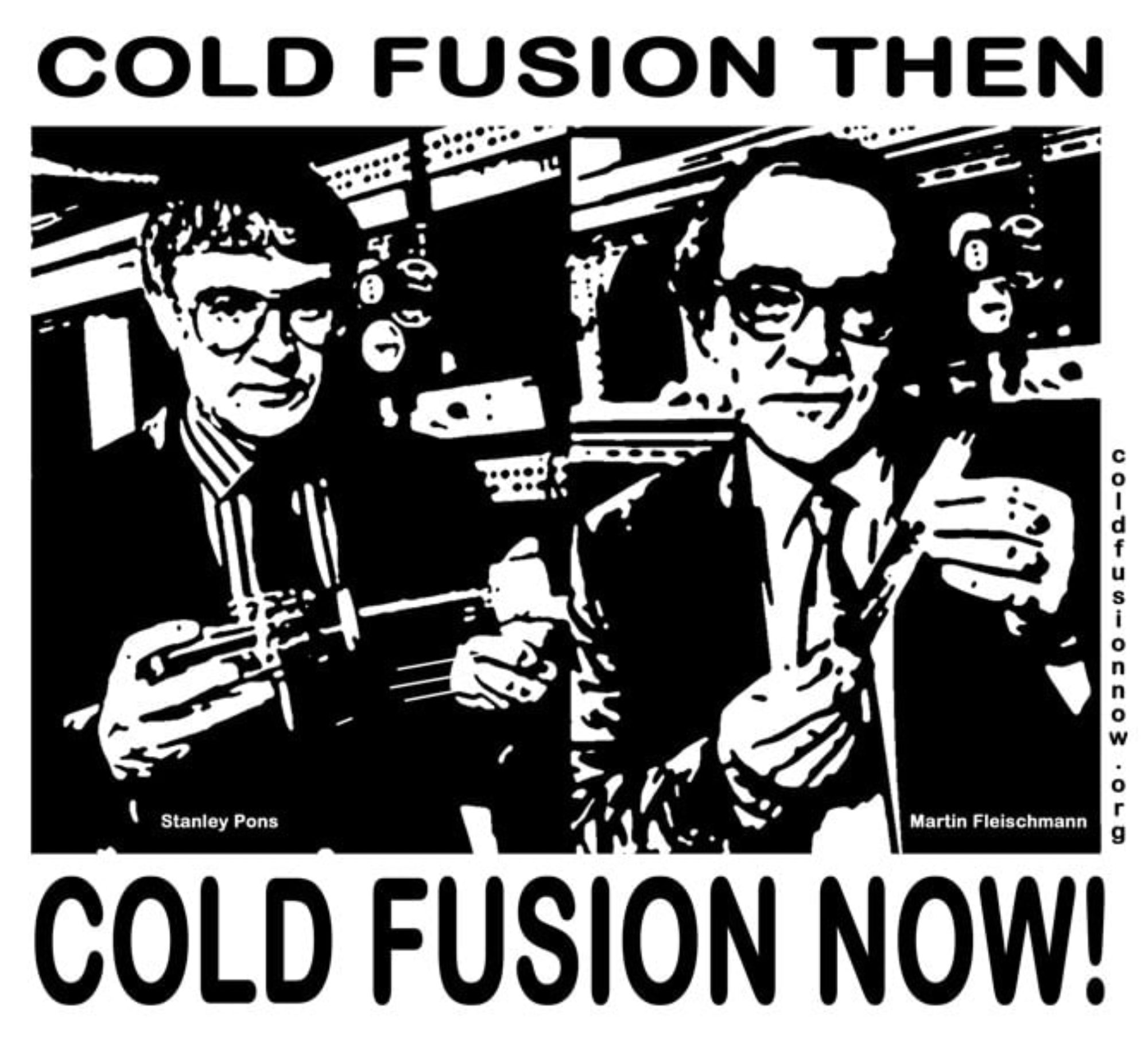
“The modern history of cold fusion begins with the premature announcement made in the United States by the two electrochemical Martin Fleischmann and Stanley Pons, who in 1989 convened a press conference…there were numerous attempts to replicate (their) result, but for some years had little success, so that soon the question of cold fusion was labeled by the media and mainstream science as a “hoax.”

Menichella continues, “The probably better experimental work…carried out in Siena since the early Nineties, by a group of physicists composed by Sergio Focardi (University of Bologna), Francesco Piantelli (University of Siena), Roberto Habel (University of Cagliari), but it did not lead to a system capable of generating useful amount of excess energy for normal industrial or domestic applications. In Siena, in fact, the three scientists – using hydrogen and nickel as the two only “ingredients” of the reaction, plus an appropriate amount of heat supplied to the system – managed to get out a double thermal energy than the electrical energy provided in input.”

You may be wondering why the ebook is called “Secrets of E-Cat.” As you can see, LENR (otherwise loosely known as “cold fusion”) is a proven scientific phenomena, but the excess energy from this exothermic reaction was not large enough for normal industrial or domestic applications. In comes Andrea Rossi, the e-cat fusion developer, an Italian inventor who has a Masters Degree in Engineering from Milan University.

To quote the article “ANDREA ROSSI BIOGRAPHY – STORY”
( http://ecatfusion.com/e-cat/andrea-rossi-biography-the-e-cat-fusor-story ):

“In 2007, Andrea Rossi arrived at the very critical point in his research and concentrated his time on his invention. He also hired Sergio Focardi, a physicist from the University of Bologna who is an acknowledged expert in field. The physicist’s work on nickel hydrogen reactions proved to be invaluable…In 2009, Mr. Rossi introduced to the public a process and a device called the E-Catalyst. This is a revolutionary process in energy production and is also called low energy nuclear reactions. It could be a breakthrough invention since it can solve some of the energy problems of our planet.”

I recommend watching the video contained in this article titled “Nobel laureate touts E-Cat cold fusion” (http://pesn.com/2011/06/23/9501856_Nobel_laureate_touts_E-Cat_cold_fusion/ ). Dr. Brian Josephson, winner of the 1973 Nobel Prize in Physics, stars in the video whose stated purpose is to wake up the media to the E-Cat story, which has not been widely reported on in the mainstream media of the English-speaking world.

By the way, here is a article titled “The New Breed of Energy Catalyzers: Ready for Commercialization?” ( http://www.cleantechblog.com/2011/08/the-new-breed-of-energy-catalyzers-ready-for-commercialization.html ), which contains a relatively current survey of all the companies that are trying to bring LENR to commercialization.

The subject of LENR, a clean, very very cheap, and super abundant energy technology, is too deep to comprehensively cover in this limited space. Using only nickel and hydrogen, both very abundant and cheap, in a LENR exothermic reaction, could be a source of almost unlimited energy for humanity, with a cost close to nothing, and no environmental pollution. Hopefully the limited evidence for LENR cited above will go part of the way toward convincing an open minded reader of the validity of this too good to be true energy technology.

“Total replacement of fossil fuels for everything but synthetic organic chemistry.” —Dr. Joseph M. Zawodny, NASA

Cold Fusion Now Exclusive Video with Andrea Rossi


Cold Fusion Now shot a 30-minute video interview with Andrea Rossi Friday March 2, while chatting with the inventor in his Miami Beach, Florida office.

The office was furnished with the standard office hardware, but complemented with a couch and dining table for comfort. There were books everywhere. Mr. Rossi is a serious reader, consuming all kinds of material from fiction to science. Knowing he has been a jazz drummer, and is currently without a set, we brought him a green ceramic doumbek to play when he needs it.

Our first question was about the source of the heat in the E-Cat.

“The source of the heat are the radiations that are emitted as an effect when hydrogen and nickel in the presence of catalyzers react. We have a precise idea about the effect and the source of it. And they wrote a theory, but I am waiting until the patents are granted to describe the theory because the theory is strictly connected with the technology. We learned the theory from the technology and learned the technology from the starting theory.”

“What I can say now is that I changed very much my ideas in these last two years. Two years ago I thought that the E-Cat worked upon an effect that has been described, but now I have changed ideas in good part, and I think we have discovered very well the source of the effect. I think we have understood very well why the E-Cat works.”

At the end of the interview he responds to a question about his factory stating “I will not tell you where is my factory – not even under torture!

“The fact is, all the times that I gave information about the name of a customer or the the name of a supplier, the poor guys have been submerged by tens of thousands of inopportune contacts. You can imagine under a safety point of view what the risk can be if we give in this moment the address where we are working. When it will be in operation, it will be impossible to make it hidden. But for now, we want to work in peace.”

Mr. Rossi continued,

“The robotized line is already under construction. The factory will be in the United States of America, the E-Cat will be a Made In The USA product, both in the industrial and the domestic version.”

“The day when we will start the production is also bound to the day when we will be certified.”

“I am sure that Underwriter Laboratories will modify something to make it safer, probably we will get requirements from them. So, we can not start a production before knowing what we have to produce and how we have to produce it, so we have to wait a little bit.”

“But we are already making the robots etc, we have started our software service to the robots to save money and, of course, we will have to make adjustments when we have the directions of the certificators.”

So, for all the people who need to know, when Mr. Rossi says “We are already manufacturing the line of production“, that means the factory is being stocked with the machines that will manufacture the E-Cats. In other words, no E-Cats are yet being manufactured yet, only the robotic lines are being installed, and the software programmed.

Cold Fusion Now is currently preparing to go back on the road, heading due West to the edge the North American continent. We apologize to readers for the lack of transcript, but that’s the way the tire rolls.

We thank Mr. Rossi for his time, DJ Le SPAM and SPAM Allstars for their music and support of new energy, and all the artists, musicians, and inventors who, in the face of hostility, continue to pursue their vision of a new arrangement for living in peace on planet Earth.

Cold Fusion Now!

Why ColdFusion/LENR has not been seized upon by private industry

The following is a further posting in a series of articles by David French, a patent attorney with 35 years experience, which will review patents of interest touching on the field of Cold Fusion.

In my last posting I started Part 1 of what was to be a two-part reference to the initiatives of Randall Mills  and Blacklight Power in respect of  producing energy through exploitation of a shrunken hydrogen atom, the “Hydrino”.   Part 2 will soon follow.  Meanwhile I wish to now address a consideration respecting what will be needed to make Cold Fusion a commercial success.

It’s been 23 years since Pons and Fleischmann made their initial announcements. Hundreds if not thousands of examples of unexplained excess heat have now been identified in the laboratories of heroic “cold fusion” researchers struggling around the world on very modest budgets. Yet industry has not picked-up the baton to join in the race. Why is this?

There are no doubt many reasons but this article addresses the issue of thermal efficiency. It is proposed that industry will not be interested in ColdFusion technology until energy gains well in advance of 3:1 are achieved. Something higher e.g., 6:1 or 8:1 is a minimum in order to activate commercial interest in the exploitation of the excess energy phenomena associated with condensed matter physics. It all starts with the Carnot cycle.

Nicolas Léonard Sadi Carnot (1 June 1796 — 24 August 1832) was a French military engineer who, in his 1824 book Reflections on the Motive Power of Fire, gave the first successful theoretical account of heat engines, now known as the Carnot cycle. He is often described as the “Father of thermodynamics”, being responsible for such concepts as Carnot efficiency, Carnot theorem, the Carnot heat engine, and others.

The Carnot theorem applies to engines converting thermal energy to work. This is to be contrasted with fuel cells and batteries which convert chemical energy into work. The theorem states that the maximum efficiency that any heat engine can obtain depends on the difference between two hot and cold temperature reservoirs that are its “source” and its “sink”.

The principles behind Carnot’s theorem are as follows:

• there is a maximum limit to the efficiency by which work that can be extracted from heat;

• only an engine operating on the Carnot cycle can achieve the maximum efficiency possible in extracting energy from heat in order to produce work

• only a perfect, reversible, heat engine operating between a heat source and a heat sink can equal the efficiency of a Carnot engine operating between the same reservoirs

• all irreversible heat engines operating between two heat reservoirs are less efficient than a Carnot engine operating between the same reservoirs.

Generally, for an engine to operate “reversibly”, it has to function very slowly and have not heat loss through “leakage”. Virtually all practical heat engines are of the irreversible kind.

The formula for this maximum efficiency is:

Efficiency = 1 – T(cold)/T(hot)

where T(cold) is the absolute temperature of the cold reservoir, T(hot) is the absolute temperature of the hot reservoir, and the Efficiency is the ratio of the energy-value of the work done by the engine to the heat drawn out of the hot reservoir.

Using the above formula to demonstrate an example, and recalling that 0°C is 273° Kelvin, the ideal Carnot efficiency of a heat engine operating between 273°C and a block of ice at 0°C is 50% i.e. 1- 273°K/546°C. This is ideal. This is perfection. Typical gasoline automobile engines operate down in the range of 20% thermal efficiency. Power generation stations achieve typical thermal efficiencies of around 33% for coal and oil-fired plants, and up to 50% for combined-cycle gas-fired plants.

Using the above figure of 33 1/3%, it takes 3 barrels of oil to make one barrel of electricity in terms of heat value. This is a shocking thought for national planners who see citizens using electricity for heating. Nevertheless, electricity is an amazingly convenient energy source that is delivered apparently effortlessly to the door of the consumer and is available at the turning of a switch. Only the cost of electricity limits its consumption as a source of heat.

Because electricity is such a special form of energy, ready to do work directly with 98% efficiency through electric motors, it can be used in some applications to recover a portion of the heat value used to create it. And if you do not demand too much, it can provide even more. Heat pumps are designed to extract heat from the environment and raise the temperature of the extracted heat to certain modest target levels.

If the object is to heat a room with 30°C hot water, then this heat can be pumped out of the ground from a depth of 30, 40 or more feet, where the temperature is generally a constant 10° to 15°C. Heat pumps are rated based on their “coefficient of performance” – COP.  Depending on the temperature spread between the heat source and the heat sink, the co-efficiency of performance for an electrically driven heat pump can be higher than 3:1, for example 4.5:1. Thus it is possible to recover some of the heat value used to generate electricity if the object is to provide only a moderate boost in the temperature of the heat being pumped.

If on the other hand, you aspire to re-create the furnace temperatures used when the oil or natural gas is combusted to create electricity in the first place, then a heat pump just won’t do the job.

Meanwhile, in the field of cold fusion, virtually all of the experimentation that has been going on has been using electricity as the source of heat to stimulate the low energy nuclear reaction, (if that’s what is occurring). On this basis, if the reaction does not produce a 300% output of heat for 100% input of electricity, then that technology has failed to achieve even a bare minimum recovery of the value that it has consumed. In addition, there are always system inefficiencies. That’s why a ColdFusion reactor is not really going to make sense until it has a gain, or coefficient of performance – COP, in excess of 6:1 and preferably 8:1 and more.

The original question posed was: Why has industry not picked-up the challenge to develop ColdFusion into a working industrial resource?  One reason is that a large number of experiments done around the world have not shown a COP of 6, 7 or 8. In fact, many of the scientific results have shown excess energy gains of 20%, 30%, etc. rather than the 600%, 700% or 800% that would make investors sit up and pay attention.

If an LENR reaction were to produce heat at the temperature of 500°C, or preferably 600-800°C and do so with a COP for the input electrical energy of even just 600%, then interest may suddenly arise. The Carnot efficiency, that is the ideal theoretical capacity to generate electricity from thermal energy for a source at a temperature of 850°C, relying on a cold-water sink at 27°C would be just under 67%.  Allowing for production losses, a thermal efficiency of 25-30% might be achievable for the production of electricity.

Electricity is like “White Gold”. It can be sold instantly. There is always a market for it. This removes one major uncertainty from the business case for investing in ColdFusion technology. You know that you will have something to sell that people will buy.

But this hasn’t happened. We still haven’t had a demonstration of the sustained production of high-grade heat for an extended period of time.

This is not to say that the production of steam, “wet” steam if it still contains water droplets and is only at a temperature of 100°C, is not valuable. It can be used for low temperature applications throughout our society. Heating homes is only just one application. Running air conditioners is another. Industry consumes a lot of hot water. And the desalination of water is a big application that will change the lives of hundreds of millions of human beings.

Let us hope that demonstrations at higher levels of COP will soon attract the interest of industry and provide the breakthrough that every fan of ColdFusion has been hoping for, for so long.
Top