A new online petition from Quinton Crawford believes that “Cold Fusion atomic energy (non-radioactive) has been ignored and pushed aside in discussions/ presentations about alternative energy for too long.”
In his Overiew, Quinton has a link to a video describing the Palladium-Deuterium system as it is excited by Superwave.
You can digitally sign his online petition that states:
“World leaders in nations/unions such as Japan, The United States of America, Russia, South Africa, The European Union, and so on have the ability and power to fully engage in the building mass energy production plants now. Solar, Wind, Wave, Geothermal, etc., are not the only alternative energy resources.” –Quinton CrawfordPetition
Perhaps, if you are inclined to sign the petition as I was, you could post your favorite new energy video link. (You can choose to Show your signature, or not.)
Thank you Quinton.
We expect that cold fusion technology will be released for public use at some point in future, but we’d like to see it as soon as possible, and with a free and open development and implementation. Politicians should not decide what we use for energy.
We decide what we will use for energy.
Sign Quinton Crawford’s Cold Fusion Energy Petition here and show support for the public campaign towards a cold fusion technology targeting politicians and “world leaders”.
According to the Congressional Research Service (using NEI data), there were 62,683 metric tons (138,192,360 lbs) of commercial nuclear spent fuel accumulated in the United States as of the end of 2009.
Of that total, 48,818 metric tons – or about 78 percent – were in pools.
13,856 metric tons – or about 22 percent – were stored in dry casks.
The total increases by 2,000 to 2,400 tons annually.
Before vacating the Cold Fusion Now HQ in beautiful Eureka, California and taking the show on the road, we squeezed in a visit to our local Pacific Gas & Electric Humboldt Bay Power Plant HBPP. A geologist friend of mine Bob MacPherson and I had made an appointment to see the Plant Manager Paul Roller to tour the facility.
Currently, providing 163 MW of power for Humboldt County, California from 10 brand new Wärtsilä natural gas engines, the HBPP is dismantling Units 1 and 2 of the original heavy fuel oil reactors from the late 50s which had then moved to natural gas in the 60s.
In addition, the facility is decommissioning a Unit 3 nuclear reactor built next to the old natural gas units, and underground 66 feet below sea level, in 1963 and which had been shut-down since 1976. (See HBPP timeline here.)
I wanted to see how the spent fuel assemblies were going to be stored on-site. Though the Unit 3 nuclear reactor had been closed for the past 35 years, the radioactive fuel rods had been stored at the plant in a pool of water 40 feet below the surface.
Spent fuel pools are steadily filling up in the US.
Most spent fuel in the US is stored in pools of water, but a geologically active region like the Pacific coast of the United States is challenged by both earthquakes and tsunami presenting added difficulty to safely storing this high-level radioactive waste, and this facility sits on the Cascadia Subduction Zone and Little King Salmon faults along the Ring of Fire.
In 1988, the HBPP was granted “site-specific permission” from the Nuclear Regulatory Commission to construct an Independent Spent Fuel Storage Installation (ISFSI), in what is called SAFSTOR. This meant that the plant operators could take the radioactive fuel assemblies out of the waterpools, and put them in more secure dry containers for interim storage. (See the NRC page on HBPP here.)
Mr. Roller is in charge of the decommissioning and first brought us up to his office to talk about the layout of the facility and how it changed over the decades. He mapped out what the power plant would look like after decommissioning. Then he showed us the method of SAFSTOR that they were implementing using models. It took about an hour as he was patient and careful about answering all of our questions.
Today’s conventional nuclear power poses a high contamination risk from mining the radioactive fuel through it’s eventual form of weapons or waste, and I was upfront about not wanting to invest scarce resources in any more of these types of power plants. However, I told him truthfully that I was glad to hear about their new design for storage of the fuel assemblies that could better prevent tragedy occurring on our coast, and I was grateful for his time and openness about the process.
Models of the inner and outer casks for storage of radioactive spent fuel assemblies. The stainless-steel inner cask on the right holds the fuel assemblies. The carbon-steel outer cask is on the left.
Mr. Roller described an inner cask made of 40 tons of stainless steel is big enough to take 80 used radioactive fuel assemblies – with the surrounding water. After setting down inside, the water is drained through a small hole near the bottom of the canister, and a 10,000 kilogram (22,000 pound) lid is robotically welded shut.
Again through the small hole, the container is evacuated and filled with helium gas. Then, the small hole is welded shut. The inner container is then put into a carbon steel canister with 54 bolts sealing the top and similarly filled with helium.
This is a model of the inner cask with its 10,000 kilogram lid welded shut.
The steel vaults stand 12 feet high and are partially buried so the top of the cask is at 44-feet elevation. This height accounts for a 40-foot tsunami wave hitting the low-elevation coastline. The nearby natural gas reactors stand at 12-feet elevation.
The casks are designed to maintain integrity and withstand 1.3 horizontal g-forces and 1.6 vertical g-forces. According to Mr. Roller, “At Fukushima, the vertical g’s recorded were 0.52. The only thing built to withstand these forces in Humboldt County are these storage facilities.”
After the Fukushima disaster, the HBPP issued a press release that was published in our local weekly, the Arcata Eye [1] outlining the strength of the facility:
“The Independent Spent Fuel Storage Installation (ISFSI) project was completed in 2008 and the facilities have been designed to withstand an 8.8 magnitude Cascadia subduction zone earth quake and a tsunami surge between 28 to 43 feet above sea level. The underground vault affords greater seismic stability, greater protection from tsunamis, reduced maintenance, enhanced aesthetics, and uses conductive cooling, making it completely passive, meaning that the facility is able to perform its job without requiring any actions to be taken by plant workers.”
We took a quick walk around the property. This is a view of the hill where the five vaults, which can hold a total 390 fuel assemblies, are located partially underground. Work is ongoing so it’s currently surrounded by those cement blocks and I took the photo through a chain link fence. Interestingly, being the highest elevation in the area, the nearby coastal town of King Salmon goes to this same hill during tsunami alerts.
Storage containers are being partially buried underground on the hill.
A rendering of the final landscaping shows the storage casks partially emerging from the top of the hill in the upper left. Just to the left you can see the edge of King Salmon.
The little spot on the top of the hill shows the top of the storage casks.
This site is only interim. There is no clear national policy in the US on long-term storage or recycling of toxic nuclear wastes. The 104 licensed commercial nuclear plants operating in the US are generally responsible for storing their own used fuel assemblies.
Because of another appointment, Mr. Roller wasn’t able to give us the full plant tour, but he showed us a few labs staffed by engineers who were also local residents and concerned about the safety of Humboldt Bay. I got the impression there was an excellent team running the facility.
Yes, that was some cold fusion materials in the Plant Managers office. Mr. Roller was very interested to learn of the recent developments in clean energy reactors and excited to receive some recent issues of Infinite-Energy magazine, as well as a copy of Nuclear Transmutation: The Reality of Cold Fusion by Dr. Tadahiko Mizuno.[4] Genuinely interested in hearing about cold fusion, Mr. Roller was bewildered at why, if this was so promising for clean energy, weren’t more people working on this, and indicated that he would investigate himself. I gave him a couple of complimentary Cold Fusion Now stickers to enjoy after his surely imminent conversion.
The Humboldt Bay Power Power plant generates 163 MW of electrical power using 10 natural gas reactors that can be dialed down below baseline to accommodate new power sources. I’ll be following up with Mr. Roller soon to see if he is ready to dial down a few Wärtsilä’s and purchase a some ultra-clean E-Cat modules as replacements.
How about making an appointment with your local power plant for a tour? Be friendly, and you’ll learn how your local power is generated. Have a conversation and communicate with those who maintain and operate your local power station and see the level of commitment the staff has.
Bring some information about LENR with you, and tell them where they can order an ultra-clean replacement for those rods.
But yo yo yo – the left coast here is Ruby’s sales territory!
Related links
Arcata Eye PG&E Statement On The Humboldt Bay Power Plant – March 21, 2011
Nuclear Energy Institute, Key Issues from an industry-funded association.
Nuclear Regulatory Commission HBPP public webpage here.
Pacific Gas & Electric’s Humboldt Bay Power Plant public webpage here.
Times-Standard Officials say Humboldt Bay Power Plant fears unwarranted March 26, 2011.
Tokyo Electric Power Company presented Integrity Inspection of Dry Storage Casks and Spent Fuels at Fukushima Daichi Nuclear Power Station 6-1_powerpoint November 16, 2010 at ISSF 2010.
After the biggest oil disaster in US history, there was one man who relentlessly barked at both US and BP spokestrons. He is by no means a perfect politician (who is?), but Congressional Representative Ed Markey gave some comfort to those of us who watched in horror as our ocean and wildlife was assaulted, again, by reckless drilling practices. He relentlessly pursued BP to release the video showing the leak gusher at the bottom of the sea, and was seemingly The Lone Ranger in Washington, DC as he pushed for accountability from one of the largest corporations in the world.
Recently, he was at the forefront of an effort to require gas companies to disclose the chemicals they use during the practice of “fracking”. This report reveals dangerous carcinogens that are being injected into aquifers that supply drinking water to millions. (See our recent post: “What the Frack is Going On?” and read the Hydraulic Fracturing Report)
He also led a panel looking a nuclear safety in the US after the tragedy in Japan, which is still ongoing, and is a trauma that our friends in that island nation will have years, if not decades, to work through. (See our recent post: Dangers of Nuclear Fission Plants..)
But this sometime maverick, outspoken more than most about energy and the environment, has never spoken of the solution staring us right in the face – cold fusion and LENR technologies. Surely he must know. So why not speak out on this issue?
We can only speculate. But as we have learned in the past year of our existence, all the answers are complicated.
In the last year, we have written many letters to our elected officials in the US urging them to lend their support to low-energy nuclear reactions research, and find funding to fast-track the development of ultra-clean nuclear power from hydrogen.
Since we began our energy advocacy in the wake of the BP oil catastrophe, which is still not over, despite the lack of media coverage (See Project Gulf Impact and BP Oilslick), we have assimilated so much information on this topic of clean nuclear power.
And as we have learned more, we wonder now at the worth of sending letters to politicians. Does it really make a difference? Deep water permits for oil drilling in the Gulf, temporarily suspended, have been continued, and there is no evidence at all that multi-national corporations such as BP have developed any tools capable of responding to a similar disaster, which makes it only a matter of time before another one occurs. As the largest consumer of fossil fuels, the US has done little to create a clean energy policy.
Is it be better to throw our efforts at wealthy private individuals, angels, and venture capital firms, and direct that money towards the blossoming number of private companies who might rather stay under the radar of meddling politicians? Perhaps US officials get involved, they will ruin the opportunities that exist today for young scientists and start-up companies to create a new world?
We are conflicted.
In any case, though our letter writing has diminished in recent months (due to the demands of daily classroom activities), we have not stopped the activism.
We have spoken with colleagues who work at colleges and universities, educating them about the recent advances in LENR, most of whom knew nothing about it. We have spoken to our students, and showed them the papers and videos of these emerging technologies.
I have personally done math problems in algebra class adapted from this science. Yes, that’s right, energy out/in ratios, mass-to-energy equations, and many more LENR topics that I can simplify to basic algebra. And students loved it.
Today, we send Representative Ed Markey a letter thanking him for his accomplishments in holding Big Fossil accountable and pursuing justice for the environment. We also sent Representative Henry Waxman and House Energy and Environment Committee Chairman a letter as well. Each letter asks for support for LENR research and includes a Cold Fusion Now sticker.
As we mailed these few letters today, not knowing if it is helpful, or possibly hurtful, we continue to keep talking, and keep typing. (See archived post: Jan Marwan: “Start talking.”) And if your so inclined, and you feel it helps, copy and paste portions of this letter in a message to send to your Representative.
Worldwide, we must hold our leaders accountable, demanding action when they do wrong, and rewarding them when they do right. The fragile life that exists on this planet deserves no less from us.
Cold Fusion Now!
April 20, 2011
Representative Ed Markey
2108 Rayburn House Office Building
Washington, DC 20515
202-225-2836
Dear Representative Markey,
Thank you for continuing the fight to hold oil and gas companies accountable for the environmental damage done by reckless drilling practices. Your work on the Energy and Environment Subcommittee, including the recent hearings exposing, again, the dangers of radiation contamination, ranks you as one of the most respected supporters for our natural environment, admired around the country.
Now I ask you to put your powerful voice towards a truly clean energy, low-energy nuclear reactions, also called cold fusion, a type of ultra-clean nuclear power generated by hydrogen. If you have dismissed this research in the past, please do not miss this opportunity to get ahead of this two-decades-old science, just about to emerge as a technology. Research and engineering has been limping along with virtually zero federal support, other than military, yet the successes are increasing. It may be as soon as the end of this year that we will see a working device, manufactured in Florida, to be installed in a factory – in Greece.
Already there are numerous small businesses involved in LENR-related research and development around the country, several in your own state, each employing a handful of people. These companies need funding to hire more young scientists and increase productivity. Private investment has been inhibited by the United States Patent Office’s refusal to accept patents relating to this technology, a practice that should be reversed immediately.
LENR technology will create a renaissance of new businesses, jobs for young scientists, and more importantly, a clean energy to build a future on. We should make every effort to explore all avenues of clean energy quickly as possible to mitigate the effects of declining fossil fuels and aging nuclear fission power plants.
This technology will emerge eventually, with or without federal support, but public support means public ownership. Please sir, consider hearings on the state of the science and technology with the goal of funding research and development in this truly sustainable area of green nuclear power.
Thank you, and best wishes for continued success in the area of clean energy and the environment.
Yours,
Your Name Here!
Letters and stickers also went to Rep. Waxman and Chairman Upton.
If you’re in their district, see if they sport em anywhere!
Cold Fusion Now represented at the Humboldt Math Festival in beautiful Humboldt County on the north coast of California this past Saturday April 9 at the area’s Bayshore Mall.
The Humboldt Math Festival is a gathering for the local county’s math instructors from the earliest grades through Humboldt State University. Teachers set up tables and activities for the kids in the community and expose them to different kinds of math and science fun.
I have been teaching part-time as a math instructor at a local community college for the past couple of years, and I have presented exhibits regularly for community events, mostly on the topic money – favorites such as Paper Money and Inflation and Ancient Coinage and Pythagoras, with the occasional space-science topic such as Sounds of Space.
Now, there is little more important than finding another arrangement for living on this planet. And cold fusion is the clean energy that will provide this. This year’s topic had to be nuclear. I decided to try an activity posted on the Lawrence Berkeley Lab site called activity on Marshmallow Nuclei.
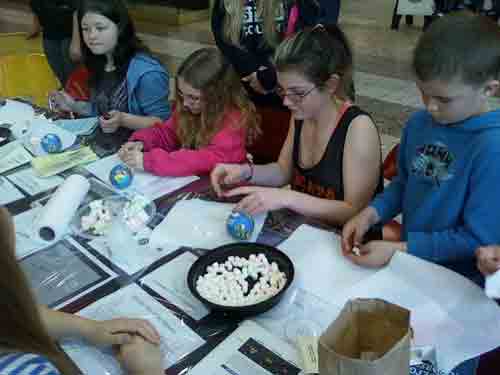
We had the kids make nuclei out of marshmallows. The protons were pink and the neutrons were white.
Kids making nuclei out of colored marshmallows.
We had emission spectra tubes and diffraction gratings to view the different elements. A Van der Graff generator demonstrated charge perfectly.
Student get charged over science.
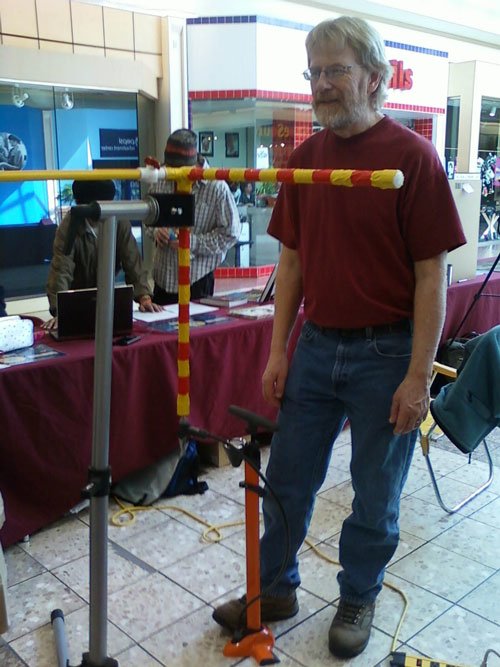
The kids could then shoot the nuclei with a Marshmallow Accelerator operated by math teacher Michael Butler. (That’s two fellows perusing the cold fusion materials in the background!)
Professor operates homemade accelerator.
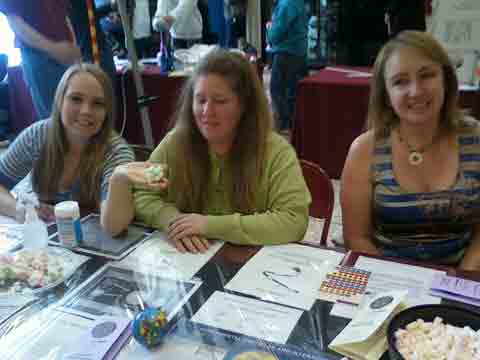
I had algebra students helping out – for extra credit! – and they did a great job.
Algebra students help out for extra credit.
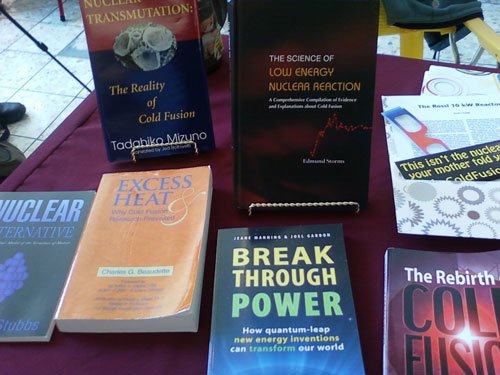
Of course we had a table of cold fusion info for the parents and older kids. This was our assortment of books to peruse.
Books on display at our table.
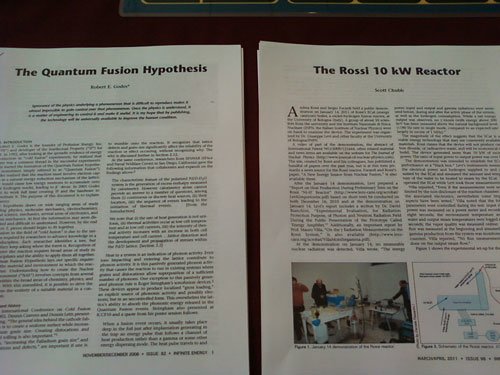
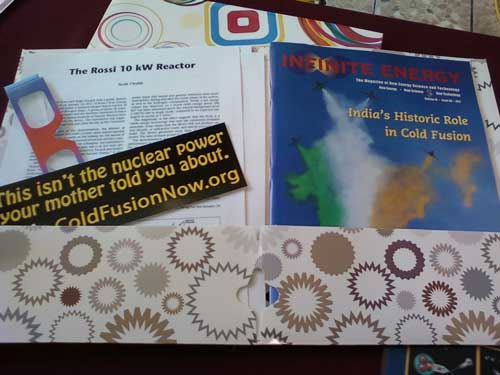
We gave out Scott Chubb‘s article reviewing Rossi’s demonstration which many people where happy to hear about. Copies of Robert E. Godes‘ Quantum Fusion Hypothesis went fast.
Free info on science and news were available.
And thanks to Infinite-Energy, we were able to giveaway a some Fire from Water videos, which are posted on their New Energy Foundation Youtube channel and you can watch for free, and a packet of info on energy and other fun stuff with a complimentary magazine.
Magazines were compliments of Infinite Energy.
We thank Infinite-Energy magazine for all your support, and best wishes in this time of transition. Your continued generosity has helped to educate alot of people today, as you have for years, with your rare publication.
I had a number of conversations about LENR technologies with passersby, and the response was overwhelmingly positive. One person said “Boy, I’d like to invest in this!” Many young people had never hear of cold fusion or LENR, and they were excited about the possibilities. I gave away all the info I had, and lots of stickers with the website on it.
All in all, the day was full of communication on an issue that has no parallel in importance. As our world unravels, and adults flounder, kids wake up every morning with an innocent hope, and today, though they don’t require it, we gave them a good reason for it.
Cold Fusion Now!
Related articles:
New Energy Outreach Success on 10/10/10 by Ruby Carat October 10, 2010
Letter to the Secretary of Energy by Ruby Carat October 14, 2010
Keep talking, keep typing by Ruby Carat July 22, 2010
Planet Forward is a consortium including PBS, National Geographic and George Washington University, set-up seemingly to create dialogue on innovative energy solutions.
They are planning a special PBS broadcast on innovative energy for this year’s Earth Day, and they want you to decide what innovative ideas should be featured..
From their website http://planetforward.org/vote-pbs/: On April 8, 2011 PBS will air a Planet Forward special…made by you. Our members have submitted their ideas about how we generate or use energy more efficiently, and YOU decide if they get on the show. Learn more about the special….
WHAT CAN YOU DO?
On October 26, Cold Fusion Now posted the CBS 60mins video clip on Cold Fusion: More than Junk Science as an innovative energy idea.
If you vote for this idea, cold fusion could be featured on the special broadcast to be aired for Earth Day 2011.
Follow this link and scroll down to October 26, 2010. (Fifth row of submissions down. You will see the greenish cold fusion cell bubbling.)
Click the thumbs up to add to the “Viability” of cold fusion energy. The more votes, the better.
Very few ideas even have votes – and it ain’t hard to beat zero.
Cold fusion is creeping from ground to figure, and nothing will stop that. But a little push, and low-energy nuclear reactions could be a feature of Earth Day 2011.
From Planet Forward: The days are counting down. Nominations close on February 4 and voting closes a week later on February 11.
In 1989, Dr. Stanley Pons and Dr. Martin Fleischmann, world-renowned in the field of electro-chemistry, announced their discovery: the creation of an enormous amount of heat, a nuclear-power sized heat, but generated from a small tabletop electrolytic cell using a piece of palladium metal in a glass of heavy water, a type of water made from sea-water.
Their claim was so great that, after describing the apparatus in a news conference on March 23, scientists of all stripes around the world rushed to reproduce the experiment. Unfortunately, they met with few successes.
In the Groks Science Show of May 2009, hosts Charles Lee and Frank Ling interviewed Dr. Michael McKubre, a researcher at SRI International, along with Dr. Irving Dardik of Energetics Technologies, on the then-current status cold fusion science, and Dr. McKubre described how difficult the initial “simple-sounding” experiment was to do, even as an experienced electro-chemist.
In fact, back in 1989, estimates for the initial reproducibility of the Pons/Fleischmann effect ranged between 5-10%. This means that about 90-95% of the scientists who attempted to re-create the Pons/Fleischmann experiment did not succeed. Nothing happened. No heat. No particles. Nothing.
It was this lack of reproducibility that contributed to the now unfounded belief many scientists hold, still to this day, that Drs. Pons and Fleischmann were mistaken in their measurements, and in the worst case, that their results were fraudulent.
But, the few percent who were able to successfully re-create the experiment, and witness the nuclear fusion-sized energy-effect in their little glass beakers, were hooked, for they knew what this discovery meant.
With a virtually limitless fuel of deuterium in the oceans of Earth to power an ultra-clean nuclear-sized energy source, for the entire planet, for tens of millions of years, and created in a small table-top device in your room, this technology would radically change the entire world. Civilization would finally move off of the chemical burning of hydrocarbons for the first time in history and all the associated problems that face our planet because of this oil-fueled civilization can be solved.
And so over the past 22 years, it is these few researchers who have continued to investigate the cold fusion effect, technically named low-energy nuclear reactions. And their ranks have grown, albeit slowly. Worldwide, there are dozens of labs conducting this research and their results, ignored and unpublished by the established scientific societies and agencies in the US, have grown as well.
But here at the end of 2010, cold fusion still has no theory to describe or predict the many effects. So what do scientists know? Here’s a few notions that are experimentally verified:
1. There is excess heat generated above and beyond a mere chemical reaction and on the order of a nuclear fusion reaction.
2. Particles such as Helium-3, helium-4 and tritium, which are normally associated with hot fusion, are detected, though in significantly smaller quantities.
3. The transmutation of elements is found to occur on the surface of the metal in what is called the nuclear active environment.
4. It is a many-bodied physics, not the one-to-one interaction that models hot fusion.
But perhaps the most exciting development in cold fusion research is that, at least for SRI and Energetics, the reproducibility rate has climbed to 73%! Meaning, when they set up the cells, and attempt to induce the cold fusion effect, they can make it happen 73% of the time.
So what’s happened? The last two decades of research point to two fundamental criteria.
First, for the reaction to occur, hydrogen isotopes (deuterium) must be loaded into the metal to at least 90%. This means, for instance, the palladium metal must be super-stuffed with deuterium atoms in an almost one-to-one ratio with the palladium atoms, causing the isotopes to crowd up tight together.
Secondly, these isotopes must then be induced to “move”. Dr. Irving Dardik’s Superwave stimulation, a fractal-type, nested wave, pattern-oscillation of electrical current, drives the deuterium atoms to move in particular patterns and this has been key to improving their reproducibility rate. “Directed in the proper pattern as input energy”, Superwaves act on the deuterium in a cohesive way.
Also, it must be acknowledged that the improved quality of the metal since 1989, needed to withstand the loading of deuterium and the flux of Superwaves, has been crucial to successfully implementing the experiment. The small piece of metal in which the reaction takes place must be designed and manufactured on the nanoscale and as nanotechnology continues to develop, materials science has been able to mange ever greater control over the design of metals.
Early experiments using any old chunky palladium could not be successful. Only the few random pieces of metal that happened to have a few spots with the proper conditions of a nuclear active environment were successful in re-creating the effect.
In that same interview conducted in 2009, Dr. Dardik boldly estimates that a reproducibility rate of 100% could be achieved within one year, although he admitted that a two to -three year time frame was more likely.
A year later, Energetics Technologies had moved into a new lab in the University of Missouri Business Incubator Park, and we look forward to their announcements.
Currently, researchers are operating under the hypotheses that loading a metal with deuterium and producing flux to move the atoms at high-rates will achieve a 100% success rate of reproducibility, and when that happens, a new technology will be ready to massage the planet, and humanity will be given a second chance at survival.
The stakes are so high.
In the words of Dr. Michael McKubre,
“I can’t think of anything more important for me to work on. If you have any talent, any ability, any ideas in this particular research area then I think you have a moral obligation to do it.“