There was a lone page of free address stickers to the Senators from California, US and a Humboldt County Representative to Congress that didn’t make it for that wildlife conservation campaign last year…sigh.
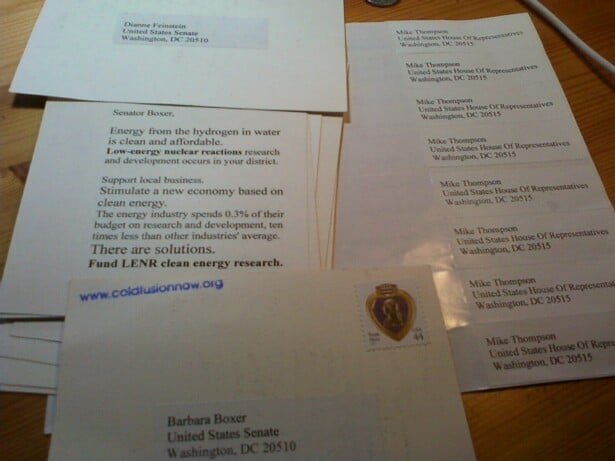
Not wanting them to go to waste, I printed up some postcards supporting LENR research, and dropped the sticker address on them.
Why send one letter with lots of signatures when you can send multiple post cards each with a signature – the number of them making a greater physical impact in the mailbag? (Reason: postage! Maximum size: 6 inches long by 4-1/4 inches high by .016 inch thick for US postage rate of $0.29.)
The Senators from California will receive multiple messages of support for LENR research with these postcards, each hand-signed by a different person.
After applying stamps, I say “super-dense clean-energy from the hydrogen in water”, and people are happy to sign.
Surely our Senators from California know of this research. Surely this was brought to their attention. Surely they know what type of energy research is occurring right in their own districts.
Whatever their state of knowledge, legislators, those holding government office need to hear from us. If our present energy brokers don’t do research and development, for clean energy or otherwise, then the federal government needs to address this.
Energy industry R&D is paltry compared to other industries.We need action on a viable alternative energy.
The energy industry spends 0.3% of sales on research and development, ten times less than the average for other industries.[1]
Energy from the hydrogen in water is clean, safe and affordable.
Low-energy nuclear reactions research occurs in your district!
Support independent business.
Stimulate a new economy based on clean energy.
There are solutions.
Fund LENR research now.
Getting out in the streets and collecting signatures is fun, and you give people the gift of feeling as though they are acting for something beyond themselves. Filling up a mailbag with physical messages for new energy research is a small step in turning that feeling into a habit.
From Dynamics and Bifurcations:Small changes in any parameter can completely alter the phase portrait.
Cold fusion deals with elements, isotopes and energy. In other words, it deals with matter and energy, which after all is also a form of matter by E=MC^2. Before thinking of the matter of things, we humans thought just about things. Looking at things, particularly how they are used differently or have different cultural meanings, it is not clear that there is a commonality between, say a rock, a knife, a banner, a pen and a table.
Ancient Greek philosophy allowed that to change and started us talking abstractly about the commonality of all things, which is what we would call matter. That has gone so far that what was once considered certain in antiquity (the human realm) and what was once uncertain (nature), has switched places. People find solace from the certainty of modern science, whereas particularly the spiritual realm (but also ethics and politics), is increasingly thought by many today as being without firm foundations. The demise of the spirit has been much exaggerated, but that is a different story.
One thing that philosophy and the Greeks had going for them is that Ancient Greek is an Indo-European language. Indo-European languages can treat existence as a thing (being), and therefore metaphysics comes naturally to them. Metaphysics, far from being a new age phenomenon, is what allows one to make generalized claims about existence.
Another thing about the ancient Greek language and how it shaped thinking, Greek has a definite article but no indefinite article. In English, the definite article is “the,” while the indefinite article is “a” or “an.” Therefore, in ancient Greek one does not talk about “a rock,” but merely about “rock.” This means that linguistically it was a natural transition for Greeks to talk about [a particular] rock, to talking about [the general nature of] rock. It is not just the brilliance of early philosophers that lead them to start the investigation of what eventually became labeled as matter; the actual structure of the Greek language shaped their discourse.
The examples above sound progressive because they seem to lead to modern science and to us. We like to think that we are the logical conclusion of what has happened in the past. This last example (below) seems backward to us, but I include it because it relates to philosophy and by its strangeness, it shows us how little we understand. Yes, when explained we can see the rationale behind it, but we probably never would have guessed it without being told. It is foreign to how we think of mathematics.
Here is one more example concerning the Greek language and how the Greeks thought. The Pythagoreans considered three to be the first number. One is for the unity of the universe; two is for duality of a pair. For a pair of things, one really does not need to count to acknowledge units in the pair. Three, however, is where we begin to count and therefore, for the Pythagoreans, is the first number.
No, to be honest, it does not quite make sense to me either. But such thinking has its roots in Greek language. In English we have singular and plural, duck and ducks, goose and geese. In Greek, however, there is singular, there is dual for pairs of things, and there is plural. A person does not get to counting until they get into the plural. Perhaps, for ancient Greeks, counting was what made a number a number. We should remember that they did not have negative numbers nor zero. For the Pythagoreans, one and two are not properly numbers, but are the “things” from which numbers are made.
It may have been necessary for the development of theories of matter that the ancient Greek language have certain characteristics, but the presence of such characteristics is not sufficient to explain the origin and direction of Greek philosophy. Language shapes our thinking, but our thinking also shapes our language. There is nothing inevitable about how things turn out. However, understanding a little about how languages work (or don’t work), helps us in imagining a different world than how things seem superficially. Imagining a different world helps us to change what needs to be changed, and to preserve what is already good.
In the wake of Saturday’s cold fusion conference in Viareggio, Italy, Roy Virgilio has released more details on the Piantelli group’s research on the Italian renewable energy forum EnergeticAmbiente. Virgilio is an administrator on the forum with the username eroyka. Akira Shirakawa has provided an English translation on the Vortex mailing list here and here. To summarize:
Experiments are being performed in a lab near Siena, Italy.
Older units worked continuously for months and produced 2× to 4× energy gain, but the actual energy balance was higher, as the cells reached self-sustaining mode.
Several unnamed third parties have confirmed that the older units worked in self-sustaining mode for long periods of time.
Several of these older units were recently reactivated. After some maintenance they turned on easily and produced 2× to 3× energy gain, but they haven’t yet been pushed to high excess energy levels.
New units with new fuel should be completed in about two months, and are expected to produce 200× energy gain.
The new units will be tested gradually in several steps of increasing power, beginning from a few hundred watts up to high levels of power on the order of kilowatts.
The scale-up will take as long as is necessary. Smaller devices will be ready for sale first.
No catalyst is necessary. The trick is in the preparation of the nickel.
Piantelli has a theory that doesn’t require exotic reactions, but can be explained using known physics and mathematics. A semi-complete theory has been provided to the University of Siena and will be published shortly. The complete theory will probably be disclosed after the first commercial units have been sold.
No Italian public institutions are involved in the current research, but a US government agency that has had the opportunity to review the research will probably validate and certify the reactor, as well as contribute to its development.
Piantelli’s group is also in talks with several large industrial corporations to develop generators operating at certain power levels.
The research is protected by three pending patents, the latest of which was filed last week.
Piantelli’s group will create a supporters’ trust. In two to four months the public will be able to buy shares in the trust to support the research, to prevent the technology from suddenly disappearing, and to share in any future revenues. Piantelli’s group doesn’t need money: the aim is protect the technology by putting it under the control of a multitude of stakeholders and enthusiasts, but there is no guarantee the shares will make a profit. [Emphasis added. —Ivy Matt]
Thanks, Akira!
The three patents mentioned above probably do not include Piantelli’s 1995 patent application. The Piantelli group filed an Italian patent application, “Method for Producing Energy and Apparatus Therefor”, on November 24, 2008, which was published on May 25, 2010. More recently, on April 26, 2011 they filed an Italian patent application, “Method and Apparatus for Generating Energy through Nuclear Reactions of Hydrogen Adsorbed by Orbital Capture to a Metal Crystalline Nanostructure”, which is due to be published on October 27, 2012. And then last week they filed a third patent application, the title of which is not yet known, and which should be published in January of 2013.
It looks like 2011 will be the year cold fusion attempts to make it on the commercial stage, and with at least two competitors. Piantelli’s group appears to be starting off at a disadvantage to Rossi and Defkalion, as Defkalion claims to have already achieved a 6× to 30× energy gain. (See Section 3: “Product Status” in the white paper.) However, Piantelli professes to have a comprehensive theory of the hydrogen-nickel reaction, which may speed up his group’s research. Cold fusion is not exactly suffering from a lack of explanatory hypotheses, but if Piantelli’s hypothesis fits well with the available evidence and, more importantly, if it makes predictions that can be tested experimentally, it will be worthy of the notice even of detractors of cold fusion research.
************************************************************ Related posts:
Viareggio Cold Fusion conference: science, politics, and an Italian competitor — Ivy Matt July 23, 2011
A conference titled “Has cold fusion become a reality?” was held at 4:00 PM July 23 at Villa Borbone in Viareggio, Italy. The conference was hosted by Italian solar energy company Delta Energie. Among the participants were Andrea Rossi via Skype; his research partner, retired University of Bologna physicist Sergio Focardi, via a pre-recorded presentation; Instituto Nazionale di Fisica Nucleare physicist and cold fusion researcher Francesco Celani; astrophysicist and futurologist Mario Menichella; renewable energy researcher and author Roy Virgilio; and author and blogger Daniele Passerini, who is also a long-time friend of University of Bologna physicist Giuseppe Levi.
Roy Virgilio is the author of a small Italian paperback book on cold fusion and an acquaintance of Francesco Piantelli, an early researcher in nickel-hydrogen reactions. Daniele Passerini has provided a summary of events on his blog and promises a video of the conference will appear online in a few days. Giorgio at Talk Polywell has provided an English translation of the more important news from the conference:
16.13 – Rossi is contacted on Skype, he confirms delivery of the 1MW plant according schedule. The first industrial plant will be delivered “patent pending”, hoping that this will push the European patent application.
Domestic reactors will have to wait a couple of years due to certifications.
16.57 – Focardi in his pre-recorded interview states again that he does not know the Nuclear process that brings an atom of nikel to capture a proton and transform it into Copper, but the chemical analysis prove that this is what happens.
17.03 – The temperature when the reaction starts is 60-70° C.
17.05 – Focardi states that many samples of reactors has been tested, including closed circuit reactors.
17.56 – Celani states that he is researching on nanoparticles deposited on thin and long strings of Pd, in Deuterium atmosphere.
He states he is getting 400/W/g at 500°C with good reproducibility.
He has worked also with Ni strings in Hydrogen atmosphere and he is getting an efficiency of 1800W/g at 900°C, but with difficulties in reproducibility.
18.26 – Roy Virgilio takes the word. He states that Piantelli research is going good. A new company (NickEnergia) has been formed 5 month ago and is already licensing his know how to other industries to produce reactors of different sizes. [The name of the company appears to be Nichenergy. —Ivy Matt]
18.35 – Piantelli is not willing to to make any type of publicity. He will arrive on the market with a commercial product and let the market decide if the technology is real or not.
18.37 – Piantelli is not using catalizers, just Nickel and Hydrogen.
18.39 – The first reactors that will be offered for sale will be on the range of the Kw. After they will scale up.
Another interesting tidbit from the conference.
19.10 – Among the public Milly Moratti takes the word and states that there are clearly now experimental evidences of Cold Fusion.
Now, for the one who do not know, Milli Moratti is the wife of Massimo Moratti, one of the richest man in Italy and owner of the Saras Petrol Refinery, The biggest in Italy and one of the biggest in Europe.
That’s a 5,3 Billion Euro Company.
She has money and the political knowledge.
Thanks, Giorgio!
That’s good news about the research and political interest, disappointing news about the timeline for the arrival of the domestic reactor.
Several other items of interest were brought up at the conference: Celani’s allegation that the public denigration of cold fusion research and the hiring of the best cold fusion researchers by US military and government labs likely stem from the same policy, the military interest in cold fusion research being the production of tritium for use in thermonuclear warheads; his naming of Japanese researcher Yoshiaki Arata as the “real father of cold fusion”, having studied deuterium in the gas phase (loaded into a metallic lattice or powder, presumably) since 1958; and Virgilio’s comment on Piantelli’s insistence that what occurs in the nickely-hydrogen reaction is not properly cold fusion, but rather some other type of low-energy nuclear reaction consisting of a complex sequence of events.
It seems clear now—if it wasn’t before—that the “Italian competitor” Andrea Rossi has mentioned several times on his website is Francesco Piantelli, with whom Sergio Focardi worked for many years. In his recent dust-up with physicist Julian Brown, Rossi said Brown had claimed that his competitor had a patent on the matter granted in 1995. Piantelli applied for a patent, “Energy Generation and Generator by Means of Anharmonic Stimulated Fusion”, in 1995, but the patent was never granted. However, whether the patent was granted or not, it could still be used as evidence for prior art in a claim against Rossi’s 2008 patent, which is probably the idea Brown was trying to convey to Rossi.
Earlier reports had claimed that Piantelli’s group had achieved 40 kW of thermal power and 7 kW of electrical power, but the recent report from Virgilio seems to point to a more modest claim. If the Piantelli device produces under 5 kW of thermal power, Nichenergy’s best option would seem to be to compete with Defkalion GT on price—and possibly time to market, if Nichenergy’s reactor is not also hampered by regulations on domestic use.
NOTE: this post has been updated to reflect what is apparently the actual name of Piantelli’s company, Nichenergy, based on updated information on Daniele Passerini’s blog.
Jake is one of the first round of newborn’s who enter a world where fossil fuels have peaked, and Cold Fusion technology is right now on the brink of potentially becoming a liveable reality.
Jake will be entering unprecedented territory. A world completely different than those around him grew up in.
Sometimes a photo can evoke some deep curiosity on what the future will hold for those just making their grand entrance.
The general scenario is likely to be a balancing act between Collapse and Cold Fusion. But which extreme will come first and how much of each will be unleashed in the meantime?
2011 is half over and while Collapse continues it’s path, the excitement over a Cold Fusion reality has been extraordinary. And the second half of this year looks to be twice as exciting.
Let’s take Jake into a Free Energy future and keep pushing, promoting and supporting this much needed technology. The technology that is going to be necessary for the safe, healthy and positive upbringing of newborns everywhere.
(Oh and by the way, Jake Fusion here was actually born on Andrea Rossi’s birthday).
The early days of the space race between cold war foes the United States and Soviet Union were set in a world of plenty for the victors of World War II.
After the centrally-planned, collective effort to retool industry for war, an attitude prevailed among American citizens that the most important new technologies would not result from work in the private sector, but would derive from federal initiatives.[1,177]
President Kennedy’s decision committing the nation to sending a man to the Moon before the decade was over was made in a milieu of broadening federal engagement with technology.
This is the thesis put forth by author T.A. Heppenheimer in his book Countdown: The History of Space Flight who noted federal involvement in new technology had been ongoing in the US since President Lincoln built the first transcontinental railroad in the United States “by awarding generous land grants to the builders of the Central Pacific and Union Pacific.” The Panama Canal, Depression-era dams and water projects, and later, President Eisenhower‘s interstate highway system of the mid-50s are all mentioned as historical precedents for federal support of new technologies that serve the public interest.
He mentions jet airliners and commercial nuclear power [the dirty radioactive kind] as technologies created by transforming “major military systems into products that would create new industries in the civilian market”. All of these projects “demonstrated dramatically the scale of activity that Washington was now prepared to pursue.”
Whether for the public good, or, prestige and technological superiority among nations of the world, the services and disservices of these industries are directly related to the systematic mobilization of diverse resources towards a common end.
President Kennedy To The Moon SpeechPeople in the mid-20th century saw government as “the formation from which new technologies would flow”, and generally trusted what their government said. If the push to appropriate taxpayer dollars in support of new technology was so apparent in the space program, the absence of sustained and coordinated federal involvement for a new, clean-energy technology is all too evident today. The fossil fuels that built the large public works projects of the last hundred years are depleted and manufacturing industries have been exiting North America for decades. In “the long, slow afternoon” [2] of American might, the consumption economy uses arcane financial instruments to glue together the remnants its petro-dollar past.
We march backwards into the future.
—Marshall McLuhanThe Medium is the Massage
The public and private collaborations that have generated and delivered energy for over a hundred years have done so at a high cost, environmentally, financially and socially. The patchwork scheme of multiple generations of technology that has provided power thus far, sputtering with age and neglect, is neither efficient or sustainable for our future.
Given the fundamental nature of energy in our lives, federal engagement in the development of clean, safe and efficient energy seems appropriate. But the national undertaking that characterized the Apollo project in the 1960s will not occur in the current climate of segregated interests. Even in a time of crisis, there is no call from the President to participate in a renaissance of invention, for either the public good or the prestige among nations, and there are no contracts forthcoming. Even were that to occur, our population has lost trust in a governing class that has forgotten the integrity of mission and succumbed to compromises with large donors.
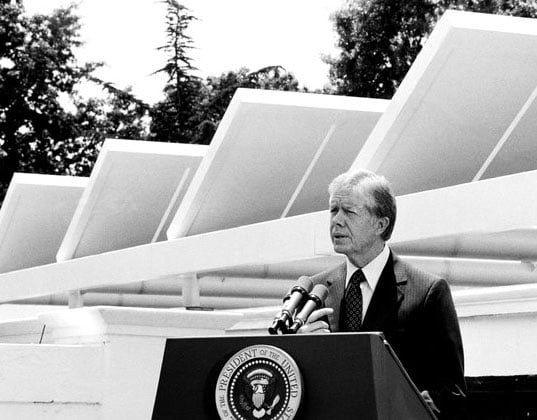
President Carter put solar panels on the Whitehouse in 1979.The last effort to redirect energy policy on a national scale was in 1979 when only the image of confidence in federal initiatives remained and President Carter put solar panels atop the Whitehouse in a symbolic gesture meant to redirect attention on renewable energy. They were subsequently eliminated by his successor President Reagan who moved the country back into an even deeper reliance on fossil fuels, and whose legacy we live with today.
The age of Chemical Energy ends with Peak Oil. We have a future with new-energy, or we will have no technological future at all. The inability of federal institutions to move quickly to develop LENR energy technology means private investment bears the burden. Though projects that posses technical risks are “unattractive to Wall Street”,[1] eventually, demand will insist upon it.
But the Rossi Effect, the heightened interest of venture capital in LENR devices since the demonstration of the E-Cat earlier this year, is certain to grow and recent news of one private company’s plans to work with a national lab on reproducing their results as a pre-requisite to funding is a positive sign of cooperation between public and private enterprise.
The ‘expert’ is the man who stays put.
—Marshall McLuhan and Quentin Fiore The Medium is the Massage
Lauded aeronautical engineer and designer of Spaceship 1 and 2, Burt Rutan headed his own spaceship company with a small band of dedicated individuals in the scrubby deserts of Mojave, California and succeeded in creating a new industry of space tourism with the private partnership of Paul Allen, the X-prize Foundation, and Sir Richard Branson. A critic of NASA’s budgetary choices, he saw the future of space in private enterprise.
“Manned space flight is not only for governments to do,” says Rutan. “We proved it can be done by a small company operating with limited resources and a few dozen dedicated employees. The next 25 years will be a wild ride; one that history will note was done for everyone’s benefit.”[3]
We say the same about cold fusion energy. Small, independent companies are right now sacrificing sweat and tears to follow a dream that takes humankind to the next phase of development for all the world’s benefit.
A new energy technology that uses a fuel of water can save the Earth from further degradation and reap rewards beyond our present imagination, but encouragement for these intrepid inventors is needed from the public, both morally and financially, to simulate the “federal involvement” that succeeded so well in landing humans on the Moon.
There are no passengers on Spaceship Earth. We are all crew.
—Marshall McLuhan [5]
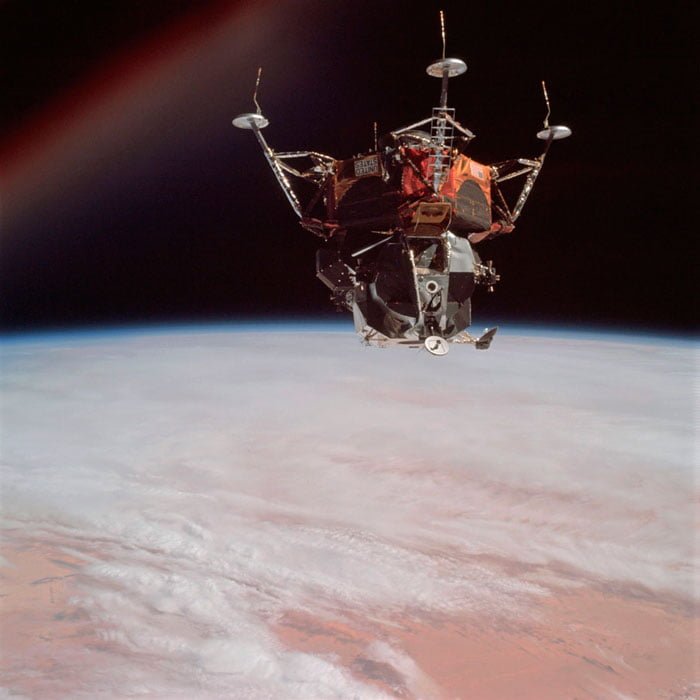
Apollo 9 tumbles above planet Earth.
Supporting Links:
[1] Countdown A History of Space Flight by T.A. Heppenheimer publisher’s Wiley website.
[2] John F. Kennedy “That is what we have to overcome, that psychological feeling in the world that the United States has reached maturity, that maybe our high noon has passed and that now we are going into the long slow afternoon.” 1960 campaign speech.