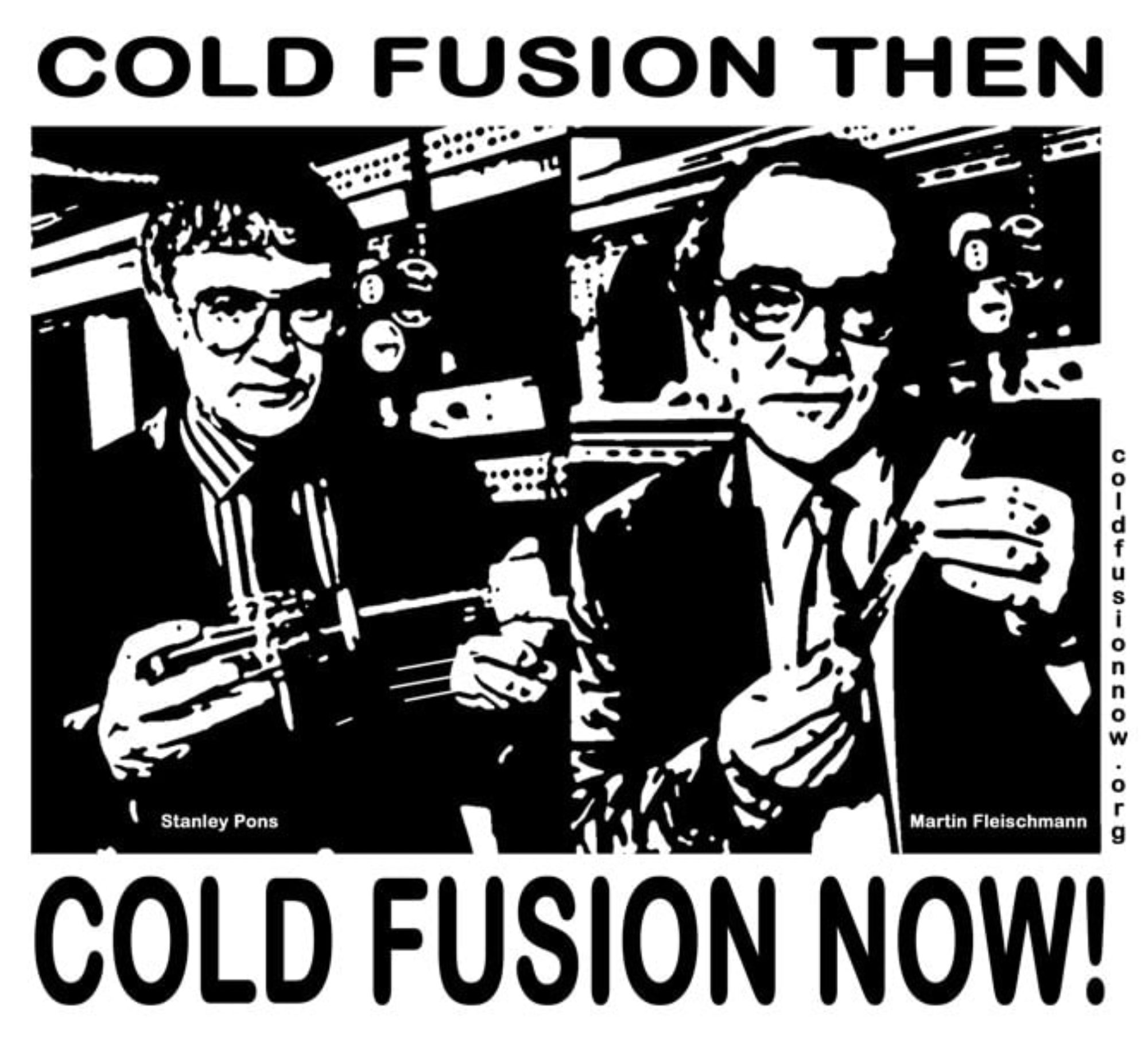
Remove institutional blocks at MIT and CalTech; fund cold fusion programs now

First published by Infinite Energy IE24 in 1999, the MIT and Cold Fusion Special Report [.pdf] by Eugene Mallove featured a detailed history of the Massachusetts Institute of Technology’s (MIT) investigation into the claims made of cold fusion technology. The brief episode of research was undertaken by the MIT Plasma Fusion Center (PFC) in 1989 while Mallove was the school’s News Office Chief Science Writer. Mallove’s report on the hot-fusion scientist’s findings is fully documented with an analysis that shows a discrepancy between the original lab data and the data published in their final evaluation.
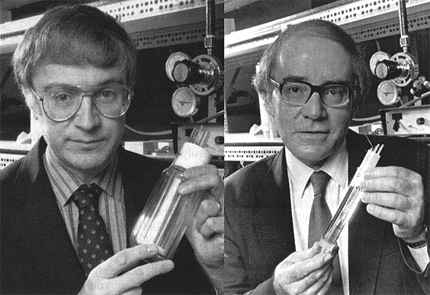
Drs. Pons and Fleischmann with cold fusion energy cells in 1989.
In that year 1989, two scientists Drs. Fleischmann and Pons working out of the University of Utah Salt Lake City Chemistry department announced the discovery of what was called cold fusion, a clean and powerful form of energy generated in a small test-tube of heavy water. The cell made excess heat, which means more heat comes out of the cell than goes in. And it was alot of heat, the kind of heat that could be developed into an energy-dense technology to provide clean, abundant power for the entire world. It was an astounding declaration.

Upon learning of this breakthrough discovery, scientists around the world dropped what they were doing and attempted to reproduce the Fleischmann-Pons Effect (FPE). Brilliant individuals and talented researchers from a variety of disciplines, including hot fusion and plasma scientists, threw electro-chemical cells together using materials on hand, and attached a battery.

Unfortunately, for all the groups that attempted the experiment, there was only about a 15% success rate.

Most of the attempts to reproduce the effect failed, and many of the researchers saw nothing out of the ordinary happen.

Within months after the announcement, two of the top science institutes in the United States, with the power to shape policy at the highest levels, had declared cold fusion a ridiculous hoax.

More than any other factor, it was the negative reports by MIT on the east coast, and CalTech on the west, that influenced the U.S. federal policy of excluding cold fusion from the energy portfolio.

Federal agencies cited the recommendations from MIT and CalTech as a basis for their policy.

PFC Director Ronald Parker and professor Dr. Richard Petrasso wrote the MIT final report, making the claim that the Utah scientists had “misinterpreted” their results.

Quoting Mallove’s account, scientists at MIT claimed that “tritium detection in cold fusion experiments at Los Alamos National Laboratory should be ignored because it had been done by ‘third-rate scientists'”. They were of course talking about Dr. Edmund Storms and Dr. Carol Talcott, specialists on tritium and metal-hydrides who were measuring “significant amounts of tritium” along with others teams at the national lab.

MIT and CalTech expert opinions were broadcast through the TV/satellite peak of power, just as the Internet was first emerging in the civilian sphere. The message was total. In a story to the press, Parker characterized the work of Fleischmann and Pons as “scientific schlock” and “possible fraud”.

Though he first denied saying anything of the kind, an audio tape made by the reporter confirmed his particular language. The same vocabulary was unleashed on May 1, 1989 at the Baltimore meeting of the American Physical Society with an emotional vehemence uncharacteristic of scientific objectivity.

While Director Parker was meeting with Boston Herald reporter Nick Tate, he took a phone call from NBC-TV news Science Reporter Robert Bazell during the interview. The press eventually ran the message that cold fusion was a big mistake. Since then, virtually no coverage of cold fusion breakthroughs have been broadcast, with the exception the 2009 CBS 60mins report Cold Fusion More Than Junk Science.

During the Herald interview, Parker also took a phone call from Richard Garwin, Chief Science Researcher at IBM Corporation and a member of the Energy Research Advisory Board tasked by then-Secretary of Energy James Watkins with determining the federal response to cold fusion. The ERAB ultimately decided there was no need to investigate the phenomenon further.

In the years that followed, then-President of MIT Charles M. Vest was also on a federal panel that advised President Bill Clinton’s administration to increase funding for hot fusion. The U.S. Department of Energy (DoE) has refused to even acknowledge the existence of cold fusion, resulting in no research funding for over twenty-years, including their $29 billion 2012 budget.

These reports were cited by the U.S. Patent and Trademark Office (USPTO) to justify diverting cold fusion patents out of the normal processing stream. Mallove stated that the MIT report effectively “killed the Pons and Fleischmann patent, which happened in the Fall of 1997”.

The meme created by MIT and CalTech in 1989 remains in scientific and political circles to this day: that cold fusion is a phenomenon imagined in the minds of lesser scientists.

Dr. Vesco Noninski was first to be curious about the MIT cold fusion experimental data. A subsequent analysis performed by MIT alumnus Dr. Mitchell Swartz, now of JET Energy, confirmed discrepancies between the original lab data and the reported data. The MIT reported data appears to be shifted downward, indicating that excess heat may have been measured, as represented by the higher-temperature lab data.

Swartz detailed his findings in three papers which can be found in the Proceedings of ICCF-4 prepared by the Electric Power Research Institute in 1993: “Re-Examination of a Key Cold Fusion Experiment: ‘Phase-II’ Calorimetry by the MIT Plasma Fusion Center“, “A Method to Improve Algorithms Used to Detect Steady State Excess Enthalpy” and “Some Lessons from Optical Examination of the PFC Phase-II Calorimetric Curves“. [download .pdf]

But the damage had been done. Administrators were not interested in re-visiting an already dismissed claim.

If it were not for that lucky 15%, we would not have known anything different, and prospects for a clean energy future would indeed be gloomy.

It is now known that for the types of palladium-deuterium electrolytic cells that they were experimenting with, significantly long times are needed to “load” the deuterium into the palladium. Weeks, or even months, could go by before excess heat would be produced. Turning on the cell in the morning, and expecting the effect to occur by dinner, was unreasonable.

In addition, scientists who were experts in their own field were not necessarily skilled in the complex art of electro-chemical cells. Measuring heat, a science in itself called calorimetry, is difficult for an experienced electro-chemist, let alone a novice. Experiments done by both MIT and CalTech were plagued with poor calorimetry.

Swartz’ examinations of MIT data twenty-years ago were recently appended when Melvin Miles and Peter Hagelstein re-visited the PFC’s experimental procedures of calorimetry. Miles and Hagelstein published their analysis in the Journal of Condensed Matter Nuclear Science Volume 8 2012 pages 132-138 [download .pdf]

Miles is a retired Professor and Navy researcher who is an expert in measuring heat. Hagelstein is MIT Professor of Electrical Engineering who has theorized on the nature of the cold fusion reaction. Hagelstein has collaborated with Mitchell Swartz over the years on several IAP short courses and public demonstrations of active cells on the MIT campus without the official support of MIT. The most recent cold fusion cell continues to produce excess heat for six months now.

The summary of the Miles and Hagelstein calorimetry analysis is reproduced here:

 
The 1989 report from MIT remains flawed with unjustified shifts of temperature plots and poor calorimetry procedures. Yet this report, along with the CalTech conclusions, established the baseline for all academic and federal policy over two decades.

Twenty-years ago, Dr. Charles McCutchen of the National Institute of Health (NIH) responding to Eugene Mallove’s request to examine the MIT PFC data, asked MIT President Vest:

For its own good, and to restore some civility to a contentious field, MIT should look into (1) how its scientists came to perform and publish such a poor experiment, (2) why they either misdescribed their results, making them seem more meaningful than they were or used a subtle correcting procedure without describing exactly what it was, (3) how it came about that data from calorimeters with a claimed sensitivity of 40 mw converged, between drafts, after completion of the experiments, to within perhaps 5 mw of the result that hot fusion people would prefer to see. It might have been chance, but it might not.” –Charles McCutchen NIH 1992

In light of the problems that characterized the Plasma Fusion Center’s experiments over those few months in 1989, and in light of the twenty-three years of research confirming without a doubt the existence of a form of energy that is dense, safe and ultra-clean, both MIT and CalTech have two choices: implement Dr. McCutchen’s recommendations, or, remove any long-standing institutional blocks that have kept research on cold fusion out of the most prestigious science schools in the U.S., and begin again by instituting a serious program to understand and develop what is now called condensed matter nuclear science (CMNS).

Both MIT and CalTech have refused donor money for cold fusion research. Most recently, an “MIT physicist” denied a group’s ability to fund Hagelstein’s research by actually returning the dollars. Meanwhile, the University of Missouri increases its support for new-energy company Energetics Technologies with private donations over $5 million. For elite science schools like MIT and CalTech to ignore the reality of cold fusion is not only a threat to the integrity of our institutions of science, but a threat to our planet.

There is alot of catching up to do in order to develop the myriad of technologies that will allow humankind a second chance at living a technological future, in peace, on a green planet Earth, and we need our most talented and creative minds to do it.

New-Energy Program begins tomorrow!

Opening party starts at 4PM.
Related Links

How Nature refused to re-examine the 1989 CalTech experiment by Jed Rothwell [.pdf]

JET Energy NANOR device at MIT continues to operate months later by Ruby Carat May 22, 2012

1994 BBC doc profiles early history of cold fusion underground by Ruby Carat June 7, 2012

International Society of Condensed Matter Nuclear Science Publications

Health care and cold fusion

I would like to pose a question. Will the implementation of Obamacare have a positive effect for the development of cold fusion, a negative effect, or a negligible effect?

I have been reading the Daedalus issue on ‘the alternative energy future, vol 1,’ (no mention of cold fusion so far:-(   ), and one thing that it goes into is that we do not pay the true cost of an fossil fuels economy.  It divides costs into two categories, private costs and external costs.  Private costs are the costs to fill up the car, or to heat or, especially now, air condition our homes.  External costs are the costs to the standard of living and to the economy primarily from pollution, or other ecological effects (I would include bat kills from windmills).  The intermittent nature of wind and solar also is effectively an external cost, making those options less economical.

True costs are basically private (or overt) costs plus external (or implicit) costs.  The Daedalus issue says that in order for alternative energy to be more competitive, we need to assess the costs more fairly.  That is the case for renewables, and it is also the case for cold fusion.  Cold fusion is further away than renewables, but a better understanding of the costs of a fossil fuel economy but also of renewables, will make a better case for cold fusion.  Pollution is a cost, but so far its effects have been externalized, charged to individual suffering from ailments instead of being included in the calculation.

If the government takes an active hand in healthcare, then all of a sudden the external costs from pollution suddenly become a great concern.  Health care costs are growing, but one way a government can limit its expenditures in this area is by tackling sources of pollution.  This is, from my limited understanding, some of the thinking over in Europe.  Pollution becomes very much a public concern through healthcare.  Healthcare could add a whole new dynamic to the energy equation, making expenses reflect true costs.

But I am not sure whether that will be how Obamacare will work.  Will there be that kind of overt need for the government to limit costs, or does the individual mandate obscure the issue.  Will that dynamic occur, or for that dynamic is a single payer system necessary?  Therefore, I ask myself will Obamacare have a positive, a negative or a negligible effect on cold fusion?

But the reason why I bring it up, is to show how something as different as healthcare might cause a domino to fall, starting a chain reaction which will lead to greater attention to cold fusion.  Ultimately, everything in the world is related, its just a matter of how we can best make the connections.

Jf

Greetings from the Groundlings

To the participants of the 17th International Conference on Cold
Fusion: http://www.iccf17.org/program.php

by Kelley Trezise a.k.a. Zedshort

From the “Groundling-believers of the Blog-O-Sphere”, we the unvetted, the unmarked many (or possibly few as we too are uncertain as to our numbers) devoted to the events and rumors of the day concerning, LENR, LANR, cold-fusion or what name you may apply to the phenomena, send you salutations. Your scientific endeavors are close to our hearts in that we too hope you may, some day soon, bear forth the truth concerning the evolution of Anomalous Energy Generation.

Fear not. We, the groundlings, the uninvited, are not here to storm your stage and disrupt the proceedings, nor to make demands for more and better evidence; nor are we here to engage in a loud, rancorous battle of the believers-vs.-skeptics here, before your alarmed eyes. We are, in fact, not even here.

We, the groundling-believers are simultaneously nowhere and everywhere as we fill the ether of the net. Our communications, though they may capture the attention for a time as brief as that of the life of a mayfly some interested few of our fellow groundlings, we too are in a sense here among you, and we are hopeful to hear the good news.

We, the believers, the groundlings, hope that someday soon you will reveal the facts, the whole facts and nothing but the facts and so to end for us this interminably long and tortuous suspension of our judgment as to the reality of the phenomena. We implore you: give us evidence and give us peace.

We, the believers, ultimately hope from you affirmative results, and penultimately the production of some device capable of producing the clean, abundant energy that might lift us, the mere groundlings, to greater and greener abundances.

We, the believers, the groundlings, lift our faces upward, however tremulously and briefly, into the face of a hope for a brighter future for all.

And though we are mere groundlings, we wish you the best and success in your scientific endeavors be they positive or null.

Frank Znidarsic on fossil fuels and next-generation energy: “As one door closes, another opens”

Photo: Frank Znidarsic at George Miley’s lab.

His grandfather was a farmer who immigrated to America claiming to be a coal miner, but grandpa knew nothing about coal. He did know that the growing nation needed miners to extract the newly discovered cache of carbonaceous fuel, so he did what he had to, and settled in Pennsylvania coal country. His grandson Frank Znidarsic still lives there, working in the Pennsylvania energy industry, a third-generation coal miner whose own father left this world with a bad case of black lung.

When Znidarsic writes about coal mining, and the environmental damage it causes, he does so authoritatively. Now an engineer and author, Znidarsic was the first in his family to go to college, but he labored deep underground in the mines before landing a series of jobs above-ground in the power plants that burn fossil-fuels. The second edition of his book Elementary Anti-Gravity II is almost mistitled, for the first half of the book is a condensed survey of the major sources of energy in use today from the perspective of a miner and engineer who has worked directly in the field.

The world’s current power source is met just about wholly by burning fossil-fuels like coal, natural gas, and oil. Describing each of these fuels by its method of extraction and the processing needed for commercialization, he also shows how these techniques are leaving an ecological disaster for generations to come, though he seems willing to lose the battle in order to win the war. In weighing the consequences of extracting natural gas with the ecological damage it causes, Znidarsic supports the use of natural gas over coal.

Frank Znidarsic monitors smokestack emissions in 2011.
If you are interested in what kinds of pollution are emitted by coal-fired power plants, and the complex solutions attempting to make the emissions cleaner, this book gives a concise summary of the current methods applied to this problem. He describes how costly clean coal technologies are not quite the bargain they are advertised as.

Not limited to fossil-fuels, Znidarsic also describes a brief history of nuclear accidents, including the Fukushima-Daichi Reactor #4 explosion. Referencing M. King Hubbert‘s landmark June 1956 thesis of Peak Oil in which he predicted that nuclear power would provide Earth with a technological future, Znidarsic states that cold fusion will supplant any near-future hot-fusion technology, quoting as support Jed Rothwell‘s observation that “the introduction of a new technology often follows major advances within an existing technology”.

Frank Znidarsic and Yuri Potapov at Los Alamos
Marshall McLuhan describes this as technological reversal, when one technology “flips” into another through speed-up, the way a series of photographs, brought together in rapid succession form a movie.

William Draper Harkins gives personification to this idea. Born in Titusville, Pennsylvania where the American Oil Age began, he suggested that we might get our energy by the fusion of four hydrogen atoms to make a helium atom, using Albert Einstein‘s mass-to-energy equivalence.

The second half of Elementary Anti-Gravity II is a modern science lesson, including the associated math to derive the quantum condition for cold fusion to occur. Students of physics will enjoy his algebraic derivations and the unique perspective on quantum mechanics and relativity, as well as the answer to how anti-gravity fits in.

Frank Znidarsic graduated from the University of Pittsburgh with a B.S. in Electrical Engineering in 1975. He is currently a Registered Professional Engineer in the state of Pennsylvania. In the 1980’s, he went on to obtain an A.S in Business Administration at St. Francis College. He studied physics at the University of Indiana in the 1990’s. Frank has been employed as an Engineer in the steel, mining, and utility industries. Frank has been investigating new sources of energy for twenty years. His papers have been published in numerous places including Infinite Energy Magazine and the Journal of New Energy. His work was documented in a series of videos by Seattle4Truth which you can view here.

Q&A with Frank Znidarsic

CFN You have been working in the fossil-fuel industry for years. What is your current position and what kinds of things do you do in your job today?

FZ Today I am retired, however, I am looking for commissioning contracts at power plants.

CFN Can you describe how energy returns from fossil fuels have decreased over the last century?

FZ Yes, the returns on energy were larger when the environmental costs were not considered. We use so much energy today that the environmental costs are paramount. We cannot go back to the old way of doing things, and clean energy is expensive.

CFN Talk a little about the environmental damages caused by mining practices. Is it possible to clean up the damage, and restore habitat to wildlife?

FZ Yes, strip mines can be reclaimed and water can be treated. However, I don’t believe that it is possible to restore lost streams and wells, or to stop the flow of acid water from abandoned mines. And no one really knows what all of the carbon that was released into the atmosphere will eventually do.

CFN Fracking pollutes water tables to the degree that some water supplies are combustible, and can be lit on fire right out of the tap. Wildlife has died as a result of poisonous chemicals that the industry has been allowed to keep secret. Yet it’s true that natural gas burns cleaner than coal or oil. Do you really think the benefits of natural gas outweigh the damages?

FZ Yes. Gas produces half the amount of carbon dioxide per kilowatt and the majority of the deep gas wells have caused no problems at all. I am hoping that the new wells remain in production for a long time.

CFN You’ve stated that carbon-capturing systems for coal-fired power plants can use as much as 25% of the power generated by that coal. What do you see is the future of clean coal?

FZ The price of natural gas has been unstable. Unstable prices upset the investment markets. The price of coal has been stable. On this basis, the use of coal must be continued. I don’t know if our economy can sustain the costs associated with carbon capture. I am not sure that the Earth can sustain its environment without it.

CFN Can you describe your idea of cold fusion in layman’s terms? How does this relate to anti-gravity?

FZ Yes, just as soft iron increases the strength of the electromagnetic field, the active areas in a cold fusion cell appear to increase the magnetic component of the strong nuclear force. This force is known as the nuclear spin orbit force. This increased spin orbit component tends to flip nucleons and induce Beta decays. Remarkably the same condition seems to increase the intensity of the gravitomagnetic field. I have found that this condition is fundamental to the quantum jump. I am anxiously awaiting comments on my Amazon book page.

CFN How sure are you that cold fusion will be able to provide power to the planet for a technological human future? What time-frame are we looking at, years or decades?

FZ It hard to say when could fusion technology may emerge. I have been waiting since 1989. In comparison, the production of deep natural gas arrived quickly and surprised many in the energy industry.

As with any revolutionary technology, the result rides on the shoulders of the prior work of others. The technology has now reached a point were experiment, theory, and finance are coming together. I am hoping that Dr. George Miley or Andrea Rossi will surprise us soon with commercial units. I expect commercial cold fusion products within five years.

CFN Thank-you!

FZ My pleasure.

Related Links

Youth keeping the new energy movement alive with constant creations investigating non-conventional science by Ruby Carat October 29, 2010

More on USPTO reluctance to patent Cold Fusion

The following is a further posting in a series of articles by David French, a patent attorney with 35 years experience, which will review patents of interest touching on the field of Cold Fusion.

On the eternal issue of concern for Cold Fusion fans: Why the US Patent Office is reluctant to issue patents in this area, I have been referred a link to the following article: Cold Fusion & Patent Office. This article by Hal Fox, President, Fusion Information Center is dated August 8, 1999 and reports on an investigation being carried out by Special Agent Kimberlee Taylor of the Office of the Inspector General, Commerce Department. Apparently this lady was assigned to investigate complaints that the Patent Office was rejecting patent applications for Cold Fusion, or low-energy nuclear reactions, as a matter of general policy.

The article identifies believed sources of resistance to this new technology and ends with a plea for readers to: “WRITE THE MEMBER OF CONGRESS FROM YOUR DISTRICT AND BOTH SENATORS FROM YOUR STATE” and copy Ms Taylor.

It is apparent from a short reading that this reference is from somebody who is greatly in favor of, and believes in, Cold Fusion technology. No matter how sincere that belief was in 1989, we are now 23 years later and still have not seen a solidly recognized commercial demonstration of a working Cold Fusion apparatus. This is actually a consideration in addressing the policies and behavior of the United States Patent Office.

Before leaving this document it is apparent that it was written by someone who has a prejudice in favor of the granting of patents. The following statement made in the document is a telling indication:

“The big issue is the denial to U.S. inventors of their constitutional rights to the protection of their inventions!”

There is no “constitutional right” for inventors to obtain protection for their inventions. The U.S. Constitution grants powers to the Federal Government to create exclusive rights under the terms and conditions that the Federal Government chooses to impose. Article 1, Section 8(8) of the U.S. Constitution states:

“The Congress shall have power…To promote the progress of science and useful arts, by securing for limited times to authors and inventors the exclusive right to their respective writings and discoveries;”

The Constitution does not create a right to obtain a patent. The Constitution creates a power in the Federal Government to grant patents on such terms as the Federal Government sees fit.

Quite rationally, the Federal Government does not want to be issuing patents for things that do not work. The problem is that persons can file for patents and if the patent is granted, members of the public may assume that this is an endorsement that the invention works. This is far from the truth.

In the case of most patents, the Examiner does not question whether the invention will work. The Examiner does not question whether the claims made in the application as to the usefulness of the invention under various conditions are all true. An applicant may file for a glue that it alleges will hold a car attached to a cable 10 feet above the ground. Perhaps the statement is true if the car is some micro-vehicle. But it might not be true if the car is standard weight. The Examiner never gets into arguing with the applicant whether these kinds of statements are true.

In all cases, the Examiner is concerned whether the exclusive rights that the applicant is requesting will interfere with anything that was previously available to the public. This is the Golden Rule of patent law. A patent may not issue for anything that was previously “available to the public”. This phrase includes not only everything that was disclosed or done before, but also includes obvious variants on all such things. Obvious variants are in the class of things previously “available to the public”. Collectively, this summarizes the famous novelty standard of patent law.

While Examiner’s focus on this novelty issue in reviewing every patent application, only in a few cases do Examiner’s undertake to question whether the statements of usefulness made in a patent application are true. In the case of perpetual motion machines, applicants are asked to file proof that their invention works. Filing a working model would be totally acceptable. This class of invention is so clearly impossible that it would be an embarrassment to the Patent Office to issue a patent for such technology.

Patents addressing Cold Fusion issues are a little different, but are treated in the same way as patents applications that purport to deliver a perpetual motion benefit. The Examiner does not refuse the application. He says to the applicant: “Prove it”; and then gives the applicant an opportunity to file papers by way of proof.

The above referenced article mentions 35 pounds of paper filed by Dr Mitchell Swartz in order to support his application to obtain a patent in the Cold Fusion field. Both the Examiner handing the Swartz filing and the Board of Appeals in the US Patent Office did not think that these 35 pounds of paper proved that the arrangement presented by Mitchell Swartz worked in accordance with his representations. Therefore they refused to grant him a patent. Perhaps they were wrong, but it would take a major effort to sort it out.

Mitchell filed an appeal to the Court of Appeal for the Federal Circuit. It is not the job of this Court to review 35 pounds of paper and they said as much in dismissing this appeal. They only look to see whether the Board of Appeals at the US Patent Office made a mistake in principle or were outrageously irresponsible. They ruled that Mitchell Swartz had not shown them that his situation fell into any of these two categories. Therefore they rejected his appeal to the Court.

This scenario has occurred repeatedly before the US Patent Office. Applicants can say almost anything they want in a patent application, but they have to accept the consequences. The claims have to pass the novelty test. And in respect of certain classes of invention, the Patent Office insists that evidence be filed demonstrating that the application passes the utility test and the sufficiency of disclosure test. The latter test requires that the patent application tell others how to achieve the benefits of the invention.

Try and see this situation from the viewpoint of the US Patent Office. Up until 1836, patents were granted without any review whatsoever, whether they were new or not. They could be canceled before a Court if they were not new. But people would actually go to the Patent Office, copy an existing invention, file for a patent on that same invention and obtain a certificate signed by the President of the United States stating that they had obtained a patent. They would then go out and pressure manufacturers who apparently infringed the claims of these patents, demanding licenses on the threat of forcing such companies into litigation. This was very oppressive. This is the reason why in 1836 the United States Patent Office was established with a mandate to carry-out an examination procedure.

Here is the danger. Today, if a company were to obtain a patent purporting to cover a Cold Fusion technology, i.e. a patent representing that its special procedures could produce unlimited amounts of energy, electricity, etc., through a low-temperature fusion effect, then many investors would buy shares in the belief that the issuance of a patent was evidence that the technology was true. In a sense, the US Patent Office might be in a situation where they are facilitating a fraud. In the case of Cold Fusion technology, as well as perpetual motion machines, the USPTO has drawn a line. If you wish to address these types of technologies, then they say that you have to prove that your invention works.

Is that so unreasonable?

David French is a retired patent attorney and the principal and CEO of Second Counsel Services. Second Counsel provides guidance for companies that wish to improve their management of Intellectual Property. For more information visit: www.SecondCounsel.com.

David French is prepared to address questions included as commentaries to any of his postings or bydirect email. In particular, he would like to learn what people need to know in order to better understand patents.

1994 Martin Fleischmann and Stanley Pons interviewed on Good Morning America – from France!

The May 31, 1994 “Good Morning America” program included an exclusive interview with Dr. Martin Fleischmann and Dr. Stanley Pons, from their lab in France. The pair left the United States due to a targeted assault from the American science community that left them unable to continue their work on a revolutionary new fusion-sized energy generated tiny test-tube.

“The whole system is guided against innovative science. It is only guided to making a better product, not to look at new things, and you are damned for looking at new things”, says Stanley Pons.

“The public in America, in the system, has to devise a more effective way to do innovative science and technology”, added Martin Fleischmann. “If it doesn’t do that, then America will really slide down the scale.”

Science editor Michael Guillen presented a positive spin on the status of cold fusion, including interviews with Dr. Eugene Mallove and Dr. Eichii Yamaguchi.

Guillen did repeat the oft-quoted failure of the Massachusetts Institute of Technology’s (MIT) cold fusion experiment designed to reproduce the Fleischmann-Pons Effect of excess heat. A subsequent analysis by Mitchell Swartz showed that the published data was “shifted down” from the original, casting doubt on the lab’s negative conclusion and revealing the strong possibility that MIT did in fact measure excess heat.

How will mainstream science, which holds a powerful sway in academia and government, respond when the first products are available to the public? How will we transition when we’re twenty years behind? Two heroes for tomorrow’s children convey a message from the past, about innovation and the future, that we can act upon today.

“It has the potential of really revolutionizing things”, says Guillen. “I think these folks just need a fair hearing and the two or three years they were given in this country is not hearing enough.”

Cold Fusion Now!

Thanks to the New Energy Foundation for posting this historic video.

Top