Cold Fusion Now UPdate

Cold Fusion Now website may be in and out of visibility as we work on changes to the program files and server. We also will be changing web hosting services to a more affordable and responsive company.

We continue to evolve and prepare for the next wave of interest that, in our opinion, will be even bigger than the Rossi Wave, the huge influx of people brought to new energy awareness by Andrea Rossi‘s public demonstrations of the E-Cat.

Economic failures, ecological collapse and the end of the oil age are converging in one big clusterfuck, and there is nowhere else to run.

Marshall McLuhan, one of the great thinkers of the twentieth century, taught that as much as we shape our tools, technology shapes our minds, and we believe that

the biggest changes in the human mental imprint will occur with a new energy technology that also has the power to free peoples around the world from the scourge of poverty, pollution and war.

It is our function to create the awareness that cold fusion/LENR/LANR/quantum fusion is not only real, but developing at an ever accelerating pace. Providing a platform for the voices of new energy scientists and speaking to the public about ultra-clean energy from cold fusion is our mission. I recently took a trip up to Northern California and here are some highlights.

I first stopped at Heinz Klostermann‘s lab in Palo Alto, California where he and his partner Tamerlane Sanchez are developing a version of the Papp engine. It was a full day tailing Mr. Klostermann here and there through the heart of Silicon Valley, finally getting a small demonstration of the engine that runs on air.

You read right – an engine that runs on air.

Look for that video in mid-October (after Iraj Parchamazad‘s interview of his work with zeolites).

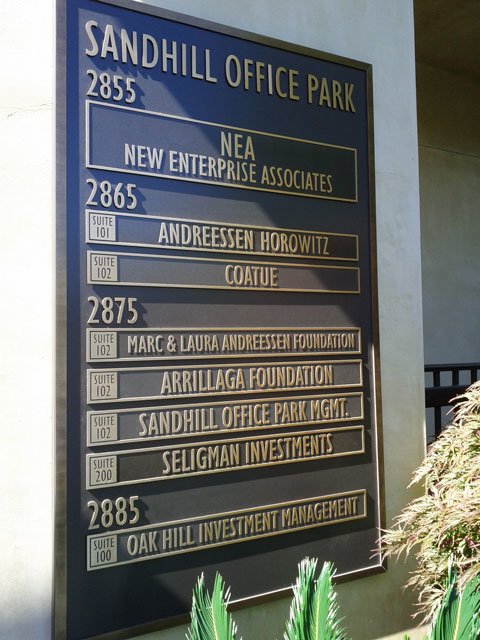
After the Klostermann visit, I couldn’t leave Palo Alto without stopping by Andreessen Horowitz, the venture capital firm of Mark Andreessen and Ben Horowitz. You may remember Mark Andreessen as the young man who gave us Netscape back in the early nineties.

He and his pal Ben have lots of resources that they invest in forward-thinking projects, companies, and industries of the future. I had hoped to get an appointment with the pair and relay the many opportunities available in the field of condensed matter nuclear science.

Unfortunately, they were both out of the office on vacation, but I managed to get an email address for further contact, and left two envelopes containing my card and Cold Fusion Now stickers with the lovely secretary who said she’d deliver them personally.

I took a picture of the library in the Andreessen Horowitz lobby.

As a chronic bibliophile myself, I always like to see what others are reading. This happens to be Andreessen’s personal collection and not surprisingly, the contents are mostly about computers.

On the way out, I stopped at New Enterprise Associates to see if they really do “Dare to Dream Big”, and I dropped off a few Cold Fusion Now stickers to a bemused front desk clerk, as well as a somewhat eager fellow who happened to be standing by the door.

Everyone gets a sticker, ’cause you never know….

Leaving the Silicon Valley, I stopped off at the Silver Crest diner in San Francisco to meet with Gregory Goble, the Cold Fusion Now Poet-in-Residence, and Paul Maher, a cold fusion activist who enjoys emailing institutions and challenging their personnel on clean energy policy.

We had a great conversation, and it was wonderful to meet these talented and committed individuals in person after so many Chip Body encounters (email messages).

Then, I headed north up to Eureka California, my old stomping grounds. I hoped the storage unit sheltering my thousand+ book collection was secure after a wet winter along the North Coast. What a relief to find everything dry and no mold anywhere. Whew.

While in Eureka, I took a long walk on the beach with my Geiger counter, taking radiation samples from seaweed, dead birds, crab shells, a decomposing seal, driftwood, and anything else I could test. I did not have the meter attachment I thought I ordered, so only the audio “beep” signal indicated a positive radiation measurement.

I was really happy to find the seaweed totally clean.

Only a few beeps now and then from lower portions of the dead birds, a few beeps from the decomposing seal. A few driftwood pieces had a little beep or two.

In no sample did I find an elevated, continuous beeping, the sign of higher-than-background radioactivity, which was extremely gratifying.

Of course, the reality of the early 21rst century is this could change at any moment. Whether it’s the thousands of nuclear weapons scattered about the planet on land and sea, or the nuclear power plants on the brink of failure, nuclear holocaust is a scenario much too possible to forget about.

On the beach I met a young man walking his dog who “had all the equipment in his lab” to do cold fusion, but he was skeptical.

I said “Get to it!” and told him to check out our website for more info. I hope he does, ’cause having some active cells in lovely Humboldt County would be a real plus.

On my way back to the Southland, where I’m house-sitting for my uncle in Los Angeles, California, I stopped for a hike in the Humboldt Redwoods State Park, one of the most beautiful and precious stands of giant Redwoods trees on the west coast of the U.S.

I even stopped at the Park Visitor Center, where I was reminded that new energy science has a long and storied history, for here was a display of Charles Kellogg, naturalist and Renaissance man who purportedly put out a flame – on more than one occasion – using sound.

Here’s an NPR piece on Charles Kellogg and a bio from Mendocino Rail History.

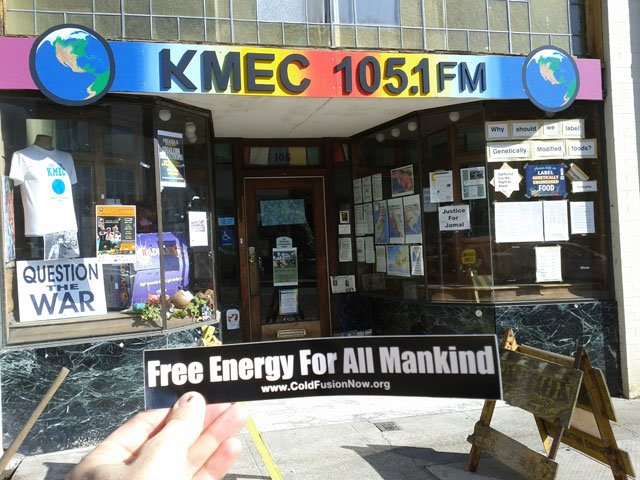
Further south in Ukiah, California, I walked by WMEC radio station to drop off some stickers, and ran into two of the station people.

One of them, Govinda, said “Hey can you come back in fifteen minutes? I’ve got to interview somebody right now, but we’ll do you right after.”

“Sure!”, I said.

Within twenty minutes, I had the earphones on and was speaking into the mic about cold fusion. He even interrupted the Amy Goodman Democracy Now! special two-hour broadcast to put me on live.

The two fellows (and presumably all of Mendocino County!) were very interested to hear that cold fusion was alive and well. Apparently, the town of Willits, about twenty miles north of Ukiah, used to have an alternative energy fair where cold fusion scientists spoke!

“I have tapes of that somewhere”, he said.

I was dying to get my hands on those classic recordings. “Hoo boy, you better find em!”

Before I left, I thanked them for their open-mindedness. I have attempted to get environmentalist, Peak Oilers, the Green Party, and plenty of people who should know better, on board with the solution to our energy problems, with no success. Yet these two fellows at the Mendocino Environmental Center want more, and I am sure that I will be back there updating Mendo County again on the positive developments on cold fusion in the future.

So if the website goes in and out over the next week, you can rest assured that we have not been deterred from action. We are gearing up for more and better times to come.

Cold Fusion Now!

Breakthrough Energy Movement Conference Organizes Paradigm Change

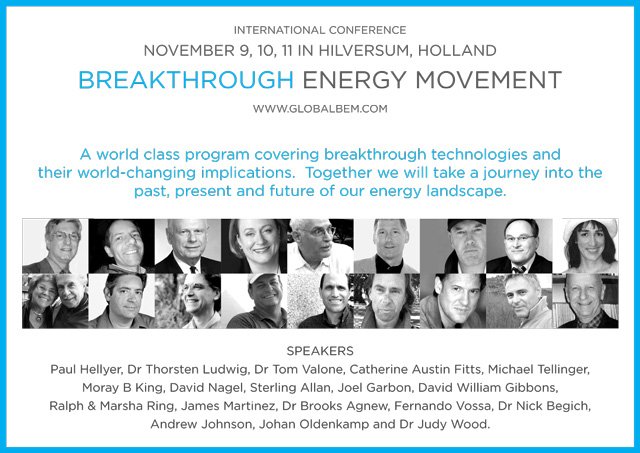
An international conference sponsored by the Global Breakthrough Energy Movement (GlobalBEM) will be held November 9, 10 and 11 in Hilversum Holland highlighting new energy science and technology.

The program will feature LENR, as well as advanced physics concepts in hybrid energy sources, noble gas and plasma technologies, magnetics, and zero point energy. The event is dedicated to Dr. Brian O’Leary, an astronomer, planetary scientist, and Apollo-era NASA astronaut who later embraced new energy technology becoming the founder of New Energy Movement [about].

GlobalBEM started as a volunteer driven group and non-profit organization in 2011 “to educate and bring awareness to the general public about breakthrough energy technologies, which are clean, sustainable, abundant and world-changing.”

“While we recognize and support the importance and growing role of conventional renewable energy technologies like wind, solar, biofuels, geothermal, hydroelectric, etc., our particular focus is on breakthrough energy technologies which have the capacity to produce quantum leap advances in clean energy generation for the entire planet.”

Echoing O’Leary’s teaching, GlobalBEM sees the subject “reaching beyond the technical and scientific sides of the discussion, into a global, social and cultural movement of awareness.”

The content of the three-day program has been “carefully put together to not only interest scientists, students, technicians and entrepreneurs, but also provide basic knowledge for the general public.”

Day 1 reviews the basic science and technologies.
Day 2 surveys environmental, societal implications of energy paradigm change.
Day 3 pulls together the history of these technologies while taking inventory of possible future developments.

Among the speakers at the conference will be Cold Fusion Radio’s James Martinez.

Also attending is long-time cold fusion researcher David J. Nagel of NUCAT Energy. Joel Garbon and Thomas Valone of New Energy Movement will speak as will Sterling Allan of Pure Energy Systems Network and the New Energy Congress.

Early bird tickets are available before October 9, 2012. For more information on discount accommodations, visit the GlobalBEM Tickets page.

You can also visit BEM’s Facebook page, check out their Twitter feed, and watch videos at GlobalBEM’s Youtube page.

GlobalBEM has collected a core team of artists, filmmakers, designers and musicians as well as technologists.

P è n i n s o l a r – Warmth – Breakthrough Energy Movement Mix by GlobalBEM

Find more of the GlobalBEM sounds from Peninsolar and others at their Soundcloud page.


UPDATE: Live Stream of E-CAT Conference in Zurich

Here is a link for a Live Stream of the E-Cat-Hot Honeycomb Zurich conference taking place — (EDIT) September 8-9. (sorry, original post had Sept.7th)

http://www.ecat-deutschland.org/index.php/live-stream

Here’s a program pdf of the entire conference breakdown, schedule, etc. in English –
http://www.borderlands.de/Links/Kongress080912M-e.pdf

Live streaming is here from UStream:
http://www.ustream.tv/channel/z%C3%BCrich-09-2012-live

Here’s the recorded video that was posted from Day 1, with many thanks to steverybak:


Video streaming by Ustream


Video streaming by Ustream


Video streaming by Ustream

E-cat World has published three associated files about the Hot Cat for this event.

Hot Cat data

Hot Cat Corrections Powerpoint

This file documents a test of the Hot Cat by Fabio Penon and David Bianchini: Penon4-1

Some points from Andrea Rossi’s talk on Day 1 are listed. (The list is not comprehensive due to loss of stream):

  • The E-cat Congress was organized in part by Adolf and Inge Schneider from TransAltec Inc. in Zurich, Switzerland.
  • Andrea Rossi spoke in the evening and announced that the industrial version of the E-cat has been certified from SGS, limited to the safety features. SGS is a company that provides inspections, testing, certification and training for scientific research and consumer products.
  • The 10 kilowatt consumer steam generator has been more difficult to certify due to the safety considerations when utilizing a hydrogen tank.
  • The new Hot Cat reactor can withstand up to 1200 Celsius degrees and a special paint was invented specifically for use in the E-cat. Internal temperature can reach 1250 Celsius degrees while external surface can reach 1050 C.
  • Inner core has dimensions length 33 cm, outer diameter 9 cm, inner diameter 3 cm made of AISI 310 steel to withstand higher temperatures.
  • .
  • David Bianchini, a physicist from the University of Bologna made radiation measurements outside of the reactor that was crucial to the certification. Rossi has said he has been “just a spectator” during those measurements.
    .

    These measurements are extremely important because of safety, “no radiations should go outside the reactor” says Rossi. Bianchini’s report concludes there is no significant radiation above background, summarized here:

  • .
  • One charge of hydrogen fuel is 1 gram for six months of 10 kilowatt power continual operation.
  • A prototype Hot Cat generator appears to have a minimum COP of 2.5. Planned commercial product has COP of 6.
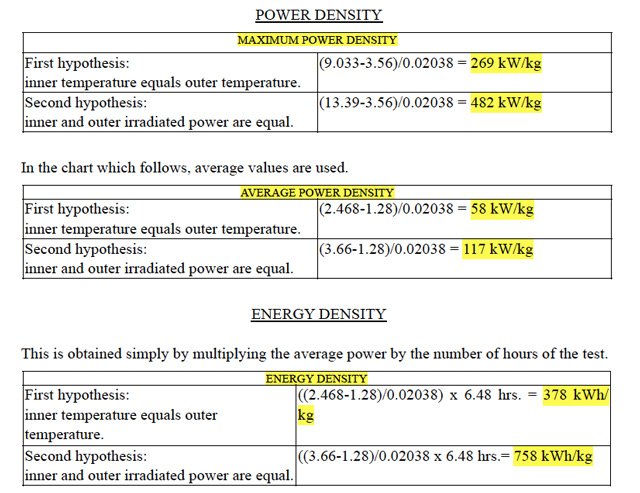
  • Energy density measured and calculated by Penon resulted in these values:
  • .
  • A full report on Hot Cat specifications will be released in two months time after repeated tests of a similar nature.
.

Day 2 of Ecat Conference had a number of panels. Recorded video posted follows:


Video streaming by Ustream


Video streaming by Ustream


Video streaming by Ustream


Video streaming by Ustream

Here is a partial transcription of Roger Green’s presentation panel:

Use Ecat to make ethanol, says Roger Green. “Food is for people.”

Green of E-cat Australia and Eco Global Fuels describes the hydroxy method, which takes seawater to make ethanol, and how Ecat can power the process.

“Industrial heat is a commodity to start with. We’re talking about developing it down the line for desalination and transportation.”

“It’s no longer research and development”, Green says of the applications for the Ecat technology. “It’s actually a scale-up.”

“When you run the hydroxy generators, you have iron as a by-product. We know exactly how much, and the iron goes into creating algae. We decided to use a bit of the excess energy to make bio-char.”

“I love solar, but it’s expensive. With the Ecat“, Green says, “we can sequester CO2 and make a renewable fuel.”

William Donavan [contact] who has been investigating various free energy systems and providing consulting services for energy and propulsion for years, is Green’s Chief Technical Advisor. He described how the Ecat can assist in desalination for clean water.

Conventional desalination is energy intensive and requires huge boilers. “The biggest problem is the heat of vaporization and the heat loss to the environment.” Reverse osmosis wastes huge amounts of water, despite being the most popular method of desalination.

“Low-pressure distillation currently uses petroleum to run generators that run 24-7. This is potentially an application for LENR.”

Donavan listed a number of desalination methods with their pros and cons. Energy and Environmental Science issue #10 highlights Capacitive Desalination, which is on the horizon, and researchers at MIT are working on Graphene Desalination.

“Though the global recession has put a dent into the contracted capacity, demand is still outstripping what can be done now.”

He cites statistics from Global Water Intelligence that, in 2012, “the global desal market will add 6.4 million cubic meters per day (1,690 Million Gallons per Day) of capacity valued at $9 billion,” including both “brackish and seawater desal”, and “equipment sales could surpass $18 billion by 2016”.

“They’ve got the equipment; what they haven’t got is the energy to do it, which I think, we can supply that for them,” said Donavan.

The oil industry is also looking for water recycling for fracking operations. They are contaminating the aquifers, and this requires remediation.

The Ecat technology offers a solution for clean-up.

“There are literally millions of square kilometers that are contaminated, and the aquifers are no longer useful.” LENR is “a good fit” to solve these problems, and being green, “it’s acceptable to the environmental community.”

And for business interests, Donavan says, “billions are to made in global profits.”

Sitting in the audience was Andrea Rossi, who had previously considered desalination as an application of Ecat technology himself, but turned away from it due to the cost-effectiveness compared to osmosis, was impressed with Donovan’s ideas. “This is a dramatic game-changer”, he said of the newer technologies.

Rossi asked, “Have you made a comparative economic analysis between the cost of desalination of water made with the Ecat and made with reverse osmosis?”

In answering, Donavan cited “Waste to water: a low-energy water distillation method” [.pdf], a study by Florida Atlantic University researchers led by Brandon Moore, along with two other studies done by and Israeli group and a Russian group, where the average consensus was, “a 40% reduction in energy” use with the Ecat over osmosis, though Roger Green admitted they are still getting benchmarks in the R&D program and “don’t have it down to that number yet – that’s what’s possible.”

Moving into the “heat to electricity” portion of the talk, Donavan began by stating that “Conventional turbine to hydrogen, and then to electricity, is the worst efficiency of all.”

“24% efficiency power generation into 20% efficiency electrolysis yields an overall efficiency of 4.8%”, using a conventional turbine, with “95.2% of heat wasted”.

“Though politically correct, the so-called ‘hydrogen economy’ is uneconomical and environmentally disastrous.”

“Only on-site generation is practical.”

Now a conventional turbine has a 30% efficiency, and with an 80% efficient alternator, the combined efficiency yield is only 24%, leaving 76% of the heat wasted.

This type of system is only feasible when you can use that wasted heat. But this is how conventional power plants operate – using the wasted heat as “environmental heaters”, i.e. heating the environment.

A Tesla turbine has a high efficiency, from 50-80%. Using the lowest efficiency with an 80% efficiency alternator yields an overall efficiency for electrical power of 40%.

This mature technology was proven in 1911!

Thermoelectrics is another robust technology to provide electrical power generation known since the 1950s that provides a comparable efficiency to photovoltaic electricity generation, costing $10 per watt with 200 Watt units costing $1919.00.

Devices available now [visit] are solid state with no parts to wear out, can work by convection, and can be used for co-generation with temperature over 270 degrees Celsius are typical.

These units are highly adaptable to LENR though not as price competitive as the turbine and alternator combination. Thermoelectric generators have been used on for spacecraft power for decades, but the true life expectancy of these devices have yet to be determined. They also need an inverter to turn output into AC as well as high-temperatures to operate, around 1226-1726 degrees Celsius.

Stirling engines, originally designed by Robert Stirling in 1816, can reach efficiencies of 50% if configured correctly, and gas can be looped through a LENR reactor as a primary method of cooling.

On the downside, these types of engines need higher temperatures to be more efficient, between 500-1000 degrees Celsius and the high pressures are more difficult to “seal in” over time. It also has more moving parts than other methods of converting heat to electricity.

Variants of the Stirling engine include the free piston engine design, of which Siemens uses the Alpha (three to six cylinder) version, the Beta configuration, a high-output and stable version, and a new 10-year-old technology called a Quasiturbine Stirling, which may hold the most promise teamed up with LENR.

Research at the NASA Glenn Research Center is being done on a Stirling Radioisotope generator which puts out 12.5 kilowatts per cylinder, a close match for the 10 kilowatt output of the small Ecat.

There are Rotary Stirling system, some of which are even more efficient than the other alpha, beta, or gamma, Stirling designs. This technology was abandoned to pursue “cheaper” engines, but is “begging to be repurposed for LENR.”

Stirling Engine Forum http://www.stirlingengineforum.com/

For converting heat to electricity, there are several horizon technologies. One is Quantum Well technology. Operating at a relatively low 450 degree Celsius temperature differential, they can run as high as 800 degrees, providing efficiencies as high as 32.5%, and higher in the future. Future efficiency if 50% or more then compete with turboelectric conversion systems.

These high efficiencies utilize capton substrates, as well as other engineered plastics, act as a “heat funnel”.

This technology is being used by military on Abrams tanks as a 5 kW energy conversion system, and we need civilian use!

Efficiencies as high as 92% come from experimental IR (Nano) Antennas, where infrared radiation is directly converted to electricity. First proposed by Steve Elzwick in the 1980s, the development was stymied by the lack of teraherz diodes not fast enough to operate, but they are on the market now, which makes this thermoelectric technology “begging to be developed.”

Applications being researched at the Idaho National Laboratory include solar cells that work at night.

Interestingly, you can cut these types of nanoantennas to 1/4 wavelength of your blackbody temperature. This means that when the infrared radiation (heat) approaches that temperature, the nanoantennas begins to converge and acts like a self-regulating thermostat.

Wrapping up his talk, Donavan listed a number of applications for LENR technology: adsorption type refrigeration and HVAC systems, hybrid cars and trucks, substitutes for diesel-electric locomotives, turbine-driven ships and submarines, replacements for spacecraft power currently using radiothermalisotope generators (RTG), exotic propulsion systems for space planes, and locally-generated power not connected to a grid.

Many of these applications have already been proposed and are actively being pursued. For instance, the Navy is interested in replacing their reactors on their nuclear submarines.

In conclusion, while almost all thermoelectric conversion technologies have merit, when nanoantennas are available, that one will be the most efficient.

Bot Stirling and Tesla turbines are close competitors in cost as well as efficiency to mechanical power conversion, but the only ones that do NOT measure up are the conventional power conversion systems in use now.

Roger Green closed the talk with a business proposal for their R&D efforts at e-Cat Australia. Their research efforts are based in labs located in the south of France and Sydney, Australia. The talk left out two or three proprietary products-in-development.

The company is focusing on two products in particular, a small prototype for the low-pressure desalination unit, as well as the most innovative heat-to-electricity technology, and they are looking for only about $200-300 thousand to do it.

Sourced from global search for talent, Green is thrilled to have William Donavan leading the R&D.

Brillouin Energy patent granted in China

Brillouin Energy of Berkeley, California has been granted a patent for their hot-water boiler technology in China.

Patents had been submitted in countries around the world with Japan “not rejecting” the patent and “some back and forth” on the patent in the European Union, but as with virtually all submissions referencing this new energy technology in North America, the United States Patent and Trademark Office (USPTO) rejected the application. Cold Fusion Now’s David J. French reviewed the rejection in this article from last May.

Further, though no product is currently slated for public release and the company is still prototyping their commercial design, an Original Equipment Manufacturing (OEM) company has contacted Brillouin with interest in licensing the technology.

The Chinese patent is a huge breakthrough for commercial development of this ultra-clean energy technology. Any duplicate technologies released in the United States would force the USPTO to grant the Brillouin patent, and compel the other company to negotiate with the Brillouin Energy Corporation. This would necessitate a break in the long-standing Department of Energy (DoE) policy that refuses to acknowledge the existence of cold fusion, also called low-energy nuclear reactions (LENR), lattice-assisted nuclear reactions (LANR), and quantum fusion, and which influences USPTO policy.

Brillouin Energy has just recently begun a partnership with SRI International of Menlo Park, California to test both the science and technology developed under the guidance of Robert E. Godes, the Founder, President and Chief Technical Officer at Brillouin Energy. It was in this capacity that Brillouin was able to garner funding for their hot-water boiler design that used a nickel cathode and regular water (H2O) to create the energy-producing excess heat.

That funding allowed Brillouin to expand their team, adding seven additional engineers and physicists, along with the handful of non-technical support staff and three law firms helping the corporation in various aspects to move this revolutionary energy technology forward.

The Brillouin lab is currently engineering a new gas-loaded design that will run at much higher temperatures, thereby increasing the power output. The Brillouin Hydrogen Hot Tube (HHT)™ is the core reactor of the new design.

Essentially, it is a tube containing the catalytic material with the metal nickel that allows for control over the flow of hydrogen gas as well the Q-pulses, the electromagnetic pulses that start and drive the reaction.

The company has been successful with the nickel environment, but is also working on a new architecture that uses titanium and tungsten in the core generator.

Godes says the new dry-cell designs require Brillouin to raise more capital funding to expand the pace of work.

“We’re not saying we’ll have a product right away, but we have a technology that we know can be developed, and we’re working with all possible speed to get it to market.”


Related Links

More News on Brillouin Energy Corp patent filing by David French May 25, 2012

New kid on the block? – Brillouin Energy Corporation by David French April 23, 2012

Brillouin Energy interview on Ca$h Flow: “We can re-power coal plants with LENR” by Ruby Carat March 28, 2012

Brillouin Energy Quantum Fusion animations by Ruby Carat March 21, 2012

Funding dam almost breaks for Brillouin Boiler that uses – water! by Ruby Carat July 7, 2011

Brillouin Energy Home

SRI International Home

“President Obama and Cold Fusion LENR” Is an October Surprise Immanent, Eminent, and Imminent? Part 2 U.S. Administration

“Address the Nation: LENR Power and Expansion into Space”

This is an adaptation of a speech given by President John F. Kennedy.

The original speech should be listened to before reading the adaptation. President Kennedy’s speech gives insight into the driving forces behind NASA and our continued space programs. That context is needed to understand the adaptation of President Kennedy’s famous speech.

“On the Nation’s Space Effort”, John F. Kennedy 12 September 1962. Address at Rice University in Houston, Texas (voice recording)

President Obama is the Chief Excecutive Officer of NASA.

President Obama is Commander in Chief of the Navy (research laboratories) and the Defense Intelligence Agency.

LENR/cold fusion power is a matter of national security for both NASA and the Armed Forces. Please study what NASA, the Defense Intelligence Agency, and the Navy know about LENR/cold fusion power. That information is found in the following papers and videos and is essential for a good reading of my adaptation of Kennedy’s Address.

 Navy

“Thermal and Nuclear Aspects of the Pd/D2O System Volume 1: A Decade of Research at Navy Laboratories”  Technical Report 1862 – February 2002 (read)

“Thermal and Nuclear Aspects of the Pd/D2O System Volume 2: Simulation of the Electrochemical Cell (ICARUS) Calorimetry” Technical Report 1862 – February 2002 (read)

Defense Intelligence Agency

Defense Analysis Report – Technology Forecast:

“Worldwide Research on Low-Energy Nuclear Reactions Increasing and Gaining Acceptance” DIA-08-0911-003 13 November 2009

  • LENR could serve as a power source for batteries that could last for decades, providing power for electricity, sensors, military operations, and other applications in remote areas, including space. LENR could also have medical applications for disease treatment, pacemakers, or other equipment. Because nuclear fusion releases 10 million times more energy per unit mass than does liquid transportation fuel, the military potential of such high-energy-density power sources is enormous. And since the U.S. military is the largest user of liquid fuel for transportation, LENR power sources could produce the greatest transformation of the battlefield for U.S. forces since the transition from horsepower to gasoline power. (read)


NASA

Sept 22, 2011 LENR Brief @ GRC – J.M.Zawodny “Low Energy Nuclear Reactions: Is there better way to do nuclear power?” (pdf)

Sept 22, 2011 LENR Brief @ GRC – Dennis M. Bushnell “NASA and GRC – LENR Workshop 2011” (pdf)

Recommended Follow Up (by NASA)

.

 “METHOD FOR PRODUCING HEAVY ELECTRONS” NASA Patent

United States Patent Application Publication No.: US 2011/0255645 Al Zawodny/NASA Pub. Date: Oct. 20, 2011 (pdf)

“Low Energy Nuclear Reactions, the Realism and the Outlook” Dennis Bushnell, Chief Scientist, Langley Research Center (read)

” Abundant Clean/Green Energy” by Joseph Zawodny. (video)

NASA Technology Gateway – LENR

“Welcome to the Technology Gateway. At Langley we have a long history of creating technologies that improve the way we live and the way we work. In the future we would like to enable those technologies to move from the laboratory into the marketplace and we’re going to do that through partnerships.”

 “NASA’s Method for a Clean Nuclear Energy For Your Power Operated Technology.” (Licensing available)

Noteworthy

The NASA – LENR device is on the U.S. marketplace through their Technology Gateway and that the E-Cat is making major design improvements while planning to enter the U.S. market on an accelerated timetable. (Cold Fusion Now – Hot Honeycomb)

The race to LENR power is real.

The following adaptation of the speech by President Kennedy is fiction.

Imagine President Obama giving it or a similar one as an October Surprise. The imminent surprise of cold fusion is which polititian, industry, or company will announce it first?

Oil Industry

Journal of Petroleum Technology, July 2012

“On the Precipice of a New Energy Source?” Go to Page 18  (read)

“Address the Nation: LENR Power and Expansion into Space” 


We live in a nation noted for knowledge, in a nation noted for progress, in a nation noted for strength, and we stand in need of all three, for we are in an hour of change and challenge, in a decade of hope and fear, in an age of both knowledge and ignorance. The greater our knowledge increases, the greater our ignorance unfolds.

Despite the striking fact that most of the scientists that the world has ever known are alive and working today, despite the fact that this nation’s own scientific manpower is leading the world, despite that, the vast stretches of the unknown and the unanswered and the unfinished still far outstrip our collective comprehension.

No man can fully grasp how far and how fast we have come, but condense, if you will, the 50,000 years of man¹s recorded history in a time span of but a half a century. Stated in these terms, we know very little about the first 40 years, except at the end of them advanced man had learned to use the skins of animals to cover them. Then about 10 years ago, under this standard, man emerged from his caves to construct other kinds of shelter. Only five years ago man learned to write and use a cart with wheels. Christianity began less than two years ago. The printing press came this year, and then less than two months ago, during this whole 50-year span of human history, the steam engine provided a new source of power.

Newton explored the meaning of gravity. Last month electric lights and telephones and automobiles and airplanes became available. Only last week did we develop penicillin and television and nuclear power, and now with America’s newest spacecraft leaving the solar system we literally reach out to the stars before midnight tonight.

This is a breathtaking pace, and such a pace cannot help but create new ills as it dispels old, new ignorance, new problems, new dangers. Surely the development of new knowledge promises high costs and hardships, as well as high reward.

So it is not surprising that some would have us stay where we are a little longer to rest, to wait. But this country of the United States was not built by those who waited and rested and wished to look behind them.

If this capsule history of our progress teaches us anything, it is that man, in his quest for knowledge and progress, is determined and cannot be deterred. From the frontiers of science now comes to us a revolutionary source of energy, LENR power. Inexpensive, clean, and nearly unlimited LENR power developed from early cold fusion research. The world’s conversion to LENR power will go ahead, whether we join in it or not, and it is one of the great adventures of all time, and no nation which expects to be the leader of other nations can expect to stay behind in the worldwide conversion to LENR power.

Those who came before us made certain that this country rode the first waves of the industrial revolutions, the first waves of modern invention, and the first wave of nuclear power, and this generation does not intend to founder in the backwash of the coming age of LENR power. We mean to be a part of it–we mean to lead it. For the eyes of the world will now look forward to LENR power.

Yet the vows of this Nation can only be fulfilled if we in this Nation are first, and, therefore, we intend to be first. In short, our leadership in science and in industry, our hopes for peace and security, our obligations to ourselves as well as others, all require us to make this effort, to solve these mysteries, to solve them for the good of all men, and to become the world’s leading LENR powered nation.

With LENR power, we can now truly set sail on the new sea of space. All NASA missions unrealized can now be realized because of this inexpensive, clean, unlimited source of energy. LENR power and space are the new frontiers to be won, and they must be won and used for the progress of all people. For LENR power, space science and all technology, has no conscience of its own. Whether LENR power will become a force for good or ill depends on man, and only if the United States occupies a position of pre-eminence can we help decide whether unlimited LENR power and the new ocean of space will be a sea of peace or a new terrifying theater of war. I do not say the we should or will go unprotected against the hostile misuse of unlimited energy and permanent space habitation any more than we go unprotected against the hostile use of land or sea, but I do say that space can be explored and mastered without feeding the fires of war, without repeating the mistakes that man has made in extending his writ around this globe of ours.

There is no strife, no prejudice, no national conflict in outer space as yet. Its hazards are hostile to us all. Its population will deserve the best of all mankind, and its opportunity for peaceful cooperation may never come again. But why, some say, convert to LENR power and expand habitation into space? Why choose this as our goal? And they may well ask why climb the highest mountain? Why, 93 years ago, fly the Atlantic? Why, 43 years ago, fly the to the Moon?

We choose to convert to LENR power and enable permanent habitation of humanity in space. We choose to convert to LENR power and see humanity expand into space and do other things, not because they are easy, but because they are hard, because that goal will serve to organize and measure the best of our energies and skills, because that challenge is one that we are willing to accept, one we are unwilling to postpone, and one which we intend to win.

It is for these reasons that I regard the decision to shift our efforts from low to high gear as among the most important decisions that will be made during my incumbency in the office of the Presidency.

The conversion to LENR power and expansion into space will spur growth, our science and education will be enriched by new knowledge of our universe and environment, by new techniques of learning and mapping and observation, by new tools and computers for industry, medicine, the home as well as the school. All will reap the harvest of these gains.

However, I think we’re going to do it, and I think that we must pay what needs to be paid. I don’t think we ought to waste any money, but I think we ought to do the job. It will be done during or past the term of office of some of the people who sit here on this platform. But it will be done. And it will be done before the end of the next two decades.

Many years ago the great British explorer George Mallory, who was to die on Mount Everest, was asked why did he want to climb it. He said, “Because it is there.”

Well, the unlimited, clean energy of LENR power and the frontiers of space are there, and we’re going to answer the call, and the moon and the planets are there, and new hopes for knowledge and peace are there. And, therefore, as we set sail we ask God’s blessing on the most challenging and daring and greatest adventure on which man has ever embarked.

Thank you

“Special Message to the Congress on Urgent National Needs” Page 4


President John F. Kennedy May 25th 1961. Delivered in person before a joint session of Congress announcing aspirations for the Apollo Program (read)

I therefore ask the Congress, above and beyond the increases I have earlier requested for space activities, to provide the funds which are needed to meet the following national goals…

     No single space project in this period will be more impressive to mankind, or more important for the long-range exploration of space…

     Now this is a choice which this country must make, and I am confident that under the leadership of the Space Committees of the Congress, and the Appropriating Committees, that you will consider the matter carefully…

     It is a most important decision that we make as a nation. But all of you have lived through the last four years and have seen the significance of space and the adventures in space, and no one can predict with certainty what the ultimate meaning will be of mastery of space…

     I think every citizen of this country as well as the Members of the Congress should consider the matter carefully in making their judgment, to which we have given attention over many weeks and months…

     This decision demands a major national commitment of scientific and technical manpower, materiel and facilities…

     It means we cannot afford undue work stoppages, inflated costs of material or talent, wasteful interagency rivalries, or a high turnover of key personnel…

     New objectives and new money cannot solve these problems. They could in fact, aggravate them further–unless every scientist, every engineer, every serviceman, every technician, contractor, and civil servant gives his personal pledge that this nation will move forward, with the full speed of freedom, in the exciting adventure of space…

In conclusion, let me emphasize one point: that we are determined, as a nation in 1961 that freedom shall survive and succeed–and whatever the peril and set-backs, we have some very large advantages.

     The first is the simple fact that we are on the side of liberty–and since the beginning of history, and particularly since the end of the Second World War, liberty has been winning out all over the globe.

     A second real asset is that we are not alone. We have friends and allies all over the world who share our devotion to freedom.

–serious conversations do not require a pale unanimity–they are rather the instruments of trust and understanding over a long road.

     A third asset is our desire for peace. –that we seek no conquests, no satellites, no riches–that we seek only the day when “nation shall not lift up sword against nation, neither shall they learn war any more.”

     Finally, our greatest asset in this struggle is the American people–their willingness to pay the price for these programs–to understand and accept a long struggle–to share their resources with other less fortunate people–to meet the tax levels and close the tax loopholes I have requested–to exercise self-restraint instead of pushing up wages or prices, or over-producing certain crops, or spreading military secrets, or urging unessential expenditures or improper monopolies or harmful work stoppages–to serve in the Peace Corps or the Armed Services or the Federal Civil Service or the Congress–to strive for excellence in their schools, in their cities and in their physical fitness and that of their children–to take part in Civil Defense–to pay higher postal rates, and higher payroll taxes and higher teachers’ salaries, in order to strengthen our society–to show friendship to students and visitors from other lands who visit us and go back in many cases to be the future leaders, with an image of America–and I want that image, and I know you do, to be affirmative and positive–and, finally, to practice democracy at home, in all States, with all races, to respect each other and to protect the Constitutional rights of all citizens.”

Rossi Update: The Hot Honeycomb

We’ve been holding off on an E-Cat/Andrea Rossi update until more can be validated amidst the whirling claims and mystery leaks of recent weeks. But, here’s some brief notes.

The E-Cat has seemed to have had a name change: the HOT CAT (though recent comments to Rossi’s blog indicate that it could now be called, “The Hot Honeycomb”….) This name change due to the recent claims of achieving high temperatures with the E-Cat, 1,200 degrees Celsius or higher from one small ten pound unit, producing 10 kilowatts of power with complete stability.

Claims of a high temp E-Cat were apparently first leaked out by a mystery internet forum poster calling himself “Cures”. It was eventually revealed that “Cures” was the consultant of Rossi’s military customer. Rossi stated he was very upset with the leaks, but was also understanding over the excitement and temptation to get the word out. Having known the consultant as a young man, some suspected the leak to be purposeful. In any event, drama O-rama once again…

A year ago we were awaiting the big October test, and now, once again it seems September and October of 2012 will be the unveiling of more test results, this time with the Hot Honeycomb. In September, potential validation of the Hot Cat will be released at the Zurich conference. And then, an October release will follow, from University of Bologna scientists regarding the tests that they have performed.

Hank Mills from Pure Energy Systems has a recent summation of the scenario with the possible enormous implications and more specific details of the actual Hot Honeycomb here.

If the claims made about the high temperature “hot cat” prove to be accurate, this radically evolved version of the original E-Cat could provide a near total solution to the world’s energy crisis. -H.Mills

Top