Gerald Celente puts new energy as a top trend for 2011

Gerald Celente of Trends Research Institute has put new energy as a top trend for 2011.

He made the statement on Eric King‘s King World News interview for Wednesday, December 29, 2010.

He rattled off a list of various methods of energy generation such as using permanent magnets and hydrino power, putting cold fusion at the top of the list saying there would be many investment opportunities in this area!

Go to the Trends Institute website and download the Preview of Top Trends for 2011. He doesn’t write the words there, but it’s clear what he means.

On his Trends Research Institute Media blog page, the Top Trends for 2011 video runs through a couple trends on his list. At about the 4:40 mark, the list is says “Alternative Energy”, and the host skips over it quickly.

In the segment on Fox News from New Years Day, he mentions the “new energy revolution” at the 2:48 mark, saying a little more about “scientific visionaries and entrepreneurs”.

You have to subscribe to the Trends Journal to get the full scoop. Who’s got a copy??!

Just back from a couple weeks out of town and this is great news to get. And anyway, where else can you put money?

There is no where else to go.

Join the new energy movement and keep talking about a transformation of technology that will change the way live on this planet.

Funding LENR research will start a whole new economic paradigm, employing skilled workers, developing a path for young scientists, and jumpstart a new manufacturing sector based on a new energy technology.

The time is now to go after funding. Gerald Celente just put out a little sunshine – better make some hay!

What makes cold fusion reproducible?

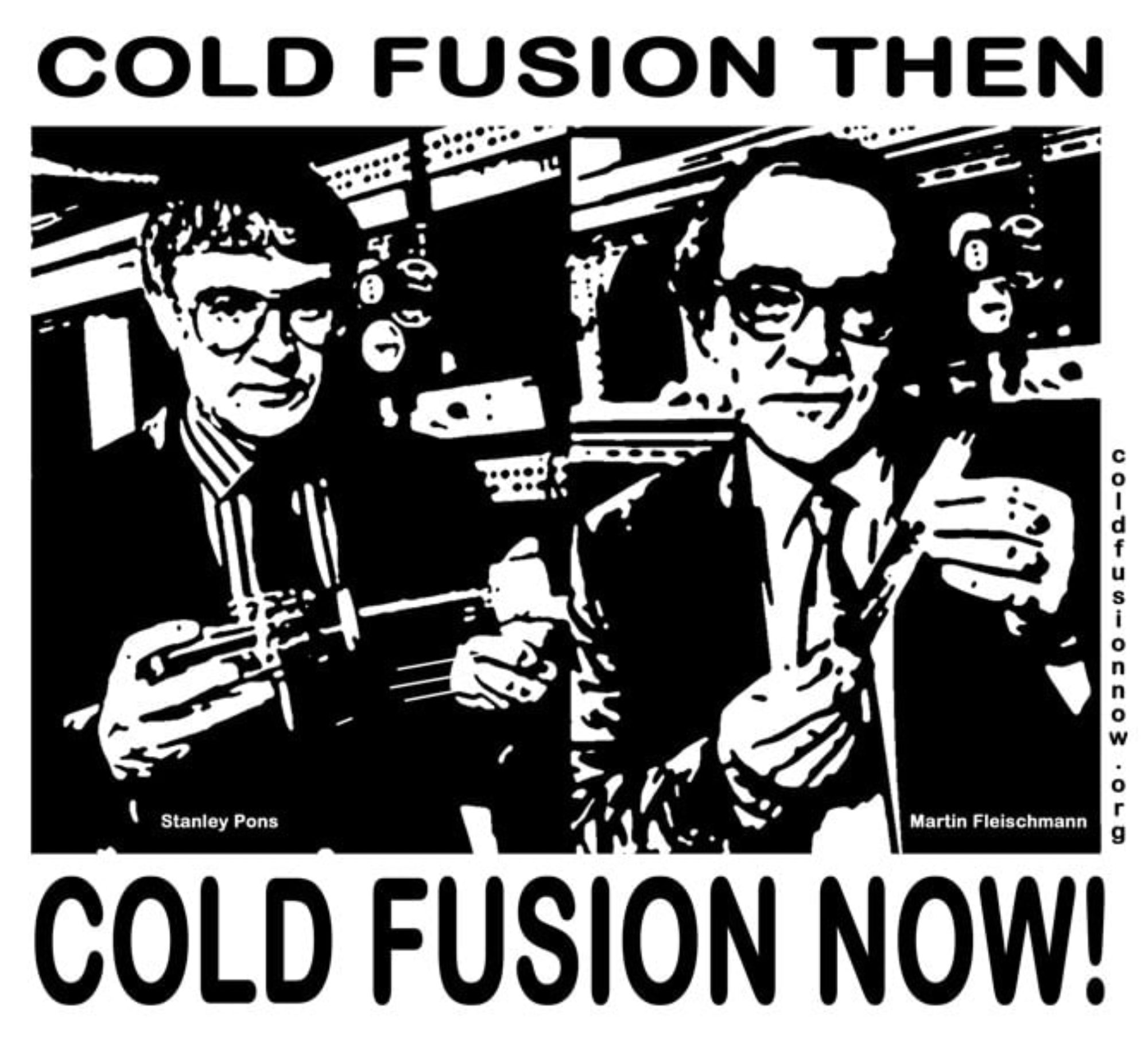
In 1989, Dr. Stanley Pons and Dr. Martin Fleischmann, world-renowned in the field of electro-chemistry, announced their discovery: the creation of an enormous amount of heat, a nuclear-power sized heat, but generated from a small tabletop electrolytic cell using a piece of palladium metal in a glass of heavy water, a type of water made from sea-water.

Their claim was so great that, after describing the apparatus in a news conference on March 23, scientists of all stripes around the world rushed to reproduce the experiment.  Unfortunately, they met with few successes.

In the Groks Science Show of May 2009, hosts Charles Lee and Frank Ling interviewed Dr. Michael McKubre, a researcher at SRI International, along with Dr. Irving Dardik of Energetics Technologies, on the then-current status cold fusion science, and Dr. McKubre described how difficult the initial “simple-sounding” experiment was to do, even as an experienced electro-chemist.

In fact, back in 1989, estimates for the initial reproducibility of the Pons/Fleischmann effect ranged between 5-10%.  This means that about 90-95% of the scientists who attempted to re-create the Pons/Fleischmann experiment did not succeed.  Nothing happened.  No heat.  No particles.  Nothing.

It was this lack of reproducibility that contributed to the now unfounded belief many scientists hold, still to this day, that Drs. Pons and Fleischmann were mistaken in their measurements, and in the worst case, that their results were fraudulent.

But, the few percent who were able to successfully re-create the experiment, and witness the nuclear fusion-sized energy-effect in their little glass beakers, were hooked, for they knew what this discovery meant.

With a virtually limitless fuel of deuterium in the oceans of Earth to power an ultra-clean nuclear-sized energy source, for the entire planet, for tens of millions of years, and created in a small table-top device in your room, this technology would radically change the entire world.  Civilization would finally move off of the chemical burning of hydrocarbons for the first time in history and all the associated problems that face our planet because of this oil-fueled civilization can be solved.

And so over the past 22 years, it is these few researchers who have continued to investigate the cold fusion effect, technically named low-energy nuclear reactions. And their ranks have grown, albeit slowly.  Worldwide, there are dozens of labs conducting this research and their results, ignored and unpublished by the established scientific societies and agencies in the US, have grown as well.

But here at the end of 2010, cold fusion still has no theory to describe or predict the many effects.  So what do scientists know?  Here’s a few notions that are experimentally verified:

1. There is excess heat generated above and beyond a mere chemical reaction and on the order of a nuclear fusion reaction.

2. Particles such as Helium-3, helium-4 and tritium, which are normally associated with hot fusion, are detected, though in significantly smaller quantities.

3. The transmutation of elements is found to occur on the surface of the metal in what is called the nuclear active environment.

4. It is a many-bodied physics, not the one-to-one interaction that models hot fusion.

But perhaps the most exciting development in cold fusion research is that, at least for SRI and Energetics, the reproducibility rate has climbed to 73%! Meaning, when they set up the cells, and attempt to induce the cold fusion effect, they can make it happen 73% of the time.

So what’s happened?  The last two decades of research point to two fundamental criteria.

First, for the reaction to occur, hydrogen isotopes (deuterium) must be loaded into the metal to at least 90%. This means, for instance, the palladium metal must be super-stuffed with deuterium atoms in an almost one-to-one ratio with the palladium atoms, causing the isotopes to crowd up tight together.

Secondly, these isotopes must then be induced to “move”.  Dr. Irving Dardik’s Superwave stimulation, a fractal-type, nested wave, pattern-oscillation of electrical current, drives the deuterium atoms to move in particular patterns and this has been key to improving their reproducibility rate. “Directed in the proper pattern as input energy”, Superwaves act on the deuterium in a cohesive way.

Also, it must be acknowledged that the improved quality of the metal since 1989, needed to withstand the loading of deuterium and the flux of Superwaves, has been crucial to successfully implementing the experiment.  The small piece of metal in which the reaction takes place must be designed and manufactured on the nanoscale and as nanotechnology continues to develop, materials science has been able to mange ever greater control over the design of metals.

Early experiments using any old chunky palladium could not be successful.  Only the few random pieces of metal that happened to have a few spots with the proper conditions of a nuclear active environment were successful in re-creating the effect.

In that same interview conducted in 2009, Dr. Dardik boldly estimates that a reproducibility rate of 100% could be achieved within one year, although he admitted that a two to -three year time frame was more likely.

A year later, Energetics Technologies had moved into a new lab in the University of Missouri Business Incubator Park, and we look forward to their announcements.

Currently, researchers are operating under the hypotheses that loading a metal with deuterium and producing flux to move the atoms at high-rates will achieve a 100% success rate of reproducibility, and when that happens, a new technology will be ready to massage the planet, and humanity will be given a second chance at survival.

The stakes are so high. 

In the words of Dr. Michael McKubre,

I can’t think of anything more important for me to work on. If you have any talent, any ability, any ideas in this particular research area then I think you have a moral obligation to do it.

First commissioned Cold Fusion Now art created on the curb

Tony B. Conscious
Tony B. Conscious makes and sells original art on the street.
Family is finding their way back home after the holiday, and I’m on the beach.

A sunny day in Venice and I come across Tony B. Conscious, a street artist who uses spray paint and magic marker to spread his message of love.

If you don’t find what you like, he’ll make art for you on demand. He had a crowd of passersby purchasing his under $25 creations.

I asked him to make one for me.

He did.

Tony B. Conscious
Tony B. Conscious shows his Cold Fusion Now artwork.
Cold Fusion Now
Cold Fusion Now by Tony B. Conscious, Venice, California street artist

Thanks Tony.  And Happy New Year. MMXI

Tony B. Concscious at www.flydyeart.com

Funding “the future” means funding cold fusion

Investor Peter Thiel co-founded PayPal with Elon Musk, and when they sold it in 2002, they took their millions and moved on.

Peter Thiel
Elon Musk

Elon Musk boldy started his own rocket company SpaceX, as well as Tesla Motors, an electric car company. I used to read Space News, the trade paper of the satellite, launch, and space industry, and I followed the ups and downs of the Falcon rocket for several years, always rooting for the private company that could make space travel accessible in my lifetime.

It was a giant leap from IT to rockets, but Mr. Musk has big ideas, and though his Musk Foundation doesn’t have much online presence, it purports to provide grants in support of “Renewable energy research and advocacy” among other philanthropic concerns.

After PayPal, Mr. Thiel seems to have stuck with Internet related investments using his Clarium Capital, investments including Friendster and Facebook. He’s been wildly successful, but compared to rockets and futuristic electric cars, it’s been …. can I say …more conventional?

But in 2005, he co-founded and became a partner in the Founders Fund, which invests in “ground-breaking idea” companies. SpaceX was a recipient of some $20 million in funding from them. [The Founders Fund takes submissions here].

And on December 2 of this year, the Founders Fund and New Enterprise Associates announced the winners of the second annual TechFellow Awards. These awards are pretty much chip body/IT related, even for the category of Disruptive Technology, a title more deserving for cold fusion than anything else I know of.

But now, it appears that Mr. Thiel is getting the bug for even bolder projects. 

An article entitled Internet guru embraces sci-fi future by Marcus Wohlsen of the Associated Press reports that the hedge fund entrepreneur is looking to “fund breakthrough technology”. From the article:

As venture capital in Silicon Valley chases the next big mobile app or group discount service, Thiel was asking for them to fund technological breakthroughs that some believe in fervently and others see as sheer fantasy.

He even has a name for it: Breakthrough philanthropy.

Instead of just giving to help the less fortunate here and now, Thiel encouraged his fellow moguls to put their money toward seemingly far-fetched ventures that he believes could improve the lives of everyone for good.

A controversial figure for sure, but one who wants to do something big, and has the capacity to follow through.

These are the people we need on the side of cold fusion energy research.

There is no bigger break-through technology than cold fusion.
Cold fusion is the technology that will redefine the human race on Earth AND space.

In the words of Mr. Thiel: “Do we try to pursue ideas that are weird and have optimism about the future, or do we give up on all new things and compromise?”

I’m wondering if he’s up to the cold fusion challenge.. Let’s find out!

I don’t have a phone number, but I’m sending this guy some stickers!

Skate park gets 90% saturation

Cold Fusion Now is away from the office on holiday break, but the message never stops.  Visiting Venice Beach, California skate park, the kids were rolling through some curves.

Between rounds, I gave out a couple of stickers. The reaction?

“Cold Fusion Now? Cool.”

“It’s nuclear power out of sea-water.  No radioactive waste.  No CO2.  If you have access to water, you got fuel”, I say.

“Awesome.”

They slapped ’em right on their boards.

That’s what I call awesome!

This pint-sized flyer wowed the crowd, and everybody saw her Cold Fusion Now sticker when her board floated!

Short bit genius on wheels.

We walked the beach and gave out stickers to a few select artists, some of whom knew what cold fusion was, and were pleasantly surprised to find out it’s for real.

A couple of good conversations about energy on a beautiful sunny day.

Merry “Cold Fusion” Christmas from the beach!

Happy Holidays and a Happy New Year to All!

“On the Relation of Hydrogen to Palladium”

Thomas Graham describes some of his first results investigating the properties of hydrogen-infused palladium in a paper published in the Proceedings of the Royal Society of London in 1869.

The link below opens the Proceedings book scanned to a .pdf by Google books in a new tab.

What’s really cool is the guy was a numismatist as well as a researching chemist – and Master of the Mint!

Top