Cold Fusion Now Cross-Country Tour


Yours truly spent the last couple of weeks traveling across the United States from the Left Coast to South Florida spreading the Cold Fusion gospel. Here’s a few highlights of the tour.

I first spent a couple nights with my friends in Las Vegas, Nevada. It was great to see my old bandmate and drummer Michael Petta, and we drove to Bigelow Aerospace, the makers of inflatable “rooms” designed for orbit. I asked to see Mr. Bigelow so I could talk to him about the opportunities in cold fusion for space applications, but not surprisingly, he was unavailable. I did write him a short note with some Cold Fusion Now stickers and left it with the security agent who agreed to drop it in the mail for him. This is a picture of a model of one of their “rooms” that is located in the Bigelow Aerospace lobby. It’s amazing that these “spaces” are designed to be inflated in orbit.

Despite Las Vegas being one giant strip mall where the scourge of foreclosure is quite apparent, there are several fabulous used book stores with unique and rare collections. If you are a bibliophile like me, then taking a trip to Las Vegas is worthwhile just for the bookstores. I would have spent all my money had I stayed longer, but luckily, I was on my way north to the University of Utah in Salt Lake City, Utah to drop Cold Fusion Now stickers off at the Chemistry Department.
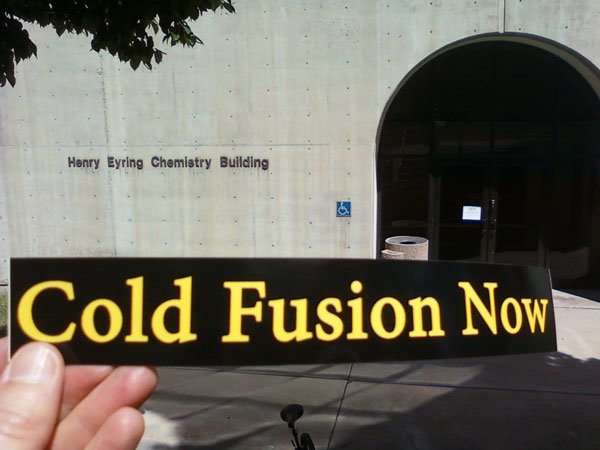
SSPX0406_UU_Eyring_Chem_Bldg_CFN

The long hot drive finally took me to the Chemistry building and I walked around to find the mailboxes in which I would give each professor a CFN sticker. But the mailboxes were locked. Being early August, the school was pretty empty, and the lone Chemistry Office Person said she would put the stickers in the boxes for me.

I asked her if she knew what cold fusion was, and she replied “I know it was a big fiasco years ago.” I said to her, “Did you know that cold fusion was real, and they are close to releasing a first commercial device?” And she repeated, “I know it was a big fiasco years ago.”

It was clear that she wasn’t interested in chatting, or hearing about the latest developments, so I thanked her and moved on. I hope she really did put those stickers in the mailboxes.

I walked around the empty halls looking for an open door. I found a small office filled with students, and introduced myself. I told them I’m doing clean energy advocacy and I wanted to drop off a few stickers for them. I asked the students if they knew what cold fusion was, and a few nodded their heads, looking at me somewhat askance. I asked if they knew that cold fusion was real, and one young man nodded his head. Again though, it was clear that they weren’t interested in any more interaction, so I said good-by and left, listening to their laughter as I walked down the hall.

I found another open door, and popped my head in. “Hi, I’m doing clean energy advocacy and I’d like to give you a sticker.” He was a professor for sure, and as he turned towards me and took the sticker, he looked down at what it said. His face wrenched in irritation, and he reached to drop it in the trash can.

Immediately seeing the annoyance in his face, I reached towards the sticker to retrieve it from his hand, quickly saying “Oh, I’m sorry, I’ll take that out.”

“I’m too busy…I don’t have time for this”, he said, shaking his head and turning his back to me.

I thanked him for his time and left.

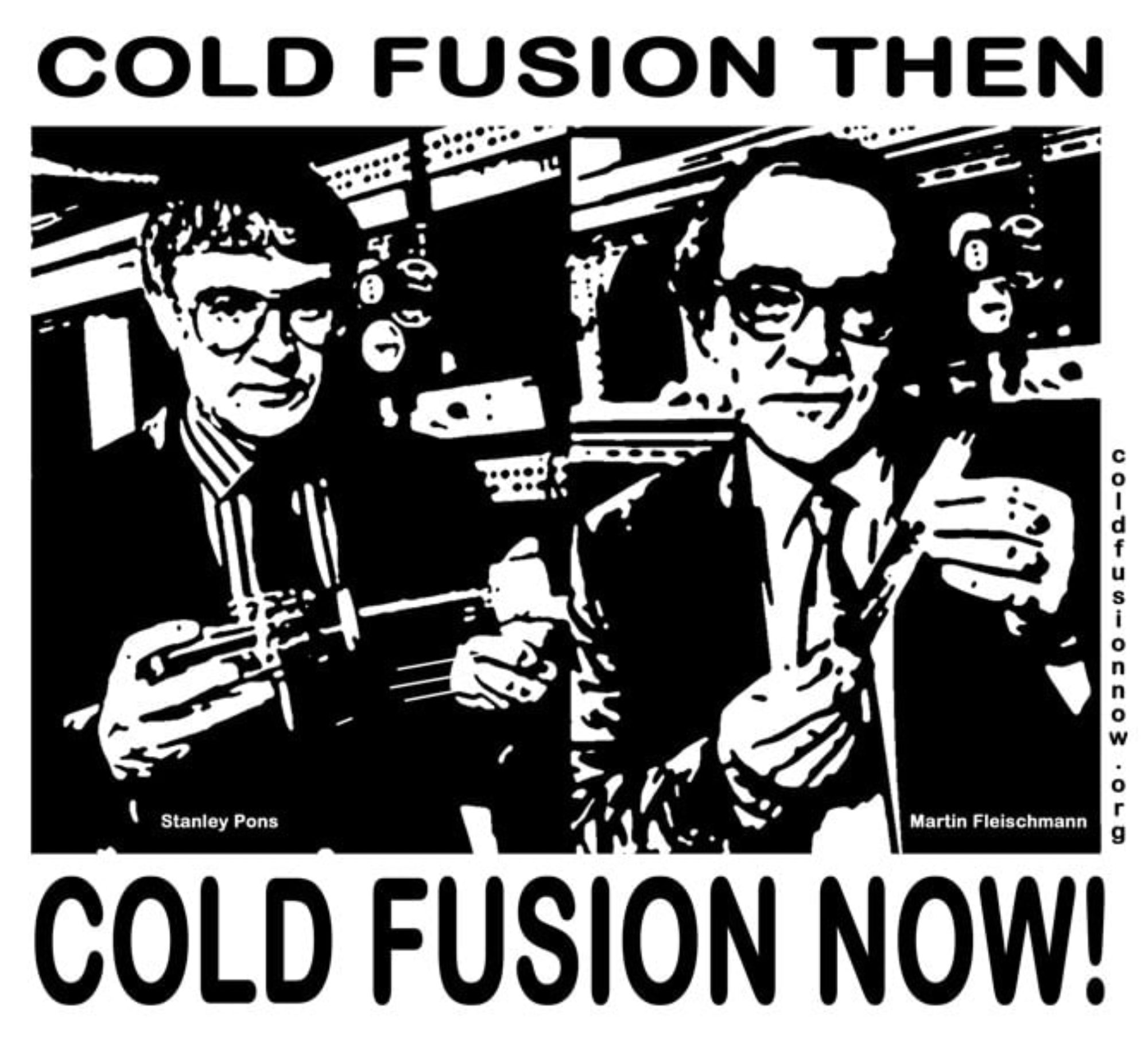
A little discouraged that this place of learning, this holy ground where Stanley Pons, Chairman of the Chemistry Department, and his partner Martin Fleischmann, one of the greatest electro-chemists that ever lived, made an immense discovery with huge ramifications for the whole of humanity’s future, was filled with such ignorance and negativity, I tried a different hallway.

Seeing another open door, I took a breath and walked in. With my friendliest smile, I started: “Hi, I’m doing clean energy advocacy and I wanted to drop off a sticker for you.”

The young man, a graduate student, or perhaps a young professor, looked at the sticker with slight bemusement. At last, I thought hopefully, a friend. I asked him if he knew what cold fusion was. “I’m familiar with the issues”, he said. I asked, “Do you know that cold fusion is real?” He repeated, “I’m familiar with both sides of the issue.” Again, I could feel that he wasn’t interested in chatting, so I asked him to check out the website and left.

I went to the University’s Marriott Library to peruse the archives on cold fusion.

The University of Utah has a beautiful library, with gorgeous art, a cafe, and an excellent rare book collection. I went up to the Special Collections and asked to see the archives on cold fusion. The library has “vertical stacks” located in situ and another group of materials in a warehouse. I asked to see the vertical stacks, and ordered the warehoused materials for the next day. This is a picture of reading room.

SSPX0410_UU_special_collections

The vertical stacks consisted of four file boxes containing newspaper and magazine articles, memos from University officials, and some scientific papers. The newspaper articles, cut out by some unknown person, were yellowing and becoming brittle, but otherwise, it was easy to read the materials, loosely ordered by date.

Getting the whole history of the initial announcement in one fell swoop, I was struck by the quickness of the physics community in denouncing the effect, and the strong support the university gave to Drs. Fleischmann and Pons. The University had started the National Cold Fusion Institute, but it closed by 1991. It was sad to read about those who were forced to resign under criticism. One of the highlights was reading a piece by Sheila Pons, the wife of Stanley Pons, where she expressed dismay at the emotional outbursts and rancor towards her husband. More than one moment had me steaming in my chair at the ridiculous behavior of the so-called “objective” scientists.

There was alot of articles in those four boxes, and after a second day of sitting and reading, I had not yet finished looking at everything. The materials ordered from the warehouse had not arrived, I never found out why, and I cancelled them as I had to be on my way. I gave the Special Collections librarian a Cold Fusion Now sticker, thanking him for his help, and he said “Oh, we’ll put this in our archives.” Woah. I gave him one of each.

Curious as to what’s on their shelves in the book section? There was three shelves with cold fusion materials.


IMGA0133_UU_bookshelf1

IMGA0134_UU_bookshelf2

IMGA0135_UU_bookshelf3

The library staff were kind and helpful, and more interested in hearing about recent developments than anywhere else on campus. It was clear that the chemistry department has done everything possible to erase all traces of this historic work from their campus.

But we know better.

It is only a matter of time before the University of Utah will once again embrace their history proudly, and statues will be erected of Drs. Pons and Fleischmann, a new research wing will open with a name like The We-Always-Knew-It-Was-Real Institute, and the two men who had the Courage of Lions will be revered as the heroes they are.

I had to take off to visit another friend, fellow Cold Fusion Now blogger John Francisco, in Colorado, with whom I converse on archaic Greek philosophy and coinage. He showed me his copy of a Gutenberg Bible. (Yes! Gutenberg later – circa 1400sAD) Really cool.

SSPX0427_guten

After a brief foray into 500BC, I headed south to Santa Fe, New Mexico, and dropped in on long-time researcher and Cold Fusion Now mentor Edmund Storms.

He and his wife Carol, herself an early cold fusion scientist at a national lab, now an artist and businesswoman, graciously extended their hospitality to me. They have a beautiful house that they built themselves in the hills above Santa Fe. After meeting their dozens of hummingbirds that live in the trees, I talked with Dr. Storms for several hours, most of it captured on video, as well as took part in a rousing dinner conversation about the effects of technology on society and the nature of humankind.

A quick tour of his lab revealed Dr. Storms’ research on excess heat is ongoing with a hydrogen and nickel system. He was simultaneously measuring gamma rays and the “clicks” of the background radiation was almost continuous, with no real discernible radiation from his test cell.

We’ll be editing the video in the coming weeks. Sadly, I neglected to take a few photos to quickly post; there was so much to think of. Suffice to say, science, art, and philosophy are all intersecting and moving forward within the Kiva Labs compound.

Luckily, my truck made it out of their steep mountain driveway and I headed further south for the new Spaceport America being built to host the first commercial sub-orbital space tourism flights for Virgin Galactic and their WhiteKnightTwo and SpaceShipTwo fleet. It was quite a ways outside of Truth or Consequences, New Mexico and when I got there, I was unable to get past the Security gate as they are still under construction. I asked the guard if Mr. Branson visited often, as I had hoped to slide him some Cold Fusion Now stickers for his private jet bumpers, but apparently he had only been there twice in the last two years. Oh well. I’ll get to Mr. Branson yet!

This is not my first attempt at trying to reach private space entrepreneurs. I have made several visits to Scaled Composites, the company Burt Rutan built to craft his SpaceShip designs. One time, I was able to get upclose with SpaceShipOne before it was sent to the Smithsonian, actually able to touch the surface, dinged as it was by re-entry. This is a picture of a SpaceShipOne reproduction housed at the Mojave Spaceport in Mojave, California that I took on my most recent visit.
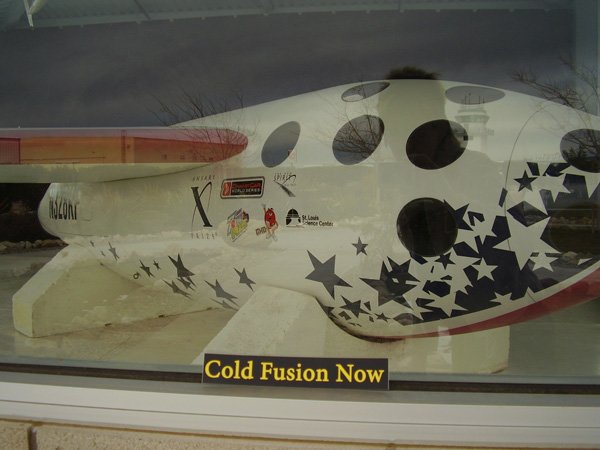
spaceship1_P1070034

After the Spaceport, I hightailed it to Roswell, New Mexico to drop some CFN stickers off at the UFO Museum. The ladies at the desk were excited and happy to hear about this new source of energy.

When humans develop cold fusion rocket engines, we’ll be able to meet our future head-on in the far spaces of our solar system, and beyond. I took this photo of one of their displays just for fun. Too bad I didn’t use the Free Energy For All Mankind sticker….
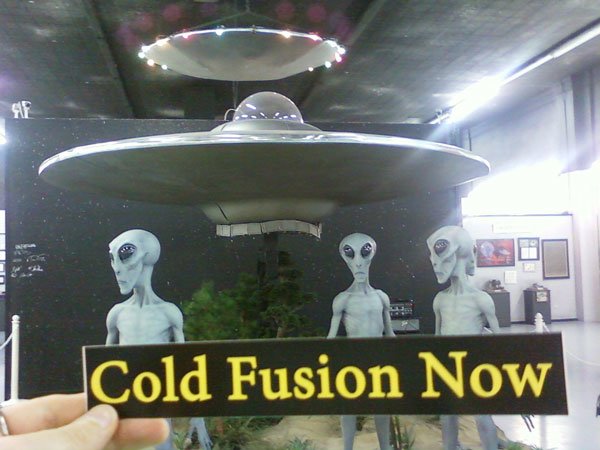
roswell_cfnSSPX0462

After Roswell, I just tried to make it through Texas, where there is a drought and it’s over 100 degrees Fahrenheit almost everyday. Wildlife is in trouble all over the southwest as humans drain every drop of water from the wilderness, and food supplies are short. The sides of the road were littered with carcasses. Very disturbing.

Driving my giant Ford F350 diesel truck with NO air-conditioning was a challenge, and everybody passes me as I only travel 55 miles per hour to save gas. I finally made it to Pensacola, Florida, one of my favorite places.

I pulled over on Highway 98 which hugs the coast along one of the most beautiful stretches of beaches in the US. I wanted to see if there were lingering effects of last year’s BP Oil Catastrophe apparent on the beach. I dug a small hole about a foot deep and didn’t see any oil. A few sample holes along the Florida Panhandle also yielded no apparent oil, and I was glad of that. However, Gulf wildlife are still recovering, oil continues to “leak” throughout the ocean floor, and residents are continuing the battle with BP.

We all need to stop our oil addiction (as I’m driving 4000 miles across the US) and that’s why we are so strong in our support of cold fusion science, for there is nothing else that will provide the kind of technological future with a clean footprint.

I finally made it to South Florida where Cold Fusion Now will operate our satellite facility through the end of the year.

I must take special note of an air conditioning repairman in the SoFlo parking lot with whom I struck up a conversation. As I asked him if he had heard about cold fusion, he said no, but it reminded him of the movie The Saint with Val Kilmer and Elisabeth Shue. I told him he was spot on, although it doesn’t light up the sky like in the movie.

All in all, relocation from Eureka, California to South Florida has been an adventure. Alot of conversations, alot of sticker drops. In a new sub-tropical location, the Humboldt fog and Redwoods are far behind, but the education and activism continues – until we have Cold Fusion Now!

SSPX0490_pensacola_beach

Related Links

Cold Fusion Now Cross-Country Tour 2012 Ruby Carat returns to the Left Coast

Response from the Secretary of Energy

Cold Fusion Now recently sent a second letter to the Department of Energy DoE requesting remedy to the lack of funding for LENR research. 30 signatures in support of the letter were collected over two hours from concerned citizens during an event at the beach.

We are gratified to receive a response from Mr. Eugene A. Henry, though it was not the response I had hoped for.

“However, it is clear the topic of low energy nuclear reactions remains highly speculative and that the purported mechanism has not yet been validated by the physics community as a reality.”
–Mr. Eugene A. Henry

On May 1, 1989, the Spring meeting of the American Physical Society held a Special Session on Cold Fusion. Just over one month after Professors Fleischmann and Pons made their announcement, scientists were trying to sort out the results from hasty experiments attempting to reproduce the excess-heat effect.

The most vocal of the group were all negative about the veracity of the claim, and apparently, they won the day, and the next two decades. Funding by the Department of Energy was denied to cold fusion researchers and they pointed to statements from this meeting to justify why.

Current Under-secretary of Energy Steve Koonin was at that meeting more than two decades ago, stating that there was no reliable confirmation [of the excess heat effect], and “we are suffering from the incompetence or delusions of Fleischmann and Pons.”[1]

Twenty years later, with the world on fire, and a 100% reproducibility rate available for LENR, we can no longer ignore this solution to our energy problems.

Make postcards, get your friends to sign them, and send them to the Department of Energy. We need a miracle on Pennsylvania Avenue.

Response from the Secretary of Energy

Special Session on Cold Fusion the American Physical Society May 1-2, 1989 Report

Cold Fusion Art Audio Action by Eli July 8, 2011

More Messages through Postcards

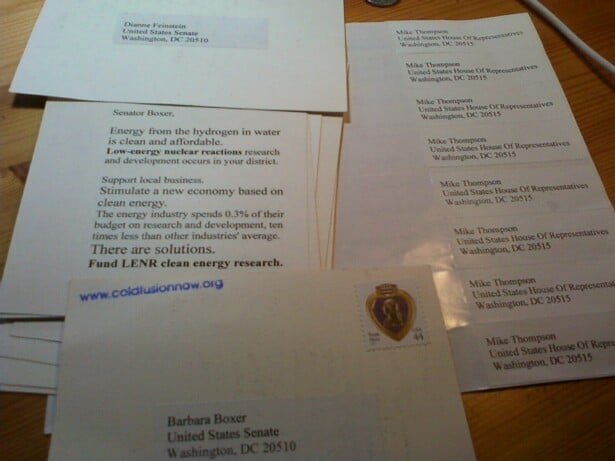
There was a lone page of free address stickers to the Senators from California, US and a Humboldt County Representative to Congress that didn’t make it for that wildlife conservation campaign last year…sigh.

Not wanting them to go to waste, I printed up some postcards supporting LENR research, and dropped the sticker address on them.

Why send one letter with lots of signatures when you can send multiple post cards each with a signature – the number of them making a greater physical impact in the mailbag? (Reason: postage! Maximum size: 6 inches long by 4-1/4 inches high by .016 inch thick for US postage rate of $0.29.)

Post Cards
The Senators from California will receive multiple messages of support for LENR research with these postcards, each hand-signed by a different person.

After applying stamps, I say “super-dense clean-energy from the hydrogen in water”, and people are happy to sign.

Surely our Senators from California know of this research. Surely this was brought to their attention. Surely they know what type of energy research is occurring right in their own districts.

Whatever their state of knowledge, legislators, those holding government office need to hear from us. If our present energy brokers don’t do research and development, for clean energy or otherwise, then the federal government needs to address this.

Energy Industry R&D Spending
Energy industry R&D is paltry compared to other industries.
We need action on a viable alternative energy.

The energy industry spends 0.3% of sales on research and development, ten times less than the average for other industries.[1]

Energy from the hydrogen in water is clean, safe and affordable.

Low-energy nuclear reactions research occurs in your district!

Support independent business.

Stimulate a new economy based on clean energy.

There are solutions.

Fund LENR research now.

Getting out in the streets and collecting signatures is fun, and you give people the gift of feeling as though they are acting for something beyond themselves. Filling up a mailbag with physical messages for new energy research is a small step in turning that feeling into a habit.

From Dynamics and Bifurcations: Small changes in any parameter can completely alter the phase portrait.

Related Links:

[1] A Business Plan for America’s Energy Future Energy Innovation Council Report

“Federal involvement” fired-up moon launch; private investment will light New Fire

The early days of the space race between cold war foes the United States and Soviet Union were set in a world of plenty for the victors of World War II.

Colliers Magazine

After the centrally-planned, collective effort to retool industry for war, an attitude prevailed among American citizens that the most important new technologies would not result from work in the private sector, but would derive from federal initiatives.[1,177]

President Kennedy’s decision committing the nation to sending a man to the Moon before the decade was over was made in a milieu of broadening federal engagement with technology.

This is the thesis put forth by author T.A. Heppenheimer in his book Countdown: The History of Space Flight who noted federal involvement in new technology had been ongoing in the US since President Lincoln built the first transcontinental railroad in the United States “by awarding generous land grants to the builders of the Central Pacific and Union Pacific.” The Panama Canal, Depression-era dams and water projects, and later, President Eisenhower‘s interstate highway system of the mid-50s are all mentioned as historical precedents for federal support of new technologies that serve the public interest.

He mentions jet airliners and commercial nuclear power [the dirty radioactive kind] as technologies created by transforming “major military systems into products that would create new industries in the civilian market”. All of these projects “demonstrated dramatically the scale of activity that Washington was now prepared to pursue.”

Whether for the public good, or, prestige and technological superiority among nations of the world, the services and disservices of these industries are directly related to the systematic mobilization of diverse resources towards a common end.

President Kennedy Speech
President Kennedy To The Moon Speech
People in the mid-20th century saw government as “the formation from which new technologies would flow”, and generally trusted what their government said. If the push to appropriate taxpayer dollars in support of new technology was so apparent in the space program, the absence of sustained and coordinated federal involvement for a new, clean-energy technology is all too evident today. The fossil fuels that built the large public works projects of the last hundred years are depleted and manufacturing industries have been exiting North America for decades. In “the long, slow afternoon” [2] of American might, the consumption economy uses arcane financial instruments to glue together the remnants its petro-dollar past.

We march backwards into the future.
Marshall McLuhan The Medium is the Massage

The public and private collaborations that have generated and delivered energy for over a hundred years have done so at a high cost, environmentally, financially and socially. The patchwork scheme of multiple generations of technology that has provided power thus far, sputtering with age and neglect, is neither efficient or sustainable for our future.

Given the fundamental nature of energy in our lives, federal engagement in the development of clean, safe and efficient energy seems appropriate. But the national undertaking that characterized the Apollo project in the 1960s will not occur in the current climate of segregated interests. Even in a time of crisis, there is no call from the President to participate in a renaissance of invention, for either the public good or the prestige among nations, and there are no contracts forthcoming. Even were that to occur, our population has lost trust in a governing class that has forgotten the integrity of mission and succumbed to compromises with large donors.

President Carter
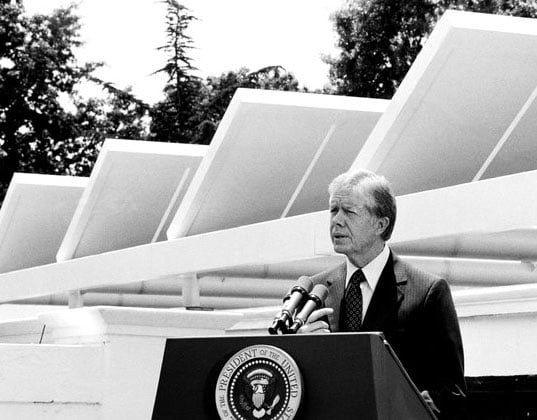
President Carter put solar panels on the Whitehouse in 1979.
The last effort to redirect energy policy on a national scale was in 1979 when only the image of confidence in federal initiatives remained and President Carter put solar panels atop the Whitehouse in a symbolic gesture meant to redirect attention on renewable energy. They were subsequently eliminated by his successor President Reagan who moved the country back into an even deeper reliance on fossil fuels, and whose legacy we live with today.

The age of Chemical Energy ends with Peak Oil. We have a future with new-energy, or we will have no technological future at all. The inability of federal institutions to move quickly to develop LENR energy technology means private investment bears the burden. Though projects that posses technical risks are “unattractive to Wall Street”,[1] eventually, demand will insist upon it.

But the Rossi Effect, the heightened interest of venture capital in LENR devices since the demonstration of the E-Cat earlier this year, is certain to grow and recent news of one private company’s plans to work with a national lab on reproducing their results as a pre-requisite to funding is a positive sign of cooperation between public and private enterprise.

The ‘expert’ is the man who stays put.
Marshall McLuhan and Quentin Fiore The Medium is the Massage

Lauded aeronautical engineer and designer of Spaceship 1 and 2, Burt Rutan headed his own spaceship company with a small band of dedicated individuals in the scrubby deserts of Mojave, California and succeeded in creating a new industry of space tourism with the private partnership of Paul Allen, the X-prize Foundation, and Sir Richard Branson. A critic of NASA’s budgetary choices, he saw the future of space in private enterprise.

“Manned space flight is not only for governments to do,” says Rutan. “We proved it can be done by a small company operating with limited resources and a few dozen dedicated employees. The next 25 years will be a wild ride; one that history will note was done for everyone’s benefit.”[3]

We say the same about cold fusion energy. Small, independent companies are right now sacrificing sweat and tears to follow a dream that takes humankind to the next phase of development for all the world’s benefit.

A new energy technology that uses a fuel of water can save the Earth from further degradation and reap rewards beyond our present imagination, but encouragement for these intrepid inventors is needed from the public, both morally and financially, to simulate the “federal involvement” that succeeded so well in landing humans on the Moon.

There are no passengers on Spaceship Earth. We are all crew.
Marshall McLuhan [5]

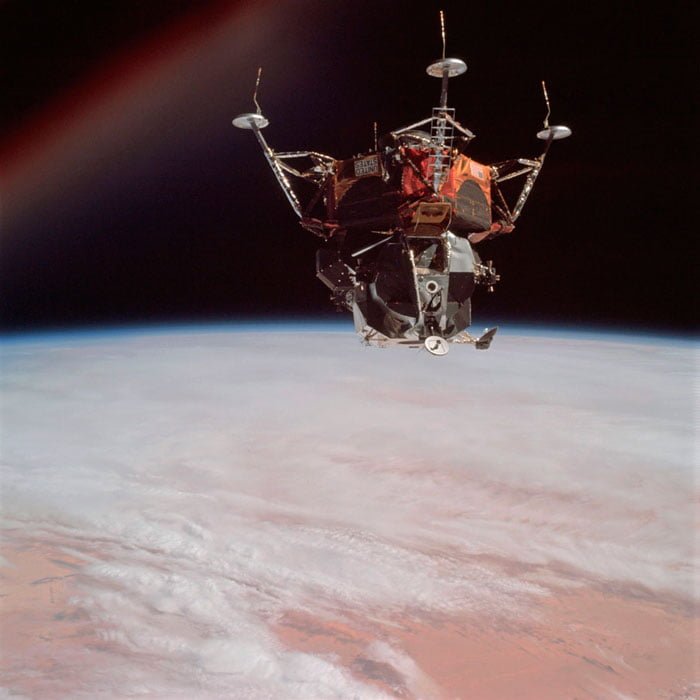
Apollo 9
Apollo 9 tumbles above planet Earth.

Supporting Links:

[1] Countdown A History of Space Flight by T.A. Heppenheimer publisher’s Wiley website.

[2] John F. Kennedy “That is what we have to overcome, that psychological feeling in the world that the United States has reached maturity, that maybe our high noon has passed and that now we are going into the long slow afternoon.” 1960 campaign speech.

[3] Scaled Composites: Burt Rutan About

[4] The Medium is the Massage by Marshall McLuhan reprinted by Gingko Press.

[5] Marshall McLuhan from Famous Quotes.

[6] Happy 100th Birthday Marshall McLuhan! celebrate with McLuhan on Maui July 21rst, 2011

The New Fire


You know, sometimes dreams are more important than actuality.
Andrea A. Rossi EVWorld interview

C’ mon baby, light my fire.
Jim Morrison

texas-wildfires-2011
Wildfires dot the mountains surrounding the McDonald Observatory in West Texas, US

Our planet is heating up.

Whether its rising temperatures, or the limits of human tolerance, we’ve reached a bifurcation point, and a phase change is in progress: the age of Chemical Energy is ending.

The degradation of the physical environment mirrors the perversions of human perception that have reduced our bodies and souls to numbered sacks of biomass starved by our own virtual fantasies of infinite growth upon a finite Earth.

But as the world burns, a discovery of such magnitude that it guarantees humanity another chance at life is coming to light, literally, an opportunity to heal the wounds of industrial expansion and allow Earth’s biosphere to emerge as the greatest work of art ever shaped by man.

This newly developing energy technology is based on the discovery announced 22 years ago by Drs. Martin Fleischmann and Stanley Pons, and after two decades of assiduous research, a simple hot-water boiler called the Energy Catalyzer will be the first model of breakthrough engineering based on that discovery with a planned commercial release for industrial applications in the last quarter of this year.

The heat-energy reactor is the invention of Andrea A. Rossi and he calls it the New Fire. The New Fire is described by it’s developers as a nickel-hydrogen exothermic reaction for it uses a fuel of hydrogen gas and a powder made of nickel. Infused into the nickel powder at high-pressure, the hydrogen reacts with the metallic nuclei creating a huge amount of heat well beyond that of any chemical interaction.

Internal E-cat proto-type
A test of the early proto-type of the E-Cat. photo: Mats Lewan

One early test of the Energy Catalyzer E-Cat reportedly produced over 15 kilowatts of heat energy over 18 hours. In Low Energy Nuclear Revolution a documentary video from PhiZero,[1] one of Mr. Rossi’s collaborators Sergio Focardi, himself a longtime researcher in these types of nickel-hydrogen systems, said of the early E-Cat tests, “On average the relationship between thermal energy gained and input electrical energy was on the order of around 200 times.”

Another collaborator of Mr. Rossi’s, Giuseppe Levi, described an early test of the E-Cat where an astounding 120 kilowatts of power was produced, at which point it was turned off. “We restarted it, and the system ran for one hour at 40 kilowatts,” said Mr. Levi. “I saw that it was capable of being self-sustaining.”

You cannot step into the same water twice.
Heraclitus

The Fleischmann-Pons Heat Effect FPHE was first studied in a glass beaker using a heavy-water solution and a small, solid piece of the metal palladium, but with that initial system, the effect of excess heat was difficult to reproduce. Today, nano-sized particles of metal such as nickel, platinum, titanium, and others, are the medium that support reproducibility. The plethora of metals that create the nuclear active environment where the reaction occurs is further diversified by the fuel of hydrogen, which can be either in gas or liquid form and even in the form of water.

There are three forms of hydrogen: protium, deuterium, and tritium, and possibly even more in the form of hydrinos, hydrogen purported to exist in fractional ground-states. Both protium and deuterium have been used to initiate energy-producing reactions, while tritium is a sometime by-product of the reaction whose presence reveals the nuclear nature of the reaction.

halpha_shassa_big
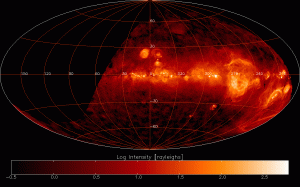
The red visibile light of hydrogen in the southern sky.

Hydrogen makes up about 75% of the chemical mass of the universe and is the most abundant material that exists. Indeed, three-fourths the mass of our Sun is hydrogen, and the reactions that keep our Sun alive begin with the fusion of hydrogen nuclei deep in the interior. On Earth, hydrogen makes up the bulk of water.

Chemically, water is H2O, meaning two hydrogen atoms and one oxygen atom together make up a water molecule. Continually replenished on Earth by the solar wind and cosmic particles from interstellar space, hydrogen is “the ultimate renewable energy resource”.[2]

Hydrogen can be burned just like oil or gas, and this is what many alternative energy advocates are proposing when they discuss hydrogen technologies, but that is not what the New Fire does. Chemical burning of fuel is a process that involves the outer electrons of atoms as they mix and match, forming new compounds as well as energy. Wood and oil burn, but the New Fire is a reaction of nuclear dimension whereby protons, the nuclei of the hydrogen atoms, interact with electrons and other nuclei to liberate energy many times greater than any chemically-induced process.

Neither is the excess heat of the New Fire the process of fusion that occurs in the Sun’s plasma. While the theory behind the reaction is unknown at this time, scientists piece together scraps of 20th century modern physics in an attempt to describe a 21rst century phenomenon: clean, dense energy from the most plentiful material in the universe.

Prehistoric humans discovered fire

Not having a definitive theory won’t stop this technology from materializing out of the Mystery Landscape, nor will it be stopped by the virtual silence of the mainstream scientific community and media which has been deliberately hostile to this research in the past. Historically, just about every new technology ever introduced was brought into existence without a theory first. Humans discovered fire hundreds of thousands years ago, and it’s possible that as far back as 800,000 years, our ancestors made opportune use of natural fire in the environment.

They did not have to know how it worked, only that it did.

It was Marshall McLuhan who noticed that “the biggest secrets are kept by public incredulity”. We the public are surviving in the after-image of 20th century myopia with little knowledge of this epoch-making advancement in energy technology. But when the mass of men realize that a solution to scarcity exists, and this solution is available to all, power will re-distribute around the globe “at the speed of thought”.[3]

The New Fire will be able to replace radioactive fuel assemblies one-for-one, generating ultra-clean steam heat for today’s power plants, but an off-grid, clean technology that uses a fuel of water decentralizes power allowing individuals and local communities to better control their own energy choices.

greek protestThe New Fire is not an incremental change in existing energy technology introduced by multi-national corporations. The New Fire does not recognize the hierarchy of centralized authority, and will not be stopped by parochial notions such as “reputation”. The New Fire burns through satellite links sparking the minds of young people who haven’t the prejudices of their parents, and who will not wait patiently while their future is mortgaged by distant incorporated entities.

The New Fire comes from the curious tinkerings of those who believe they really can change the world, and aren’t afraid to succeed.

In their book Breakthrough Power, authors Jeane Manning and Joel Garbon describe some of the opportunities that exist with a green and plentiful energy like the New Fire. The list included:

“rewarding, life-affirming work that enhances human dignity and contributes to the planetary clean-up and advancement of global society. Low-cost energy permits recycling on an unprecedented scale, and the unsightly gigantic heaps of trash that previously blighted the landscape are transformed into valuable mines of recovered resources.”

“The world’s thirsty families are supplied abundant and pure drinking water extracted from the atmosphere itself or by desalination of ocean water. Depleted farmland is restored to productive agriculture. Stream, rivers, and aquifers are no longer exhausted by damaging diversion and over-pumping, but are restored to their natural balance, permitting fish stocks and streamside ecosystems to thrive once again…”

“Food can be grown anywhere – even in the desert or arctic conditions – in compact, multi-level greenhouses whose natural heating and lighting are augmented by energy easily and cleanly extracted from space itself.” –Breakthrough Power

And

“…imagine how both the environment and and the forest industry would benefit if new energy technology resulted in a fuel-less helicopter. Suddenly selective harvesting of trees from the air would be economical. No logging roads would be needed. Instead of clear-cutting swaths of forest, heli-loggers could selectively thin the weakest tress. Forest could be restored to pristine “old growth” status.”

“Without the need for hydroelectric power, there is no need to dam rivers. With certain dams dismantled, salmon in the northwest would be able to easily return upriver to spawning grounds. The vitality of cool, clear, unimpeded flowing waters could be restored.” [4] –Breakthrough Power

The ideas and dreams of new-energy researchers have imagined some of the possibilities that the New Fire may bring. Jed Rothwell‘s Cold Fusion and the Future describes many more solutions to be derived from this technology. But all these fantastic possibilities are not guaranteed.

We as citizens have to be ready to participate in co-creating our society and demand the tools to do so. We cannot expect others to create the reality we want to live in if we’re not willing to put any effort in that.
Birgitta Jonsdottir Icelandic Parliment July 5, 2011 Ca$h Flow

Humans may never appreciate the beautiful and delicate world we inhabit until other worlds are explored, for as exotic and amazing as they are, toxic gases and the severe cold vacuum of space will not support our life without layers of artificiality. The pleasant air, the sweet water, the elegant variety of life that complements beautiful formations of forest, plain and desert are unique in our corner of the universe, with not another living sphere in sight.

Earth, our home – it is this world we must care for. It is this world we must preserve, this time, with our eyes wide open, and the New Fire to light the way.

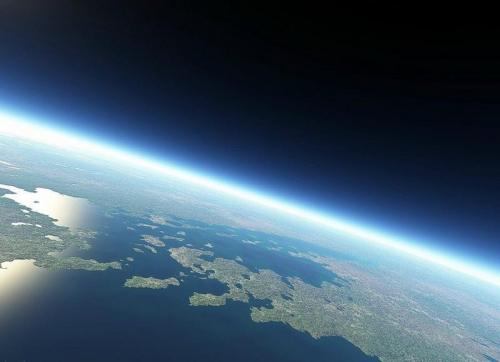
Earth's atmosphere
Thin, delicate atmosphere of Earth protects all life on the planet.

Supporting links:

1. Low Energy Nuclear Revolution from PhiZero by Ivy Matt June 23, 2001
2. Robert E. Godes Funding dam (almost) breaks for Brillouin boiler that uses – water! –Ruby Carat July 7, 2011
3. “Now, we’re living at the speed of thought.” Bob Neverit Ca$h Flow July 6, 2011
4. Breakthrough Power by Jeane Manning & Joel Garbon www.breakthroughpower.net
5. Cold Fusion and the Future Part 1: Revolutionary Technology Jed Rothwell Infinite-Energy

Funding dam almost breaks for Brillouin Boiler that uses – water!

He’s young, brilliant, and the designer and engineer of a hot water boiler based on LENR technology in – Berkeley. His name is Robert E. Godes, the Chief Technical Officer at Brillouin Energy, a company he founded that’s now hosting visits from venture capital groups finally ready to partake in “the greatest investment opportunity of the 21rst century”.

In December 2006, Mr. Godes’ first test cell was an open beaker using palladium wire and ordinary distilled water, yet this simple system achieved an excess heat up to 45%.

The newest device began operating in October of last year and is a pressurized nickel-hydrogen system that has allowed superior calorimetry measurements. According to the Early Phase 2 Data Report, this cell generated excess heat output greater than 100% in February of this year. (You can read the Phase 1 and Phase 2 Data Report on the Brillouin Energy website).

With steady progress meeting each company milestone, the lab runs with a skeleton staff, including volunteers. Negative perceptions about the field of LENR research have discouraged potential investors. One possible private donor seeking a technical evaluation was informed by a National Science Foundation member (whose review entailed “a quick scan” of the Brillouin Energy website) that it was “quite possible they had created the ‘instant death’ version of cold fusion”.

Sigh.

The very much alive Mr. Godes does believe this is a nuclear reaction, but to quote Nobel Laureate Julian Schwinger, whose 1991 A Progress Report paper you can down-load from the Brillouin Energy website, ”The circumstances of cold fusion are not those of hot fusion.”

Brilloun Boiler
Robert E. Godes uses proprietary electronic "Q-pulses" to stimulate the reaction. Q-pulses are a central feature of his Quantum Fusion Hypothesis which attempts to explain LENR reactions theoretically.

The reaction is not only safe, but clean, and the fuel is abundant. According to Mr. Godes:

“Fusing the Hydrogen out of H2O results in 355,000 times more energy than is contained in the same volume of gasoline. The Hydrogen used in the fusion process is continually replaced by solar wind and interstellar space: the ultimate renewable energy source.”

Thanks to recent demonstrations of Andrea Rossi‘s Energy Catalyzer and the plans to commercialize this technology, venture capital has finally taken notice of the potential. Brillouin Energy is fielding calls from new investors and will now be working with Los Alamos National Lab LANL to replicate Brillouin’s work. First, a confirmation report from a nationally recognized lab, and then the funds.

We recently asked Mr. Godes a few questions about his boiler design and what’s next after funding.

Q&A with Robert E. Godes of Brillouin Energy

CFN How did you first get interested in this form of energy production?

REG I was talking with another engineer at work in 1992. He told me about Cold Fusion. When I asked him about the use of palladium for the cathode, he told me that they used palladium to filter hydrogen. Filter hydrogen? I asked. Helium will not pass though it? No!

CFN Which came first, your Hypothesis or the experiments?

REG I knew that the Hydrogen atom was almost twice the size of Helium (corrected!) atom. So when I herd that helium would not pass but hydrogen would, I formed my hypothesis almost instantly. At that point I started studying material science. Once the hypothesis was solid, it was used to drive the design of the control systems to run the experiments.

CFN You are also using nickel-hydrogen system for your reactor. How does your design and process differ from Andrea Rossi’s?

REG The IP [Intellectual Property] I filed in 1995 includes some aspects of what Rossi is doing, but there are problems in trying to move the technology he is developing into production. He may have trouble meeting his deadline for the 1MW reactor as it could be difficult transferring the technology to other licensees for production.

He had a smiler problem with a potentially great technology doing direct thermal to electrical conversion. The manpower needed to produce and tweak Rossi units will limit profit margins. He would have a much easier time doing small units consisting of single devices for consumers, but insurance companies will not allow home use due to safety issues. The safety issues with the Rossi device will not likely have to do with radiation. Brillouin Energy Corp. (BEC) technology will be more reliable making it the market winner. Safety issue #1: we use the hydrogen out of ordinary water (H2O) in the form of water.

The technology BEC is developing will be easier to manufacture and transfer to licensees for market penetration and get approval for commercial and consumer use. I have significant experience in moving products from engineering to production with involvement in some products being produced at more than 100K units / year.

We only started working with the pressurized unit in Q2 2010. However we have already identified a large number of the variables that need to be controlled and how to control them. When we start production I expect it will be a much smoother ramp up than what Rossi is facing right now.

CFN What has your experience with the Patent Office been like?

REG Our first patent was initially rejected just on the basis of being cold fusion. However after some back and forth they said it actually looks like 5 to 7 patents and what would you like to prosecute first. So the application is still in process. My guess is we will not be granted a patent until we produce lots of data at industrially useful levels.

CFN What’s the next step in developing this newest test cell?

REG We have identified several variables that need to be controlled and ways to control them. Once we have access to the capital, we will be able to automate the process refinement and have several units to run the development in parallel. Till then, we are still making progress and figuring out how to best leverage the equipment we have.

CFN We look forward to your progress. Good luck!

REG Thanks, Ruby. What we really need is clean, dense, always available source of energy.

Related Links

Brillouin Energy Corporationcompany website

Brillouin Energy Technical Powerpoint with Audiodownload.pps.

The Quantum Fusion Hypothesis Infinite Energy Magazine Vol 14 issue 82 —download .pdf

Infinite Energy Vol 14 issue 82 —Table of Contents

Brillouin Energy Video of early open beaker test —download .wmv (Windows Media)

New Energy Outreach – in the Mall! –Ruby Carat April 10, 2011

Top