In the beginning was the Word, and the Word was with God, and the Word was God. –John 1:1 Holy Bible
The name cold fusion describes the biggest technological advance in energy since humans tamed fire. It also continues to generate intense emotional responses, both positive and negative.
Such is the Power of Word.
In this presentation slide below, he notes the vocabulary characterizing various aspects of condensed matter nuclear science. Dr. McKubre described a few of the terms during the introduction of the lecture.
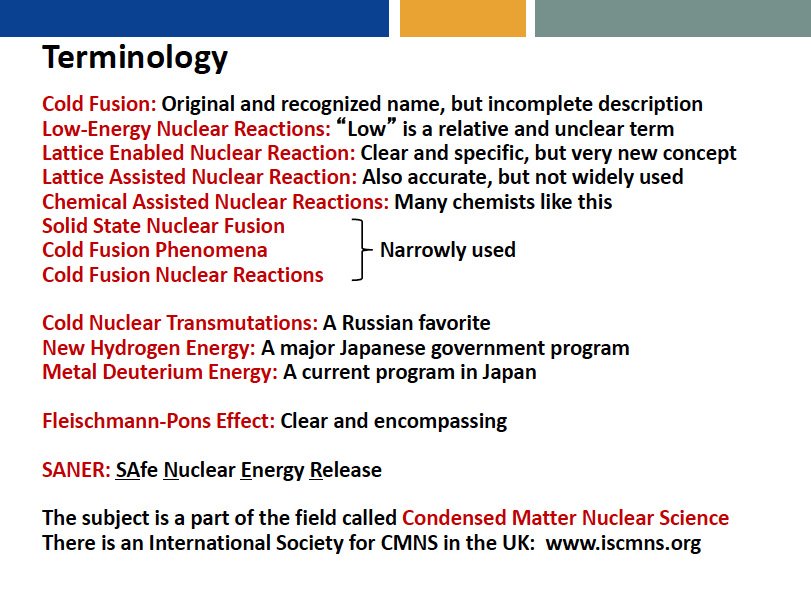
“All of these terms in red are used to describe what was announced on March 1989 as cold fusion. The term cold fusion actually came from previous work in hot fusion – muon catalyzed hot fusion.
The term stuck, it’s unfortunate, it irritated the physicists. I think the physicists would have been irritated anyway, but this didn’t help.
In attempts to soften the blow we’ve called it low energy nuclear reactions or lattice assisted nuclear reactions – LENR/LANR. Those terms are not very good. Low is subjective and pejorative – you know we don’t really want to produce low energy.
And nuclear is always a bad word. We took the nuclear out of nuclear magnetic resonance and called it magnetic resonance imaging because sociologically, nuclear is not a good term.
Chemically assisted nuclear reactions. A whole slew of things.
The Japanese rather coyly called it new hydrogen energy which really conceals a wealth under that phrase.
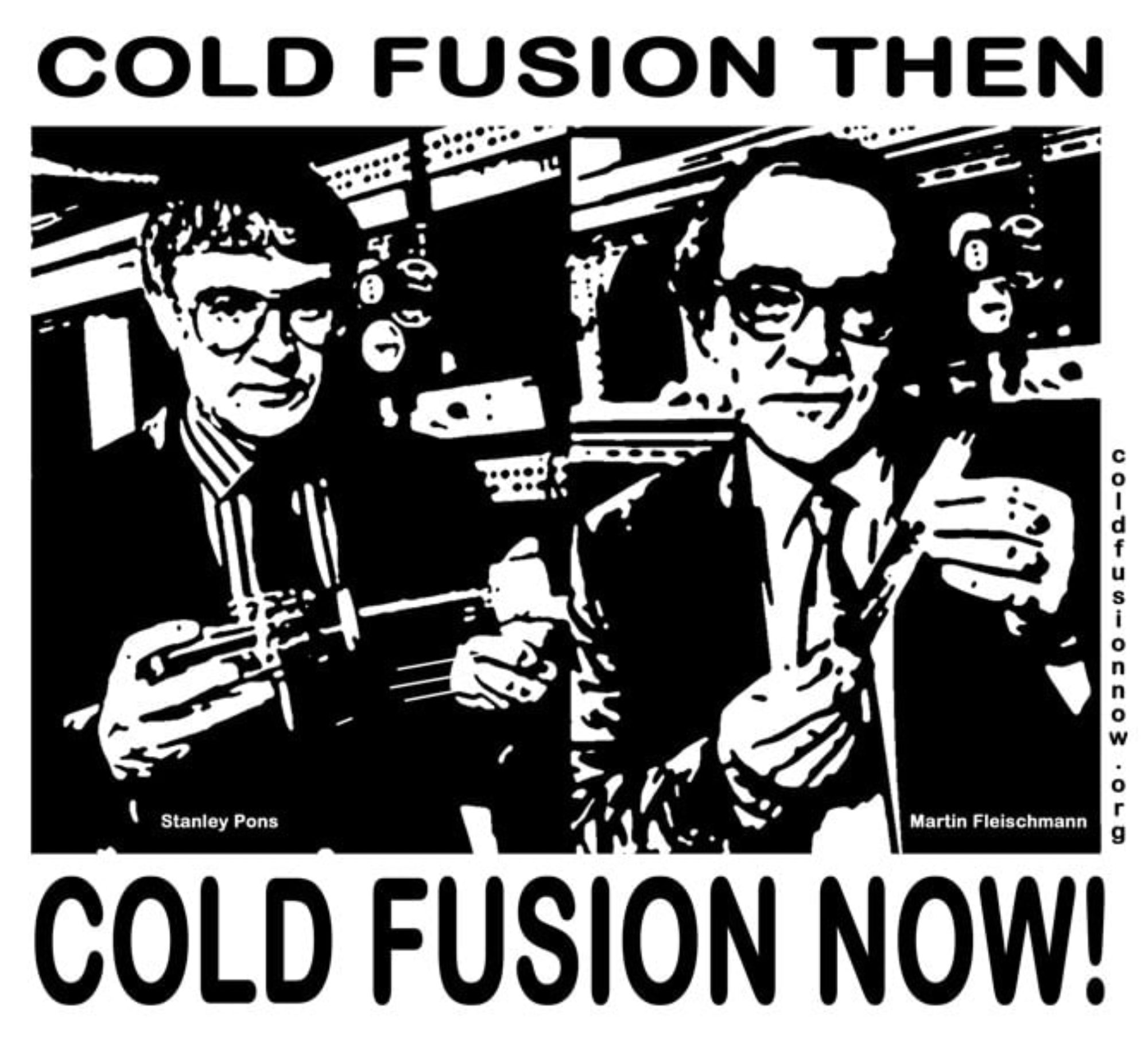
If we’re talking about the Fleischmann-Pons Effect, the effect that Martin Fleischmann and Stanley Pons announced to the world on March 23 which was the electrolytic production of excess energy from a cell containing heavy water D20 and a palladium cathode, then the Fleischmann-Pons Effect is an accurate descriptor.
But the field has expanded vastly beyond that, and we now have an overall terminology condensed matter nuclear science attempting to distinguish what we do from what physicists do with high-energy particles or high-temperature plasmas.” –Michael McKubre
Each name expresses a particular aspect of a highly elusive process that has defied explanation for more than two decades.
As long as there is no definitive theory and scientists are still not sure how this special excess heat effect is initiated, or what the Nuclear Active Environment really is, there will be no definitive name.
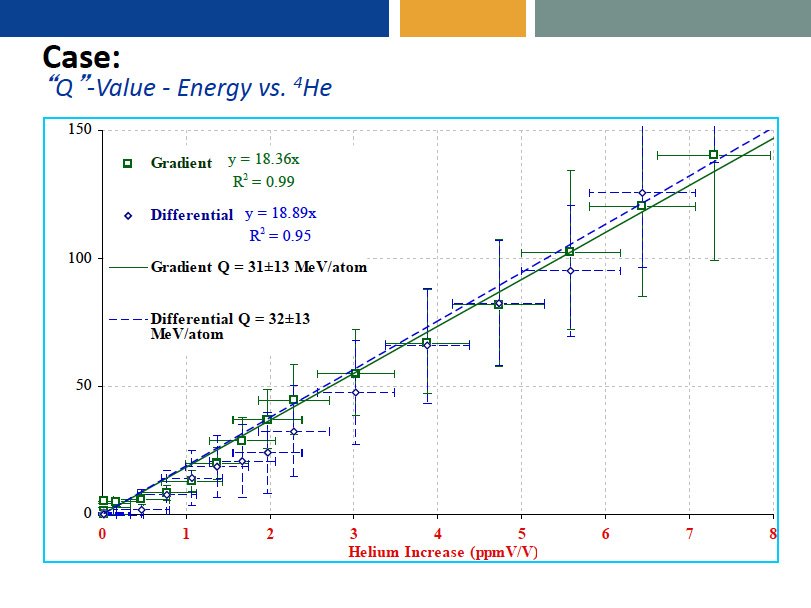
One reason the moniker ‘cold fusion’ has “stuck” is that, as the Palladium-Deuterium Pd-D systems have shown, deuterium in can give rise to measurements of Helium out.
In this slide from Dr. McKubre’s presentation, we see excess heat is positively correlated with the production of Helium. The slope of the line represents the rate of change of energy per helium measured and is close to 31 MeV, +/- the error.
Assuming two deuterium nuclei pair up to form a helium nuclei, the measure of the heat generated, or Q-value, would be 24 MeV. Dr. McKubre believes that the observed higher bias may be due to experimental design elements, and that a value closer to the expected 24 MeV Q-value is possible.
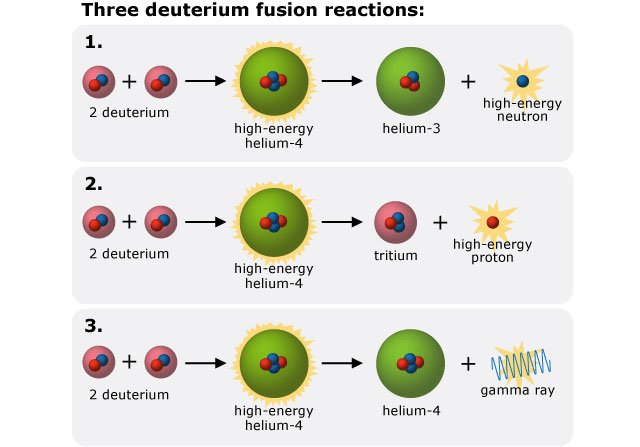
In Pd-D systems, two deuterium nuclei are somehow ending up to form a Helium nuclei, which is the essence of fusion, but not fusion as we know it now.
That can’t be all that’s going on either, for the excess heat effect is also generated from Nickel-Hydrogen Ni-H systems, which do not use a fuel of deuterium, but the simplest form of hydrogen, protium.
And because elements not originally present in a cell can be created during the process, there is also a transmutation effect, which could be from either fusion or fission inside the atomic matrix, or, some other new nuclear process.
For these outcomes to occur in different systems, creating multiple different effects, implies nuclear reactions occurring beyond conventionally known theories from 20th century physics.
Nevertheless, the name cold fusion reflects this idea of fusion occurring in “cold” circumstances, i.e. not hot plasmas.
“The future of the future is the present.”
Marshall McLuhan
In ancient times, before science, words were magic. Uttering a name gave power and dominion over that thing. Saying a word could bring whole universes into existence.
It will be remembered that Thoth is called the “scribe of the gods,” the “lord of writing,” the “master of papyrus,” the maker of the palette and the ink jar,” the “lord of divine words,” i.e., the holy writings or scriptures, and as he was the lord of books and master of the power of speech, he was considered to be the possessor of all knowledge both human and divine.

At the creation of the world it was he who reduced to words the will of the unseen and unknown creative Power, and who uttered them in such ways that the universe came into being, and it was he who proved himself by the exercise of his knowledge to be the protector and friend of Osiris, and of Isis, and of their son Horus. From the evidence of the texts we know that it was not by physical might that Thoth helped these three gods, but by giving them words of power and instructing them how to use them.
–E. Wallis Budge Egyptian Magic 1901
What we choose to call this transformational new energy technology will continue to evolve, until the secret formula is unlocked. In an instant, the simple, clear, perfect vision of our clean energy future will be summoned by a new and powerful Name. Scientists in every basement lab and every DOE office will be able to relax for a bit, and then get down to the hard work of implementing a revolution across the globe.
But the kids won’t care. They make up their own names. Change nouns to verbs, verbs to nouns, mess up the plural, create their own magic.
For this year, we’ll stick with Cold Fusion Now, not just cause we mean it, because it fits – and the kids dig it too!
Related Links
SRI International: “What happened to cold fusion?” video lecture with Michael McKubre at Cafe Scientifique by Ruby Carat November 21, 2011
Rumpelstiltskin Brothers Grimm from Short Stories


