The Leonardo Art Science Evening Rendezvous (LASER) series of lectures and presentations on art, science and technology is a project of Leonardo®/ISAST, started by Piero Scaruffi in San Francisco. Events take place at a number of venues: the University of San Francisco, Stanford University, UC Berkeley, UCLA and a New York Studio and bring scientists together with artists to foster inspiration and innovation between disciplines.
The UCLA Art|Sci center has two great events for you tonight and we’re looking forward to seeing you at both of them!
UPDATE: Thursday’s release:
First, from 5-7pm in our Art|Sci gallery (CNSI 5419), we’ll be exhibiting and play testing our board game, Dog Nose Knows! The game Dog Nose Knows evolved from the 2011 conference “Made for Each Other? Dog and Human Co-Evolution” as a fun and simple way to introduce the concept of a dog’s sensory world to people. In creating a game about a dog’s sense of smell, we hope to evoke the player’s curiosity in the sensory world of a dog – and how this sensory world differs from a human’s. Come check out the game art, meet the game designer, Adeline Ducker, and play the game yourself!
Later in the evening, we will be hosting our second UCLA Leonardo Art Science Rendezvous (LASER): Games People Play, from 7-9pm in the CNSI 5th floor presentation space! You’ll get to hear from the following people and interact with other Angelenos working at the intersection of art and science:
Nina Eidsheim (musicologist, UCSD)
Ruby Carat (Cold Fusion Now)
Blanka Earhart (independent media artist and author)
Douglas Campbell (Founder, ProjectFresh)
Adeline Ducker (Dog Nose Knows board game design / graphics)
Alex Groff (independent game and web designer)
Alison Lipman (co-founder of SELVA International)
Mathias Dörfelt (graduate student, Design | Media Arts)
Zac Harlow (graduate student in Ecology and Evolutionary Biology)
Paul Hunt and his son Ryan formed the Hunt Utilities Group (HUG) and initiated the Martin Fleischmann Memorial Project to reproduce and test cold fusion experiments.
They announced the project at the most recent International Conference on Cold Fusion ICCF-17 in Daejon, South Korea, and since then, have been experimenting with Francesco Celani‘s nickel wire, making surprising discoveries about the material. Their work is open-source and can be found at quantumheat.org.
While the reporter incorrectly states Paul Hunt as the originator of the name New Fire (that was Andrea Rossi), the story brings ultra-clean cold fusion energy news back to the TV landscape, and we love to hear it.
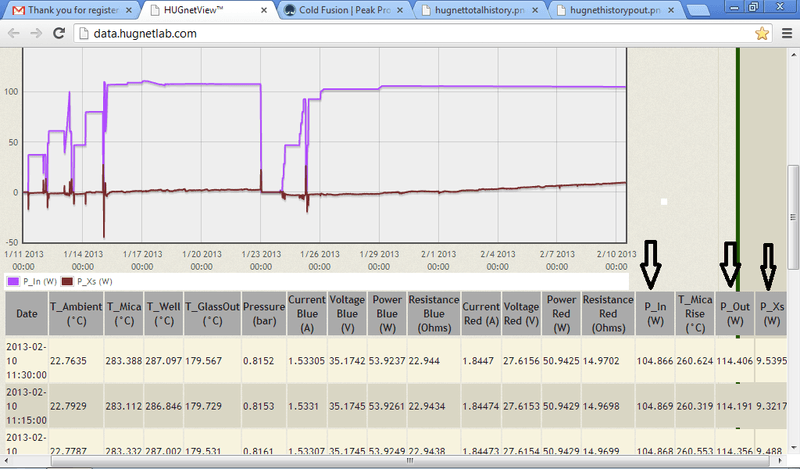
Cold Fusion Now associate Arthur Robey made this image from some of the Hunt’s publicly available data writing:
Choose the European cell, toggle all the lines off and then toggle excess power on.
Then choose dates from Jan 2nd to the present at 15 min sampling intervals. You will see a steady increase in the excess energy line.
Efficiency μ
=output power / input power (x100%)
=114.406/104.866
=1.091 p.u.
=109.1%
or nearly 110%!
Not quite commercial-ready technology, but for a project started only within the last year, it is a major accomplishment showing the reality of the science.
The self-funded project is seeking financial support and you can contribute. Make a donation at quantumheat.org and win a cold fusion “powder cell” constructed by the team!
New company LENUCO first reported here on Cold Fusion Now a year ago is now releasing more on its new LENR technology.
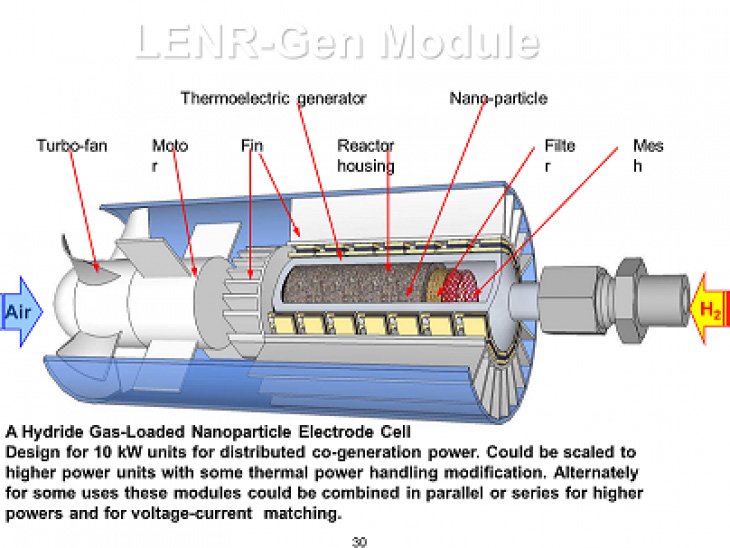
Designed by George H. Miley and his team, the LENR-Gen Module is conceived for 10 kw units, but can be scaled up for larger power needs.
VOTING has ended. No further info is to be found at this time…
Please Vote Now at Future Energy to give this project attention from ARPA-E.
Your vote will allow George Miley to speak at the ARPA-E Energy Innovation Summit Future Energy Pitching Session on February 25, 2013 6:30-8:30pm.
From the website:
Provide one sentence describing your core technology.
LENR Power Units use pressurized hydrogen –nickel nanoparticles undergoing low energy nuclear reactions to create a very high energy density heat source configured for co-generation power for home or industrial distributed power.
Short description of your technology
The recent discovery of practical applications of low energy nuclear reactions has created much activity and interest worldwide. Several companies, including LENUCO, have entered this business. Our approach using hydrogen loaded nanoparticles to produce heat that is converted to electrical output offers many advantages. Lenuco was founded to commercialize this technology and has a two-pronged business model. One prong is to manufacture small to medium range distributed power sources for home and industrial use. The second prong is to provide develop the technology for use by in Army bases, both homeland and in forward facilities, for a main power source. Both uses capitalize on the high power density and low maintenance, radiation free, long lifetime characteristics of LENR power cells.
What is the key element of your technology that differentiates it from existing solutions
LENUCO’s LENR power source is a revolutionary new technology based on high pressure hydrogen loading of nickel alloy based nanoparticles. Heat is produced by the resulting low energy nuclear reactions through a process which avoids any significant radioactivity. Uses range from home heating to central heating units. Compared to other renewable energy, LENR power units offer two distinct advantages: 24/7 operation and higher power density, hence significantly smaller units per unit power. LENR cells also provide power without greenhouse emissions and with no significant wastes. These advantages plus minimum maintenance and long lifetime result in a distinct economic advantage over other renewable energy sources as reflected by shorter pay-back times than solar, wind or fuel cells.
Watch Cold Fusion 101 Week 1 lectures with Professor Peter Hagelsteinhere.
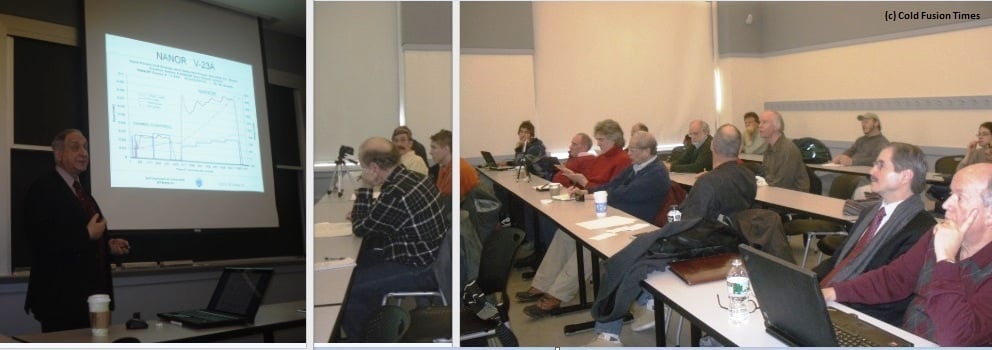
This video features course co-teacher Dr. Mitchell Swartz speaking on the experimental research done by his company JET Energy as they develop the NANOR cell.
Demonstration of Excess Heat from a JET Energy NANOR at MIT [.pdf] is a report by the course co-teachers summarizing the NANOR’s excess heat results from last year.
From Cold Fusion Times: Jan. 28, 2013 – On day 5, Dr. Mitchell Swartz continued with the substantial experimental proof for cold fusion (lattice assisted nuclear reactions). After discussion of the materials involved in the desired reactions, he surveyed the methods of calibration of heat producing reactions including the copious controls, time-integration, thermal waveform reconstruction, noise measurement and additional techniques, as well as those methods which are not accurate.
Many examples of excess heat generated by CF/LANR systems were shown, using aqueous nickel and palladium systems. Then using the Navier Stokes equation, he developed the flow equations for both “conventional” cold fusion and codeposition. Optimal operating point operation was shown to have the ability to determine the products, and how the OOP manifolds demonstrate that CF is a reproducible phenomenon, applicable to science and engineering.
He focused on the salient advantages of the LANR metamaterials with the PHUSOR®-type system being one example. Returning to the experimental results and engineering methods developed to control cold fusion, he surveyed “heat after death” and its control and useful application, and the use of CF/LANR systems to drive motors.
DAY 5 Part 1
DAY 5 Part 2
DAY 5 Part 3
Jan. 29, 2013 – On day 6, Dr. Mitchell Swartz continued with the discussion of cold fusion (lattice assisted nuclear reactions) in aqueous systems, beginning with the near infra-red emissions from active LANR devices, and the use of CF to generate electricity. Problems in the feedback loop were discussed. Then the focus was on the new dry, preloaded nanomaterial CF/LANR materials.
After discussing their novel characteristics and electrical breakdown (avalanche) issues, and which electric drive regions actually generate excess energy, he presented the development of several types of the NANOR®-type CF electronic components. Using multiple ways of documenting the excess energy produced, he presented the results of the latest series of such devices, such as were shown at MIT over several months in the second series of open demonstrations of cold fusion by JET Energy, Inc.
With energy gains from 14 and greater, these electronic components, in conjunction with advanced driving circuits, were shown to have excess energy documented by temperature rise, heat flow, and calorimetry; heralding their revolutionary potential to change the energy landscape in circuits, distributed electrical power systems, artificial internal organs, propulsion systems, space travel, and more.
The course begins with the theoretical lectures by Dr. Peter Hagelstein, a principle investigator of the Research Laboratory of Electronics at Massachusetts Institute of Technology (MIT) and leading theoretician in the field of condensed matter nuclear science (CMNS).
A second part now ongoing features an experimental component as Dr. Mitchell Swartz of JET Energy demonstrates his NANOR device.
Demonstration of Excess Heat from a JET Energy NANOR at MIT [.pdf] is a report by the course co-teachers summarizing the NANOR’s excess heat results from last year.
Hagelstein begins the first day of this year’s course with a warning: this field can be dangerous for your career.
Then why the new course?
“A lot of reasons, one reason is there are starting to become jobs in this area. There are companies that are pursuing technology in this area.”
“I’ve been contacted a number of times and the question goes like this: ‘Do you know anybody who is qualified to take a position to lead this particular effort – and participate in the effort – in the cold fusion business?'”
“And the answer is ‘No, there’s no courses, there’s no training, there’s no way for anybody to get experience’.”
Here is the first part of the Cold Fusion 101 course lectures. We apologize about the poor audio. You may need an external amplifier to hear it. Please feel free to download and process audio for mp3 clean-up! (And send me a copy!)
Thank you to all who participated for allowing this video to broadcast.
From Cold Fusion Times:
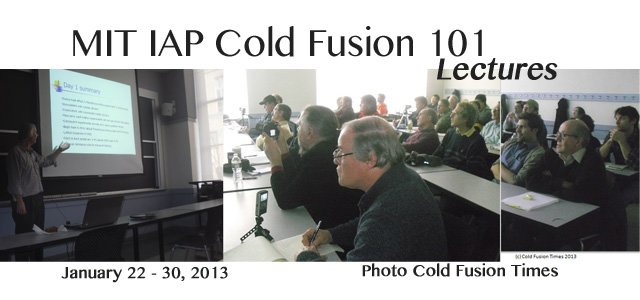
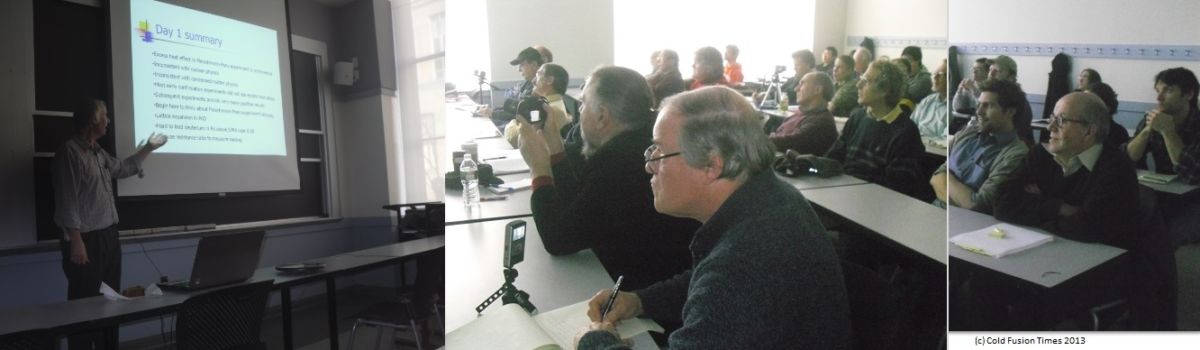
Jan. 22, 2013 – On day 1, attendees intently focus on Prof. Peter Hagelstein’s lecture on palladium hydrides and the role of the highly loaded lattice, beyond the miscibility gap, as required for achieving successful deuterium fusion in cold fusion (LANR) as initially (correctly) reported by Drs. Fleischmann and Pons in 1989.
1 DAY 1 Part 1
2 DAY 1 Part 2
3 DAY 1 Part 3
Jan. 23, 2013 – On day 2, Prof. Peter Hagelstein presented his original theory involving de novo helium formation in CF/LANR, specifically at vacancies surrounded by loaded octahedral sites, and made very clear -in that light- exactly why early attempts at reproduction of CF were so difficult to achieve. The roles of loading (Volmer, Tafel, and Heyrovsky reactions), chemical potential, sigma-bonded hydrogen, codeposition, embedded atom theories, vacancy diffusion and stabilization by loading, and the important differences between Pd and Ni were also made clear; as he tied these together based upon years of condensed matter data.
4 DAY 2 Part 1
Day 2 Part 1
Start Summary of Day 1
[copy Youtube]
13:40 Loading vs current density
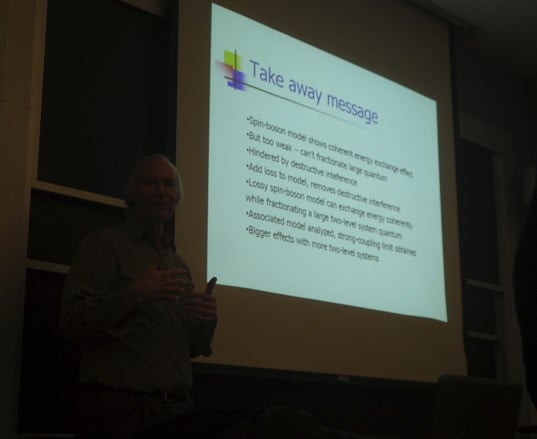
16:11 Take away message Electro-chSummary
16:50 Does the migration of H or D into the metal off the surface affect these relationships?
17:50 What’s the best way to measure loading, is it the resistance?
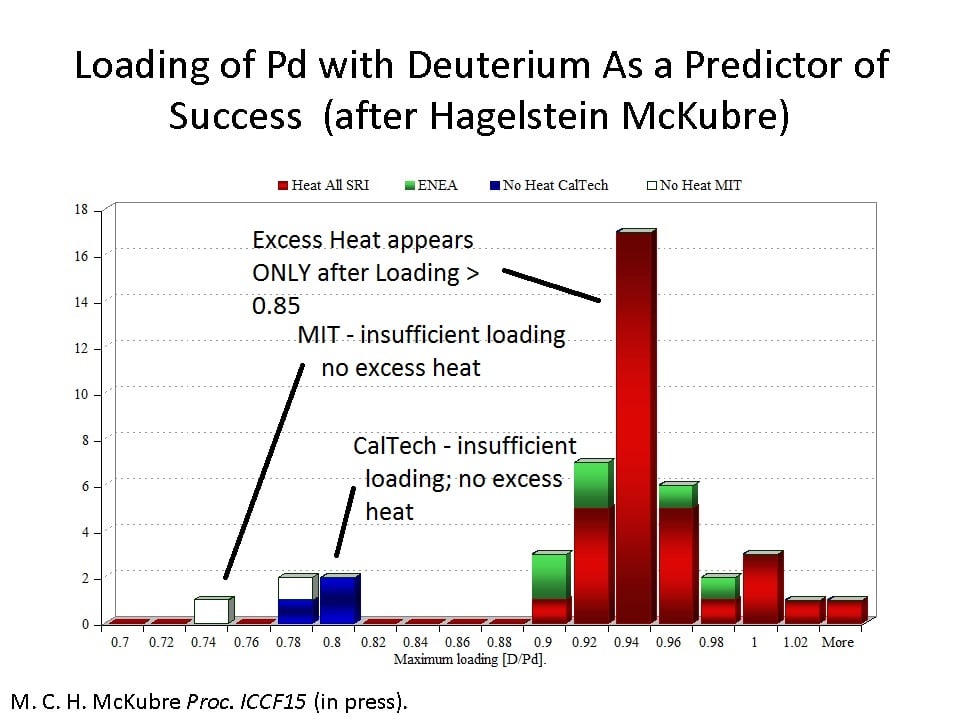
18:46 Excess Power vs Loading in Pd-D systems
19:22 Loading vs. Power data correlation from SRI
20:00 Threshold holding value around 0.85 D/Pd or less
21:19 Revisit the electro-chemical model and Green-Britz.
22:50 Akita et al data re-produce loading
23:30 What about effect of current on loading with respect to time?
24:25 Loading ratio D/Pd =0.93 at SRI
26:09 Loading and resistance with Superwaves. Woah.
27:19 How can the loading be so high? Why, with the “moving” Volmer-Tafel model?
29:30 It’s not Volmer, it’s Tafel.
30:06 I have lots of fractures and voids and fissures increasing the surface area, allowing the D to leak out, and that will increase the Tafel.
30:50 “internal surfaces” meaning cracks where D leaks out
30:55 estimating that effect
5 DAY 2 Part 2
6 DAY 2 Part 3
Jan. 24, 2013 – On day 3, Prof. Peter Hagelstein went through the experimental proof that de novo He4 production is commensurate with excess energy (Miles, and Case, and SRI experiments), and its rate of production is commensurate with excess power (Gozzi). He discussed the role of cell temperature in positive feedback in the CF/LANR system (Fleischmann, and Cravens, and Storms, and Swartz); and then focused on the problem associated with helium occupancy at the critical sites of CF/LANR in active systems. Moving through Rutherford issues to the Hamiltonian, he also demonstrated the roles of deuteron flux as well as loading. Finally, using an analogy similar to Corkum’s mechanism, he led the way towards the spin boson model of Cohen-Tannoudji, but demonstrated exactly where it was insufficient to explain CF/LANR in the absence of his discovery of the role of destructive interference and other loss and dephasing issues.
7 DAY 3 Part 1
8 DAY 3 Part 2
9 DAY 3 Part 3
Jan. 25, 2013 -On day 4, Prof. Hagelstein began with evidence, based upon PdD and D2O as the detectors, that de novo Helium 4 must be “borne” with energies below 10 keV or less, and that the upper limit for neutron production must be less than 0.01 neutrons/joule. Then, having demonstrated that destructive interference in the spin boson model prevents its use in CF/LANR, he corrected that, and expanded the Hamiltonian to now include coupling parameters and examined the quantum exchange characteristics based upon coherence.
Successful energy transfer was demonstrated to require interactions of all the atoms in the lattice. For further analysis, a donor-receptor system was then included. At that point, he showed how the Coulomb barrier need not be overcome, because by this method the factor is linear, rather than quadratic (needed for classical analysis of D+D interactions). Supporting this analysis is the Karabut data in glow discharge on Pd which yielded both diffuse emissions and collimated x-radiation. with beamlets of energy over a wide bandwidth, which were consistent with the theory Prof. Hagelstein developed.
Finally, he used the Foldy-Wouthuysen rotational operation, and demonstrated how this analysis is becoming asymptotic with what is being observed in CF/LANR, with the use of his corrected condensed matter nuclear science (CMNS) Hamiltonian. Finally, with the addition of nonlinear Rabi oscillations (which yields Dicke superradiance), his model was shown to also be near-complete and consistent with both the observed pulse emissions and the wide bandwidth.
26 uploads later, an open-beaker, plasma-initiated, electrolytic cell has evolved into the Confined Plasma Water (CPW)-type Inertial Fusion Reacteur that “solves the problems of the Z-machine” and “can produce a sustainable fusion”.
Working for 14 years in the pharmaceutical industry allowed him “to gain experience in a variety of fields, electronics, chemistry, microbiology, manufacturing process, ISO, production in explosive environments, etcetera.”
“Quite by chance”, he says, “during my thesis in Computer Science in 2008, I realized many autonomous robots polymorphic multiprocessor machines had one common deficiency: lack of battery life. So I looked for a way to feed my models by an energy other than the batteries.”
“I am interested in the lost discoveries of modern science, and at the time, I conducted many experiments on the work of Nikola Tesla, including the transmission of electrical energy without wires, and particularly on electrical plasmas.”
I stumbled across a publication Transmutation of metal at low energy by a confined plasma in water by D.Cirillo, A.Dattilo, and V.Iorio. It was a revelation.
“After a careful reading, I decided to realize the experience described in Tadahiko MizunoAnomalous Energy Generation falling on conventional electrolysis.”
Charles François now utilizes a high-voltage electrode immersed in a water-solution to initiate excess heat and transmutation products, according to his video release. Watch LENR-CPW Three Years of Research in 8 Minutes for an overview of the various types of reactors.
In section 6.25 of The Science of Low Energy Nuclear Reaction, Edmund Storms describes Electrolysis Under Plasma Conditions as “When voltage in excess of about 100 V is applied to an electrolytic cell, a plasma forms. This creates a high-energy environment, broad spectrum light emission, destruction of the cathode, chemical changes in the electrolyte, and heating of the solution. Occasionally, extra energy and transmutation products are observed.”
This cell-type has been reproduced in multiple labs around the world and at least as early as 1993 by T. Matsumoto. Two of these early experiments are described in papers linked here:
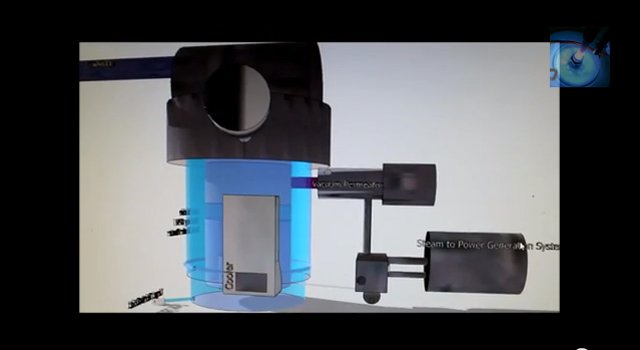
A few of the specifics about his new proto-type steam generator were released by Charles Francois on 12/12/12 in REACTEUR INERTIAL FUSION ENERGY TYPE CPW [.pdf], though most of the data gathered here is garnered from the video annotations.
A solid nickel metal cathode 4 grams or less, in a light-water solution with an input of 200 Wh will purportedly generate 2.5 kWh “conventional electrical resistance”, which FuturProbable calls “consumption divided by 10”.
Asked what he uses for an anode, he said “… different materials, Copper, Silver, Gold, Tungsten, Stainless Steel, Iron, Nickel, Aluminium, depending on the intended use.”
“For example, a boiler for the production of steam heat, the production of high-temperature steam for steam turbine power generation, or the nucleosynthesis and applications of a type Z Machine – for each of these applications, a particular type of electrode is best.”
François says the generator is under complete control and the power-adjustable unit can be turned off and on at will.
Steam production from the compact design begins in less than 5-minutes yielding “a thermal efficiency of 98%”.
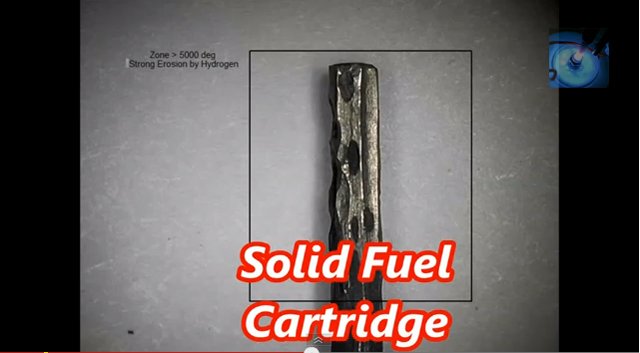
The proto-type steam boiler can operate at plasma temperatures between 500 – 3500 degrees Kelvin on average, and 5000 – 6000 degrees K at maximum power.
Watching his videos on the FuturProbable channel, you can see color and intensity changes of the emitted light, despite some of the video being filtered and treated with special effects.
He explains in the video Electric Sun Technology C.P.W. that “variation in voltage = variation in mass = variation in color”.
Electrolytic cells are more difficult to quantitatively analyze than other types of LENR cells, like gas-loaded. The complexity of reactions between chemical and nuclear must all be factored into the excess heat measurements, and the computations are long.
Storms wrote in 2007 The Science of …, “Study of this method has been difficult because conditions are very chaotic and the local temperature is very high. Voltage and current spikes occur, making applied power measurement difficult. Decomposition of the electrolyte makes a chemical balance hard to achieve. More attention needs to be applied to improving the design of the apparatus so that the many corrections presently required need not be made.
But Storms adds, “Of the various methods, this is the most spectacular and the one for which the highest power production has been reported.”
Excess heat by electrolysis under plasma conditions can be so great, calculations of chemical energy are moot.
A similar instance occurred with François’ CPW generator.
After operating “normally” with a stable plasma at 230 Watts power input, a warning for sudden temperature change occurs, and at 2480 degrees Kelvin, a sudden, sputtering burst vaporizes the “arm” of the electrode, and the cell goes dead.
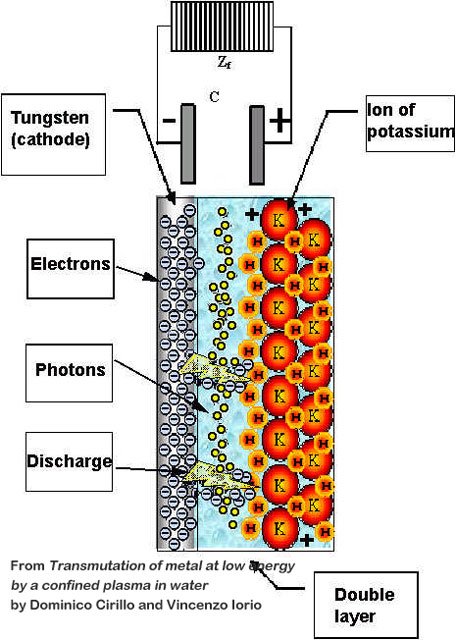
Applying it to their cell, they observe positively-charged potassium ions from the potassium-carbonate K2CO3 electrolyte solution appear to “condense around the cathode, without depositing on it, thereby generating a screen with a positive potential that holds itself a few nm from the electrode.”
Increasing the voltage causes hydrogen ions to block the cathode (they are so small, they pass right through the potassium-screen) which increases the resistance of the electrode.
“Once the region near the cathode acquires a sufficiently high resistance, the voltage drop between the potassium-ion shield and the cathode can cause a plasma to form, thereby forming a gaseous dielectric”, write Cirillo and Iorio.
Charles François believes that a “stable plasma in the electrolyte” is capable of catalyzing electron capture by protons, and the subsequent neutrons then initiate reactions that cause the transmutation, the source of the heat.
Self-described as “fully-independent, financially and intellectually,” Francois exemplifies the citizen scientist, capable and curious. After 24 years of incubation “underground”, the explosion of interest and wider-geography of experimentation, of young and old working together, independently, simultaneously, facilitated by the digital environment, is bringing new vigor to the field. While Youtube videos won’t generate clean, dense energy, or replace a concerted federal effort to understand and develop this energy lifeboat, they do inspire others to try and reproduce the results, and answer the dogged questions that have prevented this science from becoming a usable technology.
“We are currently in a phase of compiling our recorded data,” says FuturProbable. “2012 was a year full of lessons.”
As he prepares to move into a new lab space in the summer of 2013, “New experiments are emerging”.
“We plan to use the process to improve Celani gas recycling fusion. We would also like to explore new avenue of research including thermo-acoustic application integrated into our new reactor CPW.”
“This has profoundly changed my worldview and our “knowledge”, and more particularly, on what we understand. My work on wireless power transmission had prepared my mind for this phenomenal encounter with cold fusion, because I am still convinced that we live in a world electrical.”
We must stop showing beautiful laboratories unable to make a concrete demonstration, always conducting research that shows little results, and has led the public to believe the negative myth of Cold Fusion. We should not be content to remain in the shadow of giants missing out on this great discovery of 1989, and who live in fear of the independent laboratory, and lack the motivation, or worse lack the skills, to confirm our calculations and measurements.
I welcome the masterly demonstration of Mr. Andrea Rossi and Sergio Focardi, and for the development of this extraordinary device E-CAT, I support their fantastic discovery and hope that they bring it to fruition soon.
Cold Fusion is. We must now end this pointless debate. Scientific timidity has always been throughout history, and when great minds come to show us the extent of our ignorance, we must learn to question and learn. That which can not be explained today, will shake tomorrow.
Published on Nov 11, 2012, in Français:
La Fusion Froide n’est pas un rêve, mais une réalité.
Il faut arrêter de montrer de beaux laboratoires incapable de réaliser une démonstration concrète , toujours dans l’exercice de la recherche qui n’aboutit pas ou si peu , cela est négatif et fait croire à l’opinion publique que la Fusion Froide est une vue de l’esprit . Il ne faut pas se contenter de rester dans l’ombre des géants disparus qui sont à l’origine de cette grande découverte en 1989 et vivre dans la crainte du laboratoire indépendant qui par manque de motivation ou pire manque de compétences ne puisse confirmer nos calculs et mesures.
Je me félicite de la magistrale démonstration de Mr Rossi et Focardi pour la mise au point de cet appareil extraordinaire E-CAT, je soutiens leur fantastique découverte et l’espoir qu’ils apportent.
La fusion froide c’est maintenant il faut en finir avec ce débat stérile. Le monde scientifique manque d’audace il en a toujours été ainsi, tout au long de l’histoire. Et quand de grands esprits viennent nous montrer l’étendue de notre ignorance il faut savoir se remettre en question et apprendre. Ce qui ne s’explique pas aujourd’hui le serra demain.

 The Leonardo Art Science Evening Rendezvous (LASER) series of lectures and presentations on art, science and technology is a project of Leonardo®/ISAST, started by Piero Scaruffi in San Francisco. Events take place at a number of venues: the University of San Francisco, Stanford University, UC Berkeley, UCLA and a New York Studio and bring scientists together with artists to foster inspiration and innovation between disciplines.