HOPE cell offers clean fuel for Hydrogen Economy

Video: HOPE plasma cell #4 view from top

Early cold fusion researcher John O’M. Bockris is credited with coining the term “hydrogen economy” in 1970 while a Professor at University of Pennsylvania. Twenty years later, and one of the top electro-chemists in the world, Bockris became an embattled academic at Texas A&M University when he found positive results confirming the nuclear nature of the Fleischmann-Pons Effect (FPE).

His prescience in seeing humanity’s energy future within the most abundant element in the universe was shared by many. In Jules Verne‘s 1874 novel Mysterious Island, the author wrote “…I believe that water will one day be employed as fuel, that hydrogen and oxygen which constitute it, used singly or together, will furnish an inexhaustible source of heat and light, of an intensity of which coal is not capable.”

But why don’t we have a hydrogen economy now?

It’s not just the vested interests of the fossil fuel industry, or the ignorance of policy makers. The reason is mostly scientific.
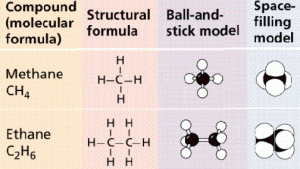
Hydrocarbons are built from carbon atoms. The simplest hydrocarbon is methane (CH4), and the addition of more carbon molecules creates more complex hydrocarbons which can form chains or rings. Image Credit: M.J. Farabee
Hydrocarbons are built from hydrogen H and carbon C atoms. The simplest hydrocarbon is methane (CH4), and the addition of more H and C atoms creates hydrocarbons which can form chains or rings. Image Credit: M.J. Farabee
Hydrogen doesn’t show up alone; it’s a highly reactive element that loves to pair up and bond with other elements forming the many complex molecules we see all around us.

Besides water, hydrogen is largely locked inside hydrocarbon molecules, the source of most hydrogen on the market today. Unfortunately, current processes, whereby high-temperature steam is heated with methane in the presence of a nickel catalyst to form the hydrogen, leave as by-product the greenhouse gas carbon-dioxide CO2.

Regardless of how efficient a fuel cell can be developed, existing production of hydrogen by steam thermal reaction produces almost 8.8 billion tons of the carbon per year (Royal Society of Chemistry, 2009). Burning a gallon of gasoline releases about 20 pounds of CO2. Producing 1 kg of hydrogen by another method using electrolysis would generate, on average, 70 pounds of CO2. [J. Romm, The Hype About Hydrogen]

The grim reality of our ‘Green Economy’ today is that retrieving hydrogen cleanly is an energy-expensive process, and still a technical challenge, reducing the economic viability of the abundant fuel: it takes so much energy to produce the hydrogen, the energy you get back just isn’t enough to make business, or ecological, sense.

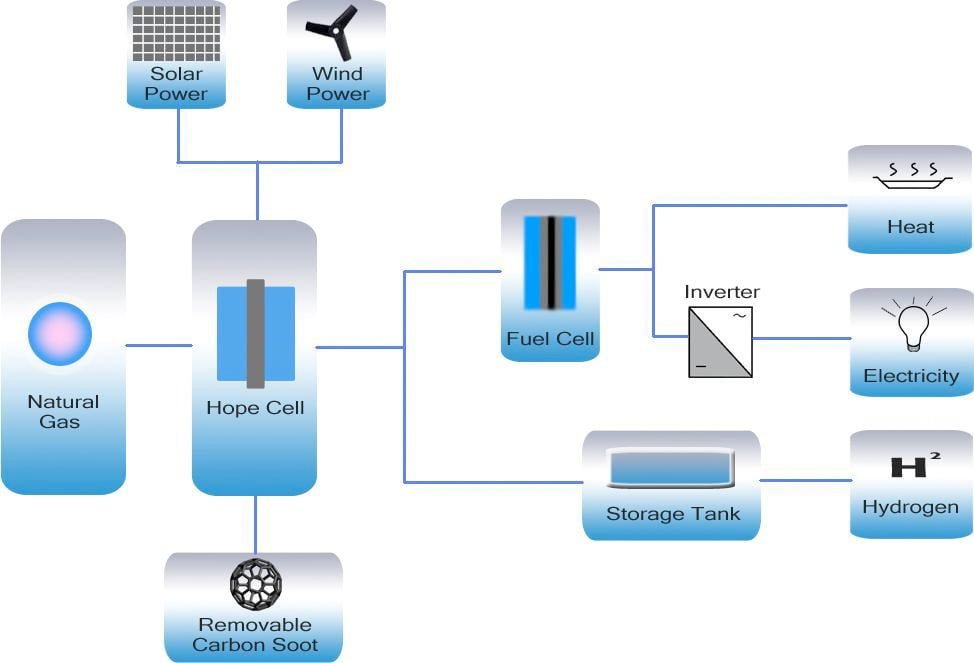
But suppose we could, say, re-route the methane emitted as pollution from landfills and cheaply, safely decompose it into the hydrogen we want, while converting the CO2 into a solid soot form, which could be stored or re-purposed?
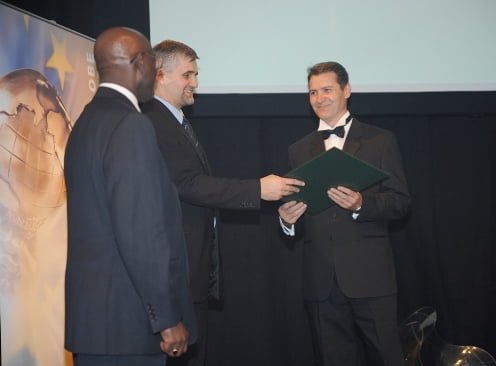
Robert Vancina accepting Energy Globe award for Sustainability 2009
Robert Vancina accepting Energy Globe award for Sustainability 2009 for HOPE cell concept.
Robert Vancina‘s HOPE cell won the Energy Globe Award 2009 World Award for Sustainability by demonstrating such a process, and he’s been developing a usable technology ever since, recently receiving two patents for his hydrogen production process.

An independent effort, Vancina will present his work at this year’s Green Leaders Summit 2013 where he will be speaking before a host of innovators from around the world who are attempting to build a clean energy infrastructure.

Entrepreneurs such as Elon Musk, Chairman and CEO of TESLA Motors, have manufactured electric cars to run on lithium-ion batteries, not fuel cells, because of the difficulties that hydrogen poses as a fuel. The production, transport and storage of hydrogen all pose significant engineering challenges, until now. HOPE cell technology offers a path to on-demand hydrogen production in-situ, promising to revolutionize power production for applications from transportation to power-production for grid or grid-less energy supply.

signatureIn developing his hydrogen-oxygen plasma electrolysis (HOPE) cell for hydrogen separation, Vancina discovered that it also made excess heat, and he is now developing a 5th generation model to enhance the low-energy nuclear reaction (LENR) effect.

HOPE cell hydrogen production with added efficiency of LENR heat marks a transition technology between the 20th-century fossil fuel infrastructure we have now, and the de-centralized independent power production of the 21st-century new energy age we need.

Plasma research inspired by Tesla, Mizuno, and Cirillo

Vancina’s father was an inventor, but due to conditions in his home country of Croatia at the time, his dad remained unrecognized for his contribution. Instead, he taught his son the skills necessary to engineer dreams into real solutions.

As a young man, Vancina learned of Nikola Tesla‘s work, and then began his own plasma research. For Vancina, “it was a natural evolution that working on plasma implemented in hydrogen generation from water, I then became familiar with the work of Tadahiko Mizuno, Tadashi Akimoto, and Tadayoshi Ohmori, as well as other scientists such as Domenico Cirillo and Vicenzo Iorio.”

Michael Faraday‘s 1834 First Law of Electrolysis can be stated as “The amount of a substance consumed or produced at one of the electrodes in an electrolytic cell is directly proportional to the amount of electricity that passes through the cell.”

Vancina describes how a paper by Mizuno, Akimoto and Ohmori entitled “Confirmation of anomalous hydrogen generation by plasma electrolysis” [.pdf] discusses hydrogen generation in quantities greater than Faraday’s Law predicts.
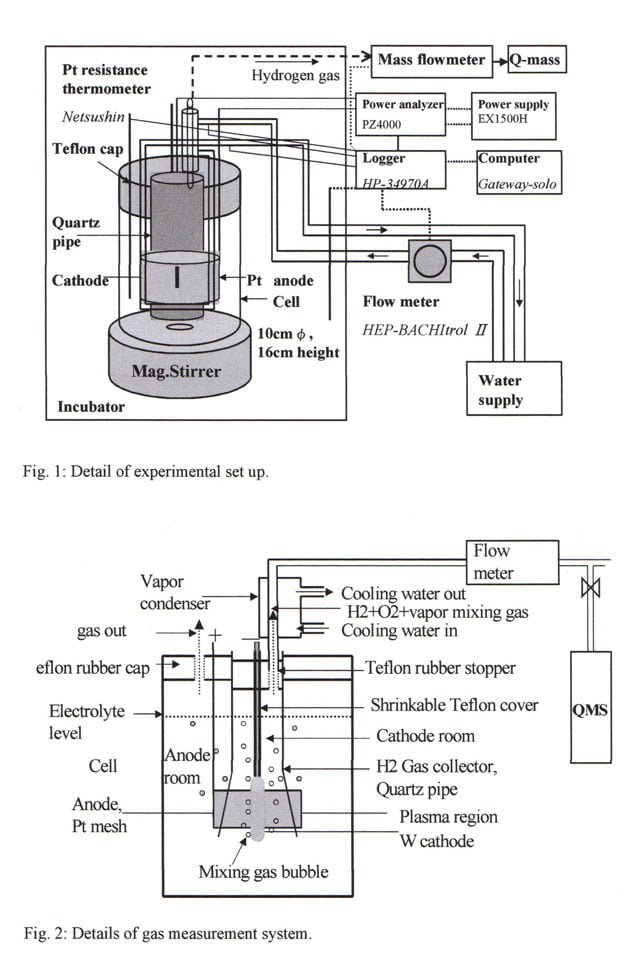
Cell design from Confirmation of anomalous hydrogen generation by plasma electrolysis by Mizuno, Akimoto, and Ohmori
Cell design from Confirmation of anomalous hydrogen generation by plasma electrolysis by Mizuno, Akimoto, and Ohmori.
Mizuno teaches that plasma forms when an applied potential difference between electrodes exceeds l00V in an aqueous solution, and that a mixture of oxygen, hydrogen and steam are formed on the surface of a cathode. However, he states: ‘The generation of hydrogen at levels exceeding Faraday’s law is observed when the conditions such as the temperature, current density, input voltage and electrode surface are suitable. The precise conditions are still not known, and controlling these conditions is difficult, so only a few observations of excess hydrogen have been made.’

Mizuno observed non-Faradic hydrogen generation. For example: when plasma electrolysis occurred at 2 A/cm2 of input current at l20V and at an electrolyte temperature of 80 degrees C, Mizuno concludes that non-Faradic hydrogen generation occurs when the potential difference between electrodes is several hundred volts, but does not provide any explanation for controlling the plasma beyond short bursts.

A theory explaining plasma electrolysis that produces non-Faradic quantities of hydrogen, and giving some base for LENR, is outlined in a technical paper by Cirillo and Itorio entitled “Transmutation of metal at low energy in confined plasma in water”. [.pdf] Specifically, Cirillo teaches that electrolysis is aided by metal anions, dissolved in an electrolyte, which form a screen spaced a few nanometres from the cathode, thereby effectively forming an anode. This is known as a ‘double layer’.

Electrochemical plasma cell from Transmutation of metal at low energy in a confined plasma in water by Cirillo and Iorio
Electrochemical plasma cell from Transmutation of metal at low energy in a confined plasma in water by Cirillo and Iorio.
Under conventional electrolysis conditions, hydrogen gases generated at the cathode, with much of the space between the cathode and the anion screen being filled with H ions, migrate through the screen to discharge on the cathode, producing hydrogen gas.

Increasing the applied voltage above 80V has the effect of significantly increasing hydrogen gas production to the point that the space between the cathode and the anion screen becomes filled with hydrogen gas. The gas has a much lower conductivity than the liquid electrolyte, so the resistance increases until unstable bursts of plasma form to discharge the potential difference between the cathode and the anion screen.

The high localized voltage can result in cathode temperatures for tungsten electrodes, greater than 3000″ C. Such heating of the cathode results in instant vaporization of electrolyte from the surface of the cathode and destabilizes plasma formation. Such a process also destroys the initiating electrode.

HOPE cell can clean up today's hydrogen generation process
HOPE cells readily use water, natural gas, or hydrogen blending in synthetic gas as a source of hydrogen. Mixing up to 15% hydrogen in with synthetic gas is cleaner, and will still power existing appliances.
Cirillo does not discuss hydrogen generation as a goal and does not address problems of stabilizing plasma. There are practical problems with those experiments being produced in a lab environment and equipment without viable implementation. Metal transmutation mechanism of effect, beyond few intermittent bursts, was not given an explanation.

However, through his research, Vancina has learned much more about the properties of hydrogen bond clusters and discovered what he describes as “techniques of scalably controlling plasma in robust enclosures, relocating the plasma away from initial electrode, stabilizing its operation, and magnifying it throughout the cell body.”

“It represents a practical approach which is dedicated for hydrogen generation,” says Vancina. “Initiating and stabilizing the LENR exothermic emission also functions to enhance bond breaking, as well as the energy efficiency of the process.”

From hydrogen to heat

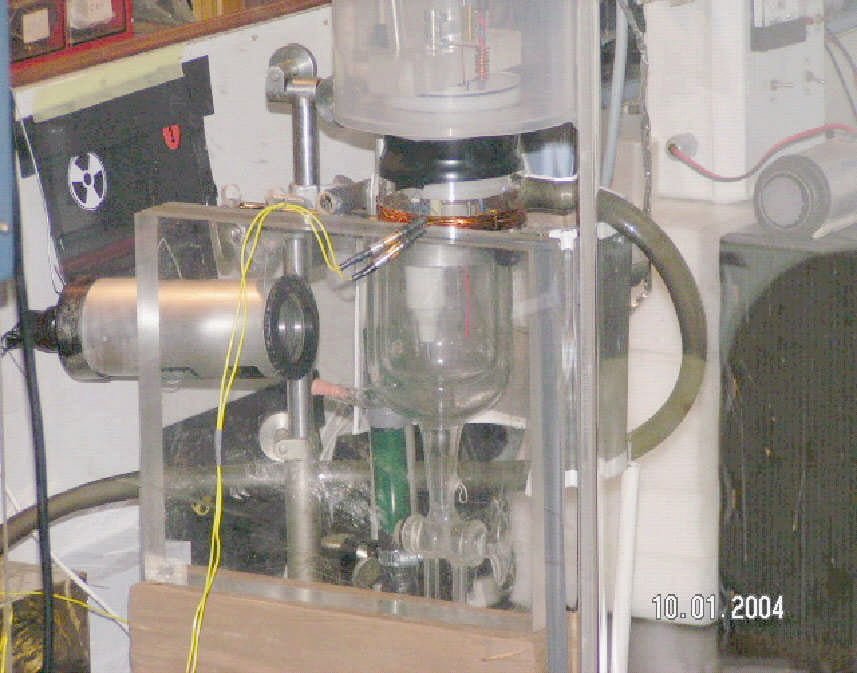
HOPE cell test unit
HOPE cell test unit
Vancina discovered the LENR effect during the first HOPE cell trials, and spent alot of time trying to manage the exothermic reaction.

“Cold Fusion seemed like a reasonable explanation at the time, but this raised some concern due to the sensitivity of publication,” he says. “After more research and testing I realized that this is a reaction of atomic hydrogen generated with plasma dislocation of medium, so I could apply techniques to induce it, stabilize bursts and scatter it across body of my cell.” 


The HOPE cell is currently at the proto-type stage. Self-funded until now, Vancina needs sponsorship to develop several applications he has designed that utilize LENR.

“I have previously approached local universities with the request of collaboration and applied for government grants to name a few. However, these attempts were unsuccessful due to scientific stigma of the nature of the project at the time.”

GLSummit_2013Sponsorships[613]Vancina believes that our own limited knowledge of atomic behavior, and strong lobbying by special interests, are holding us back from discovering a host of world-changing solutions saying, “It is fact that a great amount R&D followed by adequate capital have been invested towards Atomic Force research by the military, and power generation through civilian nuclear energy development, but there are parts of the atomic mechanisms which were missed, and now it’s time to admit that we made some mistakes along the way.”

“In the process,” he says, “we’re managing to destroy our natural environment on this planet – our home, which we are treating as a resource and commodity. That is a huge mistake.”

“I still have hope that our positive, collective mindset approach will become our savior. It’s time for LENR to come to the World stage and, coupled with alternative energy sources, become recognized as a viable option for mainstream application. It’s an exceptional opportunity to speak at the Green Leaders Summit 2013. I will strongly advocate LENR and help facilitate further research and investment in this area.”

Cold Fusion Now!

Related Links

The Truth About Hydrogen Popular Mechanics

Energy Globe http://energyglobe.info/

HOPE Cell Home http://hopecell.wordpress.com/

Anomalous Heat Generation during Hydrogenation of Carbon (Phenanthrene) [.pdf] by Tadahiko Mizuno and Shigemi Sawada

Stanley Pons’ Preface from J.P. Biberian’s La Fusion dans Tous ses États translated

Stanley Pons, co-discoverer of cold fusion, left the United States in 1991 amidst an unprecedented assault. Physicists wedded to the 100-year-old standard model of nuclear theory, and whose funding would be jeopardized by this seemingly simpler approach to energy production, ‘threw tantrums’ and attacked with vehemence.

Steven E. Koonin, who left Caltech Institute to work for BP Oil and later became the U.S. Under-Secretary of Energy 2009-2011, Robert Park, then-Director of Public Information for the American Physical Society and author of Voodoo Science, and John Huizenga, co-Chair of the Department of Energy panel charged with evaluating the scientific claims and author of Cold Fusion: The Scientific Fiasco of the Century, were just a few of the men who used their authority to create a myth that ultimately denied funding to anyone interested in researching the Fleischmann-Pons Effect (FPE) of excess heat, and to blacklist all scientific papers on the topic from mainstream publication.

Sheila Pons documented the absurd melee in her editorial ‘Fusion frenzy’ stymies research published in the Deseret News March 28, 1990. For the Pons family, as well as the Fleischmanns, the emotional cost was great.

A new laboratory in the south of France funded by Minoru Toyoda, of the Toyota Corporation fame, was set up to continue research. The Institute of Minoru Research Advancement (IMRA) provided a peaceful, supportive setting for the embattled scientists to work.

Dr. Pons describes his early experience in France in the Preface to La Fusion dans Tous ses États: Fusion Froide, ITER, Alchimie, Transmutations Biologiques (Fusion in All Its Forms: Cold Fusion, ITER, Alchemy, Biological Transmutations) by Dr. Jean-Paul Biberian. Published last December 2012 in French, a new English version is expected later this year.

Dr. Biberian has worked on cold fusion cells for the past two-decades at the University of Marseille Luminy where he was a physics professor until retirement last summer. He is also the Editor-in-Chief of the Journal of Condensed Matter Nuclear Science published by the International Society for Condensed Matter Nuclear Science (ISCMNS).

From the French version, he wrote:
À l’annonce de la découverte de la fusion froide, en 1989, l’ensemble du monde scientifique entre en ébullition. Il serait donc possible de produire de l’énergie illimitée à moindres frais ? Dans de nombreux laboratoires, connus ou inconnus, réputés ou non, chacun tente de reproduire l’expérience dont tout le monde parle. J’ai fait partie de ces pionniers, de cette aventure prometteuse extraordinaire. Mais la fusion froide ne s’est pas faite en un jour.

Laissez-moi vous raconter la petite et la grande histoire, humaine et scientifique, alchimique et biologique, de la fusion froide. Une histoire qui me passionne et qui se poursuit aujourd’hui…

with a Google translation:
At the announcement of the discovery of cold fusion in 1989, the entire scientific world boils. Is it possible to produce unlimited energy at a lower cost? In many laboratories, known or unknown, ‘deemed’ or not, everyone tries to replicate the experience the world speaks of. I was one of the pioneers of this extraordinary, promising adventure. But cold fusion was not built in a day.

Let me tell you the small and the great history, human and scientific, biological and alchemical, of cold fusion. A story that fascinates me and that continues today …Jean-Paul Biberian La Fusion dans Tous ses États: Fusion Froide, ITER, Alchimie, Transmutations Biologiques (Fusion in All Its Forms: Cold Fusion, ITER, Alchemy, Biological Transmutations)

Dr. Biberian has been a colleague and friend to Stanley Pons since they first met in 1993 at the IMRA lab.

Infinity Energy Magazine has obtained special rights to publish the translation to English of Stanley Pons‘ Preface and has made it freely available to the public. [ download .pdf]

You can support Infinite Energy Magazine with your subscription.
Your subscription helps to continue the legacy of
Eugene Mallove and the New Energy Foundation.

Related

Edmund Storms at NPA-19: What is cold fusion and why should you care? video August 7, 2012

Too Close to the Sun: 1994 BBC documentary profiles early history of ‘cold fusion underground’ June 7, 2012

World Wide Lab September 18, 2011

Cold Fusion, Derided in U.S., Is Hot In Japan by Andrew J. Pollack NYTimes November 17, 1992

Video: 1989 Steven E. Koonin “we are suffering the incompetence and perhaps delusion of …. New Energy Times

Italian Senator lobbies Parliament for action

At meeting #53, Italian Senator Domenico Scilipoti, speaking to the Ministers of Education, University and Research and Economic Development, asked the Parliamentary Legislature in Italy to take initiatives to “promote the theoretical and experimental research” and “engineering and development of these new technologies”, referring to the nickel-hydrogen exothermic reaction that is the core of Italian low-energy nuclear reaction (LENR) research.

Published in Italian June 27, 2013 on the senato.it site, a Google translate follows here:

Act n. 3-00187

Posted June 27, 2013, at its meeting no. 53

Scilipoti – To the Ministers of Education, University and Research and Economic Development. –

Given that:

has recently been published online on the archive of scientific papers at Cornell University arXiv, a technical report entitled “Indication of anomalous heat energy production in a reactor device” (Detection of abnormal generation of thermal energy in a reactor), whose authors are part of an international team of researchers consisting of: They Essén (theoretical physicist, former president of the Swedish Skeptic’s Society, Royal Institute of Technology, Stockholm), Evelyn Foschi (physics expert in radiation protection, former University of Bologna), Torbjörn Hartman ( senior engineer at the Svedberg Laboratory, Uppsala), Bo Höistad (particle physicist, professor at the University of Uppsala), Giuseppe Levi (nuclear physicist, University of Bologna and associate of the National Institute of Nuclear Physics), Roland Pettersson (former professor of Chemistry at the University of Uppsala), Lars Tegnér (professor in the Department of Electrical Engineering, University of Uppsala);

in the technical report were made public the results of two different experiments carried out on the thermal generator E-Cat (energy catalyzer) developed by Andrea Rossi in collaboration with Sergio Focardi, a physicist and professor emeritus of the University of Bologna, the reactor uses small amounts hydrogen stable isotopes of nickel and special catalysts. The experiments were funded by the Swedish company Elforsk that operates in the energy sector. On the website of this society the results obtained have been qualified in a positive and defined as “quite remarkable”;

article authors have measured in two different scientific experiments, one of the duration of 96 hours and the other of the duration of 116 hours, an anomalous heat production with an energy density considerably higher than the density obtainable by normal chemical reactions; in first experiment was produced thermal energy equal to 62 kilowatt hours with a power consumption of 33 kWh and a density of thermal energy equal to 61,000 kilowatt-hours per kilogram. In the second experiment the energy produced was equal to 160 kilowatt thermal absorption with a 35-kilowatt electric and a density of 680 kilowatt-hours per pound;

please note that the thermal energy produced by a pound of gasoline is equivalent to just 13 kilowatt hours. Both experiments are terminated with the deliberate shutdown of the reactor, not for the depletion of the active material used;

the orders of magnitude of the energies at play exclude both the possibility of experimental errors, both conventional interpretation of the new source of energy;

is also promising and realistic perspective of use in the near future such reactors for the production of electrical energy, thanks also to the thermodynamic performance obtainable from their high operating temperatures;

although there is still no generally accepted theory that explains the origin, the reality of the phenomena of abnormal heat generation is supported by thousands of scientific publications and many patents, some of which, such as the recently issued patent to Professor Francesco Piantelli University of Siena, offering technological solutions similar to those used in the E-Cat reactors;

Rossi has already obtained an Italian patent entitled “Process and apparatus for exothermic reactions, particularly nickel and hydrogen”;

many institutions and Italian and foreign companies, as Aeneas, INFN, NASA, MIT, Mitsubishi, Toyota, U.S. Navy, National Instruments, ST Microelectronics, and many universities are, or have been involved in this particular area of ​​scientific research, still considered by someone as controversial, mainly due to the lack of a conclusive theory;

Martin Fleischmann also the memorial project has recently replicated the experiments of Dr. Francesco Celani INFN,

asks to know:

if the Ministers address does not intend to take initiatives to promote the theoretical and experimental research that allow to clarify, finally, the nature and characteristics of the above phenomena;

if you do not intend to take initiatives to engineering and development of these new technologies with a view to a possible reduction of energy costs and promote economic growth and competitiveness of the country, which would become an exporter of electricity at low cost with huge benefits financial and environmental.

What Senator in the U.S. Senate has the … courage to stand up and say this very speech?

Related

European parliament ITRE committee meets over Fleischmann-Pons Effect

Political Support for Cold Fusion in an Election Year

Life at the Center of the Energy Crisis: A Technologist’s Search for a Black Swan by George H. Miley


cover-image-9789814436489_p0_v1_s260x420Published by World Scientific, Life at the Center of the Energy Crisis: A Technologist’s Search for a Black Swan by Dr. George H. Miley describes “the story of the author’s work and struggles in the field of energy research.”

Dr. Miley is Professor Emeritus at the University Of Illinois Urbana-Champagne (UIUC) in the Department of Nuclear, Plasma, and Radiological Engineering, and, he was one of the few plasma scientists who considered seriously the possibility of nuclear reactions taking place in a solid metal at low-temperatures after the announcement of Drs. Martin Fleischmann and Stanley Pons.

As Director of the Fusion Studies Lab at UIUC, he has engaged students (though he will say his students engaged him!) in cold fusion research, also called low-energy nuclear reactions (LENR) since 1989.

When virtually all other mainstream scientific journals refused to accept them, he as a founding editor of the American Nuclear Society’s (ANS) Fusion Science and Technology was singular in allowing publication of blacklisted cold fusion research papers.

From the World Scientific site:

The author’s experience in the field spans from work with Admiral Rickover and the Nuclear Navy to research with NASA designing propulsion for spacecraft to travel to Mars. The book provides insights into the differences between nuclear research done during the Cold War by the two superpowers, and offers a commentary on the flaws in each system with hope for change in the future. The book also provides a look into the development of the nuclear engineering program at the University of Illinois from the author’s years as a professor and an administrator.

The recipient of numerous awards, Dr. Miley has been a Guggenheim Fellow and held a senior NATO fellowship. He holds six patents, and has most recently been involved in a new-energy start-up LENUCO, a company formed to develop a heat-source for energy production based on metallic-hydride reactions.

Earlier this year, LENUCO lost a crowd-voting contest in a bid for a presentation spot before venture capitalists held by Future Energy. The LEN-GEN Module followed the design Miley presented before rocket scientists at last year’s NETS conference. He continues to develop plasma solutions for multiple applications including space-drive with Nuclear Plasma Laboratories Associates, Inc., another company based in Illinois.

The book’s Foreword is by Dr. Heinz Hora, Professor Emeritus of University of New South Wales and long-time collaborator with Dr. Miley on theoretical models of LENR. In my interview with Dr. Miley during the 2012 NETS conference, I profiled some of their work.

Table of Contents

Foreword [.pdf]
Why a “Black Swan”?
Living at the Center of the Energy Crisis
Timeline and Apology
Early Days and Searching for a Starting Path [.pdf]
Burnable Poison Control for Nuclear Submarine Reactors
Nuclear Pulse Propagation and Fission Reactor Kinetics
Nuclear Pumped Laser (NPL) Research
Direct Electron Beam Pumped Laser
Advanced Lasers
Alpha Particle Effects in Thermonuclear Fusion Devices
Alternate Fusion Concepts
Advanced Fuel Fusion and Direct Energy Conversion
Inertial Confinement Fusion (ICF)
Inertial Electrostatic Confinement (IEC) Fusion
Low Energy Nuclear Reactions (LENR)
Hydrogen Economy and Fuel Cells
Fusion Propulsion and Space Colonization
Nuclear Batteries
Computation and Theory
Nuclear Power Plant Safety and the Illinois Low-Level Waste Site
Teaching, Education, and University Administration
Creation of a Small Company, NPL Associates, Inc.
Where Am I in the Search? What Have I Found?
Concluding Comments
Timeline of Events

The contents are suitable for undergraduates and PhDs, as well as anyone in the public interested in the history of the field.

Buy George H. Miley’s book from World Scientific or from Amazon

Related

New Book Tells of Miley’s Career, Energy Crisis

Washington Post blog cites Cold Fusion Now in LENR win

Weeks ago, the Washington Post asked readers What energy sources offer the most promise for the U.S.?

LENR won.

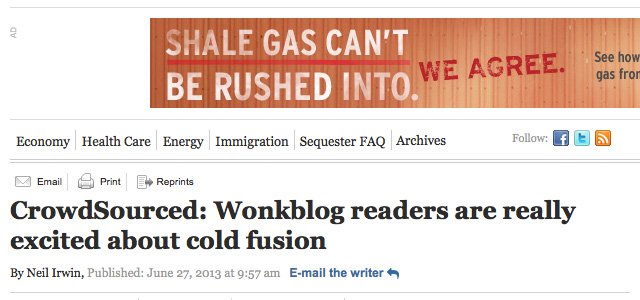
Today the journal noted that win, with author Neil Irwin citing the strong community support:

After four weeks of the first Wonkblog CrowdSourced, there is a consensus! Asked to explain what you view as the most promising energy source for America’s economic and environmental future, you favored one answer, heavily, above the others: Low energy nuclear reactions, or cold fusion. Nine of the top ten vote-getters favored this answer. (Perhaps with an assist from the website ColdFusionNow.org, which urged readers to participate).

Well, I must add Harry Veeder posted a call on Vortex-l first, and that’s what got us all started, and thanks go to Lenr-forum.com for spreading the word far and wide. (If I ever get my Subscription button working, I may be able to help even more. It might be working now, so subscribe again please and let me know!) And no doubt more than a few E-Cat World readers contributed to this win.

Featured are two top comments, the first from Tom888 who wrote:

There is little doubt that the future energy will be LENR, aka cold fusion. The field developed off the mainstream over the past years and we are at a point where commercial applications are being prepared for roll out now by several companies. This is mainly engineering and inventor driven, whereas basic science is lagging behind understanding the phenomenon. Nevertheless, the effect is indisputable now and the prospect is clean, unlimited source of thermal energy at very low cost. Today, June 03, this subject is being discussed at the EU in Brussels – questions are funding and how to move forward. In US, the company National Instruments is involves in supplying control software for LENR reactors, Siemens is looking at it, research is being done at many places (U of Missouri, NAS, SRI…). Several companies in US announced commercial LENR heaters within the coming months.
Those reactors are typically small, table top devices, overall low-tech, which can be bundled to larger units for heating, steam and electricity generation. This puts an end to CO2 problems and oil wars.

And PeterRoe wrote:

While it makes sense to continue to use existing ‘renewable’ energy sources such as solar, hydro and tidal power where available, all these, together with fossil fuels and nuclear will soon be obsolete. The energy source of the future is the phenomenon of cold fusion, also known as LENR etc.

Before skeptics dismiss this as fantasy, they need to do a bit of research. Several parties have recently claimed breakthroughs at kilowatt levels from cold fusion reactors including Brillouin, Defkalion Green Technologies and Leonardo Corporation (Andrea Rossi), and a number of very serious researchers are reporting positive results.

The current leader of the field seems to be Rossi, who recently had one of his devices tested by a group of independent scientists, under the auspices of a major Swedish power consortium. The test results clearly confirmed his claim that he has invented a practical cold fusion reactor. Through his agent ecat.com, he is also offering to install a 1MW thermal plant free of charge to a suitable host organisation, in order to publicly demonstrate the technology in action.

And that’s how it will roll. There’s no stopping it. We will have a clean energy future, with a green technology to power this planet, and beyond.

Trolls continue typing, but no matter. The efforts are nothing but the itch on a phantom limb, soon to fade away as a new vision takes hold.

Cold Fusion Now!

Book on exotic energy features LENR

A new book published this year by Inner Traditions and Bear & Company features exotic energy technologies including cold fusion, also called low-energy nuclear reactions (LENR).

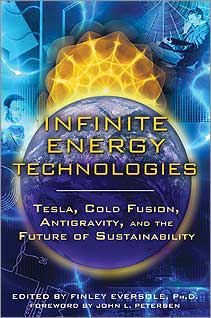
Infinite Energy Technologies: Tesla, Cold Fusion, Antigravity, and the Future of Sustainability is edited by Finley Eversole, Ph.D and includes chapters on “clean, sustainable energy solutions from the geniuses of our past and the visionaries of our future” authored by the leading new-energy technologists and writers today.

infinite-energy-technologies-9781594773808Described by the back cover copy,

As the global need for clean, renewable energy grows and the shortage of viable large-scale solutions continues, it is time to look to the geniuses of our past and the visionaries of our future for answers. Taking inspiration from Albert Einstein’s statement that “problems cannot be solved by the same level of thinking that created them,” Finley Eversole explains that the key to a pollution- and poverty-free future of infinite energy lies not in pursuing one single method but in investigating all the possibilities–in uniting as a world in creative pursuit of global transformation.

Exploring five nearly unknown geniuses of our past–John Worrell Keely, Nikola Tesla, Viktor Schauberger, Royal Raymond Rife, and T. Townsend Brown–and their revolutionary discoveries about free energy, electricity, water vortex motion, electric ray and super-microscope technology, and antigravity, this book helps to restore their long-suppressed scientific legacies and bring us one step closer to the destiny they foresaw. Eversole has gathered research from leading experts on cold fusion, zero-point energy, power from water, and the free-energy potential of the Searl Effect Generator to reveal technologies that work with Nature’s laws and that, if fully implemented, could establish sustainable energy systems in a single generation.Infinite Energy Technologies: Tesla, Cold Fusion, Antigravity, and the Future of Sustainability [link]

***Support Eugene Mallove‘s New Energy Foundation and buy this book here.***

The Table of Contents
Acknowledgments
Foreword … John L. Petersen
Introduction … Finley Eversole, Ph.D.

Part 1 Back to the Future: The Legacy of the Visionaries

1 Nikola Tesla: Electrical Savant … Marc J. Seifer, Ph.D.
2 John Worrell Keely: Free-Energy Pioneer–a New Chapter …Theo Paijmans
3 Viktor Schauberger: A Brief Overview of His Theories on Energy, Motion, and Water … Callum Coats
4 Royal Raymond Rife: The Fate of Compassion and the Cancer Cure That Worked … Gerry Vassilatos
5 T. Townsend Brown: The Suppression of Antigravity Technology … Jeane Manning

Part 2 Infinite Energy: A New Science for a Pollution-Free World

6 The Sustainable Technology Solution Revolution: A Universal Appeal … Brian O’Leary, Ph.D.
7 Power for the People–From Water … Jeane Manning
8 Imagine a Free-Energy Future for All of Humanity … Steven M. Greer, M.D.
9 Energy Technologies for the Twenty-first Century … Theodore C. Loder III, Ph.D.
10 Harnessing Nature’s Free Energy: The Searl Effect Generator … John R. R. Searl and John A. Thomas Jr.
11 Cold Fusion: The End to Conventional Energy and the Start of Social Reorganization … Edmund Storms, Ph.D.
12 Zero Point Energy Can Power the Future … Thomas Valone, Ph.D., P.E.
Afterword … Brian O’Leary, Ph.D.

Appendix A The Four Occupations of Planet Earth … Tom Engelhardt
Appendix B Evidence of Cosmic Community … Finley Eversole, Ph.D.
Appendix C The Earth Charter
Notes
Additional Resources
Contributors
Index

The 400-page paperpack has 74 black & white illustrations. An excerpt from Chapter 5 by Jeane Manning is available here or as a downloadable .pdf

With humanity facing the dismaying prospects of global ecological collapse and geopolitical chaos, there is an urgent need for clear solutions-based guidance that penetrates our dulled consciousness and pulls us back from the precipice. Infinite Energy Technologies delivers such guidance. Through a powerfully resonant combination of new energy science, societal analysis, and spiritual insight, Finley Eversole’s compilation shakes us awake from our dangerous stupor. The wise voices in this anthology make a compelling case for the immediate embrace of a new wave of energy technologies that is key to launching an era of shared abundance, planetary healing, and unprecedented creativity. I pray that millions will heed this call for action without delay and lead the transformation so desperately needed on our imperiled planet.” —Joel Garbon, President of New Energy Movement and coauthor of Breakthrough Power

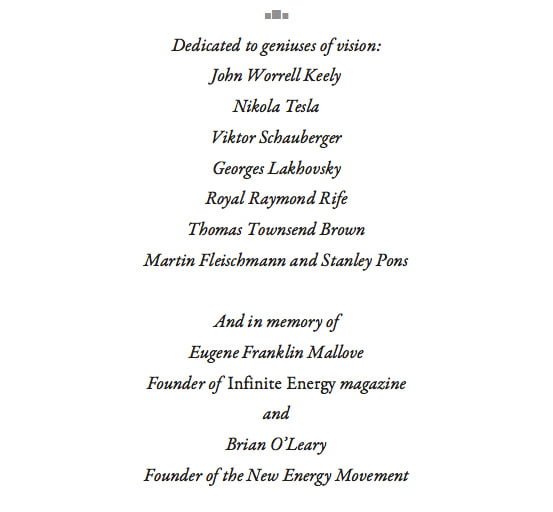
Infinite-energy-technologies-dedicated-to

Top