
The Believers – the Movie

A local Association devoted to Product Management who is considering showing the the above film at their final monthly meeting in June asked me if it would be appropriate material within their theme of supporting the cause of Product Management. Along with providing a private showing of the film to the Board of Directors, I also prepared the following Synopsis of the movie for possible distribution to members.

__________________________________________________________

Synopsis

Released in October, 2012 The Believers is a documentary that tracks the dark side of the March 1989 announcement at the University of Utah that two respected chemists had solved the world’s energy problems. They had discovered “Cold Fusion”. Within days Martin Fleischmann and Stanley Pons were on the covers of numerous magazines worldwide. But three short months later their science has been discredited and their reputations ruined. The established community of physicists refuse to accept the alleged experimental results. Retreating to France the two pioneers pursue their researches for another five years before retiring into twilight. Meanwhile “Cold Fusion” has become synonymous with “pathological science” within the general scientific community.

There could not be a better modern example of a combination of hubris and bad public relations for a product launch. Understanding what went wrong makes this story worthy to be the central focus of courses in marketing, or more precisely bad marketing, for years to come.

Meanwhile, twenty-three years later, laboring under the disdain of their peers, a small group of faithful scientists still persist in trying to resolve the un-answered Mystery of where the incontrovertible unexplained heat of the Fleischmann & Pons Effect comes from. Once solved, this scientific breakthrough may yet become the salvation of civilization providing an unending supply of low-cost energy.

The movie is not, however, so much about the science as it is about the tragedy of the personal lives of the two original discoverers. It is also about the tragedy of the rejection by established institutions of the opportunity to pursue a discovery of unparalleled importance. This assumes that its riddles can be solved and the science applied to produce its potentially vast technological rewards. But the Believers themselves are not organized. Without the presence of overseeing management and meaningful financial resources, they are all struggling with their individual theories and personal myopic experiments leaving little hope that a breakthrough is imminent.

No one can leave the theater without asking themselves: “How could this have happened?”
__________________________________________________

The movie, a documentary, is definitely focused on the tragic impact of the unfolding scenario on the lives of the two original scientists. In fact, the movie is rather dark. Martin Fleischmann is shown in his declining years suffering from Parkinson’s disease. He is also caught in moments of reflection that are quite poignant. This is particularly true when he ponders how to answer the question: “What happened between you and Stanley Pons?” He never does answer that question properly, but the look in his eyes as he stares off into the distance searching back in his memory is telling. We see the panorama of opportunities lost and dreams dashed. In Martin’s stare we can imagine the closeness that must once have existed between these two collaborators, and the gulf that now separates them.

Fleischmann until his death in August 2012 was living in England and Pons is presently, 2013, living in the South of France. In one short scene while being interviewed with his wife, Pons seriously contemplates giving-up his American citizenship.

But the movie is not just about these two individuals. It is also about the tragedy of the lost opportunity to resolve the challenge of understanding the “Fleischmann & Pons effect”. And it is indeed remarkable that in our present times with all the tools and acquired knowledge available, that those still researching in the Cold Fusion field have not determined how to reliably produce heat at a level that will boil a cup of coffee.

No doubt the scientists assembling for the next annual world conference for the Cold Fusion community, ICCF-18 to be held in July, 2013 on the campus of the University of Missouri in Columbus Missouri, will wince at the description that they are all “struggling with their individual theories and personal myopic experiments”. Unfortunately, I cannot help but lean towards that colorful image in my personal struggle to answer the question: “How could this have happened?” Why has there been no breakthrough even after 24 years?

It may well be that the puzzle is indeed complex. But there is a vast amount of data available for those who wish to accept a challenge. Reported experiments in the field showing the generation of unexplained excess heat must by now have exceeded the millennium level. A half a dozen potentially practical theories already exist and a dozen more less- credible concepts regularly float up into the air. But surely there’s enough information assembled now for some genius to hit upon the solution. What is the source of the excess energy – heat – that flows from Cold Fusion experiments??

There is an analogy in history. In 1898 Pierre Curie and his wife isolated for the first time a quantity of Radium. To their great surprise, 1 gram of radium produced heat apparently endlessly! (Ra226 half-life: 1601 years; 1000 joules per gram per year when pure.) It was not, however, until 1938-39 when Lise Meitner, an Austrian Jew exiled to Sweden by Nazi politics, solved the source of the heat based experimental results for uranium reported to her by her former associate, Otto Hahn. She identified the source of this heat as: Nuclear Fission and the mass difference of the nuclei. The elapsed time was 40 years. But that was in the first half of the 20th century. Surely in the last and first decades spanning the 20th and 21st century a similar unexplained source of energy, albeit intermittent and unreliable, should have been explained by now.

The movie The Believers is not just about Martin Fleischmann and Stanley Pons. It’s a story about the failure of the scientific community to resolve the puzzle that these two electro-chemists presented to the world. The movie depicts the toxic condemnations that descended on the heads of these two gentlemen, primarily because many laboratories could not duplicate their results, and additionally because the theory that nuclear fusion was the source of the energy was incompatible with nuclear fusion as understood by the physicists. The physicists believed that if fusion were occurring then there had to be an associated emission of high-energy particles. In the case of Cold Fusion, there was no substantial demonstration of energetic particle emissions associated with the process. The fact that there was an unexplained supply of heat, a phenomenon that would otherwise violate one of the most fundamental laws of thermodynamics, the Conservation of Energy, was simply ignored. This is a travesty of the highest order.

The movie ends with a tone of despair expressed by one of the eminent theoreticians laboring in the field: Dr. Peter Hagelstein of the Massachusetts Institute of Technology. Peter, with the demeanor of a defeated man but probably intending ironic humor, speculates that when the present generation of Believers has passed on (most of them are elderly having adopted this as their career back in 1989-1990), the field will fall into neglect only to be discovered at some future date by scientific archaeologists. These are the words of a man holding tenure at MIT who nevertheless has no grants to spend and no students to do experiments. That is the burden that these Believers labor under.

While these observations are in keeping with the tone of the movie, exploring a theme which is dark and depressing, there is hope. So many favorable experimental results have now accumulated that a breakthrough in theoretical understanding in this field must occur in the near future. At least that will be the hope of all those attending ICCF-18 this coming July. In expressing such expectations and hopes myself, I have disclosed my own membership in a group that I’m sure one day will be honored for their loyalty to the cause, – The Believers.

Nanoscale Ag may decrease radiation of Cesium 134 and 137 by LENR transmutation?

On  the week of Feb 5, the conference of “radiation detectors and their uses” was held in High Energy Accelerator Research Organization in Tsukuba city of Japan.  Japanese web site is (here) and Google translated one is (here).

In the conference, there was a very interesting presentation “Experiment and verification of the radioactive cesium decrease effect of nanoscale pure silver (Ag) with supporting material” for LENR watchers.  (This title is translated to English by me and may be inaccurate.)

The Japanese abstract (PDF document) was published (here) and p.69 and p.70 are for the presentation.

Experiment and verification of the radioactive cesium decrease effect of nanoscale pure silver (Ag) with supporting material

The author, Dr. Shin Iwasaki, a physicist and ex-professor of Tohoku University of Japan, describes the results of some experiments that the nanoscale Ag supported by bone charcoal and white granite or collagen liquid can decrease the radioactivity of the radioactive cesium in Fukushima prefecture of Japan in the laboratory.

In Fukushima, after the Fukushima Daiichi nuclear disaster of March 11, 2011, the soil and many houses were contaminated by radioactive cesium. To decontaminate, people had to wash roofs and walls by water, and remove the surface-soil containing the radioactive material.  The big problem is how to treat the washing water or removed soil, because we have no way to decrease the radioactivity.

Dr. Norio Abe, a biologist and the chief of Itabashi Firefly Ecosystem Center in Tokyo, thought of the idea to use nanoscale silver Ag to decontaminate radioactive soil because he had well-known the capability of nanoscale Ag to keep the environment clean for the firefly.  

Surprisingly, the radioactivity of the soil decreased after he had spread nanoscale Ag with collagen liquid.

While the reason or mechanism is unknown, he succeeded to decrease the radioactivity of contaminated water or soil in several fields in Fukushima.

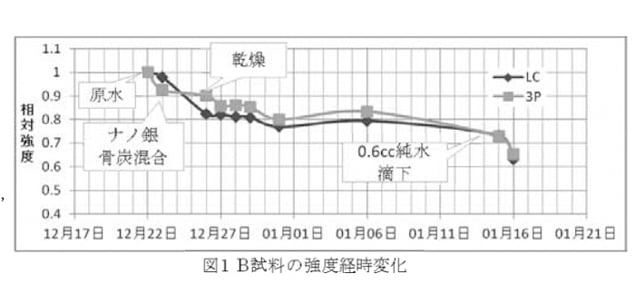
In March 2012, Dr. Shin Iwasaki joined the group with Dr. Norio Abe and started to help verify the strange phenomenon.  Then in Nov 2012, after much trial and error, he was able to measure the effect. In the abstract, the main result is shown in Fig. 1.

He made the sample in U9-type container by combining the 4-5 nanometer Ag with bone charcoal and washing with water including Cesium.  He measured radioactivity by monitoring the gamma spectrum over a long period using Csl (T1) detector + 512ch MCA.  He said that his team payed attention to uniformity of the sample, self shielding, volatilization and location of the measuring instruments.  

While the natural half-life of Cs-134 is 2 years, and one of Cs-137 is 30 years, Dr. Iwasaki analysed the experiment and concluded there was a decrease in the “half-life” of radioactivity of these Cesium isotopes to about 1 or 2 months.

The graph of Fig. 1 shows the time series of the relative values of radioactivity to the original sample without nanoscale Ag.  For example,  “1.0” is the value of the original sample and “0.6” means the value is 60% of the original sample.  3P and LC shows the following values and the background radioactivity is reduced.

3P: sum of 3 peaks including 604keV of Cs-134, 661.6keV of Cs-137 and 795.7keV of Cs-134 and others.

LC: sum of continuous values under the 3 peaks.

Nano-silver-Fig-1

This experiment started at Dec 22, 2012 and ended at Jan 16, 2013.  In the first few days, the half-life of the radioactivity is equal to about 20 days,  He added 0.6 cc pure water to the sample and stirred at Jan 14, 2013 and the value started to decrease again.

This result is very impressive for me because the experimental system is simple and the effect is big. Dr. Shin Iwasaki suggested the phenomenon may be one kind of LENR.

Unfortunately, this project has little budget, and he can not analyze the mix of elements of the used sample.  In the abstract, he calls for other scientists to reproduce this experiment.  I hope they will too.  This phenomenon may help to decontaminate water and soil around the Fukushima Daiichi nuclear plant.

Cold fusion now!

Contact Toshiro Sengaku or go to Amateur-Lenr Wants To Know

Cold fusion-powered car engineer has history of discovery

Dennis Cravens has a crowd-funding campaign to work on a cold fusion-powered car.

He doesn’t expect steam from cold fusion to be able to power the vehicle directly, but electricity generated from the steam would “trickle-charge” a battery to operate the vehicle.

Can he do it?

For twenty-four years, Dr. Cravens has been experimenting with the anomalous heat effect (AHE), and in that time, he has focused attention on gathering criteria and methods to initiate and trigger excess power.

Heat, pressure, current, radio-frequency, chemical, laser, acoustic, magnetic field – all were investigated by Cravens and longtime research partner Dennis Letts.

Cravens presented Factors Affecting The Success Rate of Heat Generation In CF Cells at ICCF-4 in Maui 1993, and together Cravens and Letts presented The Enabling Criteria of Electrochemical Heat: Beyond Reasonable Doubt at ICCF-10 in 2003, both works referring to palladium-deuterium Pd-D systems.

But it was investigating the various triggering methods that the collaborators made a surprising discovery.

Excess heat can be triggered by radio frequency.
RF-triggered excess heat experiments had been ongoing since 1992, and Letts’ collaborations with R. Sundaresan, Z. Minevski, and J.O’M. Bockris, the Texas A&M chemistry professor who nearly lost his job because of his research into cold fusion, were presented at ICCF-4.

Radio frequencies stimulated the reaction, but as usual with cold fusion, “it was difficult to reproduce”.

In Letts, D. and Cravens D. Laser Stimulation of Deuterated Palladium: Past And Present, PowerPoint slides presented at ICCF-10 2003, the authors describe one early experiment designed to test the effect of RF radio frequencies on excess power.

laser-cell-diagram-1A standard palladium-deuterium Pd-D electrolytic cell was modified to use the more-economical gold metal as an anode, instead of platinum.

During electrolysis, the gold dissolved into the solution, settling on the surface of the palladium cathode, and ruining the experiment.

A pocket laser pointer, emitting the familiar red-light at 670 nanometers, was directed at the cathode, just to see what would happen.

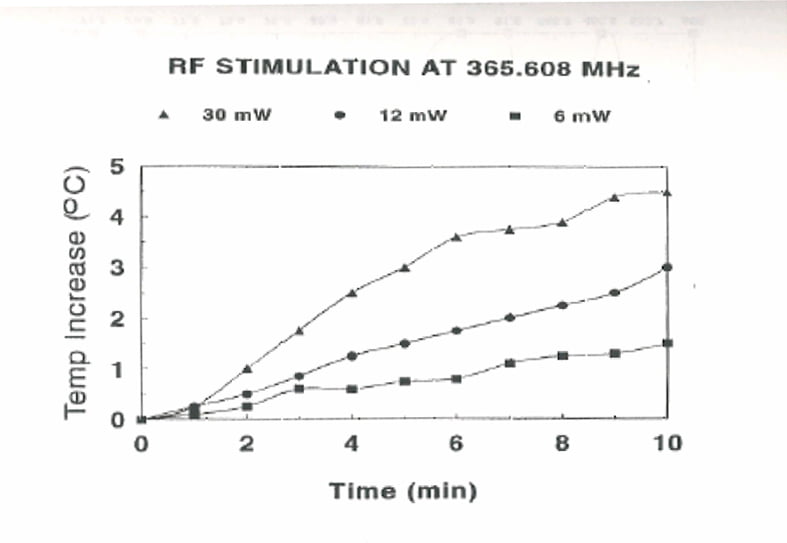
The cell temperature of the 75-gram electrolyte “rose several degrees, in a short time”.

In fact, a 3-degree increase in the electrolyte suggested that the 1 milliWatt laser pointer initiated heat in excess of 500 milliWatts.

An afterthought of directing laser-light saved an experiment.  Graph annotations by Ruby Carat
An afterthought of directing laser-light on the cathode saved an experiment.
Graph annotations by Ruby Carat.

In subsequent experiments, other frequencies were found to initiate a thermal effect, at 681 and 685 nm. “Most of the time this results in triggering a thermal response 10-30 times larger than the thermal output of the laser.” —Laser Stimulation of Deuterated Palladium Past and Present

The keywords there are not “10-30 times laser power”, but “most of the time”. Like RF, the laser triggering method did not guarantee 100% reproducibility.

However, one successful laser-triggered experiment ran live at ICCF-10.

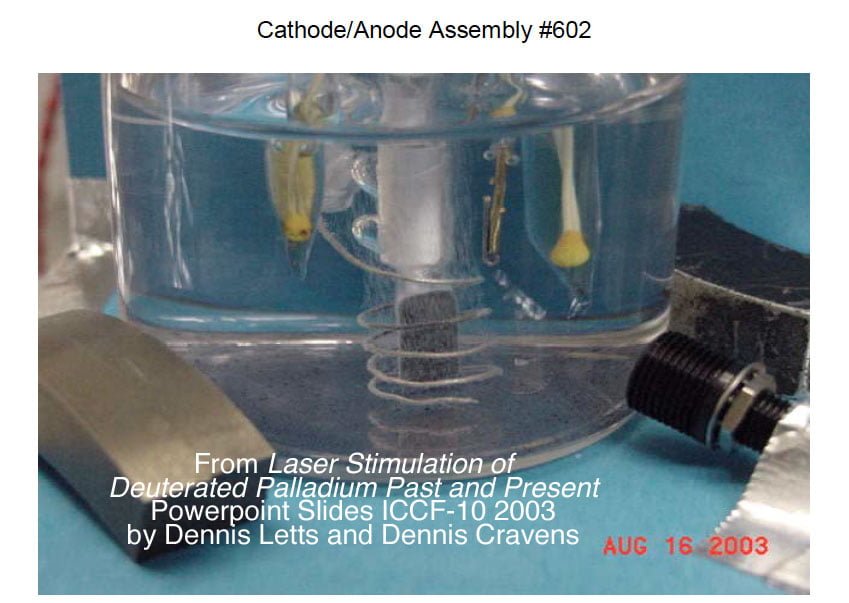
demo-cell-602

After days of loading, a 681 nm laser irradiated a 1mm spot on the cathode of demo cell #602; excess power jumped immediately. The laser was turned off, and excess power decreased. Power to the cell was 500 mW, and with a 30 mW laser stimulation, 500 mW excess power was generated.

Demo cell 602 power graph
Demo cell 602 excess power graph

Laser stimulation to initiate anomalous heat reflects the criteria that many researchers find critical: dynamic conditions must exist in the chamber. Energetics’ Technologies used Superwaves, Brillouin Energy uses Q-pulses, and even nickel-hydrogen Ni-H systems produce higher thermal power output when the chamber is heated.

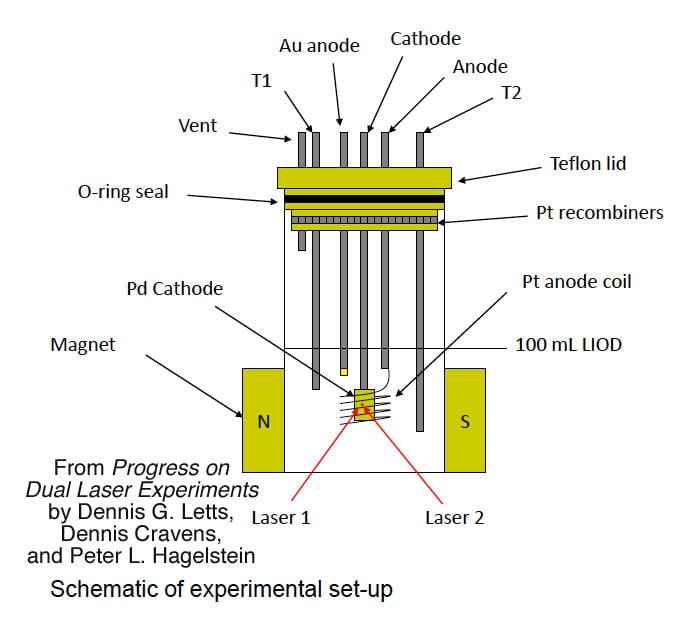
dual-laser-cell-diagramResonance by laser-light was further studied by Cravens and Letts with Peter Hagelstein, when two lasers were operated together to mix optical frequencies, creating beats to stimulate phonons in the Pd-D lattice that would initiate the reaction. Excess heat was associated with beat frequencies at 8.3 and 15.3 THz and 20.4 THz.

In addition, the size of the active regions was also compared to the laser’s region of impact. From their paper, it appears that the Nuclear Active Environment (NAE) is “larger than the laser spot in previous single laser experiments.”

While these undertakings describe basic science research, Cravens is no stranger to commercial efforts.

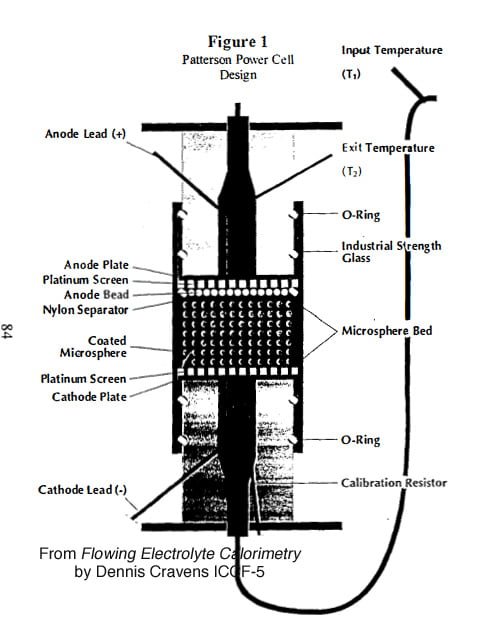
Patterson-Cell-diagram-CravensRepresenting ENECO, an early new-energy company initially formed to develop the Fleischmann-Pons work, Cravens was hired to provide an independent evaluation of the Patterson Power Cell, a proto-type commercial thermal generator designed by James Patterson of Clean Energy Technologies, Inc. (CETI) that utilized “plastic microspheres” layered with transition metals. Cravens reported on this investigation in Flowing Electrolyte Calorimetry at ICCF-5 in 1995.

Attendees at that conference were also treated to a live demonstration of the Patterson Power Cell. Here’s what Hal Fox of the New Energy Institute and publisher of Fusion Facts wrote in April of that year:

BEHIND THE SCENES AT ICCF-5 by Hal Fox

One of the most impressive presentations at the ICCF-5 was
given by Dr. Dennis Cravens and supported by a working
cold fusion cell set up in the foyer by Clean Energy
Technologies, Inc. (CETI) of Dallas Texas. Attendees at the
conference could take their own data, compute the results,
and show that a cold fusion cell was operating at 200 to 400
percent excess thermal power. This cold fusion system
utilized the patented inventions of James A. Patterson. This
invention consists of small plastic beads coated with copper,
nickel, and palladium. These beads provide a uniform large
surface area (of either palladium or nickel) to catalyze the
nuclear processes that are the heart of cold fusion
phenomena. The CETI patents cover both light and heavy
water electrolysis using the metal-coated microspheres.

Writing for the second issue of Infinite Energy magazine, Jed Rothwell provided further details of the demo.

Patterson’s company, Clean Energy Technologies, Inc. (CETI), got together with Dennis Cravens and brought to the conference a demonstration cell in a flow calorimeter. It worked spectacularly well. Cravens [2] discussed it on the first day. The device output 3 to 5 times input energy, ignoring energy lost to electrolysis gases, and as much as 10 times input if you include various factors such as electrolysis gases and the heat lost from the cell container.

As a demo, the Patterson cell output power was only a few Watts, but the durability was impressive. Rothwell continued:

The CETI demo system is fairly predictable, well controlled, and well-behaved, although it did get a bit quirky in the harsh conditions of the ICCF5 hallway. During breaks, the hotel coffee pots kept tripping the circuit breakers. This sent jolts of power through the transformer, which crashed the experiment. The CF reaction started up again every time, usually in about 10 minutes. The high precision flowmeter unfortunately did not survive the beating; the batteries and power supplies in it burned up. Fortunately, the low-precision flowmeter—a 10-ml laboratory supply graduated glass cylinder plus stopwatch—cannot be affected by power outages and excess voltage. The experiment was subjected to other abuses: the cart holding the experiment was wheeled up to a hotel room every night, carried on elevators, and pushed around. Cravens even lifted the cell from its container to show it to people while it was running! Yet in spite of this, the reaction started up in the morning after 10 or 20 minutes of electrolysis, although on the last day it took about a half hour, and the power was turned up higher than before. The fact that the cell survived this treatment at all demonstrates that this is one of the most robust and practical electrochemical CF systems yet developed.

Unfortunately, when Patterson’s beads ran out, the next batch didn’t work; the mystery of cold fusion had claimed another honest effort.

Yet the work of Dennis Cravens has persisted, and in his latest project, powering a 1928 Model-A with cold fusion, the aesthetic of a longtime researcher in anomalous effects marries the old with the new. Why?

“It is bold. It is daring. It is crazy but I have to try,” he writes.

Want to participate in something truly extraordinary? Go to Dennis Craven‘s Cold Fusion Powered Car Part 2 before April 20 to contribute.

The quote on his page says it best:

You don’t have to see the whole staircase, just take the first step.
Dr. Martin Luther King

Cold Fusion Now!

Aneutronic Fusion Spacecraft Architecture – LENR Cold Fusion

George Miley is poised to harness electricity from LENR without a Rankine or Carnot cycle and utilize it to power Aneutronic Fusion Spacecraft.  Coincidentally NASA released its latest posting about LENR technology on its Climate Change site. NASA sees LENR as the solution to global warming and planned space missions yet unrealized.

Colonization of the solar system is the goal. (Deep Space Industries) and (Planetary Resources Inc.) WOW!

I’m also excited to share with you the latest video in the following climate conversation series, The Price of Carbon. This short video, narrated by comedian and musician Reggie Watts, underscores the high cost we are all already paying for carbon pollution.

Posted by Maggie L. Fox – President & CEO – The Climate Reality Project

“From Superstorm Sandy to soaring temperatures in Australia, ongoing drought that has parched more than 60% of the U.S., and flooding from hurricanes around the world, we are experiencing the consequences of our carbon pollution now. We are paying the cost of these dirty weather disasters and other climate impacts through taxes, medical bills, and insurance rates (to name just a few). It’s past time to talk about the real cost of carbon pollution and to take action so that the polluters are paying their fair share.”

“In the spirit of moving forward to solve the climate crisis, it’s time to jump-start a real carbon conversation. Watch the video. Share it with your friends. Be part of the carbon conversation.”

Be sure to mention that Cold Fusion research is NOW emerging as LENR Engineering.

“Aneutronic Fusion Spacecraft Architecture”  (link) 

NASA-NIAC 2001 PHASE I RESEARCH GRANT

Final Research Activity Report (SEPTEMBER 2012) P.I.: Alfonso G. Tarditi
Collaborators: John H. Scott, George H. Miley – University of Houston – Clear Lake, Houston

This research is not about exploring a new fusion energy concept, it actually assumes the availability of an aneutronic fusion energy reactor. The focus is on providing the best (most efficient) utilization of fusion energy for propulsion purposes.”

Mr. Miley has been awarded a U.S. patent for an LENR energy device… the “assumption” of a “new fusion energy concept” is correct.

An Ambitious Goal

“This Phase I study is targeting a new spacecraft architecture to enable an unprecedented range of mission capabilities that, for the purpose of simple comparison, can be summarized as 10 times faster, 10 times further, and 10 times heavier with respect to the current state of the art. The improved traveling capabilities offer new, exciting mission possibilities and, in fact, an entire new paradigm for approaching the solar system exploration and colonization.”

Of Particular Interest Is this from section 4.6

“Fission Hybrid Interim Concept” (uranium fission/aneutronic fusion)

A system level analysis that extends the Phase I system level study shall be conducted including compact fission reactor performance for state-of-the-art and near-term foreseeable designs. This particular investigation is aimed at providing a high-level assessment of the “a” obtainable for different scenarios in which fission power provides all or part of the energy required for running the aneutronic fusion core and producing the ion flow.


I surmise a new approach…

“Fusion Hybrid Interim Concept”

(LENR fusion/aneutronic fusion)

George H. Miley proposes to replace conventional NASA fission power units with existing LENR fusion thermoelectric technology.

This new approach applied to Aneutronic Fusion Spacecraft Architecture may be summarized as where LENR fusion thermoelectric power provides all or part of the energy required for running the aneutronic fusion core and producing the ion flow.


NASA Goals for LENR: “The Nuclear Reactor in Your Basement”


NASA Has LENR Patents

NASA Glenn Research Center Experience with LENR Phenomenon 

Author:Wrbanek, Susan Y.; Fralick, Gustave C.; Wrbanek, John D.; Niedra, Janis M.
Abstract:Since 1989 NASA Glenn Research Center (GRC) has performed some small-scale limited experiments that show evidence of effects claimed by some to be evidence of Low Energy Nuclear Reactions (LENR). The research at GRC has involved observations and work on measurement techniques for observing the temperature effects in reactions of isotopes of hydrogen with palladium hydrides. The various experiments performed involved loading Pd with gaseous H2 and D2, and exposing Pd thin films to multi-bubble sonoluminescence in regular and deuterated water. An overview of these experiments and their results will be presented. Collection:NASA NASA Center:Glenn Research Center Publication Date:May 2012 Document ID:20130001794 Subject Category:PHYSICS (GENERAL) Report/Patent Number:GRC-E-DAA-TN5141

Subsonic Ultra Green Aircraft Research Phase II: N+4 Advanced Concept Development

Author:Bradley, Marty K.; Droney, Christopher K. Abstract:This final report documents the work of the Boeing Subsonic Ultra Green Aircraft Research (SUGAR) team on Task 1 of the Phase II effort. The team consisted of Boeing Research and Technology, Boeing Commercial Airplanes, General Electric, and Georgia Tech. Using a quantitative workshop process, the following technologies, appropriate to aircraft operational in the N+4 2040 timeframe, were identified: Liquefied Natural Gas (LNG), Hydrogen, fuel cell hybrids, battery electric hybrids, Low Energy Nuclear (LENR), boundary layer ingestion propulsion (BLI), unducted fans and advanced propellers, and combinations. Technology development plans were developed. Collection:NASA NASA Center:Langley Research Center Publication Date:May 2012  Report/Patent Number:NASA/CR-2012-217556, NF1676L-14434

The 2013 President’s (Budget)

Funding Highlights:

Provides $27.2 billion in discretionary funds, a 3.2 percent increase above the 2012 enacted level. This request includes increased funding for priority areas such as clean energy, research and development to spur innovation, and advanced manufacturing. Savings and efficiencies are achieved through cuts to inefficient and outdated fossil fuel subsidies, low-priority and low-performing programs, and by concentrating resources on full utilization of existing facilities and infrastructure.

Increases funding for applied research, development, and demonstration in the Office of Energy Efficiency and Renewable Energy. The Budget also maintains and expands funding for the Advanced Research Projects Agency-Energy. These investments in high-performing programs will help position the United States as a world leader in the clean energy economy, and create the foundation for new industries and new jobs.

Improves the competitiveness of U.S. industries by more than doubling research and development on advanced manufacturing processes and advanced industrial materials, enabling companies to cut costs by using less energy while improving product quality.

Works through the President’s Better Building Initiative to make non-residential buildings more energy efficient by catalyzing private sector investment. Creates jobs through mandatory funding for HomeStar incentives to consumers to make their homes more energy efficient.

Promotes basic research through $5 billion in funding to the Office of Science.

Positions the Environmental Management program to meet its legally enforceable cleanup commitments at sites across the country.

Continues investments to maintain a safe, secure, and effective nuclear weapons stockpile in support of the planned decrease in deployed U.S. and Russian weapons under the New Strategic Arms Reduction Treaty.

Strengthens national security through funding for securing, disposing of, and detecting nuclear and radiological material worldwide.

Thank you Walker for the following…


“With the head scientist at NASA Langley research saying LENR is confirmed along with confirmation from Labs at Toyota, Mitsubishi, and STMicroelectronics as well as Amaco, the US Navy research labs, along with a course on the Fleischmann/Pons effect at MIT and working replications of the Celani reactor at academic sites around the world as well as hundreds of confirmed and peer reviewed experimental paper, that professors and Nobel prize winners are saying it is real and that Patents now being granted, the case that LENR is a real working system of cold fusion is proven.”


LENR Proof

The fact that…

“Oil companies like BP, Shell, Exon, and a host of others are all selling off their oil fields around the world, that Petrobas who spent a decade to aquire the controling interest in a texas oil refinery, now are desperate to sell it at a loss.”

“The fact that Nuclear power plant owners are cancelling their big investment projects, and preparing to close their plants.”

“It is well known that the major players are on a divestment and diversification strategy. Many are giving various excuses, but when you check them they do not pan out. We are shifting to US based fields is a common one, but when you look they have bought options to consider buying or leases rather than the asset.”

“That is key no buying only renting. You rent assets when the asset value is about to take a hit. And the total US Proven reserves does not add up to what has been sold.”

Shell has been on a massive divestment strategy on its oil field assets, from Africa to the Far East for the last 12 months, or since Rossi did his first demonstration this time last year.”

“Other Fossil Fuel companies on a divestment strategy are BP who are selling their stakes in fields in the North Sea, Russia, the Arctic and the Gulf to name but a few and not even batting an eyelid about being refused license to buy future assets in the Gulf. (link) (link) and (link)

Connoco

“Exxon  (link) (link) (link) and (link)

“Even the pipeline parts and refinery companies are joining the rush to divest the fossil fuel business.”

“Do a Google search for any oil company and the phrase “Oil field” and the words divest or sell.

“Some are trying to cover their strategy and the risk by divesting half of the asset others are just cashing in their chips.”

“This year has been an Oil Field Night of the Long Knives as all the major players have been dumping these soon to be seriously downgraded assets.”

“The price per barrel dropped 20+ dollars since May.”

“I expect the real drop to be when the 60 day and 30 Day options on the price per barrel get shorted when the Rossi announcement is about to be made. I expect the price per barrel will drop below 70. Then it will resurge as people realise LENR will not happen overnight.”

“Then Oil and other fossil fuels will go into a long decline with investors on a business decline strategy making money out of the asset stripping and running the oil fields into the ground. Natural Gas will be the longest lived of the Fossil Fuel assets.”

“Coal might die out out in as little a year and a half as converting coal power plants to use Rossi’s Hot Cat or other LENR tech will be very easy. Oil will be next. Converting all power plants could take a 5 to 7 years but the fact that President Obama changed the Law to allow Combined Heat and Power means that many plants will end up being scrapped before they can convert, as faster cheaper more nimble competitors will create power plants on customers door steps, that provide power at a tenth but theoretically at up to one thousandth of the cost.”

“With regard to Nuclear and Green power the same applies Siemans dropped all their Nuclear industry like a hot potato after September 2011 others followed suit. Siemans also dropped their $33bn green business.”

“Buckle up people its about to get bumpy.”

Thanks Walker – Cold Fusion Now – LENR Engineering

QUEMA (fire) Q.uantum U.nlimited E.nergy M.anufacturers A.ssociation – coldfusionnow.org2012

By the by…

A few of the many other patents involving George H. Miley… impressive.


How many LENR patents have been filed and not published yet? None of us Know!

Here are a few published in the U.S.

Electron capture by a proton – Where would the energy come from?

Library David standing IMG_1798
In this posting, David French makes excursion outside his field: patent law, to speculate on possible aspects relating to the physics and mechanism of the cold fusion phenomena.

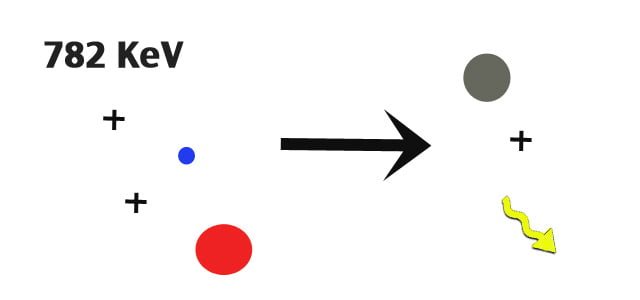
One of the theories to explain the ColdFusion excess energy effect is based on the premise that a proton can capture an electron, become a neutron, and then all sorts of magical things can happen. However, a neutron is heavier than the combined weight of a proton and an electron. The relative masses are:

Neutron = 1
Proton = 0.99862349
Electron = 0.00054386734

When you do the addition and subtraction it works out that a neutron is heavier than the proton-electron combination by a mass-energy equivalent of about 780 kilo electron volts ( keV). This amount of mass-energy must be found to make a neutron out of a proton and an electron. Here are some thoughts on that point.

Structure of an Atom
A neutron does not have a proton and electron within it. The basic structure of a neutron is three quarks: 1 up, 2 down. A proton has three quarks: 2 up, 1 down. An up quark and a down quark are not the same thing. A neutron is a new entity. And it requires energy to produce it from combining a proton with an electron, or does it?

When an electron falls from infinity towards a proton it acquires 13.6 electron Volts of energy to reach the ground state “orbital” around the proton. I have always wondered why it does not go all the way. Apparently, its Debroglie wavelength has to fit” around the “orbit radius” for it to occupy a stable state.

Perhaps another explanation is that an electron can only arrive in an atom and occupy an orbital by dissipating its arrival energy in the form of a photon. All the light we see originates from electrons settling into an empty slot in the shell of permitted orbitals around nuclei. If atomic dynamics do not permit the emission of such a photon, then an electron cannot settle into a stable orbital but must move on.

But what if an electron acquired enough energy to crash through the base orbital and proceed onward into a proton? How much more energy could the electron acquire hurtling towards the nucleus of a hydrogen atom? I have a suspicion that this might be a very large value if the radius of a proton is small enough.

Let us start by an analogy. Here is the formula for gravitational potential energy for a small mass “m” coming in from infinity to arrive at a radial distance “r” from a large mass M:

E = – GmM/r

This formula has an extraordinary consequence: if a mass were to fall to a point source where “r” drops to zero the energy would be infinite! This does not happen in the Sun, or even in the case of a penny being dropped down a very deep hole in the Earth. This is because as you go below the surface of the Sun or Earth the mass above you starts to cancel the gravitational force below you. Newton showed that there is no gravitational force at the center of the Sun or the Earth. The formula stops working when you reach a surface.

Let us turn to the potential energy associated with an electrical field. By integrating the energy acquired as an electron falls in from infinity, the amount of energy that it acquires as it approaches a proton is given by the following formula:

E = kQq/r

where Q and “q” are the sizes of the respective charges and “k” is a constant.

It will be seen directly that this formula parallels the one for energy acquired through gravitational attraction.

Again we are presented with the possibility that “r” might go to zero. Why is this important?

Well, Widom & Larsen postulate that an electron can be captured by a proton in order to become a neutron. But this requires approximately 780 keV, the mass difference between a neutron and the total mass of a proton and electron.

(I note that it has been said in Wikipedia about electron capture: “A free proton cannot normally be changed to a free neutron by this process; the proton and neutron must be part of a larger nucleus.” No reference is given for this statement.)

This large energy gap which is based on the mass difference between a neutron and a combined proton and electron has always seemed to me to be a barrier to electron capture by a proton. Since an electron only acquires 13.6 V falling from infinity to its ground state, it has got to acquire a lot more energy to get up to 780 keV. On the other hand, when “r” gets small, this kind of energy could be acquired quite quickly if the formula for potential electrostatic energy does not break down.

The gravity we experience from the Sun is the accumulation of force from the distributed mass contained in a body having substantial dimensions. It is not a point source. (Maybe a black hole is a point source!) But a proton is very nearly a point source. What does this size say about the potential energy that could be associated with the electrical attraction that extends between a proton and electron? Now let me take you on a little excursion concerning Blacklight Power and Randell Mills.

Randell Mills has his theory that electrons can occupy orbitals that are below the normal base orbital for a hydrogen atom. Randell calls such a special hydrogen atom a “hydrino”. Perhaps he has part of the explanation. I have met with Randell back in 1980’s and here is what he explained to me.

Electrons cannot fall below the base level in the normal hydrogen atom because they cannot emit a photon on their own. For his hydrinos to form there has to be a resonant absorption of energy from a nearby atom in order to permit an electron to drop below the normal base state. When falling through energy levels into an atom from infinity, an electron emits a photon to dissipate its acquired energy.

Apparently, once an electron reaches the base orbital, it is no longer capable of emitting photons as a way of losing energy. But according to Randell if a nearby atom is able to eject an electron, acting as a “catalyst”, it may serve to allow a proximate electron that is in the base orbital of a proton to fall to a lower energy level, closer to the proton. The energy that is associated with the electron falling through the electric field towards the proton is released through the resonant absorption of that energy by the nearby “catalyst” atom which disposes of the energy by ejecting one of its electrons. Here is a description of his theory from the web:

“According to Dr. Mills, when a hydrogen atom collides with certain other atoms or ions, it can sometimes transfer a quantity of energy to the other atom, and shrink at the same time, becoming a Hydrino in the process. The atom that it collided with is called the “catalyst”, because it helps the Hydrino shrink. Once a Hydrino has formed, it can shrink even further through collisions with other catalyst atoms. Each collision potentially resulting in another shrinkage.”

From the same source:

“For those of you with a mathematical bent, the formula is ((2 x n) -1) x 13.598 eV, where “n” is the level number. (BTW the maximum level number is certainly no larger than 137, and may well be less than that, not least because when a Hydrino gets very small, it may undergo fusion reactions with other atoms.) Of course, the numbers can be added up. IOW if you start with a Hydrogen atom, and end up with e.g. a level 5 Hydrino, then you get a total of 41 + 68 + 95 + 122 = 326 eV. The total for any level can be calculated with the formula (n^2 -1) x 13.598 eV.”

[End of quotation]

Well, 137 x137 = 18769 electron Volts and (n^2 -1) x 13.598 eV gives 18769 – 1 × 13.598 = 255,207.264 eV.

This is a value which is well on its way to 780keV!! I do not know why the limit in the above formula is 137, but let us accept that for the moment. Using the formula for the potential energy that becomes available when two electrically charged bodies are brought into close proximity to each other, namely E = kQq/r , it may be that this requisite energy condition is within reach of some force or effect originating from within the proton. At that moment, the magical conversion into a neutron may occur.

Maybe having fallen to level 1/137 an electron is able to fall further into a proton, eventually contributing the additional energy that it acquires into a quark conversion that changes the proton into a neutron of higher mass, and then the electron simply disappears!

On the other hand, there may be some other principle or limitation that would forbid such an event. Still, it is interesting to muse on the consequences an energy formula that includes the remarkable factor: 1/r.

Persons wishing to make comments on this posting are invited to visit the Cold Fusion Now website where this article is posted.

Peter Hagelstein Intro to Excess Power (with Enhanced Audio)

Introduction to Excess Power in Fleischmann-Pons Experiments lectures by Dr. Peter Hagelstein now with enhanced audio compliments uploadJ.

What follows are Jeremy Rys‘ classroom video series with the processed audio track by uploadJ.

Watch the second week’s lectures with JET Energy engineer and co-teacher Dr. Mitchell Swartz, who describes experimental results on their NANOR technology here.

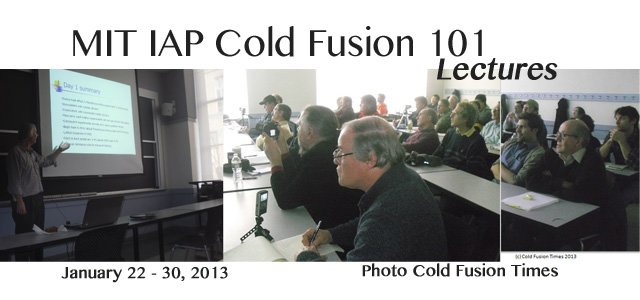
ALSO: Gayle Verner‘s Synopsis of Cold Fusion 101 courtesy Infinite Energy Magazine.

Top