
Seldon Technologies, NASA, and LENR

The present disclosure combines the unique properties of nanotubes and in one embodiment carbon nanotubes, in a novel manifestation designed to meet current and future energy needs in an environmentally friendly way. Devices powered with nanotube based nuclear power systems may substantially change the current state of power distribution.” 
–Retired U.S. Rear Admiral Craig E. Steidle of Seldon Technologies on cold fusion nanotube-based nuclear power systems.

Rear Admiral Craig E. Steidle – USN, NASA, DoD
Admiral Craig E. Steidle served as the first Associate Administrator of the Office of Exploration Systems at NASA (now known as the Exploration Systems Mission Directorate), an organization formed to implement NASA’s human exploration of the solar system as announced in the Vision for Space Exploration.

Adm. Steidle served as the Director of the Department of Defense (DoD) Joint Advanced Strike Technology Office and was the Director of the Joint Strike Fighter Program, DoD’s largest program.

Admiral Steidle officially resigned from the position of associate administrator for exploration systems in June 2005. He served as a Visiting Professor in Aerospace Engineering at the U.S. Naval Academy for five years and then briefly as the President of the Commercial Spaceflight Federation before fully retiring in 2011.

Craig Steidle NASA’s Future Is Rising From ‘the Swamp’
by Guy Gugliotta, Washington Post, Dec.15, 2004
At NASA headquarters, they call it “the swamp,” a broad expanse of the fifth floor where experts gather to figure out how to accomplish the most ambitious space feat ever: a multi-decade plan to send humans from Earth to the moon and ultimately to Mars.

The master of this domain is Associate Administrator Craig E. Steidle, the retired Navy rear admiral who runs NASA’s not-so-new-anymore Office of Exploration Systems and who went to work for NASA after the top brass lured him in as a consultant….

Craig Seidle and Dennis Bushnell were each highlighted in 2008 American Society for Engineering Education Conference. I imagine each know of each others works, Admiral Steidle as board-member of cold fusion company Seldon Technologies and Dennis Bushnell as a leader in NASA cold fusion.

Distinguished Lectures Presentation Title: “The Future(s) of Energetics” by Dennis Bushnell was sponsored by the Mechanical Engineering Division. This talk summarizes the increasingly dire and ever nearer term implications of Global Warming and Peak Oil and then considers the spectrum of “Green” and the “Ways Forward” to replace Fossil Carbon Energy Sources. There are four approaches possible in the nearer term. These include approaches with the capacity to replace petroleum for transportation and coal/natural gas for base load. While they require research, they are both feasible and affordable.

The lecture also considers the “frontiers of the responsibly imaginable” in energetics going forward, and “Wild Card” approaches which proffer revolutionary possibilities. Energetics issues considered include Generation, Storage, Conservation and Transmission. Lecture concludes with a brief discussion of “Second Law Warming”, which will follow Atmospheric Warming and constrains the solution options for Atmospheric Warming.

Best Paper Award – NSEE 2008 “The Loss of the Space Shuttle Columbia: Portaging the Leadership” by Robert Nieweoehner, Craig Steidle, and Eric Johnson, sponsored by the Engineering Management Division.

December 2008 “The Energetics Futures Brief” with NASA Chief Scientist Dennis M. Bushnell” for the University of Alberta Energy Club.
This presentation will focus on the advanced and futuristic technologies already at the laboratory stages or on the horizon that have the potential to shape how we will live and conduct our activities. The urgency for humanity to change energy consumption, and the types of energy that is used will form part of this presentation leading to a discussion on the following topics:

  • Nano-plastics for the conversion of solar energy into electricity
  • Thermo-electrics (i.e., the direct conversion of temperature differences), tidal-current turbines and geothermal sources for electricity production
  • Production of food biomass and biofuels by means of genetically modified halophytes (salt tolerant plants) and algae growing in saline or brackish waters
  • Robotics replacing higher-level human labour, machine intelligence and human life extension
  • Carbon dioxide (CO2) to carbon monoxide (CO) conversion and hydrogen production by artificial photosynthesis
  • Photo-catalytic electrolysis of water for hydrogen production
  • Low-radiation nuclear fusion, such as proton – Boron 11 aneutronic fusion
  • Low energy nuclear reactions

Seldon Technologies
Now, Craig Steidle is on the board of directors of Seldon Technologies, Inc. The two following Seldon patents are noteworthy.

Methods of Generating Energy and/or he-4 Using Graphene Based Materials
Publication date: Oct 30, 2013

Inventors Christopher H. Cooper, William K. Cooper, James F. Loan
From the Patent:

Deuteron-Based Reactions

[0050] Fusion of two deuterons that are confined in a solid can theoretically result in three different outcomes as shown in the following equations (V. E. Kim, Purdue Univ., The 15th International Conf. on Condensed Matter Nuclear Sci. (ICCF-15) Oct 5 -9, 2009)

[0052] For each 4He produced by two deuterons 23.8 MeV energy is released because of the well-known relationship between change in mass during a fusion process and energy release (E=mc2). It is speculated that the energy released is in the form or electromagnetic radiation with wavelengths ranging from Gigahertz to extreme UV, sometimes referred to as “soft x-rays”

[0053] It has been discovered that graphene materials have an unusual electronic structure making it an ideal candidate for a variety of applications, primarily in the field of electronics. In particular, it has been discovered that the single atomic layer of carbon, characteristic of graphene materials, effectively screens Coulomb interactions, causing graphene to act like an independent electron semimetal. Furthermore, one particular graphene material, carbon nanotubes, can be grown with remarkable uniform diameters, number of walls, and atomic structure. See, “The Effective Fine-Structure Constant of Freestanding Graphene Measured in Graphite,” Science, Vol. 330 no. 6005 pp. 805-808 5 November 2010, which is herein incorporated by reference

[0058] The results presented herein are, in general, consistent with other reported low-energy nuclear reaction (LENR) experimental results, most notably the work of McKubre at Stanford Research Inst, who reported a peak 4He concentration of 1 ppm after 20 days of aging palladium powder in D2 gas (APS meeting, Denver CO, March 5, 2007)

Methods of Generating Energetic Particles Using Nanotubes and Articles Thereof
US 20130266106 A1 – Publication date Oct 10, 2013

Inventors: Christopher H. Cooper, James F. Loan, William K. Cooper, Alan G. Cummings Original Assignee: Seldon Technologies, Llc

From the patent:
ABSTRACT

There is disclosed a method of generating energetic particles, which comprises contacting nanotubes with a source of hydrogen isotopes, such as D2O, and applying activation energy to the nanotubes. In one embodiment, the hydrogen isotopes comprise protium, deuterium, tritium, and combinations thereof.

There is also disclosed a method of transmuting matter that is based on the increased likelihood of nuclei interaction for atoms confined in the limited dimensions of a nanotube structure, which generates energetic particles sufficient to transmute matter and exposing matter to be transmuted to these particles.

DESCRIPTION

This application claims the benefit of domestic priority under 35 USC §119(e) to U.S. application Ser. No. 60/741,874, filed Dec. 5, 2005, and Ser. No. 60/777,577, filed Mar. 1, 2006, both of which are incorporated by reference herein.

Disclosed herein are methods of generating energetic particles, by contacting nanotubes with hydrogen isotopes in the presence of activation energy, such as thermal, electromagnetic, or the kinetic energy of particles. Also disclosed are methods of transmuting matter by exposing such matter to the energetic particles produced according to the disclosed method.

A need exists for alternative energy sources to alleviate our society’s current dependence on hydrocarbon fuels without further impact to the environment.

The inventors have developed multiple uses for nanotubes and devices that use such nanotubes. The present disclosure combines the unique properties of nanotubes and in one embodiment carbon nanotubes, in a novel manifestation designed to meet current and future energy needs in an environmentally friendly way.

Devices powered with nanotube based nuclear power systems may substantially change the current state of power distribution. For example, nanotube based nuclear power systems may reduce, if not eliminate, the need for power distribution networks; chemical batteries; energy scavenger devices such as solar cells, windmills, hydroelectric power stations; internal combustion, chemical rocket, or turbine engines; as well as all other forms of chemical combustion for the production of power.
NASA LENR Aircraft and Spaceplanes

It’s mind-boggling to imagine the numbers of people who have viewed the NARI Low Energy Nuclear Reaction Aircraft Seedling Seminar by Doug Wells – people from companies serving the aerospace industries, to leaders in engineering and research. The seedling seminar is even being reported in aviation magazines worldwide. Wow!

Doug Wells Low Energy Nuclear Reaction Aircraft [.pdf]

Doug Wells will also present a paper at the AIAA Aviation 2014 Conference, a Study Webinar by Marty Bradley available through the American Institute of Aeronautics and Astronautics, and a paper was presented in January, at the 52nd Aerospace Sciences Meeting, by Robert A. McDonald from Cal Poly.

Thousands upon thousands of savvy people are now grasping that cold fusion is emerging as a source of clean energy beyond our most promising dreams, with the power to move humanity through our next evolution. With popular cold fusion/LENR science, we are on the verge of an epic technological advancement with the concurrent personal, social, economic, environmental, spiritual, and philosophical advancements.

With that change in energetics, the paradigm changes, and we begin building an ecologically sustainable society.

 “-given the truly massive-to-mind boggling benefits – solutions to climate, energy and the limitations that restrict the NASA Mission areas, all of them. The key to space exploration is energetics. The key to supersonic transports and neighbor-friendly personal fly/drive air vehicles is energetics, as simplex examples of the potential implications of this area of research.”
–Dennis Bushnell, Chief Scientist NASA Langley on the energetics of LENR.

Low Energy Nuclear Reaction Aircraft Investigator
Doug Wells, NASA Langley Research Center

Purpose
The purpose of this research is to investigate the potential vehicle performance impact of applying the emergent Low Energy Nuclear Reaction (LENR) technology to aircraft propulsion systems.

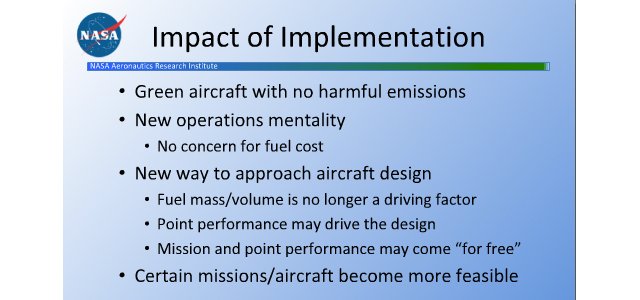
LENR potentially has over 4,000 times the density of chemical energy with zero greenhouse gas or hydrocarbon emissions. This technology could enable the use of an abundance of inexpensive energy to remove active design constraints, leading to new aircraft designs with very low fuel consumption, low noise, and no emissions.

The objectives of this project are to gather as many perspectives as possible on how and where to use a very high density energy source for aircraft including the benefits arising from its application, explore the performance impacts to aircraft, and evaluate potential propulsion system concepts.

Background
LENR is a type of nuclear energy and is expected to be clean, safe, portable, scalable, and abundant. The expected benefits make it an ideal energy solution. When it is applied to aircraft, LENR removes the environmental impacts of fuel burn and emission from combustion. Excess energy could be used to reduce noise so that all three of NASA’s technology goals for future subsonic vehicles are either eliminated or addressed.

Furthermore, aviation impacts almost every part of our daily lives, civilian and military.

A revolutionary technology like LENR has the potential to completely change how businesses, military, and the country operate as a whole, giving a tremendous financial, tactical, and resource advantage to anyone that utilizes it in the most effective way.

High-density energy sources create some unique capabilities as well as challenges for integration into aircraft.

An LENR concept that has reported some success generates heat in a catalyst process that combines nickel metal (Ni) with hydrogen gas (H). The initial testing and theory show that radiation and radioisotopes are extremely short lived and can be easily shielded.

Although nuclear fission has been looked at for use in aircraft, LENR is different. LENR has a higher energy density and no radioactive by products.

Success of this research will provide a firm foundation for future research and investment for high-density energy source technology integration into aircraft.

FIVE EMERGENT EXAMPLES

NASA LENR Aircraft 2014 Seedling Technical Seminar
The Team

California Polytechnic State University

  • Dr Rob McDonald
  • Advanced Topics in Aircraft Design Course
  • Sponsored Research Project Team

NASA Glen Research Center

  • Jim Felder, Cris Snyder

NASA Langley Research Center

  • Bill Fredericks, Roger Lepsch, John Martin, Mark Moore, Doug Wells, Joe Zawodny

The Application of LENR to Synergistic Mission Capabilities
Submitted by Doug Wells for publication and presentation at the AIAA Aviation 2014 Conference. Date: 16 – 20 June 2014.
Location: Atlanta, Georgia. (we must wait to view it)

The American Institute of Aeronautics and Astronautics (AIAA) is the world’s largest technical society dedicated to the global aerospace profession.

Lessons Subsonic Ultra Green Aircraft Research (SUGAR)
Study Webinar Recorded 18 December 2012 – Martin K. Bradley
Available at the American Institute of Aeronautics and Astronautics
1801 Alexander Bell Drive, Suite 500 – Reston, VA 20191-4344

Synopsis
This webinar summarizes the work accomplished for NASA by the Boeing Subsonic Ultra Green Aircraft Research (SUGAR) team during a continuing two-phase study, which started in 2008. Results through February 2012 are reported.

In Phase I, the team completed the development of a future scenario for world-wide commercial aviation in 2030, selected baseline and advanced configurations, generated technology suites for each, conducted detailed performance analysis, calculated noise and emissions, assessed technology risks, and developed technology roadmaps. Five concepts were evaluated in detail including a high span strut braced wing concept, a gas turbine battery electric concept, and a hybrid wing body.

In Phase II, the study was extended to the N+4 2040 timeframe and considered the following additional technologies: Liquefied Natural Gas (LNG), Hydrogen, fuel cell hybrids, Low Energy Nuclear (LENR), boundary layer ingestion propulsion (BLI), unducted fans, and advanced propellers.

Presenter
Dr. Marty Bradley is a Technical Fellow for The Boeing Company, working in the Boeing Research and Technology organization in Huntington Beach, California. For Boeing, he is the leader for a variety of projects related to green aircraft technologies, aviation environmental life cycle analysis, and propulsion integration for advanced technologies. Marty has 28-years of experience in vehicle design, propulsion integration, and technology studies for a wide variety of commercial and military aerospace applications. He has led and conducted projects for green aircraft design, alternative fuels, and environmental life cycle analysis (LCA).

Marty is the Principal Investigator for this NASA funded study looking at advanced technologies for future commercial aircraft, which will be discussed. Marty has a B.S., M.S., and Ph.D. in Aerospace Engineering, all from the University of Southern California.

LENR-Spaceplane-2-Parts-of-aircraftImpact of Advanced Energy Technologies on Aircraft Design
Robert A. McDonald, California Polytechnic State University
American Institute of Aeronautics and Astronautics
Publication Date: 13-17 January 2014
Chapter DOI: 10.2514/6.2014-0538

The impact of low energy nuclear reaction (LENR) technology on the design of aircraft is examined. Energy conversion possibilities considered and a Brayton cycle engine with an LENR heat exchanger is selected.

Potential aerospace applications of LENR devices are discussed and a high altitude long endurance (HALE) unmanned ariel vehicle with multi-year endurance is conceptualized with primary focus on (LENR) energy management.

SpaceWorks Engineering Advanced Concepts Group
Key customers and partners are NASA, Air Force Research Laboratory, DARPA, JPL, Pratt Whitney a United Technologies Company, ULA United Launch Alliance, Orbital, IHI AeroSpace, National Institute of Aerospace, UDRI University of Dayton Research Institute, UTC Universal Technology Corporation, and SI Satrec Initiative.

LENR Spaceplanes
Advanced Propulsion System Concept Studies
Customer: NASA LaRC
Duration: 6 months
Date: 2009-2010

SpaceWorks conducted separate vehicle design studies evaluating the potential impact of two advanced propulsion system concepts under consideration by NASA Langley Research Center:

The first concept was an expendable multistage rocket vehicle which utilized an advanced Air-Augmented Rocket (AAR) engine. The effect of various rocket thrust augmentation ratios were identified the resulting vehicle design where compared against a traditional expendable rocket concept

The second concept leverage Low Energy Nuclear Reactions (LENR), a new form of energy generation being studied at NASA LaRC, to determine how to utilize an LENR-based propulsion system for space access. For this activity, two LENR-based rocket engine propulsion performance models where developed jointly by SpaceWorks and LaRC personnel.

The Complete NARI 2014 Seedling Seminars  (click people tab to view investigators)

The NASA Aeronautics Research Institute (NARI) presented a 6-day virtual technical seminar on February 19–21 and February 25–27, 2014 to showcase innovative concepts developed by NASA researchers, primarily featuring work from the Seedling Phase 2 (Round 1) and Seedling Phase 1 (Round 3) funds.

http://nari.arc.nasa.gov/sites/default/files/attachments/SeedlingWELLS.pdf

http://nari.arc.nasa.gov/sites/default/files/attachments/SeedlingCOGAN.pdf

NARI awards the ARMD Seedling Fund grants to make deliberate investments in early-stage and potentially revolutionary aviation concepts and technologies that are aligned with NASA’s mission. These grants go to civil servant-led teams at NASA Research Centers. This seminar was an opportunity for members of the NASA aeronautics community to view the results of this research and see how these innovative concepts might complement and benefit their work and projects across the agency. The results were presented in 33 talks: 30 minutes for each presentation and 10 minutes for discussion and questions. Each session featured a special guest NASA leader as Keynote Speaker and Moderator.

The NASA seminar was free and open to all. Watch the archive and download the slides.

Amazing and fantastic!

*****************************************************************************************

BUILDING AN ECOLOGICALLY SUSTAINABLE SOCIETY

XXXVII INDIAN SOCIAL SCIENCE CONGRESS – December 27-31, 2013
Published by Indian Academy of Social Sciences – 380 page pdf
Iswar Saran Ashram Campus, Allahabad 211004, INDIA
Telefax: 0532-2544170, 2544245

Website: www.issaindia.org.in

Here is a small yet important part of their wonderful work. Enjoy.

“Why Science is Social”

What is social?
An act or result of an act involving two or more than two individuals is called social. Since science is produced by two or more than two individuals, it is social. In other words basic character of science is social.

What does it mean?
It means that very notion of science is social. It means the notions of verify-ability and repeatability, reliability, validity, precision, exactness, isomorphism, measurement, methods, hypothesis, inference and theory are social notions. It means there is close connection between society and science and between social conditions and science. As humans and their societies develop so does science.

It also means that proclivity of all humans to social influence and their inability to free themselves wholly from the social and personal prejudices tend to influence objectivity of science. It means science is ‘primitive’ to some extent and ‘precious’ to large extent. It is ‘primitive’ to some extent because it is never cent percent objective. It is, ‘precious’ to a large extent because there is no other system of better objective knowledge.

What is its implication?
It implies that the division of science between science and social science is no longer correct. Today there is no dichotomy between Nature, humans and society or between living matter and non-living matter. Through long and arduous pursuits humans discovered their origin and connections with Nature. Today the term Nature connotes all non-living and living objects including humans and their societies. The 18th century notion of Nature and science or basic science is no longer a valid notion. It might be convenient to fragment science into various subcategories for the sake of study, but it will not serve its social purpose if it is not put together.

Science of Nature, therefore, is necessary for modern humans and their societies. Science of Humans and their societies is integral to the science of Nature. It also means that science is never eternal or static. All objects/things are in constant motion. Since all objects/things keep on changing so does their science. Also, each object is divisible into two because of mutually opposite attributes inherent in it. That is to say, nature of nature, be it non-living or living is dialectical. There is nothing like linearity in Nature.

Science, therefore, is dialectical and not linear. The need for verification and repetition makes science authority free. There is no place for authority in science. Any one and every one enjoys the right to challenge science. Democracy, therefore, is necessary for science. Science grows in democratic conditions and dies in undemocratic or authoritarian conditions.

***************************************************************************************

A bit of Prose

REAL ENERGY

Not so far in the near distant future…

The next generation in fact.

Will look back at our generation as the last of the fire era.

And know the term energy shortage was…

A term for unenlightened minds.

gbgoble2009


ColdFusionNow.org Accepting Bitcoin Donations

ColdFusionNow.Org is pleased to announce that is has started accepting donations in the form of Bitcoin.

Our bitcoin address is: 1MHZ9JQ2mD4CSQN7bYuqM2sTFDey5YJ9Zx

Your donation supports news analysis, education, and advocacy for the science and technology of Cold Fusion aka Low Energy Nuclear Reactions (LENR).

CFN takes great pride accessing primary sources without bias. Exclusive interviews with leaders in the field, conferences, and lab tours provide rare views of a revolution in the making. Best of all, it’s freely available to you as a public service.

Dedicating the time and equipment for high such high-quality coverage and interviews, and developing relationships with the individuals and groups solving the scientific question of our time, has come at a cost. Your donation can help us continue.

Donations in other forms are of course still welcome.


Cold Fusion Now will be reporting from the 2014 LANR/CF Symposium in Cambridge, Massachusetts on March 21, 22, 23, 2014 on the 25th Anniversary of the Announcement of Cold Fusion, an announcement offering an ultra-clean, energy-dense source of power for a green technological future on Earth, should we choose to develop it.

As the science is now slowly emerging, and a technology being developed, Cold Fusion Now will be there to monitor progress. Let us know you like what we’re doing!

Investing in LENR/Cold Fusion

With the LENR/Cold Fusion field advancing every day smart money is watching carefully.  There will be countless opportunities to benefit from this revolutionary technology.  Here are a few ways to invest:


Mitsubishi Heavy Industries (TYO:7011) has been investigating LENR for a long time.  Their recent presentation at ICCF-18 showed concept LENR system which would generate heat by transmutatating elements, including nuclear wastes and co-producing heat.  Recently, they were granted an international patent for this work.  MHI’s involvement in the traditional nuclear industry and their involvement with industrial power equipment puts them in an excellent position to develop large scale reactors.  Their investigation of exotic turbines and nuclear based technology could be easily applied to LENR.  Even with their strategic position and intense LENR involvement they are a large company, the stock price may not be influenced in the short term, this would be a good long term investment.

Toyota (NYSE:TM) has had its eye on LENR from day 1.  Technova, a Toyota affiliated lab, actually hired Fleischmann and Pons and essentially gave them a new life in France away from the media circuis in the US.  They were hired for a secret research program in LENR, continuing their work in private.  While they may have not created a commercially relevant reactor system, they did spark the interest of Toyota, whos work in LENR continues to this day.  Recently Toyota replicated a key experiment of Mitsubishi, showing the massive opportunities in LENR energy as well as LENR transmutation.  Toyota is a huge company and would be best for a long term invesment.

STMicroelectronics (NYSE:STM) is worth mentioning because they are a publically traded company interested in LENR.  One of their scientists has been collaborating with Celani, attempting replications.  They have a patent application for a LENR device, more specifically a control system for a LENR device.  It does not seem likely that STM actually has any LENR devices other than a celanie replication.  The patent seems to be very forward looking and specific and it is yet to be determined if it will hold any value if it is granted.  STMicroelectronics is a huge company with a questionable foothold in LENR, this may be a stable long term investment.

National Instruments (NASDAQ:NATI) has a serious interest in LENR from the highest levels.  The president Dr. Truchard, gave the keynote speach at ICCF-18, voicing his support for the researchers in this field.  NI has been known to sponsor LENR research groups by donating high dollar data aquistion systems and other equipment.  It is rumored that NI has been collaborating with Andrea Rossi and has helped design the control and monitoring systems for the systems based on arrays of smaller units.  NI week 2012 had a large LENR presence with very open endorsement of the technology, many LENR researchers and advocates were present. NI week 2013 was focused on smart grid technology and had less of a LENR presence, although Dennis Cravens provided a very intuitive public demonstration of LENR excess heat.  Regardless, NI is a large company and initial media frenzy of LENR should not drive up the price excessivly.  This is a very safe medium to long term investment.

Cyclone Power Technologies (CYPW:OTC) is a small company which researches and produces engines operating from thermal energy.  CYPW is a penny stock listed on OTC:Pink stock exchange, the wild west of the stock world.  The stock price is currently at an all time low due to delays in the R+D process.  Regardless, they are looking toward LENR technologies, even adding Dr. Kim from Purdue to their consulting board.  Dr. Kim is heavily affiliated with Defkalion and even with his academic background he is very entrepreneurial, there is no doubt he will do all he can to combine Dekflaion LENR technology and CYPW’s engines.  Due to the low volume and price, as well as the highly speculative nature of penny stocks, CYPW is expected to explode during widespread LENR media attention.  This is an ideal short term investment.

Nickel/Palladium
Nickel and Palladium come to mind when thinking of long term cold fusion investments.  Unfortunately, Nickel is the fifth most abundant material in the earth, a change in the demand of nickel would not affect the price drastically.
Compared with Nickel, Palladium has a much higher hydrogen reactivity and much lower Debye temperature, allowing for palladium based LENR systems to be triggered at lower temperatures.  Even if commercial LENR systems use Nickel/Hydrogen, Palladium will always have a use in the LENR world.
Palladium is currently worth 725$ an ounce, compared to its all time high of 1100$ in 2000, its nowhere near overpriced.  Keep in mind the price of Palladium is currently heavily tied to the projections of worldwide car production.
Palladium Exchange Traded Funds (ETF’s) i.e. palladium stocks are a convenient way to get in the game, but whats the point of investing in a precious metal if you can’t gawk at it?
Buying physical palladium online and having it mailed prevents you from having to pay state sales tax on your investment. APMEX.com is a prefered vendor and sells a variety of palladium coins and bullion.  Palladium would be a good short and medium term investment.

LENR Startup companies may provide the largest return on investment, of course with high risk.  LENR will not be dominated by one company, there will be so many niche uses of LENR and various embodiments that thousands of companies could be successful without saturating the market.  Think Dotcom boom on steroids.  Traditionally, startup companies only want to attract “professional investors” or investors putting in more than about 30k$.  A recent article pointed out that LENR is the perfect use of crowd-funding and with recent legislation it has become much easier for startup companies to receive small investment from private individuals.  If you are reading this now, you are in the perfect position to get in early with the next Elon Musk of LENR.  While most currently active LENR companies are seeking investment, very few would accept non professional investors.  LENRinvest was recently set up and would be worth contacting if you had some cash on hand.  My advice is to keep your eyes peeled for brand new LENR companies, perform due diligence and approach them directly.  Keep in mind that the US patent office likes to block cold fusion patents, so be cautious about the value of any pending intellectual property, it may become a money drain due to office actions, appeals and litigation down the line.

Mitsubishi Cold Fusion LENR Patent Granted Transmutes Nuclear Waste

Amazingly enough LENR patents are now being granted, after passing the muster of the patent examiner. They must perform, as described, in order to do so. Each time I rejoice, and after studying it deeply, appreciate the brilliant and applied efforts undertaken to achieve such a patent granted.

Initial Patent Application – Filed 2001

Nuclide Transmutation Device and Nuclide Transmutation Method

Iwamura, Y., T. Itoh, and M. Sakano Iwamura, Y., T. Itoh, and M. Sakano, 2002, Mitsubishi Heavy Industries, Ltd.: U.S.A.

Abstract

The present invention produces nuclide transmutation using a relatively small-scale device. The device that produces nuclide transmutation comprises a structure body that is substantially plate shaped and made of palladium (Pd) or palladium alloy, or another metal that absorbs hydrogen (for example, Ti) or an alloy thereof, and a material that undergoes nuclide transmutation laminated on one surface among the two surfaces of this structure body.

The one surface side of the structure body, for example, is a region in which the pressure of the deuterium is high due to pressure or electrolysis and the like, and the other surface side, for example, is a region in which the pressure of the deuterium is low due to vacuum exhausting and the like, and thereby, a flow of deuterium in the structure body is produced, and nuclide transmutation is carried out by a reaction between the deuterium and the material that undergoes nuclide transmutation.

Cold Fusion

Now this LENR patent has been granted, Dec. 4th, 2013

Years of consolidated efforts between multiple branches of advanced arts of science has led to improvements, another successful LENR patent is granted. This important LENR technology transmutes nuclear waste to benign elements, with simpler processes than used today, much less expensive machinery, and can even handle those hard to transmute actinides, such as Cs-137.

A Key to How

[0032] According to the nuclide transmutation method described above, the material that undergoes nuclide transmutation is transmuted to a nuclide having a similar isotopic ratio composition, and thereby the nuclide transmutation reaction can be promoted.

Nuclide Transmutation Device and Nuclide Transmutation Method

Google Patents Link  –  Espacenet Link

INPADOC legal status: EP1202290  (B1) ― 2013-12-04

Legal status of EP1202290 (A2) 2002-05-02; EP1202290 (A3) 2003-06-04; EP1202290 (B1) 2013-12-04: EP F 01402812  A (Patent of invention)

Publication number: EP1202290B1

Publication type: Grant
Application number: EP20010402812
Publication date: Dec 4, 2013
Inventors: Yasuhiro Iwamura, Takehiko Itoh, Mitsuru Sakano

Applicant: Mitsubishi Heavy Industries, Ltd.

Description of Arts Related to Actinides Remediation

[0004] Three types of disposal processing methods are known:
  • i) disposal processing for actinides and the like by neutron irradiation in a nuclear reactor such as a fast breeder reactor or an actinide burn reactor;
  • ii) nuclear spallation processing for actinides and the like by neutron irradiation in an accelerator,
  • iii) and disposal processing of cesium, strontium, and the like by gamma ray irradiation in an accelerator.

Known Processing Methods are Problematic

Hence the growing stockpiles of nuclear waste. Presently utilized nuclear waste disposal processes are clearly inadequate, difficult, and extremely expensive as described here.

[0010] However, in the case of carrying out nuclide transmutation using a nuclear reactor or an accelerator, as in the disposal processes in the above-described examples of conventional technology, there are the problems in that large-scale and high cost apparatuses must be used,

[0011] Furthermore, in the case of processing, for example, Cs-137, which is a long-lived radioactive nuclide fission product, when transmutating Cs-137 radiated from an electron power generator of about one million KW to another nuclide using an accelerator, there are problems in that the necessary power reaches one million KW and a high strength and large current accelerator become necessary, and thus efficiency is low.

[0012] In addition, in contrast to a thermal neutron flux of about 1×10¹⁴/cm2/sec in a nuclear reactor such as a light water reactor, the neutron flux necessary for nuclide transmutation of Cs-137, which has a small neutron interaction cross section, is about 1×10¹⁷ – 1×10¹⁸/cm2/sec, and there is the problem in that the necessary neutron flux cannot be attained.

Mitsubishi Patented LENR Nuclear Waste Remediation 

Claims

A nuclide transmutation device for achieving a nuclide transmutation, comprising:
  • i) a multilayer structure body; that is made of palladium or a palladium alloy, or a hydrogen absorbing metal other than palladium, or a hydrogen absorbing alloy other than a palladium alloy,
  • ii) an absorption part and a desorption part that are disposed so as to surround said multilayer structure body on the sides and form a closed space that can be sealed by said multilayer structure body,
  • iii) a high pressurization device that produces a relatively high pressure of deuterium at said absorption part on the side of the surface of said multilayer structure body,
  • iv) and a low pressurization device that produces a relatively low pressure of deuterium at said desorption part on the other side of the surface of said multilayer structure body,
Characterized in that said multilayer structure body includes:
  • i) a base material  including a hydrogen absorbing metal or a hydrogen absorbing alloy;
  • ii) a mixed layer formed on said base material and comprising a hydrogen absorbing metal or a hydrogen absorbing alloy,
  • iii) and a material having a low work function that allows emission of electrons equal to or less than 3 eV;
  • iv) a surface layer formed on said mixed layer and comprising a hydrogen absorbing metal or a hydrogen absorbing alloy;
  • v) and an additional layer bound on the surface of said surface layer and that undergoes nuclide transmutation,
  • vi) said high pressurization device includes a deuterium gas supply device configured to supply the deuterium gas into said absorption part so that said additional layer that undergoes nuclide transmutation is exposed to the deuterium gas and a flow of the deuterium that penetrates through the multilayer structure body is provided.

A nuclide transmutation device according to claim 1, wherein said additional layer that undergoesnuclide transmutation includes at least one of Cs, C, Sr and Na.

A nuclide transmutation device according to claim 1 or 2, wherein said low pressurization device comprises an exhaust device which evacuates said desorption part.

A nuclide transmutation device according to any one of claims 1 to 3, wherein said base material is formed by Pd, said mixed layer is formed by Pd and a material having a work function equal to or less than 3 eV, and said surface layer is formed by Pd.

A nuclide transmutation device according to any one of claims 1 to 4, wherein said mixed layer comprises layers of Pd and layers of CaO that are laminated alternately.

A nuclide transmutation device according to any one of claims 1 to 5, wherein a heating device for controlling the temperature of the multilayer structure body is provided.

A nuclide transmutation method using the nuclide transmutation device according to any one of claims 1 to 6, comprising the step of:

  • i) a low pressurizing process that brings about a state in which the pressure of the deuterium is relatively low on the other surface side of said multilayer structure body,
  • ii) characterized in that the method further comprises a high pressurizing process of supplying a deuterium gas from said deuterium gas supply device into said absorption part so that the surface of said additional layer that undergoes nuclide  transmutation is exposed to the deuterium gas,
  • iii) and providing a flow of the deuterium that penetrates through the multilayer structure body.

KEEP UP THE GOOD WORK

Ain’t just show biz…
When you know your biz…

Everyone’s sayin’… Keep Up The Good Work!

Anticipatin’

A generation…

Everyone’s sayin’… Keep Up The Good Work!

Now we’re provin’ …
That we’re groovin’…

Everyone’s sayin’… Keep Up The Good Work!

Now we’re growin’
We keep on flowin’

Everyone’s sayin’… Keep Up The Good Work!

Sweet romancin’…
In all our dancin’…

Everyone’s sayin’… Keep Up The Good Work!

Ain’t just show biz…
When you know your biz…

Everyone’s sayin’… Keep Up The Good Work!

gbgobleapgoble2012

Future Strategic Issues/Future Warfare [Circa 2025] Dennis Bushnell – NASA – LENR

LENR, ZPE, Graphene, Nanotechnology, Robotics,Virtual IT, Supercomputers, Artificial Intelligence, and Bioengineering; all these arts of science and advanced technologies are of interest in this document. Everyone working in these scientific fields should review this document, envision the solution proposed by Dennis Bushnell, bring the issues forward in public forums, and work together to create a world where people do not feel the need to go to war.

Future Strategic Issues/Future Warfare [Circa 2025] by Dennis Bushnell et.al.

This 113-page slide-show from NASA, June of 2013, lays out what we are preparing to prevent; by foreseeing what the capabilities of advanced technologies will bring to the theater of war.

Dennis Bushnell is bringing everything out into the open for us to think about: these advanced warfare technologies are NOT something we can all just live with.

They are difficult to defend against, and often untraceable; being cheap and easy to manufacture. They will be developed commercially, and very simply; without requiring any long-term governmental development like mega-trillion dollar stealth bombers, naval carriers, and observational platform programs.

They are soon becoming commercially available, legally. Actions which classify these dangerous technologies as illegal are needed.

Page 2 The ‘Bots, ‘Borgs, ‘& Humans welcome you to 2025 A.D.
Nano-Bots and Swarms (by land, sea, or air) create a whole different scenario; where all large war objects become vulnerable to disabling attacks. How can one stop an attack from a cloud of thousands of single, individually-minded mosquitoes, or other swarms intent to disrupt or destroy Systems, Objects, Habitats, or Peoples?

All offensive weapons of war should be made illegal; to produce or sell, period. Defense systems will then be the  only legal military industrial complex sales allowed by law. The defense industry must comply and focus their efforts on defense, offensive abilities are forthwith illegal… Once again, period.

How can we create a human culture where people simply refuse to create war?

What can the emergent LENR energy and advanced technology communities do to contribute to a world culture that does not feel the need to ever go to war again?

That is the challenge according to Bushnell, and in many peoples’ opinion, the only solution.

Think out of the box… We will enable peace…  It is extremely important for our future.

Future Strategic Issues/Future Warfare [Circa 2025] Dennis Bushnell et.al.

NASA – LENR energetics and advanced technologies

Page 4 This presentation is meant to incite thought/ discussion and is based in all cases upon existing data/trends/analyses/technologies. (e.g., NO PIXIE DUST)

It provides, in some cases, a somewhat broader view of prospective developments and issues.

SO IT DOES, YES?

Indeed it does…

Page 22 The “Bushnell Challenge”
“In this [Worldwide] economy our ability to create wealth is not bounded by physical limits/resources but by our ability to come up with new ideas.”

However, even “universal wealth” will not obviate the other causes of warfare which include Politics, ”Face” (which include) Religion, Megalomania, and Territorial Disputes.

Page 7 Need to Plan “Differently”
Our World is in the throes of triple/exponential (IT/Bio/Nano) Technological Revolutions.
• Changes occurring at scales of months (instead of decades).
• Zeroth order potential effects upon Defense/Offense equipment/conops/threat.

Page 8 “SPACESHIP EARTH”
The crew are:
– Plundering the ship’s supplies.
– Tinkering with the temperature and life-support controls.
– Still looking for the instruction manual.
– Engaging in bloody skirmishes in every corner of the vessel.
– Increasing the size of the crew by 2 million PER WEEK.

ENERGETICS ACCORDING TO NASA
High Energy Density Materials (HEDM) (Power, Explosives, Propellants)
Tetrahedral N (Isp 600+ sec)
Atomic Born, C, H (Isp 600+ sec)
Metastable He (Isp 1500 sec) • Metallic Hz (Isp 2000 sec)
ISOMERS ( 105 x TNT)
Anti-matter
LENR’s

Page 37 Revolutionary Power Generation/Storage Opportunities
• Ultracapacitors • Adv. Fuel Cells (e.g. Lithium/water/air)
• HEDM (e.g. Solid H2, Isomers, antimatter, etc.
• Adv. PV (50%?) • Room Temperature SC/SMES
• C-Nanotube storage of H2 (non-cryo)?
• Offshore Methane Hydrate
• Blacklight power?
• LENR
• ZPE

Page 57 High Energy Density Materials (HEDM) (Power, Explosives, Propellants)
• Tetrahedral N (Isp 600+ sec)
• Atomic Born, C, H (Isp 600+ sec)
• Metastable He (Isp 1500 sec)
• Metallic Hz (Isp 2000 sec)
• ISOMERS ( 105 x TNT)
• Anti-matter
*LENR’s

Page 101 “Circa 2025”
• Machines as creative/“smart” as humans “Robotics” the “norm”
• Zeroth order “warstopper” – Binary bio into nation’s agric./food distrib. system (every home/fox hole)
• Next level of concern: Ubiquitous/Cheap micro-to-nano EVERYTHING (sensors, munitions, weapons swarms/hordes)
• Battlefield attrition/CNN syndrome forces U.S. Army to look/act like SOCOM

Page 106 Future “Warfare”
• “Defense” against the “then year” multitudinous conventional and unconventional delivery methods for volumetric and precision munitions is essentially neither doable nor affordable.
• Suggested National Defense Approaches:
– Work Technology, Intel, Diplomacy, SOCOM for detection/interdiction/deflection of the “pre-delivery” phases (causes of war, motivational and decision processes, design and construction, test)
– Work and ADVERTISE a REALLY EFFECTIVE RETRIBUTION to deter delivery (ala MAD).

Page 110
“War between mass armies weighed down with baroque equipment has become a third world sport. The advanced world, too vulnerable to survive a war of attrition or mass destruction, must learn to conduct its affairs by the Rapier–by the threat or use of small specialized forces exploiting high tempo and strategic surprise” – R. E. Simpkin, “Race to the Swift” – 1985

Page 111
In the second half of the 1900’s Nuclear/Bio Warfare was “Unthinkable”

In the first half of the 2000’s “conventional” warfare may become so deadly/effective as to become “Unthinkable” (“Killer Aps” available to mitigate the “Causes of War”)

Page 112 Approaches to Countering Group/Individual Deployment of IO/Bio

WMD PREVENTION
-Universal inexpensive Web based educ.
– Biomass via sea water irrigation DISCOVERY
– All Source Intel/Fusion/AI Analysis PREEMPTION/RETRIBUTION
– SOF (Foreign)

Page 113 (Usual) Reactions to this Presentation
• Is in the “Too Hard Box”;
• Not being done yet by anyone, therefore, will not be done;
• They would not do that.

We have to Hope they would not do that.

• Why go there, since there is no defense against it.

Some Disbelief, but agreement there is too much there to disregard.

Top