After a month of reticence, New Energy Times editor Steven Krivit has broken his silence to announce that his long-awaited third report on Rossi’s E-Cat is coming soon—”within the next few days”. This report is supposed to cover the technical details supporting his reasoning that the E-Cat—the one Rossi demonstrated for him, at any rate—does not produce as much energy as Rossi claims it does. Rossi calculated an energy gain factor of 6 for that particular demonstration. In a recent post on New Energy Times, Krivit estimated that the energy gain was at most one or two times, and that possibly there was no excess energy at all.
The primary reason Krivit gives for the delay is that he received numerous comments—more than 50—on his videos and reports, some from people of apparently great technical knowledge. Consequently, he decided to incorporate some of these comments in his report. After releasing his third report, Krivit will release the videos of his interviews with Andrea Rossi, Sergio Focardi, Giuseppe Levi, University of Bologna physicist David Bianchini (who has performed various measurements on the E-Cat), and blogger Daniele Passerini (who has covered the E-Cat story since the beginning). Lastly, Krivit will write a final report giving some of his reflections and observations on the story, and then he will move on to other things—”until and unless [Rossi] and/or his associates make an appropriate scientific communication or deliver a publicly available energy device for sale.”
So far Rossi and his E-Cat have been the big news in cold fusion this year; otherwise cold fusion enthusiasts would probably be spending their time discussing Brian Ahern’s replication of Arata (not so much of Rossi, as some have reported—Rossi’s device is not really replicable by independent researchers until more is revealed about the details of its functioning). It looks like Krivit’s third report will add new detail, but not much new information to the E-Cat debate, so whether Andrea Rossi ends up being seen as the savior of cold fusion or a pariah even among the small community of cold fusion researchers probably depends mostly on the outcome of his megawatt thermal reactor demonstration three (not four) months away, and the subsequent sales of the devices by Defkalion GT and AmpEnergo.
************************************************************ Related posts:
Jake is one of the first round of newborn’s who enter a world where fossil fuels have peaked, and Cold Fusion technology is right now on the brink of potentially becoming a liveable reality.
Jake will be entering unprecedented territory. A world completely different than those around him grew up in.
Sometimes a photo can evoke some deep curiosity on what the future will hold for those just making their grand entrance.
The general scenario is likely to be a balancing act between Collapse and Cold Fusion. But which extreme will come first and how much of each will be unleashed in the meantime?
2011 is half over and while Collapse continues it’s path, the excitement over a Cold Fusion reality has been extraordinary. And the second half of this year looks to be twice as exciting.
Let’s take Jake into a Free Energy future and keep pushing, promoting and supporting this much needed technology. The technology that is going to be necessary for the safe, healthy and positive upbringing of newborns everywhere.
(Oh and by the way, Jake Fusion here was actually born on Andrea Rossi’s birthday).
The early days of the space race between cold war foes the United States and Soviet Union were set in a world of plenty for the victors of World War II.
After the centrally-planned, collective effort to retool industry for war, an attitude prevailed among American citizens that the most important new technologies would not result from work in the private sector, but would derive from federal initiatives.[1,177]
President Kennedy’s decision committing the nation to sending a man to the Moon before the decade was over was made in a milieu of broadening federal engagement with technology.
This is the thesis put forth by author T.A. Heppenheimer in his book Countdown: The History of Space Flight who noted federal involvement in new technology had been ongoing in the US since President Lincoln built the first transcontinental railroad in the United States “by awarding generous land grants to the builders of the Central Pacific and Union Pacific.” The Panama Canal, Depression-era dams and water projects, and later, President Eisenhower‘s interstate highway system of the mid-50s are all mentioned as historical precedents for federal support of new technologies that serve the public interest.
He mentions jet airliners and commercial nuclear power [the dirty radioactive kind] as technologies created by transforming “major military systems into products that would create new industries in the civilian market”. All of these projects “demonstrated dramatically the scale of activity that Washington was now prepared to pursue.”
Whether for the public good, or, prestige and technological superiority among nations of the world, the services and disservices of these industries are directly related to the systematic mobilization of diverse resources towards a common end.
President Kennedy To The Moon SpeechPeople in the mid-20th century saw government as “the formation from which new technologies would flow”, and generally trusted what their government said. If the push to appropriate taxpayer dollars in support of new technology was so apparent in the space program, the absence of sustained and coordinated federal involvement for a new, clean-energy technology is all too evident today. The fossil fuels that built the large public works projects of the last hundred years are depleted and manufacturing industries have been exiting North America for decades. In “the long, slow afternoon” [2] of American might, the consumption economy uses arcane financial instruments to glue together the remnants its petro-dollar past.
We march backwards into the future.
—Marshall McLuhanThe Medium is the Massage
The public and private collaborations that have generated and delivered energy for over a hundred years have done so at a high cost, environmentally, financially and socially. The patchwork scheme of multiple generations of technology that has provided power thus far, sputtering with age and neglect, is neither efficient or sustainable for our future.
Given the fundamental nature of energy in our lives, federal engagement in the development of clean, safe and efficient energy seems appropriate. But the national undertaking that characterized the Apollo project in the 1960s will not occur in the current climate of segregated interests. Even in a time of crisis, there is no call from the President to participate in a renaissance of invention, for either the public good or the prestige among nations, and there are no contracts forthcoming. Even were that to occur, our population has lost trust in a governing class that has forgotten the integrity of mission and succumbed to compromises with large donors.
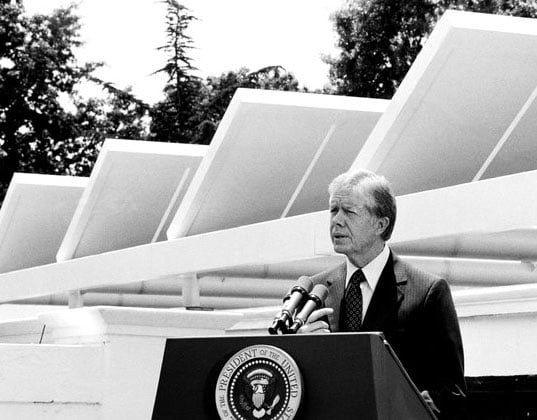
President Carter put solar panels on the Whitehouse in 1979.The last effort to redirect energy policy on a national scale was in 1979 when only the image of confidence in federal initiatives remained and President Carter put solar panels atop the Whitehouse in a symbolic gesture meant to redirect attention on renewable energy. They were subsequently eliminated by his successor President Reagan who moved the country back into an even deeper reliance on fossil fuels, and whose legacy we live with today.
The age of Chemical Energy ends with Peak Oil. We have a future with new-energy, or we will have no technological future at all. The inability of federal institutions to move quickly to develop LENR energy technology means private investment bears the burden. Though projects that posses technical risks are “unattractive to Wall Street”,[1] eventually, demand will insist upon it.
But the Rossi Effect, the heightened interest of venture capital in LENR devices since the demonstration of the E-Cat earlier this year, is certain to grow and recent news of one private company’s plans to work with a national lab on reproducing their results as a pre-requisite to funding is a positive sign of cooperation between public and private enterprise.
The ‘expert’ is the man who stays put.
—Marshall McLuhan and Quentin Fiore The Medium is the Massage
Lauded aeronautical engineer and designer of Spaceship 1 and 2, Burt Rutan headed his own spaceship company with a small band of dedicated individuals in the scrubby deserts of Mojave, California and succeeded in creating a new industry of space tourism with the private partnership of Paul Allen, the X-prize Foundation, and Sir Richard Branson. A critic of NASA’s budgetary choices, he saw the future of space in private enterprise.
“Manned space flight is not only for governments to do,” says Rutan. “We proved it can be done by a small company operating with limited resources and a few dozen dedicated employees. The next 25 years will be a wild ride; one that history will note was done for everyone’s benefit.”[3]
We say the same about cold fusion energy. Small, independent companies are right now sacrificing sweat and tears to follow a dream that takes humankind to the next phase of development for all the world’s benefit.
A new energy technology that uses a fuel of water can save the Earth from further degradation and reap rewards beyond our present imagination, but encouragement for these intrepid inventors is needed from the public, both morally and financially, to simulate the “federal involvement” that succeeded so well in landing humans on the Moon.
There are no passengers on Spaceship Earth. We are all crew.
—Marshall McLuhan [5]
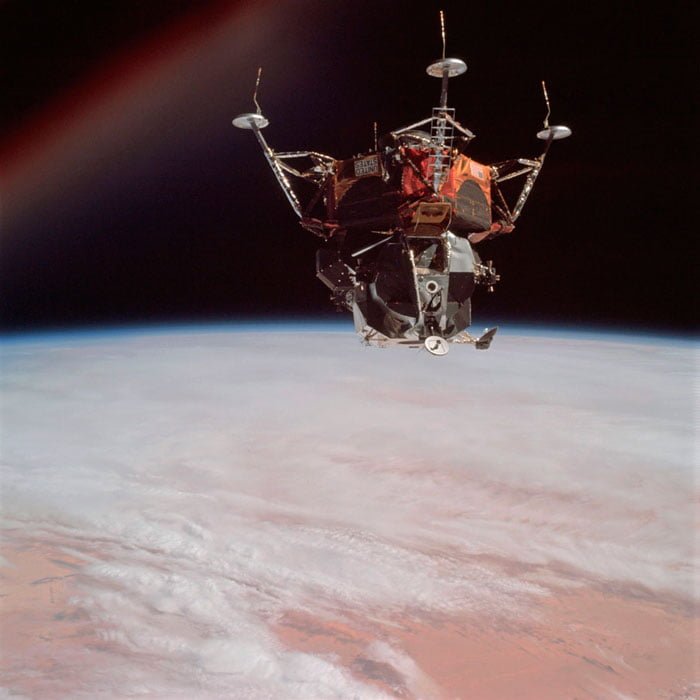
Apollo 9 tumbles above planet Earth.
Supporting Links:
[1] Countdown A History of Space Flight by T.A. Heppenheimer publisher’s Wiley website.
[2] John F. Kennedy “That is what we have to overcome, that psychological feeling in the world that the United States has reached maturity, that maybe our high noon has passed and that now we are going into the long slow afternoon.” 1960 campaign speech.
You know, sometimes dreams are more important than actuality.
—Andrea A. RossiEVWorld interview
C’ mon baby, light my fire.
—Jim Morrison
Wildfires dot the mountains surrounding the McDonald Observatory in West Texas, US
Our planet is heating up.
Whether its rising temperatures, or the limits of human tolerance, we’ve reached a bifurcation point, and a phase change is in progress: the age of Chemical Energy is ending.
The degradation of the physical environment mirrors the perversions of human perception that have reduced our bodies and souls to numbered sacks of biomass starved by our own virtual fantasies of infinite growth upon a finite Earth.
But as the world burns, a discovery of such magnitude that it guarantees humanity another chance at life is coming to light, literally, an opportunity to heal the wounds of industrial expansion and allow Earth’s biosphere to emerge as the greatest work of art ever shaped by man.
This newly developing energy technology is based on the discovery announced 22 years ago by Drs. Martin Fleischmann and Stanley Pons, and after two decades of assiduous research, a simple hot-water boiler called the Energy Catalyzer will be the first model of breakthrough engineering based on that discovery with a planned commercial release for industrial applications in the last quarter of this year.
The heat-energy reactor is the invention of Andrea A. Rossi and he calls it the New Fire. The New Fire is described by it’s developers as a nickel-hydrogen exothermic reaction for it uses a fuel of hydrogen gas and a powder made of nickel. Infused into the nickel powder at high-pressure, the hydrogen reacts with the metallic nuclei creating a huge amount of heat well beyond that of any chemical interaction.
A test of the early proto-type of the E-Cat. photo: Mats Lewan
One early test of the Energy Catalyzer E-Cat reportedly produced over 15 kilowatts of heat energy over 18 hours. In Low Energy Nuclear Revolution a documentary video from PhiZero,[1] one of Mr. Rossi’s collaborators Sergio Focardi, himself a longtime researcher in these types of nickel-hydrogen systems, said of the early E-Cat tests, “On average the relationship between thermal energy gained and input electrical energy was on the order of around 200 times.”
Another collaborator of Mr. Rossi’s, Giuseppe Levi, described an early test of the E-Cat where an astounding 120 kilowatts of power was produced, at which point it was turned off. “We restarted it, and the system ran for one hour at 40 kilowatts,” said Mr. Levi. “I saw that it was capable of being self-sustaining.”
You cannot step into the same water twice.
—Heraclitus
The Fleischmann-Pons Heat Effect FPHE was first studied in a glass beaker using a heavy-water solution and a small, solid piece of the metal palladium, but with that initial system, the effect of excess heat was difficult to reproduce. Today, nano-sized particles of metal such as nickel, platinum, titanium, and others, are the medium that support reproducibility. The plethora of metals that create the nuclear active environment where the reaction occurs is further diversified by the fuel of hydrogen, which can be either in gas or liquid form and even in the form of water.
There are three forms of hydrogen: protium, deuterium, and tritium, and possibly even more in the form of hydrinos, hydrogen purported to exist in fractional ground-states. Both protium and deuterium have been used to initiate energy-producing reactions, while tritium is a sometime by-product of the reaction whose presence reveals the nuclear nature of the reaction.
The red visibile light of hydrogen in the southern sky.
Hydrogen makes up about 75% of the chemical mass of the universe and is the most abundant material that exists. Indeed, three-fourths the mass of our Sun is hydrogen, and the reactions that keep our Sun alive begin with the fusion of hydrogen nuclei deep in the interior. On Earth, hydrogen makes up the bulk of water.
Chemically, water is H2O, meaning two hydrogen atoms and one oxygen atom together make up a water molecule. Continually replenished on Earth by the solar wind and cosmic particles from interstellar space, hydrogen is “the ultimate renewable energy resource”.[2]
Hydrogen can be burned just like oil or gas, and this is what many alternative energy advocates are proposing when they discuss hydrogen technologies, but that is not what the New Fire does. Chemical burning of fuel is a process that involves the outer electrons of atoms as they mix and match, forming new compounds as well as energy. Wood and oil burn, but the New Fire is a reaction of nuclear dimension whereby protons, the nuclei of the hydrogen atoms, interact with electrons and other nuclei to liberate energy many times greater than any chemically-induced process.
Neither is the excess heat of the New Fire the process of fusion that occurs in the Sun’s plasma. While the theory behind the reaction is unknown at this time, scientists piece together scraps of 20th century modern physics in an attempt to describe a 21rst century phenomenon: clean, dense energy from the most plentiful material in the universe.
Not having a definitive theory won’t stop this technology from materializing out of the Mystery Landscape, nor will it be stopped by the virtual silence of the mainstream scientific community and media which has been deliberately hostile to this research in the past. Historically, just about every new technology ever introduced was brought into existence without a theory first. Humans discovered fire hundreds of thousands years ago, and it’s possible that as far back as 800,000 years, our ancestors made opportune use of natural fire in the environment.
They did not have to know how it worked, only that it did.
It was Marshall McLuhan who noticed that “the biggest secrets are kept by public incredulity”. We the public are surviving in the after-image of 20th century myopia with little knowledge of this epoch-making advancement in energy technology. But when the mass of men realize that a solution to scarcity exists, and this solution is available to all, power will re-distribute around the globe “at the speed of thought”.[3]
The New Fire will be able to replace radioactive fuel assemblies one-for-one, generating ultra-clean steam heat for today’s power plants, but an off-grid, clean technology that uses a fuel of water decentralizes power allowing individuals and local communities to better control their own energy choices.
The New Fire is not an incremental change in existing energy technology introduced by multi-national corporations. The New Fire does not recognize the hierarchy of centralized authority, and will not be stopped by parochial notions such as “reputation”. The New Fire burns through satellite links sparking the minds of young people who haven’t the prejudices of their parents, and who will not wait patiently while their future is mortgaged by distant incorporated entities.
The New Fire comes from the curious tinkerings of those who believe they really can change the world, and aren’t afraid to succeed.
In their book Breakthrough Power, authors Jeane Manning and Joel Garbon describe some of the opportunities that exist with a green and plentiful energy like the New Fire. The list included:
“rewarding, life-affirming work that enhances human dignity and contributes to the planetary clean-up and advancement of global society. Low-cost energy permits recycling on an unprecedented scale, and the unsightly gigantic heaps of trash that previously blighted the landscape are transformed into valuable mines of recovered resources.”
“The world’s thirsty families are supplied abundant and pure drinking water extracted from the atmosphere itself or by desalination of ocean water. Depleted farmland is restored to productive agriculture. Stream, rivers, and aquifers are no longer exhausted by damaging diversion and over-pumping, but are restored to their natural balance, permitting fish stocks and streamside ecosystems to thrive once again…”
“Food can be grown anywhere – even in the desert or arctic conditions – in compact, multi-level greenhouses whose natural heating and lighting are augmented by energy easily and cleanly extracted from space itself.” –Breakthrough Power
And
“…imagine how both the environment and and the forest industry would benefit if new energy technology resulted in a fuel-less helicopter. Suddenly selective harvesting of trees from the air would be economical. No logging roads would be needed. Instead of clear-cutting swaths of forest, heli-loggers could selectively thin the weakest tress. Forest could be restored to pristine “old growth” status.”
“Without the need for hydroelectric power, there is no need to dam rivers. With certain dams dismantled, salmon in the northwest would be able to easily return upriver to spawning grounds. The vitality of cool, clear, unimpeded flowing waters could be restored.” [4] –Breakthrough Power
The ideas and dreams of new-energy researchers have imagined some of the possibilities that the New Fire may bring. Jed Rothwell‘s Cold Fusion and the Future describes many more solutions to be derived from this technology. But all these fantastic possibilities are not guaranteed.
We as citizens have to be ready to participate in co-creating our society and demand the tools to do so. We cannot expect others to create the reality we want to live in if we’re not willing to put any effort in that.
—Birgitta Jonsdottir Icelandic Parliment July 5, 2011 Ca$h Flow
Humans may never appreciate the beautiful and delicate world we inhabit until other worlds are explored, for as exotic and amazing as they are, toxic gases and the severe cold vacuum of space will not support our life without layers of artificiality. The pleasant air, the sweet water, the elegant variety of life that complements beautiful formations of forest, plain and desert are unique in our corner of the universe, with not another living sphere in sight.
Earth, our home – it is this world we must care for. It is this world we must preserve, this time, with our eyes wide open, and the New Fire to light the way.
Thin, delicate atmosphere of Earth protects all life on the planet.
Supporting links:
1. Low Energy Nuclear Revolution from PhiZero by Ivy Matt June 23, 2001
2. Robert E. Godes Funding dam (almost) breaks for Brillouin boiler that uses – water! –Ruby Carat July 7, 2011
3. “Now, we’re living at the speed of thought.” Bob Neverit Ca$h Flow July 6, 2011
4. Breakthrough Power by Jeane Manning & Joel Garbon www.breakthroughpower.net
5. Cold Fusion and the Future Part 1: Revolutionary Technology Jed Rothwell Infinite-Energy
Italian Nuclear Physicist Fulvio Frisone on Cold Fusion
“In fact, thanks to cold fusion, we could have unlimited energy, at low price and, most of all, environmentally friendly (in fact the only reaction’s product is helium-4!). ”