The testing of a proto-type 1 Megawatt nickel-hydrogen reactor today appears to be a success. The Energy Catalyzer, or E-Cat, a thermal energy device that runs on a fuel of hydrogen and hosts the reaction in a nickel powder generated 479 kilowatts of power over 5.5 hours in self-sustain mode.
Sterling Allan of Pure Energy Systems was in attendance and wrote the positive report here. He took this video of inventor Andrea A. Rossi making a statement in response to a Radio Citta del Capo reporter’s query “if the test today was a breakthrough”:
Self-sustain mode means that there is no input power to continue the reaction. In this state, when the input energy is zero, the energy-out over energy-in ratio becomes infinite. The energy was computed by measuring the difference in temperature of coolant water flowing through the reactor as it turned into steam.
Why the unit performed at 479 kilowatts and not 1 Megawatt is unclear and may be due to “a glitch”. In the late-night report released by Mr. Rossi, Domenico Fioravanti, the lead engineer testing the unit and representing the Customer, indicated the system of gaskets will need to be upgraded as there are some “leaks”. [Download .pdf report formatted by Mats Lewan here along with temperature data here.]
The decision was made earlier in the day to test the unit at a lower power in self-sustain mode, rather than the full 1 Megawatt capacity. Nevertheless, generating almost one-half megawatt of power with no input over five hours is a huge accomplishment.
According to the report, the 1 Megawatt unit is composed of 107 smaller 10 kilowatt units connected in parallel and housed in a shipping container. Each 10 kW unit comprises three 3.3 kilowatt units together in parallel.
University of Bologna’s Dr. David Bianchini detected no measurable radiation above the background level being emitted from the device.
Fascinating video by Mr. Allan shows the set-up:
In attendance along with Mr. Allan was New York Associated Pressreporter Peter Svensson who had exclusive story rights through midnight, but since it will be days before his story makes it to the wire, Sterling Allan and Mats Lewan were able to release their articles this evening. NYTeknik science journalist Mats Lewan has covered the E-Cat demonstrations regularly and wrote this article here. Rounding out the media were also Focus.it.
Scientists, engineers and specialists in nuclear physics from France, Sweden, Russia, China, and Italy were also present, indicating the strong interest from around the world in this revolutionary energy technology.
The still unknown Customer for the E-Cat reactor is reportedly “happy” with the test, and ready to make the sale. Wherever the unit ends up, we are looking forward to the first commercial cold fusion energy reactor on the market, and the many more to come.
Related Links
Bologna 28 ottobre: primo resoconto del test dell’impianto da 1 MW di Andrea Rossi by Daniele Passorini 22passi Blogspot October 29, 2011
First commercial cold fusion reactor tested in Bologna by Ruby Carat October 6, 2011
The testing of Andrea A. Rossi’s 1 Megawatt proto-type nickel-hydrogen reactor is underway in Bologna, Italy. Reportedly conducted for a customer from the US, there is limited access to the private event, although Sterling D. Allan from Pure Energy Systems is attending and will be posting his impressions here on E-Day: Tracking the 1MW Test.
What is 1 Megawatt? This article from Hank Mills and Mr. Allan describes it in easy to understand language. Given an average electrical usage of between 1 and 1.5 kiloWatts per home, a 1 MegaWatt unit producing electricity could power between 750 and 1000 homes.
It should be noted that Mr. Rossi’s reactor is a thermal energy device that produces steam heat and not electricity. However, as a first step in a revolutionary new energy technology, this is the beginning of an era for the development of ultra-clean power from hydrogen.
While negative press continue to prejudice this science, the effect of Mr. Rossi’s demonstrations technology has increased the level of awareness in the public about cold fusion research.
Here Edmund Storms talks about how a commercially available device will affect the attitudes in the political class.
Mitchell Swartz of Jet Energy, a cold fusion research company that has developed the Phusor and Nanor reactor, has put together some quotes made by accomplished individuals that reveal bias towards the new, the unfamiliar, the revolutionary, for even the smartest people can’t always imagine what’s possible.
Consider this statement:
“There is no reason anyone would want a computer in their home.” Ken Olson Chairman and founder Digital Equipment Corporation from 1977
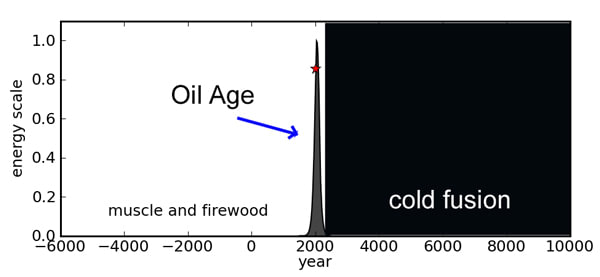
The graph of the Oil Age shows a thin blip in geological time with an Era of Cold Fusion for the future – and a “little” space between them. The Oil Age is a blip. Cold fusion can take humanity beyond what can be foreseen.
The transition from dirty fossil fuels and today’s dangerous nuclear power plants into clean cold fusion will entail the dismantling of an entire infrastructure core to the economy and culture of the world, and particularly for the Western nations.
The scale and reach are staggering.
What would a transition narrative look like? Edmund Storms, LENR researcher and author of The Science of Low Energy Nuclear Reaction has thought about these issues for two decades, and has some compelling scenarios.
We spoke with Dr. Storms this past August and this is what he had to say on “Transition”.
The spate of “mainstream” press on Andrea Rossi’s Energy Catalyzer has brought new pubic attention to the field of cold fusion/LENR/LENR research.
Some of the recent articles include:
Wired U.K. 2011/10/06 Cold Fusion rears its head as ‘E-Cat’ research promises to change the world. [link]
Oilprice.com 2011/10/13 Are we on the Brink of an Energy Revolution: Andrea Rossi to Build 1MW Power Plant. [link]
Computerworld 2011/10/14 Cheap Power: An overnight revolution. [link]
Forbes 2011/10/17 Hello Cheap Energy, Hello Brave New World [link]
Even beyond the excess-heat effect between the forms of hydrogen and various metals that cold fusion research seeks to exploit, the entire field of new-energy, including the generation of power from magnets, zero point and other sources, and that Sterling Allan of Pure Energy Systems has cataloged, is receiving more deserving eyeballs.
In his Commentary on Cheap power: An overnight revolution, Mr. Allan noted the “favorable coverage” the article in Computerworld and echoed by Forbes, gave to Mr. Rossi’s E-Cat demonstration. He also seized upon one of the links in the article to The Singularity is Near, a website based upon the work of Ray Kurzweil and his book The Singularity is Near.
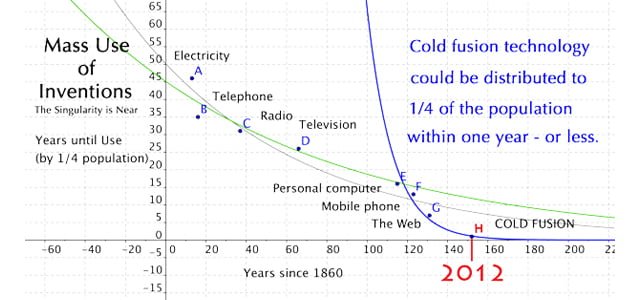
The website has a number of charts based on sourced data that all support the idea that humanity is nearing a point of singularity, a bifurcation point if you will, where a profound change in our civilization will occur. Using data given for the Mass Use of Inventions, where mass-use is defined as use by one-quarter of the population, Mr. Allan extrapolated the time it would take to have a mass use of cold fusion, after its first commercialization. His conclusion was that it might take about 3 years to disseminate the technology to one-quarter of the population.
Having read previous estimates of ten years by other informed analysts, I read Mr. Allan’s conclusion with great enthusiasm, tinged with disappointment. As one of my friends and music mentor Jack Wright wrote, “I want everything and I want it now.”
Concerns for safety are at the heart of many of the lengthy timeframes for adoption of cold fusion technology. However I fear our planet can’t wait 10 years for clean energy, and to stretch my vision even three years hence is to view a dark chasm, where economic and ecological devastation, famine and war are the only reference in sight.
Yet between bouts of doom-and-gloom, we always return ‘cheerful and optimistic’ (a la Jayne Cortez), and it appears distinctly possible that 1.75 billion people worldwide could be using cold fusion technology much sooner than three years. But how can I justify that fantastic belief to the world of men?
Without trying to “one-up” Mr. Allan, as it was his inspiration that led to this chart, here the data is fitted (using the wonderful free and open-source Geogebra) to three exponential curves and, in my opinion, gives visual-space credibility to the mass use of cold fusion in one year or less after it is commercially introduced.
A first exponential fit for all the data points does not improve the timeline, as the thin, black curve shows.
But notice the inventions listed; the telephone, radio, and television are all the innovative tools of communication based on analog technology; the computer, the mobile phone, and the Internet are all innovative tools of communication based on digital technology.
These are two distinctly different types of technology.
Fitting an exponential curve to just the points B, C, and D representing the analog inventions gives the green curve.
Fitting an exponential curve to the points E, F, and G, representing the digital devices gives the blue curve. Looking at the year 2012 on the blue curve, we could project that the next innovative technology, one of energy, could be adopted by the population in about one year.
Data points A-G were given by The Singularity is Near at www.singularity.com. Points E, F, and G generate the exponential-fitted blue curve. Point H representing cold fusion is inserted on the curve at the year 2012.
“The reality is, while there’s immensely more interest, it still hasn’t hit the major media, the New York Times, Time magazine, things like that. If Rossi does what he is planning to do, namely run a 1 Megawatt source for a couple of months, then, it is going to be big news.
You look back in history, 40 some days after the Fleischmann/Pons announcement 23rd of March in 1989, the covers of Time, Newsweek, and US News and World Report I think it was, all had cold fusion on them. It could be a repeat of that if Rossi comes through.“ —David J. Nagel
If it took 40 days to be on the covers of major magazines in 1989, it may only take a week in 2012, and that lengthy stretch is only because the hardware realities of printed matter require a lead-time. We know the information about any new energy technology in use will be distributed everywhere on Earth, as well as in orbit, in a matter of moments through the Noosphere.
In many systems, past behavior does not predict future behavior. Likewise, it should be clear by now that complex mathematical modeling does nothing to clarify the elements of our financial system, nor do smooth functions describe the bumpy reality of human technology. Math is a magic that hypnotizes men’s minds. We only accept these gross approximations as a rough estimate of one possibility.
There are many factors to take into account, including unquantifiable ones.
Cold Fusion Now!
Supporting Links
Cheap Power: An overnight revolution – Commentary by Sterling Allan from Pure Energy Systems
A new effort to address both the ensuing global economic meltdown and an impending energy revolution sparked by Andrea A. Rossi‘s E-Cat technology has been initiated by the organisation Xecnet, Ltd[visit] of the U.K.
According to their website, Xecnet is a corporate consultancy that implements the “GEM (Global Enterprise Model) in organizations”, where “company staff can learn to apply a genuinely leaderless approach in their organizations – putting the needs of all of the members of the organization at the centre of their attention in such a way that new and vital energies are released and real operational efficiencies are made.”
Rossi's eCat: Free Energy, Free Money, Free People by John MichellXecnet is also a publisher and their most recent offering is a book called Rossi’s E-Cat: Free Energy, Free Money, Free People by John Michell, which “tells the story of how this energy source was discovered, developed by inventor Andrea Rossi, how it challenges modern science and what the consequences for mankind could be. This is a discovery which heralds nothing less than the start of a new era – the year 0 PR (Post-Rossi).”
In this book the proposed new economic paradigm based on energy is described. Energy will back a Human Value Unit, or HVU where one HVU is equivalent to 400 Joules of energy.
I first heard about a monetary system based on energy credits through the work of M. King Hubbert, but never really understood how it would function in actuality. Having not yet read the book by John Michell, I asked Raymond Aitken, gatherer of news at Scoop.it’seCat economics and friend to Xecnet‘s board of directors, to provide some background.
Mr. Aitken has “been interested in complementary currencies for some time” but only recently, through discussions with author of the book ‘Rossi’s eCat‘, that he “realized the fundamental link between energy and money, and how such an energy production system could represent a transformational paradigm-shift to a ‘new world’ of human possibility.”
I first asked Mr. Aitken, how is one Human Value Unit equated to 400 Joules of energy? He replied:
“Firstly, concerning the dominant fiat monetary system:
The present fiat monetary system creates claims on real goods and services in the economy without any real and measurable linkage to the true capacity and output of the real wealth creation process (based on available natural resources, including energy, and human know-how i.e. technology). This means that there cannot be any discipline or means to guarantee that the magnitude of such arbitrary claims (the money supply) will match a corresponding increase in real goods and services.”
“This together with the fact that such fiat money is created as debt that is loaned at compound (exponential) interest means that the Western fiat (fractional-reserve banking) system is inherently and structurally inflationary, as well as non-transparent – and therefore open to manipulation and fraud, as well as requiring spiralling exponential economic growth, to create more debt-money in order to pay the interest on previous debt-money.”
“Inflation (currency debasement, or “legal counterfeiting”) is both an invisible tax of government and the large scale fraud of private financial institutions. Interest amounts to the massive and hidden transfer of wealth from the poor to the rich, leading to debt-slavery.”
“Although the conventional economic text books describe the functions of the dominant monetary system in terms of “a medium of exchange and store of value”, it is much more used as a tool of empire (centralization of power and war) and speculation (>95% of global currency movements are for speculative purposes). This monetary system was created to serve and profit from war, including economic warfare (commodity dumping etc). Being devoid of human values, this system maximizes profit on the basis of human misery and deprivation (starvation, violence, destruction, enslavement, privatization of the commons – genes, patents, money, traditional knowledge, seeds, medicine, etc).”
“Some background about the link between energy and money:
Energy is what underwrites every economic and ecological process. It is the foundation of all human wealth creation. Since money can be anything which is representative of value that can be traded for a wide range of goods and services across geographical areas, then energy itself can be used as money.”
“Unlike fiat currencies, an energy currency is a genuine commodity in universal demand, which represents the value of work already done as well as the potential of work which can be done. As a scientific unit of measure, there can be no manipulation of its value over time or place, and therefore no speculation. It can be used to scientifically stabilize and rationalize the economic process at every level. The value of commodities, services and goods can fluctuate in relation to the standard of value of an energy currency, but those fluctuations will not be speculatively driven on the monetary side (as is the case with the dominant fiat system), any fluctuations will be driven by real factors of cost and demand.”
“An energy currency easily translates into energy accounting, and therefore provides a more accurate and complete analysis of economic output and resource consumption, so it would not be possible to exclude the full human-social and ecological costs of any economic activity in the accounts, as it the case with the present system. Since no one nation or corporation can “own” energy as a currency, it will represent the first genuine international and non-political monetary system.”
“Why 1 HVU = 400 Joules of Energy:
The Human Value Unit (HVU) as a monetary measure of value was first proposed by a man called Harold who has since died. Harold’s purpose was to address the fact that our monetary system had become completely divorced from human values, and his proposition was to anchor the monetary standard of value on the daily food requirement of a human being, so that the behavior and decisions of users of money would be influenced by this humane-based measure.”
“Strange as it seems, complementary currencies have already proven how the innate values of a currency can dramatically influence the behavior of its users, even if they are unaware of monetary technicalities. Perhaps because the circulation of money represents the actualization of human relationships, then the way in which the money is created and put into circulation will color those relationships (competitive vs. cooperative etc). After much research Harold eventually settled on a scientific value of energy that was equivalent the daily human food requirement – 400 Joules.”
“The concept of the HVU relative to the creation of a complementary energy-backed global monetary system, which will belong to its users (and not to a private banking cartel that controls central government) – “a currency by the people for the people” is still at an early stage of development. We are therefore in the process of developing a global network of people who are committed to harnessing the monetary implications of the eCat to create a new money and finance system based on energy that can serve humanity, which includes restoring the ecological integrity of the planet.” —Raymond Aitken ”
In a practical sense, I asked how one would spend the HVUs? And when I spent them all, how would I get more?
“The HVUs do not need to be spent”, wrote Mr. Aitken, “they are a monetary-energy equivalence, when you buy an Ecat at say $500, then the accounting is in HVUs but you need to spend dollars to buy the HVUs which are then used to purchase the eCat.”
“Because the HVUs are based on energy-systems bought, as the value of the US Dollar goes down against energy, as it must due to Quantitative Easing (QE) etc, the value of dollars diminishes relative to the HVUs, and therefore you will need more dollars to buy the HVUs. You can always go online and buy more – we are putting a HVU-based online banking system in place.”
“Given that the technological and economic implications of the eCat are “paradigm-shifting”, the understanding of us all is necessarily in a flux of evolution, which is why Xecnet is organizing a first seminar in London this November. We need to bring together experts in economics and energy science to create a new economic approach that is grounded in genuine science, and not based on the obtuse quackery of the fraudulent monetary magicians. (It was the last chairman of the Federal Reserve, Alan Greenspan, who said “if you can understand what I am saying, I’m not making myself clear”!).”
Mr. Aitken continued with some personal reflections:
“Perhaps the most important and urgent matter is how can a complementary currency approach provide a way of financing the commercialization of Rossi’s technology? If the commercialization of Rossi’s technology depends on the corporate fiat monetary system, then it’s availability for the greater good of humankind could be distorted, in accordance with the narrow commercial and political interests of this ‘corporatocracy’.”
“We can imagine creating an investment fund for the commercialization of Rossi’s technology using a “crowd funding” approach, which is what Xecnet are trying to do with their planetpay.com site.”
“At this stage they only intend to gather pledges, to see if the financial potential from small investors around the world is large enough to represent a sufficient financial partner for Rossi, so that he can at least have a stronger negotiating position with prospective corporate investors, and if possible, to be able to commercialize his technology independently of corporate finance on a more equitable basis for the common good of humanity.”
“At some point the pledges would be converted to actual deposits of fiat money, which could be used to manufacture and distribute the first generation of eCats. During this initial stage, any HVU’s (as a complementary currency) would be backed by the fiat money held on deposit for orders worldwide. Since people would be “buying” HVU’s with fiat currency, and since the standard of value of the HVU’s would be fixed to energy (400 Joules), it would not be subject to inflation in the fiat monetary system.”
“Fiat money deposited on account, in exchange of HVU’s would act as a “store of value” (in competition to commodities like gold), which might bring in more and larger deposits of fiat money during the first phase of the fund. The ideal for this phase one would be the accumulation of a sufficiently large investment fund in fiat currency to commercialize Rossi’s technology worldwide, independently of the conventional banking system.”
“Once Rossi’s industrial eCats are commercially available, we can imagine using the same fund to establish energy production enterprises on a cooperative basis. Each energy production enterprise would serve a local-regional economic area, and would represent the phase of creating a genuine energy-based complementary monetary system to serve the specific needs and potential of any given local-regional economy, in accordance with human values and local ecological integrity.”
“The energy production enterprise would also function as a new type of local economic development bank, which would put into circulation an interest-free energy-backed currency to facilitate trade and provide working capital for local enterprises (thereby generating work), as well as the creation of investment finance (equity-based) for the development of new or existing enterprises and maintenance or creation of social capital (education and training) and material capital (physical assets and infrastructures).”
“To avoid any conflict of interest, this “bank” would be owned by its users (cooperative legal structure), who would appoint professionals to manage it. We can imagine the establishment and operation of such an “energy production bank” using a financial strategy based on the historical example of the Wara [1] energy monetization approach.”
“By the local energy production enterprise paying its workers and local suppliers in an energy-backed complementary currency, these monetary (exchange) units would enter into local economic circulation. With a demurrage charge on the demand-accounts above a certain level, HVU’s would be transferred to saving-accounts, which would create the basis of the finance part of the system. The HVU would only exist as an electronic currency, and would circulate via mobile phone, smart card and Internet devices. The required transactional platform already exists as an open-source software, called Cyclos.”
Ambitious? Most certainly.
I can’t say I completely understand energy units yet, but I certainly look forward to learning more.
What’s most encouraging is the wave of participation among peoples around the globe in response to the E-Cat demonstrations. Andrea Rossi has ignited something much more than a thermal energy device; he’s started a transformation of minds that are now busily preparing for a new kind of world, a world where people work together cooperatively based on abundant clean energy for all.
There will be fits and starts; there will be successes and failures. But, like the best strategies for long-term investing, we will ignore the noise, and focus our efforts on the big picture: there is now an open door and we can see a path forward.
We have a new clean energy technology.
Let’s not fixate on the deficiencies, but strengthen and raise the positives.
Cold Fusion Now!
Notes
[1] The ‘Wara’ system was implemented in a small town in Germany in the early 1920’s. At the time, Germany was experiencing a complete collapse of their national currency with the value plummeting to near worthlessness. During this time, Dr. Hebecker, an owner of a coal mine in the town of Schwanenkirchen, convinced his workers to accept 90% of their wages in a complementary currency called ‘Wara,’ or he would be forced to close the mine. He agreed initially to provide food that they could purchase with their ‘Wara,’ which means ‘commodity money’ in German. He also stated that the money was backed by the coal inventory. The Wara itself was paper money that also incorporated the small monthly stamp fee to prevent hoarding and encourage circulation. The Wara was immediately successful in saving the coal mine and in saving the entire town of Schwanenkirchen. Over the next several years, the circulation of the Wara spread dramatically throughout Germany and over 2000 corporations began using the new complementary currency. However, the central bank considered the Wara to be too successful and even thought it was an inflationary threat although its value was tied to the value of coal. In October 1931, the Minister of Finance declared that the Wara was illegal thus ending the success.
Related Links
Rossi’s E-cat: Free Energy, Free Money, Free People by John Michell from publisher Xecnet
Defkalion Green Technologies has announced on its website forum the planned release of its Hyperion line, a series of thermal energy devices based on Andrea A. Rossi’s E-Cat technology. The Greek company first formed to license Mr. Rossi’s E-Cats around the world though their association ended recently for reasons publicly unknown.
On June 23 of this year, Defkalion had a press conference and released a white paper describing the Hyperion line which, at that time, was “in its final stages of becoming an industrialized and commercially viable prototype.” Today’s press release implies that the company has improved on the original designs, and that the recent demonstration by Mr. Rossi included some aspects of the original Hyperion technology and was “implemented wrongly”.
According to the June white paper, “the current range of products produce from 6 to 30 times more heat than the energy it takes to run the machine” and their Hyperion product line “ranges from kW units (5 – 30kW) to MW units (1.15 – 3.45 MW).”
The content of today’s press release did not lay out any specific timetable for their units’ release, just that Defkalion is “ready for production” of their “self-financed” line. They reject any demonstrations of their units before the final product is ready to issue, though they claim that 62 companies have been in contact with Defkalion, in some cases, witnessing ‘their work’.
Previously, Defkalion Green Technologies had listed board members that included former heads of state as well as high-level financiers and industrialists from Greece, Italy and the European Union. Christos Stremmenos, a chemical engineer and friend of Mr. Rossi who attended the recent October 6 E-Cat demonstration, is also listed as a board member. They appear to be a formidable team with the ability and clout to produce and distribute their technology worldwide.
Just what purpose the press release was intended to serve is unknown. However, it’s clear that cold fusion energy technology is breaking through from multiple locales.
Whoever is first to market will have that special honor and a place in history, but the new-energy technology market is so huge that there is more than enough room for the multitudes of entrepreneurs sure to follow. Indeed, the evolution of this technology will engage generations as it develops from these first steps to a fully integrated component of our daily lives.
******************************************************************************* Defkalion Green Technologieshomepage